Final Report:
Stage 1: Results
Research Project No: 2004-016-A-3
The research described in this report was carried out by:
Project Leader Kerry London
Researchers Jessica Chen
Steve Rowlinson Fiona Cheung
Project Affiliates Harry Copeland
Michelle Jeppessen John Spathonis Allan Carse Wayne Roberts Don Allan
Wendy May-Taylor Stuart Rayner
Research Program: A
Business and Industry Development
Project: 2004-016-A
Supply Chain Sustainability
Date: 10 November 2005
QUT Digital Repository:
http://eprints.qut.edu.au/26959
CRC for Construction Innovation (2005) Final report: stage 1 : results. CRC for Construction Innovation, Brisbane
The Participants of the CRC for Construction Innovation have delegated authority to the CEO of the CRC to give Participants permission to publish material created by the CRC for Construction Innovation. This delegation is contained in Clause 30 of the Agreement for the Establishment and Operation of the Cooperative Research Centre for Construction Innovation. The CEO of the CRC for Construction
Innovation gives permission to the Queensland University of Technology to publish the papers/publications provided in the collection in QUT ePrints provided that the publications are published in full. Icon.Net Pty Ltd retains copyright to the
publications. Any other usage is prohibited without the express permission of the
CEO of the CRC. The CRC warrants that Icon.Net Pty Ltd holds copyright to all
papers/reports/publications produced by the CRC for Construction Innovation.
Distribution List
Cooperative Research Centre for Construction Innovation Authors
Disclaimer
The Client makes use of this Report or any information provided by the Cooperative
Research Centre for Construction Innovation in relation to the Consultancy Services at its own risk. Construction Innovation will not be
responsible for the results of any actions taken by the Client or third parties on the basis of the information in this Report or other information provided by Construction Innovation nor for any errors or omissions that may be contained in this Report. Construction Innovation expressly disclaims any liability or responsibility to any person in respect of any thing done or omitted to be done by any person in reliance on this Report or any information provided.
© 2005 Icon.Net Pty Ltd
To the extent permitted by law, all rights are reserved and no part of this publication covered by copyright may be reproduced or copied in any form or by any means except with the written permission of Icon.Net Pty Ltd.
Please direct all enquiries to:
Chief Executive Officer
Cooperative Research Centre for Construction Innovation 9
thFloor, L Block, QUT, 2 George St
Brisbane Qld 4000 AUSTRALIA T: 61 7 3138 9291 F: 61 7 3138 9151
E: [email protected]
W: www.construction-innovation.info
Table of Contents
Table of Contents ... 1
List of Tables ... 2
List of Figures ... 3
PREFACE ... 4
EXECUTIVE SUMMARY ... 5
1. INTELLIGENCE CAPTURING PHASE ... 6
1.1 Objectives ... 6
1.2 Intelligence capturing techniques ... 6
1.2.1 Interviews ... 6
1.2.2 Interview coding ... 8
1.3 Observations ... 9
1.4 Document analysis ... 9
2. RESULTS ... 11
2.1 Public sector supply chain policy implementation ... Error! Bookmark not defined. 2.2 Case study 1: Pre cast concrete sector ... 12
2.2.1 PCC: Government/client perspective ... 12
2.2.2 PCC: Industry/supplier perspective ... 16
2.3 Case study 2: Construction and Demolition Waste sector ... 34
2.3.1 CDW: Government/client perspective ... 34
2.3.2 CDW: Industry/supplier perspective ... 38
3. ACTION OUTLINE ... 50
3.1 Case study 1: Action PCC ... 50
3.2 Case study 2: Action CDW ... 50
4. SUMMARY ... 51
5. REFERENCES ... 52
List of Tables
Table 1.1 Framework of interview questions: Internal staff workshops & interviews ... 7
Table 1.2 Framework of interview questions: external industry suppliers’ interviews ... 8
Table 1.3 Open coding: themes arising from interview transcripts ... 8
Table 1.4 Axial coding: Dominant/common themes emerging ... 8
Table 2.1 Key characteristics of pre cast concrete supplier organisations interviewed ... 16
Table 2.2 Key client of PCC suppliers ... 17
Table 2.3 Suppliers’ perspective on the key problems related to the sector ... 18
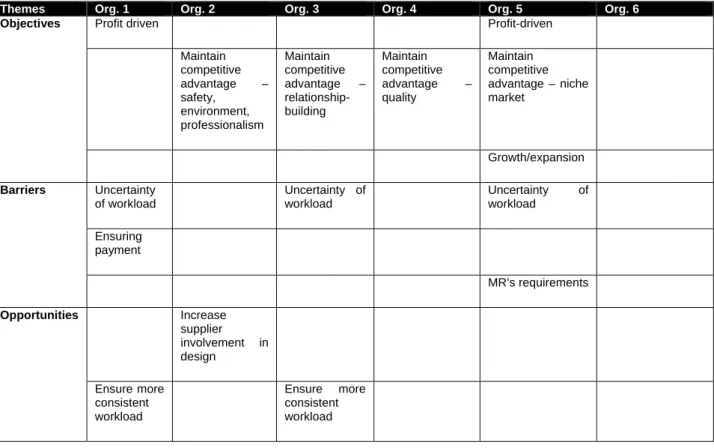
Table 2.4 Key objectives of suppliers and various barriers and opportunities associated with achieving those objectives ... 27
Table 2.5 Key characteristics of CDW supplier organisations interviewed ... 38
Table 2.6 Key clients of CDW suppliers ... 38
Table 2.7 Suppliers’ perspective on the key problems related to the sector ... 39
Table 2.8 Key objectives of suppliers and the barriers and opportunities associated with those objectives ... 48
List of Figures
Figure 1.1 PI01: Supply chain policy implementation: overview ... Error! Bookmark not defined.
Figure 1.2 PI02: Supply chain policy implementation: overview ... Error! Bookmark not defined.
Figure 1.3 PI03a: SPP critique & document analysis ... Error! Bookmark not defined.
Figure 1.4 PI03b: SPP critique & document analysis ... Error! Bookmark not defined.
Figure 1.5 PI03c: SPP critique & document analysis ... Error! Bookmark not defined.
Figure 1.6 PI04a: Transition space & Capability Map analysis ... Error! Bookmark not defined.
Figure 4.7 PCC01a: Overview to workshop and results sheets ... 12
Figure 1.8 PCC01b: Chain and demand analysis ... 13
Figure 1.9 PCC01c: Chain analysis ... 14
Figure 1.10 PCC01d: Supplier strategies: risk vs expenditure ... 15
Figure 1.11 CDW01: Overview to workshop and results sheets ... 34
Figure 1.12 CDW01b: Chain and demand analysis ... 35
Figure 1.13 CDW01c: Chain analysis ... 36
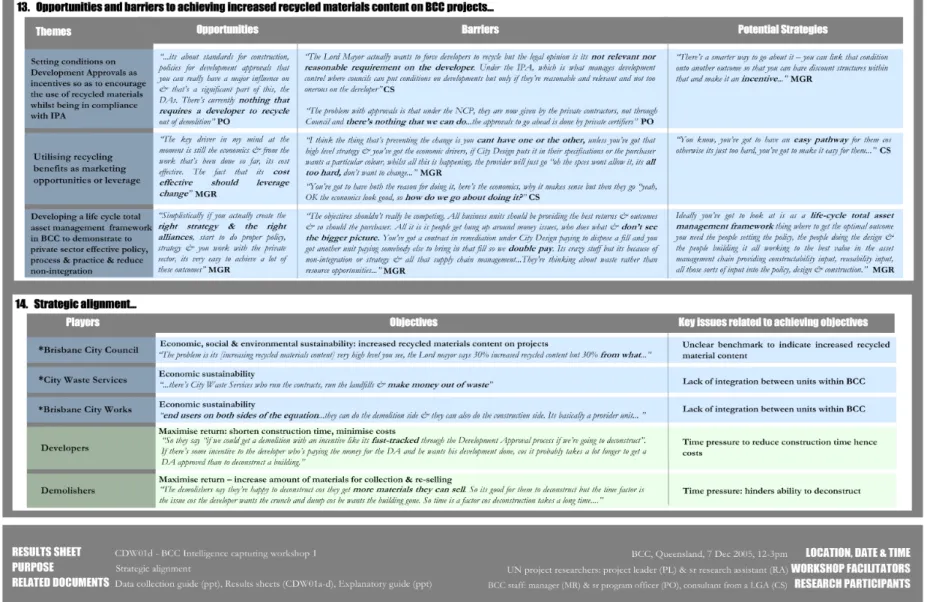
Figure 1.14 CDW01d: Strategic alignment ... 37
PREFACE
The research project is an academic and industry collaboration combining the following partners: Queensland Department of Main Roads, Brisbane City Council, Queensland Department of Public Works, Ryder Hunt, the University of Newcastle and Queensland University of Technology. The project is lead by the University of Newcastle.
The project is lead by the University of Newcastle.
EXECUTIVE SUMMARY
This research project aims to improve economic, social and environmental sustainability of the pre-cast concrete and construction and demolition waste supply chains through the development, trial and evaluation of an innovative supply chain management strategy. The long-term goals are to improve competitive behaviour and market sector performance and improve business process efficiency and effectiveness of public sector program delivery by influencing policy development, changing organisational behaviour and implementation development to achieve more economic, social and environmental sustainable markets.
The general research question that will be addressed is “How do public sector clients develop sustainable supplier group strategy maps?”
The research objectives are to:
investigate the productivity and performance problems and the associated actions or changes of two supply chains (pre cast concrete and construction and demolition waste) to indicate to industry and government what can be achieved,
develop, trial and evaluate a Supplier Group Strategy Map for the two chains,
document the development, trial and evaluation process to develop a Supplier Strategy Map (practice),
develop a benchmarking guide to monitor market performance post implementation (monitor policy and practice) to inform decision-making to monitor business environmental changes triggered by federal, state and local government policy,
develop a best practice guideline for government supply chain management (policy and practice)
The study will promote business process efficiency improvement in program delivery by Brisbane City Council and Queensland Department of Main Roads through policy and implementation development and also promote improved competitive behaviour.
The study seeks to address the Brisbane City Council (BCC)’s strategic objective of increased recycled materials content of construction projects through the expansion of the construction and demolition waste sector through market diversification. The study will also investigate strategies for economic sustainability of the pre-cast concrete sector through a state-wide smoothing of Queensland Department of Main Road (QDMR)’s market investment strategy with the long term benefits of stabilisation of employment levels, reduction in high staff turnover and flow on improvements in skill levels and occupational health and safety.
Short term benefits will include improved product quality and reduction in remedial work and wasted government resources to monitor a poor performing sector.
This is the third report for the study and it includes results from the “intelligence capturing phase”.
More specifically, this report includes:
a description of the objectives of the “Intelligence Capturing Phase” as well as the specific data collection and analysis techniques employed throughout the phase
a presentation of the results and findings from this phase
1. INTELLIGENCE CAPTURING PHASE
This section aims to provide a broad description of the key objectives of this phase as well as the specific role of researchers throughout this process. This is then followed by a description of the data collection and analysis techniques, which have been utilised in this study.
1.1 Objectives
The objective of this stage of the project is for participants to:
describe their work context in detail, and
define the problems related to the two sectors; precast concrete and resource recovery sectors, in their own terms clearly and comprehensively.
The role of the researcher is therefore to assist this process of bringing the participants assumptions, views and beliefs out in the open. Through this exploration, participants’ visions and worldviews of the sectors in question and of themselves are revealed and displayed for inspection by not only the researchers, but also the participants themselves. As pointed out by Stringer (1996),
“As people struggle to realize a collective vision/version of their world, they will discover perspectives that reveal new possibilities for resolving their problems. These collective visions may involve minor adjustments to people’s own perspectives or may result in transformations that dramatically alter their worldviews. At best, this activity is liberating, enabling people to master their world as they see it in a different way – a tangible process of enlightenment”
Researchers can facilitate the process of constructing the participants’ descriptive accounts of the situation at hand through the following steps (Stringer, 1996):
Intelligence capturing: interviewing participants, participating in participants’ work to observe activities/events, reading documents/records, sorting and assembling information;
Development of descriptive accounts: helping each participant (or each participant group) develop a descriptive account of the problem and context;
Formulation of a joint descriptive account with combined participants (or participant groups): interviewing participants of multiple perspectives to build a more complete picture of the sector and developing joint descriptive account of the sector.
1.2 Intelligence capturing techniques
1.2.1 Interviews
A common issue faced by researchers during the interview process is that questions can often be flavoured with pre-conceived biases, interests and/or notions. As such it is important for questions to be framed in such a manner that participants perceptions will not be governed by the ‘flavours’ imposed by the researchers.
A framework of neutral and non-leading questions was developed specifically for the workshops (Spradley, 1979) to minimise the potential ‘better word for flavouring’ participants perceptions. This framework includes the employment of three types of questions (Stringer, 1996):
Grand tour/global: enable participants to describe the situation in their own terms
- Typical: enable participants to describe the typical events that occur - Specific: enable participants to focus on specific events or phenomena
Activity: enable participants to visualize their situation more clearly
- Guided tour: enable participant to show researchers around their workplace setting and provide further details relating to the people and activities involved - Task: enable participants to demonstrate particular features of their work
Prompts: enable participants to reveal more details of the phenomena discussed - Extension: enable participant to further extend accounts
- Encouragement: provide encouragement to participant - Example: aids the participant
Internal staff members: demand perspective
Two facilitated workshops were held with participants from the two case study organisations.
The primary aim of these workshops was to gain a deeper understanding of the participants perspectives of the sector and of themselves, with the two case study organisations’ role as major clients within the two sectors. The workshops were largely centred around four key themes, which include chain analysis, demand analysis, strategic alignment and supplier strategies.
Participants were taken through a PowerPoint presentation, which was divided into four parts:
Overview of research project aims and specific workshop aims
Chain analysis and strategic alignment
Demand analysis and supplier strategies
Wrap up
The PowerPoint slides acted largely as a tool to guide the broad direction of the discussion outlining key interview questions related to each part and it was intended to be a loosely structured workshop. The entire duration of the workshops were video recorded whereby the video recorder was placed in a distant position so as not to disrupt the flow of the conversations and discussions. Further to that, follow-up interviews were also held with the participants to confirm the researchers’ interpretations from the workshops and also to obtain further information relating to the key themes.
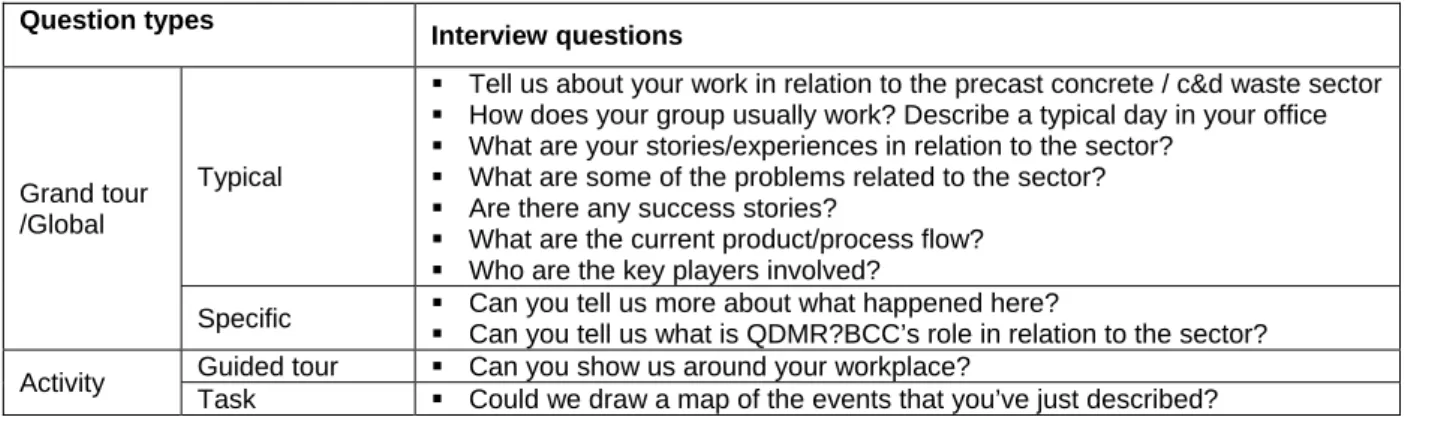
The following table summarises the types of questions asked at the workshops and interviews.
Table 1.1 Framework of interview questions: Internal staff workshops & interviews
Question typesInterview questions
Grand tour /Global
Typical
Tell us about your work in relation to the precast concrete / c&d waste sector
How does your group usually work? Describe a typical day in your office
What are your stories/experiences in relation to the sector?
What are some of the problems related to the sector?
Are there any success stories?
What are the current product/process flow?
Who are the key players involved?
Specific
Can you tell us more about what happened here? Can you tell us what is QDMR?BCC’s role in relation to the sector?
Could you draw us a map of the product/process flow that you’ve just
described?
Prompts
Extension
Are there any strategies in place to manage the risks associated with the
problems you’ve mentioned previously?
How do you measure achieving these objectives?
Encouragement Example
The analysis of the data collected from the workshops and interviews is documented in the section 4.2 and 4.3: Results: Case studies 1 and 2 of this report.
External industry suppliers (PCC & CDW): supply perspective
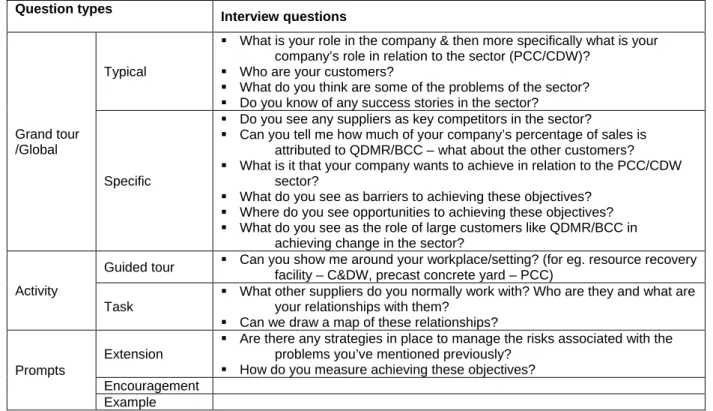
Individual interviews were held with suppliers from the two markets sectors; pre cast concrete and construction and demolition waste sectors. The interviews were carried out at the participants’ workplace and the following framework acted as a guide/tool to
Table 1.2 Framework of interview questions: external industry suppliers’ interviews
Question typesInterview questions
Grand tour /Global
Typical
What is your role in the company & then more specifically what is your
company’s role in relation to the sector (PCC/CDW)?
Who are your customers?
What do you think are some of the problems of the sector?
Do you know of any success stories in the sector?
Specific
Do you see any suppliers as key competitors in the sector?
Can you tell me how much of your company’s percentage of sales is
attributed to QDMR/BCC – what about the other customers?
What is it that your company wants to achieve in relation to the PCC/CDW
sector?
What do you see as barriers to achieving these objectives?
Where do you see opportunities to achieving these objectives?
What do you see as the role of large customers like QDMR/BCC in
achieving change in the sector?
Activity
Guided tour
Can you show me around your workplace/setting? (for eg. resource recoveryfacility – C&DW, precast concrete yard – PCC)
Task
What other suppliers do you normally work with? Who are they and what are
your relationships with them?
Can we draw a map of these relationships?
Prompts
Extension
Are there any strategies in place to manage the risks associated with the
problems you’ve mentioned previously?
How do you measure achieving these objectives?
Encouragement Example
1.2.2 Interview coding
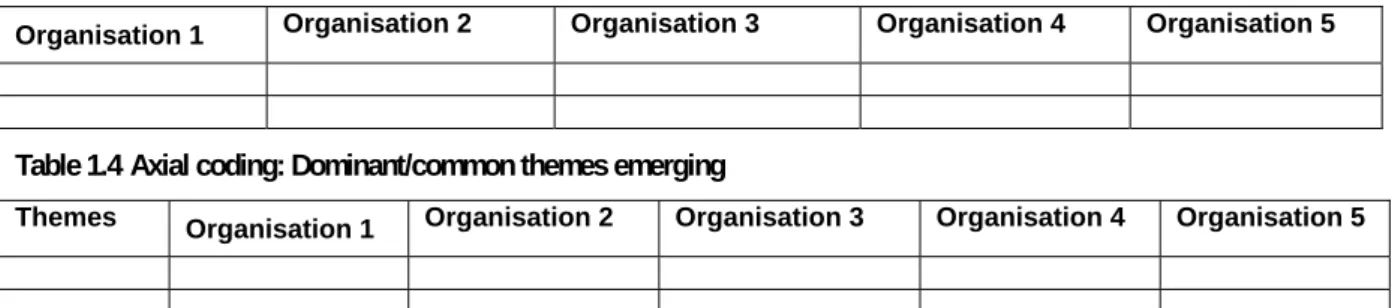
All interviews conducted for both case studies have been recorded (either through voice recorder or video recorder), transcribed and subjected to two stages of coding; open coding and axial coding. Prior to that, a coding schema has been developed for the analysis of the data collected through interviews. The first stage of coding involved the loose association of themes and concepts as revealed by the individual interview transcripts (refer to Table 2.3).
The second stage progressed to the arrangement of data according to dominant themes that have emerged (refer to Table 2.4).
Table 1.3 Open coding: themes arising from interview transcripts
Organisation 1 Organisation 2 Organisation 3 Organisation 4 Organisation 5
Table 1.4 Axial coding: Dominant/common themes emerging
Themes Organisation 1 Organisation 2 Organisation 3 Organisation 4 Organisation 5
Various data displays have also been developed to draw and verify conclusions (Miles &
Huberman, 1994). The analysis of the data collected from the interviews is documented in the section 4.2 and 4.3: Results: Case studies 1 and 2 of this report.
1.3 Observations
Observations of the settings, places or conditions in which participants work can provide researchers a clearer picture of the context in question, which in this case include the characteristics, behaviour and problems related to the two sectors. When provided the opportunity, researchers should record their observations to provide ongoing records of key elements related to the settings. More specifically, information relating to the following have been recorded for this study (Stringer, 1996):
Places: offices, locations of activities and events, physical layouts
People: types of people, formal positions, roles
Objects: buildings, furniture, equipment, materials
Acts/activities: actions and sets of acts people take
Events: set of related activities
Purposes: what are people trying to accomplish
Time: frequency, duration, sequencing of events and activities
Feelings: emotional responses and orientations to people, events, activities, etc Observations, which have been recorded for the study to date is documented in the section 4.4: Results: Observations of this report.
1.4 Document analysis
Document analysis involves the collection, review, interrogation and analysis of various types of documents in the form of ‘text’ (O’Leary, 2004). There are a wide variety of document types that are suitable for analysis ranging from reports to photographs, and letters to television programmes. All these “documents” are considered sources of data, which is similar to data collected through interviews, surveys and observations. The key distinguishing factor between the data sources for document analysis and other modes of analysis is that the data for document analysis are composed of pre-produced texts that have not been generated by the researcher whereas in other methods of analysis, data is primarily generated by the researcher (for eg. interview transcripts, observation notes, etc). As such, in document analysis the researcher’s role is limited to gathering, reviewing and analysing relevant documents, which have already been produced.
More specifically, some of these document types include (O’Leary, 2004):
authoritative: these include documents that are produced by authorities with the aim of gaining unbiased knowledge. For example: surveys, reports, journals, books, etc
agenda-based: these include documents that have an ‘agenda’ or documents produced by those with a vested interest in the outcomes. For example: political campaign/promotional materials, etc
personal: these include documents that are personal and subjective by nature. For
example: letters, emails, sketches, diaries, photographs, memos, etc
multimedia: these include documents that are multimedia-based. For example:
newspaper/magazine column/articles, current affairs shows, news reports, TV sitcoms/commercials, etc
historical: these include documents that have been produced within a particular historical period of interest to the topic in question. For example: organisation’s records, minutes, policy documents, etc
The process of analysing documents typically involve the following activities:
Plan: What are the types of documents that are to be explored? How will these documents be accessed? What types of data will be gathered from the documents?
Gather: How will the documents be managed/organised?
Review: What is the “agenda” of the document?
Interrogate: What is the content of the document? Who is the author/audience and what is the purpose and style of the document? What is the “witting evidence” (what is the document meant to impart?) and “unwitting evidence” (what other background information is related to the document?)
Reflect/refine: Were there any difficulties associated with gathering the data, reviewing the sources or exploring the content? Are there additional documents that need to be gathered/reviewed/interrogated?
Analyse data: What conclusions or interpretations can be drawn from the document?
2. RESULTS
This section presents the results of the first stage of the study, which is Intelligence capturing phase and is divided into two parts including:
Case study 1: internal & external perspectives
Case study 2: internal & external perspectives
2.1 Case study 1: Pre cast concrete sector 2.1.1 PCC: Government/client perspective
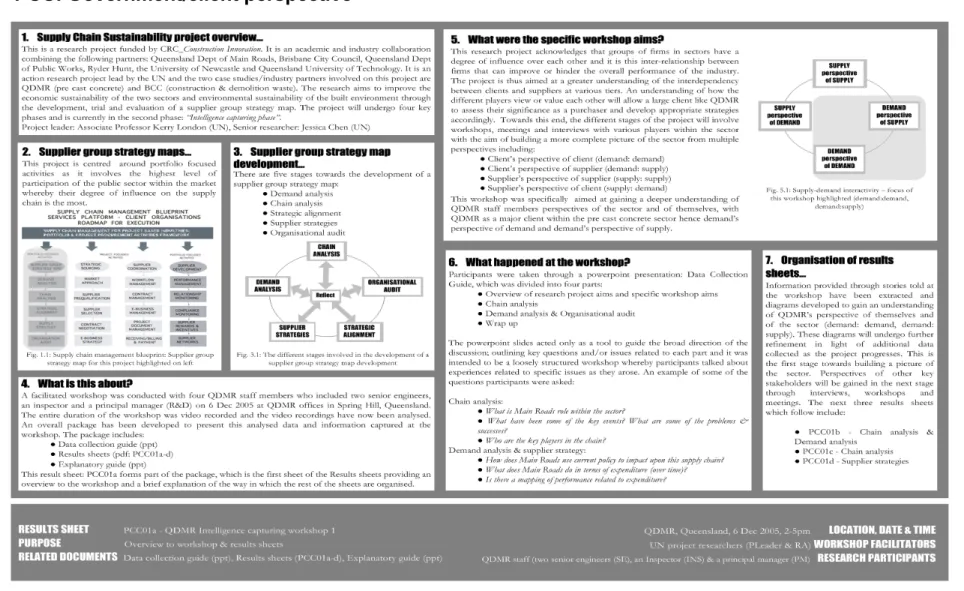
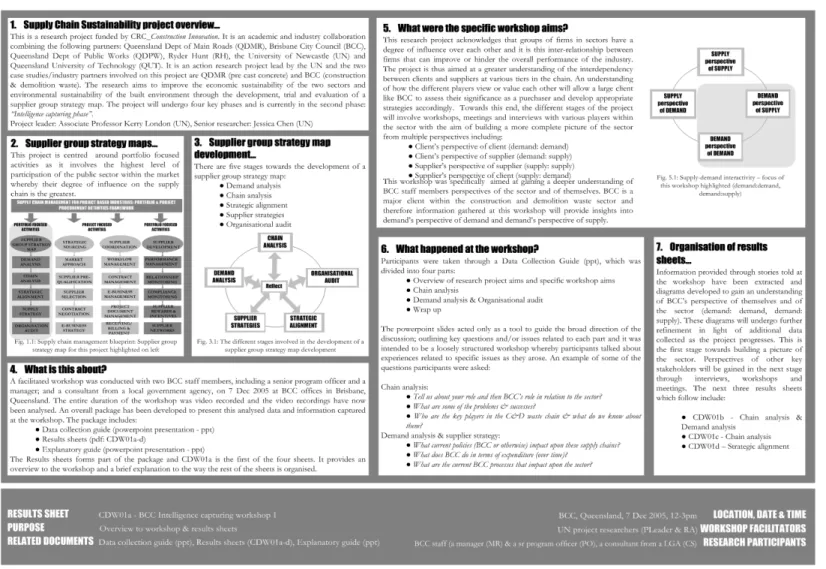
Figure 4.1 PCC01a: Overview to workshop and results sheets
Figure 1.2 PCC01b: Chain and demand analysis
Figure 1.3 PCC01c: Chain analysis
Figure 1.4 PCC01d: Supplier strategies: risk vs expenditure
2.1.2 PCC: Industry/supplier perspective
OVERVIEW OF PARTICIPANTS
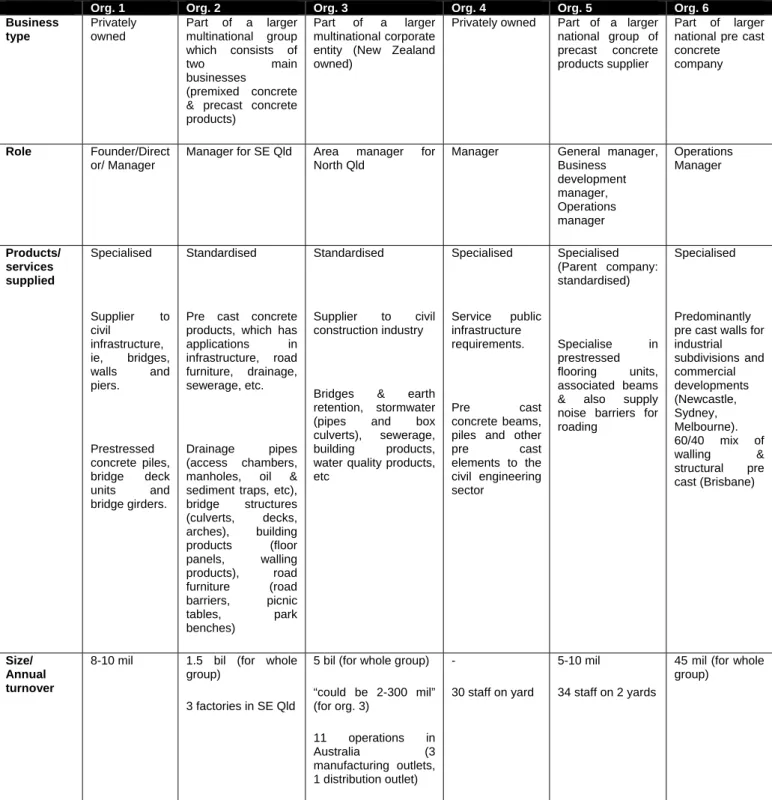
Table 2.1 Key characteristics of pre cast concrete supplier organisations interviewed
Org. 1 Org. 2 Org. 3 Org. 4 Org. 5 Org. 6
Business type
Privately owned
Part of a larger multinational group which consists of
two main businesses
(premixed concrete
& precast concrete products)
Part of a larger multinational corporate entity (New Zealand owned)
Privately owned Part of a larger national group of precast concrete products supplier
Part of larger national pre cast concrete company
Role Founder/Direct or/ Manager
Manager for SE Qld Area manager for North Qld
Manager General manager, Business
development manager, Operations manager
Operations Manager
Products/
services supplied
Specialised
Supplier to civil
infrastructure, ie, bridges, walls and piers.
Prestressed concrete piles, bridge deck units and bridge girders.
Standardised
Pre cast concrete products, which has applications in infrastructure, road furniture, drainage, sewerage, etc.
Drainage pipes (access chambers, manholes, oil &
sediment traps, etc), bridge structures (culverts, decks, arches), building products (floor panels, walling products), road furniture (road barriers, picnic tables, park benches)
Standardised
Supplier to civil construction industry
Bridges & earth retention, stormwater (pipes and box culverts), sewerage, building products, water quality products, etc
Specialised
Service public infrastructure requirements.
Pre cast concrete beams, piles and other pre cast elements to the civil engineering sector
Specialised (Parent company:
standardised)
Specialise in prestressed
flooring units, associated beams
& also supply noise barriers for roading
Specialised
Predominantly pre cast walls for industrial subdivisions and commercial developments (Newcastle, Sydney, Melbourne).
60/40 mix of walling &
structural pre cast (Brisbane)
Size/
Annual turnover
8-10 mil 1.5 bil (for whole group)
3 factories in SE Qld
5 bil (for whole group)
“could be 2-300 mil”
(for org. 3)
11 operations in Australia (3 manufacturing outlets,
1 distribution outlet) -
30 staff on yard
5-10 mil
34 staff on 2 yards
45 mil (for whole group)
DEMAND ANALYSIS: significance of various client types Table 2.2 Key client of PCC suppliers
Org. 1 Org. 2 Org. 3 Org. 4 Org. 5 Org. 6
Main Roads (direct) 10% Occasionally ? 9% - -
Contractors:
Infrastructure (for eg., JH, Leightons, Thiess, JFHollett, Gabridge, QBuild, Abi Group)
90% 20-50% 30-65% 90%
7-12 consistent clients
20-45% 50%
Contractors:
Subdivisional market Multiplex, Abi Group, Balderstone
- 50-80% 35-70% - 55-80% 50%
Others Occasionally 1%
Main Roads in total (indirect & direct)
70-80% 20-50% 30-65% 99% 20-45% Up to 50%
CHAIN ANALYSIS: Key problems related to the sector Table 2.3 Suppliers’ perspective on the key problems related to the sector
Themes Org. 1 Org. 2 Org. 3 Org. 4 Org. 5 Org. 6
Payments Ensuring payment by large
contractors
Industry cycles Skilled labour issues – wasted resources on training & impact on ability to take on more work
Skilled labour issues – wasted resources on training
Skilled labour issues – incentives to maintain workforce an added cost
Skilled labour issues – enhanced pay structures & work conditions to maintain workforce an added cost
Skilled labour issues Skilled labour – risks involved with training, pay structures
Lack of lead time – stock of materials, planning
Lack of lead time – stock of materials, planning
MR’s requirements MR’s specifications higher than
Australian standard – onerous, less cost effective & disadvantages existing precast concrete suppliers
MR’s specifications higher than Australian standard – onerous & less cost effective
QA not reflective of product/supplier performance
Specialised vs standardised specifications – increased complexities associated with specialisation (re-evaluation by suppliers as to the viability of supplying to MR)
QA systems onerous & complex
MR’s specifications higher than Australian standard – onerous & less cost effective (re-evaluation as to viability of supplying to MR)
MR’s prescriptive vs performance specification -‘overspecified’, less cost effective & limits innovation
MR’s prescriptive specification (instead of performance specification) – ‘overspecified’, less cost effective & limits innovation Inconsistency in specifications –
performance/material/both
Inconsistency in specifications –
performance/material/both Communication /
understanding
Indirect line of communication with MR – lack of clarity
Communication with various parties &
distance from MR – complexities & time consuming
Indirect line of communication – creates inflexibility, ie inability to make changes
Lack of communication /consultation in relation to specifications (changes, etc) – limits innovation & imposition on suppliers
Lack of communication /consultation in relation to specifications (changes, etc) – imposition on suppliers
Delayed communication – lack of input at early stages of design resulting in higher costs
MR’s lack of understanding of supplier’s perspectives & unwillingness to co- operate
MR’s lack of understanding of supplier’s expectations/ perspectives/ objectives
‘Meat in sandwich’ metaphor – contractors backcharging mentality and suppliers protecting downstream suppliers
MR’s lack of support for suppliers – increased difficulties/ complexities
Supplier selection Price as key criteria – disadvantages some
suppliers
Price as key criteria – impact on quality and disadvantage to suppliers who focus on quality
Downstream suppliers
Ensuring consistent supply of materials – logistics etc
Ensuring consistent supply of materials Ensuring consistent supply of materials - Downstream suppliers facing similar skilled labour issues – impact on supply/quality
Ensuring consistent quality of materials (concrete)
Storage Storage issues
Ensuring payment from upstream clients
Lack of cash flow could potentially lead to inability to pay downstream suppliers:
“I suppose the biggest commercial risk we all take in any business is getting paid. We spent a lot of money to make this product if we don’t get paid it could spell the end of this company so I’m not suggesting it’s a problem but there is a variety of rules that seem to be applied…When we work for larger contractors they tend to wanna be a bit authoritative, dictatorial, and there’s “you’ll work to our rules or not at all” so payments tend to get extended 45 to 50 days and they argue about paying for product that’s held in our yard…with Main Roads you almost get paid at 28 to 30 days. The others can be 60 days. The actual cost of that I’ve never actually measured…you could sit down and how much is this money gonna cost you in loss of interest. It’s not so much that, it’s the lack of cash flow because we must pay our suppliers at 30 days, it’s an agreement we have and if we don’t pay them they’re likely to cut off our supply, now the cost of that it’s unmeasurable…They wouldn’t do it for being late once but if it’s an ongoing saga then I can understand why they’d be asking the question and they have a right to, they don’t need to have suppliers on board who are not paying them on their accepted terms so we make all attempts to pay our own suppliers in 30 days, to do that we need other people to pay us so that we can pass the money on” (Org.
1)
Industry Cycles
Themes Org. 1 Org. 2 Org. 3 Org. 4 Org. 5 Org. 6
Industry cycles
Skilled labour issues – wasted resources on training & impact on ability to take on more work
Skilled labour issues – wasted resources on training
Skilled labour issues – incentives to maintain workforce an added cost
Skilled labour issues – enhanced pay structures &
work conditions to maintain workforce an added cost
Skilled labour issues
Skilled labour – risks involved with training, pay structures
Lack of lead time – stock of materials, planning
Lack of lead time – stock of materials, planning
Skilled labour most significant issue as a result of industry cycles Loss of skilled labour during trough periods, time required to up skill:
“Labour’s our biggest issue. Mm we like to maintain a steady workforce...Unfortunately the peaks and lows are quite large sometimes and our workforce has to be double and it’s just not there…there’s no trade in it but it’s the kind of work that you get good at by doing it and if you’re not doing it you lose the ability and they go off and do something else and you can’t get them back, you know it’s very difficult that type of thing, variable work load…”
(Org. 1)
“The impact is most outspoken on the labour front in skills. It’s very difficult to, although it’s a fairly simple manufacturing process, yeh we operate to some very tight tolerances and very strict quality requirements and there’s a lot of science behind what we do but it’s still an art and so you can’t just go and pick up people off the street and put them in the factory, you spend quite a lot of time training them up…if you have a large project it takes you a while to train people up to the standard that you can employ them with confidence to do a job but during that time they’re very hard, if the work is not there you can’t sustain those costs…and during the trough periods those people then leave our employment and do something else but obviously when that happens the skills that you’ve spent months building up walk out the gate” (Org. 2)
“…when you find people you can’t keep them because they’re being offered more money in more lucrative jobs where they’ll pay big money just to have the people do the job…some of those mine sites are you know 50, 60, 80, 100 people, 200 people, in fact some sites have got over a 1000 people on them, they have camps and cities near their mines, so there’s a huge draw on…” (Org. 3)
“…if anything concerns me about the next three or five years in this industry it will be where do we get the people and how do we keep the people OK. People say you’ll find them, you pay them the right amount of money they’ll stay, no, people are not what they were 10 or 15 years ago, they’re itinerant, they move, they’re flexible, it’s very hard to find anyone that can make a career of this. We’re not an employer of choice and none of our competitors are employers of choice…we can’t attract people into this industry at the national payment award rates that we’re deemed to comply with. We don’t have an EBA…because we work to an award and most of our competitors work to similar sort of pay structures, those pay structures are significantly below what the mining sector pays for unskilled labour. It’s below what Greenfield construction sites pay for labour.” (Org. 4)
“Well staff issue’s a big issue. I mean it’s not only this industry any industry to find good people and if you wanna have good people some of the guys here we just have to bite the bullets and justify it, if someone like if you’re a big company and somebody plays up and says you out you can sack him.” (Org. 5)
Inability to take on more work:
“Probably our worry is generated by we do connect to doing projects and if our labour doesn’t perform we fail. And
Provide incentives to workers through enhanced pay structures, training opportunities, improved processes, enhanced work conditions – added costs/risks to suppliers:
“…we pay our people an agreed above award rate and then we pay a production incentive on top of that…we do skill our people, we value add their expertise as labourers, we give them training and certificates in certain training, whether it be tickets in machining operations such as fork lifts, cranes, doggers tickets, we give them training in concrete technology, we also put them through front line management training…we’re just about to undertake another new training programme with all our employees through a national training organisation to give them certificate 3 in process manufacturing. So we have all these training, and we have to do that to provide the incentive for people to wanna work here and stay here, they can’t see the benefit…Oh we’ve improved our processes over the years as much as we can do and we’ve invested money and our organisation’s invested capital in new manufacturing techniques and new machinery to keep up to date productivity wise if you know the highest investment in our product now is our labour…” (Org. 3)
“…one of the issues we’re contending with in the next three or four years of heavy demand is what pay structure will we have to end up having here to maintain human resource levels …We’ve got 30 men in the factory at the moment, we can run this factory with 60 men and if they have the work to do I can run the factory with 60 men but I have to find another 30 men and I have to potentially match payment structures outside the factory to keep them, that’s a very serious issue for the short term…that’s not uncommon to do over, in a month you might do 20 inductions.
We’re lucky if we end up with two or three in that month with those people…it gets hot here in Queensland and you know when you’re out in 40 degree heat in the shade it’s hard, hot, dirty work, we can’t find the people who’ll work in those sort of conditions. People say put up another structure, OK I’ll amortize the cost of the structure to give another shade, who’s going to pay for that when contractors all they’re interested in is the bottom line, they don’t care if we keep our workers in the shade.” (Org. 4)
“you’ve just gotta have your good people, reward them more and they just work more you know and you just gotta obviously factor in that you’re gonna have more problems than you’re normally gonna have in your factory…we have been successful with apprenticeship, more so than with traineeships including government. We’ve got one guy that’s been with us a couple of years now in a traineeship he’s good you know, we’re about to start another one so you know we’re doing certain things like that just trying to fill the gaps there but it’s hard work that because you’re taking the guy out of school that’s got no idea about you know certain things and working in a work force, it’s a high risk investment for us you know to do that” (Org. 6)
Lack of lead time as a result of industry cycles Ensuring supply of materials, etc for continual production
“with the Main Roads…you’re not involved in the planning so all of a sudden it’s out so there’s peaks and troughs of demand and in a business like ours that’s so reliant on the Main Roads as a supplier, if their business operates peak and trough stuff it makes it very difficult for us to manage our business and manage our margins and manage our people and our training and everything…cos we’re so far away from the market of supply in some instances, especially in cement and steel we can’t afford a just in time process… if I don’t get my steel supply here on time to make the products I need I stop, I can’t do anything so it’s important that I get that good chain of supply and I don’t want too much in stock, no sense having a million dollars worth of steel sitting out there if I don’t need it…the peaks and troughs of the process of purchasing, of ordering things can sometimes be a bit abrupt from a Main Roads’ perspective” (Org. 3)
“We’re in an industry here where you just can’t turn on the tap and the water starts to flow, we’ve got a factory and we’ve got a good momentum up but it can take anywhere from two months to eight months of lead time, planning and procurements of downline items to get set up for major projects…without a word of a lie in the current market we might anywhere up to six to eight months to get up to start a job, now if the contractors come to us two months before they need products and we need six months to get ready to start to supply the products, well we’re gonna say to the contractor “no you’ll have to wait another four months or pay three times the cost to try to compress six months of work into two months” and we’d strongly suggest to them that they ignore the offer to pay three times the cost cos they can’t swallow it and nor could we cos that would mean we’d have to pass that onerous requirements down to our suppliers and it just won’t happen… the problem with the upside clients also is that they don’t understand sometimes the real timing that you need when decisions really should be made, when commitments have to be made to their downline suppliers so that their downline suppliers have got a hope in meeting the milestones. So that’s pretty symptomatic of an industry too where there’s a lot of work around, people are missing the picture, they’re not programming it correctly, perhaps not as experienced as much as they should be, they don’t understand what to do, a bridge that’s 300 metres long requiring 200 girders weighing 60 tonne each, they just don’t happen overnight you know there’s a lot of planning…” (Org. 4)
MR’s requirements/specifications
Themes Org. 1 Org. 2 Org. 3 Org. 4 Org. 5 Org. 6
MR’s requirements
MR’s specifications higher than Australian
standard – onerous, less cost effective &
disadvantages existing precast concrete
suppliers
MR’s specifications higher than Australian
standard – onerous & less cost effective
QA not reflective of product/supplier performance
Specialised vs standardised
specifications – increased
complexities
associated with specialisation (re- evaluation by suppliers as to the viability of supplying to MR)
QA systems onerous &
complex
MR’s specifications
higher than Australian
standard – onerous & less cost effective (re- evaluation as to viability of supplying to MR)
MR’s
prescriptive vs performance specification -
‘overspecified’,
less cost effective & limits innovation
MR’s prescriptive
specification
(instead of performance
specification) –
‘overspecified’, less cost effective
& limits innovation Inconsistency in
specifications – performance/ma terial/both
Inconsistency in
specifications – performance/mate rial/both
MR’s specifications higher than Australian standard
Disadvantages existing suppliers and favours new manufacturing processes/entrants:
“The feeling that we get recently is that Main Roads have dictated their own requirements for standards upon the industry and basically said you know, pipes 100 years we want 300 going on to a 1000…So that’s my biggest concern is that the industry seems to be targeted in favour of the new entrants into the market who have these super duper new manufacturing processes that haven’t been around and have no proven record whereas we have the proven record and yet we’re the ones who seem to be suffering…” (Org.2)
Onerous:
“Main Roads are about supplying the infrastructure to everybody to support that secondary activity as it comes along so they’re driven by a whole lot of different issues but with them driving those issues they bring with them a whole lot of other different type of concerns from our point of view as a supplier. They’re a lot more technically demanding than normal customers…our requirements to supply to their specifications at times seem onerous but they’re difficult to achieve… “ (Org. 3)
“I guess one of the biggest issues there is the contractual complexity that’s coming into a lot of these projects now, enormous for small companies like ourselves, we’re expected to have complete QA systems you know and we just don’t have the resources to do it, we’re expected, you know you’re expected to wade through that *** job was a 74 page document and another 70 pages of specifications and the specifications were written with absolutely no understanding of the product they were buying so they take it off the shelf bang and see to do it properly you’d have to go through and ask for 400 variations which they won’t give you because they don’t understand the variations cos they didn’t understand your product in the first place so the contractual requirements that are placed on a lot of small suppliers is really quite high. Put it this way – it’s too complex…Just too hard to keep them going…” (Org. 5)
Prevents standardisation – re-evaluation of viability to supply to MR, erosion of profit margins/less cost-effective for suppliers:
“when you start to have different segments of the market are broken up into certain specifications and other markets in another specification, especially in the type of product that we make…our market is not big enough to split…so I make the higher standard, stack it and store it, and then when the orders come I can supply any particular market segment I like with that one product. So as the Main Roads impose new levels - you keep having to lift the
marker…unfortunately in the real market you can’t demand more cost…As a sector of the market the Main Roads may be prepared to pay but they aren’t our only sector in the market. The other part of our market that we need to keep our business buoyant and viable will not pay the extra bit that the Main Roads wants…in a real
absorb the cost so what it does is…our margins have been eroded by continual review and change of specifications.” (Org.3)
“Now we’re certified to supply Main Roads and that takes quite a lot of effort and we can do it but we can do it because we make the same product for them each time and we know exactly what we’re doing but when they call for specials it makes it very difficult. A lot of people just don’t want to deal with Main Roads now cos it’s too hard, you’ve never been involved, Joe Bloggs down the street there uses the same quality he does everything…Main Roads is just too hard.” (Org. 5)
“…it’s you know every Main Roads’ job’s difficult for a precaster who doesn’t just do that work day in day out…cos the normal procedures we follow in the standard quality system for developers and you know obviously other commercial clients that look for economies of scale and they’re obviously looking for a product which is economically viable to the development so we can’t do everything that’s required that a Main Roads’ job requires OK?
Only on Main Roads’ jobs do we follow Main Roads’ contracts right and other jobs we follow our own quality system which not necessarily has any specifications attached to it OK?Main Roads’ jobs are quite separate. You can say we have separate management tools to manage Main Roads’ criteria compared to the RTA…when it comes to Main Roads’ jobs it’s always difficult because you’ve got different people on site who can see different things…We feel that if that’s the way Main Roads are, if that’s the direction Main Roads are doing then one we’ve gotta think about what jobs we do target, you know two our pricing and three our level of resources whenever we need to carry to win two or three Main Roads’ jobs a year you know so you know they’re all the decisions we’ve gotta look at just because of the specification…we precast for ten clients every day, ten different clients every day, ten different jobs in the factory every day. Right so you know we’re dealing with a whole range, the landscape is we’re dealing with architects, we’re dealing with builders, we’re dealing with developers you know, we’re dealing with road builders, bridge builders, so all sorts of things. So it’s different for us, see we are as a precast factory our main aim is product in product out so we pour one day we strip the next day so we can, our efficiency is that we can pour another lot of products the same day. Main Roads don’t allow that…” (Org. 6)
QA not reflective of supplier performance/product quality
“What we fear is starting to happen is that those QA documents are not that difficult to put together like you don’t have to be a specialist in this game to put the quality assurance documents together to become accredited with the state government, you can be a banker and appoint the correct consultants, here write me a set of documents for this industry and the current processes in the roads authorities is they don’t really care about your track history or your record or how many years you’ve been doing it, they look at the paperwork and if the financials are correct, if you’ve addressed all the systems, you could own just a house in the suburbs and you could be prequalified as a supplier”.(Org. 4)
Prescriptive vs performance based specifications Limits potential innovation/cost savings:
“there’s a few considerations to be taken into account when taking this very prescriptive approach you know for instance a prescriptive approach that says you will have that many millimetres reinforcement and your reinforcement will be this and you will steam it for this long and you will have a of this… as a manufacturer it makes it very easy, we just look at what we have to do step by step and we do it but it also means that if the specification changes, any technological advances any add mixtures that we could add to the concrete, any concrete technologies or from a slab of concrete or, is basically not allowed for, we can’t use it because we have such a prescriptive approach. How can you be innovative if you have all these hurdles to jump through? There’s immediate benefits by going from a prescriptive standard to a performance based standard cos it allows us to be innovative, all we have to do is basically certify the product to a performance…the beauty of a performance standard is it allows me to be creative in the factory and go and test all different kinds of different approaches to see what works best from our point of view whilst still ensuring the product performs to a standard” (Org. 2)
“The thing there is it’s not a performance specification it’s a material specification. Most people have moved towards performance specification…QMR has the reputation of being the most difficult organisation in the country to get product specified for, which I guess means they are the most careful of the tax payers’ money if you like as long as they are building equally for the 50 years but very often they are building 50 year structures in 20 years plans…so very often the pace of change and development in the industry is moving much faster than the understanding and knowledge inside a large organisation and there are better cheaper products available in terms of performance but Main Roads takes the attitude that unless they understand every last component that goes into a design unless they specify and approve it can’t be put in” (Org. 5)
Inconsistency in specifications Disadvantages some suppliers:
“my argument is allow us to be creative on the square products as well, why just the round products not the rectangular products, so we’re saying alright well make up your mind, have a performance standard on the square products the same as the round products or have a prescriptive standard on the square and the round products but make up your mind… I’m like have some consistency between the two so that we as an industry then don’t feel disadvantaged and so yeh so it’s really it’s a lot of trouble at the moment. The problem with the approach on the circular products on the pipes is that it’s only prescriptive to a certain extent and it allows people a way out” (Org. 2)
Increased complexity:
“It varies from project to project yeh some projects they just want to go with the performance of the product
Some will specify both which makes it sometimes very difficult because although you’re complying with performance the actual materials that we’re using do not comply with the material specifications” (Org. 5)
Communication/understanding
Themes Org. 1 Org. 2 Org. 3 Org. 4 Org. 5 Org. 6
Communication /understanding
Indirect line of communication with MR – lack of clarity
Communication with various parties & distance from MR – complexities &
time consuming
Indirect line of communication – creates inflexibility, ie inability to make changes
Lack of
communication /consultation in relation to specifications
(changes, etc) – limits innovation
& imposition on suppliers
Lack of communication
/consultation in relation to specifications
(changes, etc) – imposition on suppliers
Delayed communication – lack of input at early stages of design resulting in higher costs
MR’s lack of understanding of supplier’s
perspectives &
unwillingness to co-operate
MR’s lack of understanding of supplier’s expectations/
perspectives/
objectives
‘Meat in sandwich’
metaphor – contractors
backcharging mentality and suppliers
protecting downstream suppliers
MR’s lack of support for suppliers – increased
difficulties/
complexities
Importance of constant
communication re design changes &
delays etc – significant impact on costs, storage, etc
Importance of communication - information/dela yed decision- making within MR & significant impact on suppliers
Lack of understanding of
real timing &
decision-making processes
Decision-making process within MR – lacks clarity
Indirect contractual relationship with MR
Indirect line of communication causing delays/complexities on production:
“I guess the lines of communication can sometimes be drawn out… we can be fairly way down the pecking order if we’re a supplier to a subcontractor who in turn goes through a contractor who has to work through a superintendent to the designer we can be fifth in the line on the information chain so if we have a problem with a drawing we don’t know who to ask anymore…we don’t have a direct contact to somebody that can give us an answer quickly, so we tend to cut corners as most people do, we’ll often go directly to the Main Roads ourselves… we may get an answer but then we have to confirm that answer right back through the circuit of information again and it can take a long, long time, if we’re going that way you know we can have a long delay in our works if there is a problem we need to get sorted out…” (Org. 1)
“…in any give project you’ve got a designer say an architect, you’ve got a specifier like an engineer, you’ve got a developer who owns the product and is paying the money and you’ve got the builder who has to put it together. Now unless all four of them at least are open to a new way of construction you’re gonna have troubles. So we need to make sure that not only is it specified but the developer is happy with it, they understand the finish they’re gonna get, the engineer is happy with how it’s gonna fit into the structure and the builder knows how it’s gonna work so the other issue we have is not only educating people about it but make sure when you get any given development that those group of people that very often haven’t worked together before, if you’ve got a design builder developer that’s different but if you’ve got somebody who gets a different architect, a different builder in to do his designs and his contract you need to get them all thinking the same way…don’t forget Main Road will often hire an architectural firm or they’ll hire an engineering firm, in this particular case *** will hire the designer and then they hired
*** to do so *** is having to deal with Main Roads, with ***’s designer and God knows how many other people you know so for us to know who the client is is very difficult so at any given time there can be 8, 9, 10, 12, 15 different parties involved in the final finished product. It’s getting worse, it’s getting more complex. (Org. 5)
Inflexibility on projects run by consultants:
price to that cos they actually cost us money. Oh well if you kind of look at the way it is they don’t have any flexibility the way we see it. They have a contract with Main Roads, they just stipulate it, they’ve gotta deliver that contract so they get paid you know and so therefore we’re kind of piggy in the middle and we’ve gotta do everything that opens and shuts by the book and certain contracts sometimes you just can’t do that, you’ve gotta compromise and it just becomes a massive battle to get anything changed …so that’s probably our biggest problem is trying to manage contracts managed by consultants because there’s another tier of contracting above that… We try and work closely with the client, it forces us to spend more time and money on you know on projects that probably don’t, that shouldn’t require much management time…because we’ve been doing Main Roads’
jobs for 14 years and this is what we’ve done and agreed you know certain things are done this way and now the consultants get involved it’s all gone back 14 years and here we are trying to justify all this again. Over and over and they won’t change, they just say that’s our contract with Main Roads so we’re kind of piggy in the middle that we don’t get any compromise out of that.” (Org. 6)
Lack of input from suppliers re specifications/non-cooperative approach Suppliers uninformed of objectives, limits potential innovation/cost efficiencies:
“I think it’s more a question of they take the asset manager’s view. To ensure that the assets they inherit from the third parties are up to the standard they require they set the standard the products have to be built to which is fair enough, we don’t have a problem with that. Because they take that view they want everything built to withstand World War 3 and 4 and we’re saying that if we have a cooperative effort from the start we can actually help you save money along the way and make sure that you still end up with a product that’s fit for the purpose right. Right now the increases in the standards have gone to increase to such an extent that we’re saying well where’s the logic…and why have these inconsistencies in one standard versus another for a square product versus a round product, what’s the difference. So one of our main concerns is that yes we understand the asset manager’s point of view…but on the other hand we can assist them in making sure that what they buy is installed properly, cos a lot of problems have to do with you know installation practices, people putting them in are trained properly and that the purchasing decisions and clear and concise and well defined up front right so that in the end they end up a product that is fit for the purpose…Well we’ve tried to get in touch with them to set up meetings and get them to respond to our concerns about the discrepancies and inconsistencies in the standard but they’re not returning our calls …The concern is that if there’s no input from industry into standards and that in the end industry will just go off and do its own thing” (Org. 2)
“What will happen is the cost for that project will be higher than it would have been otherwise [if don’t get to the design earlier on projects].” (Org. 5)
“when they do increase their specification they generally do it not with consultation but generally for a reason and they tend to consult after they’ve actually changed it rather than consult before they change it…well that’s my opinion from where I sit you know, they may put it out in some draft form you know we’ve just amended this new specification for I don’t know for some product or other, there’s the new draft specification and it might be out there for 12 months before they actually make it you know the only specification but in that 12 months there’s generally few forums for you to argue about whether or not it’s appropriate or not because they only argue from their point of view but from a durability point of view or from a structural point of view they don’t have any cost point of view because as a Main Roads, as a government entity they don’t have any cost issues, they’ll pay, they’ve got propensity to pay to which the private sector hasn’t and doesn’t want to pay” (Org. 3)
Transition space between upstream clients and suppliers
Absence of cooperative approach/ MR’s lack of skill/understanding of suppliers’
perspectives:
“we are dealing with materials that can vary from day to day and you can have people who are sick and not on the job and they make a mistake and and there is absolute realisation on our part that we’re not perfect, in fact far from it but when a problem happens you want a cooperative approach to fix it and that’s what seems to have suffered a little bit is that you know I have made some fantastic mistakes in my time and you just learn but if there’s someone you can go to and say look we stuffed up…at least then there’s that cooperative approach and we can say
“right the problem is this, what do we want to achieve, how do we fix it to ensure the product still achieves what it is that you want it to achieve” and we feel that’s fallen by the wayside a bit, they expect us to be perfect which we’re not. So and in a sense to have that expectation is great you know, they are paying a price for a product and it is up to us to ensure that we supply fully to their expectations and our realisation is that it doesn’t always happen but if it does there needs to be someone for us to go and talk to instead of trying to bury it or try and get it through and hope they don’t. Cos what most problems - they end up being discussions about very little cos there’s never an issue with the performance of the product, there is so many safety factors and so many tick boxes along the way that the product will perform because otherwise the risk of it not performing, there’s too many balances, too many checks and balances in the system to ensure that doesn’t” (Org. 2)
“The specifications, not only are the specifications too tight but the difficulty of deeming when you miss one, usually with a builder if we have a panel or something that doesn’t quite meet the specs they’ll go oh it’s OK we can make it fit and then they’ll go she’ll be right. Not QMR, they will raise a non conformance report under the QA system, often it means nothing....result of simple problems you can resolve it the next day, that one drags into meetings, I’ve got emails, I’ve got reports and you know…When you’re dealing with what we call the buck stopper, the buck stops, you go out with the developer, you go to site and you can say we’ve got a problem here, you can stand with them, you can say well this, this, that done and they’ll either accept it, I’ll accept it but it’s five bucks left for what else, you cannot do that the amount of management time that’s soaked up”. (Org. 5)
“…we’re expected to do everything correctly the first time. We make a dud product you know out of tolerance