A dissertation submitted for the Degree of Doctor of Philosophy in the Department of Social Administration and Social Work in the Faculty of Social Sciences at the Flinders University of South Australia. This thesis reports on the findings of a study examining the barriers to cessation among community-based and institutionalized psychiatric populations. The findings suggest that there are significant barriers to quitting for clients and staff due to a culture that reinforces smoking.
Among the most important systemic factors that reinforce smoking are the use of cigarettes to help manage psychosis and other symptoms of mental illness, to cope with feelings of helplessness, stigma and hopelessness, and the use of smoking to control behaviour. of the client. The use of cigarettes in facilitating and regulating staff-client interactions was found to be important, as was the rate of staff smoking in response to the dynamics of the environments. Among the conclusions drawn are recommendations regarding the management of smoking within mental health settings that address the needs of clients and staff and provide support for the complex change processes required.
Finally, the thesis examines the implications of these findings for understanding the role of smoking behavior in institutions in general. I believe that this thesis is properly presented, complies with the thesis specifications and is of sufficient standard to be, prima facie, worthy of consideration.
ACKNOWLEDGEMENTS
LIST OF TABLES
CHAPTER ONE - OVERVIEW
The high prevalence of smoking among people with mental illness is clearly a serious public health problem. There may also be cultural and existential reasons to do with current understanding of the phenomenon of smoking and mental illness. Research in the area of smoking and mental illness has increased, especially within the fields of medicine, psychiatry and psychology.
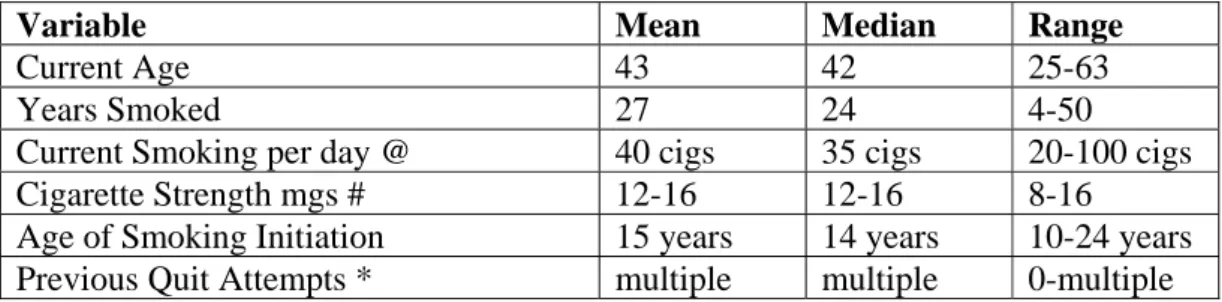
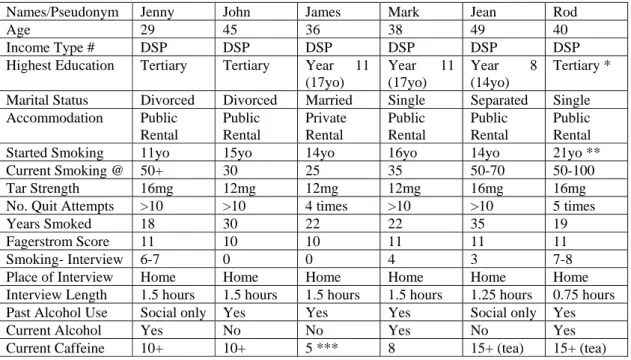
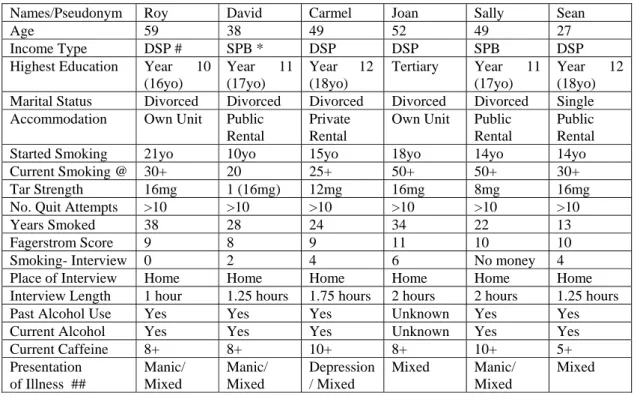
Basic demographic data on people with mental illness who smoke are also seriously inadequate in the existing research literature (Farid, Bird, & Naik, 1998). There is no thematic analysis using a qualitative methodology in current research on smokers with mental illness. To describe the experience of smoking for people with mental illness, in relation to their attempts to quit and cope with their mental illness.
To holistically describe the phenomena of co-occurring smoking and mental illness within mental health service settings. To contribute to strategies that smokers with a mental illness can use to help them quit smoking.
CHAPTER TWO - LITERATURE REVIEW
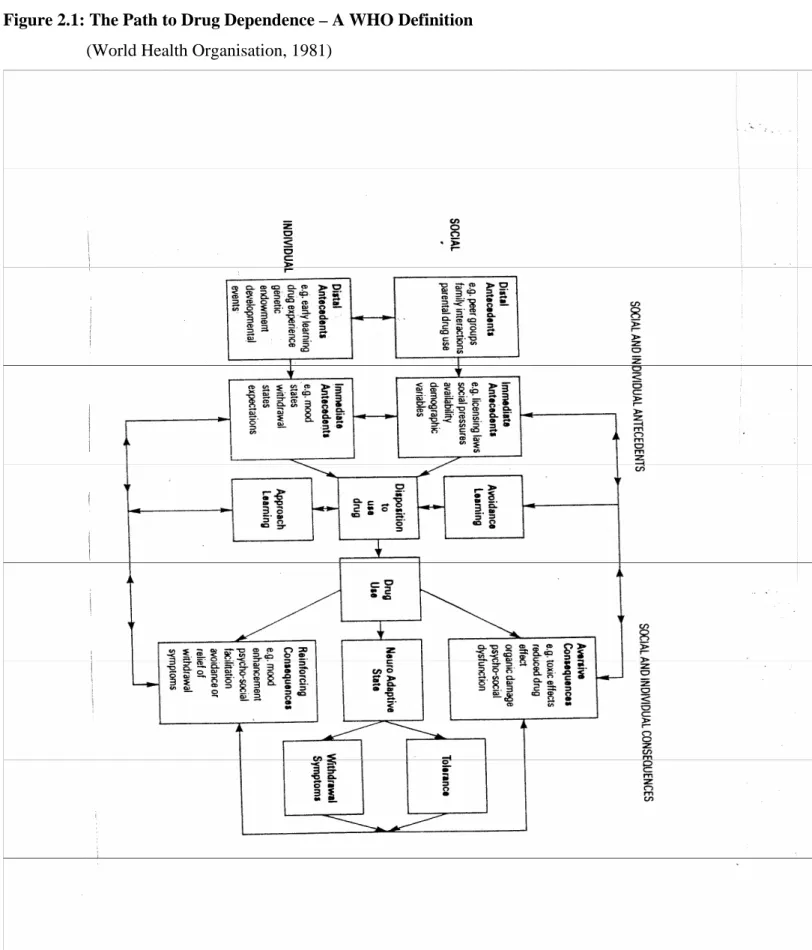
The link between smoking and lung cancer was first confirmed by Doll and Hill (1950; see also 1964). Evidence has also emerged that tobacco companies in the United Kingdom and the United States have been aware of these health risks of tobacco use and the addictive effects of nicotine for over thirty years (Glantz, et al., 1995). Decreased levels of dopamine release in the brain are believed to be one of the factors responsible for the negative symptoms of schizophrenia, such as amotivation and emotional blunting.
In the 1930s, Allport identified the degree of social conformity as one of the most important predisposing personality variables that determine excessive appetite (see Jessor & Jessor, 1977). Thus, the primary reinforcer no longer plays such an important role in maintaining behavior. A review of existing research on smoking and mental illness found significant comorbidity (George & Krystal, 2000).
Psychotic symptoms may be experienced as part of the illness (Kaplan, et al., 1994; American Psychiatric Association, 1994). These researchers have not mentioned nicotine addiction, despite the likelihood that it precedes all other drug use, and despite its recognition as a significant problem for people with a mental illness, with a prevalence more than twice that of the general population (Gonzales, et al. , 1998. These researchers found that the percentage of cigarettes smoked increased with the severity of the person's depression and that the number of smoking cessations decreased with increased severity of symptoms.
Goffman (1961a, 1961b, 1961c) describes in detail how power was displayed and used in asylums of the past.
CHAPTER THREE - METHODOLOGY
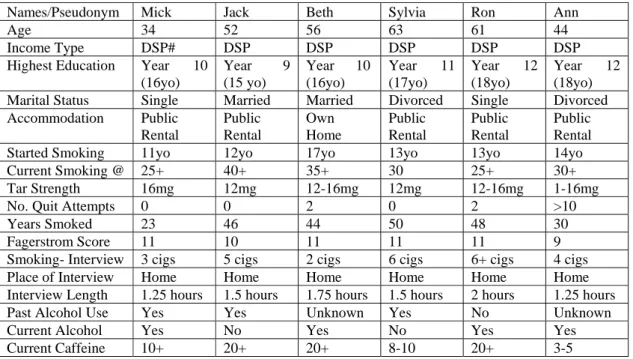
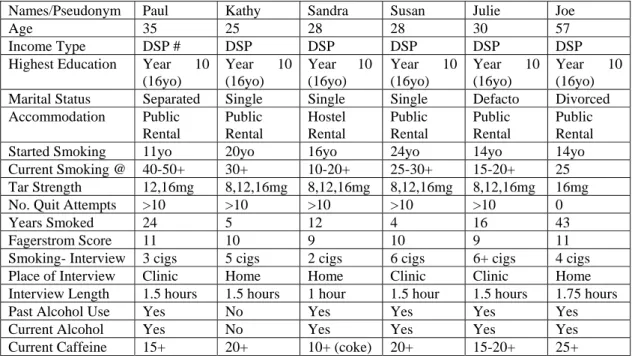
The researcher had previous experience working in all of the mental health settings in which this study took place and she had also smoked in the past. Thematic analysis of the data was conducted following the process described for customer and staff interviews in the following sections of this chapter. Determination of clients' Fagerstrom scores (Fagerstrom, 1978; Fagerstrom & Schneider, 1989) was conducted as part of the interview process (see Appendix D).
The actual words of the participants in response to the researcher's comments and questions were transcribed verbatim at all times. The actual words of the researcher were not transcribed verbatim, unless the researcher felt that they had particular influence on the participants. As part of the transcription process, the researcher used the numbering option on the computer word processor used for typing transcripts.
In this sense, coding and analysis of the data occurred simultaneously with theorizing about the data. The researcher repeatedly returned to the literature to build a holistic understanding of the data and to reflections from the interviews. The researcher's status as a worker in the field and her pre-existing relationship with several of the institutions and their staff also aided the recruitment process.
According to client interviews, staff were fully aware of the researcher's identity, work history, and research goals. The researcher's own knowledge and experience of working in all the environments being studied. The activities and further consequences of the research are noted in the final note of this thesis.
The participants consisted of inpatient staff and clients who were present in the nominated wards, as mentioned above, at the time the researcher was present in the hospital. Joint departmental meetings between staff and clients were seen as a useful forum for explaining the purpose of the study and the researcher's presence. As with the previous interview phases, one of the researcher's supervisors (R.G. Pols) served as the second coder of the data.
CHAPTER FOUR
STUDY ONE: CLIENTS WHO HAVE SUCCESSFULLY QUIT
I tried everything; spots, gums, and the four D's. Take control of the process to quit. These participants showed a commitment and determination to take control of the process of quitting and to accept responsibility for the change in their smoking behavior. As part of the quit process, these participants recognized the need to stay busy and alert to combat the urge to smoke.
Stress balls were noted to be effective and kept as a memento of the successful fight to quit. I used to get bloated at the start of the year, but now it's not a problem. The female participant had attended a quit group run by psychiatry for clients of the service and this had been described as beneficial.
She treated me like a person, you know... One of the people who supported me the most was a chemist. I chose the easy option because of other stresses in my life; family court and problems with an illness that marks me as a second-class citizen in the eyes of the law. I think I actually smoked less when I was really bad with depression because I spent most of the day on the couch… (quitting).
All of these successful quitters clearly describe the hospital's role in reinforcing smoking behavior. The changes brought about by effective treatment of mental illness with medication, particularly clozapine, and the impact of this on a person's sense of control and hope for the future are worth further research. All those who successfully quit smoking confirmed the dominant role of the psychiatric hospital in reinforcing smoking behavior and the high risk of relapse during the periods of admission due to this.
Interviewing current smokers with mental illness who have made unsuccessful attempts to quit can provide a more complete picture of the barriers to smoking cessation. However, their experiences show a clear difference from their descriptions of the role of mental illness and the system of psychiatric treatment and care in reinforcing smoking behavior. The results of these interviews are provided in the next chapter, as part of the building process of describing the experiences of smoking and barriers to smoking cessation for people with mental illness.
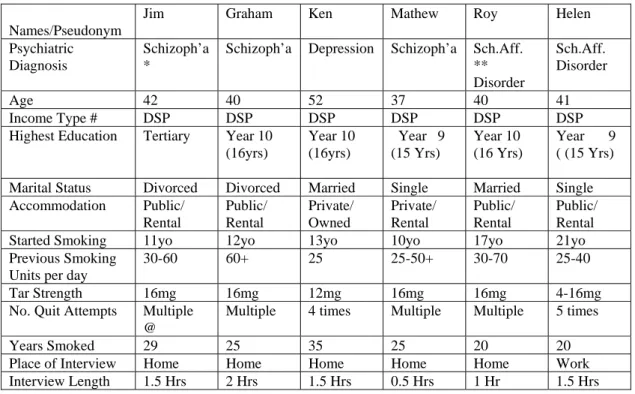
CHAPTER FIVE
STUDY TWO: CLIENTS WHO SMOKE
I don't feel like I have a proper life at the moment, it's just a thing without purpose. This is the hardest part of my illness because I actually like my illness, but it's not something I'm allowed to do. Well, I don't set goals for myself anymore..It's like accepting the way things are for me.
And the chewing gum..It's a good one. stat filler' if I'm going to my mother's, where I know I'm not allowed to smoke. It's what I've always used when I'm depressed...It's just always been there from such an early age that now it's just a habit. At the moment smoke takes up a lot of the purpose I have in my day..It's just a whole way of being.