To address the need for effective musculoskeletal care, the Department of Health and Aging (now the Department of Health) implemented the Better Arthritis Care Program (2002 to 2005), followed by the Better Arthritis and Osteoporosis Care Program (2006 to 2010) (the Department) of Health [ and Ageing], 2010) and the Arthritis and Musculoskeletal Quality Improvement Program (AMQuIP), managed by the Royal Australasian College of Physicians (Brand et al., 2011). Musculoskeletal conditions are the main cause of reduced physical function globally (Vos et al., 2012, Woolf and Pfleger, 2003), and much of the treatment for these conditions is provided in PHC settings (Dziedzic et al., 2009). The results of the 2010 Global Burden of Disease study suggest that musculoskeletal disorders account for 6.8 percent of disability-adjusted life years (DALYs) (Murray et al., 2012).
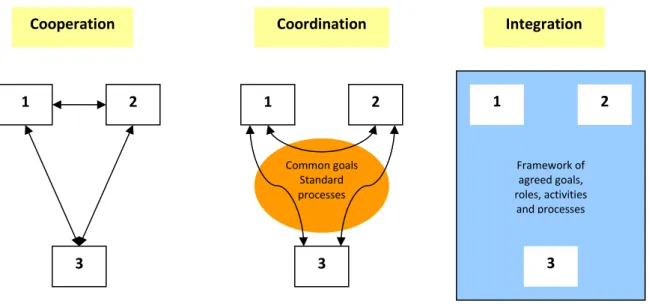
Polypharmacy (the prescribing and use of many medications) is also a problem, particularly with regard to benzodiazepines and other psychotropic drugs, which increase the risk of falls (Huang et al., 2012). A study of health promotion by AHP in the United Kingdom (Needle et al., 2011) found that musculoskeletal disorders were the main conditions targeted (28%), followed by cancers (20%) and obesity (11%). Alternatively, collaboration was described as healthcare providers working together but maintaining their autonomy in the absence of formal structure and processes for delivering patient care (Mior et al., 2010, p. 681).
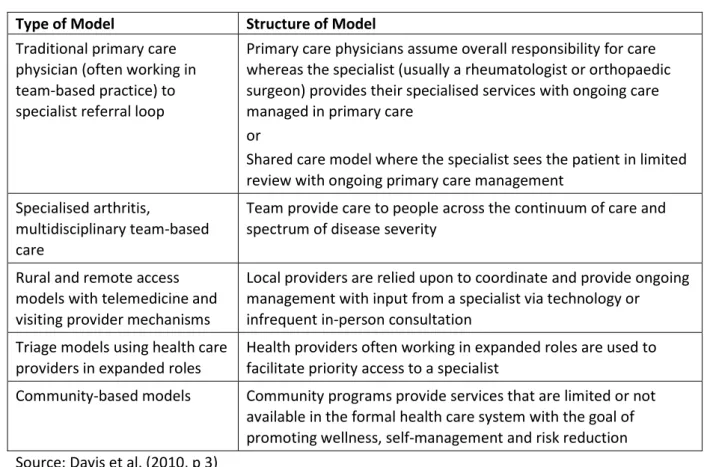
In particular, there is evidence of underutilization of AHP services, both in Australia (Brand, 2007, Brand et al., 2011, Department of Health, 2009) and elsewhere. For example, an Australian study by Maneze et al. 2014) found that few patients with diabetes believed that. Health care organizations in Canada refer to a number of different structured models (Table 4) for arthritis care (Davis et al., 2010).
These health networks are responsible for developing evidence-based 'Models of Care' (MoCs), including four created by the WA Musculoskeletal Health Network (Briggs et al., 2012) (see p. 21 for more details). The Arthritis Program (TAP) of Ontario has provided a model of interprofessional practice for over 25 years (Bain et al., 2012). For example, a Finnish randomized controlled trial evaluated the impact of a multidisciplinary rehabilitation program after primary total knee arthroplasty (Kauppila et al., 2011).
Furthermore, conventional care was cheaper and therefore more cost-effective than the multidisciplinary model (Kauppila et al., 2011). For example, Brand et al. 2010) found that patients often did not take recommended conservative therapy. Community members also perceived that the networks had raised awareness of the needs of people with musculoskeletal disorders (Cunningham et al., 2012).
The need for interdisciplinary clinical practice guidelines for musculoskeletal health has often been emphasized (Mior et al., 2010). In a Canadian study of interprofessional collaboration in community-based primary care, focusing on chiropractors and primary care physicians, a health care participant emphasized that “the patient is truly the most powerful integrator of health care” (Mior et al., 2010, p. 682 ). It is necessary to set clear boundaries (Harding et al., 2010); especially in the field of the musculoskeletal system, where each doctor's specific background will determine their specific treatment approach.
Although it is generally recommended that AHPs be included in multidisciplinary teams, there is evidence that this often does not occur sufficiently (Brand et al., 2011).

Roles and services provided by allied health professionals
To qualify for Medicare rebates, a podiatrist must be registered with the Podiatry Board of Australia (Department of Health, 2014). Podiatrists play a substantial role in the treatment of musculoskeletal disorders (Denby, 2009), primarily in maintaining foot health and assessing and treating foot problems, thereby promoting mobility and helping to maintain general health. Referring to podiatry as a 'Cinderella' service, they advocated the integration of podiatrists into multidisciplinary teams: “what is needed is an integrated approach to the management of foot problems, with podiatrists being the key practitioners in coordinating the assessment and management of the foot problems. foot and associated problems” (p. 94).
To be eligible for Medicare rebates, a chiropractor must be registered with the Chiropractic Board of Australia (Department of Health, 2014). Chiropractors have a role in the treatment of musculoskeletal disorders, primarily in relation to spinal problems. To be eligible for Medicare rebates, an osteopath must be registered with the Osteopathy Board of Australia (Department of Health, 2014).
Osteopaths play a role in the management of musculoskeletal disorders, primarily by providing spinal manipulation for low back pain (Licciardone et al., 2005). To be eligible for Medicare rebates, a dietitian must be an 'Accredited Practicing Dietitian' as recognized by the Dietitians Association of Australia (DAA) (Department of Health, 2014). Dietitians play a role in the management of musculoskeletal disorders, primarily in terms of weight control, which affect joint function and mobility.
However, when searching for this report, no equivalent information regarding PHC institutions could be found. Pharmacists play a role in the treatment of MSDs, mainly in the role of a pharmacy, dispensing medicines (both prescription and over-the-counter), and their services are used by most people with MSDs made. In the health sector, psychologists primarily focus on mental health issues, but also participate in the treatment of physical conditions such as diabetes, obesity and cardiovascular disease.
To qualify for Medicare rebates, a psychologist must have General Registration with the Psychology Board of Australia (Department of Health, 2014). Member' of the Australian Association of Social Workers (AASW) and be certified by AASW as meeting the mental health standards set out in the document published by AASW entitled "Standards of Practice for Mental Health Social Workers" effective 8 November 2008" (Department of Health, 2014, p. 15). Social workers have a role in the management of musculoskeletal disorders, for example in organizing and making referrals for home, employment and vocational support and modifications.
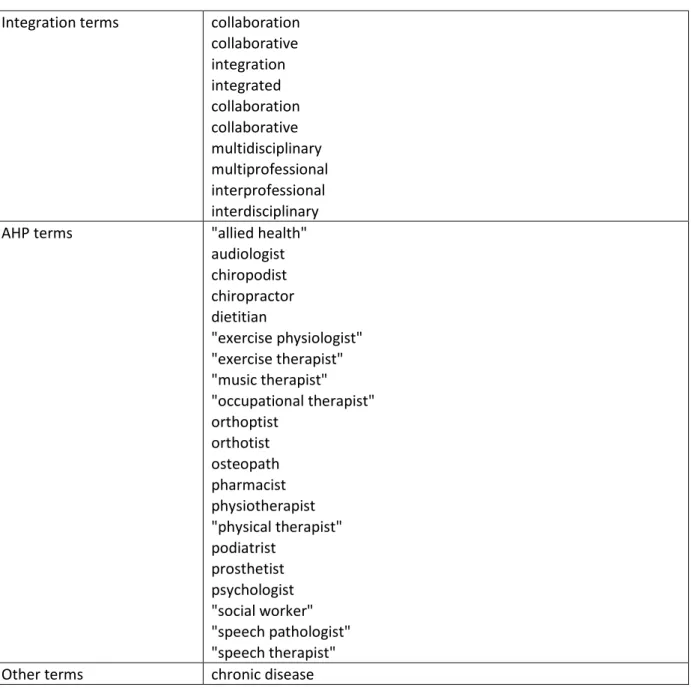
Search terms
Examples of musculoskeletal care guidelines
People should have access to a named member of the multidisciplinary team (e.g. the specialist nurse) responsible for coordinating their care. People should have access to a podiatrist for assessment and periodic assessment of their foot health needs.
Models of integrated care
Reduce waiting times for patients who receive an assessment within two weeks and a rheumatology consultation within four weeks. Improvements in patients' perceived self-efficacy to manage their condition, cope with pain and maintain function. Osteoarthritis Chronic Care Program (OACCP) (Agency for Clinical Innovation, 2012b, Agency for Clinical Innovation, 2012c, Agency for Clinical Innovation, 2014).
The program aims to reduce pain and improve function and quality of life among individuals who have chosen conservative management or are awaiting elective joint replacement surgery. physiotherapist with extensive experience in the management of musculoskeletal disorders) includes appropriate health care providers. The intervention group reported higher levels of satisfaction with the quantity and quality of information received, the organization of care, and the effectiveness of treatment. The education days were well received with participants citing increased access to information and positive changes in arthritis management, self-efficacy and understanding of team members' roles.
Patients attended four sessions of workshop led by care manager and internist or physical therapist, received educational materials and a list of community resources.
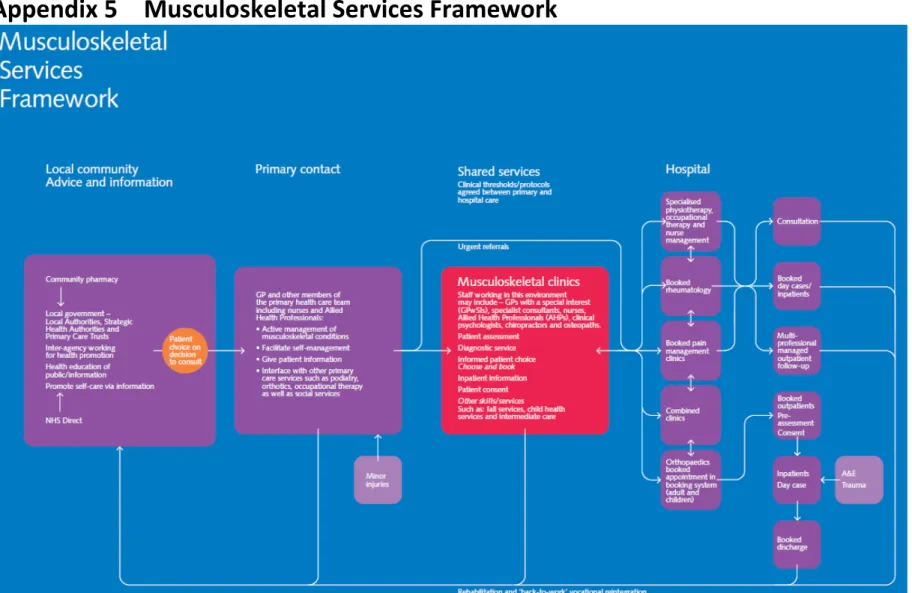
Musculoskeletal Services Framework