Building a shared internal context helps reduce "the uncertainty that each speaker has about the other's intentions, perceptions, and expectations" (Kramsch, 1986, p. 367). Taking an emic perspective implies that speech and interaction insights are made from the point of view of the participants or social actors at the moment of the interaction (Jenks, 2014). CA research on epistemic resources focuses on “the knowledge claims that interactants assert, contest, and defend in and through turns at talks and sequences of interaction” (Heritage, 2013, p. 370).
The majority of the CA studies of multilingual resources focus on language exchanges in classroom-based settings (Üstünel. & Seedhouse, 2005; Bonacina & Garafanga, 2011), i.a. The goal of the student projects is to design high school teaching units that promote Intercultural Communicative Competence (ICC). The groups mainly consist of 4-7 students, generally with one or two more students on the German side, as the class size ratio on the respective courses in this cohort was unequal.
Video data from the first online meetings show that most groups use similar strategies or stereotypical moves to create common ground, such as talking about the weather and cultural touchpoints ("I just ate shakshuka yesterday."). Other moves were more specific to the online space, such as giving their counterpart a little “tour” of the campus or sharing the view out the window. Similar task-related ESSs were evident in six of the ten initial video student meetings.
Some of which were accompanied by code switching, which resulted in the temporary exclusion of virtual counterparts.
Turn-taking
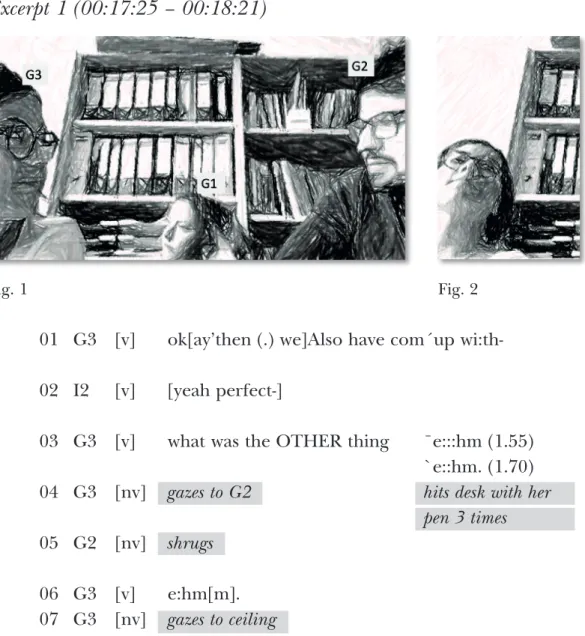
15 G1 [nv] stares at the ceiling, looks at the camera, smiles (Fig. 6) At the beginning of the transcribed excerpt, G1 takes turns contrasting the Israelis' story of military service with her experiences after finishing the school (l. 01 ). G1 becomes aware that it takes the lead in interacting with the Israeli group members (l. 03). Early in the conversation, she interrupts her utterance in the middle of a sentence (l. 03) and stares at G2.
G1 then offers the stage to the members of his group by pointing his pencil towards them (Fig. 5), which is rejected in the process of the next turn (l. 05) (cf. As a result, G1 looks back at the camera and addresses the Israelis again with an anecdote about the stereotypical pursuits of German high school graduates.From the end of excerpt 2, G1 is constantly looking back and forth between the camera and his classmates on the spot.
Constantly keeping an eye on both the screen and the needs of the local group can hamper conversational flow as shown in this example. One group (Group 6), consisting of four German and three Israeli students, stands out clearly, as one participant takes over the conversation and conducts a quasi-interview, at times interrupting the counter-questions of the others.
Multilingual resources
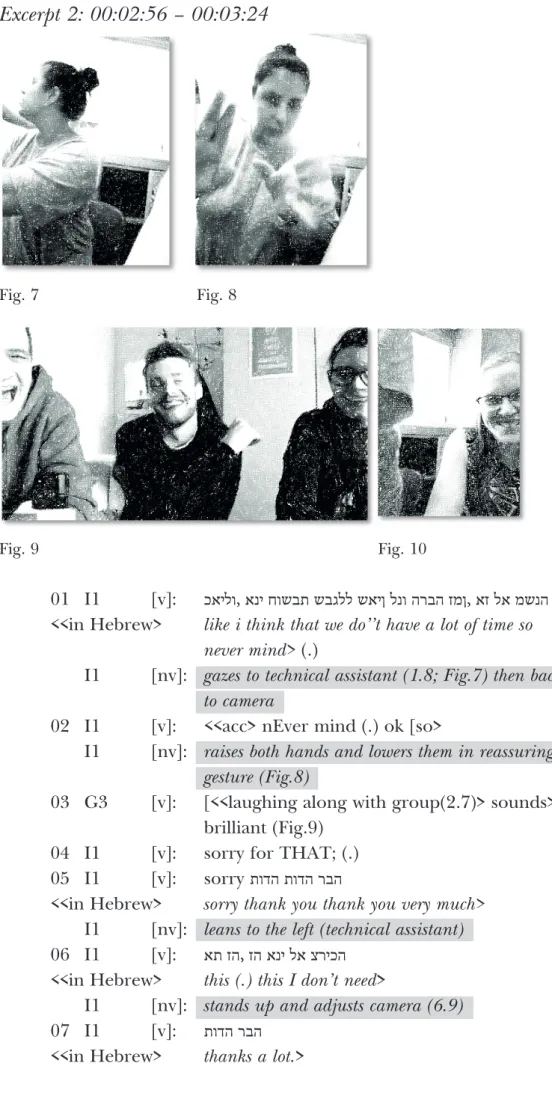
Her code-switching sequence (l. 01) is followed by two correction sequences addressed in English (l. 04) to the German group members and in Hebrew (l. 05) to the technical assistant. I1's rapid code-switching from Hebrew to English is spontaneously responded to by laughter from G1, G2 and G3 (Figure 9) and an ironic remark from G3. One of the limitations of this study became apparent to the author after data collection: although multimodal sources were considered in the transcription of the current study, it should be noted that the Zoom hand-held recordings only show the side of the current speaker.
Similar to existing research, a common observation in the analysis of telecollaborative group conversations in this study's data was epistemic search sequences (Jakonen & Morton, 2015) and word search sequences (Leyland, 2014). This occurs non-verbally by orienting their gaze towards their fellow students in the same room and in some cases is accompanied by code-switching in the L1. In terms of change, project participants had to consider not only their local chat group, but also other team members on their screens.
At the same time, there were many changing behaviors in the data that appeared to occur in both virtual and face-to-face settings. Although project participants communicated online rather than being physically present with each other, they often drew on multimodal resources, such as a turn-based pointing arrangement (Auer, 2021; Mondada, 2007), by using gaze to address their group members to online (Markaki & Mondada, 2012) or by displaying embodied conclusions (Mondada, 2015). An analysis of the student online conversation in the interaction in the ETP project showed that there was frequent code-switching in the initial meetings.
One reason for the involuntary code-switching that is specific to AF was that both sides of the participants remained in the settings of their respective institutions and switched to their L1 to interact with individuals who were on-site and did not speak in target language (eg, technical assistant). Involuntary code-switching sequences (cf. Lipski, 2016) often entail a certain disconnection of the in-group from distant virtual in-group members. As described in the existing literature, participants in this study often provided multilingual resources to perform multicultural identities and display openness (Lee, 2014).
Future studies, both in the general area of telecollaboration and in the ETP project, should focus on the further use and development of interactive resources in this virtual setting, for example by implementing comparative research designs that include face-to-face communication as a future vocational education curriculum. development can benefit from these insights. Some of the practices suggested by the participants, such as showing their surroundings via webcam or picking up words and phrases from the others' L1, had positive interaction effects and created opportunities for further conversation topics. On the other hand, processes such as code switching to their own L1, for example when problems arose, have proven to be detrimental to the participants' subsequent attrition.
Turn allocation and gaze: A multimodal revision of the “current speaker selects next” rule of the turn-taking system of conversation analysis. He has a master's degree in bilingual education and is a member of the Institute of English, Ludwigsburg University of Education, Germany.