EMPOWERMENT OF WOMEN THROUGH ENTREPRENEURSHIP DEVELOPMENT IN DHAKA CITY
SONIA NUSRIN
DEPARTMENT OF DEVELOPMENT AND POVERTY STUDIES SHER-E-BANGLA AGRICULTURAL UNIVERSITY
SHER-E-BANGLA NAGAR, DHAKA-1207
DECEMBER, 2018
………
(Prof. Dr. Md. Sekender Ali) Supervisor
Dept. of Agricultural Extension and Information System
Sher-e-Bangla Agricultural University, Dhaka -1207
EMPOWERMENT OF WOMEN THROUGH ENTREPRENEURSHIP DEVELOPMENT IN DHAKA CITY
BY
SONIA NUSRIN Reg. No.: 10-03840
A Thesis
Submitted to the Faculty of Agribusiness Management, Sher-e-Bangla Agricultural University, Dhaka,
in Partial fulfillment of the requirements for the degree of
MASTER OF SCIENCE (MS) IN
DEVELOPMENT AND POVERTY STUDIES SEMESTER: JULY-DECEMBER, 2018
A
pproved by………
(Dr. Ashoke Kumar Ghosh) Associate Professor & Chairman Dept. of Development and Poverty Studies Sher-e-Bangla Agricultural University, Dhaka -1207
……….
(Bisakha Dewan) Co-supervisor Assistant Professor
Dept. of Agribusiness and Marketing Sher-e-Bangla Agricultural University,
Dhaka -1207
………
(Prof. Dr. Md. Sekender Ali) Supervisor
Dept. of Agricultural Extension and Information System
Sher-e-Bangla Agricultural University, Dhaka -1207
‡W‡fjc‡g›U GÛ †cvfvwU© ÷vwWR wefvM
‡k‡ievsjv K…wl wek¦we`¨vjq
‡k‡ievsjv bMi, XvKv-1207, evsjv‡`k
‡Uwj‡dvb: +88-02-44814053
Dept. of Development and Poverty Studies Sher-e-Bangla Agricultural University
Sher-e-Bangla Nagar, Dhaka-1207, Bangladesh
Telephone: +88-02-44814053
CERTIFICATE
This is to certify that the thesis entitled “EMPOWERMENT OF WOMEN THROUGH ENTREPRENEURSHIP DEVELOPMENT IN DHAKA CITY”
submitted to the Department of Development and Poverty Studies, Faculty of Agribusiness Management, Sher-e-Bangla Agricultural University, Dhaka in partial fulfilment of the requirements for the degree of Master of Science (MS) in Development and Poverty Studies, embodies the result of a piece of bonafide research work carried out by SONIA NUSRIN, Registration No. 10-03840 under my supervision and guidance. No part of the thesis has been submitted for any other degree or diploma.
I further certify that any help or source of information, as has been availed of during the course of this investigation has been duly acknowledged by the Author.
Dated:
Dhaka, Bangladesh
THIS THESIS IS LOVINGLY
DEDICATED TO MY
PARENTS
i
ACKNOWLEDGEMENT
Alhamdulillah, all praises are due to the almighty Allah for His gracious kindness and infinite mercy in all the endeavours which create that opportunity for the author to successfully complete the research work required for the partial fulfilment of the degree of Master of Science.
The author would like to express her heartfelt gratitude and sincere appreciations to her Supervisor, Professor Dr. Md. Sekender Ali, Department of Agricultural Extension and Information System, Sher-e-Bangla Agricultural University, Dhaka, for his valuable guidance, advice, encouragement and support throughout the study.
Likewise grateful appreciation is conveyed to her Co-supervisor, Assistant Professor Bisakha Dewan, Department of Agribusiness and Marketing, Sher-e- Bangla Agricultural University, Dhaka, for her constant encouragement, constructive criticisms and valuable advice to complete the thesis.
The author express her sincere respect to Dr. Ashoke Kumar Ghosh, Associate Professor and Chairman, Department of Development and Poverty Studies, Sher-e- Bangla Agricultural University, Dhaka for providing valuable advice and sympathetic consideration regarding to the research.
The author is deeply indebted and grateful to her Parents and siblings who continuously prayed for her success and without their love, affection, inspiration and sacrifice this work would not have been completed.
December, 2018 The Author
ii
LIST OF CONTENTS
CHAPTER TITLE PAGE
ACKNOWLEDGEMENT i
LIST OF CONTENTS ii-iv
LIST OF TABLES v
ABBREVIATIONS vi
ABSTRACT vii
CHAPTER I INTRODUCTION 1-9
1.1 Background to the Study 1
1.2 Women in Bangladesh 2
1.3 Women Entrepreneurship in Bangladesh 2
1.4 Statement of the Research Problem 4
1.5 Research Questions 6
1.6 Objectives of the Study 6
1.7 Rationale of the Study 7
1.8 The Significance of the Study 7
1.9 The Limitation of the Study 8
CHAPTER II REVIEW OF LITERATURE 10-25
2.1 Introduction 10
2.2 Theoretical Perspectives 10
2.2.1 Who is An Entrepreneur? 10
2.2.2 The Role of Enterprises in Development 11
2.2.3 Gender and Gender Relations 12
2.2.4 Concept of Power in Relation to Gender 13
2.2.5 Intra-household Power Relations 15
2.2.6 Conceptualizing and Analyzing Women's Empowerment 17
2.3 Review of Previous Studies 18
2.3.1 Entrepreneurship and Empowerment 19
2.3.2 Women Empowerment and Microfinance 23
2.3.3 Women Empowerment in Other Sector 23
CHAPTER III METHODOLOGY 26-32
3.1 Selection of the Study Area 26
3.2 Sources of Data 26
3.3 Sampling Technique 26
3.4 Data Collecting Instruments 26
3.5 Data Collecting Procedure 27
3.6 Variables and their measurement techniques 27
3.7 Measurement of the Variables 27
3.7.1 Age 27
3.7.2 Education 28
iii
3.7.3 Family size 28
3.7.4 Annual family income 28
3.7.5 Organizational Participation 28
3.7.6 Cosmopoliteness 29
3.7.7 Training exposure 29
3.7.8 Knowledge on Family Management 29
3.7.9 Family Co-operation 29
3.7.10 Participation in household decision making process 30
3.8 Women Empowerment 30
3.9 Hypothesis of the study 31
3.9.1 Research hypothesis 31
3.9.2 Null hypothesis 31
3.10 Compilation of data 31
3.11 Statistical analysis 32
CHAPTER IV RESULTS AND DISCUSSION 33-47
4.1 Selected Characteristics of the women entrepreneurs 33
4.1.1 Age 34
4.1.2 Education 34
4.1.3 Family size 35
4.1.4 Annual family income 36
4.1.5 Organizational participation 36
4.1.6 Cosmopoliteness 37
4.1.7 Training exposure 38
4.1.8 Knowledge on family management 38
4.1.9 Family cooperation 39
4.1.10 Participation in household decision making process 40
4.2 Empowerment of rural women 40
4.3 Relationship between selected characteristics of the
respondents and their empowerment 41
4.3.1 Relationship between empowerment of women and their
annual family income 42
4.3.2 Relationships between empowerment of women and
their organizational participation 43
4.3.3 Relationship between empowerment of women and their
training exposure 44
4.3.4 Relationship between knowledge on family management
and empowerment of women 44
4.3.5 Relationship between empowerment of women and their
family co-operation 45
4.3.6 Relationship between participation in household decision making process and empowerment of rural women
46
iv
CHAPTER V SUMMARY OF FINDINGS, CONCLUSIONS AND
RECOMMENDATIONS 48-53
5.1 Summary of Findings 48
5.1.1 Characteristics of the women 48
5.1.2 Empowerment of women 49
5.1.3 Relationship between empowerment of women and their
selected characteristics 49
5.2 Conclusions 49
5.3 Recommendations 51
5.3.1 Recommendations for policy implications 51
5.3.2 Recommendation for further study 52
REFERENCES 54-59
APPENDIX-A 60-64
APPENDIX-B 65
v
LIST OF TABLES
TABLE TITLE PAGE
4.1 The salient features of the selected characteristics of the
women 33
4.2 Distribution of the women according to their age 34 4.3 Distribution of the women according to their education 35 4.4 Distribution of the respondents according to their family size 35 4.5 Distribution of the women according to their annual income 36 4.6 Distribution of the women according to their organizational
participation 37
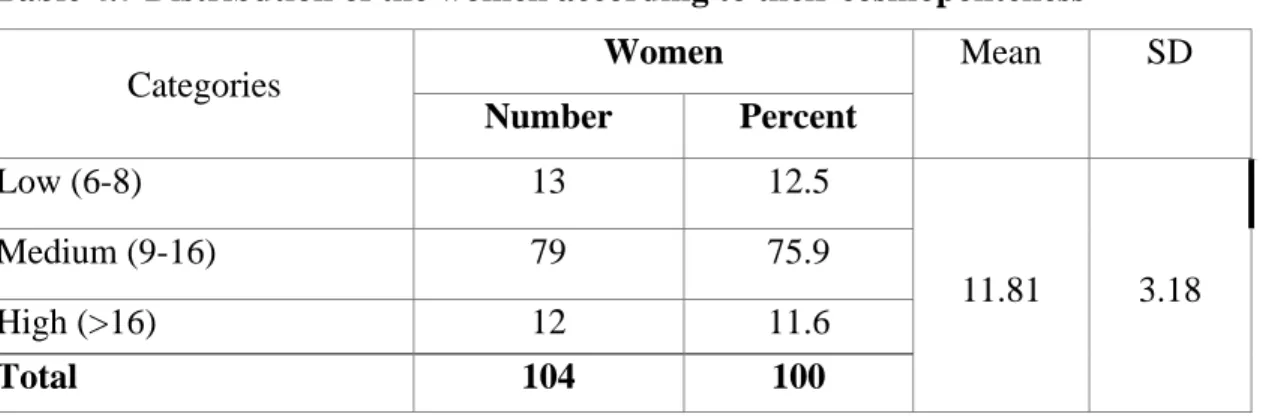
4.7 Distribution of the women according to their cosmopoliteness 37 4.8 Distribution of the respondents according to their training
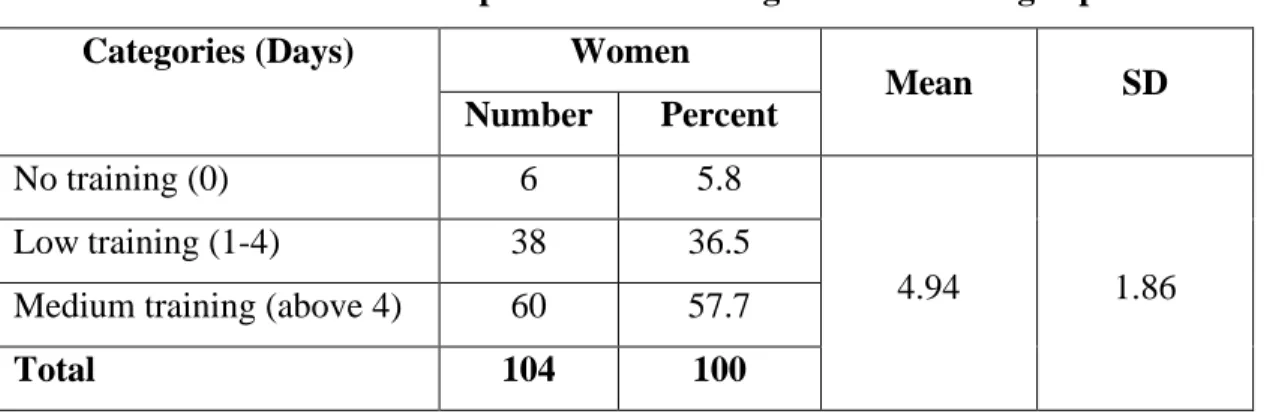
exposure 38
4.9 Distribution of the respondents according to their knowledge
on family management 39
4.10 Distribution of the respondents according to their family
cooperation 39
4.11 Distribution of the respondents according to their participation
in household decision making process 40
4.12 Distribution of the respondents according to their
empowerment 41
4.13 Co-efficient of correlation showing relationship between
selected characteristics of the women and their empowerment 42
vi
ABBREVIATIONS DAE Department of Agricultural Extension FAO Food and Agricultural Organization BBS Bangladesh Bureau of Statistics
SD Standard Deviation
SPSS Statistical Package for Social Sciences
UN United Nations
SIDA High Yielding Variety
MDG Millennium Development Goal
DFID Department for International Development
PE Psychological empowerment
OE Organizational empowerment
SME Small or Medium Enterprise
BWCCI Bangladesh Women Chamber of Commerce and Industry RWECP Rural Women Employment Creation Project
NGO Non-Governmental Organization
vii
EMPOWERMENT OF WOMEN THROUGH ENTREPRENEURSHIP DEVELOPMENT IN DHAKA CITY
ABSTRACT
Bangladesh is a developing nation rich in human resources where women constitute slightly less than half of the population. They provide an essential opportunity for economic and social development and progress. Women's participation in any kind of economic activity is of a complementary nature to their family incomes; their participation in no way reduces their family duties. Women's equal rights are now defined by women's economic empowerment and the ultimate empowerment is through entrepreneurship. The overall objective of the present study was to determine some selected characteristics of the women entrepreneurs, to determine extent of empowerment of women entrepreneurs and to explore the relationship between each of the selected characteristics of the women entrepreneur and their empowerment.
Dhaka city was selected as the study area and the data were collected from 104 women entrepreneurs classifying into three groups namely: boutique and handicrafts, foods and catering and beauty parlor of the Dhaka city by using an interview schedule. Data were collected during 25th July to 24th August, 2019. Scales were developed in order to measure the variables. Less than half (49.1 percent) of the women had lower middle empowerment while 47.1 percent had upper middle empowerment and 3.8 percent had low empowerment. Pearson Product Moment correlation was used to ascertain the relationship between each of the selected characteristics of the women to their empowerment. Among the selected characteristics annual family income, organizational participation, training exposure, knowledge on family management, family co-operation and participation in household decision making process of the women showed positive significant relationship with their empowerment. Whereas, age, education, family size and cosmopoliteness of the women had non-significant relationships with their empowerment.
SONIA NUSRIN
1 CHAPTER I INTRODUCTION
1.1 Background to the Study
Bangladesh is a developing nation rich in human resources where women constitute slightly less than half of the population. The majority of them are underprivileged, under nourished, illiterate and poor. They suffer both an unequal legal status with regard to many important rights and an inferior position with regard to cultural beliefs and practices (Huq, 2003). Moreover, there are not enough employment opportunities for women. Although lately, now the importance of the women in the economy and their necessities to take part in the economic development activities have been realized. The empowerment of women is often identified as an important aim of international development policies, and many donor agencies now include women's empowerment in their development strategies (Schuler et al., 2010). In that case women entrepreneurship development as there is lack of employment opportunity paves the quick way of economic development as well as empowerment of them. It is noticeable that entrepreneurship development and empowerment are complementary to each other. Women empowerment depends on taking part in various development activities. In other words, the involvement of women in various entrepreneurial activities has empowered them in social, economic and cultural fields. The power of and access to taking decisions has increased for women in Bangladesh, within as well as outside the family affairs (Nawaz, 2009).
Many national and international efforts are taken to facilitate the entrepreneurship development. Government and private sector interventions have generally accelerated income-generating activities of women both in the urban and rural areas with entrepreneurship development (Bhuiyan and Abdullah, 2007). According to the United Nations (UN), a women is empowered who has five components namely sense of self- worth, right to have and to determine choices, right to have access to opportunities and resources; right to have the power to control her own lives, both within and outside the home; and ability to influence the direction of social change to create a more just social and economic order, nationally and internationally. In today's competitive world, there are
2
various ways by which women get themselves empowered. The entrepreneurship of women is considered to be an effective instrument to the economic development and empowerment of women (Nachimuthu and Gunatharan, 2012).
1.2 Women in Bangladesh
Bangladesh's socio-cultural environment contains pervasive gender discrimination, so girls and women face many obstacles to their development. Girls are often considered to be financial burdens on their family, and from the time of birth, they receive less investment in their health, care and education. Women in Bangladesh are in many ways’ inferior to and dependent on men from early childhood. When the girl reaches puberty, her marriage will soon be arranged and the family will pay the husband's family a dowry to marry off their daughter to him. The girl will thereafter pursue the rules of Purdah and live under seclusion. Women that can obtain Purdah strictly show high social status. Violence against women is common in Bangladesh (SIDA, 2007, November, 5). Even if the constitution promotes equal rights to women, women still suffer from discrimination and violence that occurs in the home, at the workplace and on the society level as well (Ministry of Women and Children Affairs, 2008). The women in rural Bangladesh are hard working. Foremost, they perform heavy household work throughout the days. Women's contribution to the family income is not recognized to the same extent as men's, but they are however involved in many activities, such as post-harvest activities, farming, fuel gathering, rice husking, making and selling handicrafts, and rearing domestic animals. "A woman's work is never done", a village woman says in the study of Hartman and Boyce (1998). Although women's work is hard and time-consuming, such work does not provide them equal status to men.
A woman seldom earns money on her own, but is financially dependent on her father, then husband and thereafter her son for economic security (Hartman and Boyce, 1998).
1.3 Women Entrepreneurship in Bangladesh
It is said that entrepreneurs are persons who bring about phenomenal economic changes through their risk-taking innovativeness and constant agility. Bangladeshi women entrepreneurs need to have an extra quality in the form of dogged determination and resilience since this is greatly needed to fight with adverse situations which seem to
3
confront female entrepreneurs rather than their male counterparts in the present-day context. Women in business in Bangladesh require more efforts than men to gain a foothold as economic change agent. Sustained efforts are needed to enhance the capability of women entrepreneurs as well as to create conditions for entrepreneurship to succeed in terms of setting up and maintaining productive operations.
Women entrepreneurs constitute less than 10% of the total business entrepreneurs in Bangladesh whereas women in advanced market economies own more than 25% of all businesses (Hua Du, Asian Development Bank, 2006). It is heartening to note that despite many barriers, a new women's entrepreneur class has risen in the country taking on the challenge to work in a male-dominated, competitive and complex economic and business environment. Not only have their entrepreneurship improved their living conditions and earned more respect in the family and the society, but they are also contributing to business and export growth, supplies, employment generation, productivity and skills development of Bangladesh. It is said that economic development is closely related to the advancement of women.
Although the Constitution of Bangladesh guarantees all citizens equal rights, in reality, the society is highly stratified and services are rendered on the basis of class, gender location, etc., which often results in disparities. They are not given proper opportunity for expansion.
The educated women have already engaged in micro and small businesses, as well as export-oriented enterprises are receiving comparatively less attention. As a result, they are unable to expand their operations due to lack of technological support and expertise, fund constraints, marketing techniques, and detachment from the international business arena, especially in the context of today's globalization and rapidly growing business world.
If adequate support can be provided, these women entrepreneurs would be able to generate employment and render training to women of rural and slum areas also. All these can help them to step into new ventures of their own. In order to actively pursue the advancement of women, it is required to empower, upgrade and uplift the women entrepreneurs in both rural and urban sectors. In new ventures, modern technology can be greatly helpful in
4
facing the competitive challenge of the age. Since technology is a strategic variable in the modem business paradigm, women empowerment with technology will give rise to economic advancement.
1.4 Statement of the Research Problem
Based on the biological (sex) differences every society imposes certain rules, regulations, responsibilities, and rights of men and women based on sex. But most of these rules and regulations are discriminatory. This discriminatory behavior creates difference between men and women, which eventually gives a lower status to women in terms of men socially, culturally, religiously, economically and legally (Haque et al., 2011). From the establishment of United Nation's Charter in 1945 and the declaration of universal human rights in 1948, the rights and recognition of women came into focus for the first time. Since then it was the issue how to reduce the distress of the women around the globe specially the women of the third world countries. But then the preliminary focus was only the reproductive role of the women like access to food, contraceptives, health care.
Women were seen as mother & wife. Formulating an appropriate intervention for transforming the status of women both within and outside their homes has been one of the major preoccupations of development practitioners, at least since the mid-1970s. A number of strategies have been formulated over time, for example, raising women's status through education, training, access to health and family planning services as well as access to legal counseling. Politically, attempts have been made to raise the proportion of female participants in representative organs. Economically, the most popular strategy, especially since the 1990s, has been the involvement and participation of women in microfinance programs to assist micro and small enterprise owners (Malhotra, Schuler & Boender, 2002). Despite the above development efforts to address the situation of women by transforming social and gender relations, women have been left behind in the development process and are still subordinate to men. It is not well understood why this is so (Jahan, 1995). For example, despite the widely held assumption that women's micro and small enterprises would lead to transformation of their disadvantaged position in households and in society in general, some gender experts, argue that, because work in the informal sector
5
tends to use domestic skills that are undervalued and invisible, it is the least likely to transform gender relations and may even reinforce gender stratification. Although it is general thinking that economic solvency of women will help improve the situation of the women, it is also true that the long lasting social thoughts, cultural values that is deeply rooted on the mind of the people always keep them thinking that the male are the superior, even in the mind of the female counterparts freely accept them.
Unfortunately, the Bangladeshi women are strongly guided by the social, cultural, religious prejudices which are constraining them to break out the existing miserable situations. The first attempt to make realize the Bengali Muslim women about their rights was made by the great personality of the Bangladesh who is known as the pioneer of female awaking.
She persuaded and convinced Muslim women to be educated, to come out of all adverse social prejudices through her bold and progressive writings. But it is a matter of regret that standing on the twenty first century women of the country still are dominated by male in a variety of ways.
In her study on entry and performance barriers in female entrepreneurship in Tanzania, Rutashobya (1997) found that critical constraints experienced by female entrepreneurs include multiple roles due to the gender division of labor, unequal access to resources such as credit due to gender prejudices, lack of skills due to gender stereotypes and biased curricula and, lastly, lack of self-confidence and ability to take risks due to early inculcation of a dependence mindset.
However, there are many studies on constraints faced by women entrepreneurs in micro and small enterprises in Bangladesh (Nawaz, F. 2009) studies on women's entrepreneurship development and empowerment are almost non-existent. Moreover, women's entrepreneurship has been recognized during the last decade as an important untapped source of economic growth. Women entrepreneurs create new jobs for themselves and others and by being different also provide society with different solutions to management, organization and business problems as well as to the exploitation of entrepreneurial opportunities. However, they still represent a minority of all entrepreneurs. Thus there
6
exists a market failure discriminating against women's possibility to become entrepreneurs and their possibility to become successful entrepreneurs.
This market failure needs to be addressed by policy makers so that the economic potential of this group can be fully utilized. In this regard, while many women are coming forward and taking entrepreneurship as their occupation, the full outcome of such initiatives is not widely known. Wide knowledge of the same would be very useful for future. It is therefore pertinent to explore the impact of Women Entrepreneurship Development on women's empowerment in order to widen our experience and narrow the knowledge gap in the area.
1.5 Research Questions
The major research question for the study was:
To what extent have entrepreneurship supported women been empowered?
The following secondary research questions were formulated in order to get data for answering the major research question:
✓ What were the extent of the selected characteristics of the women entrepreneurs?
✓ What are the extent of empowerment of the women entrepreneurs?
✓ What is the extent of relationship of each of the selected characteristics of the women entrepreneurs with their empowerment?
1.6 Objectives of the Study
The overall objective of the study is to assess the women's economic contribution and their participation for enhancing the empowerment in livelihood activities. The specific objectives of the study are as follows:
i. To determine some selected characteristics of the women entrepreneurs;
ii. To determine extent of empowerment of womenentrepreneurs;
iii. To explore the relationship between each of the selected characteristics of the women entrepreneur with their empowerment.
7 1.7 Rationale of the Study
Bangladesh is one of the democratic and liberal countries in South East Asia, in terms of, awareness and religious tolerance. The gender issue in the business sector in Bangladesh is important for the purpose of ensuring women's participation in development process in a comparative perspective. This has relevance to the need for promoting an inclusive growth process, the benefits of which can reach the women population in particular. For a resource poor country like Bangladesh, entrepreneurship is the only appropriate way of development, and where almost fifty percent of the population is the women there is need not to say to what extant women entrepreneurship is important for development of the country, added that women endow less property right here compared to men. There are some very important specific reasons for undertaking the present study.
Firstly women empowerment is the third goal of the Millennium Development Goal (MDG) and also a top priority issue of the Government of the Bangladesh. It is important for mainstreaming in the economics, politics and all spheres of the life. It is imperative that to be empowered economic freedom is obviously the prime concern and entrepreneurship is the best way of it. The second reason is that studies and academic papers on women's empowerment are scanty, geographically unevenly distributed and skewed focus-wise as well as institutionally narrow. Most of them have been on the impact of micro-credit or credit-based microenterprises on women's empowerment.
1.8 The Significance of the Study
Women, women, women are not only the backbone of the family, not only the backbone of the community; they are, indeed, the backbone of the nation. If you are serious about development, then you must be serious about working with women ... that's the bottom line: development is about women. Women are the key to development (U.S. ambassador to Bangladesh Dan Mozena, 2012). This said development can only be possible when all kinds of discrimination towards women are reduced because it brings some multidimensional effects along with.
8
✓ Firstly, gender inequality in education and access to resources may prevent a reduction of child mortality, of fertility, and an expansion of education of the next generation. To the extent that these linkages exist, gender bias in education may thus generate instrumental problems for development policy-makers as it compromises progress in other important development goals.
✓ Secondly, it may be the case that gender inequality reduces economic growth. This is an important issue to the extent that economic growth furthers the improvement in well-being or at least enables the improvement in well-being. That economic growth, on average, furthers wellbeing measured through indicators such as longevity, literacy, and reduced poverty has been demonstrated many times, although not all types of growth do so to the same extent.
So the present study which main concern is empowerment through economic involvement of the women bears utmost importance from all points of view.
1.9 The Limitation of the Study
Since the study is an empirical one based on field-work through the interviews of women entrepreneurs of Dhaka city, Bangladesh, it has some obvious limitations. These are as follows:
✓ Data collection through primary source or through interview was a time consuming matter. The respondents sometimes were found non-cooperative with the interviewers. Present study covered women entrepreneurs of Dhaka city. A large number of women entrepreneurs outside Dhaka were out of the purview of the present study. This may not reflect the total picture of Bangladesh relating to women entrepreneurs.
✓ Gathering information from some of the women entrepreneurs was sometimes very difficult and extremely time-consuming. They did not give enough time to the interviewers.
9
✓ Further, it was also found that women entrepreneurs have a tendency to disclose lower income and higher expenses. They think that this would help them to get more credit.
This is considered to be a limitation to the research study. Contacting women entrepreneurs to gather information was a very difficult task. In view of time and resource constraints, conducting a comprehensive study in full depth and width has not been possible.
10 CHAITER II
REVIEW OF LITERATIJRE
2.1 Introduction
The main purpose of this chapter is to review the past research works that are pertinent of this study. Firstly, the chapter focuses on theoretical perspectives under which major concepts are defined and discussed. These include entrepreneurs and entrepreneurship development, the role of enterprises in development as well as gender and gender relations.
Secondly the practical evidences of some related studies are presented. It focuses on findings from previous studies with regard to income earning for women and intra- household relations, entrepreneurship development and women's empowerment. Finally, the chapter summary is presented.
2.2 Theoretical Perspectives
Before further going the study needs an unambiguous concept from the theoretical perspectives, because it will be helpful in clear understanding of the study.
2.2.1 Who is an Entrepreneur?
The concept of entrepreneurs has been variously defined but all the definition mostly discuss some common types of traits such as in some definition the activities carried out by whom are entrepreneurs, risk taking or capital investing by whom are entrepreneurs, or certain psychological characteristics possessed by whom are entrepreneurs. So, an entrepreneur is an individual who takes moderate risks and brings innovation. According to J.B. Say, 'Entrepreneur is an economic agent who unites all the means of production'.
The entrepreneur is the person who creates a new business in the face of risk and uncertainty for the purpose of achieving profit and growth by identifying opportunities and assembling the necessary resources to capitalize on them. According to Khanka (2002) an entrepreneur can be defined as a person who tries to create something new, organizes production and undertakes risks and handles economic uncertainty involved in enterprise.
So finally, the women who took the initiative of starting enterprises, who shouldered all
11
the risks as well as financial, administrative and social responsibilities as owner-managers fully in charge of their businesses are the women entrepreneurs.
2.2.2 The Role of Enterprises in Development
Focusing on and supporting enterprises can be justified as they have the potential to generate output, employment and income as well as being central to innovation (Kantor, 2000). More specifically, enterprises can have vital development functions in the developing countries like Bangladesh.
According to Levitsky (1993) these development functions include: Helping employment generation by using more labor in relation to capital invested; Operating in such areas with limited markets and poor infrastructure; Staring up with very limited resources; Providing practical training facilities for people with varying levels of education in both management and technical skills; Supplying both low-cost items for the poor and, in certain circumstances, high- cost quality products for the rich and for export; and
Helping to contribute equitable distribution of income when translated into reality, it will be found that the economic functions of enterprises support an increasingly large proportion of the population in the country. But there is a special challenge that is to ensure sustained entrepreneurship development among women entrepreneurs. The role of women in enterprise development is justified for at least three reasons. Firstly, a large number of women can get involved in the entrepreneurial activities
The second reason is the welfare and improvement of the women along with the society.
The third reason is that enterprises contribute to women's social and economic empowerment. It is increasingly becoming more apparent that self-employment and entrepreneurship contribute to women's self-esteem and confidence. While appreciating these three reasons, it is also important to consider the subject from a gender perspective.
12
This means that it should always be remembered that women have different needs from those of men because of the particular roles and responsibilities assigned to them by society.
2.2.3 Gender and Gender Relations
The concept of gender refers to "the socially acquired notions of masculinity and femininity" (Young, 2002). It focuses more on social and economic relations between women and men rather than on biological differences. It came about almost three decades ago, in the late 1970s, as feminist scholars worked at conceptualizing the social construction of masculinity and feminist (Mbilinyi, 1992).
The concept of gender examines the relations between women and men with the purpose of increasing our understanding of their status and inequalities, roles and capacity. As a social construct, gender coincides with other differentiation axes like age, ethnic group, race, class, urban-rural location and global location to characterize women's life situations and parameters (Pearson, 1992). From this perspective, the problem of women and development is essentially a problem of gender and power relations. It is therefore multidimensional as well.
Interactions between women and men, as well as what is considered appropriate behavior or activity for women and men, constitute the essence of gender relations. In other words, gender relations are "the socially constructed form of relations between men and women"
(Young, 2002). Gender relations are socially constructed and reconstructed because of the behavior of women and men (Mbilinyi, 1992). It is in this understanding that Mbilinyi (1992) points out that, gender relations are socially constructed and reconstructed because of the behavior of women and men. In this regard, while biological characteristics of girls and boys, women and men cannot be changed; gender relations can be transformed and changed through changes in the history of society. They are constituted in terms of the relations of power and dominance that determine the life chances of women and men, girls and boys.
13
Generally, in all patriarchal societies, gender relations are discriminatory against women.
This is illustrated by relations like division of labor, decision making, access to and control over resources, freedom to use time and freedom of movement. In all these relations, men have the upper hand compared with women. This is due to the fact that gender relations embody ideas, values and identities; allocate labor between different tasks, activities and domains; determine the distribution of resources and, more important, gender relations assign authority, agency and decision-making power (Kabeer, 2003).
2.2.4 Concept of Power in Relation to Gender
According to Lukes (Kabeer, 1994), there are three different interpretations of power, namely the power to, the power over and the power within. To begin with the power to, it is posited that this interpretation is associated with liberal forms of analysis and it is concerned with decision making on issues over which there is an observable conflict. It defines power as "the capacity of an actor to affect the pattern of outcomes against the wishes of other actors".
The Department for International Development (1997) characterizes this type of power relation as "increased individual capacity for change and increased opportunities for access".
It is roughly equivalent to "welfare" and "access" in the women's empowerment framework developed by Longwe and addresses practical needs. It is also argued that this interpretation of power underpins many women in development literature. Kabeer (1994) argues that, this interpretation cannot capture aspects that are outside observable decision making processes. With regard to the power over interpretation of power, it is seen as "the ability of some actors to initiate, decide and veto decisions but also their ability to confine decision making to safe issues". Given this aspect, conflict cannot be observed because it has not been allowed to come out into the open in the decision-making process.
Accordingly, Bachrach and Baratz (Kabeer, 1994) argue that when this interpretation of power is institutionalized, "if demarcates decisional from non-decision able issues and systematically and routinely benefits certain individuals and groups at the expense of
14
others". If there are areas that seem to be non-negotiable in household rules and practices, it is because of this interpretation of power. The power over aspect of power is also characterized as "changes in underlying resource and power constraints of household, community level and macro level and individual power/action to challenge these constraints" (DFID, 1997). It covers some aspects of control in the women's empowerment framework by Longwe and addresses strategic needs.
The power within type of power relation refers to individual conscientisation. It is self- generated and it is acknowledged that conflicts of interest may be suppressed both from the decision-making agenda and from the consciousness of the parties involved. This aspect of power "is concerned with the socially structured and culturally patterned behavior of groups and practices of institutions". (Kabeer, 1994). It is argued that this interpretation of power helps to shape whose interests will prevail as well as the perception of interests by different actors. DFID (1997) characterizes this type of power relation as increased awareness and desire for change by individual woman. It roughly corresponds to awareness raising in the women's empowerment framework by Longwe. DFID (1997) identifies another type of power relation called power with. This aspect of power is characterized as increased solidarity/joint action with other women in challenging underlying power and resource constraints at household, community and macro level. It includes participation in the women's empowerment framework by Longwe.
The above discussion shows that power is multidimensional in nature. Given the above typology of power relations, it is suggested that strategies for women's empowerment must build on a feminist analysis of power namely the power within as a necessary adjunct to improving their ability to control resources, to determine choices/agendas and make decision (Kabeer, 1994). This is because it is only the power within that is capable of enabling individuals to struggle against the internalized elements of subordination (Kabeer, 2003).
15 2.2.5 Intra-household Power Relations
Explanations of intra-household power relations are based on economic and sociological perspectives (Shklar, 1990). The economic perspective has two conceptualizations. The first is the neo-classical conceptualization as expounded by Becker (Kabeer, 1997).
According to this one it is posited that there is "an altruistic consensus within the household" and conflict is not a factor in household relations or households are headed by benevolent dictators who ensure that altruistic decision-making outcomes are reached. In such households, an inequality in the distribution of resources is explained on productivity grounds rather than power considerations. In this vein, increases in women's wages might result in increases in their share of household resources but not their decision-making power.
The second conceptualization is based on the unequal bargains model. In this conceptualization, Sen's cooperative conflict model (Kabeer, 1997) posits that three factors, namely, perceived economic contribution, relative levels of wellbeing in case of breakdown in cooperation and perceived interest response, determine a household member's bargaining power. This model suggests that, other things being equal, the higher these factors, the stronger the bargaining power. In this regard, household members' bargaining power depends on their breakdown and fallback positions. This implies that Sen's cooperative conflict model negates the positive association between power and altruism postulated in the model by Becker (Kabeer, 1997). In the same vein,
Young (2002) asserts that the persistence of inequality at the family has been due to the prevalence of intra-household relations characterized by cooperative conflict. On the other hand, there are three strands of sociological literature on household relations.
The first strand by Bhachu; Bhatty; Blood and Wolfe (Kabeer, 1997) posits that the cooperative resourcefulness of household members is a key factor in intra-household relations. It is argued that waged work enables women to establish a power base both within and outside the household. The second strand puts emphasis on the rigidity of roles, norms
16
and practices that mediate the relationship between earnings within the household. In this regard, PahI (Kabeer, 1997) defines control over income as making the policy decisions on allocation of intra-household resources; access as availability of additional resources; and management as implementation of policy decisions.
The last strand in the sociological literature by Allen & Wolkowitz; Beneria & Roldan;
Whitehead (Kabeer, 1997) focuses on labor processes through which women earn income thereby giving them more decision-making power within the household.
Whitehead (Kabeer, 1997) points out that women can retain the proceeds of their labor in certain circumstances, namely when production is independent of the male household and when it is done outside the familial sphere of command and control. She points out also that the control over and disposal of both spouses' earnings is influenced by their roles and responsibilities as defined by familial ideologies. In this respect, women tend to be more selfless. Kandiyoti (Kabeer, 1997) corroborates this analysis by arguing that women's self- sacrifice is a reflection of strategic considerations in the longer term given the dominance of patriarchy.
Therefore, sociologists consider conflict as a factor in household decision making. Guyer (Kaihula, 1995) characterizes households as sites where the various aspects of gender relations find expression through the relationship between wife and husband, parents and children. They are also sites of gender struggle and negotiation where trade-offs are negotiated in response to the many pressures that derive from internal changes in domestic style and from external changes in which the household is located.
With reference to developing countries, Pearson (1992) points out that, households are far from units in which all resources and benefits are pooled equitably. Accordingly, the use of resources and labor, and the distribution of income and output have constantly to be negotiated, and intra-household relations are often conflictive. In other words, households are not homogenous units but complex arenas of negotiation, conflicts of interest, and sometimes uncompromised decisions. In summary then, both economic and sociological
17
analyses of the household are divided between those which focus on power as resource- based and those which emphasize bargaining and negotiation based on ideology and interests of different household members (Kabeer, 1997). For the purpose of this study, the sociological perspective and Sen.’s cooperative conflict model were adopted.
2.2.6 Conceptualizing and Analyzing Women's Empowerment
Rappaport (1987) defined empowerment as "a process by which people, organizations, and communities gain mastery over issues of concern to them". Kabeer (2001) stated that women's empowerment is an expansion in the range of potential choices available to women so that actual outcomes reflect the particular set of choices which women value.
Zimmerman (1995) presented three areas in the lives of human beings in which empowerment occurs: I) Psychological empowerment (PE) refers to empowerment at the individual level of analysis, 2) Organizational empowerment (OE) refers to improved organizational effectiveness by effectively competing for resources, networking with other organizations, or expanding its influence (i.e., empowered organization) and 3) At the community level of analysis empowerment refers to individuals working together in an organized fashion to improve their collective lives and linkages among community organizations and agencies that help maintain that quality of life. He further expounded on his theory by distinguishing between empowering processes and empowered outcomes. He defined empowering processes as those "where people create or are given opportunities to control their own destiny and influence the decisions that affect their lives".
Shefner-Rogers, Nagesh, Rogers, & Wayangankar (1998) described empowerment as "a communication process designed to change an individual's behavior through communication relationships with others". They based their arguments on the work of Freire (1973), who emphasized that "empowerment occurs through a communication process in which the relationships between the oppressed and the oppressor undergo a fundamental change". Several researchers have identified self-confidence and self-esteem as essential 'first steps' to empowerment (Anderson, 1996). Feelings of greater individual
18
control are another important aspect of psychological empowerment (Anderson, 1996;
Kishor & Gupta, 2004).
Stine and Karma (2003) explained that empowerment is the gain of power to control their lives and the ability to make strategic life choices.
Varghese (2011) further identified income, education, employment, media exposure and acquisition of assets, knowledge of legal rights, political rights and land ownership etc. as parameters to judge the empowerment of women.
Kabeer (2001), whose definition is the most widely accepted, defines empowerment as "the expansion of people's ability to make strategic life choices in a context where this ability was previously denied to them".
Bennett (2002) described empowerment as "the enhancement of assets and capabilities of diverse individuals and groups to engage, influence and hold accountable the institutions which affect them."
Keller and Mbwewe (1991) described women empowerment as "a process whereby women become able to organize themselves to increase their own self-reliance, to assert their independent right to make choices and to control resources which will assist in challenging and eliminating their own subordination". The core of the meaning of women empowerment lies in the ability of a woman to control her own destiny. Almost all definitions of women empowerment include some reference to an expansion of choice and freedom to make decisions and take the actions necessary to shape life-outcomes (Malhotra and Schuler 2005).
2.3 Review of Previous Studies
There are some studies conducted by some scholars on the stated topic which will help to put light on the fact of women empowerment and entrepreneurship development.
19 2.3.1 Entrepreneurship and Empowerment
Upadhye and Madan (2012) conducted a study on 'Entrepreneurship and Women Empowerment: Evidence from Pune City' and showed that women from the lower strata of the society though educated, are unable to find employment in urban India. It is entrepreneurship that paves the path of development of these women in particular and society in general. The study concludes that there is a marked change in the personality, the economic and the social status of these women who take entrepreneurship as their occupation.
Parvin et al. (2012) have studied that women who involved in various micro, small and medium enterprises take on the challenge to work in a male-dominated society, competitive and complex economic and business environment with the government policy supports and financial institutions participation became able to improve their living conditions and earned more respect in the family and the society.
Sathiabama (2010) has found in her study that Entrepreneurship development among rural women helped to enhance their personal capabilities and increase decision-making status in the family and society as a whole.
Das (2012) has shown in her study that a nation can only be developed if its women are given ample opportunities. Developing entrepreneurship among the women is the right approach for women empowerment. Once a woman feels that she is economically strong she will feel equal to men in all respect.
Nachimuthu and Gunatharan (2012) have conducted a study on 'Empowering Women through Entrepreneurship: A study in Tamil Nadu, India' and argued that economic status, self-worth, self-confidence and social status of women entrepreneurs are the variables that define empowerment of women. They concluded that entrepreneurship of women has enhanced their economic status and decision making power. Women entrepreneurs are aware of opportunities available to them, but there is scope for improvement in it.
20
Ademokun and Ajayi (2012) conducted a study on 'Entrepreneurship Development, Business Ownership and Women Empowerment in Nigeria' that showed that the need for independence is the major reason women start a business. Furthermore, the study showed that entrepreneurship plays an important role in economic empowerment of the perceived disadvantaged segment of the population of which women form a larger part in the Nigerian context.
Sultana (2012) conducted a study on 'Promoting Women's Entrepreneurship through SME:
Growth and Development in the context of Bangladesh'. Her study focused on role of SME to promoting women entrepreneurs. It also explores the social perspective of women entrepreneurs as well as the impact of these entrepreneurs on the economic development of Bangladesh. She showed that women's entrepreneurship of Bangladesh is growing at accelerate rate and their contribution to socio-economic development is significant. It is observed that 62.5% of the respondents took the SME loan to establish and run their business smoothly. This study found some problems facing by women's entrepreneur of Bangladesh.
Nawaz (2010) carried out a case study on the 'Nexus between Women Entrepreneurship Development and Empowerment: Bangladesh Context' and in her case study she tried to document a strong relationship between women entrepreneurship and empowerment. She found that being entrepreneurs, women are capable to take their own decisions liberally. It has been found that women are trying to free themselves from male dominance. The women entrepreneurs have the capability to take different decisions. Being entrepreneurs, the women concerned have become aware of the ownership of property and other assets.
She concluded that positive changes have taken place in women's attitudes and perceptions of their own role after their involvement in different entrepreneurial activities. In other words, participation in different entrepreneurial activities has empowered women in the social, economic and cultural fields.
21
Drine and Grach (2010) argued that females starting new businesses are often motivated by goals of personal and professional accomplishments; the factors most often cited are the desire for greater challenge, and the need for better flexibility in the work environment.
Afrmn, Islam and Ahmed (2008) aimed at identifying the factors related to the development of entrepreneurship among the women borrowers through micro credit programs. Using a multivariate analysis, they showed that financial management skills and the group identity of the women borrowers have significant relationship with the development of rural women entrepreneurship in Bangladesh.
Huda (2009) examine that women entrepreneur of Bangladeshi engaging both formal and informal sector of economy and have growing interest of them to extend their business commercially. Most recently, Bangladesh Women Chamber of Commerce and Industry (BWCCI) 2008 made an extensive analysis as a case study on women entrepreneurs in Bangladesh, which was the country's first trade body working exclusively for women economic and social empowerment.
Parvin et al. (2004) carried out a study on 'Women Empowerment Performance of Income Generating Activities Supported by Rural Women Employment Creation Project (RWECP): A Case Study in Dumuna Thana, Bangladesh'. In their case study, they found that irrespective of type, all economic activities supported by RWECP have induced positive impact in women empowerment, though the extent of changes is not significantly high. The activities have enabled women to have a better access to basic needs and make important contribution to household decision making, especially the decision regarding their personal needs and availing treatment and recreational facilities. It is also found that, husbands of most of these women possess full control over income and sole right of decision making.
Saleh (1999) found inadequate cash flows, marketing deficits and discriminating treatment from supportive service agencies to create obstacles to women entrepreneurship development in Bangladesh.
22
Huntley (1985) used a case study approach named 'Women entrepreneurs and career choice' to explore the life events and experiences that had influenced women to choose entrepreneurship as a career alternative. Most ventured into entrepreneurship because of a desire to be independent and to be in control of their lives.
Dolinski et al. (1993) studied the growth in women entrepreneurship over the past two decades in their book on, "The effects of education on business ownership: a longitudinal study on women," Entrepreneurship: Theory and Practice.
Hisrich and Fuldop (1993) found in a study of 50 women entrepreneurs in Hungary that women entrepreneurs played an emerging diverse role in terms of enterprise creation in Hungary.
According to Rathore and Chhabra, (1991) Indian women found it increasingly difficult to adjust themselves to the dual role that they have to play as traditional housewives and to compete with men in the field of business and industry.
Surti and Sarupriya (1983) investigated the psychological factors affecting women entrepreneurs in India. Results indicated that unmarried women experienced less stress and less self-role distance than married women.
Mohiuddin (1983) found that women became entrepreneurs due to their economic needs, as a challenge to satisfy some of their personality needs.
Sextan and Kent (1982) compared 45 women executives with 48 women entrepreneurs and found that women entrepreneurs were better educated, placed a slightly higher emphasis on their job than on their family.
Furthermore, dissatisfaction or limits on their earnings and advancement (Familoni, 2007), job dissatisfaction and retrenchment as well as social networking (Gadar et al., 2009), need to improve quality of life (Cooper, 1983), desire to earn more income (Stoner and Fry,
23
1982), growth and innovation (Carland et al., 1984), desire for independence, risk-taking propensity (Brockhaus, 1980), education, freedom, job flexibility and previous experience (Mansor, 2005) have been identified as motivating factors for women entrepreneur.
Other researchers (D'Souza et al., 2000; Kitching & Woldie, 2004) indicated that the emergence of female entrepreneurs in a society depends to a great extent on the challenges they encounter towards entrepreneurial development. These challenges are often underpinned by the economic, cultural and religious environment.
These traits and behaviors come into conflict with gender expectations that women should be humble and modest amid the priority given to their roles as wives and mothers, that they should take a lesser role in business or income earning activities (Zakaria, 2001).
2.3.2 Women Empowerment and Microfinance
Lakshmi and Vadivalagan (2011) conducted a study on 'Impact of Self Help Groups on Empowerment of Women: A Study in Dharmapuri District, Tamilnadu' and found that the participation of women in Self Help Groups (SHGs) made a significant impact on their empowerment both in social and economic aspects. The results of their study revealed that the SHGs have had greater impact on both economic and social aspects of the beneficiaries.
Kabeer (2005) in a study apparently concludes that while access to financial services can and does make important contributions to the economic productivity and social wellbeing of poor women and their households, it does not "automatically" empower women – any more than do education, political quotas, access to waged work or any of the other interventions.
2.3.3 Women Empowerment in Other Sector
Hossain and Jaim (2014) have conducted a study on 'Empowering Women to Become Farmer Entrepreneurs: Case Study of an NGO-supported Programme in Bangladesh' and they assessed the effectiveness of the project in encouraging women to become farm
24
managers and to be economically and socially empowered. They found that the substantial engagement in economic activities has made women feel socially empowered.
Haque et al. (2011) have conducted a study on 'Women Empowerment or Autonomy: A Comparative View in Bangladesh Context'. This study attempts to measure and distinguish women empowerment and autonomy from each other by constructing indices in three specific dimensions namely economic decision making, household decision making, and physical movement in Bangladesh context. The level of women autonomy decreases with the increase of education whereas education increases the level of women empowerment but not smoothly. Women's current age, place of residence, education, religion, media exposure etc. are the important factors affecting women empowerment and their autonomy.
Schuler et al. (2010) have conducted a study on "Women's empowerment revisited: a case study from Bangladesh". This article explores the changing dimensions of women's empowerment over time in three Bangladesh. The article discusses theoretical issues related to the measurement of women's empowerment, and describes findings from a recent study in the villages exploring the current salience of indicators developed for a 1992 survey. In the article the types of social, economic, and political change that affect the measurement of women's empowerment are discussed; a new set of indicators for the rural Bangladesh setting is proposed and explained; and implications for measuring women's empowerment in other settings also discussed.
Parveen and Leonhauser (2004) conducted a study on Empowerment of Rural Women in Bangladesh: A Household Level Analysis and their study concluded that education, training and exposure to information media have the potential to increase women's empowerment. Therefore, effective initiatives undertaken by the concerned agencies in improving women's education, skill acquisition training and access to information could enhance women's empowerment in order to achieve gender equality and development at all levels in the rural society of Bangladesh.
25
Maihotra and Boender (2002) conducted a study on 'Measuring Women's Empowerment as a Variable in International Development', Social Development Group, World Bank. This study was conceptualized considering basically three important dimensions of women's empowerment. These dimensions are dynamic, interlinked and mutually reinforcing at household level and recognize the fact that the level of gender equality and development are directly proportional. These dimensions are as follows:
Socio-economic dimension: It includes economic contribution (both from farm and non- farm) to household welfare, access to socio-economic resources and ownership of productive and non-productive assets. This will increase women's earning capacity, bargaining power, control over resources, and role in household economic decision- making, meeting the basic needs and altogether improving self-reliance, thereby reducing women's economic subordination.
Familial dimension: It includes participation in household decisions covering six major dimensions. The increased role in household decision-making would enable them to improve their self-determination, bargaining power, control over resources, self-esteem, autonomy, status and power relations within households.
That means the increased role of women in household decision-making will lead to their own well-being and that of their children.
Psychological dimension: It includes perception on gender awareness with regard to basic rights of women and coping capacity to different household shocks. It will enhance self- confidence, bargaining power, freedom of choices and coping abilities within the households.
26 CHAPTER III METHODOLOGY
A research work should be very careful in formulating methods and procedures.
Methodology gives clear direction to a researcher about his works and activities during the whole period of the study. Appropriate procedure for collecting data should be taken by the researcher to collect valid and reliable information. Method of analysis should be appropriate to arrive at correct conclusion. Various methods, tools and techniques were used during different stages of this research work and compilation of data. The purpose of this chapter is to describe the setting, methods and procedures used in conducting this study.
3.1 Selection of the Study Area
Dhaka city was selected as the study area because most of the successful women entrepreneurs can be found in this city.
3.2 Sources of Data
The study is analytical based on collection of data from primary sources. Primary data were collected from well-structured questionnaire.
3.3 Sampling Technique
Collecting data from each and every element of the population is time consuming and expensive. So, a sample size of 104 was determined primarily consisting 34 from Boutique and handicrafts entrepreneurs, 35 from the food business entrepreneurs and last 35 from the parlor entrepreneurs. Accidental sampling was done for this data collection.
3.4 Data Collecting Instruments
In order to collect valid and reliable data from the respondent women entrepreneurs an interview schedule (questionnaire) was designed keeping the objectives in mind. The English version of interview schedule has been enclosed in appendix-A. Simple and direct
27
questions and different scales was used to obtain information. Both open and closed form questions was designed to obtain information.
The interview schedule was pre-tested with 15 sample respondents from the study area.
Questions were asked systematically and explanations was made whenever it was necessary. The respondents were interviewed at their leisure time by using local language to the extent possible so that they can give accurate information in a cool brain.
3.5 Data Collecting Procedure
Data were collected through personal interviewing by the researcher herself. All possible efforts were made to establish rapport with the respondent so that they could feel easy and comfort to response the questions in the schedule. Necessary steps were taken to explain the purpose of the study to the respondents and their answers were recorded sincerely. If any respondent felt difficulty in understanding any question, care was taken to help her getting understood. The researcher did not face any serious problem in data collection. The data collection took 30 days from 25th July to 24th August, 2019. The collected data were complied, tabulated and analyzed. Qualitative data were converted into quantitative form by means of suitable scoring whenever needed.
3.6 Variables and their measurement techniques
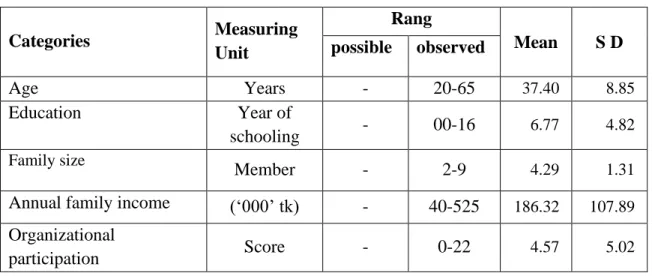
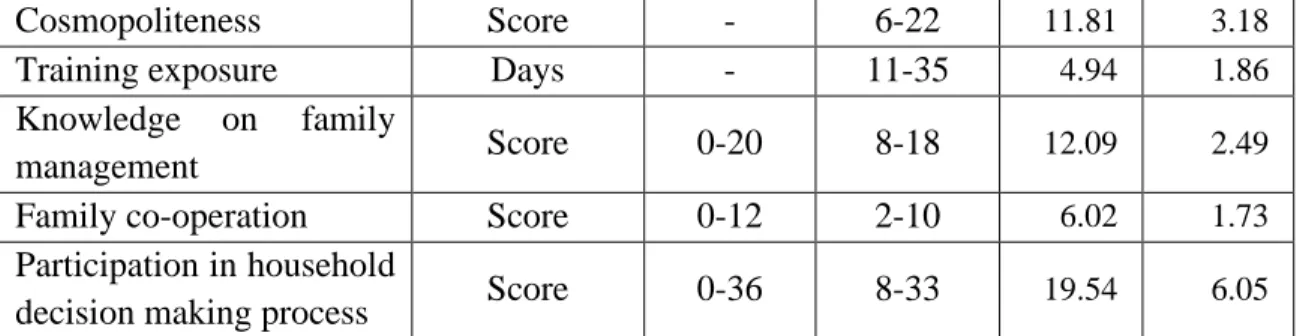
According to the relevance of the research area, 10 characteristics of the women entrepreneurs like age, education, family size, annual family income, organizational participation, cosmopoliteness, training exposure, knowledge on family management, family cooperation and participation in household decision making process were the causal variables of the study. On the other hand, women empowerment was the focus variable.
The following sections contain the procedures of measurement of the variables of the study.
3.7 Measurement of the Variables 3.7.1 Age
The age of a respondent woman was measured by counting the actual years from her birth to the time of interview on the basis of her statement. It was measured in terms of actual