In this dissertation report, I will investigate the determinants of dividend policy in registered banks in Bangladesh. In the following chapters, I will first give a brief overview of dividend policy and the factors that influence it. The study on the determinants of dividend policy of listed commercial banks in Bangladesh has one main objective to accomplish as well as some complementary objectives to explore as well.
Main objective: The main objective of the study of the paper is to examine the determinants of the factors of the dividend policy of the listed commercial banks in Bangladesh. This will provide a more comprehensive understanding of the dividend policy and its implications for the banking sector in Bangladesh. The purpose of the study is to examine the factors influencing the dividend policy of banks listed on the Dhaka Stock Exchange (DSE).
The study is expected to make a number of contributions to the literature on dividend policy. First, it will provide new insights into the factors influencing dividend policy in the context of the Bangladeshi banking sector. Second, the study will help to fill a gap in the literature on the impact of government policies on dividend policy.
This research will provide an overview of the factors influencing dividend policy in the banking industry.
Background of the Report
All these regulations are intended to ensure that Bangladesh's banks remain financially healthy and continue to provide the services their customers need. The aim behind this research work is to investigate the dividend determinants of Bangladeshi banking sector. It will delve into the historical trends of dividend payments by banks in Bangladesh and discuss its implications for the banking sector.
In addition, it will examine the impact of the regulatory environment on bank dividend payouts in Bangladesh. The research will analyze the relevant literature on the determinants of dividends in banking and conduct a detailed empirical analysis of bank dividend payouts in Bangladesh. The empirical analysis will use panel data from multiple sources including Bangladesh Bank, Central Banking Authority, DSE market and brokers in Bangladesh to analyze the dividend policy of banks in the country.
The outcome of this study is to give us insight into the dividend policy of banks in Bangladesh and its implications for the banking sector and the economy as a whole. The findings can also be used by policy makers to develop appropriate strategies for managing dividend policy of banks in Bangladesh.
Previous Studies on Dividend Policy in Bangladesh Banking Industry
2009) conducted a study on private commercial banks in Bangladesh and their dividend policy, they took ten private commercial banks listed on DSE. The study found that only five of the eight variables could adequately explain dividend policy. The authors of the paper wanted to know what the dividend policy of UK-based companies is.
The aim of the study is to critically analyze the dividend policy of companies listed on the London Stock Exchange in the United Kingdom, including organizational dividend policy theories, justifications for and against dividends and other factors influencing dividend policy. In addition, the study examines how the dividend rate is influenced by liquidity, leverage, profitability, etc. be influenced. At the end of the study, they discovered that those factors positively affect the dividend rate for UK-based companies, while liquidity and growth negatively affect the payout ratio for the company's dividend.
The current study examines the relationship between the dividend payout ratio and profitability, investment opportunities, company risk and ownership concentration. Except for business risk, the study's findings do not support a substantial significance for these drivers in the dividend policy of Bangladeshi banks. 2014) in his study the excess stock market returns are empirically estimated for each of the 30 banks listed on the DSE from 2007 to 2011. An attempt is made to examine the relationship between two things, one of which is dividend policy and another is the stock market returns of these banks.
2018 in his research, the author focuses on the many perspectives that specialists in financial understanding have on companies' dividend behavior. 2018) in his study outlines the dividend decision elements that are considered before deciding on a payout policy. In the next phase, a dividend selection is primarily based on the dividend payout pattern from the previous year.
The authors take dividend payouts as a representative form of dividend policy for non-financial firms in the Bangladesh region. This means – when ownership is public, it can create a significant and positive impact on dividend payouts. Impact on company value. 2012) created a paper showing the relationship and impact of dividend policy on increasing farm value.
Data
Data Source
Population
Sample
Method
Variable Specifications
Dependant variable
Independent Variable
Hypothesis
Analysis & Findings
- The Graphical Framework
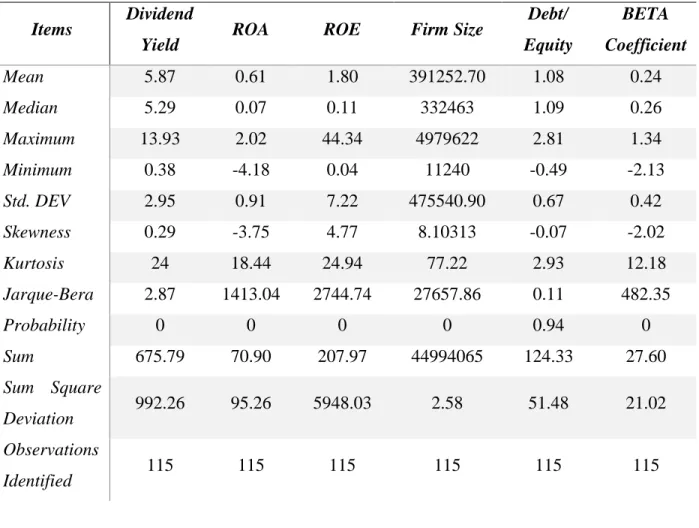
- Descriptive Statistics
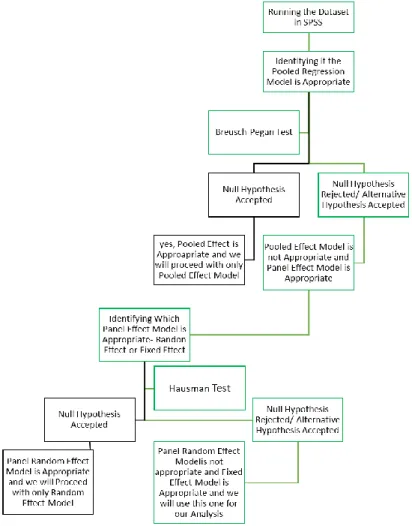
- The Selection of Panel Regression Model
- Breusch-Pegan Test
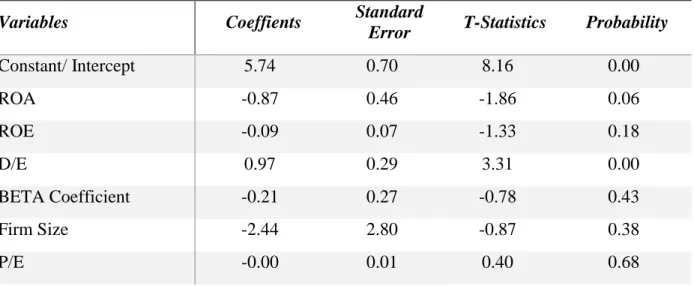
- Random Effect Regression Model
- Housman Test
- The Fixed Effect Regression Model
- Decision
- Conclusion
- RECOMMENDATIONS
The Pooled Regression (PR) Model is a good statistical model that has a constant number of coefficients. Null hypothesis is pooled Regression model is found to be appropriate Alternative hypothesis is panel regression model is found to be appropriate. As for the Random Effects Regression Model (REM), I will use this panel data regression model.
The random effects model is used when there is heterogeneity between individuals in the population and when the time-invariant individual effects cannot be explained by the available independent variables. The random cross section effect shows a considerable amount of variation in the intercepts across different cross sections of the panel data, with an SD of 2.31161 and a good correlation of 0.8486. H0= Null hypothesis is random effect regression model is Fit HA= Alternative hypothesis is Fixed effect regression model is Fit.
I have implemented a panel data regression model for the analysis, which takes into account variation within each individual entity over time. This fixed effect is not captured by variables that are independent in the model. The FE model is particularly useful when time-invariant characteristics of the entities in the panel may have a significant effect on the outcome variable.
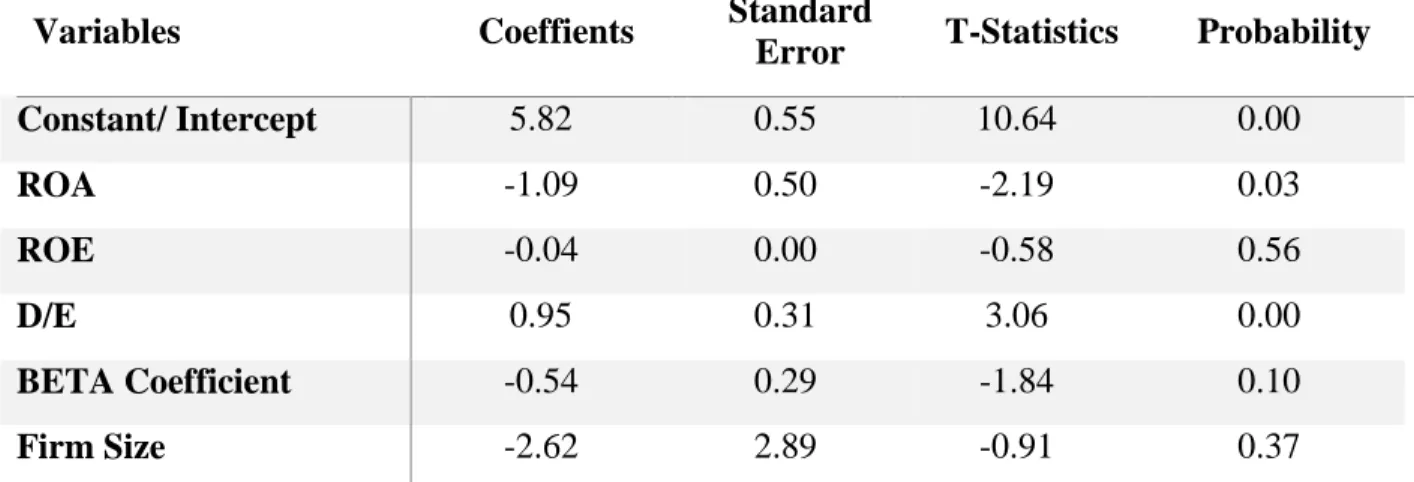
After running the fixed-effect regression model on our data set, the following response is obtained. Similarly, I expect the dividend yield to increase by 0.952489 units for every one unit increase in the debt-to-equity ratio, holding all other variables constant. In addition to Durbin-Watson, the Akaike and Schwarz information criteria and the Hannan-Quinn criterion provide additional information on model fit and indicate that this fixed-effects regression model is an appropriate choice to analyze the relationship between independent variables and yield of the dividend.
The fact that the results obtained from the analysis part are significant suggests that there is a good correlation between changes in the free-moving variables and changes in the dependent variable. This means that there is a relationship between any changes in the return on assets and any changes in the dividend yield. There is also a correlation between any changes in debt to equity and any changes in the dividend yield.
The low R-squared value indicates that there are other unseen or external factors that affect the dividend yield, but these factors are not included in the model. The effect specification provides important information about the variance components of the random effects in the model.