The title of the thesis was 'Investigation into strength and deformation characteristics of cement and lime treated soft clay'. The title of his thesis was 'Investigation into strength and deformation characteristics of cement and lime treated soft clay'.
INTRODUCTION 1.1 General Background
LITERATURE REVIEW
I Stress-strain behavior of untreated and cement-treated clays Anomalous stress-axial stain relationships of untreated clays Effect of wc/c ratio on deviator Stress-axial strain relationships Effects of hardening and clay type on anomalous stress-strain relationships Effect of water mixing on Deviator stress - Axial strain relations 227 5.8. I .5 Effect of pre-shear on deviator stress-axial strain relationships Normalized deviator stress-axial strain relationships 228 5.8.2 Volumetric strain characteristic of untreated and cement-treated clays 228.
CONSLUSIONS AND RECOMMENDATIONS
Cc and C for lime-treated clays are found to be greater than those of cement-treated clays. Values of k for lime-treated clays are found to be higher than those of cement-treated clays.
INTRODUCTION
Organization of the Thesis
At the end of the chapter, concluding remarks are also presented as a way of determining the current state of the art in evaluating the physico-chemical and microstructural behavior of treated clays at high water content and their integration with the observed engineering behavior. Conclusions and main findings related to the main areas of this study are summarized in Chapter 7.

General
Deep Mixing
- Previous History
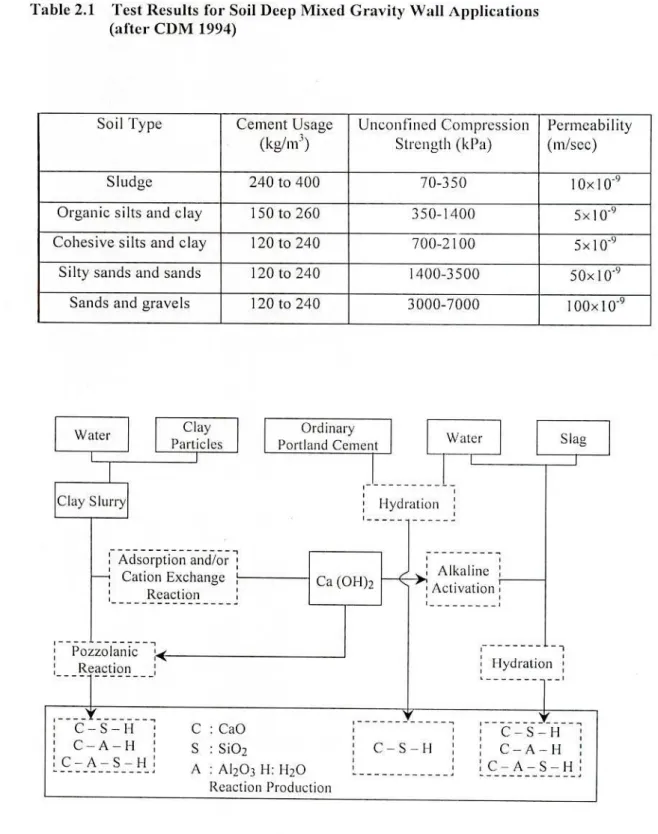
In (Double liquid stream piping, an all coniprescd casing, (I 0-I 5 bar pressure) is l)uillPecl to surround the sludge stream thereby increasing the penetrating abi lit of the stream. I : I and I .5: I (by weight) the amount of cement, again by weight, is usually 5-I 5% of the soil weight of the soil to be treated.
Fundamental Concepts of Cement Stabilization .1 Mechanism of Soit-Ceineiit Stabilization
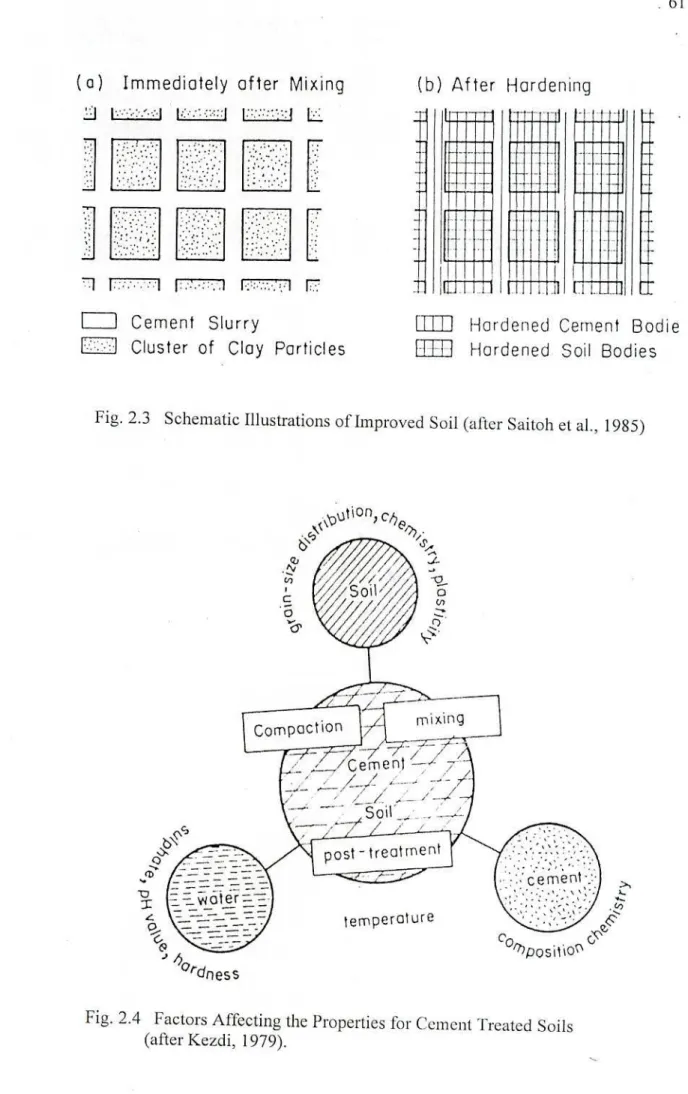
- Schematic Illustrations of Clay-Cement Interact iOns 811(1 IIfll)rOvcd Soil
- lype of Admixtures and Amount of Cement
- Curing Time
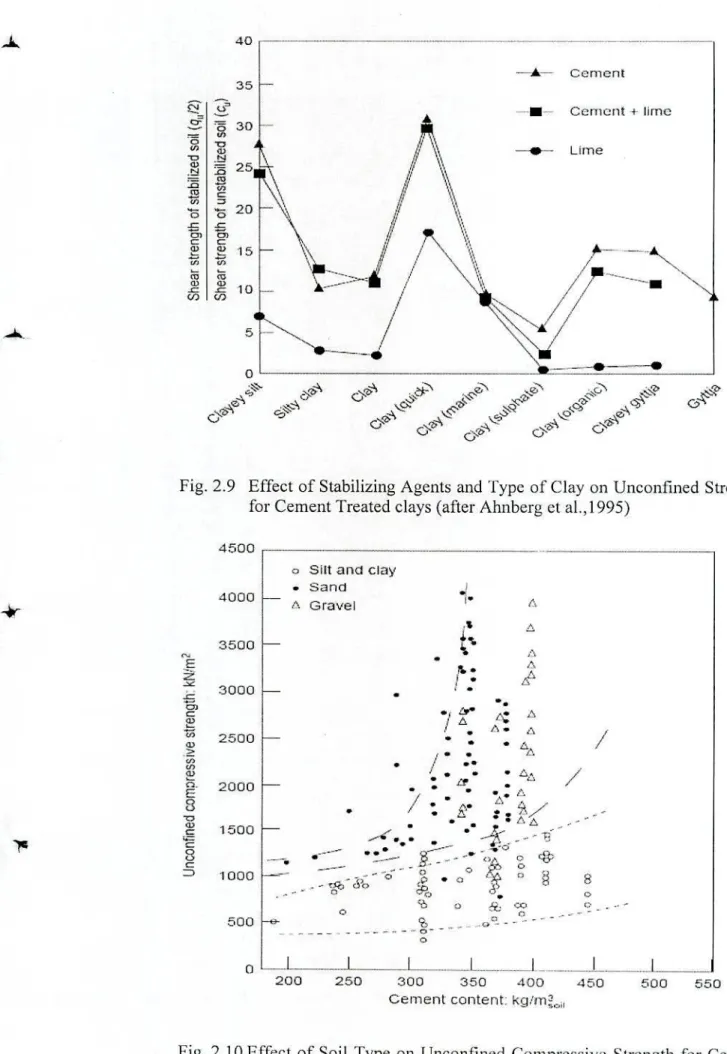
- Soil Type
- Soil Minerals
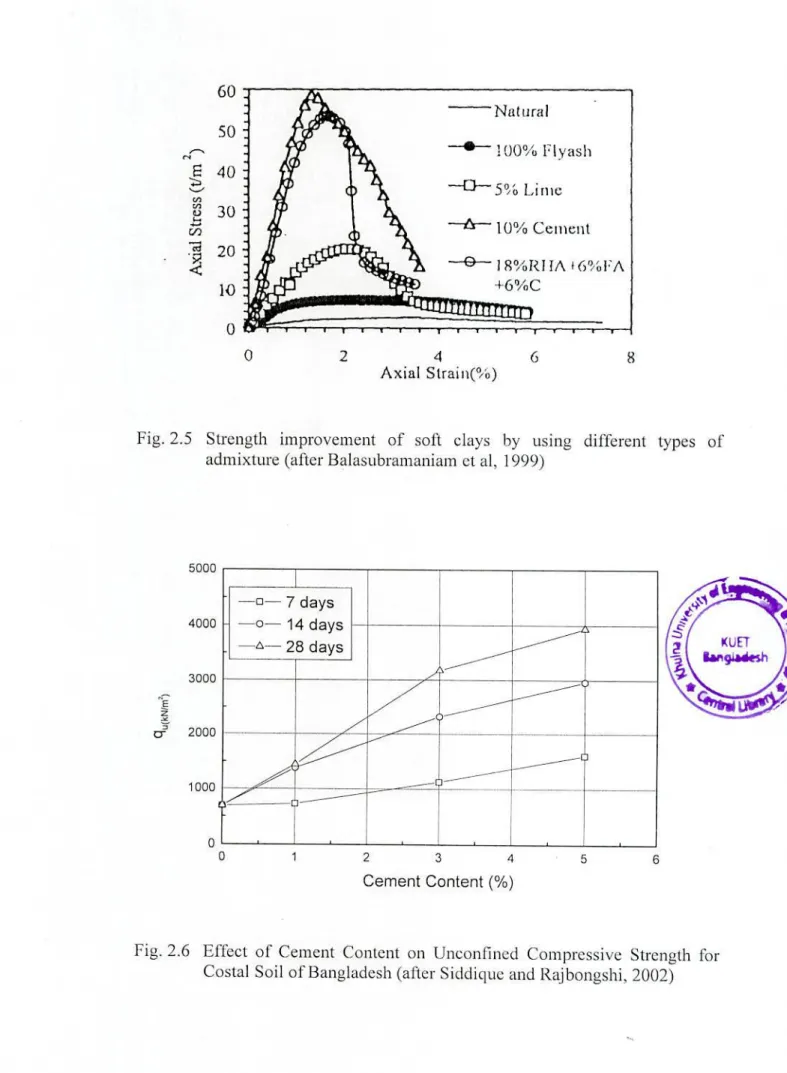
Ahmed (1984) and I lossain (1986) found that compared to the untreated soil, the independent compressive strength of the cement treated specimens increased significantly depending on the cement content and curing age. It was well established that the strength of the cement-treated clay increases with the increase of the curing time (Kawasaki et al., 1981, Nagaraj et al.
Fundamental Concepts of Lime Stabilization .1 Iy)CS and Pi'opei'tics of Limes
- Pozzolanic Reaction
- Curing 'I'iinc
- lype of soil
Serajuddin (1992) reported that the results of three types of lime treated soil from the South West region of l3ngladesh. For Kaulinite clay, the increase in strength begins with the addition of the first amount of lime.
Modification of Chemical Properties of Treated Clays .1 1)11 Value
- Electrical Conductivity
- Specific Gravity
- Degree of Saturation
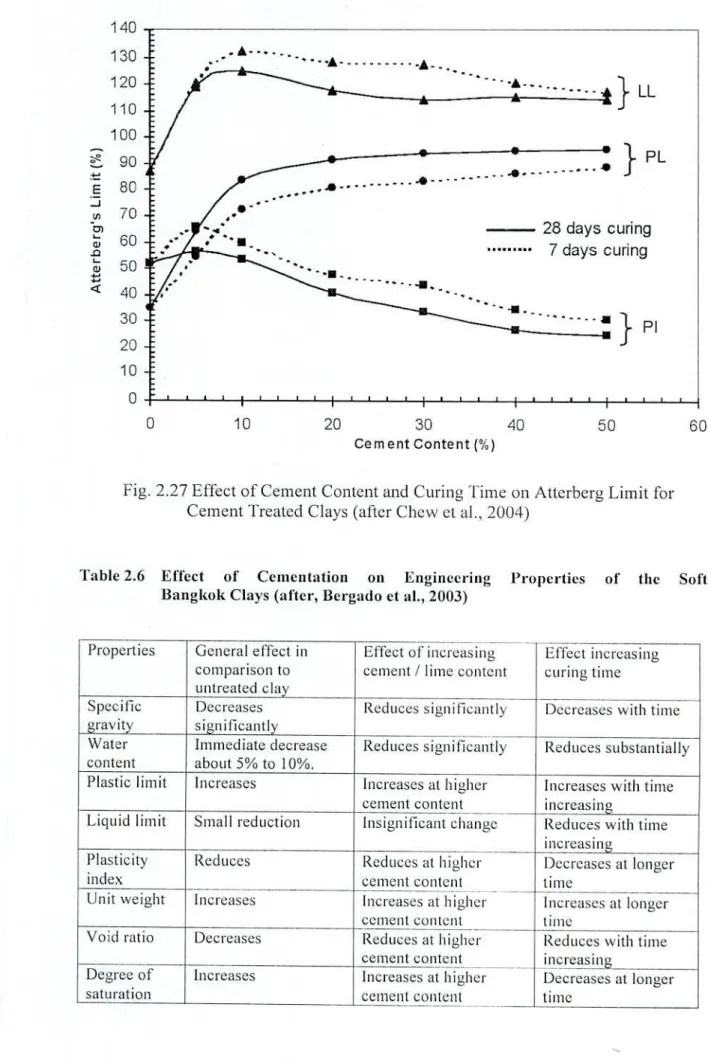
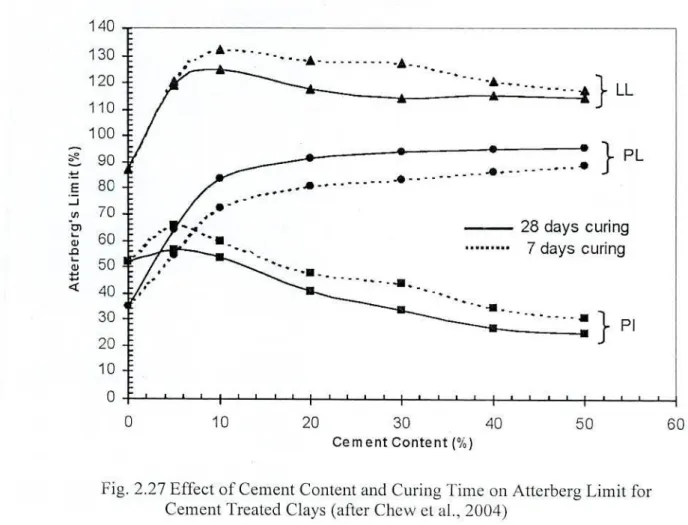
In general, the liquid limit and plastic limit of soil generally increase with increasing values, while the plasticity index decreases with increasing cement content. 2003) found that, for treated clays, the plasticity limit of the soil increases with increasing cement content, while the plasticity index decreases. 2004) reported that the rates of increase in liquid and plasticity limits with respect to cement content are almost the same at low cement content, as shown in Figure 2.
Modifications of Engineering Properties due to Cheiiiical Stabilization
- Compressibility Characteristics
- Coefficient of Consolidation
- Permeability Characteristics .1 Permeability and Vertical Stress
- Permeability and Void Ratio
- Deviator Stress-Strain Relationship from CILJ i'est
- P)re Pressure Characteristics
- Failure Envelopes Characteristics
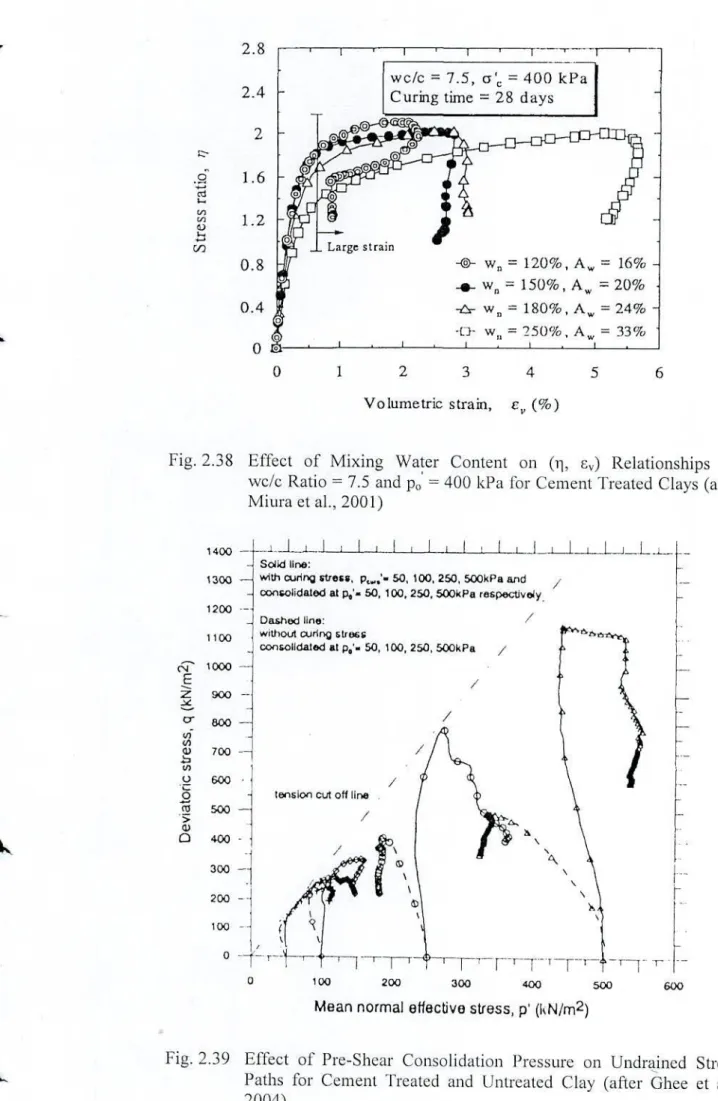
- Stress Ratio and Voitiinetric Strain
- Effective Stress Paths Characteristics
- Shear Stress, Vertical and llorii.ontal I)isplaceiiient Characteristics
- Strength 1)evelopment Index
- Normalized Strength
- Flexural Strength
- Stiffness Characteristics
- interrelationship among Strength, Curing Time and we/c Ratio
- Direct Shear and Unconfined Compression Tests Results Relationship
- Cam Clay Model
- Modified Cani Clay (MCC) Model
- The Critical State
- Strain Hardening
- PLastic Potential Function
- Yield Locus and Flow Rule
- Prediction and Comparison Results by Developed MCC Mo(lel
The normal it)' rule is app! cd such that the equation of the yield locus is Atkinson and Bransby (1978) stated that the critical condition occurs at a certain ratio of the mean effective stress p' and the shear or deflection stress q. Equation (2.45) is called the yield function, where p is the pre-consolidation effective cell pressure of the soil.
For stress states within the yield function, the stress-strain response of the soil is assumed to be elastic. In the EMMCC model, the tensile strength is assumed to decrease with the accumulation of the absolute value of the plastic volumetric strain. In the E3MMCC model, the increase in consolidation strength due to cementation is assumed to decrease as the absolute value of the plastic volumetric strain increases.
Cap Model
- Yield Caps
- Prediction and Comparison of Results by Cap Model
It was observed that the predicted initial shear stiffness and initial pore pressure are higher for cemented soil using MMCC model compared to the prediction of the MCC model. The fixed yield surface (Fig 2.60), which can be considered as an ultimate yield surface, is expressed as. In the initial Cap model, the solid surface was assumed to consist of an initial portion of the Drucker-Prager envelope smoothly connected to the subsequent von Mises surface (Fig. 2.59).
The fixed and movable yield surfaces are assumed to intersect in such a way that the tangents to the yield surfaces at the intersection are parallel to the J-axis. As a result, with the associated plasticity, the increment of plastic deformation vector is parallel to the -axis, meaning no volume change once the solid surface is reached. This corresponds to the concept of critical state, where the material does not change in volume at the critical state.
41Iiiu
IJ Cluster of Cloy Particles
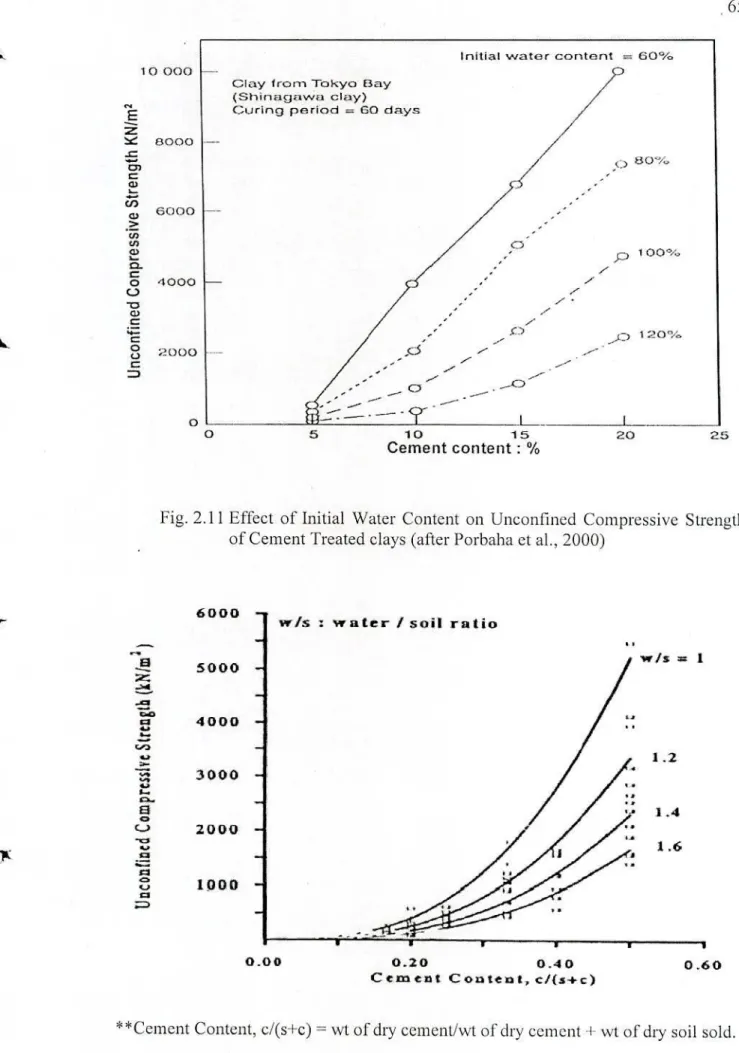
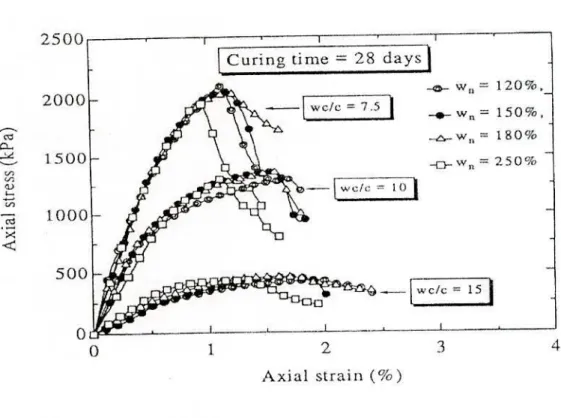
11 Effect of initial water content on unlined compressive strength of cement-treated clays (after Porbaha ci. al., 2000). Cementitious products (CSI-1 I CASI-I) versus cement content relationship of cement-treated clays at 120% and curing = 28 days (after Chew et al., 2004).
General properties eiThci in Growth effect Growth effect compared to cement / lime content setting time untreated clay .. l)erks over time Specific E)creases.
V 7% Cement
Axial Strain (%
LABORATORY INVESTIGATIONS, EQUIPMENT AN!) INSTRUMENTATION
General
Geology and Sub-Soil Conditions of the Project Sites
The North-Eastern Region or Sunm Valley : The whole of Sylhct Division and the North-Eastern part of Mymensingh Division. Central and Eastern Regions: Dhaka division, south-eastern part of Mymensingh, Tangail, Gazipur and western part of Comilla districts. Subsoil conditions in Gazipur district consist of inter-stream and older alluvial deposits contain yellowish-grey or gray to reddish-grey, light ycl low-grey/brown, orange, light to brick-red and greyish-white soft to medium sti ft / St 11 clay, silty clay, silt from existing ground level to approx. 13 m depth and approx. from 13 to IS m depth contains yellowish brown loose sandy silt and then approx. from IS to 30 m depth contains brown medium dense to dense fine to medium sand.
Subsurface conditions in the Gopalgonj district consist of streams and intercalated deposits containing light to yellowish gray. Subsoil conditions in Khulna district consist of tidal and deltaic deposits contain light to greenish gray, yellow gray, gray, blue gray, yellow gray soft to medium silt clay, silt clay, silt with occasional organic soil layers of existing g1 '01.111(1 level to about 15 iii. 41 depth and approximately from 15 to 30 iii depth contains gray med urn dense to dense line to medium.
Properties of So1't Base Clays Used
Adinixlures Used
- lyl)e of Cement Used
- Adniix(ure Content
- P11 Test
- Loss on Ignition Test
- Organic Content Test
- Exchangeable Cations Test
- Microst met tire Test and Test Program me
- U iteonlined Compression 'l'esl .1 Testing Progra in me
- l)irect Shear 'lest .1 Testing 1'rogram me
- Test Appa rat us and Accessories
- Loading 1)evice
- Consolidated Drained Triaxial Compression Test
- Isotropic Compression Test
- End of Testing ol'triaxial Test
- Calculation of Stress
In this regard. the total number of lime-treated samples is counted as eighteen. To prevent disruption of the microstructure of the soil. the Nil itche II, 1 drying method was used to dry the soil sample before SI analysis. A 11cr sample diiiieilsi011s was 01. nieasum'ed. it was placed in a . split fermer which allowed time cutting of the sample to the correct height by cutting at both ends or the spec imien, 1'or tile. Calculation of the weight of the unit. the trimmed specimen was weighed without the SI)! It.
For it had the sequence al)phicd. the corresponding hoop loads were calculated in accordance with the known rocker arm rat iO. and taking into account the weight of load in the rig cap and the top porous rock on the samples. A standard cutting box for testing apparatus (63.5 mm in diameter x 25.11 mm in height) manufactured by SO!. The cutting box was SI)l it in two halves, therefore it is known as the cutting box. The cell pressure (ie consolidation pressure plus back pressure) was gradually raised to the desired value (with the back pressure line closed) and the counter weight provided by the hanger weight.
Stream deposits: Streambed, meandering bolt, floodplain and low-lying terrace deposits, undivided including some swamp deposits. I Midstream deposits: Silt, sand and gravel deposits with a slightly higher attitude than adjacent floodplain and low-lying terrace deposits. Tidal deposits: Tidal delta deposits and deltaic floodplain deposits. . - l)eltaic deposits: Deltaic floodplain deposits.
Tidal and delta deposits are separated mainly on the basis of difference in land use, vegetation and drainage pattern. Sedimentary rocks: Grayish yellow, medium-grained and cross-bedded sandstones, gray sandstone, gray shale and limestone, up to 10,000 ft thick. Sedimentary Rocks: Yellowish-brown, medium- to coarse-grained sandstone and mottled clay and sandy clay up to 5,000 ft thick.

Summary of the Test Variables Used
KIM-
Summary of X-ray Diffraction Test
Summary of Microstructure Test
CHAPTER 4
ChEMICAL, MiNERALOGICAL AND PFIYS1CAL PROPERTIES OF CEMENT TREATED CLAYS
General
Chemical Properties of Untreated Base and Cement 'treated Clays
- Soil 1)11 Value
- Organic Content
- Electrical Conductivity
- Exchangeable Cations
- Summary for Effect of Cement Treatment on Chemical Properties
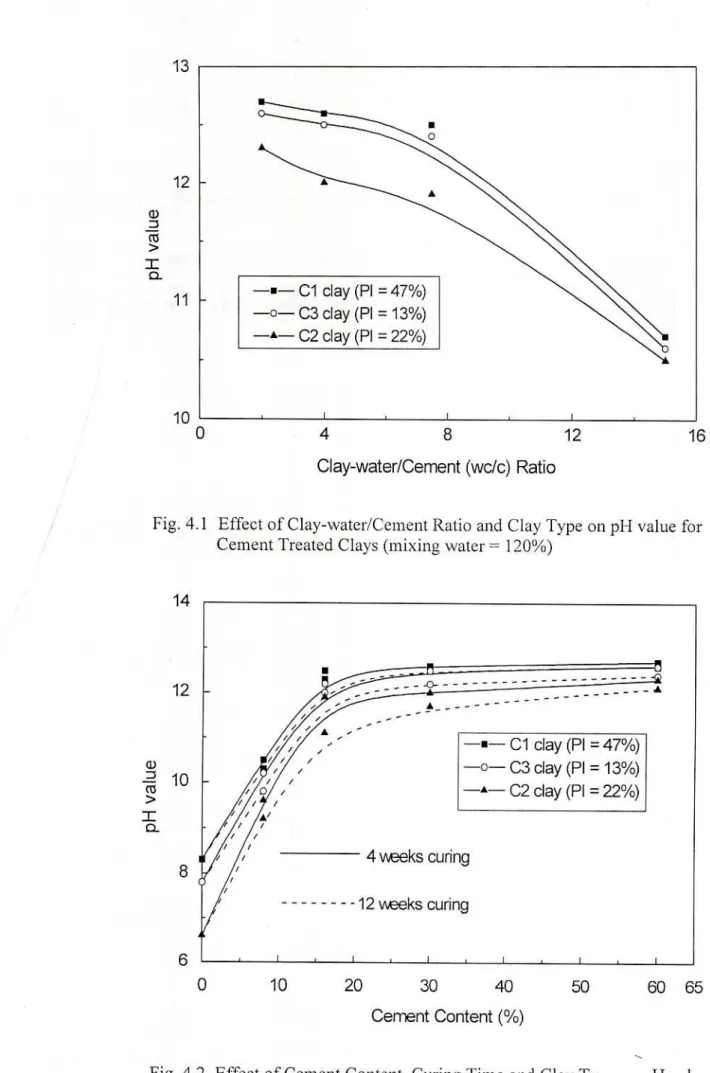
The comparisons of the variation for the p1-I value with the clay-water/cement ratio are shown in figure. The increase in p1-i with an increase in cement content is indicative of displacement of the Ca2 ion concentration on the clay surface, leading to changes in the stability of the cement-treated clay (i.e. the formation of a flocculated clay-cement matrix ). The effect of cement content, setting time and clay type on the loss of glow values of the treated clays is shown in Fig.
The organic content of treated and untreated clays was determined by wet oxidation methods. The exchangeable cations of untreated basic clays and cement-treated clays are summarized in Table 4. The increase in 'pt-I with an increase in cement content is due to the accumulation of cation concentration on the surface of the clay, leading to changes in the fabric of cement-treated clay (ie, the formation of a flocculated clay-cement matrix).
Mineralogical Properties of Untreated Base and Cciiieni Treated Clays
As Table 4.4 shows, kaolinite appears to have disappeared in all eight of the cement-treated soil samples. 1 7), the flocculated nature of the structure becomes most apparent, with clay particle clusters interrupted by large openings. As the curing time increases through 4 to 12 weeks, the flocculated nature of the structure becomes more apparent, with the formation of clay cement clusters.
This is consistent with the results of the XRI) analysis discussed above, as well as with SEM results for lime-treated clay (Locate et al., 1990; The flocculated nature of the fobric has been attributed to the cation exchange process, leading to that Ca ions replace K cations (Locate et al. 1990; Shen 1998) The basic physical properties of the clay can be explained by grain size and surface distribution.
JK 4.5.3 Water Content
- Unit Weight
- Specific Gravity
- Atterberg Limits
- Void Ratio
- Summary for the Effect of Cement Treatment on Basic 1'roperties
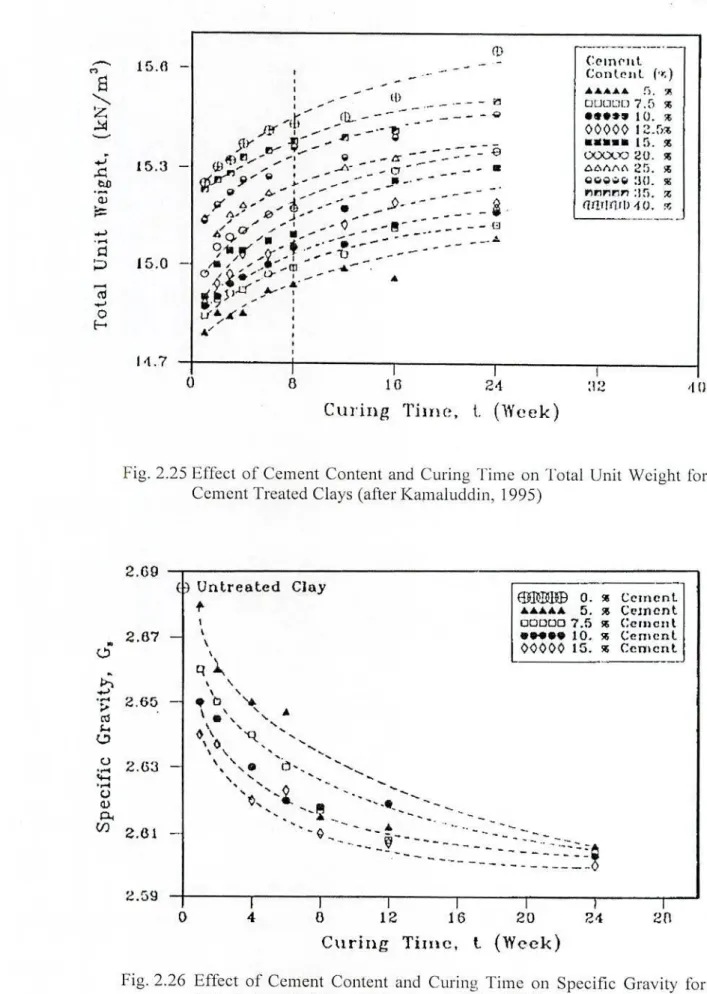
Comparison of the variation of water content with clay-water/cement ratio and curing time are shown in Fig. The effect of dry unit weight on clay-water/cement ratio at different curing times is shown in Fig.
The effect of cement content and setting time on Atterberg limits is shown in Fig. It has also been found that the void ratio of all clays decreased with increasing cement content (decreasing wc/c ratio) and setting time. Ultimately, it was found that the degree of saturation for all clay types decreased with increasing cement content and setting time.
8-: structure