Medinfo: An Android and Web based Application BY
Md. Shahidullah Saikat ID: 172-15-10158
Monira Khatun ID: 172-15-9941 Md. Abubaker Siddik
172-15-10078
This Report Presented in Partial Fulfillment of the Requirements for the Degree of Bachelor of Science in Computer Science & Engineering.
Supervised By Dewan Mamun Raza
Lecturer Department of CSE
Daffodil International University
DAFFODIL INTERNATIONAL UNIVERSITY DHAKA, BANGLADESH
JUNE 2021
APPROVAL
This Project titled “Medinfo: An Android and Web based Application", was submitted by Md.Shahidullah Saikat ID No: 172-15-10158, Monira Khatun ID No:172-15-9941, Md.Abubaker Siddik ID No: 172-15-10078 to the Department of Computer Science and Engineering, Daffodil International University, has been accepted as satisfactory for the partial fulfillment of the requirements for the degree of B.Sc. in Computer Science and Engineering and approved as to its style and contents.
The presentation has been held on 2ndJUNE 2021
BOARD OF EXAMINERS
Professor Dr. Touhid Bhuiyan Chairman
Professor and Head Department of CSE
Faculty of Science & Information Technology Daffodil International University
Md. Riazur Rahman Internal Examiner
Assistant Professor Department of CSE
Faculty of Science & Information Technology Daffodil International University
Nusrat Jahan Internal Examiner
Senior Lecturer Department of CSE
Faculty of Science & Information Technology Daffodil International University
Dr. Mohammad Shorif Uddin External
Professor
Department of Computer Science and Engineering
DECLARATION
We hereby declare that this project has been done by us under the supervision of Dewan Mamun Raza, Department of CSE, Daffodil International University. We also declare that this type of project has not been submitted elsewhere for the award of any degree or diploma.
Supervised by:
Dewan Mamun Raza Lecturer
Department of CSE
Daffodil International University Co-Supervised by:
Mr. Ahmed Al Marouf Lecturer
Department of CSE
Daffodil International University Submitted by:
Md. Shahidullah Saikat ID: 172-15-10158
Department of CSE
Daffodil International University
Monira khatun ID: 172-15-9941 Department of CSE
Daffodil International University
Md. Abubaker Siddik
ACKNOWLEDGEMENT
Firstly, we want to express our heartiest thanks and gratefulness to Almighty Allah for his blessing makes us possible to complete the final year project/Internship successfully.
We grateful and wish our profound indebtedness toDewan Mamun Raza,Lecturer, Department of CSE Daffodil International University, Dhaka. Deep knowledge &
helping; keen interest of our supervisor in the field of "Mobile application development "to carry out this project. His endless patience, scholarly guidance, continual encouragement, constant and energetic supervision, constructive criticism, valuable advice, reading many inferior drafts, and correcting them at all stages have made it possible to complete this project.
We would like to express our heartiest gratitude to Prof. Dr.Touhid Bhuiyan, our honorable Head, Department of CSE, for his kind help to finish our project and also to other faculty members and the staff of the CSE department of Daffodil International University.
We would like to express our gratitude to our Co-supervisorMr.Ahmed Al Marouf, Lecturer, Department of CSE, for his remarkable guidance.
We would like to thank our entire coursemate in Daffodil International University, who took part in this discussion while completing the course work.
Finally, we must acknowledge with due respect the constant support and patients of our parents
ABSTRACT
The main purpose of "MEDINFO" is to provide a clear concept about a medicine which is detected by image processing and give detected medicine info such as Generic name, ingredient, commonly used for treatment, giving easy access to get pharmacy shop located around the user, and per-unit price of that medicine. This paper proposes an intelligent medicine recognition system based on Google image recognition and classification cloud vision. This proposed system consists of an intelligent medicine recognition device, an app running on an Android-based mobile device. Currently, two hundred different medicine can be detected and recognition by this proposed system.
This experiment shows that this system can recognize up to 98.2% accuracy.
Therefore, the proposed system can effectively reduce the problem of drug interactions caused by taking incorrect drugs, thereby reducing the cost of medicine and giving the correct price list of medicine. This app will enable users to search the medicine and get info within a single tab. Finding medicine is easy just tab search to scan and tab result to show, can search by typing, medicine pharmacy finding is just a one-tab way. The user needs to connect a provided IP address to connect with the server and run the full system. All requests from App user will be delivered to the connected server and fetch data from server to user.
TABLES OF CONTENTS
Board of examiner i
Declaration ii
Acknowledgement iii
Abstract iv
CHAPTER
CHAPTER 1: INTRODUCTION
1-31.1 Introduction 1
1.2 Motivation 1
1.3 Fundamental of Study 2
1.4 Developed Question 2
1.5 Expected outcome 3
1.6 Report layout 3
CHAPTER 2: BACKGROUND
4-72.1 Introduction 4
2.2 Related Works 4
2.3 Project Summary 6
2.4 Problem arise 6
2.5 Challenges 6
CHAPTER 3: REQUIREMENT SPECIFICATION
8-123.1 Business Process Modeling 8
3.2 Collection and Analysis Requirement 8
3.2.1 Requirement of software 8
CONTENTS PAGE
3.3 Use Case Model 9
3.4 Detection Process and Database Schema 11
3.5 Design Requirements 12
CHAPTER 4: DESIGN SPECIFICATION
13-174.1 Frond-End Design 13
4.2 Home Screen & Feature Page 13
4.3 Drugs Directory Layout 13
4.4 Medications Detection Progressively 14
4.4 Specification Back-End Design 16
4.4.1 Pharmacy in Map Layout 15
4.4.2 Settings 15
4.5.1 Insertion of Data 16
4.5.2 Interaction Design and UX 16
4.5.3 Implementation Requirements 17
CHAPTER 5: CONCLUSION, RECOMMENDATION
18-195.1 Summary 18
5.2 Conclusion 18
5.3 Recommendation 18
5.4 Implication of Further study 19
REFERENCES
20-21APPENDIX
22LIST OF FIGURES PAGE
Figure 1: 3.1 Business Process Model 8
Figure 2: 3.3 Use Case Model of Med-info 10
Figure 3: 3.4.1 Overview of the Google Image Vision Classification 11 Figure 4: 3.4.2 Database Schema of the Med-info Application 11 Figure 5: 4.2 Home Screen & Feature Pages in Med-info 13
Figure 6: 4.4 Medicine Detection 14
Figure 7: 4.4.1 Pharmacy in Map Layout 15
Figure 8: 4.4.1 Settings of Med-info 15
LIST OF TABLES PAGE
Table 1: 4.3 Drug Directory Layout 14
Table 2: 4.5.1 Data Insertion 16
CHAPTER 1 Introduction
1.1 Introduction
Now a days, there are so many diseases among us and also there is a cure for each disease. So, everyone needs to be depending on the medicine. Day by day drag manufacturing is increasing in Bangladesh. So, there is a lot of medicine that could be used for many purposes. A different manufacturing company with the same specific generic name is used to get appropriate medicine. But the matter of sorrow that most of the rural people don't know a medicine why it needed they only have to believe in the doctor's prescription. Price problem is one more factor because sometimes pharmacies will take different prices for different people.
There are two types of method in photography acknowledgment. These are scan- based and camera-based, a scanner-based framework is very different to scan and then analysis. Therefore, we have proposed a continuous structure that will help with capturing the medicine and give results to resolve this crisis which makes people feel trust in the financial dealings, not depending upon just only pharmacy. While a camera-based framework can be created with the assistance of the current picture preparation method and each Smartphone has camera highlights, which makes it accessible for all. Therefore, the camera-based framework will be a lot simpler to utilize and practical for the users.
1.2 Motivation
Many people are suffering from finding medicine issues because they have no knowledge about group of medicine. The motivation driving this investigation is to find an approach to manage an image-based system for people why they use it, what ingredients therefore in that medicine. As seeing this result medicine is extreme for the consumer considering the comparability of Bangladeshi drug. If such a system can be made, people can have a better concept of find that particular medicine information.
By using this application people can fix this problem
People of rural area aren’t that much knowledge about similar medicine. By using it they can solve the problem.
People also can fix the pricing problem very easily.
They also benefited to find out the location of nearest pharmacy.
They are able to know the ingredients, uses, generic name of their expected medicine.
1.2 Fundamental of Study
The advancement of the study of informatics, particularly the devices handling, graphical UI data frameworks dependent on web innovations, versatile advances, cell phones, tablet PCs, and other devices assume a significant part being developed of e- medication. The interaction of information in medical care is situated towards the foundation of brought together clinical data space working with the correspondence among researchers and clinical personnel, utilization of files and libraries of clinical information and advancements, just as the utilization of dynamic hardware straightforwardly grinding away spot and progressively system. Accordingly, the progression in the information of healthcare. But if such a framework can be created, it will help others and inspire others to do this kind of work again .so for the implementation of this project we need two things.
1.Recognize medicine, capturing an image, and process that image with the available dataset.
2.Getting data, User can look through medications in the medications catalog and read information text data and value manufacturing company, near the pharmacy.
1.4 Developed Questions
To making an Image Detection system to see Bangladeshi Medicine for such a people.
The huge requests concerning this investigation were:
Q1.How can this application be used for low-budget smartphones where the camera is lower in picture resolution?
Q2.What is needed for the consumer to get this information?
1.5 Expected Outcomes
The fundamental after effect of the assessment is to showing result as Bangladeshi drugs for such people. Therefore, realize the structure as an Android Application that have the alternative to run on low monetary arrangement smartphones.
This project is also helping people to fix the medicine recognition-related problems and also, they can get the solution with in minute. Through this android application, we can easily get the medicine brand name, medicine prices, generic name, the strength of the medicine, the uses of those medicines. We also able to know the group name of our scan medicine and especially find out the nearest location of the pharmacy. We are trying to help people with overall medicine-related problems that one's can face.
1.6 Report Layout
In the remainder of the report,
Chapter 1:In this section, we discuss the introduction of this project, motivation, the rationale of the study, developed question, and expected outcome.
Chapter 2:Presents the foundation study, related works, research work, extent of the issue, and difficulties.
Chapter 3: We'll momentarily talk about our examination philosophy, information assortment and Medicine data set arrangement, factual investigation, and implementation requirements. These results and investigation will be talked about in Chapter 4:Trial results and investigation will be talked about in this section.
Chapter 5: End will be finished by summing up the exploratory outcomes and extents of future implementation.
References and informative supplements will be given later Appendix as Research Reflection and Related Issues.
CHAPTER 2 Background Study
2.1 Introduction
In this part, we have examined various kinds work completed by the researcher on the difficult explanation of this report. Different works have been done in this field to better output. However, a large portion of the acknowledgments was done between objects of various shapes as our consideration on Bangladeshi medication and the greater part of the medication are of the same size and surface, it was very difficult to settle. Just as we needed to consider distinctive ongoing item acknowledgment-based portable application. Moreover, we work on image processing, we also have to work with the google map to finding the nearest pharmacy location. So, we find to a simple way to achieve what the user needed most. Therefore, a section was created filled with a map.
Considering a continuous framework to identify the Bangladeshi medication precisely, we'll focus on two things in this portion: related works in drug recognition utilizing picture handling and related chips away at constant versatile application for a similar issue.
2.2 Related Works
A few techniques have been embraced by the researchers for tackling this issue. This will make it easier for the user to do one app process to learn about medicine selection and finding the map. By this process, several methods have been adopted by the researchers for solving this problem. L. J. Feng et al. [2] proposed an algorithm for the real-time detection of Chinese currencies. A modified Korhonen Network is developed for recognizing Chinese paper currencies for the experiments by them. The method applied could be used for a practical currency sorting system. A hardware implementation is performed in [3] for paper currency number recognition utilizing the CIS scanning circuits and ARM.
An edge-based defect detection algorithm is proposed in [4] for paper currency by J.
Ye. The method divides the currency image into several overlapping sub zones and
within each subzone, the defect feature is calculated to estimate the stage of contamination. The method proved to be robust while applied to low-quality paper currency.
K. Fanhui et al. [5] proposed a Gaussian Mixture Model (GMM) based on paper currency recognition. The applied method in [5] is based upon structural risk minimization (SRM) to develop a faster system. The experimentation shows that GMM exploiting the SRM provides more flexibility and leads to an improved result on Chinese paper currency recognition.
Y. Weiqi et al. [6] proposed a fast recognition system for paper currency numbers.
The method captures the 24-bits color images using a CCD camera, then outputs number clusters through the process of segmentation by the gray ridge-vale algorithm.
The orientation by projection and character recognition by the structure-analyzing algorithm is implemented as data processing. The experimental analysis shows satisfactory results as the system recognizes the paper currency with a high rate and fast recognition speed.
As an example, an image processing-based fake banknotes detection system is proposed in [7] which only works on a denomination of 1000 BDT. They got 63.34%
accuracy for the experimental analysis presented using edge detection methods.
Focusing on the fake or counterfeit Bangladeshi currency in [8], presented by Z.
Ahmed et a l., and presented a feasibility analysis. Similar Bangladeshi currency detection system proposed in [9] by M. M. Rahman, utilizing similar approach, but with 89.40% accuracy on the white paper background and 78.40% accuracy tested on a complex background. Similar machine vision-based approaches [10, 11], hardware implementation using PIC or ATM e g a88 devices [12] are presented. After that, the first way is achieving to a complete field nearly pharmacy is to use Google Maps. But Google map is self another application for that we work with Google Maps API because that's API could deliver what its main apps do. [15,16]
Though all the above-mentioned algorithms and methods were presented for Chinese paper currency and developed system using machine learning.
2.3 Project Summary
In our experience of study, we are expected to crack down a practical answer for making an android-based picture acknowledgment framework to perceive Bangladeshi Medicine. As the framework needs to perceive medication continuously, to do we need to diminish the time complexity for acknowledgment. Various methodologies were done, some were included based on location and some were CONVOLUTIONAL NEURAL NETWORK (CNN) based identification. As executing CNN straight forwardly on Android Application isn't adaptable enough at this moment, we'll need focus to include faster processing and accuracy.
2.4 Problem Arises
This investigation centers around figuring out how to build up an ongoing Drug Directory discovery framework for all individuals. Assuming such a framework can be grown, outwardly weakened individuals can:
i. Medicine Recognize: They will actually recognize the scanned Medicine with a helpful apparatus as the framework will be executed as an Android Application that will run on both higher and lower-cost Smartphones.
ii. Financial Dealings: People know the actual price of that medicine; it could help them to save money for their family.
iii. Finding Pharmacy: It's hard to find a pharmacy location if someone is new on that areas. So, they can easily find out a pharmacy location by using our android application.
2.5 Challenges
To make this system run faster and deliver the result for the consumer, A portion of the complexity may come in the improvement of developing this system:
i. Smartphone Usability: Many people face problems in how they can operate this type of smart device. As a result, we need to think as simple way so that, 10+ aged to 40+ aged people can easily use this application without knowing what happens inside.
ii. Timely delivery: As the system is a real-time application so it needs to show the information in a short period of time. So, we have to focus on that too.
iii. Low-Resolution picture: As the 75% of smartphones in our country are budged friendly so those smartphone cameras are lower in capturing the picture that’s why we have to work as it can recognize the lower image.
iv. Online System: As the internet is available and chip in price all around the country and we have to work for real data set and location on smartphones we need to connect the application to the internet. As a result, it can deliver faster and correct information to users.
v. Location:Getting a nearest pharmacy location near to the user location.
CHAPTER 3
Requirement Specification
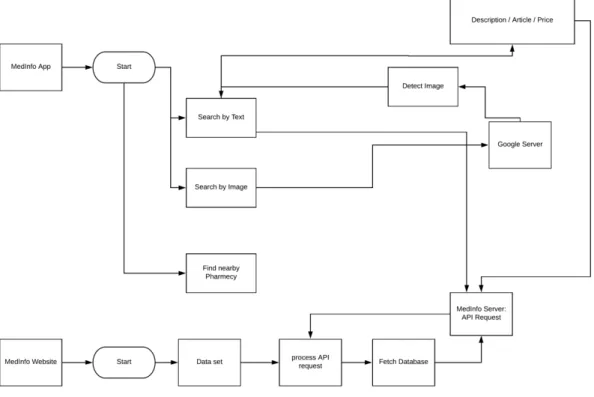
3.1 Business process Modeling
This will lead this paper to a basic concept to achieve competing business methodology using information and measure.
Figure 3.1: Business Process Model
3.2 Collection and Analysis Requirement
3.2.1 Requirement of software Google cloud image vision API v11 Android Studio
Apache Server PHP
LARAVEL framework C++
3.2.2 Requirement of Hardware
Android OS upheld Device (Android Smartphone) Windows Operating System
As for System it needs
I) CPU: SSE2 guidance set upheld ii) GPU: Graphics card
iii) RAM: 4GB (minimum), 8GB (ideal) iv) Hard Disk: 256GB (minimum) v) Processor: 1.5-2 GHz (minimum)
3.3 Use Case Model
Use case model is a model of how different kinds of customers interface with the structure to handle an issue. Around there, it relates the motives of the customers, the correspondences between the customers and the system. The important leaders of the structure in satisfying these goals. A utilization case model includes various model parts. The main model parts are use cases, performers, and the associations between them.
Figure 3.3: Use case model of Med-info
Figure 3.3 shows the utilization case model chart of Med-info where we can see that there are two sorts of the client in the framework, App User and Admin.
Administrator client can one of the controllers and customization of the Application.
Moreover, the administrator can oversee classifications of Articles and make change or erase data like generic name, brand name, the price for the unit, and description.
App users of "MED-INFO" use this application for 3 purposes. One is to get knowledge of what is this medicine inside and what is the main reason consumers use it. The second is what is the price of that medicine, and the third is to find a pharmacy location near the user. All this aspect from the user goes to the server and fetches data
3.4. Detection Process and Database Schema
This system uses Google cloud vision for easy recognition of any medicine image to text form then image text form is set to a database where it is matching with other data set then fetch the data to the application user
Figure 3.4.1: Overview of the Google Image vision Classification
Figure 3.4.2: Database Schema of the Med-info Application
Med-info app
3.5 Design Requirements
Any kind of client will able to easily use MED-INFO Application
User can just access the information passed through API to the android application without direct data set admittance authorization
Users can understand basic uses of that medicine and what ingredients that medicine have.
Users can know the prices before buying that medicine.
Users can check out their expected medicines and read the information about the medicine.
Users can search for medicine and find out near pharmacies to easily getting the medicine.
The user could find a one-page UI for better knowledge about this android application.
CHAPTER 4 Design Specification
4.1 Front-End Design
In the front-end form, we attempt to keep our (UI) UI plan extraordinary and straight forward, in light of the fact that UI permits the client to collaborate with portable clients. The plan of UI is generally referring to the (GUI) graphical UI.
4.2 Home Screen & Feature Pages
In the home screen for first and easy use home screen content all features such as searching input button, find a pharmacy, and at bottom setting wear given. A single home screen content all things, because of user don’t need unnecessary elements so we want to make simple as possible that can use all Aged people and understand it &
use it.
Figure 4.2: Home Screen & Feature Pages of Med-info
4.3 Drugs Directory Layout
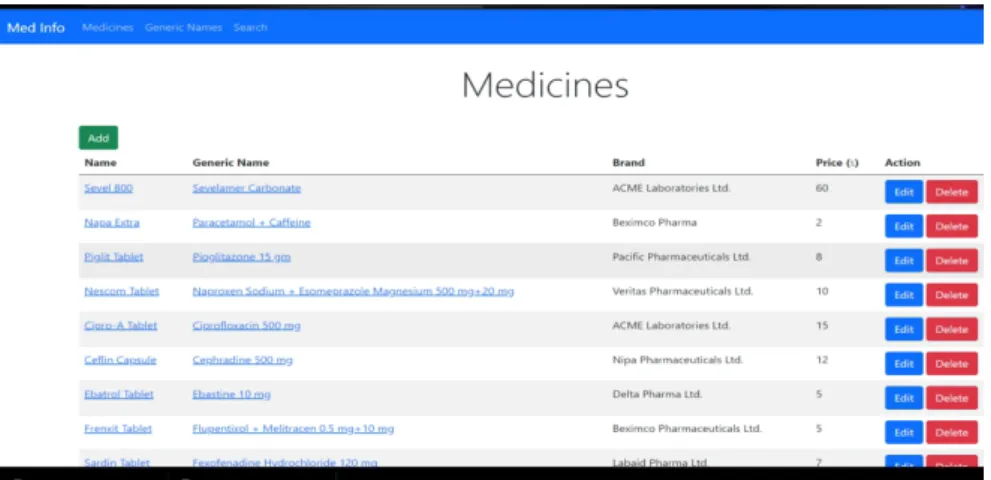
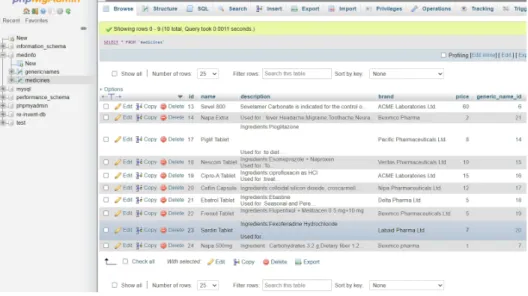
Essentially Drug Directory Layout use in the administrator board. From here we add new medication dataset in subtleties. As a producer, brand name, why we use it, what ingredients are used, and costs of that medicine. This all is in our applications when get information then search it here. This everything is constrained by drug catalog design.
In the event that we need to refresh drug dataset or change cost and so on. In the
Figure 4.3: Drug Directory Layout
4.4 Medications Detection progressively
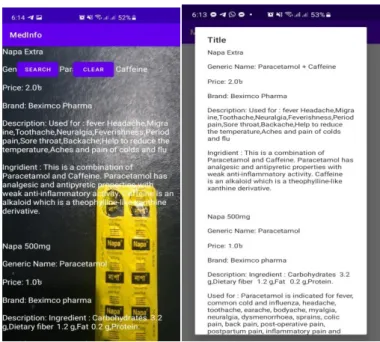
Here we can see the way of our application is scanning and showing the data as a result. By using Cloud Vision API, we can easily recognize the name and compare it to our database and can get our expected result.
Figure 4.4: Medicine Detection
Here a scanning, when we center the camera around the medicine it shows the name
‘Napa extra’. By the constant handling we can identify every medication which all are a contribution to database index.
4.4.1 Pharmacy in Map Layout
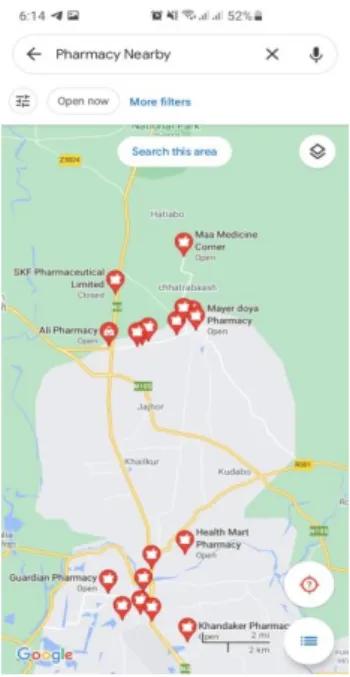
Here we just click the button to see the nearest pharmacy around my location, in a single layout.
Figure 4.4.1: Pharmacy in Map Layout
4.4.2 Settings:
For connecting with the server, we need to connect to a server for connectivity purpose
By connecting our localhost, we need to connect through IP address simply by adding Local-host. Here likewise a choice which Whole this interaction is held by picture preparing framework.
4.5 Specification Back-End Design
4.5.1 Insertion of Data
Our portable application will give a wide range of kinds of data so we need to work with an information base. Furthermore, for this, we work with the MYSQL data set.
We need to make a data set and store all the information and data in the MYSQL data set. For various information and data of various highlights or segments will store in various classifications in the data set. At the point when a client will explore an element into the application then the application will demand the predefined API from the worker. From the MYSQL information base worker will get information. And it will pass through JSON.
Figure 4.5.1: Data Insertion
4.5.2 Interaction Design and UX
records the augmentation we've to use is an android X's life cycle expansion. UX configuration is tied in with forming the experience of utilizing a framework item, and most pieces of that experience include some communication between the client and the framework. The objective of our connection configuration is to make an item that permits the client to accomplish their goal.
We worry about the graphical components like pictures, a symbol that clients interface with. A smartphone utilizes the client's fingers so we worry about what sort of actual space is required for the client. We additionally worry about the planning and conduct of the interface that we planned.
4.5.3 Implementation Requirements
To carry out our proposed project we need some equipment and programming different things which are given underneath:
I. We need some innovation for example Android X, XML, MYSQL
II. In programming or prearranging language we need to know JAVA, XML III. We have to know MYSQL for the data set.
IV. From devices and locales, we need Android Studio
V. In the Server site we should have to connect WI-FI Router and XAMPP
CHAPTER 5
Conclusion, Recommendation
5.1 Summary
We are living in a universe of innovation. Day by day Advancements are improving step by step. However, applying the modernization in fitting fields that will help individuals is necessary. In this examination-based work, we attempted to utilize a picture acknowledgment framework to recognize Bangladeshi Medicine. It was our intention to make the framework a constant picture acknowledgment Android Application. For this, we attempted various component-based methods to check out which strategy is more beneficial with faster and more efficient.
5.2 Conclusion
In this report, we try to formalize a real-time Bangladeshi medicine detection system implemented over a mobile application. We have applied the widely used ORB-based feature from Google Cloud Vision API. The average recognition rate for each of the different types of medicine is documented in the experimental results. The recognition rate is higher than any other methods applied for experimentation and the average matching rate is also quite satisfactory considering a real-time system. The presented system could be very useful for basic knowledge of knowing people, who can use the mobile application to capture photos and read the information.
5.3 Recommendations
There are a few proposals that ought to be followed if this exploration is to be led again later on. More quantities of preparing pictures to be utilized for the advancement of results.
For the Application Development, LARAVEL, JSON and Cloud Vision API ought to be used to get quicker handling speed.
5.4 Implication for Further Study
Our everyday life is getting more easier to utilizing these advancements in fitting fields is additionally fundamental. We should utilize advancements technologies for them. There are numerous researches are being directed everywhere in the world. Yet, we ought to utilize those researches to make a total arrangement that will help individuals straight forwardly. It could lead an easy way to other as a work which is faster and easy to implement and can apply faster than the other way.
REFERENCES
[1] S. R. Flaxman, R. R. A. Bourne, T. Braithwaite, M. V. Cicinelli, A. Das, J. B.
Jonas, “Vision Loss Expert Group. Magnitude, temporal trends, and projections of the global prevalence of blindness and distance and near vision impairment: a systematic review and meta-analysis”, Lancet Glob Health. 2017 Sep.
[2] T. Xiang Long, L. Jia Feng, L. Song Bo, “An Algorithm of Real-Time Paper Currency Recognition”, Journal of Computer Research and Development, 2003.
[3] Li Liang Ding Wanshan, “Paper currency number recognition system based on ARM”, Electronic Measurement Technology;2008-10.
[4] Jin Ye, Liu Jiafeng, Liu Songbo, Song Ling, and Tang Xianglong, “An Edge- Based Defect Detection Algorithm for Paper Currency”, Journal of Computer Research and Development, 2007-02.
[5] Y. Liping, K. Fanhui, M. Jiquan, G. Xin, “Paper Currency Recognition Using Gaussian Mixture Models Based on Structural Risk Minimization”, Journal of Computer Engineering and Applications, 2006-13.
[6] Y. Weiqi, Z. Yu, “A Fast Recognition System for Paper Currency Numbers”, Journal of Computer Engineering, 2005-24.
[7] M. M. Alimushwan, A. Mohaimin, R. Islam, S. Chowdhury, M. H. Ali, “Fake Currency Detection using Image Processing Method”, BRAC university
[8] Z. Ahmed, R. U. Ahmed, S. Yasmin, M. N. Islam, “Image Processing Based Feature Extraction of Bangladeshi Banknotes”, The 8th International Conference on Software, Knowledge, Information Management and Applications (SKIMA 2014), 18-20 Dec. 2014.
[9] M. M. Rahman, H. Yan, Bruce Poon, M. A. Amin, “Recognizing Bangladeshi Currency for Visually Impaired”, International Conference on Communication in Computer and Information Science, July 2014.
[10] Daniel Pedro Ferreira Lopes, António J. R. Neves “A practical study about the Google Vision API”, Universidad de Aveiro, Portugal Abstract ,5 January 2021.
[11] K. K. Debnath, J. K. Adhikari, M. Shahjahan, “A currency recognition system using negatively correlated neural network ensemble”, 2009 12th International Conference on Computer and Information Technology (ICCIT), 21-23 December
[12] F. A. Jewel, R. F. Sajal, K. Yoshida, M. Kamruzzaman, "Design and implementation of a machine vision-based but the low-cost standalone system for real-
time counterfeit Bangladeshi banknotes detection", 2007 10th International Conference on Computer and Information Technology (ICCIT), 27-29 December 2007.
[13] Shih-Hsin Chen, Yi-Hui Chen, “A Content-Based Image Retrieval Method Based on the Google Cloud Vision API and WordNet”, Asian Conference on Intelligent Information and Database Systems February 2017
[14] Google Cloud vision API <<https://cloud.google.com/vision/>> [Last accessed on Nov2020].
[15] Googlemap<<https://developers.google.com/maps>>[Last accessed on Oct 2020].
APPENDIX A Research Reflection
In the earliest reference point of our analysis, we began to execute the acknowledgment utilizing TensorFlow, yet we found that domineering the items are of comparative shapes, TensorFlow can't perceive as expected. As the picture quality should be better. However, we moved to include based image acknowledgment. Also, we've taken in the significance of time complexity as acknowledgment time should be lower and exactness should be higher for this position. The entire implemented application is based on Google Vision API image recognition where a continuous image is capturing and compare through the local database server and fetches its data to the app client. By doing this research, we learned various pre-processing techniques that Google Cloud Vision image processing made easy. While implementing the research as an android application we learned online integration of the system that made this app work faster than we cannot imagine.
APPENDIX B Related Application
Different domineering work has been done in the field of image preparation and acknowledgment. In any case, it is vital to utilize these investigates as carried out framework to make genuine usable. There are many applications like Med Ex, google near the pharmacy, recognition of note application this will help us for our project to inspire us and make easy our work on development in a single interface all in one Application.