University of Rajshahi Rajshahi-6205 Bangladesh.
RUCL Institutional Repository http://rulrepository.ru.ac.bd
Department of Sociology PhD Thesis
2014
Problems and Prospects of Agricultural Change on Efforts to Development in Rural Areas of Bangladesh A
Md. Repon, Abu Russel
University of Rajshahi
http://rulrepository.ru.ac.bd/handle/123456789/712
Copyright to the University of Rajshahi. All rights reserved. Downloaded from RUCL Institutional Repository.
Problems and Prospects of Agricultural Change on Efforts to Development in Rural Areas of Bangladesh
A Dissertation Submitted for the Degree of Doctor of Philosophy in Sociology under the Faculty of Social Science
Submitted by Abu Russel Md. Repon
PhD Fellow Session: 2010-2011
Assistant Professor and Department of Sociology
University of Rajshahi Rajshahi-6205
Bangladesh
A Dissertation Submitted for the Degree of Doctor of Philosophy in Sociology
June-2014
i
Declaration
I do hereby declare that the thesis entitled Problems and Prospects of Agricultural Change on Efforts to Development in Rural Areas of Bangladesh submitted to the university of Rajshahi for the degree of Doctor of Philosophy in Sociology is exclusively my own and original research work. No part of it, in any form, has been submitted to any other university or institute or organization for any degree or diploma for other similar purposes.
Date:... Abu Russel Md. Repon PhD Fellow
Session: 2010-2011 Assistant Professor and Department of Sociology
University of Rajshahi Rajshahi-6205
Bangladesh
ii
Certificate
It is my sincere declaration that the thesis, entitled Problems and Prospects of Agricultural Change on Efforts to Development in Rural Areas of Bangladesh prepared by Abu Russel Md. Repon, is a completely new and original research work. He has conducted this research under my supervision at the Department of Sociology, University of Rajshahi. I do hereby recommend him to submit the thesis in partial fulfillment of the requirement for the degree of Doctor of Philosophy in the discipline of Sociology under the Faculty of Social Science.
Professor AKM Shafiul Islam PhD Research Supervisor
Department of Sociology University of Rajshahi
Rajshahi-6205 Bangladesh
iii
Dedicated
To
My Father and Mother
iv
Acknowledgement
Research is not completed without the help and co-operation from respective experts and personnel. At first I am grateful to almighty Allah who gave me His kind blessing that help to complete the dissertation. I would like to express my deepest gratitude sincerest appreciation and respect to my reverent supervisor Professor Dr. AKM Shafiul Islam for his inspiration, kind guidance, sociological insights, enthusiasm, brilliant criticism and full time support for frequent discussion. It was an excellent opportunity for me to learn and practice how to conduct a research successfully.
I am grateful to the chairman, Department of Sociology Professor Nilufar Sultana for her kind support and enthusiasm.
I am grateful to Professor Wardatul Akmum and Professor Dr. Md. Zulfiqar Ali Islam for their valuable suggestion and inspiration.
I also convey my sincere thanks to Professor Dr. ANK Noman, Department of Economics, University of Rajshahi for his inspiration and valuable suggestion that help to enrich my research work.
I am grateful to Mr. Md. Shafikuzzaman Joarder and Mr. Md. Nazmul Hoque for their endless support, aspiration and valuable opinion regarding the development of the dissertation.
I would like to express my immense gratitude and ever remarkable thanks to my elder brother-in-law Dr. Shekh Md. Rabiul Karim for his inspiration and kind support in the research period.
I am thankful to my cousin Bablu and Shahin for their kind support and spending much more time for me during research time.
I am thankful to my uncle Anamul Hoque and, Milon, Tareque, Shariful, Ashraf, Al-Amin, Atik, Manik and Arun for their support in different time during the research period.
I am also endless indebted to my father and mother for their inspiration, ever-
v I am grateful to my younger brother Md. Masuduzzaman for his kind support during tabulation and his inspiration.
I wish to express my thanks to my wife for her inspiration, great patience and enthusiasm.
I am grateful to the authority of central library, University of Rajshahi; Seminar library-Department of Sociology, University of Rajshahi; The Bangladesh Institute of Development Studies, Dhaka for their kind support and co-operation.
At last I would like to express my sincere thanks to all the respondents for their endless co-operation during data collection period in different time.
I am also thankful to the participants of Focus Group Discussion (FGD), case study and Key Informant Interview (KII) for their giving excellent information regarding the subject matter of the study.
.
Date:... Abu Russel Md. Repon
vi
Abstract
Agriculture has been the backbone of the economy in Bangladesh providing employment and source of livelihood for the increasing population. To improve agricultural productivity in rural areas of Bangladesh, a holistic solution rather mechanical, view of what drives and agricultural productivity need to be taken.
This study has been conducted at Bilsha of Gurudaspur upazilla under the district of Natore in Bangladesh where all of the people directly or indirectly depend on agricultural production. People become happy in terms of any successful agricultural production and, also very unhappy and disappointed for the destruction of their production by any natural calamities or unfavorable conditions. After
‘Green Revolution’ agricultural production is increased more that is like High Yielding Varieties (HYV) produced more in the research area. Once upon a time they produced local varieties of crops that produced fewer amounts of crops like rice, mustard. The problems which are facing in the study area are identified by this research and also prospects in relation to agricultural production are also identified by this research. This research is completed through using sociological methods like social survey, case study and participatory rural appraisal, and tries to explore the agricultural change and its relations with development in rural areas of Bangladesh. Besides these, key informant interview method is also used in the present study. Through this research it is tried to know and identify the following subject matters:
►to know the socio-economic condition in terms of development of the rural people that are very much related with the agricultural production.
► to know the land tenure system in rural areas that is achieving and losing on the basis of successful agricultural production.
► to identify the nature of agricultural production and change that help to the real scenario of agricultural production in the study area and rural areas as well. .
► to investigate the nature of agro-ecological system that is important for
vii
► to find out the environmental as well as climatic impact on agriculture that creates threat for the agricultural production in rural development.
The major findings of the research are: agricultural production system has been changed in nature due to high yielding varieties and modern varieties crops, agricultural production has been increased because of high yielding varieties and modern varieties with respondent’s awareness, income has been increased in rural area for increasing agricultural production and creation of opportunities, savings has been increased in rural area due to the awareness and opportunities, occupational opportunities have been created in the rural area because of multiple crops production and other opportunities, tendency of taking education by the children has been increased because of creation opportunities and awareness of the respondents, the nature of land tenure system has been changed due to practice of leased and other systems, housing pattern has been developed in the rural area because of financial solvency and needs that imply the development of rural people, opportunities are creating in terms of development in rural area for multiple crops production and infrastructural development, agro-ecological system has been degraded due to over use of chemical fertilizer and pesticides, natural calamities create obstacle in agricultural production in many ways like draught, fog, hailstorm etc. Over all agricultural problems have negative impact on efforts to development and agricultural prospects have positive impact on efforts to development in the study area as well as rural areas of Bangladesh. This scenario imply that being an agricultural dominant country like Bangladesh has been improved remarkably in agriculture that helps to develop rural livelihood and opportunities in the rural areas of Bangladesh.
viii
Abbreviations
a+a+n=Availability, Accessibility and Nutrition AEZ: Agro-ecological Zone
FGD: Focus Group Discussion GDP: Gross Domestic Product HY: High Yielding
HYV: High Yielding Varieties IPM: Integrated Pest Management LLPm: Low Lift Pump
MAS: Myanmar Agriculture Service mMT: Million Metric Ton
MDG: Millennium Development Goal MV: Modern Varieties
NR: Number of Respondents
PRA: Participatory Rural Appraisal SDP: State Domestic Product
SSP: Single Super Phosphate STWs: Shallow Tube Wells TSP: Triple Super Phosphate
UNDP: United Nations Development Programme UP: Union Parishad
USAID: United States Agency for International Development WB: World Bank
ix
Glossary
Aga: Top of the crops
Angla: An iron material for weeding.
Balti: A tin made pot that preserves an amount of water.
Bosta: Jute or plastic made big bag.
Cannel: It is the branch of river.
Chatal: Two storied room which is made by soil and clay.
Doan: Tools of traditional irrigation which is made by palm tree.
Golaghor: Place of keeping rice.
Goli: Small road for walking within the para.
Gora: Bottom of the crops
Hari: Earthen pot which is used for various domestic needs.
Jhaka: Made from bamboo that is used for various domestic needs.
Jhata: Made by bamboo that is used in cleaning the yard.
Kacha Rasta: The road which is made of soil.
Kachi: An iron material which is used for weeding and cutting the crops.
Kakra: One kind of small animal that is harmful for the crops production.
Khaita: Made by bamboo for using agricultural and domestic needs.
Khaonti: It is practiced in mortgage system.
Koat: It is actually mortgage system but well known to all as koat locally.
Kodal: An iron material which is used for making drain, boundaries of the arable land and other domestic activities where is necessary.
Kolosh: An earthen pots which is mainly used in preservation of water and, other domestic and agricultural activities.
Macha: It is made by bamboo stick for crushing crops by dint of hand.
Molon: It is completed by cows for crushing the crops.
Nikari: Muslim fishermen called as nikari.
Pachon: An iron material which is used for weeding the crops.
x Roshi: It is made of jute that is used for keeping and bearing crops, and other domestic activities.
Samaj: Somaj is an organization which is established in rural society to control and maintain the society by some rules and regulations.
Shaluk: It was used for food which grows under water.
Shamaj: It is an organization of rural society which controls the social activities.
Shewti: Tools of traditional irrigation which is made by tin.
Suti: It is the tools of catching fish by long tail in the place of river or any place where heavy water flow.
Talaimora: It is used for keeping crops for long time.
Thor: It is the pre-moment of crops (rice, wheat and maize) and symbol of successful crops production.
Vut Machine: The machine which is used for crushing crops.
Contents
xiSl No. Title of the Contents Page
Declaration No.
Certificate Dedicated To Acknowledgement Abstract Abbreviation Glossary
CHAPTER- ONE: INTRODUCTION
i ii iii iv vi viii
ix
1.1 Background of the Study 1
1.2 History of Agriculture 2
1.3 Present Scenario of Agriculture in Bangladesh 4
1.4 Agricultural Revolution 5
1.4.1 Neolithic Revolution 5
1.4.2 The Arab Agricultural Revolution 6
1.4.3 The British Agricultural Revolution 6
1.4.4 Green Revolution 7
1.5 Statement of the Research Problem 8
1.6 Objectives of the Study 13
1.7 Hypothesis of the Study 13
1.8 Rationale of the Study 14
1.9 Organization of the Study 15
1.10 Justification of the Study 17
1.11 Limitations of the Study 18
1.12 Summary 18
xii
Sl No. Title of the Contents Page
No.
CHAPTER- TWO: REVIEW OF THE RELATED LITERATURE AND CONCEPTUAL FRAMEWORK
2.1 Introduction 20
2.2 Review of the related Literature 20
2.2.1 Review of Related Literature in Bangladesh 21
2.2.2 Review of Related Literature in Aborod 42
2.3 Conceptual Framework 54
2.4 Theoretical Framework 59
2.4.1 Theory of Agricultural Change 59
2.4.2 Development Theory in Agriculture 61
2.5 Summary 62
CHAPTER-THREE: RESEARCH METHODOLOGY
3.1 Introduction 63
3.2 Study Area 63
3.2.1 Demography 63
3.2.2 Population 64
3.2.3 Economic Condition 64
3.2.4 Social Class 64
3.2.5 Communication System 64
3.2.6 Education 65
3.2.7 Religion 65
3.2.8 Recreation 65
3.3 Techniques of Data Collection 66
3.3.1 Primary Data 66
xiii
Sl No. Title of the Contents Page
No.
3.3.1.1 Sampling 68
3.3.2 Secondary Data 69
3.4 Analysis of Data 69
3.5 Agro-Ecological Zone 70
3.6 Operational Definition of the Concepts 71
3.6.1 Agriculture 71
3.6.2 Agricultural Change 72
3.6.3 Development 72
3.6.4 Rural Development 72
3.6.5 Problems 72
3.6.6 Prospects 73
3.6.7 Household 73
3.6.8 Food Security 73
3.7 Summary 73
CHAPTER- FOUR: SOCIO-ECONOMIC STRUCTURE
4.1 Introduction 75
4.2 Age 75
4.3 Religion 76
4.4 Marital Status 77
4.5 Occupation 77
4.6 Problems Taking Occupation 79
4.7 Prospects of Taking Occupation 80
4.8 Education 80
4.9 Number of Members of the Households 82
4.10 Head of the Households 82
xiv
Sl No. Title of the Contents Page
4.11 Age of the Households Members No. 83
4.12 Occupation of the Households members 84
4.13 Education of the Household’s members 84
4.14 Problems of Taking Children’s Education 85
4.15 Prospects of Taking Children’s Education 86
4.16 Drop out the Children 87
4.17 Forms of Family 88
4.18 Types of Housing 88
4.19 Income 89
4.20 Problems of Increasing Income 91
4.21 Prospects of Increasing Income 92
4.22 Expenditure 93
4.23 Savings 94
4.24 Summary 95
CHAPTER- FIVE: LAND TENURE SYSTEM
5.1 Introduction 99
5.2 Land 100
5.3 Problems of Achieving Land 101
5.4 Prospects of Achieving Land 102
5.5 Sources of Land Ownership 102
5.6 Social Class on the Basis of Land Ownership 103
5.7 Problems in Land ownership 104
5.8 Mortgage System 105
5.9 Problems of Mortgage System 105
5.10 Lease System 106
xv
Sl No. Title of the Contents Page
5.11 Problems of Lease System No. 106
5.12 Problems of Land Ownership in Agricultural Development 107
5.13 Summary 107
CHAPTER- SIX: AGRICULTURAL PRODUCTION AND AGRICULTURAL CHANGE
6.1 Introduction 110
6.2 Arable Land of the Respondents 111
6.3 Change of Ownership 111
6.4 Pattern of Cultivation 20-50 Years Ago 112
6.5 Cultivation at Present 113
6.6 Expenditure in Rice (boro) Production 114
6.7 Expenditure in Wheat Production 115
6.8 Expenditure in Maize Production 116
6.9 Expenditure in Jute Production 117
6.10 Expenditure in Rice (amon) Production 118
6.11 Time of Rice (boro) Production 118
6.12 Time of Wheat Production 119
6.13 Time of Maize Production 120
6.14 Time of Jute Production 121
6.15 Time of Rice (amon) Production 122
6.16 Cultivation Method 122
6.17 Use of Agricultural Tools 123
6.18 Getting Crops in a Year 124
6.19 Multiple Crops Production 125
6.20 Use of Rice as Food 127
6.21 Irrigation System 127
Sl No. Title of the Contents Page xvi
6.22 Problems of Irrigation System No. 129
6.23 Prospects of Irrigation System 130
6.24 Problems of Seed 130
6.25 Prospects of Seed 131
6.26 Use of Fertilizer 132
6.27 Problems of Using Chemical Fertilizer 132
6.28 Prospects of Using Chemical Fertilizer 133
6.29 Use of Pesticide 134
6.30 Problems of Using Pesticide 134
6.31 Prospects of Using Pesticide 135
6.32 Changing Pattern of Crops Production 136
6.33 Problems of More Production 138
6.34 Prospects of More Production 139
6.35 Risk and Its Mitigation of Agricultural Production 140 6.36 Opinion in the Development of Agriculture 141 6.37 Social Status Due to Agricultural Production 142
6.38 Summary 143
CHAPTER- SEVEN: AGRO-ECOLOGICAL SYSTEM
7.1 Introduction 149
7.2 Qualities of Soil 149
7.3 Soil Test 150
7.4 Useful Insect and Animal 151
7.5 Present Scenario of Useful Insect and Animal 151 7.6 Causes of Decreasing Birds in Agricultural Field 152
7.7 Birds in Season 153
xvii
Sl No. Title of the Contents Page
7.8 Fertility in Terms of Same Crop Production No. 153
7.9 Impact of Irrigation on Agro-Ecology 154
7.10 Summary 155
CHAPTER- EIGHT: IMPACT OF CLIMATE ON AGRICULTURE
8.1 Introduction 157
8.2 Impact of Climate on Crops Production 157
8.3 Negative Impact of Climate on Crops Production 158 8.4 Impact of Climate on the Expenditure of Crops Production 159
8.5 Impact of Climate on Crops Marketing 160
8.6 Impact of Climate on Food Habits 161
8.7 Impact of Climate on Work/Labor 162
8.8 Loss for Climate during 10-50 Years 163
8.9 Summary 165
CHAPTER- NINE: QUALITATIVE DATA ANALYSIS
9.1 Introduction 167
9.2 Brief about the Participants in Focus Group Discussion 167 9.2.1 Socio-economic Condition of the Participants 167 9.2.2 Idea on Agricultural Production and Change 167
9.2.3 Problems of Agricultural Change 170
9.2.4 Prospects of Agricultural Change 170
9.2.5 Effects on Development 170
9.2.6 Recommendation 171
9.3 Case Studies 171
9.3.1 Case-1 171
xviii
Sl No. Title of the Contents Page
9.3.2 Case-2 No. 174
9.3.3 Case-3 176
9.3.4 Case-4 178
9.3.5 Case-5 180
9.4 Key Informant Interview (KII) 183
9.4.1 KII-1 183
9.4.2 KII-2 186
9.4.3 KII-3 189
9.4.4 KII-4 191
9.4.5 KII-5 193
9.5 Summary 196
CONCLUSION 197
REFERENCES 207
APPENDIX- I : Questionnaire 224
APPENDIX-II: Check Lists of FGD 238
APPENDIX-III: Check Lists of KII 242
APPENDIX-IV: Map of the Study Area 244
List of the Tables
xix TableNo. Title of the Tables Page
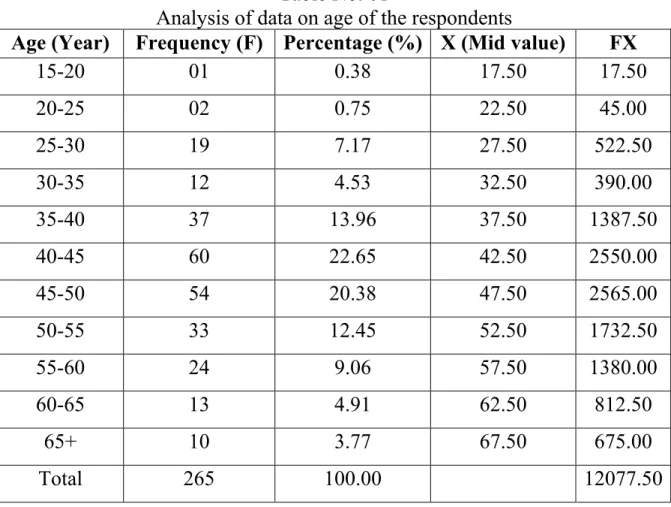
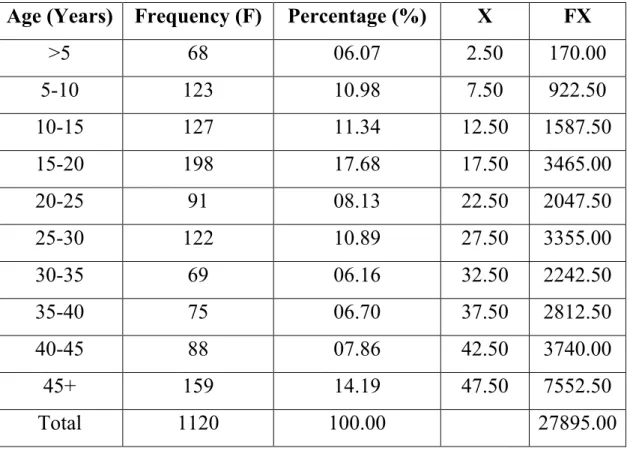
01 Analysis of data on age of the respondents No. 75 02 Analysis of data about marital status of the respondents 77
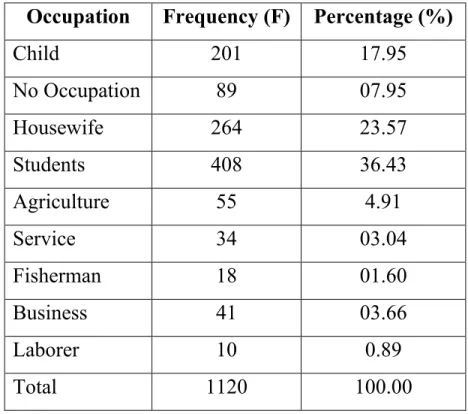
03 Analysis of data about occupation 78
04 Analysis of data regarding the problems of taking occupation of the
respondents 79
05 Analysis of data about the prospects of taking occupation of the respondents
80
06 Analysis of data about education 81
07 Analysis of data about the number of members of the households 82 08 Analysis of data about the head of the households 82 09 Analysis of data about the age of the household’s members 83 10 Analysis of data about the occupation of the household’s members 84 11 Analysis of data about the education of the household’s members &
children
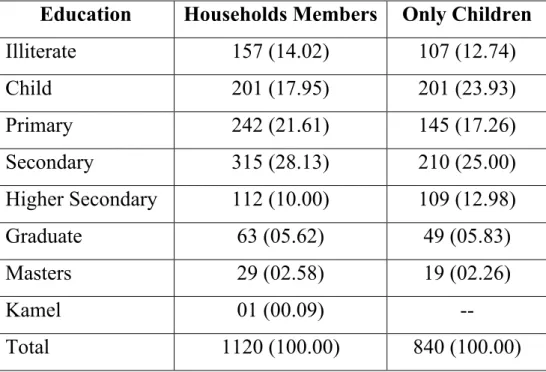
85
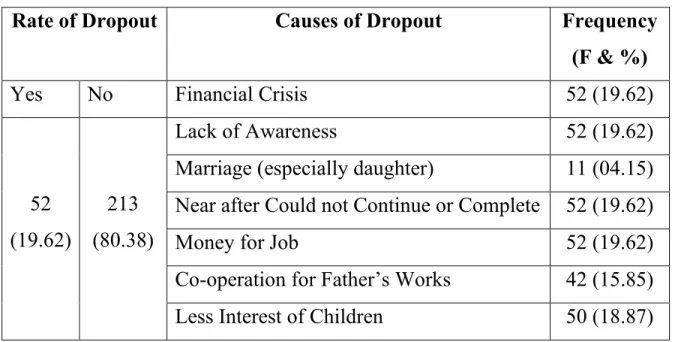
12 Analysis of data about the prospects of taking education 86 13 Analysis of data about the dropout of the children 87 14 Analysis of data about the types of housing 89
15 Analysis of data about the yearly income 90
16 Analysis of data about the problems of increasing income 91 17 Analysis of data about the yearly expenditure of the respondents 93 18 Analysis of data about the yearly savings of the respondents 94 19 Analysis of data about the amount of land 100 20 Analysis of data about the problems of achieving land 101 21 Analysis of data about the sources of land ownership 103 22 Analysis of data about the social class on the basis of land
ownership
104
Table xx
No. Title of the Tables Page
23 Analysis of data about the problems of mortgage system No. 105 24 Analysis of data about the problems of lease system 106 25 Analysis of data about the arable land of the respondents 111 26 Analysis of data about the pattern of cultivation 20-50 years ago 112 27 Analysis of data about the cultivation at present 113 28 Analysis of data about the expenditure in rice (boro) production per
acre
115
29 Analysis of data about the expenditure in wheat production per acre 116 30 Analysis of data about the expenditure in maize production per acre 117 31 Analysis of data about the expenditure in jute production per acre 117 32 Analysis of data about the expenditure in rice (amon) production
per acre
118
33 Analysis of data about the time of rice (boro) production 119 34 Analysis of data about the time of wheat production 120 35 Analysis of data about the time of maize production 121 36 Analysis of data about the time of jute Production 121 37 Analysis of data about the time of rice (amon) production 122 38 Analysis of data about the use of agricultural tools 123 39 Analysis of data about getting Crops in a year 125 40 Analysis of data about the multiple crops production 126 41 Analysis of data about the use of rice as food 127 42 Analysis of data about the irrigation system 128 43 Analysis of data about the problems of irrigation system 129 44 Analysis of data about the prospects of irrigation system 130 45 Analysis of data about the problems of using chemical fertilizer 132 46 Analysis of data about the prospects of using chemical fertilizer 133
xxi Table
No. Title of the Tables Page
47 Analysis of data about the use of pesticides No. 134 48 Analysis of data about the problems of using pesticides 135 49 Analysis of data about the changing pattern of crop production 136 50 Analysis of data about the problems of more production 138 51 Analysis of data about the prospects of more production 139 52 Analysis of data about the risk and mitigation of agricultural
production
140
53 Analysis of data about the opinion in the development of agriculture
141
54 Analysis of data regarding the birds in agricultural field 152 55 Analysis of data regarding the birds in seasons 153 56 Analysis of data regarding the fertility in terms of same crops
production
153
57 Analysis of data regarding the impact of irrigation on agro-ecology 154 58 Analysis of data about the impact of climate on crops production 158 59 Analysis of data about the negative impact of climate on crops
production
159
60 Analysis of data regarding the impact of climate on the expenditure of crops production
159
61 Analysis of data regarding the impact of climate on food habits 161 62 Analysis of data regarding the loss for climate during 20-50 years 163
xxii
List of the Figures Figure
No. Title of the Figures Page
01
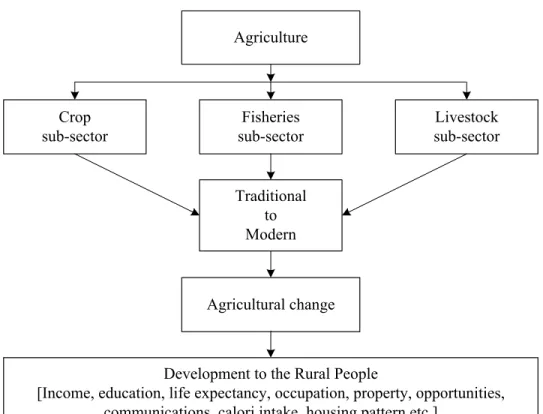
Agricultural change and its impactsNo. 55
02
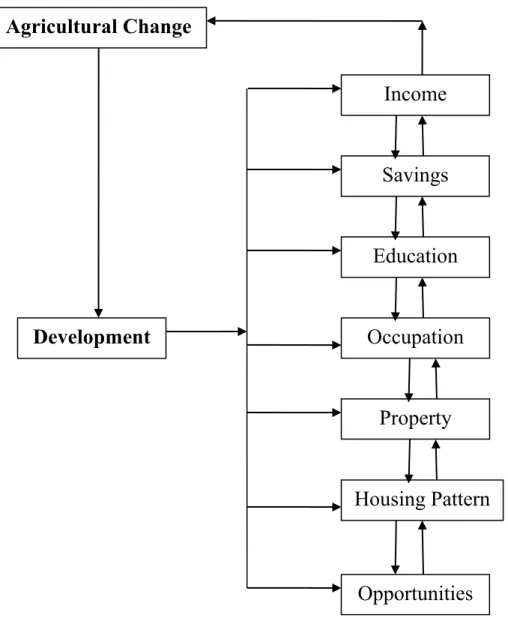
Interrelationships between the concepts57
03
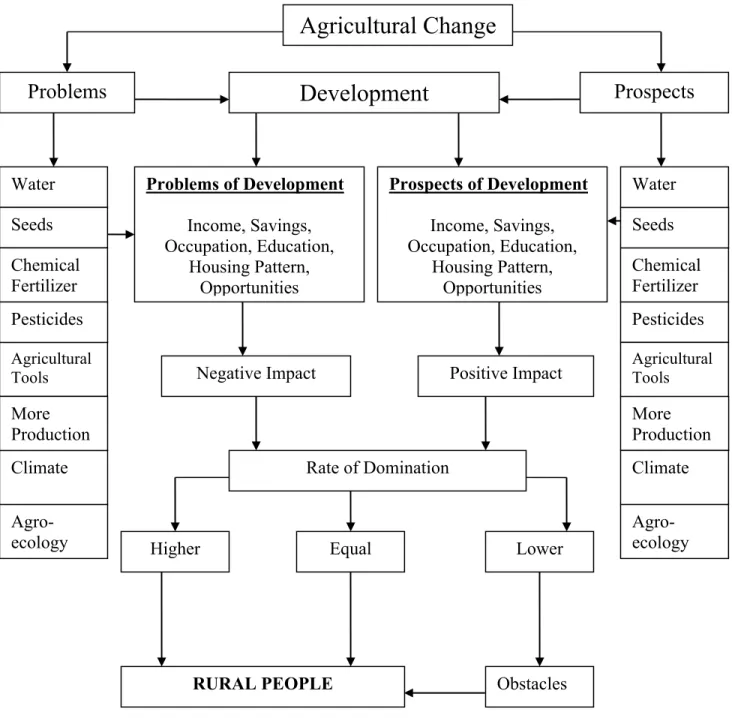
Analytical frame work58
04
Pattern of modernization in agriculture62
05
Summary of research methodology66
06
Number of the selected respondents69
07
Logical framework matrix of the Study71
08
Participant’s description in conducting FGD167
09
Changing pattern of irrigation169
10
Changing pattern of using seed169
11
Brief about the case studies171
12
Brief about the key informant interview183
13
Results of analytical framework205
xxiii
List of the Charts
Chart No. Title of the Charts Page
01 Religion of the respondents No. 76
02 Problems of taking children’s education 85
03 Forms of family 88
04 Yearly income 91
05 Prospects of increasing income 92
06 Nature of yearly income, expenditure and savings 95
07 Prospects of achieving land 102
08 Problems in land ownership 104
09 Problems in land ownership in agricultural development 107
10 Change of ownership 111
11 Cultivation Methods 122
12 Problems of seeds 131
13 Prospects of seeds 131
14 Prospects of using pesticides 135
15 Social status due to agricultural production 142
16 Qualities of soil 150
17 Soil test 150
18 Useful insects or animal 151
19 Present scenario of useful insects or animal 152
20 Impact of climate on crops marketing 160
21 Impact of climate on works/ labor 162
22 Loss of climate during 20-50 years 164
23 Average loss for climate during 20-50 years 164
CHAPTER - ONE
INTRODUCTION
1.1 Background of the Study
Bangladesh forms the largest delta in the world and is situated between 88o 10/ and 92o 41/ East longitudes and between 20o 31/ and 26o 38/ North Latitudes. The great delta is flat throughout and stretches from near the foot-hills of the Himalayan Mountains in the north to the Bay of Bengal in the south (BBS, 2001).
Bangladesh is a predominant agricultural country. Agricultural contribution is much more than industrial on economy. Though population growth creates pressure on production but development is found in different time. According to Rahman (1993), “Agriculture continues to remain the most important sector in Bangladesh.
Though, its share in total GDP has declined to around 40% in 1990/91, it still employs 55% of the total labour forces”. Virtually no “open” land existed for agricultural expansion (Hossain, 1988), and arable lands were lost to settlement.
Agricultural growth, therefore, focused on increasing land productivity—
intensification achieved primarily through increased irrigation, which facilitated double and triple cropping and the use of “green revolution” inputs (i.e., crops, fertilizer, pesticides). Socio-economic constraints to the intensification process operated, however, including government policies that favored the urban consumer over the farmer and the large-holder over the small-holder (Ahmad, 1984), as well as the overall impoverished condition of most farm households that made capital improvements difficult (Vylder, 1982).
Agriculture is central to the economy and the society of Bangladesh, but, perhaps more importantly, it represents the basic sector from which overall future economic growth must emanate. Approximately 80 percent of the total population lives in rural areas and most are engaged in some phase of agriculture-growing, starting, transporting, processing, or marketing. Agriculture in Bangladesh is essentially a rice monoculture food production constitutes the most egregious weakness and the
agriculture achieved significant production transformation. The process is underpinned by the use of agro-chemicals, ground water irrigation and increased incidence of multiple cropping. Foodgrain production has more than doubled over a period of three decades since independence (Alauddin, 2005). Land use in Bangladesh is mainly for agriculture with about 35 million acres cultivated of which 60% is in crop production (Huq et al., 1990).
Rural people are trying to reduce poverty by surplus agricultural production.
Development is being found in different cases in rural areas. Though people of Chalon beel face various problems but they look forward to develop themselves as well as the country, because agricultural production helps to create food security to the rural people and country as a whole. This study will help to find out the agricultural change on efforts to development in rural areas.
1.2 History of Agriculture
Agriculture was developed at least 10,000 years ago, and it has undergone significant developments since the time of the earliest cultivation. Independent development of agriculture is also believed to have occurred in northern and southern China, Africa's Sahel, New Guinea and several regions of the Americas.
Agricultural practices such as irrigation, crop rotation, fertilizers, and pesticides were developed long ago but have made great strides in the past century (Binford, 1968).
Last stage of plaistosin or from the beginning of holosin to 3500 years ago of BC is called the new Stone Age. Pastoral and agriculture were the main invention of this age. Simply, men were food gather in the Old Stone Age and become food producer in new Stone Age (Islam, 1978). The livelihood is becoming new paths besides hunting, fishing and rearing of livestock by the invention of agriculture. The world agriculture has long been associated with the growth of civilization (Halcrow, 1980).
Descended from wild grasses, rice is a staple food in South Asia. Historians believe that it was first domesticated in the area covering the foothills of the Eastern
Himalayas (north-eastern India), and stretching through Burma, Thailand, Laos, Vietnam and Southern China. About 2000 years ago, rice was well-established as the main cereal of the sub-continent, with barley second and wheat a barely mentioned winter food. Indian subcontinent has a remarkable history of agriculture.
Kosambi says, “Artificial irrigation for agriculture in Indian subcontinent has a long history and can be traced back in somewhere between post-Dravidian and pre- Aryan period (cited in Bose, 1942). He also mentions that Rig-Veda depicts a picture of vast irrigation work maintained by state and Arthashastra of Kaulilya refers to similar picture of this state enterprise ... Considerable part of Indus- agriculture developed depending on over flow irrigation by seasonal damming of the river (cited in Bose, 1942). The main type of wealth was land in pre-British India. So, economy was depending on agriculture. Social relationships and activities were sustained on the basis of agricultural economy. The root of agro- based economy was village community. Social stratification essentially created on the basis of land relationships. Here, agriculture was depending on nature.
Especially it was a fact for water supply. Karim (1956) says, “An Indian state was attributed to maintain as extensive irrigation and public works, as because it witnessed rainfall only once a year the monsoon period. Therefore, primary functions of the state were to look after water supply … to sink wells and build canals, tanks and reservoirs.” As a result it helps to create bureaucracy. Weber (1950) says, … existence and extensive domination of bureaucracy compulsory services of the dependent classes, existence of military organization and its monopoly power exercise through the state power in the oriental societies … was due to the crucial importance of irrigation in the East.
Agriculture plays significant role after creation of Pakistan which may be important for socio-economic development. Hassan (1996) says, “Bangladesh has a long history of colonial rule (British and Pakistani colonial forces) for more than 200 years. The British involvement in Bangladesh agriculture was mainly limited to the changes in revenue administration and little attention was given by the government
in agricultural development.” On the same way throughout the Pakistan period (1947-1971) agriculture remained a neglected sector and was assigned the passive role of supplier of foreign exchange. Yet in sixty decade change is found in agriculture. Land is treated an important elements which help to individual as well as social development. Westergard and Hossain (1998) mention, the expansion of irrigation started in the mid 1970s with the promotion of shallow tube wells. From the beginning these were sold to private individuals almost at cost, and the sales increased rapidly during the period 1979 to 1983. Independent Bangladesh takes various steps for the development of agriculture as an agro-based country.
Agricultural change is playing significant role on different socio-economic aspects in rural areas. So it is said that “agriculture is a science, a craft and a business”. In the final statement of world economic summit mention, “agriculture is the occupation of the majority of workers throughout the world.”
1.3 Present Scenario of Agriculture in Bangladesh
Bangladesh agriculture at a glance, total farm holding is 1,47,16,000, total area is 14.845 million hectares, cultivable land: 8 million hectares, current fallow land is 0.469m hectares, annual food production is 31.9m MT and annual food demand is 31.9m MT. The strategies of Bangladesh agriculture are self-sufficiency in food in 2012, ensuring food security in 2017(a+a+n) and become middle income country within 2022. The characteristics of Bangladesh agriculture are cropping intensity 179%, irrigated land 56%, surface water 21%, groundwater 79%, land-man ratio .06 ha, mainly subsistence farming, inadequate agro-processing, non-mechanized farming, fragmented land/plots and dependence largely on nature. The importance of agriculture are 21% in GDP, 48% in labor force, source of raw materials as backward and forward linkage for agro based industries, agriculture determines people’s lives and livelihood of this region, people living in rural areas 77% and export value is 12%. Government’s recent interventions are farmers’ database and farmers’ inputs support card to 1 Crore 82 Lakh farmers, increased subsidy on agricultural inputs (Fertilizer, diesel, electricity and seeds), farmer friendly
agricultural credit policy, 1 Crore 82 Lakh farmers’ new bank accounts being opened, 100 Hr. free supplementary irrigation, enhanced agricultural rehab grants to victims of natural calamities, support for accelerated mechanization of agriculture and surface water irrigation ( Ministry of Agriculture, 2010).
1.4 Agricultural Revolution
Agriculture has played a key role in the development of human civilization. Until the Industrial Revolution, the vast majority of the human population labored in agriculture. Development of agricultural techniques has steadily increased agricultural productivity, and the widespread diffusion of these techniques during a time period is often called an agricultural revolution. A remarkable shift in agricultural practices has occurred over the past century in response to new technologies.
1.4.1 Neolithic Revolution
The Neolithic Revolution is the first agricultural revolution—the transition from hunting and gathering to agriculture and settlement. Archaeological data indicate that various forms of domestication of plants and animals arose independently in six separate locales worldwide, with the earliest known developments taking place in India and the Middle East around 10,000 BP (Gupta, 2010).
The term Neolithic Revolution was coined in the 1920s by Vere Gordon Childe to describe the first in a series of agricultural revolutions in Middle Eastern history.
The period is described as a "revolution" to denote its importance, and the great significance and degree of change affecting the communities in which new agricultural practices were gradually adopted and refined (Diamond, 1999). This transition everywhere seems associated with a change from a largely nomadic hunter-gatherer way of life to a more settled, agrarian-based one, with the inception of the domestication of various plant and animal species—depending on the species locally available, and probably also influenced by local culture (Smith, 1976).
1.4.2 The Arab Agricultural Revolution
The Arab Agricultural Revolution (also known as the Medieval Green Revolution, Muslim Agricultural Revolution, Islamic Agricultural Revolution and Islamic Green Revolution) is a term coined by the historian Andrew Watson in his influential 1974 paper postulating a fundamental transformation in agriculture from the 8th century to the 13th century in the Muslim lands (Watson, 1974).
Muslims widely practiced cash cropping and a crop rotation system in which land was cropped four or more times in a two-year period. Muslims developed a scientific approach based on three major elements; sophisticated systems of crop rotation, highly developed irrigation techniques, and the introduction of a large variety of crops which were studied and catalogued according to the season, type of land and amount of water they require (Galloway, 1977).
The productions of some crops were transformed into large industries during the Muslim Agricultural Revolution. Watson argued that the economy established by Arab and other Muslim traders across the Old World enabled the diffusion of many crops and farming techniques among different parts of the Islamic world, as well as the adaptation of crops and techniques from and to regions beyond the Islamic world (Watson, 1974).
1.4.3 The British Agricultural Revolution
The British Agricultural Revolution describes a period of development in Britain between the 17th century and the end of the 19th century, which saw an epoch- making increase in agricultural productivity and net output. This in turn supported unprecedented population growth, freeing up a significant percentage of the workforce, and thereby helped drive the Industrial Revolution (Overton, 2002). The Agricultural Revolution in Britain proved to be a major turning point in history.
The population in 1750 reached the level of 5.7 million. This had happened before:
in around 1350 and again in 1650. Each time, either the appropriate agricultural infrastructure to support a population this high was not present or plague or war
occurred (which may have been related), a Malthusian catastrophe occurred, and the population fell (Kagan, 2004).
The British Agricultural Revolution was the cause of drastic changes in the lives of British women. Before the Agricultural Revolution, women worked alongside their husbands in the fields and were an active part of farming. The increased efficiency of the new machinery, along with the fact that this new machinery was often heavier and difficult for a woman to work, made this unnecessary and impractical, and women were relegated to other roles in society. To supplement the family's income, many went into cottage industries (Valenze, 1995).
1.4.4 Green Revolution
Green Revolution refers to a series of research, development, and technology transfer initiatives, occurring between 1943 and the late 1970s that increased industrialized agriculture production in India; however, the yield increase has also occurred world wide. The initiatives involved the development of high-yielding varieties of cereal grains, expansion of irrigation infrastructure, and distribution of hybridized seeds, synthetic fertilizers, and pesticides to farmers. The term "Green Revolution" was first used in 1968 by former USAID director William Gaud, who noted the spread of the new technologies and said, "These and other developments in the field of agriculture contain the makings of a new revolution. It is not a violent Red Revolution like that of the Soviets, nor is it a White Revolution like that of the Shah of Iran. I call it the Green Revolution" (Gaud, 1968).
Cereal production more than doubled in developing nations between the years 1961–1985 (Shiva, 1991). Yields of rice, maize, and wheat increased steadily during that period. The production increases can be attributed roughly equally to irrigation, fertilizer, and seed development, at least in the case of Asian rice (Pimentel, 1996).
Green Revolution techniques also heavily rely on chemical fertilizers, pesticides and herbicides, some of which must be developed from fossil fuels, making agriculture increasingly reliant on petroleum products. The world population has
grown by about four billion since the beginning of the Green Revolution and many believe that, without the Revolution, there would have been greater famine and malnutrition. The average person in the developing world consumes roughly 25%
more calories per day now than before the Green Revolution. Between 1950 and 1984 as the Green Revolution transformed agriculture around the globe, world grain production increased by over 250% (Kindall, & Pimentel, 1994).
The transition from traditional agriculture, in which inputs were generated on-farm, to Green Revolution agriculture, which required the purchase of inputs, led to the widespread establishment of rural credit institutions. Smaller farmers often went into debt, which in many cases results in a loss of their farmland (Ponting, 2007).The increased level of mechanization on larger farms made possible by the Green Revolution removed a large source of employment from the rural economy.
Modern agriculture is a term used to describe the wide majority of production practices employed by America’s farmers. The term depicts the push for innovation, stewardship and advancements continually made by growers to sustainably produce higher-quality products with a reduced environmental impact.
Intensive scientific research and robust investment in modern agriculture during the past 50 years has helped farmers double food production while essentially freezing the footprint of total cultivated farmland (Ruben et.al., 2002).With the rapid rise of mechanization in the late 19th century and 20th century, particularly in the form of the tractor, and later the Combine harvester, farming tasks could be done with a speed and on a scale previously impossible. While chemical fertilizer and pesticide have existed since the 19th century, their use grew significantly in the early 20th century.
1.5 Statement of the Research Problem
World population continues to grow. According to recent United Nations population projections, the world population will grow from 5.7 billion in 1995 to 9.4 billion in 2050, 10.4 billion in 2100, and 10.8 billion by 2150, and will stabilize at slightly fewer than 11 billion around 2200. The rate of population increase is
especially high in many developing countries. In these countries, the population factor combined with rapid industrialization, poverty, political instability, and large food imports and debt burden, make long-term food security especially urgent (Gold, 2007).
The Bengal Basin is one of the most land stressed and economically impoverished regions on earth, and Bangladesh is the anchor of the basin. A country of 143,999 km2 is occupied by nearly 119.8 million people, creating an average population density of 832 people per km2 (Hossain, 1988). Approximately 84% of population is rural, attempting to meet a major portion of its needs through agriculture. Land is intensively cultivated everywhere; the average cropping frequency approaches two harvests per plot per year. Traditional methods of irrigation include pitcher, swing basket, and a hollowed-out log fixed on a pivot and fitted with a counterbalance.
These methods have a natural grace and beauty and are still very few practiced in rural areas throughout Bangladesh. They offer the dual advantages of depending entirely on locally available materials and on human power for their operation. In those rural areas where electricity is available, tube wells with electric pumps are becoming an important irrigation device.
Bangladesh is a developing country. Its economy is predominantly agro-based and more than 60 percent of the total labor force is attached to and dependent on agriculture (Mia, 1993). Like other developing countries in Bangladesh industrialization process is not stands on expected line. Rural areas are lag behind than urban areas. The development of rural areas varies from rural areas to areas.
The areas which are underdeveloped face various problems. But taking different risk people are trying to improve their livelihood day by day.
The MDG Needs Assessment and Costing 2009-2015 for Bangladesh makes a wide range of recommendations for achieving the Goal to reduce hunger. It advocates that support for poor farmers and agriculture is the most cost effective route to poverty reduction. Improved productivity should be tackled by bringing the ideas of modern research and development into the rural economy. Seed selection and
prudent soil and water management are fundamental. Marketing opportunities can be improved through storage and processing facilities, supported by transport infrastructure. Rice is the staple food of the people of Bangladesh. Production of this crop is very important in terms of food security. Rice provides more than half of the income of farmers and employment opportunities for rural labor force (Hossain, 1989). Rice production is however, the main source of farmers’ income in the rural area. The growth in agricultural labor is related with the increase in rice production. Rice in Bangladesh is grown in three distinct seasons; Boro (January to June), Aus (April to August) and Amon (August to December). Adoption of modern rice varieties and associated technologies seems to offer an opportunity to increase output and income substantially (Alam and Jabber, 2008). Now Boro is produced mostly in the study area. Before 20-50 years ago Aus and Amon produced in this area.
Climate and agriculture are both inter-linked. Climate more than any other single environmental factors determines the vegetation of a locality. It exerts the primary influence on crop production and through the available food and water sources governs the distribution of livestock (Chatterjee, 1969). The ability of farmers to react to climatic adversity (Rosenberg, 1992) is substantial and has increased overtime. At the farm level, adaptive mechanism includes adjustments in planting and harvesting dates: changes in tillage practices, crop varieties, species, and rotations; fertilizer, herbicide, and pesticide applications; improvements in irrigation efficiency; and installation of new irrigation facilities (Parry and Carter, 1990; Reilly, 1996)
The conditions confronting Bangladesh as it became a new nation are well known and documented. Even then, it was one of the world’s most densely populated and impoverished countries. It was characterized by: (1) extremely low per capita income and relatively high population growth; (2) a low literacy rate as well as a low level of general education; (3) a traditional agricultural technology as well as low agricultural productivity; (4) a small industrial base and few mineral resources;
(5) an inadequate communication, transportation, and power infrastructure, exacerbated by the country’s extensive rivers and flood plains; and (6) a chronic balance of payment problem (Wennergren et al., 1984). Many observers have attributed Bangladesh’s lack of food grain self-sufficiency to factors such as population growth, the failure to adopt appropriately modern agricultural technology, government interference with agricultural prices, inadequate financial institutions, or insufficient investment in irrigation facilities (Jannuzi and Peach, 1990). Bangladesh is a land scarce country where agriculture is the mainstay of the economy contributing over 22 per cent to its GDP (Quasem, 2008). In agrarian society like Bangladesh, more than 80 percent people are either directly or indirectly associated with agriculture. Due to tremendous population pressure, squeezing trend of agriculture land for other use and degrading of land fertility limit, possibility of more food production remains un-expectable for the rural people of Bangladesh. Poverty stands as a common phenomenon for the land less, marginal and small farmers. People of the study area are trying to develop through agricultural change. The beel area is popular for fishing to the country people.
About 30 years ago agricultural change is found spontaneously. All of the people of the study area are directly or indirectly depend on agriculture. This dependency reflects on their different socio-economic activities. Their ultimate goal is to ensure food security themselves and contribute to country people as well. The qualitative differences are found between the developed and underdeveloped countries. Weitz (1971) says, “for the vast number of farm families, whose members constitute the main agricultural work force, agriculture is not merely an occupational or a source of income, it is a way of life.” Agricultural change means the changing pattern of cultivation and rearing of agricultural sub-sectors. This change is occurring for people’s awareness towards modernity. They are replacing their traditional production to modern. This is helpful for more production and new opportunities.
Hossain (1989) rightly says, the growth of agricultural income may also increase the opportunity for investment and employment in non-farm rural activities through
its effects on the demand for such item as (1) irrigation equipment and other modern agricultural inputs produce in the non-agricultural sector, (2) services for processing and marketing additional surplus produce and (3) trade and transport service arising from the traditional purchase of non-farm products. More production helps to develop the producer class. Increased agricultural productivity enables farmers to grow more food, which translates into better diets and, under market conditions that offer a level playing field, into higher farm incomes. With more money, farmers are more likely to diversify production and grow higher-value crops, benefiting not only themselves but the economy as a whole"(Delang, 2006).
A decline in rice production will mean more people will slip into poverty and hunger. Due to tremendous population pressure, squeezing trend of agriculture land for other use and degrading of land fertility limit, possibility of more food production remains unacceptable for the rural people of Bangladesh. The farmers who are directly involved in various types of agricultural production becoming financially benefited and savings as well. They are cultivating generation to generation and change has been come in their cultivation process. Though agricultural production system has been developed but they have some problems and prospects on their production system like more and multiple crops production.
They are using their surplus production in the development of occupational opportunities for themselves and their children as well. Tendency of children education is increasing day by day. Their housing pattern is improving and they are using their surplus value for purchasing housing and arable land. As a result land demand in terms of purchasing has been increased and most of the time purchasing and selling of land are conducting within the study area. Climatic impact like draught, dense fog, hailstorm and heavy rain are the major threats of agricultural change and production. Agro-ecological system is very important for agricultural production and change which is clearly decreased and playing negative role on agricultural change in the study area. Problems of agricultural change create negative impact on efforts to development in rural areas people due to low
production, poor income, poor opportunities and so one. On the other hand, prospects of agricultural change create positive impact on efforts to development in the rural people by more production, more income opportunities and so one. These are only common because of the dependency on agriculture of the rural people of Bangladesh.
We do not know and have no specific or definite scenario on the aforesaid sociological aspect to the development in rural areas. That is why this study will help to identify the problems and prospects of agricultural change on efforts to development in rural areas of Bangladesh.
1.6 Objectives of the Study
The main objective of the study is to explore the agricultural change and its relations with development in terms of problems and prospects in rural areas of Bangladesh. Besides this the following specific objectives are taken in the study which are-
i. to know the socio-economic condition in terms of development of the rural people.
ii. to know the land tenure system as well as ownership in the rural areas.
iii. to identify the nature of agricultural production and change . iv. to investigate the nature of agro-ecological system.
v. to find out the impact of climatic on agriculture.
1.7 Hypothesis of the Study
The major hypotheses of the study are:
1. Agriculture production system has been changed in nature, 2. Agriculture production has been increased in the study area, 3. Income has been increased in the study area,
4. Savings has been increased in the study area,
5. Occupational opportunities have been created in the study area, 6. Tendency of taking education has been increased in the study area,
7. The nature of land tenure system as well as ownership has been changed in the study area,
8. Housing pattern has been developed in the study area,
9. Opportunities have been created in terms of development in the study area, 10. Agro-ecological system has been degraded in the study area,
11. Natural calamities creates obstacle in agricultural production.
1.8 Rationale of the Study
Agriculture is a key sector in most developing countries. It has a key role to play in enabling them to accomplish development goals, including self-reliance, growth, and equity. The agricultural sector plays a vital role in the economy of Bangladesh in terms of its contribution to GDP, employment generation, livelihoods and poverty alleviation (Mainuddin, et al., 2011). Agricultural is an important human activity whose essentiality gives it an inevitable ethical dimension. This dimension includes human, animal, environmental, economic, social and political aspects (Zimdahl, 2000).
In Bangladesh, agriculture is the primary occupation and major industry of about half of the total employed population. Most employment is in the low-productivity, low-wage, informal sector (around 80 percent), with no job security and retirement benefits. Self-employed workers are the predominant group among males, and unpaid family workers among females. There is considerable underemployment, especially among females and in rural areas (Khuda, 2011). The production performance of the agricultural sector in Bangladesh, particularly the crop sector, has considerable bearing upon the rate and structure of poverty and malnutrition, the trade balance and the government fiscal position, and consequently upon the rate of growth of the Bangladesh economy as a whole (Hossain, 1991). Population growth is placing increasing pressure on land resulting in increasing number of rural landless and urban poor (Choudhury, 2008).
In Bangladesh most of the people live in the rural areas. They have very few opportunities to change their social status. Those who are engaged in agricultural
production are facing various problems like natural calamities, unavailable of crop cultivation materials, lack of knowledge, capital etc. But still rural people are cultivating agriculture from generation to generation. This study area is in the middle Chalon Beel of Bangladesh. The people of this area depend on agriculture.
Once upon a time different types of crops like jute, paddy, aush, amon, mustard, sesame, wheat etc. were produce more. Now boro production is found more than others. So many reasons behinds this not to produce traditional crops. Their livelihood, future plan, daily needs all are maintained directly or indirectly through agricultural production. At present, different types of occupations are found in the study area which is based on agriculture. So, if we want to understand the problems and prospects of agricultural change on efforts to development in rural areas, this place is the best place. This study will also help to know how rural people especially Chalon Beel areas faces and overcome the obstacles and develop in different sociological aspects. This research finding will be helpful to the policy maker for the development of agriculture through identify the problems and prospects of agricultural change and its relation with development in rural areas as well.
1.9 Organization of the Study
The present study is organized in nine chapters on the basis of its objectives. The first chapter is Introduction of which includes background of the Study, History of Agriculture, Agricultural Revolution: Neolithic Revolution, The Arab Agricultural Revolution, The British Agricultural Revolution, Green Revolution; Statement of the Research Problem, Objectives of the Study, Hypothesis of the Study, Rationale of the Study, Organization of the Study, Justification of the study, Limitations of the Study and Summary. The second chapter is Review of the Related Literature and Conceptual Framework of which includes Introduction, Review of the related Literature in Bangladesh and Abroad, Conceptual Framework, Theoretical Framework, Theory of Agricultural Change, Development Theory and Summary.
The third chapter is Research Methodology of which includes Introduction, Study
Area: Demography, Population, Economic Condition, Social Class, Communication System, Education System, Religion, Recreation; Techniques of Data Collection: Primary Data, Sampling, Secondary Data; Analysis of Data, Agro- ecological Zone, Operational Definition of the Concepts: Agriculture, Agricultural Change, Development, Rural Development, Problems, Prospects, Household, Food Security and Summary. The fourth chapter is Socio-Economic Structure of which includes Introduction, Age, Religion, Marital Status, Occupation, Problems and Prospects of Taking Occupation, Education, Problems and Prospects of Taking Education, Members of the Households, Head of the Households, Age of the Households members, Occupation of the Households members, Education of the households members, Problems and Prospects of Taking Children’s Education, Drop Out the Children, Forms of Family, Types of Housing, Income, Problems and Prospects of Increasing Income, Expenditure, Savings and Summary. The fifth chapter is Land Tenure System of which includes introduction, Land, Problems and Prospects of Achieving Land, Pattern of Land Ownership, Problems of Land ownership, Mortgage System, Problems of Mortgage System, Lease System, Problems of Lease System, Forms of Land Ownership, Problems of Land Ownership in Agricultural Development, and Summary. The sixth chapter is Agricultural Production and Agricultural Change of which includes Introduction, Arable Land of the Respondents, Change of Ownership, Pattern of Cultivation 20-50 Years Ago, Cultivation at Present, Cultivation Method, Use of Agricultural Tools, Getting Rice in a Year, Use of Rice as Food, Irrigation System, Problems and Prospects of Irrigation System, Problems and Prospects of Seeds, Use of Fertilizer, Problems and Prospects of Using Chemical Fertilizer, Use of Pesticides, Problems and Prospects of Using Pesticides, Changing Pattern of Crops Production, Problems and Prospects of More Production, Risk and Its Mitigation of Agricultural Production, Opinion in the Development of Agriculture, Social Status Due to Agricultural Production and Summary. The seventh chapter is Agro- Ecological System of which includes Introduction, Qualities of Soil, Soil Testing,
Useful Insects or Animal, Present Scenario of Useful Insects or Animal, Causes of Decreasing Birds in Agricultural Field, Birds in Season, Fertility in terms of Same Crop Production, Impact of Irrigation on Agro-ecology and Summary. The eighth chapter is Impact of Climate on Agriculture of which includes Introduction, Impact of Climate on Crop Production, Negative Impact of Climate on Crop Production, Impact of Climate on the Expenditure of Crops Production, Impact of Climate on Crops Preservation, Impact of Climate on Crops Marketing, Impact of Climate on Food Habits, Impact of Climate on Work/Labor, Negative Impact of Climate During 20-50 Years Ago, and Summary. The ninth chapter is Qualitative Data Analysis in which includes Introduction, and Summary. Another is Conclusion. References, Appendix-i: Questionnaire, Appendix-ii: Check List, Appendix-iii: Maps are also included in this thesis.
1.10 Justification of the Study
Agricultural study is not new one in Bangladesh. Many other discipline studied agricultural issues in their own perspectives. These studies are widely done after the
‘Green Revolution’. In this study, a number of documents like books, journals and reports on the relevant field both home and abroad are reviewed. Most of the studies are conducted individually and few on institutionally on the issues of impact of green revolution, nature of agricultural production, impact of climate on agricultural production and so one. But these studies were not sufficient for unfolding the problems and prospects of agricultural change on efforts to development in rural areas of Bangladesh. The studies which were completed individually and institutionally, that were much inadequacy in sociological research methodology, analysis, techniques, findings and appropriate content of the study.
This study has been tried to fulfill the research gap and made new ideas on the problems and prospects of agricultural change on efforts to development in rural areas of Bangladesh.
1.11 Limitations of the Study
There are few limitations in the study that face during the study period. Firstly, in sociological study researcher have to ask questions to the men who think about gain or loss for answering questions that make obstacle to complete in time and create absurd situation in the interviewing period. Secondly, asking single respondent many respondents attend that time and become interested answer the questions at a time that sometime make same answer of the respondents. Thirdly, some one are not interested to express their total land due to unknown causes. Later on it is identified that they think it will help to the share holders that may take their parts.
Fourthly, most of the time respondents think how could researcher helps them that some how become common desire by the all. Fifthly, secondary source like books, journal might be reviewed more. Finally this study might not be represented of the all rural areas of Bangladesh due to different geographical condition or other reasons but will be helpful to the new research and others who are involved in agricultural activities. From the above limitations, it is tried to collect data accurately by dint of clearing the objectives of the study to the respondents and then they become more interested to answer the all questions spontaneously. Moreover, they deliver additional data that helps to enrich the study as well.
1.12 Summary
Bangladesh is a developing country. Most of the people depend on agriculture.
Agriculture was as such a way of living in ancient period. No overstepping is found at present circumstances. Agriculture was developed at least ten thousand years ago and helps to develop the civilization. Before Green Revolution another three agricultural revolutions like the Neolithic Revolution, the Arab Agricultural Revolution and the British Agricultural Revolution are found that improve the agriculture and help the development the civilization. Modern agriculture is almost the results of Green Revolution. In the study area, most of the people directly or indirectly depend on agriculture. They are facing many problems in their agricultural activities but still they are trying to develop themselves by their
agricultural production. By this study, it will be possible to explore the agricultural change and its relations with development in the rural areas of Bangladesh. This research finding will be helpful to the policy maker for the development of agriculture through identify the problems and prospects of agricultural change and its relation with development in rural areas as well.
CHAPTER – TWO
REVIEW OF THE RELATED LITERATURE AND CONCEPTUAL FRAMEWORK
2.1 Introduction
Bangladeshis is predominantly a rural society with more than 90 percent of the population living in about 65000 villages. But very little systematic work has been carried so far on the social, economic and political relations at the village level, and these remain largely unpublished, and so are not readily accessible to those who might be able to use them to good advantage (Chowdhury, 1982). Several influential rural studies in the 1970s had observed that the agrarian structure would constrain the development forces in Bangladesh agriculture (Van Schandel, 1976;
Januzi and Peach, 1980; Boyce, 1987). Moreover those who studied various issues on rural life of which Bertocci (1970), Abdullah et al. (1976), Jahangir (1976), Wood (1976), Arens and Beurden (1977), Adnan (1977), Chowdhury (1978), Hossain (1978), Westergaard (1978), Alamgir (1978) Howes (1979) are mentionable. They analyzed on the mode of production, rural class relationships, agriculture structure, agro based class structure, agricultural discrimination, increase of agricultural labor price, political power and social mobility of peasant society.
2.2 Review of the Related Literature
The literature is reviewed in two sections. First section, Bangladeshi research and literature and second section besides Bangladeshi or abroad literature regarding agricultural nature, change and activities are analyzed for identifying the research gap in the study.