We hereby declare that this thesis “Solar energy potential on the roof of a municipal area in Bangladesh” represents our own work carried out in the laboratories of the Department of Electrical and Electronic Engineering under the Faculty of Engineering of Daffodil International University, in partial fulfillment of meets the requirements for the degree of Bachelor of Science in Electrical and Electronic Engineering, and has not previously been included in a thesis or dissertation submitted to this or any other institution for a degree, diploma or other qualifications. The project entitled “Rooftop Solar Energy Potential of a Municipal Area in Bangladesh” submitted by Tahzib Hamim (ID amp; Md. Iqramul Hossain Jahlak (ID) has been carried out under my supervision and accepted as satisfactory as it partially meets the requirements for the degree of Bachelor of Science in Electrical and Electronic Engineering in February 2023.
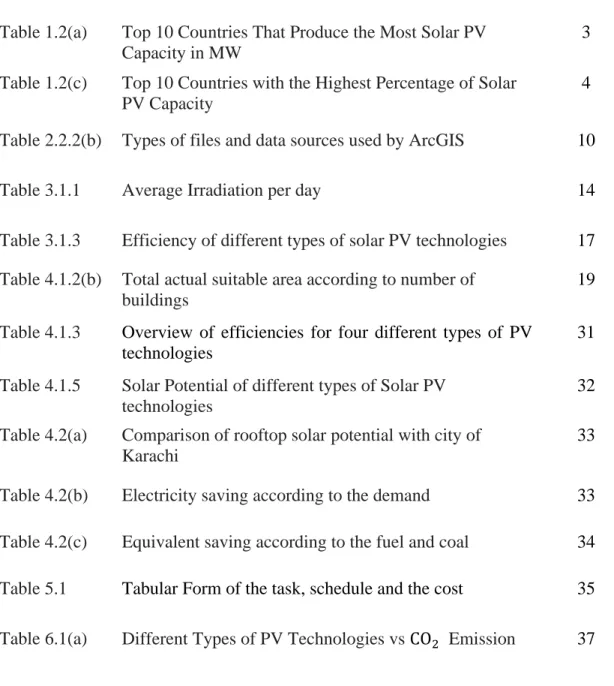
Equivalent savings based on fuel and coal 34 Table 5.1 Tabular form of the task, schedule and costs 35 Table 6.1(a) Different types of PV technologies versus CO2 emissions 37. The following research paper is based on the solar potential on roofs of a municipal area in Bangladesh. In general, inverter conversion efficiencies range from 97% to 99% for best output. 98% of the efficiency of the inverter has been chosen.
The performance ratio for the Asia region is between 84% and 86% and the best performance uses 86% of the PR value. Finally, it is shown that a total potential of 15739 MWh has been found for mono-Si PV panels.
INTRODUCTION
Introduction
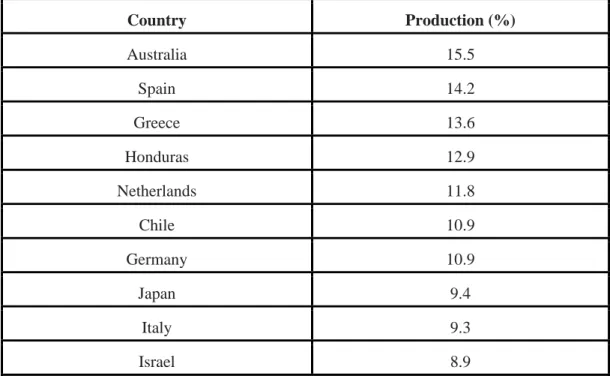
Global Potential of Rooftop Solar PV
So it can be clearly understood that solar energy is the best alternative to fossil fuels and it is the most sustainable and available renewable energy. If we use the solar energy on our roofs, it will benefit both our country and the world.
Objectives
Research Questions
Research Background
Softwares
- PVsyst
- ArcGIS
A number of solar design simulation programs exist today, including Helioscope, Aurora, and PVsyst, with the latter one of the oldest and most widely used. This program provides monthly meteorological data for almost any location on the planet, and if no other source is explicitly specified, PVsyst will use this source by default. PVsyst was a fantastic platform that provided solar radiation based on the latitude and longitude of each location.
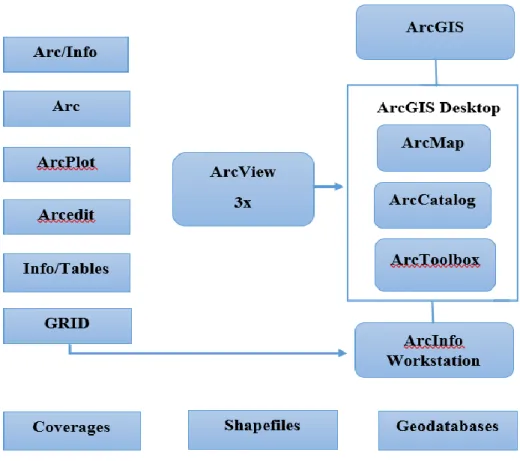
ArcGIS consists of four main software components: a geographic information model for modeling aspects of the physical world; components for storing and managing geographic information in files and databases; a set of ready-made applications for creating, editing, processing, mapping, analyzing and disseminating geographic information; and a collection of web services that provide content and capabilities (data and functions) to networked software clients. The core of the ArcGIS system is called Arc/Info and consists of the programs Arc, ArcEdit and ArcPlot (Figure 1.10). All programs are command-based, meaning that the user types commands into a window to operate them.
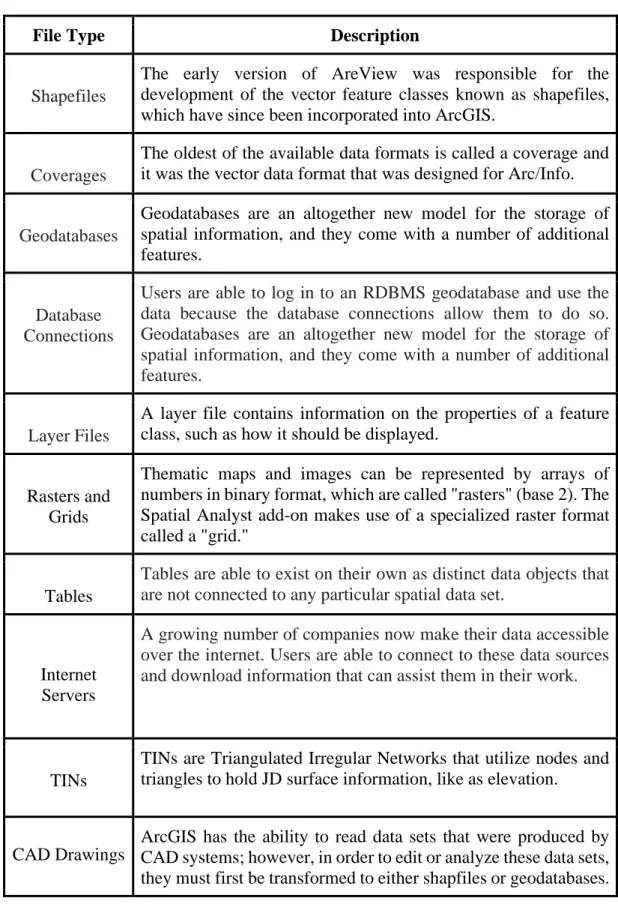
Downloadable scripts and tools can be found in abundance on the ESRI website, which can be accessed at www.esri.com. Many of the datasets that can be used in ArcGIS are listed in table 2.2.2(b). The early version of AreView was responsible for the development of the vector feature classes known as shapefiles, which have since been incorporated into ArcGIS.
The oldest of the available data formats is called an overlay, and it was the vector data format that was designed for Arc/Info. A layer file contains information about the properties of a function class, such as how it should be displayed. Thematic maps and images can be represented by arrays of numbers in binary format called "rasters" (basis 2).
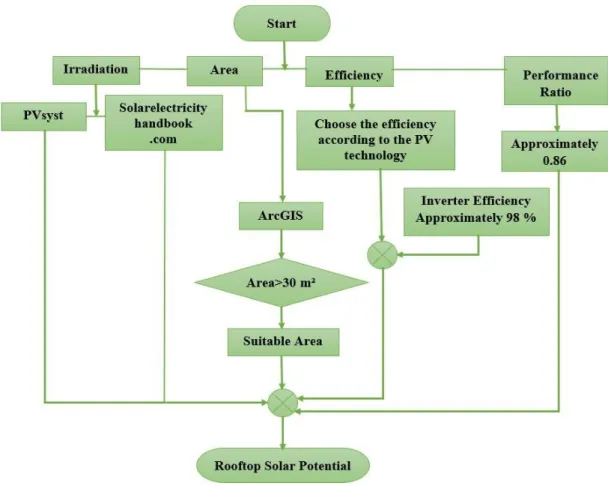
On the other hand, ArcGIS has a number of useful applications, one of which is area estimation. The process is then simplified by performing geometric calculations on the attribute table of the building footprint shape file. ArcMap is also used to estimate the suitable area and solar irradiance, and these values can be used to calculate the solar potential of the roof.
Methodology
- Irradiation Estimation
- Actual Suitable Area Estimation
- Panel Efficiency
- Inverter Efficiency
- Performance Ratio
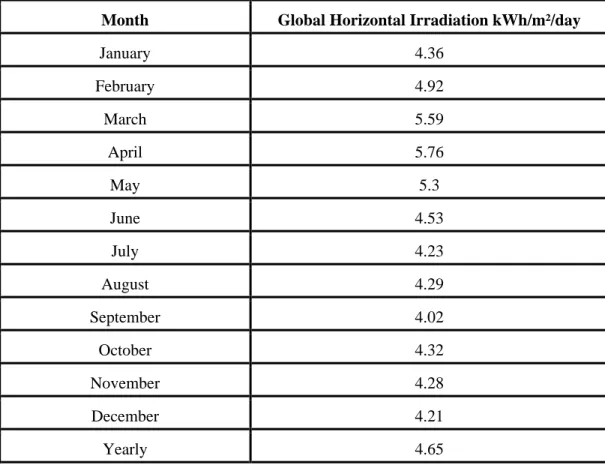
In the PVsyst technique, select the latitude and longitude values from Google (wikipedia.com). The method of using the solarelectricityhandbook.com website can also calculate the radiation simply by setting our desired location and direction of the solar panel in a special section of the website discussed below. To view solar radiation data using this method, please visit the link:. http://www.solarelectricityhandbook.com/solar-irradiance.html).
To set the panel's orientation, select "Directly South" Once the wait is complete, the required information has been received. Now to determine the size of the suitable area on the roof of each building, use another criterion to determine the suitability of solar panels. If a building has less than 30 square meters of suitable roof area, it is generally not suitable for installing solar panels because the installation investment is not worth it.
Confirm that building shapefile is selected in the "Select By Attributes" window for "Input Rows". Right-click the building shapefile in the content pane, point to Data, and select Export Features. Currently, only half of the area that would be suitable for PV installation is used on the roof [14].
The efficiency of a PV module used to produce solar energy is a major factor in determining the potential of rooftop PV. PV panels vary in efficiency and performance based on the technology and materials used in their manufacture. The following table highlights the efficiency of several types of PV panels to illustrate several return-on-investment solar power generation scenarios.
The inverter converts direct current (DC) electricity into alternating current (AC), causing some of the energy to be lost in the form of heat. Higher quality solar inverters are more efficient, meaning they can convert a greater amount of electricity without incurring significant losses. However, the efficiency of the energy system can be affected by shading and other variables, and the photovoltaic inverter can help reduce these effects [18].
Experimental Results & Analysis
- Global Horizontal Irradiation Calculation
- Actual Suitable Area Calculation
- Efficiency Estimation
- Performance Ratio
- Solar Potential Calculation
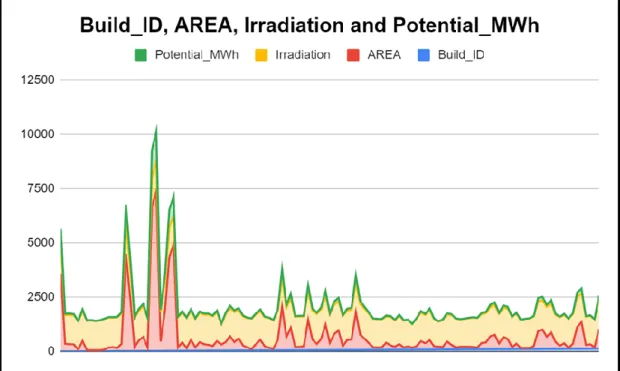
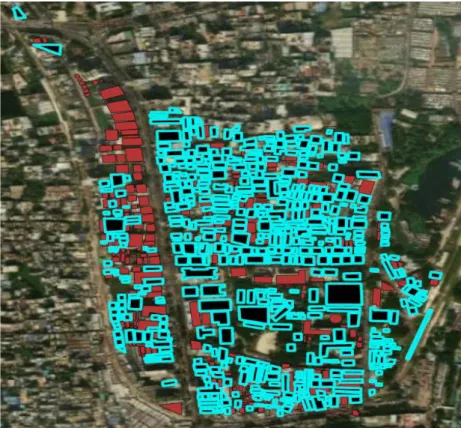
Here, the black area with a blue border represents suitable areas on the Narayanganj roof that are larger than 30 m². Only 50% of the suitable area that can be used for PV panels is used on the roof. Different types of PV technology have different levels of efficiency, with the best quality inverters achieving efficiencies between 97% and 99%.
The performance ratio (PR) can fall anywhere between 60% and 90%, with around 90% being fairly typical in Germany and 71%-72% being very common in Malaysia.
Validation
Discussion
Task, Schedule and Milestones
Area estimation Area estimation with ArcGIS is quite difficult due to the software's inconvenient features.
Resources and Cost Management
𝐂𝐎 𝟐 Emission Estimation
Conclusion
Recommendation for Future Study
5] IndexMundi (2020) Electricity consumption per population by country—world, thematic map. 2017) Renewable Energy Sector Development in Bangladesh: Current Status and Future Potentials.
![Figure 1.2(b): Top 10 countries that produce the most solar PV capacity in MW[8].](https://thumb-ap.123doks.com/thumbv2/filepdfnet/10932187.0/14.893.170.783.662.1048/figure-10-countries-produce-solar-pv-capacity-mw.webp)
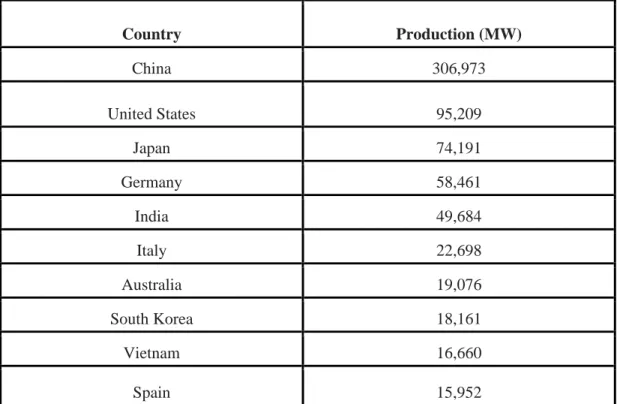
![Table 1.2(a): Top 10 Countries that produce the most solar PV capacity in MW [8].](https://thumb-ap.123doks.com/thumbv2/filepdfnet/10932187.0/14.893.162.782.279.1031/table-10-countries-produce-solar-pv-capacity-mw.webp)
![Table 1.2(c): Top 10 countries with the highest percentage of solar PV capacity[8].](https://thumb-ap.123doks.com/thumbv2/filepdfnet/10932187.0/15.893.166.782.206.1008/table-10-countries-highest-percentage-solar-pv-capacity.webp)