ROLE OF ISLAMIC EDUCATION TO DEVELOP THE
STUDENTS’ MULTICULTURAL ATTITUDE
(The Correlational Study at MTS. Pembangunan UIN Jakarta)A Minithesis
Submitted to the Faculty of Tarbiyah and Teachers Training
As a Partial of Fulfillment of Requirements for a Degree of Stratum 1 (Bachelor of Art) in Islamic Education
By:
MUHAMAD FAUZI NIM : 105011000021
ISLAMIC EDUCATION DEPARTEMENT
FACULTY OF TARBIYAH AND TEACHERS TRAINING
STATE ISLAMIC UNIVERSITY OF SYARIF HIDAYATULLAH
ACKNOWLEDGMENT
All Praises be to Allah SWT that still provides the opportunity for the
writer to believe and worship Him, especially worships in self improvement so
that he is closer to Him. He bears to witness that there is no worthy of worship
except Allah. Peace and Salutation be upon Muhammad SAW, His devoted
servant and His great messenger and he bears Muhammad SAW is Allah’s
messenger.
Finally, he was able to complete this minithesis as the partial fulfillment of
the requirement for the degree of strata 1 in Islamic education with the title “The
Role of Islamic Education to Develop Students' Multicultural Attitudes (The Correlational Study at MTs. Pembangunan UIN Jakarta)”. This minithesis is
the result of research at MTs. Pembangunan Syarif Hidayatullah Jakarta with the
focus of research about the correlation between Islamic Education to develop the
students’ multicultural attitude. He would like to thank his parents, Abi (H.
Mujeni Abdullah) and Ami (Hj. Asiah) and his lovely sister Firli Astuti. And he
also would like to thank his advisors who always guide and help him to complete
this minithesis, Prof. Dr. Dede Rosyada MA and Drs. Syauki, M. Pd.
Furthermore, he would like to thank many people who have helped him
to complete this minithesis, they are:
1. The Dean of Faculty of Tarbiyah and Teachers Training (FITK) State Islamic
University of Syarif Hidayatullah Jakarta
2. The Head and the Secretary of Islamic Education Department and All staff of
Islamic Education Department and Faculty of Tarbiyah and Teachers Training
at State Islamic University of Syarif Hidayatullah Jakarta
3. Dr. Hj. Siti Salmiah, MA as an academic supervisor who always gives him
4. All lectures of Tarbiyah and Teachers Training Faculty at State Islamic
University of Syarif Hidayatullah Jakarta, especially all lectures of Islamic
Education Department who has devoted his knowledge to him and assisted
him to complete this minithesis.
5. The principle, teachers and all staffs of Islamic Junior High school of
Pembangunan State Islamic University of Syarif Hidayatullah Jakarta, where I
did research
6. All his friends at Islamic Education Department in State Islamic University of
Syarif Hidayatullah Jakarta, especially the period 2005-2006
7. All his friends on bilingual class of Islamic Education Department periods
2005-2006 State Islamic University of Syarif Hidayatullah Jakarta
8. All his friends at BEM-J PAI periods 2005-2006
9. All his friends at IKADA Jakarta Raya
10.All his friends that he cannot mention one by one, he would like to extend his
grateful to every individual for their careful reading and valuable suggestion
as well as warm attention to the writer.
Actually, he realized that this minithesis is far from being perfect as a
scientific paper. So he expects any reader contributes his or her valuable
comments and suggestions to improve this minithesis become much better.
Jakarta, March 19th, 2010
LIST OF TABLES
Table 3. 1 The Matrix Variables of Students’ Multicultural Attitude ... 30
Table 3. 2 The Amount of Population and Sample ... 32
Table 3. 3 The Instrument of Students’ Multicultural Attitude... 34
Table 3. 4 The Result of Valid Instrument... 36
Table 3. 5 The Result of Reliability Test ... 37
Table 3. 6 Valid and Reliable of Instrument ... 38
Table 4. 1 Students of MTs. Pembangunan UIN Jakarta Gender Based ... 41
Table 4. 2 Students of MTs. Pembangunan UIN Jakarta Age Based ... 42
Table 4. 3 Distribution Frequency Score of Students’ Learning Achievement of Islamic Education ... 43
Table 4. 4 Distribution Frequency Score of Students’ Multicultural Attitude.. 44
Table 4. 5 The Result of Normality Test of Islamic Education and Students’ Multicultural Attitude ... 46
Table 4. 6 The Correlation between Islamic Educations to Develop The Students’ Multicultural Attitude at MTs. Pembangunan UIN
Jakarta
... 47LIST OF FIGURES
Figure 4.1 Distribution Frequency Score of Islamic Education ... 44
CHAPTER I
INTRODUCTION
A. Background of Study
Indonesia is a pluralist nation, which is inhabited by varieties of ethnic,
cultural and religions. The diversity is the characteristic of Indonesia. It will
become valuable manifestation for Indonesia, if it is managed properly. But if
it is not managed properly the diversity will become crucial issues that caused
the clash of civilization in Indonesia. Actually the diversity in Indonesia is
complex and not simple, requires a correct attitude in society in responding
the diversity.1 According to Muhammad Ali, diversity also could be solved by
the development of multicultural attitudes in society.2 In the discourse of
multiculturalism requires not only recognition of diversity, but also cultural
awareness and inclusive transformative, they can be done by allowing the
internal-community culture that grew and developed in accordance with
foreign cultural.3
In this context, education has an important role in dialectic–
transformation of social culture which is expected to develop the social
culture,4 in term of respect to the diversity of society. Spectrum of cultural
community is varying and they are being a challenge for the educational
process in order to be a valuable asset. Diversity of cultural society can be
solved with the students’ multicultural understanding.5 There is no
discrimination in the classroom on the basis of religious differences, ethnic,
1
Nurcholis Madjid, Islam Doktrin Dan Peradaban; Sebuah Telaah Kritis Tentang Masalah Keimanan, Kemanusiaan Dan Kemodernan, (Jakarta: Yayasan Wakaf Paramadina, 2005), 5th edition, p. 160.
2
Muhamad Ali, Teologi Pluralis-Multikultural; Menghargai Kemajemukan Menjalin Kebersamaan, (Jakarta: Kompas, 2003), p. 72.
3
Anik Farida, Menanamkan Sikap Multikultural; Belajar Menghapus Prasangka di SMA Don Bosco Padang, In Journal of Penamas, Vol. XXI, No. 1, 2008, p. 27.
4
A. Malik Fadjar, Reorientasi Pendidikan Islam, (Jakarta: YPI Fajar Dunia, 1999), p. 121. 5
gender, sex, culture, social class, race and so on. Educational process provides
equal opportunities for all students from various religious backgrounds,
ethnic, culture, and race and skin color.6
As the response of the statement above, Islamic education which
strengthens the noble cultural value such as democracy and social awareness7
has an important role in implementing the students’ multicultural
understanding in School, particularly in Islamic institutions (Islamic Boarding
School or Pesantren and Islamic School or Madrasah). Islamic education is required to perform the value transformation through moral potential in order
to create the civil society, either by the dogmatic value or by the intellectual
and cultural explanation.8
In fact, Islamic education has not provided concrete solutions to solve
the conflict in the community, especially the problem caused by racial
differences, cultural and religious groups.9 Society is not tolerant to the
cultural differences encountered in the social interaction among diverse
communities. The positive differences, for the Indonesian people, have been
changed by emotional and destructive people.10 A research conducted by
“Kompas”, reported that in Islamic education subject, there are very few textbook concerning about religious tolerances, mainly about Islamic dogma.
This proves that the Islamic education leads to form exclusive individually
and do not have sensitivity on the cultural diversity. In this case, it seems clear
that the Islamic education in Indonesia focused more to normative teaching
and far from the reality of life.11
According to the explanation above, Islamic education in Indonesia
does not support to create the relationships in a multicultural society.
6
Zakiyuddin Baidhawy, Pendidikan Agama Berwawasan Multikultural, (Jakarta: Erlangga, 2005), p. 8.
7
H.A. R. Tilaar, Membenahi Pendidikan Nasional, (Jakarta: Grafindo, 2002), p. 54. 8
A. Malik Fadjar, Reorientasi Pendidikan...,p. 123. 9
Sudirman Tebba, Islam Pasca Orde Baru, (Yogyakarta: Tara Wacana, 2001), p. 137. 10
Muhaimin et. al, Paradigma Pendidikan Islam; Upaya Mengefektifkan Pendidikan Agama di Sekolah, (Bandung: Remaja Rosdakarya, 2002), p. 88-89.
11
Meanwhile according to verse of Al-Qur’an in al-Hujurat: 8, in Islam justice
can be used as the core value of the noble morality in a plural society.
So, the justice as Islamic doctrine can be realized as the solution to
create peace, happiness for all beings, especially human beings as leader of the
world.12 According to the statement above, the Islamic education is the way
for reconstruction of the students’ multicultural understanding, increasing
mutual respect, mutual trust and mutual understanding between different of
ethnic, cultures and religions. In the development of Islamic education,
multicultural paradigm needs to be a major foundation curriculum and the
implementation process of learning – teaching activities. Islamic education
needs review again about religious perspectives, from an exclusive view into
the multicultural view or at least to maintain an inclusive and pluralist view.
Religious education in the spirit of multicultural paradigm is based on a
dialogue about the consciousness in diversity and different lives. Education is
built on the basic of harmony, mutual respect, mutual understanding and
mutual respect for differences, equality and uniqueness.13
Based on the explanation above, in an effort to improve the quality of
character of personality of Indonesian young generation in the future, MTs.
Pembangunan UIN Jakarta as an Islamic institution of education always
12
Abd A’la, Konflik Agama, Etnisitas, Dan Politik Kekuasaan: Membincang Akar Persoalan dan Signifikansi Pengembangan Teologi Tranformatif, in Thoha Hamim et. al, Resolusi Konflik Islam Indonesia, (Yogyakarta: LKiS, 2007), p. 113.
13
Sumarsih Anwar, Pendidikan Agama Berwawasan Multikultural, In Journal of Penamas, Vol. XXI, No. 1, 2008, h. 97.
makes innovation of curriculum development as a consequence of
globalization era. One of those is to develop the model of multicultural
education. Implementation of development multicultural education programs
at MTs. Pembangunan UIN Jakarta may be known by some indicator of
learning achievement, they are the students to understand the multicultural
values, for example, tolerance, and solidarity and so on.
Finally, through the construction of the students’ multicultural
understanding in Islamic education, the writer take the title of study is
“ROLE OF ISLAMIC EDUCATION TO DEVELOP THE STUDENTS’ MULTICULTURAL ATTITUDE (THE CORRELATIONAL STUDY AT MTS. PEMBANGUNAN UIN JAKARTA)”.
B. Identification of Study
Based on the background above, it has described the development of
Students’ multicultural attitude in Islamic education. The writer will identify
the problems of this study, those are:
1. Curriculum of Islamic education supports the development of students’
multicultural attitude at MTs. Pembangunan UIN Jakarta
2. Learning strategy of Islamic education supports the development of
students’ multicultural attitude at MTs. Pembangunan UIN Jakarta
3. Learning process of Islamic education increases the development of
students’ multicultural attitudes at MTs. Pembangunan UIN Jakarta
4. Objectives of learning of Islamic education supports the development of
students’ multicultural attitude at MTs. Pembangunan UIN Jakarta
5. Subject matter of Islamic education supports the development of students’
multicultural attitude at MTs. Pembangunan UIN Jakarta
6. Evaluation of learning of Islamic education supports the development of
students’ multicultural attitude at MTs. Pembangunan UIN Jakarta
According to the role of Islamic education in development of Students
multicultural Attitude is very wide, so the writer limits the study on:
1. Islamic education subject supports the students’ multicultural attitude at
MTs. Pembangunan UIN Jakarta.
D. Research Problem
Islamic education has a positive correlation in developing the students’
multicultural attitude at MTs. Pembangunan UIN Jakarta. So the writer make
questioner research, those are:
1. Is there a positive correlation between Islamic education and the students’
multicultural Attitude?
2. Is there a significant contribution between Islamic education and the
students’ multicultural Attitude?
E. Objectives and Significance of Study
1. Objectives of StudyThis study has the objectives of study including:
a. To find out the correlation between Islamic education and the
Student’s multicultural attitude at MTs. Pembangunan UIN Jakarta
b. To find out the contribution of Islamic education to develop the
Student’s multicultural attitude at MTs. Pembangunan UIN Jakarta
2. Significance of study
This study has significance of study, such as:
a. Theoretical Significance
The result of this study is expected to inform the development
of the students' multicultural attitude in Islamic education.
b. Practice Significance
To motivate the teachers in guidance the students of MTs.
Pembangunan UIN Jakarta develops the students' multicultural
attitude properly.
2) School
To inform the School that implement multicultural
education concept and strategy in instructional goal, curriculum
and management of education, especially on Islamic education
subject
3) Student of MTs. Pembangunan UIN Jakarta.
To motivate the students of MTS. Pembangunan UIN
Jakarta develops the students' multicultural attitude maximum
CHAPTER III
RESEARCH METHODOLOGY
In this chapter, the writer would like to explain about the place and time of
research, variables of research, methodology of research, population and sample,
data collection techniques, validity and reliability test of instruments, and data
analysis techniques.
A.
Place and Time of Research
The research took place at MTs. Pembangunan UIN Jakarta located on
Ibn Taimia Road IV complex of UIN Syarif Hidayatullah Ciputat-Tangerang.
The research started from May 2009 until February 2010. The Writer took
MTS. Pembangunan UIN Jakarta as the research object because this
institution developed multicultural educational program through which it
developed student personality character. So, the writer would like to know the
correlation between Islamic education and students’ multicultural attitude at
MTS. Pembangunan UIN Jakarta.
This Research uses description correlational method with two
variables; those are Islamic education subject and the students’ multicultural
attitude. The research uses Pearson correlational product moment.14
C.
Variables of Research
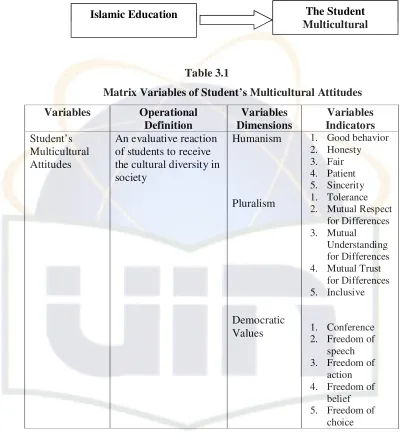
This research has two variables, as following:
1. Independent variable is Islamic education
a. The conceptional variables definition of Islamic education
Islamic education is instructional effort to develop the physical and
spiritual growth through the Islamic teaching which reached the level of the
main character and happiness in the world and hereafter (X Variable).
b. The operational variables definition of Islamic education
The Islamic education subject divided into four parts, that Al-Qur’an
and Prophet Tradition, history of Islamic culture, the belief and moral and
Islamic jurisprudences.
2. Dependent variable is students multicultural attitudes variable
a. The conceptional variables definition of students multicultural attitudes
The student multicultural attitude is an evaluative reaction of
students to receive the cultural diversity in society. Measurement of this
dimension is made by the multicultural education questioner. (Y Variable).
b. The operational variables definition of students multicultural attitudes
The dimension of this variables are Humanism which is including
good behavior, honesty, fair, patient and sincerity, Pluralism which is
including tolerance, mutual respect for differences, mutual understanding for
differences, mutual trust for differences and Inclusive, And Humanism
Values which is including conference, freedom of speech, freedom of action,
freedom of belief and Freedom of choice.
14
Table 3.1
Matrix Variables of Student’s Multicultural Attitudes
Variables Operational
Definition Variables Dimensions Variables Indicators Student’s Multicultural Attitudes
An evaluative reaction of students to receive the cultural diversity in society
Humanism
Pluralism
Democratic Values
1. Good behavior 2. Honesty 3. Fair 4. Patient 5. Sincerity 1. Tolerance 2. Mutual Respect
for Differences 3. Mutual
Understanding for Differences 4. Mutual Trust
for Differences 5. Inclusive
1. Conference 2. Freedom of
speech 3. Freedom of
action 4. Freedom of
belief 5. Freedom of
choice
D.
Population and Sample
1. Population
Islamic Education The Student
[image:14.612.112.514.115.551.2]According to Arikunto, "Population is the subject of research".15
Population is the totality of all values that may be obtained from the
results or the measurement of quantitative and qualitative characteristics of
the particular and all members of a complete and clear is that you want to
learn.16 Population in this research is all the students at MTs.
Pembangunan UIN Jakarta in the second level, 239 students. The
population have criteria, that are, they have learned about multicultural
subject in Islamic education in the second level.
2. Sample
According to Arikunto, the sample is representative of the
population studied. Samples taken in order to represent the research data,
it is necessary to calculate the number of the population.17 Arikunto stated
that:
When the subject is less than 100 it is better taken the entire
subject as population. Furthermore, if the subject is more than 100
people, it can be taken between 10-15% or 20-25% or more " as sample
depending at least from18:
a. Research capacity in terms of time, finances, and funds
b. Observation of narrow land area of each subject, because this involves a lot
of data at least
c. The size of the risk incurred researchers
In this research the sampling technique used is a purposive random
sampling by taking 20% of samples in the population, because the number
of population or subject of research to reach more than 100 of students. By
the purposive random sampling technique, subject of research that relating
the requirement of research has same opportunity for fulfillment of criteria
of research become the sample.
15
Suharsimi Arikunto, Prosedur Penelitian Evaluasi Pendidikan, (Jakarta: Rineka Cipta, 1998), p. 115.
16
Nana Sudjana, Penilaian Hasil Belajar, (Bandung: Rosda Karya, 1999), p. 6. 17
Suharsimi Arikunto, Dasar-Dasar Evaluasi…,p. 10. 18
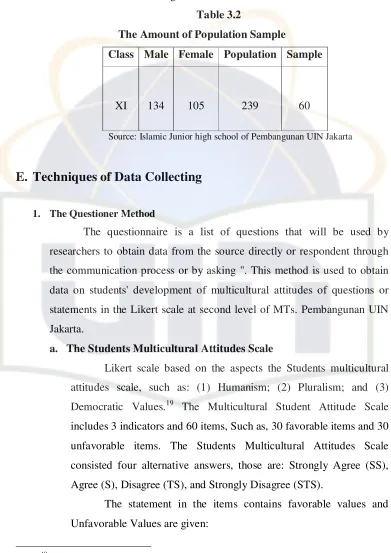
For more details about the number of samples from this research
[image:16.612.117.508.138.691.2]can be seen in the following Table:
Table 3.2
The Amount of Population Sample
Class Male Female Population Sample
XI 134 105 239 60
Source: Islamic Junior high school of Pembangunan UIN Jakarta
E.
Techniques of Data Collecting
1. The Questioner Method
The questionnaire is a list of questions that will be used by
researchers to obtain data from the source directly or respondent through
the communication process or by asking ". This method is used to obtain
data on students' development of multicultural attitudes of questions or
statements in the Likert scale at second level of MTs. Pembangunan UIN
Jakarta.
a. The Students Multicultural AttitudesScale
Likert scale based on the aspects the Students multicultural
attitudes scale, such as: (1) Humanism; (2) Pluralism; and (3)
Democratic Values.19 The Multicultural Student Attitude Scale
includes 3 indicators and 60 items, Such as, 30 favorable items and 30
unfavorable items. The Students Multicultural Attitudes Scale
consisted four alternative answers, those are: Strongly Agree (SS),
Agree (S), Disagree (TS), and Strongly Disagree (STS).
The statement in the items contains favorable values and
Unfavorable Values are given:
19
Assesment Scale
Favorable (+) Unfavorable (-)
Answer Score Answer Score
Strongly Agree (SS) Agree (S) Disagree (TS) Strongly Disagree (STS) 4 3 2 1 Strongly Agree (SS) Agree (S) Disagree (TS) Strongly Disagree (STS) 1 2 3 4
2. The Documentation Method
Arikunto stated that, documentation comes from the word “document”,
which means is the items written". In implementing the method of
documentation, investigating things like writing books, magazines, the
regulations, with daily records, and documents.20 This method to obtain data on
the number of students, the general description of student of MTs. Pembangunan
UIN Jakarta and learning achievement data values of Students at second level in
first semester 2009/2010 of the subjects of Islamic education.
a. The Reports Achievements of Islamic Education
Student achievement of Islamic education includes Islamic
jurisprudence, Morals and belief, Al-Qur'an and prophet tradition, and
History of Islamic Culture.
20
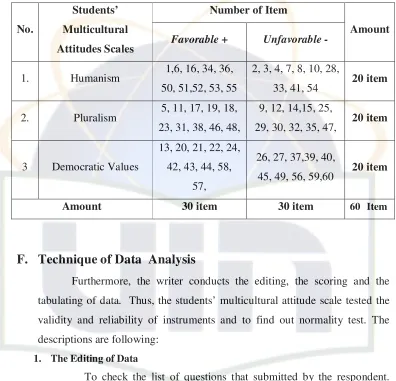
Table 3.3
The Instrument of Students’ Multicultural Attitude
F.
Technique of Data Analysis
Furthermore, the writer conducts the editing, the scoring and the
tabulating of data. Thus, the students’ multicultural attitude scale tested the
validity and reliability of instruments and to find out normality test. The
descriptions are following:
1. The Editing of Data
To check the list of questions that submitted by the respondent.
The writer examined one by one these surveys, this is done in order to
avoid the errors of questionnaire and the results obtained truly objective.
2. The Scoring of Data
That gives a score on questionnaire sheets that have been in the
content by the respondent. Favorable statements were scored 1,2,3,4 while
unfavorable statements were scored otherwise. Number of Item No.
Students’ Multicultural
Attitudes Scales Favorable + Unfavorable -
Amount
1. Humanism 1,6, 16, 34, 36, 50, 51,52, 53, 55
2, 3, 4, 7, 8, 10, 28,
33, 41, 54 20 item
2. Pluralism 5, 11, 17, 19, 18, 23, 31, 38, 46, 48,
9, 12, 14,15, 25,
29, 30, 32, 35, 47, 20 item
3 Democratic Values
13, 20, 21, 22, 24,
42, 43, 44, 58,
57,
26, 27, 37,39, 40,
45, 49, 56, 59,60 20 item
3. The Tabulating of Data
That is processing data by moving data into the frequency table to
facilitate the writers to do the data interpretation.
4. Reliability and Validity of Instruments of Research
a. Validity Test
Validity is a measurement that indicates levels validation. A valid
instrument has high validity, and invalid instrument has low validity. The
validity of tests conducted to determine whether the instrument is truly
measuring what it should be measured. The validity test uses the formula of
the Pearson’s product moment correlation, as follows21:
r
ix = N ix – ( i)( x)√√√√[N i2 – ( i)2] [N x2 – ( x)2] Description:
r
ix = item-total correlation coefficients (Bivariate Pearson)N = Number of respondents
x = Total Score
i = Item Score
The respondents of validity test are the students of MTs.
Salafiyah-Syafi’iyyah Pangkalan Jati in the second level who have
same characteristic with the sample of research, amounting to 30
students.
1). The Result of Validity Test of Research
Analysis results obtained from the correlation value between the
item score with total score. This value then is compared with Table
values of r, r searchable Table at the 0.05 significance test 2-tailedand
the amount of data (n) = 60, then found a Table of r 0.576 (see the
appendix r Table ).
21
Based on the analysis of correlation values obtained for items 11,
12, 36, 46, 48, 49, 50, 53, 56, 57, 59 score less than 0.361. It can be
concluded that these items did not correlate significantly with total score
(expressed not valid) and should be removed or repaired. Whereas in
other items more than 0.576 and it can be concluded that the items are
[image:20.612.116.515.109.516.2]valid instruments.
Table 3.4
The Result of Valid Instrument
Number of Valid Items
No Dimensions
of Variables Favorable Unfavorable Invalid Amount
1. Humanism 1,6, 16, 34,
51,52, 55
2, 3, 4, 7, 8, 10, 28, 33, 41, 54
36, 50, 53
20
2. Pluralism 5, 17, 19, 18, 23, 31, 38,
9, 14,15, 25, 29, 30, 32, 35,
47
11, 12, 46, 48
20
3. Democratic
values
13, 20, 21, 22, 24, 42, 43, 44,
58,
26, 27, 37,39, 40, 45, 60
49, 56, 57, 59
20
Amount 23 26 11 60
b. Reliability Test
According to Guilford and Fruchter, reliability is the proportion of
the variance that is true variance. Meanwhile according to Borg and Gall,
reliability is the level of internal consistency or stability of the measuring
devices over time.22 The reliability test uses the formula of Croanbach Alpha, those are23:
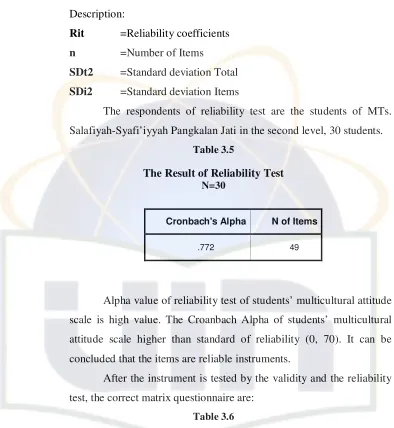
Rit = n SDt2– (SDi2) (n - 1) SDt2
22
Tedjo N. Reksoatmodjo, Statistika Untuk Psikologi dan Pendidikan, (Bandung: Refika Aditama, 2007), p. 188-189.
23
Description:
Rit =Reliability coefficients n =Number of Items
SDt2 =Standard deviation Total SDi2 =Standard deviation Items
The respondents of reliability test are the students of MTs.
[image:21.612.114.508.100.528.2]Salafiyah-Syafi’iyyah Pangkalan Jati in the second level, 30 students.
Table 3.5
The Result of Reliability Test
N=30
Alpha value of reliability test of students’ multicultural attitude
scale is high value. The Croanbach Alpha of students’ multicultural
attitude scale higher than standard of reliability (0, 70). It can be
concluded that the items are reliable instruments.
After the instrument is tested by the validity and the reliability
test, the correct matrix questionnaire are:
Table 3.6
Valid and Reliable of Instrument
Cronbach's Alpha N of Items
.772 49
Number of Item No.
Students’ Multicultural
Attitudes Scales Favorable ( + ) Unfavorable ( -)
Amount
1. Humanism 1, 6, 14, 15, 24,
32, 34, 41, 2, 7, 8, 16, 26, 31, 33, 47
16 item
2. Pluralism 4, 5, 9, 11, 17, 21, 45,
3, 10, 12, 13, 23,
30, 43,44, 46, 49, 17 item 3 Democratic Values 18, 19, 20, 22, 28,
29, 36, 38, 42, 48,
25, 27, 35, 37, 39,
[image:21.612.153.539.566.701.2]5. Normality Test
Normality test was conducted to determine whether the studied sample
has a normal distribution or not. Normality test uses Chi-Square formula is
following:
Description:
X2 = Chi-Square
fo = Frequency Observation fe = frequency expectations
6. The Finding a Correlation between Islamic Education (X) and Students’
Multicultural Attitude (Y)
To find out the correlation between Islamic education and students’
multicultural attitude uses the formula of Pearson correlational product moment
is following:
r
xy = N XY – ( X)( Y) √√√√[N X2 – ( X)2] [N Y2 – ( Y)2]Description:
rxy = Product Moment correlation coefficients
N = Number of respondents
X = Sum of all scores X
Y = Sum of all scores Y
XY = Number of times between the X and Y
X2 = Number of scores all square X
y2 = Number of Y scores all square
7. The Finding a Contribution of Islamic Education (X) to Develop Students’
Multicultural Attitude (Y)
To find out the contribution of Islamic education to develop
students' multicultural attitude uses the formula of coefficient of
Determination is following:
R2 = SS regression ( Xy1)2
SS total X1 Y1 2
Description:
R2 = the coefficients Determinacy
SS regression = the number of square regression
SS total = the total number of square
G.
Hypothesis of Statistics
Ha: r observation > r TableHo: r observation < r Table
All statistical calculation uses the program of SPSS 15.0 for Windows
CHAPTER IV
RESEARCH FINDING
In this chapter, the writer would like to explain about the description of
data, the analysis of data, the hypothesis test and the weakness of study.
A.
Description of Data
[image:24.612.112.543.160.693.2]1. Characteristic of Respondent
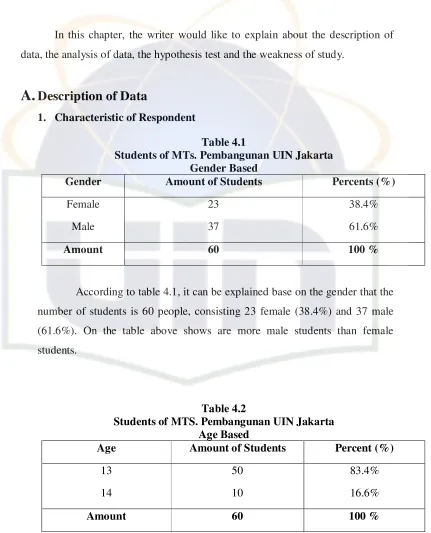
Table 4.1
Students of MTs. Pembangunan UIN Jakarta Gender Based
Gender Amount of Students Percents (%)
Female 23 38.4%
Male 37 61.6%
Amount 60 100 %
According to table 4.1, it can be explained base on the gender that the
number of students is 60 people, consisting 23 female (38.4%) and 37 male
(61.6%). On the table above shows are more male students than female
students.
Table 4.2
Students of MTS. Pembangunan UIN Jakarta Age Based
Age Amount of Students Percent (%)
13 50 83.4%
14 10 16.6%
According to table 4.2, it can be explained that 13 years old, they are
50 students (83.4%) and 14 years old, they are 10 students (16.6%). On the
above table shows most of students are 13 years old.
2. Data of Students’ Achievement of Islamic Education
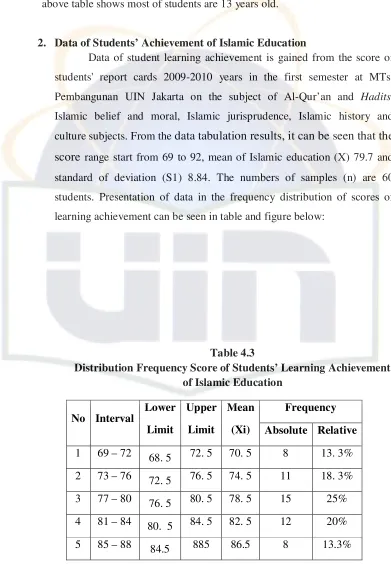
Data of student learning achievement is gained from the score of
students' report cards 2009-2010 years in the first semester at MTs.
Pembangunan UIN Jakarta on the subject of Al-Qur’an and Hadits, Islamic belief and moral, Islamic jurisprudence, Islamic history and
culture subjects. From the
data tabulation results, it can be seen that the
score
range start from 69 to 92, mean of Islamic education (X) 79.7 and standard of deviation (S1) 8.84. The numbers of samples (n) are 60students. Presentation of data in the frequency distribution of scores of
[image:25.612.112.503.149.713.2]learning achievement can be seen in table and figure below:
Table 4.3
Distribution Frequency Score of Students’ Learning Achievement of Islamic Education
Frequency No Interval
Lower Limit
Upper Limit
Mean
(Xi) Absolute Relative 1 69 – 72 68. 5 72. 5 70. 5 8 13. 3%
2 73 – 76 72. 5 76. 5 74. 5 11 18. 3%
3 77 – 80 76. 5 80. 5 78. 5 15 25%
4 81 – 84 80. 5 84. 5 82. 5 12 20%
6 89 – 92 88.5 92.5 90.5 6 10%
Amount 60 100%
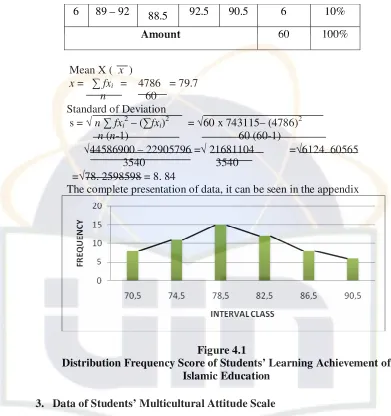
Mean X ( x )
x = fxi = 4786 = 79.7 n 60
Standard of Deviation
s = √ n fxi2 – ( fxi)2 = √60 x 743115– (4786)2 n (n-1) 60 (60-1)
√44586900 – 22905796 =√ 21681104 =√6124. 60565 3540 3540
=√78. 2598598 = 8. 84
[image:26.612.114.505.103.519.2]The complete presentation of data, it can be seen in the appendix
Figure 4.1
Distribution Frequency Score of Students’ Learning Achievement of Islamic Education
3. Data of Students’ Multicultural Attitude Scale
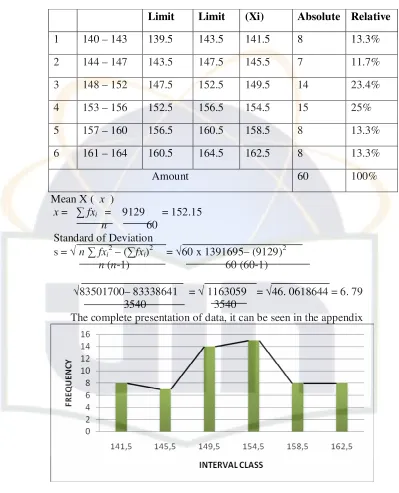
Data of the students’ multicultural attitude is gained from the
students' multicultural attitude scale. From the data tabulation results, it
can be seen that the score range start from 140 to 164, mean of the
students’ multicultural attitude (Y) is 152.15 and standard of deviation
(S1) is 6.79. The numbers of samples are 60 students. Presentation of data
in the frequency distribution of scores of students' multicultural attitude
can be seen in table and figure below:
Table 4.4
Distribution Frequency Score of Students’ Multicultural Attitude
Limit Limit (Xi) Absolute Relative 1 140 – 143 139.5 143.5 141.5 8 13.3%
2 144 – 147 143.5 147.5 145.5 7 11.7%
3 148 – 152 147.5 152.5 149.5 14 23.4%
4 153 – 156 152.5 156.5 154.5 15 25%
5 157 – 160 156.5 160.5 158.5 8 13.3%
6 161 – 164 160.5 164.5 162.5 8 13.3%
Amount 60 100%
Mean X ( x )
x = fxi = 9129 = 152.15 n 60
Standard of Deviation
s = √ n fxi2 – ( fxi)2 = √60 x 1391695– (9129)2 n (n-1) 60 (60-1)
√83501700– 83338641 = √ 1163059 = √46. 0618644 = 6. 79 3540 3540
[image:27.612.113.512.98.591.2]The complete presentation of data, it can be seen in the appendix
Figure 4.2
Distribution Frequency Score of Students’ Multicultural Attitude
B.
Data Analysis
1. Normality TestNormality test was conducted to determine whether the research
Chi-Square test (Chi Square test). Normality test calculations are presented
in the appendix. The result of normality test of Islamic education and
[image:28.612.113.517.164.519.2]students’ multicultural attitude can be seen by table below:
Table 4.5
The Result of Normality Test of Islamic Education and Students’ Multicultural Attitude
Variable
Number of Sample
X2
Observation X
2 table
Decision
Islamic Education 60 3. 904 11.070 Normal
Students’ Multicultural
Attitude
60 2.155 11.070 Normal
The value of X2 table based on the score taken at the consultation table Chi-Square at 0. 05 level of significance. Column
decisions made based on the normality hypothesis testing i.e., if X2 Observation is smaller than X2 table, the data is found has a normal
distribution. Conversely, if X2 Observation is bigger than X2 table, the
data is found did not has a normal distribution. The above table shows
that on the both of data value of X2 observation is smaller than the X2 table. It means that the data has a normal distribution.
C.
Hypothesis Test and Discuss
To find out the correlation between Islamic education and students’
multicultural attitude is used correlational Pearson Product Moment. The
calculation of correlation is used to determine the correlation between Islamic
educations and the Students' multicultural attitude at the Islamic Junior high
school of Pembangunan UIN Jakarta. The results of calculations are presented
Table 4.6
The Correlation between Islamic Educations and the Students’ Multicultural Attitude at MTs. Pembangunan UIN Jakarta
** Correlation is significant at the 0.01 level (2-tailed).
In short according to the table above, it can be concluded that the
calculation of the correlation between Islamic educations and the development
of students' multicultural attitude at MTS. Pembangunan UIN Jakarta is .659
(r Observation= .659). Base on the value of r table of product moment in 0.
05 is .254 and in 0. 01 is .330. Actually r observation is bigger than r tables of
the level of 0.05 and 0.01 (.254/.330). So that the Null Hypothesis (There are
no significant positive correlation between Islamic educations and the
development of Students’ multicultural attitude) is refused and the Alternative
Hypothesis (There are a significant positive correlation between Islamic
education and the development of Students’ multicultural attitude.
)
is accepted. It means that the Islamic education has a positive correlation todevelop the students' multicultural attitude at MTs. Pembangunan UIN
Jakarta.
ISLAMIC EDUCATION
STUDENTS' MULTIKULTURAL
ATTITUDE
ISLAMIC EDUCATION Pearson
Correlation 1 .659(**) Sig. (2-tailed) .000
N 60 60
STUDENTS' MULTIKULTURAL
ATTITUDE
Pearson
Correlation .659(**) 1 Sig. (2-tailed) .000
To find out the contribution of Islamic education to develop students’
multicultural attitude is used a simple regression analysis. The results of
calculations are presented in table 4.7 below:
Table 4.7
The Simple Regression Analysis of Islamic Educations to Develop the Students’ Multicultural Attitude at MTs. Pembangunan UIN Jakarta
N: 60
Model Summary
a Predictors: (Constant), STUDENTS' MULTICULTURAL ATTITUDE b Dependent Variable: ISLAMIC EDUCATION
Coefficient of determination indicates that the contribution of Islamic
education to develop the Students' multicultural attitude at MTs.
Pembangunan of UIN Jakarta in the second level is R2 = 43. 4%. It means
that Islamic education has a high contribution to develop the Students'
multicultural Attitude.
D.
Weakness of Study
The writer realized that the study is far from a perfect. Because, there
are still many things that cannot be controlled so, the results of this study are
not ideal, those are:
1. Lack of oversight in the charging procedure students' multicultural attitude
scale by students.
2. Psychological influences students when respondents answered the
statements about the students' multicultural attitude scale, so that students
can only answer the questionnaire items are not submitted in accordance
with what is perceived or performed daily.
3. Limitation of time of student to finish a multicultural attitude scale
Model R R Square Adjusted R Square Std. Error of the Estimate
However, these problems are not reducing the results of this study
which have been obtained. Actually, the results of this study can be used as
CHAPTER V
CONCLUSION AND
RECOMMENDATIONS
A.
CONCLUSION
Base on the results of this study, it can be summarized that Islamic
education has a significant positive correlation to develop students'
multicultural attitude at MTs. Pembangunan UIN Jakarta. It is evidenced by
the high value of the data analysis results obtained, r observation (0.659) is
bigger than r tables in the level 0.05 (0.254) and 0.01 (0.330). Besides that, the
data analysis results of this study also show that the Islamic education has a
high contribution to develop the students' multicultural Attitude at MTs.
Pembangunan UIN Jakarta. It is evidenced by the high value of the data
analysis results obtained, the contribution of Islamic education to develop the
Students' multicultural attitude at MTs. Pembangunan of UIN Jakarta in the
second level is 43.4%.
So,
the writer concludes that if Islamic education is applied maximum, the students’ multicultural attitudes will be created in theschools properly.
B.
RECOMMENDATIONS
Based on the above conclusions, it has been raised to develop the
students' multicultural attitude in Islamic education properly, the writer makes
1. Students should understand the multicultural attitudes in Islamic education
comprehensively, which will form a correct understanding of multicultural
attitudes in Islam.
2. Teachers and curriculum developer should be able to help in development
of students' multicultural attitude including humanism, pluralism and
democratic values in the school as an effort to increase mutual respect of
the diversity among students.
3. School should be able to provide the multicultural concept and strategy in
instructional goal, curriculum and management of education in all of
subject matter, especially in Islamic education as stimulus of habitual
action of students in the school in order to respect toward cultural diversity
BIBLIOGRAPHY
Abd A’la, Konflik Agama, Etnisitas, Dan Politik Kekuasaan: Membincang Akar Persoalan dan Signifikansi Pengembangan Teologi Tranformatif, in Thoha Hamim dkk, Resolusi Konflik Islam Indonesia, Yogyakarta: LKiS, 2007.
Achmadi, Ideologi Pendidikan Islam; Paradigma Humanisme Teosentris, Yogyakarta: Pustaka Pelajar, 2005.
Al-Bukhhari. Muhammad Ismail, Shahih Bukhari, translated by Zainudin Hamidy, Jakarta: Wijaya, 1970.
A. Gerungan W., Psikologi Sosial, Bandung: Eresco, 1988.
Ali. Muhamad, Teologi Pluralis-Multikultural; Menghargai Kemajemukan Menjalin Kebersamaan, Jakarta: Kompas, 2003.
Aly. Abdullah, Menggagas Pendidikan Islam Multikultural di Indonesia, in Journal of Ishraqi, Volume II No. 1, January-July 2003.
______________, Paradigma Multikultural Dalam Pendidikan Islam, presented in seminar at Darussalam Islamic School-Ciamis, August 18, 2009.
Ainurrofiq. Dawam , Pendidikan Multikultural, Yogyakarta, INSPEAL, 2006.
Anwar. Sumarsih, Pendidikan Agama Berwawasan Multikultural, In Journal of Penamas, Vol. XXI, No. 1, 2008.
Arikunto. Suharsimi, Prosedur Penelitian, Jakarta: Rineka Cipta, 1998.
Azhary. Muhammad Tahir, Negara Hukum; Suatu Studi Tentang Prinsip-Prinsipnya Dilihat Dari Segi Hukum Islam; Implementasinya Pada Periode Negara Madinah Dan Masa Kini, Jakarta: Bulan Bintang, 1992.
Azra. Azyumardi, Pendidikan Multikultural; Membangun Kembali Indonesia Bhineka Tunggal Ika, in Journal of Tsaqafah, Vol. I, No. 2, Years 2003.
Azwar. Saifudin, Sikap Manusia, Teori dan Pengukurannya, Yogyakarta: Pustaka, 1995.
Baidhawy. Zakiyuddin, Pendidikan Agama Berwawasan Multikultural, Jakarta: Erlangga, 2005.
Budianta. Melani, Multikulturalisme dan Pendidikan Multikultural, Sebuah Gambaran Umum, in Journal of Tsaqafah, Vol. I, No. 2, tahun 2003. Darajat. Zakiah, Ilmu Pendidikan Islam, Jakarta: Bumi Aksara, 2006.
DEPAG RI, Al-Qur’an Dan Terjemahannya, Semarang: As-Syifa, NY
Djabbar. Faisal, Pendidikan Antikorupsi Dan Multikulturalisme, cited from Fajar Daily, Desember 9, 2006.
Fadjar. A. Malik, Reorientasi Pendidikan Islam, Jakarta: YPI Fajar Dunia, 1999.
Farida. Anik, Menanamkan Sikap Multikultural; Belajar Menghapus Prasangka di SMA Don Bosco Padang, In Journal of Penamas, Vol. XXI, No. 1, 2008.
Feldman. Robert S., Social Psychology: Theories, Research And Applications, Singapore: Mcgraw-Hill Book Co, 1985.
Hornby A. S, Oxford Advance Learner’s Dictionary, New York: Oxford Universty Press, 1995.
Imam Abu Hamid Al-Ghazali, Fatihatul ‘Ulum, translated by. Ma’ruf Asrori, Buat Pecinta Ilmu; Hirearki Ilmu Dalam Kehidupan, Surabaya: Pustaka Progesif, 2002.
Kuntowijoyo, Iman Dan Realitas; Dalam Menelan Cakrawala, Yoyakarta: Salahuddin Press, 1981.
Kymlicka. Will, Multicultural Citizenship, A Liberal Theory of Minority Rights, New York: Oxford University Press, 2000.
Madjid. Nurcholis, Islam Doktrin Dan Peradaban; Sebuah Telaah Kritis Tentang Masalah Keimanan, kemanusiaan Dan Kemodernan, Jakarta: Yayasan Wakaf Paramadina, 2005.
Muhaimin et. al., Paradigma Pendidikan Islam; Upaya Mengefektifkan Pendidikan Agama Islam Di Sekolah, Bandung: Remaja Rosda Karya, 2005.
Nuraida and Alkaf. Halid, Metode Penelitian Pendidikan, Tangerang: Islamic Research Publishing, 2009.
Ovando. Carlos J. Et al, Bilingual And ESL Classroom; Teaching In Multicultural Context, New York: Mc-Graw Hill, 2003.
Priyatno. Dwi, Mandiri Belajar SPSS, Yogyakarta: Mediakom, 2009.
Purwanto. Ngalim, Psikologi Pendidikan, Bandung: PT Remaja Rosdakarya, 2003.
Ramayulis, Metodologi Pendidikan Agama Islam, Jakarta: Kalam Mulia, 2005.
___________, Ilmu Pendidikan Islam, Jakarta: Kalam, Mulia, 2004.
Redja Mudyahardjo, Pengantar Pendidikan; Sebagai Studi Awal Tentang Dasar – Dasar Pendidikan Pada Umumnya dan Pendidikan di Indonesia, Jakarta: Raja Grafindo Persada, 2001.
Reksoatmodjo. Tedjo N., Statistika Untuk Psikologi dan Pendidikan, Bandung: Refika Aditama, 2007.
Sarwono. Sarlito Wirawan, Psikologi Sosial: Individu dan Teori-Teori, Jakarta: Balai Pustaka, 2002.
Shihab. M. Quraish, Wawasan AL-Quran: Tafsir Maudhu'i atas Pelbagai Persoalan Umat, Bandung: Penerbit Mizan, 2007.
Sudijono. Anas, Pengantar Statistik Pendidikan, Jakarta: Raja Grafindo Persada, 1977.
Sudjana. Nana, Penilaian Hasil Belajar, Bandung: Rosda Karya, 1999.
Sugiyono, Metodologi Penelitian Administrasi, Yogyakarta: BPFE-VII, 1997.
Tafsir. Ahmad, Ilmu Pendidikan dalam Perspektif Islam, Bandung : Remaja Rosdakarya,1992.
Taylor. Shelley E., Social Psychology, translated by Tri Wibowo B. S., Psikologi Sosial, Jakarta: Kencana, 2009.
Tilaar. H.A. R., Membenahi Pendidikan Nasional, Jakarta: Grafindo, 2002.
_____________, Multikulturalisme, Tantangan-Tantangan Global Masa Depan dalam Transformasi Pendidikan Nasional, Jakarta: Grasindo,2004. Wiggins. James A., et. al, Social Psychology, New York: McGraw-Hill, 1994.
Yaqin. M. Ainul, Pendidikan Multikultural; Cross-Cultural Understanding Untuk Demokrasi dan Keadilan, Yogyakarta: Pilar Media, 2007.
Zamrizal, Multikulturalisme Dalam Buku Teks Pendidikan Agama Islam, Thesis of post Graduate of State Islamic University of Syarif Hidayatullah Jakarta, Jakarta: Library of State Islamic University of Syarif Hidayatullah, 2009.
Zuhairini, Metode Pendidikan Agama, Malang: Biri Ilmiah, Fak. Tarbayiah IAIN Sunan Ampel, 1983.
Zuhairini, Metodik Khusus Pendidikan Agama Islam, Surabaya: Usaha Nasional, 1993.
Umar. Nasaruddin, Prespektif Jender Dalam Islam, http://media.isnet.org/islam/Paramadina/Jurnal/Jender1.html,
Thursday, March 18, 2010, Time. 19.00 WIB.
www.nameorg.org, Multicultural Education,
http//www.nameorg.org/resolutions/definition.html, Tuesday July 19 2009, Time. 20.00 WIB.
www.edchange.org, Multicultural Education,