SOLAR POWERED PERSONAL DRYER USING PIC (ECODRYER)
NORNAJIHAH BINTI ISMAIL
This Report Is Submitted In Partial Fulfillment Of The Requirements For The Bachelor Degree Of Electronic Engineering (Industrial Electronic)
Faculty of Electronic and Computer Engineering Universiti Teknikal Malaysia Melaka
v
vi
ACKNOWLEDGEMENT
Assalamualaikum Warahmatullah Wabarakatuh…
First of all, thanks to Allah The Almighty because giving me blessing, health and ideas to finish my project successfully. Hopefully, Allah always blesses me in the future.
First and foremost, I would like to express my heartily gratitude to both of my supervisor, Puan Siti Huzaimah Binti Husin and Engr. Sivakumar a/l Subramaniam for the guidance and enthusiasm given throughout the progress of this project. Without his continued support and interest, this thesis would not have been the same as presented here.
My appreciation also goes to my family who has been so tolerant and supports me all these years. Thanks for their encouragement, love and emotional supports that they had given to me.
vii
ABSTRACT
viii
ABSTRAK
ix
CONTENTS
CHAPTER TITLE PAGE
PROJECT TITLE i
DECLARATION i
DEDICATION v
ACKNOWLEDGEMENT vi
ABSTRACT vii
ABSTRAK viii
TABLE OF CONTENTS ix
LIST OF FIGURE xiii
LIST OF TABLE xv
LIST OF ABBREVIATIONS xvi
LIST OF APPENDICES xvii
I INTRODUCTION
1.0 OVERVIEW 1
1.1 PROBLEM STATEMENTS 3
1.2 OBJECTIVES 4
1.3 SCOPES OF WORK 4
1.3.1 Hardware
1.3.2 Software
1.4 PROJECT WORKFLOW 5
1.4.1 Literature Review
x
1.4.4 Program the PIC
1.4.5 Testing and Troubleshooting
1.4.6 Prototyping and Cosmetic
1.5 THESIS OUTLINE 9
II LITERATURE REVIEW
2.0 INTRODUCTION 10
2.1 DC MOTOR 10
2.2 HEATING ELEMENTS 11
2.2.1 Toaster
12
2.3 RELATIONSHIP BETWEEN TEMPERATURE
AND RESISTANCE 14
2.3.3 Nichrome 14
2.4 RELAY 14
2.4.1 Relay Operation 15
2.5 SEVEN DARLINGTON ARRAY 16
2.5.1 ULN2002A, ULN2003A, ULN2003AI,
ULN2004A, ULQ2003A, ULQ2004A 16
2.6 RADIO FREQUENCY IDENTIFICATION
(RFID) TECHNOLOGY 17
2.7 MICROCONTROLLER 18
2.8 SOLAR ENERGY 20
2.8.1 Photovoltaic Cell 21
2.8.2 Solar Charger 21
III PROJECT METHODOLOGY
3.0 INTRODUCTION 24
xi
3.1.1 DC Motor 25
3.1.2 Heating Element 26
3.2 DESIGN CIRCUIT 27
3.2.1 Relay Circuit 27
3.2.2 Solar Charging Circuit 28
3.2.3 PIC16F877A Connection Circuit 29
3.3 PROGRAM THE PIC 29
3.3.1 Microcontroller PIC 16F877A 30
3.3.2 Software Design 30
3.4 INTERFACING WITH MICROCONTROLLER 31
3.5 TESTING AND TROUBLESHOOTING 32
3.6 PROTOTYPING 35
IV RESULT AND DISCUSSION
4.0 INTRODUCTION 36
4.1 EXPERIMENT: DETERMINE RELATIONSHIP OF
RESISTANCE AND HEAT 36
4.1.1 Procedures 37
4.1.2 Experimental Result Analysis 37
4.2 SIMULATION RESULT 38
4.2.1 Relay Circuit 38
4.3 PROGRAM CODE OF PIC16F877A 39
4.4 PROJECT PROTOTYPE 41
4.5 SYSTEM DATA ANALYSIS 44
V CONCLUSION AND RECOMMENDATION
5.0 INTRODUCTION 46
5.1 CONCLUSION 46
xii
5.3 RECOMMENDATION 48
xiii
LIST OF FIGURES
NO TITLE PAGE
1.0 Pedestrian Used Black Rubbish Plastic To Protect Him From
Rain 2
1.1 Pedestrian Used Umbrella During Rainy Day 2
1.2 Motorcyclists Used Raincoat To Protect Them From Rain 2
1.4 Block Diagram Of Ecodryer 3
1.5 Wet Carpet When People Step On The Carpet 4
1.6 Flowchart Of The Project 6
2.0 Toaster 12
2.1 Nichrome Heating Element 13
2.2 Relay Symbol 15
2.3 Seven Darlington Array 16
2.4 ULN 2003 17
2.5 Transmission of Reader And Tags 18
2.6 Photovoltaic Cell 22
3.0 Flowchart of The Project 24
3.1 Block Diagram Of Ecodryer System 25
3.2 12V DC Motor With Fan 26
3.3 Heating Element 26
xiv
3.5 Solar Charging Circuit 28
3.6 PIC16F877A Connection Circuit 29
3.7 Flow Chart of Programming 31
3.8 Relay circuit interface with PIC16F877A 32
3.9 PCB Layout For Relay Circuit 32
3.10 PCB Layout For Solar Charging Controller Circuit 33
3.11 Printed Transparency Film 33
3.12 Complete Assembled Component On Circuit Board 35
3.13 Prototype of Ecodryer 35
4.0 Experiment Between Resistance And Current 36
4.1 Relay Circuit Interface with PIC16F877A 38
4.2 Programming For The PIC16F877A 39
4.3 Program Code 40
4.4 Solar Charging Circuit 42
4.5 Relay Circuit 43
4.6 RFID ON 43
4.7 System ON 44
4.8 Relationship Between Time And Temperature 45
5.0 Selection Button 48
xv
LIST OF TABLE
NO TITLE PAGE
2.2 Advantages and Disadvantages of Various Type of DC
Motor 11
4.0 Relationship Between Resistance And Current 37
xvi
LIST OF ABBREVIATIONS
PIC - Programmable Integrated Circuit
RFID - Radio Frequency Identification
ID - Identification
xvii
LIST OF APPENDICES
NO TITLE PAGE
A Datasheet ULN2001A-ULN2004A 51
1
CHAPTER I
INTRODUCTION
1.0Overview
2
Figure 1.0: Pedestrian used black rubbish plastic to protect him from rain
Figure 1.2: Pedestrian used umbrella during rainy day
3
These situations will make people feel uncomfortable wearing wet clothes. Plus, this situation also can produce unpleasant odor especially people who inside air-conditioning building. Therefore, to help reduce discomfort and prevent musty smells, EcoDryer is produced to dry the wet clothes. The architecture of the EcoDryer is build to suit with the level of the wet clothes which is from waist to down. EcoDryer will use solar energy to supply power to on the system with RFID attach with the system for the public use. The overall system as shown in Figure 1.4.
Figure 1.4: Block diagram of Ecodryer
1.1 Problem Statement
4
Figure 1.5: Wet carpet when people step on the carpet
1.2Objectives
The main objective of this project is to design motor circuit that spins the fan to blow hot air. Another objectives are to design heating element circuit to produce heat, to design temperature sensor circuit for controlling the temperature and trace overheating and to design solar charging circuit as an alternative energy to supply power. In addition, the other objective is to interface all the circuits with embedded circuit and Radio Frequency Identification (RFID).
1.3Scope of Work
To achieve the objective of the project, there are several scope will be focused on which divided into hardware and software.
1.3.1 Hardware
5
heating element is functioning to produce heat and then the DC motor will blow hot air out from the system. The temperature sensor circuit also designs to control temperature produce from heating element and trace overheating occurs during the operation so that the power source will cut off automatically. Besides, the solar charging circuit is design as an alternative energy for the power source. Otherwise, all the circuits will interface with the embedded controller and RFID.
1.3.2 Software
6
1.4Project Workflow
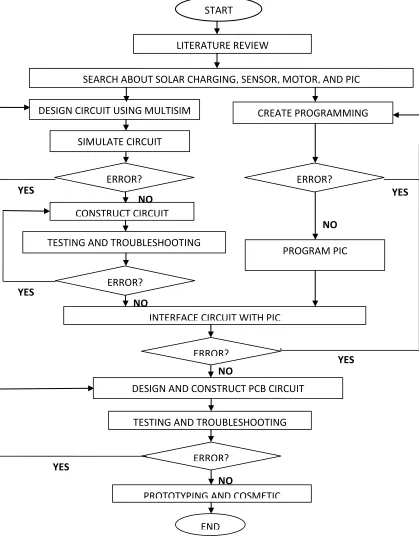
The overall workflow for this project is shown in Figure 1.6.
Figure 1.6: Flowchart of the project START
LITERATURE REVIEW
SEARCH ABOUT SOLAR CHARGING, SENSOR, MOTOR, AND PIC
DESIGN CIRCUIT USING MULTISIM
PROTOTYPING AND COSMETIC
END CREATE PROGRAMMING SIMULATE CIRCUIT ERROR? CONSTRUCT CIRCUIT ERROR? PROGRAM PIC
DESIGN AND CONSTRUCT PCB CIRCUIT INTERFACE CIRCUIT WITH PIC TESTING AND TROUBLESHOOTING
ERROR?
ERROR?
TESTING AND TROUBLESHOOTING
7
1.4.1 Literature Review
In this project, the literature review must be done in order to get the information regarding to the project. The research about conventional technology that looks similar to the technology in this project must be done to make a comparison for example floor dryer, hand dryer, and hair dryer. The review will refer to journals, reference books, and reports to compare this project with other related projects.
1.4.2 Search about material and equipment
In this part, it is all about research on the materials and equipment that will be used in the project. The motor is the first material to be considered on in searching the material and equipment. Next, it is follow with heating element for functioning in produce heat. The temperature sensor also will be used in this project so that a research about the purpose of the sensor, how it works, circuit, and where can find it are important before the project start. Same with the temperature sensor, the study about motor, solar charging and PIC are required before the project start.
1.4.3 Design Circuit