Vol 10, No 2,
Apil -
June 2001 Predictorfactors in the recurrence ofcervicalcancer
79The
histopathological predictor
factors
in the
recurrence of cervical
carcinoma
stage
IB
-
IIA
after radical hysterectomy
Deri
Edianto*,
Emil
TaufikT,M.
Farid Aziz#
Abstrak
Penelitian ini dilakuknn untuk mengetahui angka kejadian (insidens) kekambuhan knnker serviks stadium IB
-
IIA pasca histerektomi radikal dan faktor-faktor yang mempengaruhinya. PeneLitian bersifat kohort retrospektif untuk melihat kekambuhan kanker serviks stadium IB-
IIA yang dihisterektomi radikal pada 68 penderita. Akan tetapi pemeriksaan uLang histopatologik hanya dilakulcan pada58
kasus yanT memenuhi kriteria penelitian. Terhadap 58 kasusini
dilakuknn pemerilcsaan ulanghisnpatoligik
yang meiiputi penilaian tipe histopatologik, diftrensiasi, sebukan sel radang, invasi ke parametrium, Iimfe-vaskuler, sayatan vagTro,-"nio^"tium dan kelenjar getah bening (KGB), serta kedalaman invasi stroma. Insidens kekambuhan dalam waktu dua tahun pasca histerektomi radikal 30,8Vo atau 21dsri
68 knsus. Sembilan (75Vo)dari
12 knsus dengan invasi KGB mengalami kekambuhan dibandingI0
(21,7Vo)
dai 46 kasus
tanpa invasi KGB (P = 0,0004).Dari
1l
kasus dengan karsinoma adenoskuamosa, 8 diantaranyo^"rgilo*i
kekambuhan (P = 0,01). Selnin itu, hanya satu dari 12 knsus dengan kedalaman invasi stroma <5 mm yang mengalami kekamluhan, dibanding 18 kekambuhan dari 45 kasus dengan kedalaman invasi stroma >5 mm (P=
0,02). Secara statistik faktor-faktor klinik seperti paritas, stadium, dan besar lesi tidak mempengaruhi kekambuhnn secara bermakna, demikian pula denganfakior patologik Lainnya, seperti diferensiasi, sebukan sel radang, invasi ke parametrium, limfe-vaskuler, sayatan vagina dan endometrium. pada ilsldens kekambuhan pasca histerektomi radikal dalam
2
tahun pertama,faktor
risiko patoiogikyaig
berpengaruh adalah invasi KGB, karsinoma adenoskuamosa, dan kedaLaman invasi stroma. (Med J Indones 2001;I0: Zl-53)
'
-Abstract
The aim of this study is to know the incidence of cervicaL carcinoma stage IB
-
IIA
recurrence after radical hysterectomy and the histopathologic factors which are relatedto
it. This was a retrospective cohort study involving 68 patients with recurrence cervical carcinoma stage IB-
IIA who underwent radical hysterectomy, However, there were only 58 cases whichfulfilled
the studyciteria,
and therefore were evaluated histopathologically. The histopathologic evaluation consisied of differentiation, inflammatory reaction, lymph-vascular permeation, invasion to the vagina incision margin, and to endometrium, Iympi nodes metastàsis, andtie
depthof
stromal invasion. The incidence of the cervical carcinoma stage IB-
IIA recurrence 2 years after radical hysterectomy was 311i7o 12I
out of 68 cases)' The recurrence occurred in nine (75Vo) out of I2 cases with lymph node metastasis, compàred toI0
(21 .7Vo) out of 46 cases without lymph node metastasis (P = 0.0004). In addition, eight out of I I adenosquamous carcinoào,or",
had recurrence (p = 0.01). There was only one out of the 12 cases wiîh the depth of stromal invasion of < 5 mm that had recumence compared to IB otut of 45 cases with stromal invasionof
> 5
mm(P
=
0.02). The clinical factors such as parity, staging, sizeof
the tumor were not statistically significant. The other pathologic factors such as differentiation, inflammatory reaction,-aid
parametrial, vagina incision margin and endometrial invasion werenot
statistically signifcant. The incidence of the recurrence of 'cervical carcinàma within 2 years after hysterectomy was related to the pathoLogical riskfactors i.e. Iymphnode metastasis, adenàsquamous cell carcinoma anC the depth of stromal invasion. (Med J Indones 2001; 10: 79-83)Keyword: risk factor, cervical cancer
Department of Obstetics and Gynecology, Adam Malik Hospital Medan, Training in Gynecologic
-
Oncology Division,Department of Obstetrics and Gynecology, Faculty of Medicine, University of Indanesia
/
Dr, Cipto Mangunkusumo Hospital Jakarta, IndonesiaI
Department of Pathology, Faculty of Medicine, University
of
"lndonesia
/ Dr. Cipto
Man
Indonesia" Gynecologic
-
Oncology
ne,University of Indonesia / Dr. Cipto Mangunkusumo Hospital Jakarta, Indonesia
The
improvement
in
awarenessand education
of
the80
Edianto et alfor
high risk
casesto
reduce the recurrence rate. Therewere
some factors considered
in
giving
adjuvantradiotherapy
or
chemotherapy,
such as lymph
node metastases,lymph
vascular
permeation,
parametrialinvasion,
invasion
to
the
margin
of
the
vaginaincision, invasion
to
endometrium,
histopathologic
type, differentiation, the depth
of
stromal
invasion,etc.l-13
The aim
of
this
study
is to
know the incidence of
cervical carcinoma
stage
IB
-
IIA
recurrence
afterradical
hysterectomy and
the
histopathologic
factorswhich
are relatedto it.
METHODS
This
retrospective cohort study was conducted
in
Cipto
Mangunkusumo Hospital,
involving
patientswho
underwent radical
hysterectomies
for
cervical
carcinoma stage
IB
-
IIA,
from
January 1992
toDecember
1995.Inclusion
criteria
-
Cervical
cancer stageIB
-
IIA
-
First
therapy wasradical
hysterectomi-
With /
without post
surgery adjuvant therapy.-
At
least camefor follow
up at the 24'n month postsurgery
when
there was no reccurence.-
The aim
of
radical
surgery
was
reachedmacroscopically
andmicroscopically.
-
When
theaim
of
radical
surgery wasnot
reached,at
least there was a
clinically or
microscopically
tumor
freeperiod after
adjuvant therapy.Exclusion
criteria
-
Medical record
was notfound
-
Got
neoadjuvant therapybefore radical
surgery-
Reevaluation
of
histopathologic slide
cannot
bedone (mrssing or damaged slide)
-
Preparation
to
surgery and/or
follow up
were not
donein RSCM.
Follow up
was done
eachtime
thepatient
cameuntil
the last
fottow
up
(at the 24th month).Adjuvant
therapy was
given
when a
condition
below
wasfound
i.e.:-
histopathological
finding:
adenocarcinoma-
lymph
-
vascular permeation-
theborder
of
incision
was nottumor
free-
pelvic lymph
node invasionMed J Indones
-
parametriuminvasion
-
poor differentiation
The
adjuvant therapies
given
were
pelvic inadiation,
chemoradiation
(usingMMC +
5FU)
or chemotherapyalone:
The type
of
the adjuvant therapy given
was basedon
theASEAN trial
on carcinoma
of
thecervix
protocol at
that
time.
Each
of
the
casesthat fulfilled
the
criteria received
an
adjuvant therapy, and
the therapy was chosenrandomly.
The medical record
of
thepatients
werereviewed
andthe
data
collected were:
age, education,
occupation,parity,
stage
of
carcinoma
and
tumor
size.
The
pathologic
slides
were
reexamined
to
see
thehistopathologic type, differentiation,
theinflammatory
cell
reaction,
the
depth
of
cervical stromal
invasion,
parametrial invasion, invasion to endometrium, lymph
vascular permeation,
pelvic lymph node
metastasis,and
invasion
to themargin of
vaginaincision.
The
data
was
analyzed
in
the
department of
community medicine, Faculty of Medicine,
University
of
Indonesia,
to
recognize the
risk
factors
for
the recurrenceof
the disease.RESULT
There
were
108 casesof cervical
cancer stageIB
-
IIA
that
underwent
radical
hysterectomies
from January
1992to
December
1995.However,
the
evaluation
of
the
medical record and reexamination
of
the
surgicalspecimen
histopathologically showed
that
only
94cases matched to cervical cancer stage
IB
-IIA.
Age,
parity,
and
occupation
The
mean of the patients agewas 38.8
(SD
65)
yearsold
and the median was 38 yearsold.
The youngest was28 years
old,
and the oldest was 56 years old. Theparity
varied
between0
-
9.
However,
most
of
the
patients (27.6Vo) had parity 4.Most of
the patients (82.87o) were house-wives andthe
rest (l7.2Vo) were labourer. Parity, staging andtumor
size werenot statistically significant
in
increasing the incidence of recurrence.Histopathologic type
Durrng that period,
there were
68
caseswhich
werefollowed up
r.o24 months post operatively,
but
therewere
only
58
cases
which
fulfilled the
inclusion
Vol 10, No 2, AprtI
-
June 2001distribution
of
histopathologic
profile
accordingto
the recurrenceis
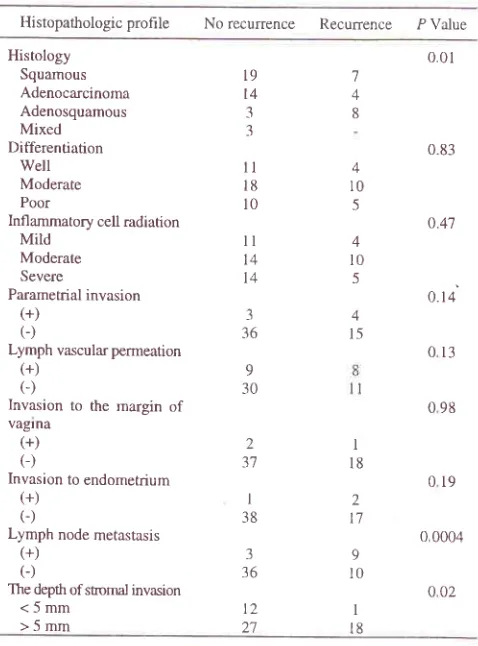
shownin Table
1.Twenty one (30.87o) out
of
68
cases
which
werefollowed
tp to
24
months
post operatively, with
orwithout
adjuvant
therapy, had recurrent carcinoma.Eight out
of
l1
adenosquamouscarcinoma
cases hadrecurrence
within 24
months, and there
were
2additional recurrent
casesafter 25 months. The rest
1case was
well
controlled
until
57 monthsof
follow
up.Table
l.
The distribution ofhistopathologic prohle according to the recurrenceI{istopathologic
prohle
No recurrence Recurrence P ValuePredictorfactors in the recurrence ofcervical
cancer
8l
operation.
This
casedid not
receivedadjuvant
therapy because there was norisk
factor.Adjuvant therapy
There were only 58
caseswhich fulfilled
the
studycriteria. From
these58
cases,there were
6
recurrent casesout
of
20 casesreceiving adjuvant
radiotherapy,4
recurrent
casesout
of
10
casesreceiving
adjuvant
chemoradiation,
2
recurrent
cases
out
of 3
casesreceiving adjuvant
chemotherapy,
and
7
recurrent cases outof
25 caseswithout
adjuvant therapy.After
the 24 months
follow up,
there was
I
morerecurrent case
in
the
adjuvant chemoradiation
groupwhich
occurredin
the 31't monthpost
operatively. The rest 5 casesin
that groupwith
nolymph
node metastasis werewell
controlleduntil
87 months offollow
up.The risk factor
(in
4 out
of
6recurrent
casesreceiving
adjuvant
radiotherapy,
and
in 3
out
of 4
recurrent casesreceiving adjuvant chemoradiation) was lymph
node
metastasis.However, the recurrent
caseswith
adjuvant chemotherapy showed
no
lymph
node metastasis.The result of multivariate analysis was shown in Table 2.
Table 2. Multivariate analysis
of
factorsin
relationto
the recurrence.*Number
of
Numberof
P ValuereculTence
cases StageIB IIA
Invasion to endometrium (+)
(-)
Lymph vascular permeation (+)
C)
Lymph node metastasis (+)
(-)
Parametrial invasion (+)
(-)
The depth ofsuomal invasion <5mm >5mm Histology Squamous Adenocarcinoma Adenosquamous Mixed 7 4 8
* Analysis was done on data that showed P value of < 0.2 on bivariate analysis Histology Squamous Adenocarcinoma Adenosquamous Mixed Differentiation Well Moderate Poor
lnfl ammatory cell radiation Mild
Moderate Severe
Parametrial invasion (+)
(-)
Lymph vascular permeation (+)
C)
Invasion to the margin of vagrna
(+) C)
Invasion to endometrium (+)
C)
Lymph node metastasis (+)
C)
The depth ofstromal invasion <5mm >5rnm 001 t9 t4 3 3
ll
l8 l0ll
l+ t4 3 16 9 30 2 37 I 38 3 36 t2 21 7 4 8 4 l5 9 l0 4 l0 5 4 l0 -5 47ll
052 3 55 I l8 2 l7 2 t7 8ll
9 l0 I l8 0.83 o.47 0.14 013 098 0190 0004
o02 l8 I t7 4t 0.57 0.004 0.42 0.30 0.72
Lymphnode
metastasis
Nine
(75Vo)
out
of
12
cases
with
lymph
nodemetastasis
had
recurence
within 24
rrionths,
and
2 more casesin
the
30th and3l't
month. The rest
I
case waswell
controlled
until
the 43 monthsof
follow
up.Stromal invasion
In
the
group
of
patients
with
< 5
mm
stromalinvasion,
1patient suffered
from
distant
metastasisin
the
inguinal
&
coli
lymph node
4
months
after
the [image:3.612.46.285.253.576.2] [image:3.612.302.542.448.705.2]I
82
EdiantoetalDISCUSSION
The
mean
of
the
patients
agein
this
study was
38.8years
old
and the
median
was 38
years
old,
which
were
younger
than thosein
other studiesi.e.
43.5-
54years
old.
It
was also not older than
those
patientswith
adenocarcinoma, whose youngest age was
37.5years
old.e'lal7
There
were 2l
(30.8Vo)recurrent
casesout of
68 casesin the
2 years
post
surgery evaluation.
The rest
26cases
were lost
in
follow
up.
If
we
estimate
aboutSOVo
of
the
recurrences
occurred
within
the first
2years,
there
will
be
38.5Vorecurrent
caseswithin 5
years.
This
number
is
quite high
compared
to those
reported
by
other workers.
It
is
apity
that up
to
now
there
is
no effective treatment
to
deal with
theserecurrences.
This high
recurrent rate was
not
only
affected
by
the histopathologic
factors,
but also
theinadequacy
in
understanding the disease that made thepatient refused the adjuvant therapy.
In
this
study,
the
adenocarcinoma cases tended
tohave
recurrence,
8
out
of
II
caseshad
recurrencewithin the
first 2
years.No
recurrence was
observedin
the
3
cases
with
mixed
histopathologic
type.Therefore,
the histopathologic type
between
adeno-squamouscarcinoma
andmixed
adenocarcinomawith
squamous
cell
carcinoma
need to
be
differentiated.
Patients with risk factors i.e
parametrial
invasion,invasion
to
the margin
of
vagina incision,
and/orinvasion
to
endometrium
respondedwell
to
adjuvantradiotherapy.
Lymph
node
metastasis
played
animportant
role
in
the
recurrence
in this study.
Nine
(757o) olut
of
the
12 caseswith
lymph
node metastasishad recurrence
within
thefirst 2
years andit
becomesII
(9l.6Vo)
in
the 31't month. Ten out of these 11
recurrent
casesreceived
either
adjuvant
radiotherapyor
adjuvant chemoradiation.
In
the
group without
lymph
node
metastasis,there
were
only
l0
(2l.7Vo)
out
of
46
caseswho had
recurrence.
Other
studieseven reported a smaller recurrent number.
Distant
recurrence
were found
in
8
out
of
the
II
recurrent
caseswith
lymph
node
metastasis.Four of
the
distant
recurrent cases received
adjuvantchemoradiation. Chemoradiation
(MMC
5FU)
wasnot effective
to
patient
with
distant
metastasis. The deepof
stromal invasion
alsoplayed
animportant role
in the
recurrence. There was
only
I
out
of 13
caseswith
<
5
mm stromal invasion who
had
recurrence,while
213of
the
caseswith
>
5 mm
stromal invasion
had recurrence.
Med J Indones
Radiation
is
chosen asthe
adjuvant therapy
for
high
risk
cases. However,
this
modality
is
unable
tr,,prevent
the
recurrence
of
disease l00Vo.
In
general,fatality
was
the
end
in
the recurrent
cases.
Someworkers
attempted
to
modify
the
adjuvant
radiotherapy
in
combination
with
chemotherapy. ZanettaG et al
reported the adjuvant chemoradiation
using vincristine, bleomycin, mitomycin C
and
cis-platin
for
28
cases
with
lymph node metastasis,
parametrial
invasion and
vascular
permeation.lt
Thecases
were
followed up to 70
months;
no
recurrencein
15 cases;
2
patients
quitted
adjuvant
therapy becauseof
the complication. However,
studies
from
otherworkers
showedthere
wasno effect
of
adjuvant
chemoradiation to the recurrence and
survival rate.tt'tn
In this
study, the adjuvant
radiation
andthe
adjuvant
chemoradiation
(MMC
+
5FU)
showed
no
difference
in
the results.
The
adjuvant therapies
were
unable
toprevent
recurrences
in
cases
with
lymph
nodemetastasis.
In
addition,
the
schedule
of
5FU
administration
was
quite
complicated
for
the
sub-educated patientswho
cameto Cipto
Mangunkusumo
Hospital,
andwould affect
thecompliance of
patient.The
relation
of
the
location
of
recurrence
to
thehistopathologic
type
or
adjuvant
therapy was
not
further
analyzed because
the number
of cases
wassmall. However, there was
areport
which
stated thatthe
distant
recurrence
rate
in
the
adjuvant
chemo-therapy group was smaller than those
in
the adjuvant
radiotherapy
g.oop.o
Sardi
et al
reported
that neoadjuvantPVB
could
reducethe central
recurrence but not the distantrecur.ence.t'
In
conclusion,
there were
30.8Vo
recurrent
caseswithin
the
first
2
years
in
the
68
radical
hysterectomies
casesdone
in
Cipto
Mangunkusumo
Hospital,
betweenJanuary 1992
andDecember
1995.Adenosquamous carcinoma tended
to
have recurrence,and
almost
all of
the
cases
with
lymph
node metastasishad
recurrence.Distant
recurrence
tendedto
occur
in
those cases,and adjuvant chemoradiation
was unable to prevent
it.
However,
caseswith <
5mm
stromal
invasion
seldom had recurrence.REFERENCES
l.
Comerci G, Bolger S, Flanneelly G, MainiM,
l,opes deBaros
A,
Monaghan JM. Prognostic factorsin
surgically treated stage IB-
IIA
carcinomaof
the cervix
with2
Vol 10, No 2, April
-
June 2001Eifel
PJ, Berek JS, ThigpenJT.
Cancerof the
cervix, vagina and vulva. In: de Vita VT, Hellman S, Rosenberg SA. Cancer principles&
Practice of oncology. 5th ed. vol. 1. Philadelphia: Lippincott-
Raven; 1997. p. 1433-56.Gerdin
E,
CnattingiusS,
JohnsonP,
Pettersson B. Prognostic factors and relapse patternsin
early
stagecervical
carsinomaafter brachytherapy and
radical hysterectomy. Gynecol Oncol 1994; 53:314-9.Iwasaka T, Kamura T, Yokoyama M, Matsuo N, Nakano
H,
SugimoriH.
Adjuvant chemotherapyafter
radical hysterectomy for cervical carsinoma :A
comparison with effectsof
adjuvant radiotherapy. Obstet Gynecol; 1998:9t,977 -81.
Kamura
T,
TsukamotoN,
Tsuruchi,
N
Saito,
TMatsuyama T, Akazawa
K
et al. Multivariate analysis ofthe histopathologic prognostic factors of cervical cancer in patients undergoing radical hysterectomy. Cancer 1992; 69:1 81-6.
Killackey
MA,
BoardmanL,
Carroll DS.
Adjuvant chemotherapyand
radiation
in
patients
with
poor prognostic stageIB/IIA
cervical cancer. Gynecol Oncol 1993;49:377-9.Lai CH, Hong JH, Hsueh S, Ng KK, Chang TC, Tseng CJ et al. Preoperative prognostic variables and the impact of
postoperative adjuvant therapy on the out come
of
stageIB
or
IIA
cervical carsinoma patientwith or
without pelvic lymph node metastases. Cancer 1999;85:1537-46. LandoniF,
ManeoA,
ColomboA,
PlacaF, Milani
R, PeregoP
et al.
Randomized studyof
radical surgery versus radiotherapyfor
stageIB
-
IIA
cervical cance,r. Lancet 1997 ; 350: 535-40.Samlal RAK, van der Velden J, Schilthuis MS, Gonzalez
DG, Kate FJW, Hart
AAM et al.
Identificationof
highrisk groups among node positive patients
with
stageIA
and
IIA
cervical carsinoma. Gynecol Oncol 1997; 64: 463-7.Sardi JE, Giaroli A, Sananes C, Ferriera
M,
Soderini A, BermudezA
et al.
Long
termfollow
up
of
the
first randomized trial using neoadjuvant chemotherapy in stagePredictorfactors in the recurrence ofcervical
cancer
83IB
squamous carsinomaof
the cervix: The final results. Gynecol Oncol 1997; 67:61-9.Wang CJ, Lai CH, Huang HJ, Honh JH, Chou HH, Huang
KG et al.
Recurrent cervical carsinoma after primary radical surgery. Am J Obstet Gynecol 1999; l8l:518-24.Wharton JT. Neoplasm of the cervix. In: Holland JF (ed) Cancer Medicine. 4th ed.
vol.
2. Baltimore:William
&
Wilkins; 1991. p. 2227 -61.Zanetla G, Colombo
A,
Milani R, Placa F, Mangioni C.Long term results
of
sequential postoperative treatmentwith
vincristine, bleomicyn, mitomicynC,
cis-stage IB-IIA. Int J Gynecol Cancer 1995;5:40-4.Sevin BU,
Nadji
M,
LampeB, Lu
Y,
Hilsenbeck S,Koechli
OR
et
al.
Prognostic factorsof
early
stage cervical cancer treatedby
radical hysterectomy. Cancer1995; 76:1978-86.
Takesima N, Katase K, Hirai Y, Yamawaki T, Yamauchi
K, Hasumi K. Prognostic value of peritoneal cytology in patients
with
carsinomaof the
uterine cervix. Gynecol Oncol 1997; 64:136-40.Waldenstrom
AC,
HorvathG.
Survivalof
patients withadenocarsinoma of the uterine cervix
in
western Sweden.Int J Gynecol Cancer 1999; 9:18-23.
Yanti
A,
Purdadi S, Sjahrul S. Kejadian residif pascahisterektomi
radikal pada penderita
adenokarsinoma serviksuteri
stadiumIB
-
IIA.
Maj Obstet
Ginekol Indones 1998; 22:183-9.Lai CH, Hsueh S, Hong JH, Chang TC, Tseng CJ, Chou
HH et al. Are adenocarsinomas different from squamous carsinomas
in
stageIB
andII
cervical cancer patients undergoing primary radical surgery? Int J Gynecol Cancer 1999;9:28-36.Monk BJ, Cha DS, Walker JL, Burger RA, Ramsinghanr NS, Manetta A et al. Extent of disease as an indication for
pelvic
radiation
following
radical
hysterectomy and bilateral pelvic lymph node dissection in the treatmentof
stage
IB
andIIA
cervical carsinoma. Gynecol Oncol 1994:54:4-9.t1
t2
l3
t4
3.
4
5.
6
t5
l6
t'7
l8
7
8
9
l9