VOCABULARY ACQUISITION BY THE INTELLECTUAL
DISABILITY IN SDLB 117709 KAMPUNG BARU
RANTAUPRAPAT
A Thesis
Submitted to the English Applied Linguistic Study Program in Partial Fulfillment of Requirements for the Degree of
Magister Humaniora
By:
FITRI PUADI RAMBE Register Number: 8136112023
ENGLISH APPLIED LINGUISTICS STUDY PROGRAM
POSTGRADUATE SCHOOL
STATE UNIVERSITY OF MEDAN
MEDAN
ABSTRACT
Puadi Rambe, Fitri. 2016. The Vocabulary Acquisition by Intellectually Disabled Children in SDLB Negeri 117709 Kampung Baru Rantauprapat. Thesis. English Applied Linguistic, Post Graduated Program. State University of Medan.
ABSTRACT
Puadi Rambe, Fitri. 2016. Pemerolehan Bahasa Anak Tunagrahita di SDLB Negeri 117709 Kampung Baru Rantauprapat. Thesis. Linguistik Terapan Bahasa Inggris, Sekolah Pascasarjana, Universitas Negeri Medan.
ACKNOWLEDGEMENTS
In the name of Allah the beneficent and most merciful who taught men what they knew not, All praises be to Allah the greatest and creator of the universe, the king
of the world, to Allah alone we pray, worship and to Allah alone we ask for help. Firstly, thank to Allah Almighty who has given me mercies and blessings till the
writer able to accomplish this thesis can be completed in order to fulfill one of the academic requirements for the degree of Magister Humaniora (M.Hum) at English Applied Linguistics Program: Postgraduate School, State University of Medan.
Secondly, as Muslim, let us sent peace and salutation to Prophet Muhammad (Peace be upon him) as the greatest man, greatest leader sent by Allah to guide human
being from distraction era to the light of belief and Islamic.
Thirdly, the writer would like to express his sincere gratitude who have given valuable guidances, suggestions and useful influences on the writing of this thesis. The
writer would like to deliver his grateful appreciation to his first advisor Prof. Dr. Busmin Gurning, M.Pd, and his second advisor Prof. Amrin Saragih, M.A.,Ph.D. Moreover, the writer would like to express to his examiners, Prof. Dr. Sumarsih, M.Pd,
Dr. Rahmad Husein, M.Ed, and Prof. Dr. Sri Minda Murni, MS. Besides, the writer would also like to thanks to all the lectures of English Applied Linguistics Program who
have given much encouragement and knowledge during taking the college.
Husein, M.Ed and Prof. Dr. Bornok Sinaga, M. Pd as the Director of Postgraduate
School at State University of Medan.
The writer would also like to deliver his gratefulness to the head of SDLB
Negeri Kampung Baru Rantauprapat, Hj. Rosmaidar, S.Pd, and April Lince, S.Pd as the teacher for giving chance to do research in this school.
Special thanks are also for her parent Drs. H. Maraposan Rambe and Dra. Erianis and his siblings Husna Qomariah Rambe, S.Pd, Mahmud Bidawi Rambe, and Mardiana Rizki Rambe for their encouragement, care and love during doing this thesis.
Super thanks goes also to the whole friends in LTBI B-2 especially Jupriaman, Eva Novelia Siregar, Ima Fitriana, Erikayani Friska Br Sembiring, and Kristin Natalia L
who helped and motivated her doing the thesis.
Finally, the writer hope this thesis will be useful for him and can be useful as branding references for the next research and enhance every one’s knowledge who read
this thesis. May Allah bless us forever, wherever,whenever and however we are. Medan, April 28th 2016 The writer,
TABLE OF CONTENTS
Page
ABSTRACT ... i
ACKNOLEDGEMENTS ... iii
TABLE CONTENTS ... iv
LIST OF TABLES ... ix
APPENDIXES ... x
CHAPTER I INTRODUCTION 1.1 Background of the Study ... 1
1.2 The Problem of the Study... 5
1.3 The Objective of the Study... 5
1.4 The Scope of the Study ... 6
1.5 The Significant of the Study ... 6
CHAPTER II REVIEW OF LITERATURE 2.1 Language Acquisition ... 7
2.1.1 Intellectually Disabled Children ... 9
2.1.2 Classification of Intellectually Disabled Children ... 11
2.1.2.1 Capable Students of Intellectually Disabled Children (Debil) ... 12
2.1.2.2 Practice Children of Intellectually Disabled Children (Imbecil) ... 12
2.1.2.3 Able to Care of Intellectually Disabled Children (Idiot) ... 13
2.2 Vocabulary Acquisition ... 14
2.2.1 Kinds of Words ... 16
2.2.1.2 Verbs ... 17
2.2.1.3 Adjectives ... 17
2.2.1.4 Adverbs ... 18
2.2.1.5 Pronoun ... 18
2.2.1.6 Numeral ... 19
2.2.1.7 Function Words ... 19
2.3 Phonology ... 20
2.3.1 Phonemes in Language ... 21
2.3.1.1 Consonants ... 22
2.3.1.2 Consonants in Indonesia Language ... 23
2.3.1.3 Vowels ... 24
2.3.1.4 Vowels in Indonesia Language ... 24
2.3.2 Process in Child Phonology ... 24
2.4 Stages of Language Acquisition ... 27
2.4.1 Pre-Speech ... 28
2.4.2 Holophrastic Stage ... 28
2.4.3 The Two-Word Stages ... 29
2.4.4 The Telegraphic Stage ... 30
2.5 The Process of Intellectually Disabled Children Acquire Words ... 31
2.6 The Social Context of Meaning Acquisition ... 33
2.6.1 At Home ... 34
2.6.3 At Environment ... 37
2.7 Educated and Uneducated Mother ... 38
2.8 Previous Relevant Study ... 41
2.9 Conceptual Framework ... 42
CHAPTER III RESEARCH METHODOLOGY 3.1 The Research Design... 44
3.2 Data and Data Source ... 45
3.2.1 Data ... 45
3.2.2 Data Source... 45
3.3 The Instrument of Collecting the Data ... 46
3.4 The Technique of Collecting the Data ... 46
3.5 The Technique of Data Analysis ... 47
3.6 The Trustworthiness of the Study ... 47
3.6.1 Credibility ... 48
3.6.2 Transferability ... 48
3.6.3 Dependability ... 49
3.6.4 Confirmability ... 49
CHAPTER IV DATA ANALYSIS 4.1 Data Analysis ... 50
4.2 Content of Vocabulary Acquisition by Intellectually Disabled Children ... 52
4.2 How the Subject Produced the Subject Matter ... 57
4.4 Findings ... 60
4.5 Discussion ... 61
CHAPTER V CONCLUTION AND SUGGEESTION 5.1 Conclusions ... 66
5.2 Suggestions ... 66
REFERENCES ... 68
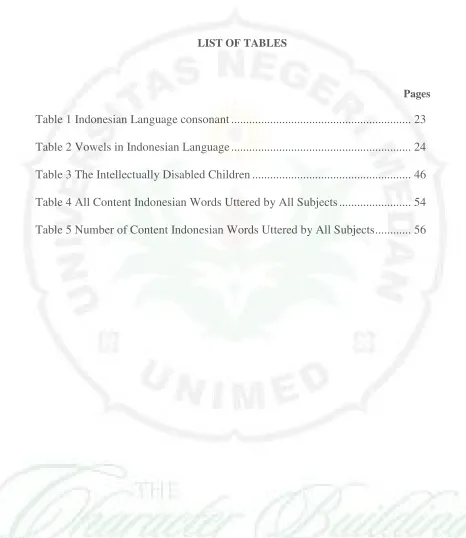
LIST OF TABLES
Pages
Table 1 Indonesian Language consonant ... 23
Table 2 Vowels in Indonesian Language ... 24
Table 3 The Intellectually Disabled Children ... 46
Table 4 All Content Indonesian Words Uttered by All Subjects ... 54
LIST OF APPENDIXES
Pages
Appendix A Interview of Teacher ... 72
Appendix B Interview Question for Parents ... 73
Appendix C Transcription of Interview with Teacher... 74
Appendix D Transcription of Interview with Parents ... 76
Appendix E Picture for Getting Data ... 80
Appendix F Students in the Class ... 90
CHAPTER I INTRODUCTION
1.1Background of the Study
Language is an important role in human life, even after all, language is one of the most communication needed by every human being, to socialize with each other. Without speaking or communicating, will feel that it lacks the information.
In addition, the language is not only embedded in every human being, but there are some people who do have limitations communicate. These limitations can
occur because of a mental or inability of said tool. By doing so, it is an inhibit a person who has limited communication.
Discussing about the language or communication is hampered because of the
limited mental or vocal organs in humans, children with intellectually disabled children can be used as one example in which communication is hampered by
mental limitations. In addition, children with intellectually disabled children also have a quiet nature, when in the act should be no specific guidance from parents, as well as others, so children with intellectually disabled children can
communicate only with the people alone.
Intellectual disability (ID) is invariably associated with impairments in social
behavior that are manifested across a range of contexts and tasks. Children and young people with ID have social difficulties (Margalit, 1995), especially in spontaneous manifestation of behaviors and communication skills, emotional
2
and adaptation within the structure of community (Gottlieb & Leyser, 1981). It has been described that people with ID experience high levels of loneliness, social
anxiety and lack of satisfaction with their social interactions (Williams & Asher, 1992). In addition, children with ID exhibit inappropriate problem solving
patterns during conflicts with peers, are less accepted as reflected by both peer socio-metric and behavioral measures, have more difficulties forming in-depth relationships with peers as indicated by more limited linkages between peers
across school and community settings, and have fewer reciprocal friendships (Gresham, Elliott, & Black, 1987. Guralnick et al., 1998, 2006).
Intellectual disability is a term used when a person has certain limitations in mental functioning and in skills such as communicating, taking care of him or herself, and social skills. These limitations will cause a child to
learn and develop more slowly than a typical child (National center for Children with Intellectual Disability, 2011).
The ability of vocabulary acquisition is the process of a child have the words. The process cannot be done directly, because it is impossible to dissect a human skill just to find out how this process occurs. Thus, the ability of vocabulary
acquisition can only be done indirectly through observation word uttered, through the speech we can know anything vocabulary controlled by a child.
3
is an important element of the language and need to be studied, understood, and understood in order to be used properly.
Pronunciation patterns must be understand some of the similarities and differences to some certain vowels and consonants.Pronunciation of words based
on a system of signs (symbols) is studied by the branch of linguistics called phonology. As explained by Kushartanti, the science of sound in general is called phonetics; the sound of the language studied and described in phonological or
phonemic. Science or system of so-called semantic meaning. Lexicon, grammar, and phonology as three parts of the structure in terms of meaning and language
concerns in terms of the sound of the language; therefore also have an aspect of semantic and phonetic aspects. Phonological subsystem or phonological structure includes aspects sounds of language, both concerned with the characteristics
(studied by phonetics), as well as those concerned with their function in communication (Kushartanti, 2005: 7).
The child has difficulty in speaking, but it does not necessarily mean the child is weak in his knowledge of the language. The speech disorders in general be problems in articulation. This includes the substitution (the sound is replaced with
other sounds), and omission (eliminating noise at all - for example, "saya" becomes "ya"). Other disorders types include state of stuttering and hoarseness or
impairments in volume and timbre of their voice.
Based on preliminary studies conducted by researchers, that the intellectually disabled children class 4 of SDLB Negeri 117709 Kampung Baru Rantauprapat,
4
problems in speaking, these children will talk when it was forced by the teacher. Based on information from their classroom teachers, children with intellectual
disabilities have started to understand simple commands (receptive) for example when the teacher said the attitude of a child praying immediately cupped hands,
the ability of social interaction still need guided. When the writer gave the picture to the retarded child to know their vocabulary, the children saw a picture "of a child who was sweeping", some children say "pu" voiceless "∫a", "apu" voiceless "∫ ". When the writer showed pictures of "three cats were sleeping", there is a
child who says "meong bobo", and say "ong". When the writer asked the teacher
their ages, then the teacher answered 10-15 years old. Based on the ages, if we see the normal child that it is impossible the child cannot acquire the language.
In Indonesia word class there are 7 classes, they are nouns, verbs, adjectives,
adverbs, pronoun, numerals, and word task. The intellectually disabled children with 10-15 years old do not have much vocabulary and the correct pronunciation
of their vocabulary.
This study has aim at finding the level of vocabularies are acquired by the children, the process of vocabulary acquisition, and describe in what context
vocabulary acquired by intellectually disabled children in SDLB Negeri 117709 Kampung baru Rantauprapat.
Chomsky in (Dardjowidjojo, 2000) stated that language is actually not all a process which is done by the children, yet happens to them. Still on the same book, He said that human being has a, what he called, Faculties of the Main. It is
5
spaces is allocated for the using and acquiring of language. Thus, by analyzing and moreover understanding the vocabulary acquisition occurred in the
intellectually disabled children in SDLB 117709 Kampung baru Rantauprapat, it is expected that people will have description inside their mind about how children’s speech is formed.
1.2The Problems of the Study
In relation to the background of this study, the problems of this study are
formulated as follows.
1) What vocabulary classes are acquired by the intellectually disabled children in
SDLB Negeri 117709 Kampung Baru Rantauprapat?
2) How are the vocabularies acquisition acquired by the intellectually disabled children in SDLB Negeri 117709 Kampung Baru Rantauprapat?
3) In what context are the vocabularies acquired by the intellectually disabled children in SDLB Negeri 117709 Kampung Baru Rantauprapat?
1.3The Objectives of the Study
In relation to the above problems, the objectives of the study.
1) To describe vocabulary classes are acquired by the intellectually disabled
children in SDLB 117709 Negeri Kampung Baru Rantauprapat.
2) To elaborate how the vocabularies are acquired by the intellectually disabled
children in SDLB 117709 Negeri Kampung Baru Rantauprapat.
6
1.4The Scope of the Study
This study attempts to investigate vocabulary acquisition of the intellectually
disabled children in SDLB 117709 Negeri Kampung Baru Rantauprapat. The aspects will be observed in this study are the kinds of vocabularies are acquired by
the children, the process of vocabulary acquisition, and describe in what context vocabulary acquisition acquired by intellectually disabled children in SDLB Negeri 117709 Kampung baru Rantauprapat.
1.5The Significance of the Study
Findings of this research are expected to provide a valuable input that can
enrich the study on the development of language acquisition. It is expected that the findings can show significant relevant to the theoretical and practical aspects.
Theoretically, the research findings can provide a basis for further research on
different stages of the children language acquisition and to see the application of theories of language acquisition.
Practically, on the other hand, the findings of this research can be made as guidelines for adults, teachers, these concerned with an early childhood education, especially parents who are interested in the process of encouraging the young
children to speak as related to the theory of language acquisition. It will make a valuable references in assisting and facilitating the children in the process of
CHAPTER V
CONCLUSIONS AND SUGGESTIONS
5.1 Conclusions
After analyze the data, conclusions are drawn as follow.
1. Based on their vocabulary that the intellectually disabled children acquire the vocabulary acquisition are dominated by noun or concrete words.
2. The subjects acquire the words in term of process developed such as learn a word through its sound with its meaning, and appreciate the meaning of a
word.
3. The subjects get the language just from their family because they cannot socialize with the children in their surroundings because they only are in the
house not socialize with others children.
5.2 Suggestions
In the view of the research conducted on the vocabulary acquisition by intellectually disabled children, the following suggestion are put forward to.
1. Assist the children in the process of language acquisition. Allow the children communicate freely or to produce words in different situation and there were
67
2. Encourage the children to communicate politely and to produce the correct words and if they make mistakes, give the exact words and pronunciations.
3. Inform the parents who worried about children language acquisition in uttering words because they have to know when and what factors can influence the
children’s ability to produce words and speech as the anticipation for same
REFERENCES
Alwi, H., Soenjono Dardjowidjojo, dkk. 2003. Tata Bahasa Baku Bahasa Indonesia. Jakarta: Balai Pustaka.
Ardhana W., 1986. Dasar-dasar Kependidikan, FKIP, Malang.
Azar, B. Schrampfer, 2001. Basic English Grammar, New Jersey: Person Education Asia.
Barret, M.D. 1995. Early Lexical Development. Oxford Blacwell.
Biemiller, A., 2009. "Teaching Vocabulary: Early, Direct, and Sequential." Essential Readings on Vocabulary Instruction, ed. by Michael F. Graves. International Reading Association.
BMA Board of Science, 2006. Child and Adolescent Mental Health: A Guide for Healthcare Professionals. British Medical Association.
Boyson-Bardies, B. 1999. How Language Comes to Children. Massachusets: Massachusets Institute of Technology.
Chaer, A. 2003. Psikolinguistik; Kajian Teoretik. Jakarta: Rineka Cipta.
Clark, E. V. 2003. First Language Acquisition. New York: Stanford University.
Crain, S., Diane Lillo-Martin, 1999. An Introduction to Linguistics Theory and
Dykens, E. M. 2000. Psychopathology in children with intellectual disability. Journal of Child Psychology and Psychiatry, 41, 407-417.
Dykens, E. M. & Hodapp, R. M., 2001. Research in mental retardation: toward an etiological approach. Journal of Child Psychology and Psychiatry, 42, 49-71.
Emerson, E., Graham, H. & Hatton, C., 2006. The measurement of poverty and socio-economic position in research involving people with intellectual disability. In International Review of Research in Mental Retardation (ed. L. M.Glidden), pp. 77-108. Academic Press.
Emerson, E. & Hatton, C., 2007. Contribution of socioeconomic position to health inequalities of British children and adolescents with intellectual disabilities. American Journal on Mental Retardation, 112, 140-150.
Emerson, E., and Chris Hatton, 2007. British Journal of Psychiatry. “Mental Health of Children and Adolescents with Intellectual Disability in Britain”.
Fikkert, P. & Levelt, C.C., 2004. The Lexicon and Emergent Constraints in the Developing Phonological Grammar. Ms. Radboud University of Nijmegen & Leiden University. Linguistics in the Netherlands 2004. Amsterdam: John Benjamins.
Giegerich, H. J., 1992. English Phonology: An Introduction. Cambridge University Press.
Goodman, R., 1995. The relationship between normal variation in IQ and common childhood psychopathology: a clinical study. European Child and Adolescent Psychiatry, 44.
Gottlieb, J., & Leyser, Y., 1981. Friendship between Mentally Retarded Children. In S.R. Asher & J.M. Gottman (Eds.), The Development of children's friendships. New York: Cambridge University Press.
Gresham, F., Elliott, S., & Black, F., 1987. Teacher-rated Social Skills of Mainstreamed Mildly Handicapped and Non-handicapped Children School Psychology Review.
Green, H., Mc Ginnity, A., Meltzer, H. et al., 2005. Mental Health of Children and Young People in Britain. Palgrave Mac Millan.
Guralnick, M., Connor, R., Neville, B., & Hammond, M., 2006. Promoting the peer related social development of young children with mild developmental delays: Effectiveness of a comprehensive intervention. American Journal on Mental Retardation.
Harris, J, Roberta Michnick Golinkoff, and Kathy Hirsh-Pasek, "Lessons From the Crib to the Classroom: How Children Really Learn Vocabulary." Handbook of Early Literacy Research, Volume 3, ed. by Susan B. Neuman and David K. Dickinson. Guilford Press, 2011.
Hayes, B. 2004. Phonological acquisition in Optimally Theory: The Early Stages. In R. Kager, J. Pater & W. Zonneveld (Eds.) Constrains in Phonological Acquisition. Cambridge.
Hodapp, R. M. & Dykens, E. M., 2004. Studying behavioural phenotypes: issues, benefits, challenges. In International Handbook of Applied Research in Intellectual Disabilities. (eds E. Emerson,C. Hatton,T. Thompson, (eds E. Emerson,C. Hatton, T. Thompson, et al).
Kager, R. 2004. Constraints in Phonological Acquisition. Cambridge: Cambridge Press.
Kerkhoff, A. 2004. Acquisition of Voicing Alternation. In: S. Baau & J. Van Kampen (eds.), Proceedings of GALA 2003, Volume 2, LOT, Utrecht. Pp. 269-280.
Kipasky, P & Menn. L. 1977. On the Acquisition of Phonology. In: J. Mac Namora (ed.), Language and Thought. New York: Academis Press.
Luthar, S. S. (ed.), 2003. Resilience and Vulnerability: Adaptation in the Context of Childhood Adversities. Cambridge University Press.
Macken, M. 1995. Phonological Acquisition. In: J. A. Goldsmith (Eds.) The Handbook Phonological Theory. Cambridge, MA : Blacwell.
Margalit, M., 1995. Effects of Social Skills Training for Students with an Intellectual Disability. International Journal of Disability, Development and Education.
Marsono. 1989. Fonetik. Yogyakarta: Gajah Mada University Press.
Menyuk, P. 1971. The Acquisition and Development of Language. Massachusetts: Massachusetts Institute of Technology.
Murthy, J. Dakshina, 2003. Contemporery English Grammar, New York: Shivem Printers.
Paivio, A and Begg, I. 1981. Psychology of Language. Newjersey. Prentice-Hall.
Pam, L. 1989. Functional Patterns in Infant Bilingualism. A Case Study for the Simultaneous Acquisition Two Language by Three-year Old Vietnamese American Child. www.Ling.Upen.Edu/Cources/Summers-2004/Ling-001/Lecture7.Htlm.
Stemberger, J.P. & Stoel, G. C. 1991. The Underspecification of Controls: Evidence from Language Acquisition and Performance Errors. In: C. Paradis & J. F. Prunet (Eds.), Phonetics and Phonology: Vol 2. The Special Status of Coronals. San Diego, CA: Academic Press.
Stergiani G., 2011. Journal of Education and Developmental Psychology.
“Second-Order Mental State Attribution in Children with Intellectual
Disability: Cognitive Functioning and Some Educational Planning
Challenges”.
Smith, N.V. 1973. The Acquisition of Phonology: A Case Study. London: Cambridge University Press.
Widia, Y, A. Jurnal Pemerolehan Kosakata Anak Tunarungu. “Pemerolehan Kosakata Anak Tunarungu Berdasarkan Kelas kata Bahasa Indonesia di SDLB Karya Mulia II Surabaya: Kajian Psikolinguistik”.