2013 International Conference on Instrumentation, Communication, Information Technology and Biomedical Engineering November 7th-8th, 2013, Bandung, Indonesia
The effect of sound levels on attention deficit
MMM Aminuddin1 and I Mustaffa2 1
Faculty of Electronic and Computer Engineering,
2
Faculty of Engineering Technology, Universiti Teknikal Malaysia Melaka, Malaysia
1
(Tel : +606-555 2156; [email protected])
2
(Tel : +606-2346972; [email protected])
This study investigated the effect of sound level on attention deficit by examining the evoked response potentials, i.e., N1 peak. Three sound levels were used as stimulation level i.e., Medium (control), Most Comfortable Loud and Uncomfortable loud. In 10 subjects, the results showed that the reduction of N1 wave is getting lesser as the sound level increases. This shows that less attention deficit at high level of sound. The finding could be used for a basis of developing an awareness system or a diagnostic for mental disorder such schizophrenia.
Keyword: attention deficit, N1 peak reduction, neurophysiological measures, evoked response potential, sound level
I. INTRODUCTION
Habituation is an unconscious and effortless phenomenon that could occurs in all living forms in this world, for examples [1][2][3]. In human, habituation is commonly studied on neurophysiological response such as evoked response potential (ERP). It is observed when the ERP amplitude declines over repeatedly stimulated by successive stimuli [3][4]. Based on previous studies such as [5][6], habituation is closely related to attention deficit. The largest component of ERP i.e., N1 amplitude was observed as being generally diminished by lack of attention [5]. Habituation of ERP is documented to show a fast and larger decrease in amplitude when a subject do not pays attention to a stimulus [5][6]. Hence, we could say that habituation projects attention deficit.
Many researchers have gained interest in using attention deficit phenomenon as a tool to investigate cognitive disorders such as a study by Horvath and Mearers [7]. They have shown in their study on how attention deficit could be used to differentiate between non-paranoid schizophrenics and paranoids. In another study by [8], this phenomenon is used to investigate the effects of distraction and attention focusing during in-vivo exposure to feared stimuli on 16 obsessive-compulsives with washing ritual. They have found that greater decrement of anxiety when attention-focusing preceded distraction.
Despite numerous studies conducted and several findings and arguments have been discussed, attention deficit is still not well documented and understood, especially the correlation of attention deficit and sound intensity/loudness. A focused study
This work is financially supported by Malaysia Ministry of High Education under research grant (FRGS/1/2011/TK/UTEM/02/9)
on the aforementioned correlation is done by Mariam et. al.[9][10]. They have found that N1 amplitude
decreases as the intensity increases. However, sound intensity does not reflect how one perceived the sound. Sound perception is influenced by age, the health of the auditory systems and totally on how the person able to receive the sound. Moreover, Mariam et. al.[9] has concluded that the decrement of N1 amplitude could be related to attention deficit but was not reliable as the experimental paradigm was simply tackle the habituation effects.
In this study, the correlation of attention deficit and loudness is investigated. Three levels of sound were in evaluated, i.e., Medium, Most Comfortable level (MCL) and Uncomfortable level (UCL). These levels are chose due to MCL and UCL are the most difficult level to determine [11]. The attention deficit will be studied on N1 peak as it reflects sensory and physical properties such as intensity [12]. Furthermore, N1 peak decrement does not depend on age [13]. This paper is organized as follows: in section 2, the description of the exogenous and endogenous paradigm for the experiment. In section 3, the obtained results are presented and in section 4, results are discussed and conclusion is given.
The findings could be used as platform of development of objective loudness scaling measurement, driving unvigilant study and others sound perceptions related study.
II. METHODOLOGY
A. Subjects and experimental paradigm
6 healthy men and 4 healthy women with an average age of 20 years and 4 months and standard deviation of 1 year and 5 months have participated in this study. They had no history of hearing problems and a normal hearing threshold (below 15 decibel (dB) hearing level). An audiogram test is conducted before and immediately after the experiment to ensure no after effects due to the experiment. The experiment is conducted after the subjects were thoroughly explained with regards to experiment procedure and they have signed the consent form.
2013 International Conference on Instrumentation, Communication, Information Technology and Biomedical Engineering November 7th-8th, 2013, Bandung, Indonesia
This stimulus is generated by a computer and presented through a headset at right ear.
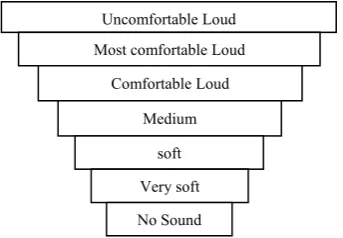
Before electrophysiological measurement is done, the levels of sound i.e., Medium (control), MCL and UCL are determined through subjective measurement. Tones are continuously presented to the subject with intensity of 0 to 90dB, randomly. Subject classified the intensity with a guide from a loudness scale as shown in Fig. 1.
To record the electroencephalographic (eeg) signal, the stimuli are presented at intensity level classified as Medium, MCL and UCL at separate recording with 5 minutes break in between. The duration of complete experiment for each subject was 1 and half hour (including preparation). The recording is conducted in sound proof room. The subject is placed on a recliner chair in resting condition. The subject is required to close his/her eyes all the time, relax and do not make any big movements. These to avoid many artefacts in the eeg signal. The subject is reminded to not fall asleep. Therefore, constant monitoring is done through the entire experiment to aware any signs of sleeping such as snoring and rapid eye movement. With regards to the experiment paradigm, the subject is instructed to listen to the tone given. This is to ensure the subject pays attention at the beginning of the eeg recording. The eeg signal is recorded by a BIOPAC Inc system, MP150 EEG 100C and computer software (Acknowledge 4.2). Surface Electrodes (Ag/AgCl) are placed at the right mastoid, vertex and forehead. The impedance is ensured below 5 kΩ.
Fig. 1. Pascoe Loudness Scale.
B. Data Segmentation
The eeg was segmented and forms a successive trials ranging from 0 to 800 ms poststimulus. These trials were filtered using a digital filter (bandpass 1-15 Hz). Trials that contained artefacts were rejected using the threshold detection (amplitude larger than 50 µV).
III. RESULTS
To analyze the amplitude of the N1, let i represent a trial and set M={ij : j=1,2, … ,N} where N is a total of trials in
respective level. These successive trials in set M were grouped into 5 and averaged. Average 1 are formed by set M={ij : j=1,2,
… ,5}, average 2 are formed by set M={ij : j=6,7, … ,10},
average 3 are formed by set M={ij : j=11,12, … ,15} and so on.
This action is to reduce signal to noise ratio and demonstrates a clear N1 peak accordingly. Fig. 2. shows a result from subject 1 at Medium level. It demonstrates the 3 consecutive averaged trials. In this case, we could see that amplitude of N1 reduced over stimulation.
The assessment of the whole trials in respective level is done by differentiate half of averaged group in the early measurement and half of averaged group in the last measurement ( let P represents a set of averaged groups [P=mean{averagek : k= 1, 2, … , Q/2}] - P=mean{averagek :
k= Q/2+1, Q/2+3, … , Q}] where Q is a total of averaged groups obtained after the averaging process of set M. Fig. 3. shows the percentage of N1 difference for each subject at all levels. Lower percentage of difference shows that the amplitude of N1 less reduces from the beginning of the stimulation.
Fig. 2. The figure shows the results of medium stimulation from subject 1. The first 5 trials (1 to 5) were averaged and plotted in the amplitude versus time graph (solid black line). The next consecutive 5 trials (6 to 10) were averaged
and plotted in thin line and other next 5 consecutive trials (11 to 15) were averaged and plotted in broken line. Clearly shown that the N1 wave peak has
reduced over stimulation.
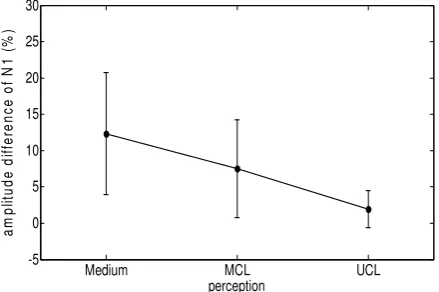
Fig. 4. demonstrates the grand average results across subjects. In general, all subjects showed a reduced of N1 peak 12.33% with standard deviation of 8.39 at Medium level stimulation. While at MCL stimulation level, the reduction of N1 peak was in general 7.52% with standard deviation of 6.74. At UCL stimulation level, the average reduction of N1 peak was 1.95% with standard deviation of 2.55 in general.
2013 International Conference on Instrumentation, Communication, Information Technology and Biomedical Engineering November 7th-8th, 2013, Bandung, Indonesia
1 2 3 4 5 6 7 8 9 10
Fig. 3. The figure shows the percentage of amplitude difference obtained from differentiate between the mean of early half trials in a measurement and last half trials in a measurement. These results are from all subjects. It is found that
as the level increases the difference is getting less. It shows that the reduction of N1 wave is getting less when the loudness is getting higher.
Medium MCL UCL
Fig. 4. The figure shows the grand average results across subjects.
IV. DISCUSSIONS AND CONCLUSSIONS
In this study, the relationship between attention deficit and sound levels is investigated. A reduce in response after repeatedly stimulated by a same stimulus is already documented in previous studies[6][7][9][10]. In [9] and [10], the relationship of sound intensity and neurophysiological measures has been studied. They have concluded that high sound produces less significant of N1 wave peak reduction. However, their paradigm could not suggest that the less significant reduction of N1 wave was due to high attention to the stimulus. In order to investigate the effect of sound level towards attention deficit, the subject was asked to listen to the stimulus with no other task such as push button. This action will make the subject listen to the stimulus at the beginning of the stimulation and the rest of the stimulations depend on their ability to pay attention. The hypothesis of this study is over repeating stimulation, subject will finally ignore the stimulus or in other words their attention will fade away. In addition, in this study, we used loudness classification as stimulation levels rather than the value of intensity. This is because one perception of sound is different to the other. With regards to
loudness scaling measurement, MCL and UCL are difficult to be determined and importance to be differentiated. In setting of hearing devices for example, MCL is the most important level need to be determine correctly [14] and the immediate level i.e., UCL is the highest level of hearing that need to be avoided as it could damage the hearing over a period of time. Therefore, we are motivated to investigate the effect of MCL and UCL on attention deficit. Theoretically, as we perceived both of this level differently, we should have different level of attention with regards to these levels.
Based on the results, the peak of N1 from Medium stimulation showed high reduction compared to MCL and UCL level in all subjects. Medium is in the level of normal conversation is about 50 to 60 dB sound pressure level [11]. Therefore, it is easy to ignore such as in uninteresting lecture. As suggested in [15], Medium level falls in a soft category , while MCL and UCL fall in loud category. Hence, a big difference of N1 peak reduction between Medium and MCL/UCL complies is expected.
With regards to the difference between MCL and UCL level, the proposed method able to show that the attention deficit of MCL is more than UCL level. Refer to Fig. 3 and 4, N1 peak from UCL stimulation had reduced very much less or no reduction compared to MCL. At UCL stimulation level, 7 of 10 subjects show reduction of N1 wave peak is less than 1.95%. This shows that as the sound getting loud, the attention is hard to fade away. Nevertheless, the obtained percentage amplitude difference in between subjects was significantly different. This is due to every person has different attention deficit latency. This gives a challenge to determine the threshold of UCL and MCL in future development.
However, the proposed method gives a promising suggestion that sound levels could be differentiate by using attention deficit assessment. The finding could be used for developing a tool for driving awareness system, or a diagnostic for schizophrenia.
ACKNOWLEDGMENT
The author would like to thank to Malaysia Ministry of High Education for the financial support under research grant (FRGS/1/2011/TK/UTEM/02/9). Special thanks to Universiti Teknikal Malaysia Melaka students for their participation in this study.
REFERENCES
[1] H. S. Jennings, Behavior of the lower organisms. New York: Columbia University Press, 1906.
[2] Y. N. Sokolov, " Higher nervous functions: The orienting refle,” Annual Review of Physiology, vol. 25, pp. 545–580, 1963
[3] A. Johnson and A. Yonovitz, “ Habituation of auditory evoked potentials: The dynamic of waveform morphology” Aust NZ J Audiol, vol. 29(2), pp. 77 - 88, November 2007.
2013 International Conference on Instrumentation, Communication, Information Technology and Biomedical Engineering November 7th-8th, 2013, Bandung, Indonesia
[5] T. Rosburg, P. Trautner, N.N. Boutros, O. A. Korzyukov, C. Schaller, C.E. Elger and M. Kurthen, “Habituation of auditory evoked potentials in intracranial and extracranial recordings,” Psychophysiology, vol. 43,
pp.137–44, 2006
[6] A. Ӧhman A and M. Lader , “Selective attention and habituation of the auditory averaged evoked response in humans,” Physiol. Behav., vol. 8, pp 79–85, 1972
[7] T. Horvath and R. Meares, “The sensory filter in schizophrenia: A study of habituation, arousal, and the dopamine hypothesis,” The British Journal of Psychiatry, vol. 134, pp. 39–45, 1979
[8] J.B. Grayson, E.B. Foa, and G. Steketee, “ Habituation during exposure treatment: Distraction vs attention-focusing,” Department of Psychiatry, Eastern Pennsylvania Psychiatric Institute, Henry Avenue, Philadelphia, PA 19129, U.S.A.
[9] Mai Mariam, W. Delb, B. Schick and D.J. Strauss, “Feasibility of an objective electrophysiological loudness scaling: A kernel-based novelty detection approach.,”ARTMED, vol. 55(3), pp. 185-195, 2012. [10] Mai Mariam, W. Delb, F.I, Corona-Strauss, M. Bloching and D.J Strauss, ”Comparing the habituation of late auditory evoked potentials to loud and soft sound,” Physiological Measurement, vol. 30, pp.141–53, 2009.
[11] J. Punch, A. Joseph and B. Rakerd, “Most comfortable and
uncomfortable loudness levels: six decades of research,” Am. J. Audiol. Vol. 13, pp. 144–57, 2004
[12] R. Näätänen and T. Picton,” The N1 wave of the human electric and magnetic response to sound: A review and an analysis of the component structure,” Psychophysiology, vol. 24, pp. 375–425, 1987
[13] H.S. Soininen, J. Karhu, J. Partanen, A. Pääkkönen, V. Jousmäki, T. Hänninen, “Habituation of auditory N100 correlates with amygdaloid volumes and frontal functions in age-associated memory impairment” Physiology & Behavior, vol. 57, pp. 927–35, 1995
[14] G.F. Smoorenburg, C. Willeboe,r and Van J.E. Dijk, “Speech perception in nucleus CI24m cochlear implant users with processor settings based on electrically evoked compound action potential thresholds,” Audiol. & Neuro-otology, vol.7, pp.335–347, 2002