•
,.
•
•
'.
•
•
セ@
..
•
セ@
..
>at
....
Mセ@
Zセ@
Nセセ@
.:"
NZセ@
Nセセ@
ZZセ@
Z[セ@
, :"!1
ZG^セ
""!1
Nセ@
INDONESIAN TMPEGS SANREM·CRSP 2009
GENDER
Gender Roles of Farmer Families in Vegetable Agro
Forestry System (A Case Study At Nanggung Sub-District, Bogor Forestry System (A Case Study At Nanggung Sub-District, West Java Province)
Tn Koesoemaningtyas
1),Herien Puspitawati
2),and Tin Herawati
3)1) Departement of Agronomi, College of Agriculture, Bogor Agricultural
University. HP: +62 8 1218066284, Email: [email protected]
2) Lecturer at Departement of Family and Consumer Sciences, College of Human
Ecology, Bogor Agricultural University Ii A National Expert Member at
Departement of National Education· Republic of Indonesia. HP: +62 8 1111
0920, Email: [email protected]
3) Lecturer at Departement of Family and Consumer Sciences, College of Human
Ecology, Bogor Agricultural University Ii a Doctoral Candidate at Major of
Exte"-sion Development, Bogor Agricultural University. HP: +62852169 66872
Abstract
The objectives of the study are to examine ensure women involvement in decision making. to ensure women participation in VAF production and marketing training, and to increase the involvement of women in women farmers' or marketing association. The study was done at Hambaro, Parakan Muncang and Sukaluyu Villages, SubDistrict of Nanggung, District of NanggungWest Java Province during JuneJuly 2006. A total of 185 household respondent were selected randomly. Results showed that the gender roles in farming system practices are dominated by men, such as land preparation, nursery, planting, maintaining plants, fertilizing, and harvesting. Moreover, there is gender differences in access and control over farm production inputs. Men dominated the access and control over
credits, production technology and labors. Although still dominated by
men, a fair number of women have access and control over marketing of agricultural products and have access to information on the price of agricultural products. However, women have little role in decision making
regarding farming financial planning and activities. But, women are
250
セ@
セ
·-...
.. Q
セ@
セ。@
:a
':3
ZGセ@
Gセ@
Nセ@
NGセ@
'..
.!!'
. '.:'::l Nセ@
[Nセ@
セ@
lNセ@
L Nセ@
|セ@
|セ@
|セ@
Aセ@
iセ@
l
IAセ@
Aセ
I .
INDONESIAN TMPEGS SANREM·CRSP 2009
dominantly act as decision maker in financial planning, evaluating familiy members for the action they take, controling financial activities of family
member. Whereas, men act as decision maker in choosing child
education.
KEY WORDS: Gender Roles, Gender values, Access and Control.
Introduction
Underlying Background
The Vegetable Agroforestry (VAF) System developed through the SANREM Project in Indonesia is expected to aleviate povery, food scarcity and reduce environmental degradation in Indonesian watersheds. The project on vegetable agroforestry in Indonesia is located at the Kecamatan Nanggung, a subdistrict located in the western part of the West Java Province.
This project recognises the importance of women in vegetable production in small scale farms. The participation of women in this project, however, may be impeded by many constraints against women's participation and by women's relative lack of time and mobility caused by their workload and multiple roles. If this project is to benefit from women's contribution and
collective views and improve the socioeconomic well being of women
engaged in vegetable production and agroforestry enterprises, a range of strategic and practical measures must be taken to overcome these barriers.
The first step in formulating specific gender strategies is to conduct gender analysis. Information from the gender analysis helps identify constraints and helps structure the initiative. The results of a gender analysis are incorpori:lted into planning to ensure that development benefits and resources are effectively and equitably targeted to both women and men, and to successfully antidpate and avoid negative impacts development may have on women or on gender relations.
Women play important roles in vegetable production in small scale farm in Indonesia. Therefore, one of the objectives of this project is to improve the socioeconomic of women in the vegetable agro forestry system (VAF) by providing mechanisms to ensure women's involvement in dedsionmaking and sustainable vegetable production and marketing practices. The partidpation of women in this project, however, may be impeded by cultural constraints against women's participation and by women's relative lack of time and mobility caused by their workload and multiple tasks. To ensure that this project benefits from women's contribution and collective views and improve the sodoeconomic well being of women engaged in the VAF system, the gender component of this project has the tasks to asses the existing differences in women's and men's role in the VAF system and its underlying factors.
a
.-.;J
:9
Nセ@
Mセ@
セMセ@
'3
Nセ@
Mセ@
. セ@
Nセ@
Nセ@
Nセ@
Nセ@
Zセ@
NZセ@
Zセ@
Zセ@
Zセ@
INDONESIAN TMPEGS SANREM·CRSP 2009
The Objectives of the Study
The objectives of the study are:
1. To describe the gender values among farner families.
2. To examine gender roles in access and control over resources.
3. To examine gender roles in decision making in farm houesholds and coping strategy, and also domestic and agricultural activities.
Literature Studies
Gender Mainstreaming was defined by the United Nations Economic and Social Council in 19997 as a strategy for making women's as well as men's concerns and experiences an integral dimension of the policies and
programs. The Government of Indonesia's increased effort!. to Gender
Mainstreaming into its national development process is an affirmation of the commitment to gender equality and the rights of both women and men (KPP· UNDP, 2007).
As a strategy, Gender Mainstreaming aims at promoting a fairer distribution of resources, opportunities and benefits of development processes and
population programs. As Indonesia is now implementing a decentralized
approach in the country's development, the need of mainstreaming gender concerns in local government's programs and policies has become more important (KPPBKKBNUNFPA, 2004).
The meaning of gender is different from the meaning of the type of sex. . However, both gender and the type of sex involve both men and women . The type of sex in general is applied to identify the difference between men
and women from biological anatomy that it is natural. Meanwhile, gender
disCltSSes the differences of role distributions and function between men and women that are deciderj by the community/culture since they were born and
that it is not natural. At this point, gender does not dJscuss women only,
but also men in relation to cooperation/partnership and the role distribution
between ュセョ@ and women to achieve the same goal. Therefore, gender
discusses the problems of both men and women in sodety's life. Thus, gender is the community perspectives toward roles, functions, and responsibilities among men and women are a result of social and cultural constructions that can be changed along with the dynamics of time and community aspirations (KPPBKKBNUNFPA, 2004).
The application of gender roles in the households' life is shown by the power of men and women, with women typically being the less powerful partners. The differences in power between men and women are directly related to differences in their income and other resources. The work of women at home is unremunerated, and therefore not regarded as "real" work, and often constrains women's opportunities to earn outside income. Thus, the public world of work is a men's domain, but the private world of home is a women's domain (Renzetti & Curran, 1995).
Gender roles in agricultural works are influenced by the gender division of labor. In some countries women are virtually fulltime farmers, while in other countries women do little work in fields. In some places, women are
252
_ _ _ _
..
-a
....
Mセ@
セN@ セ@
L
セセ@
r
lセ@
L
lセ@
セセ@
セセ@
L!l
セセ@
ャセ@
ャセ@
lセ@
[
N{セ@
Nセ@
iセ
(-INDONESIAN TMPEGS SANREM CRSP 2009
active farmers and work sidebyside with the men in the fields and in other places women are work separately with men in the fields (Osteergaard,
1992).
Research Methodology
Location of the Study
The study was conducted at three villages of the Nanggung
Sub-District, Bogor Sub-District, West Java Province. The study was done at
Hambaro, Parakan Muncang and Sukaluyu Villages, SubDistrict of Nanggung, District of NanggungWest Java Province during JuneJuly 2006. A total of 185 household respondent were selected randomly of the 2 940 households with land holding. The respondents consist of 62 farmers' families from Hambaro Village, 63 farmers' families from Parakan Muncang Village, and 60 farmers' families from Sukaluyu Village.
Types of Information Required and Their Sources
Baseline data for the sodoeconomic characteristics were gathered in a survey. To provide genderdisaggregated information, the wife or adult woman of the
household were interviewed to gather information on: Sodo economic of the
respondents, gender values among farmer families (men and women), indentification of gender needs: practical and strategic needs, gender roles in farming system practices, gender roles in control of the agricultural inputs expenditures, gender roles in access and control profiles, gender roLes in decision making profile, and domestic and agricultural activity profile.
Methods of Analysis
The information collected will be analyzed by using gender analysis approach (using Harvard and Moser Gender Analysis Techniques). Gender analYSis is a process for the analysis of data and information systematically about men and women to identify and indicate the status, function, role and the responsibility of men and wOloen and its affected factors (KPPBKKBN-UNFPA, 2004).
Findings
Socio Economic of the Respondents
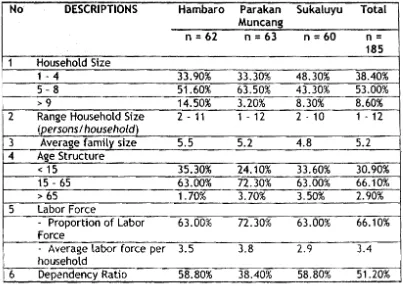
Findings show that arround 50 percent of the respondents have 58 members of the family, with the range of household size 1 to 12 persons and the average family size is 5 persons (Table 1). The proportions of labor force is
arround 66 percent with the average Labor force per household is 3.4. The
dependency ratio of the respondents is around 51 percent. Based on the data, around 6 percent of the respondents were illiterate which is Lower than the national data (9.07%).
253
ゥセャiAAijpZGM セf@
Aセ@
•
...
ᄋセエ@
.-Q
u
::.II
.
.-&A
.
Uf
...
-I..
-セ@
セ@
I
I
Zセ@
iセ@
I
13
I
iセ@
Aセ@
I
I
13
iセ@
Aセ@
I
iセ@
Aセ@
Aセ@
Aセ@
I
I
I
iGセ@
Aセ@
[image:5.599.154.557.80.366.2]
INDONESIAN TMPEGS SANREMCRSP 2009
Table 1. The SocioEconomic Characteristics of Respondents.
No DESCRIPTIONS Hambaro Parakan Sukaluyu Total
Muncang
n
=
62 n=
63 n=
60 n=
185
1 Household Size
1 4 33.90% 33.30% 48.30% 38.40% 58 51.60% 63.50% 43.30% 53.00%
>9 14.50% 3.20% 8.30% 8.60%
2 Range Household Size 2 11 1 12 2 10 1 12
(e.ersons/ household)
3 Averalle family size 5.5 5.2 4.8 5.2
4 Age Structure
< 15 35.30% 24.10% 33.60% 30.90% 15 65 63.00% 72.30% 63.00% 66.10% > 65 1.70% 3.70% 3.50% 2.90%
5 Labor Force
Proportion of Labor Force
Average labor force per household
63.00%
3.5
72.30%
3.8
63.00%
2.9
66.10%
3.4
6 . Dependency Ratio 58.80% 38.40% 58.80% 51.20%
Based on the family daily expenses, it 1s known that the ex'penses for food is
arround Rp 20 075 (std Rp 9216,1). Table 2 shows the daily avera!;e for
family expenses for food. The daily expenses for carbs range between Rp
533 to 6135.
Most family in Nanggung District engaged in agriculture (63.4%)
although off-farm inco'mes contribute most to the total household income. Total household
income is Rp 1 226 ooo/year or Rp 236 OOO/capita/month. According to the
socioeconomic survey, 52% of the surveyed household are below poverty lines
(income lower than Rp 150 000 /capita/month), with Hambaro has higher
proportion (67.7%) and Parakan Muncang with the lowest proportion (38.1%).
Based on incomeexpenditure data, 15% of the surveyed household has negative
income with expenditure higher than income generated.
Gender Values among Farmer Families.
The community of the Nanggung SubDistrict is an agricultural community dominated by rural traditionalUfe. In general the society'S norm is patriarchal, with the women's constraint in general is the limitation of
education and mobility. This means the accessibility of women to the
economic activities, financial credit and training opportunities are limited. However, most women are aware that there is a big change right now shown by the increase of women's roles in all aspects in' their village.
254
3
t:I
.-セ@
.-l.
.-L.
I.
..
E..
..
'.
.-I.
.-...
-
i3
セ@
t3
セ@
セ@
セ@
Mセ@
Mセ@
セ@
セ@
INDONESIAN TMPEGS SANREMCRSP 2009
The division of roles in their daily family activities has been
implemented respectively both in economic and domestic activities. The
community of three villages have been getting used to implement the gender distribution of roles starting from the family level and continuing to the
community level, even though it is still at the traditional stage. The value
of the division of gender roles has been practiced in their daily family management activities starting from collaboration between husband and wife in their domestic activities to the economics and community social activities.
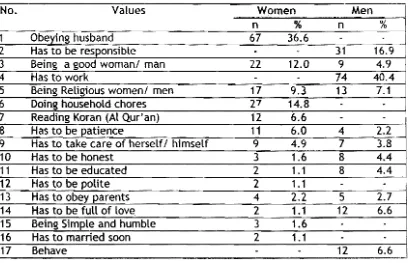
[image:6.599.137.547.323.586.2]Table 2 shows that the similarities of gender values for men and women, such as being a good woman! man, being Religious women! men, has to be patience, has to take care of herself! himself, has to be honest, has to be educated, has to obey parents, reading Koran (At Qur'an), and has to be full of love. The gender values for man only are has to be responsible, has to work, and behave, wherean the gender values for woman only are doing household chores, has to be polite, being Simple and humble, and has to married soon.
Table 2. Gender Values for Women and Men.
No. Values Wqmen
n %
Men
n %
1
Obeying husband67
36.6
2
Has to be responsible31
16.9
3 Being a good woman! man
22
12.0
9
4.9
4
Has to work
74
40.4
5 Being Religious women! men 17
9.3
13
7.1
6
DOing household chores27
14.8
7 Reading Koran (At Qur'an)
12
6.6
8 Has to be patience
11
6.0
4
2.2
9
Has to take care of herself! himself9
4.9
7
3.810
Has to be honest 31.6
84.4
11
Has to be educated2
1.1
84.4
12
Has to be polite2
1.1
13 Has to obey parents
4
2.2
52.7
14
Has to be full of love.2
1.1
12
6.6
15 Being Simple and humble 3
1.6
16
Has to married soon2
1.1
17
Behave
12
6.6
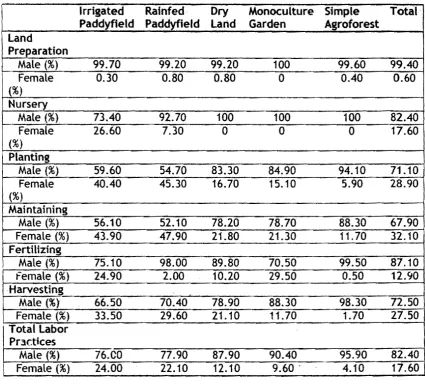
Table 3 shows the gender roles in farming system practices. It has been found out that male dominated impLement in all farming system practices, such as land preparation, nursery, planting, maintaining plants, fertilizing, and harvesting.
255
セ@
...
.J
J
•
i.
•
.
".
.-
A.
セN
l.
-
;.
セN
セ@
[セ@
セ@
セ@
Nセ@
セ@
セ@
Nセ@
Nセ@
"
.
..セ@
[image:7.599.140.566.82.467.2]INDONESIAN TMPEGS SANREM·CRSP 2009
Table 3. Gender Roles in Farming System Practices.
Irrigated Rainfed Dry Monoculture Simple Total
Paddyfield Paddyfietd land Garden AQroforest
land
Preparation
Male (%) 99.70 99.20 99.20 100 99.60 99.40
Female 0.30 0.80 0.80
o
0.40 0.60(%)
Nursery
Male (%) 73.40 92.70 100 100 100 82.40
Female 26.60 7.30
o
o
o
17.60(%)
Planting
Male (%) 59.60 54.70 83.30 84.90 94.10 71.10
Female 40.40 45.30 16.70 15.10 5.90 28.90
(%)
Maintaining
Male (%) 56.10 52.10 78.20 78.70 88.30 67.90
Female (%) 43.90 47.90 21.80 21.30 11.70 32.10
Fertilizing
Male (%) 75.10 98.00 89.80 70.50 99.50 87.10
I female (%) 24.90
2.00
10.20 29.50 0.50 12.90. Harvesting I
I Male (%} 66.50 70.40 78.90 88.30 98.30 72.50
Female(%) 33.50 29.60 21.10 11.70 1.70 27.50
Total labor Pr3ctices
Male (%) 76.CO 77.90 87.90 90.40 95.90 82.40
Female (%) 24.00 22.10 12.10 9.60 . 4.10 17.60
Gender Roles in Access and Control Profiles
Productive, reproductive and community roles of women require the use of resources. In general, women and men have different levels of both access and control over resources. Access is the opportunity to make use of the resources needed for their work, and controL is the ability to define its use and impose that definition on others over those resources. Resources can be economic: such as Land or equipment; political: such as representation, Leadership and legal structures; social: such as child care, famiLy planning, education; and aLso. The access and controL profile identifies resources individuals couLd use to carry out activities and the benefits they get from them.
Land is an important resource for an agricultural community, however, . Access and control over Land the relative power of members of a society on economy. Average land holding per household in Nanggung sub district is
0.42 ha, ranges from 0.33 0.49 ha/household. Of the household surveyed.
11 %do not have any controL over landholdings. There is unequal distribution
256
[Q
.-tQ
.-::.1.1
.-セ@
.-lUI
.-u
.-Aセ@
.-セN@
=-;.
セ@
...
セ@
セ@
セ@
セ@
セ@
INDONESIAN TMPE GS SANREM·CRSP 2009
of land holdings in the 5tudy area, with 20% of the households control 62% of
the total land .
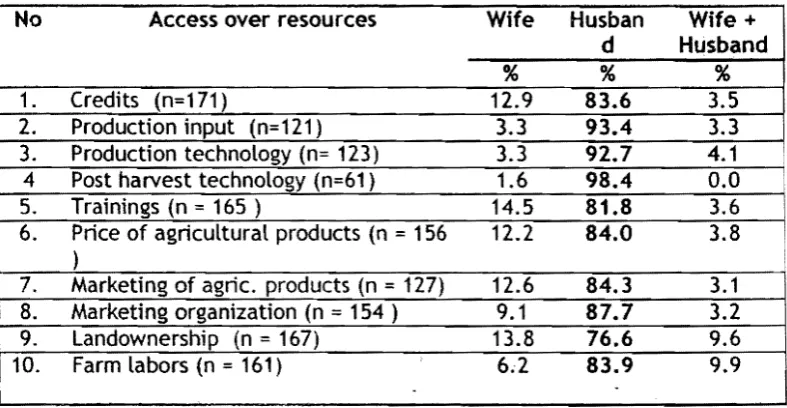
[image:8.599.130.524.186.390.2]Disparities in ger der access to land are universal, and can be found in Nanggung sub·district. ( nly 13.8 % of women have access to land whether as owner or tenant (Table ). Landownership is also dominated by men and only 13.1 %of women have c( ntrol over landownership (Table 4) .
Table 4. Gender Roles 0 n Access Over Resources.
No Access over resources Wife Husban Wife +
d Husband
% % %
1. Credits (n=171) 12.9 83.6 3.5
2. Production input ( n=121 ) 3.3 93.4 3.3
3. Production technol logy (n= 123) 3.3 92.7 4.1
4 Post harvest techn' ology (n=61) 1.6 98.4 0.0
5. Trainings (n
=
165: 14.5 81.8 3.66. Price of agricultureal products (n = 156 12.2 84.0 3.8
)
7.
Marketing of agric. products (n=
127) 12.6 84.3 3.18. Marketing organiza ation (n
=
154 ) 9.1 87.7 3.29. Landownership (n
=
167) 13.8 76.6 9.610. Farm labors (n
=
11
61 ) 6.2 83.9 9.9The study also shows t over farm production i credits, production tel access to credits. Aco not have collateral, w landownership, women socio·cultural constrair preclude women from ( banks, cooperatives anI
Very few women HSNSセ@
Generally women have and processing than ott
at there is gender differences in ac.ces!; and control
puts. Men dOr.1inated the ao:e::;s and 」ッセエイッャ@ over
hnology and labors. Only 12.? % of women have
ss to credit for women is limited because women do ich ussually is land title. Without any control over are disadvantaged over access to credits. In addition, ts and stereotypes of noncreditworthiness tend to btaining access to many formal sources of credit, like
credit unions.
) have access to production inputs and technology reater access and control over post harvest technology er production processes. However, the survey showed
that in Nanggung, only 1 6% of women have access and control over post harvest
technology and processil
g.
Although still dominated by men, a fair number of women have access
(12.6%) and control (1: .6%) over marketing of agricultural products and
12.2% of women have
a
ccess to information on the price of agriculturalproducts (Table 5). Soc oeconomic survey showed that gender role in selling agricultural product depends on the quantity of product. Women only involve in retail marketing of f rm products when the quantity is small.
257
MMMセM ... ... ..._
-セ@
セ@
••
.'
.
:;)
..
.J
セ@
..
'"
:J
...
tl
i.
I.
n.
.
セ@
セ@
=-
:3
セ@
3
Nセ@
.セ@
3
セ@
セ@
Nセ@
INDONESIAN TMPEGS SANREM·CRSP 2009
Table 5. Gender Roles on the Control Over and Benefit from Resources.
No Control over and benefits from Wife Husband Wife +
resources Husband
% % %
1.
F arming 。」エゥカゥエセ@ ( n=
161) 5.5 83.2 10.62. Production ineuts (n = 119) 4.2 84.9 10.9
3.
Production technology (n = 123) 4.1 85.4 10.54 Post harvest technology (n = 61) 1.6 95.1 3.3
I 5. Trainings ( n
=
165 ) 12.1 83.6 4.26. aセイゥ」N@ price information (n= 161) 11.8 80.1 7.1
7. Marketing of agric. products (n :: 143 ) 12.6 80.4 7.0
8. Marketing organization (n
=
154) 4.5 83.8 11.79. Land ownershie (n
=
168 ) 13.1 78.6 8.310. Farm labors (n = 168) 13.1 78.6 8.3
There is a gender difference in access to farmers' organization and trainings. OnLy 9.1% of women have access to an organization compared to
87.7 % of men who have access and control over organization. Access and
controL over trainings are also dominated by men, however, the percentage of women who have access to trainings is higher (14.5%) compared to ac\:ess to organization. The access and control of women over organization and trainings, although still low provide the entry point for trainings of women in a VAF system.
The access and control profile shows the extent to which women are impeded from participating equitably in the project. If women have limited access to income or land, they may be unable to join groups, which provide production inputs and commercial opportunities, or to become independent commercial vegetable producers.'
Gender Roles in Decision Making Profile
Women frequently perform a variety of functions in the farm household. They act as food producers, wage earners, care takers of the family looking after
nutrition, and postharvest managers. Several studies have shown that the gender affects the decisionmaking process in agricultural production and household expenditure, as well as the management of food consumption within the farm households (Balaguru, 1992).
The resuLt of the survey showed that in the three villages of Nanggung,
IILセ@ women have little role in decision making regarding farming financial planning
and activities (Table 6). The decision on farm financial planing and expenditures are dominated by men, including making routine farm financiaL planning (55.1
%), planning for purchace of production inputs (54.3%).
258
セ@
セ@
u
:u:
:.Q
l.Q
';'Q
' '
-:.L'
:.:1.
:.I.
.,.
:I.
...
.:I.
Lセセ
'
セ@
i)
ゥセ@
セセ@
セNセ@
Zエセ@
BZセ@
'" セセB@
セ@
'j'
" ..
....Lセ@ . セ@ セI@
セセ@
;1
...
u
INDONESIAN TMPEGS SANREMCRSP 2009
Table 6. Gender Decision Making in Farm Households.
No Decision Dedsion Makers
IS II) I=A AD AS
,,-1. Routine family financial planning
(n=119)
26.9 10.1 30.3 10.1 22.7
2. Routine farm financial planning (n=
118)
10.2 3.4 23.7 7.6 55.1
3.
Prediction on family cost of living (n =131 )
31.3 11.5 30.5 3.8 22.9
4. Financial planning before purchaning
inputs (n= 129)
9.3 6.2 24.8 5.4 54.3
5. Recording expenditure (n = 51) 15.7 2.0 23.5 2.0 56.9
6. Learn to manage farm finance (n=129) 11.2 5.2 25.0 3.4 55.2
7. Learn to manage family finance (n =
117)
40.2 6.8 28.2 8.5 16.2
8. Farm expenditure according to plan (n =
150)
14.0 12.0 24.0 6.0 44.0
9. Self evaluation on finacial management
(n = 132)
9.8 4.5 31.1 7.6 47.0
10. Planning types of commodity (n= 163) 6.1 7.4 34.4 6.1 46.0
11 Utilizatilizing home garden for food
crops
___JI'1_:.'_1!1L ___________________
11.4 4.4 28.1 8.8 47.4
-Notes: IS = Wife only; AS= Husband only; ID=Wife dominant, AD
Husband dominant; I=A= Wife = Husband
Women are more involved in family financial planning (31.3%). There , is a larger proportion of women who are motivated to learn about family financial planning (40.2%) compared to the percentage of women (11.2%) who are interested in learning about farm financial planning. The decision to plan for type of commodity to plant and the utilization of home garden for food crops is dominated by men (34.4%) but in some households women participation is in cooperation with men/husband (26.1%).
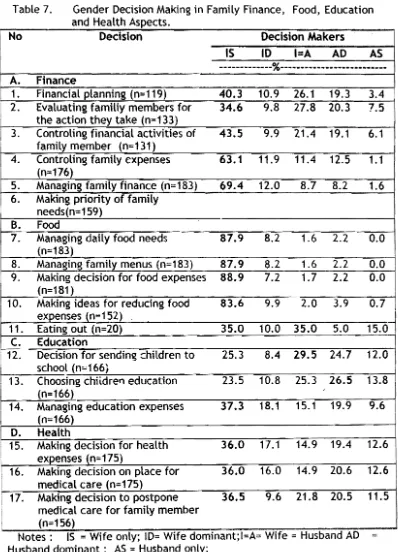
Table 7 shows that women are dominantly act as decision maker in financial planning, evaluating familiy members for the action they take, controling financial activities of family member, controling family expenses, managing family finance, making priority of family needs, managing daily food needs, managing family menus, making decision for food expenses, making ideas for reducing food expenses, making decision for health expenses, making decision on place for medical care, making decision to postpone medical care for family member, and managing education expenses. While men and women act together as decision maker in child
education planning, and planning of eating out. Whereas, men act as
decision maker in choosing child education .
259
'I
"
,
セ@
"-•
'"
"
セ@
セ@
,
セ@
セ@
セ@
セ@
セ@
セ@
;;
セ@
セ@
セ@
[image:11.599.115.513.57.609.2]INDONESIAN TMPEGS SANREMCRSP 2009
Table 7. Gender Decision Making in Family Finance, Food, Education
and Health Aspects.
No Decision Decision Makers
IS 10 I=A AD AS
,,-A. Finance
1. Financial Lanning (n=119) 40.3 10.9 26.1 19.3 3.4
2. Evaluating famil.iy members for 34.6 9.8 27.8 20.3 7.5
the action they take (n=133)
3. Controling financial activities of 43.5 9.9 21.4 19.1 6.1
family member (n=131)
4. Controling family expenses 63.1 11.9 11.4 12.5 1.1
(n=176)
5. Managing family finance (n=183) 69.4 12.0 8.7 8.2 1.6
6. Making priority of family
needs(n=159)
B.
Food7. Managing daily food needs 87.9 8.2 1.6 2.2 0.0
(n=183)
8. Managing family menus (n=183) 87.9 8.2 1.6
2.2
0.09. Making decision for food expenses 88.9 7.2 1.7 2.2 0.0
(n=181 )
10. Making ideas for reducing food 83.6
9.9
2.0 3.9 0.7expenses (n=152)
11. Eating out (n=20) 35.0 10.0 35.0 5.0
15.0-C. Education
12.
Decision for sending children to 25.3 8.4 29.5 24.7 12.0 school (n"'166)13. Choosing children education 23.5 10.8 25.3 26.5 13.8
(n=166)
14. Managing education expenses 37.3 18.1 15.1 19.9 9.6
(0=166)
D. Health
15. Making decision for health 36.0 17.1 14.9 19.4 12.6
・クセ・ョウ・ウ@ (n=175)
16. Making decision on place for 36.0 16.0 14.9 20.6 12.6
medical care (n=175)
Notes: IS = Wife only; \0= Wife dominant;I=A= Wife
=
Husband AD =Husband dominant; AS = Husband only;
17. Making decision to postpone 36.5 9.6 21.8 20.5 11.5
medical care for family member (n=156)
260
3
.
"3
hセ@
::"'a
':.!:!
セ@
'.:":. "::1
Zセ@
.-
',,,
Nセ@
·3
3'
.-Zセ@
セ@
:3
セ@
:3
セ@
セ@
Zセ@
Nセ@
セ@
INDONESIAN TMPEGS SANREM·CRSP 2009
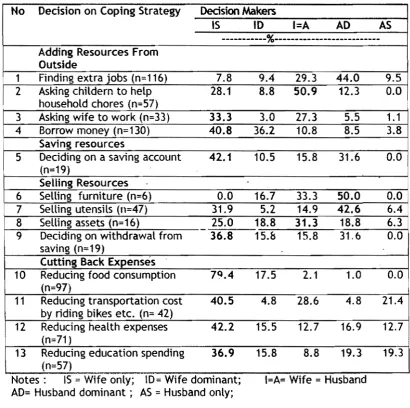
[image:12.599.118.529.196.604.2]Table 8 shows that the female roles in family coping strategy consist of adding resources from outside (through asking wife to work, borrowing money), saving resources (through deciding on a saving account, deciding on withdrawal from saving), cutting back expenses (through reducing food consumption, transportation cost, health expenses, and education spending). While the roles of male and female consist of asking children to help household chores, and selling assets. Whereas the roles of men are finding extra jobs, selling furniture, and selling utensils.
Table 8. Gender Roles in Family Coping Strategy.
No Decision on Coping Strategy Decision Makers
IS 10 I=A AD AS
,,-Adding Resources From Outside
1 Finding extra 'obs (n=116) 7.8 9.4 29.3 44.0 9.5
2 Asking childern to help 28.1 8.8 50.9 12.3 0.0
household
household choreschores (n=57)(n=57)
3 Asking wife to work (n=33) 33.3 3.0 27.3 5.5 1.1
4 Borrow money (n= 130) 40.8 36.2 10.8 8.5 3.8
Saving resources
5 Deciding on a saving account 42.1 10.5 15.8 31.6 0.0
(n=19)
6 7
Selling Resources
Selling furniture (n=6
t _._ .
Selling utensils (n=47)
0.0 31.9
16.7 5.2
33.3 50.0
_ ... _
-14.9 42.6
0.0 6.4 .
8 Selling assets (n=16) 25.0 18.8 31.3 18.8 6.3
9 Deciding on withdrawal from 36.8 15.& 15.8 31.6 0.0
saving (n=19)
Cutting Back Expenses
10 Reducing food consumption 7Q,4 17.5 2.1 1.0 0.0
(n=97)
11 Reducing transportation cost 40.5 4.8 28.6 4.8 21.4
by riding bikes etc. (n= 42)
12 Reducing health expenses 42.2 15.5 12.7 16.9 12.7
(n=71)
13 Reducing education spending 36.9 15.8 8.8 19.3 19.3
(n=57)
Notes: IS = Wife only; 10= Wife dominant; I=A= Wife
=
HusbandAD= Husband dominant; AS = Husband only;
Domestic and Agricultural Activity Profile
The household, can be defined as (nuclear) family or kinship unit; those who share a common residence; or those who share a joint function such as consumption, production, investment or ownership. Gender is one of the cause in intrahousehold difference. Within the household a socially-constructed gender division of labour exists that generally places greater
•
261セ@
Q
INDONESIAN TMPEGS SANREMCRSP 2009
IJ:t time and energy demands on women than on men. Women typically have a
triple role reproductive, productive and community managing activities.
w
The productive role of rural women is mainly in the agriculturalsector. In many parts of Indonesia, women constitute almost half of the work
.
force engaged in agriculture. Rural women participate in a broad range oftU
weeding, harvesting, threshing, drying, stacking and storing to feeding the agricultural activities starting from the selection of seeds, planting, family from the harvested produce ..
tIl
In the subdistrict of Nanggung, the socioeconomic study shows that the
..
-
involvement of women in agriculture is limited (17.6%) . The involvement is moreセ@
prominent in the irrigated and rainfed paddy fields, where women play important role in planting (40.445.3%) and crop maintainance (43.9 47.9%).
. セ@ Women partidpation in other type agriculture is minimum such as dryland
Nセ@
agriculture (12.1%) and monoculture garden (9.6%).
Consistent with the socioeconomic study, the survey showed that
セ@
women allocated most of their time (5 10 hours/ day) doing domestic
. \ acitivities. This includes domestic tasks done by women required to
GNセ@ guarantee the maintenance of the household, such as fuel and water
collection, food preparation, child care, education and health care. Women allocated less time in productive activities including agriculture activities
ゥセ@
(0.67 4.03 hours/day). Women who are working in rice fields or rainfedrice field allocated more time outside their home than those who works in home garden or other agricultural activities (Table 9) .
•.セ@
Table 9. Activity Profile of Women in the Nanggung Sub·District
.
,
NセセB@
.
I
a. Domestic 1
2
House cleaning (n= 131) 0.93 ± 0.68
Fetching water ( n
=
88) 0.61 ± 0.453 Laundry (n= 140 ) 0.90 ± 0.22
4 Washing dishes (n=143) 0.45 ± 0.29
5 Shopping for foods (n=158) 0.56 ± 0.67
6 Cooking (n= 167) 1.51 ± 0.68
7 Child care (n= 35) 10.0 ± 33.8
b. Agriculture
1 Working in the rice field (n = 123) 4.03 ± 1.47
Working in monoculture garden 3.74 ± 1.48
( n= 52)
2 Working in home garden (n = 11) 2.91±1.30
3 Animal husbandry (n = 10) 0.67 ± 0.50
4 Seling farm products to market (n = 10) 0.67 ± 0.50
...
•
I
N6
ACTIVITY Time allocationlNセ@
l
l⦅セ@
lNNセセ@
ォNセ@
lセ@
セセ@
セセ@
ャセ@
MMGMMGMMBLLGMMGMセMMGMBB@iセ@
262I...
I...
--
--13
-
Q-..
.:J
.-:
:,
oJ",
:
;"
::j
".
-·:ZIJ
.-..
Nセ@
.-Nセ@
::!J
セ@
セ@
i:if
-セ@
セ@
.
セ@..セ@
Nセ@
....
.セ@
•
セ@
セセ@
INDONESIAN TMPEGS SANREM·CRSP 2009
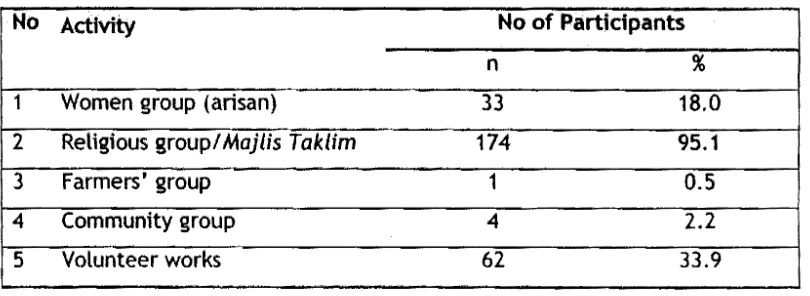
Some women also have community managing role which may includes activities undertaken primarily by women at the community level such as voluntary works in health care and education. Most of the respondents (95%)
participate in women religious groups (Majlis TakUm), but only few
respondents belongs to farmer groups (Table 10).
Table 10. Women participation in community and social activities
No Activity No of Participants
n %
Women group (arisan) 33 18.0
2 Religious group!Majlis Taklim 174 95.1
3
Farmers' group 10.5
4 Community group 4
2.2
5 Volunteer works
62
33.9Conclusions
The findings conclude that:
1. The gender values among farner families show the similarities of gender values for men and women, such as being a good woman! man, being Religious women! men, has to be patience, has to take care of herself! himself, has to be honest, has to be educated, has to obey parents, reading Koran (Al Qur'an), and has to be fuLL of love. The gender values for man only are has to be responsible, has to work, and behave, wherean the gender values for woman only are doing household chores, has to be polite, being Simple and humble, and has to married soon.
2. Gender roles in access and control over resources.
• Gender roles in farming system practices are dominated by men, such as land preparation , nursery, planting, maintaining plants, fertilizing, and harvesting.
• There is gender differences in access and control over farm
production inputs. Men dominated the access and control over
credits, production technology and labors .
• Although still dominated by men, a fair number of women have access and control over marketing of agricultural products and have access to information on the price of agricul.tural products. Socioeconomic survey showed that gender role in selling agricultural product depends on the quantity of product. Women only involve in retail marketing of farm products when the quantity is small.
[image:14.599.128.533.164.312.2]•••
c
Q
. :J
J .
:,
...
;,
.-:3
....
-,::I
. ;;1
....
,
..
.;j
'';'
':.;;7
l
ャセ@
セ@ Nセ@
L
lセ@
L
[
lセ@
I;;
Zセ@
[
[
I::
.tj
Nセ@
Hセ@
iセ@
I
iipᄋセ@INDONESIAN TMPEGS SANREMCRSP 2009
3. Gender roles in decision making in farm househoLds and coping strategy, and aLso domestic and agricuLturaL activities .
• Women have LittLe role in decision making regarding farming financial planning and activities. The decision on farm financial planing and expenditures are dominated by men, including making routine farm financial planning, and planning for purchace of production inputs .
• Women are dominantly act as decision maker in fillancial
planning, evaluating familiy members for the action they take, controling financial activities of family member, controling family expenses, managing family finance, making priority of family needs, managing daily food needs, managing family menus, making decision for food expenses, making ideas for reducing food expenses, making decision for health expenses, making decision on place for medical care, making decision to postpone medical care for family member, and managing education expenses. While men and women act together as decision maker in child education planning, and planning of eating out. Whereas, men act as decision maker in choosing child education .
• The female roles in family coping strategy consist of adding resources from outside (through asking wife to work, borrowing money), saving resources (through deciding on a saving account, deciding on withdrawal from saving), cutting back expenses (through reducing food consumption, transportation cost, health expenses, and' education spending). While the roles of male and female consist of asking children to help household chores, and selling assets. Whereas the roles of men are finding extra jobs, selling furniture, and selling utensils.
• Consistent with the '5ocioeconomic study, the survey showed that women allocated most of their time (5 10 hourslday) doing domestic acitivities. This includes domestic tasks done by women required to guarantee the maintenance of the household, such as fuel and water collection, food preparation, child care, education and health care. Women allocated less time in productive activities including agriculture activities (0.67 4.03 hourslday). Women who are working in rice fields or rainfed rice field allocated more time outside their home than those who works in home garden or other agricultural activities.
Acknowledgements
This publication was made possible through support provided by the United States Agency for International Development and the generous support of the American People (USAID) for the Sustainable Agriculture and Natural Resources Management Collaborative Research Support Program (SANREM CRSP) under terms of Cooperative Agreement Award No. EPPA000400013-00 to the Office of International Research and Development (OIRED) at Virginia Polytechnic Institute and State University (Virginia Tech).
264
======
____
""'r HltP ""(IRma ケセ@ NᄋゥBゥ[ゥLゥNGᄋヲャANGセ@'""
;.
-
.a
-
'
..
•••
...
3
セ@Nセ@
...
-
Nセ@
セ@
Nセ@
Nセ@
セセ@
セ@
Nセ@
セ@
セ@
________________________________________....
....
==.===
:J
INDONESIAN TMPEGS SANREMCRSP 2009
:.
;.
References
KPP·BKKBNUNFPA. 2004. Bunga Rampa;: Panduan dan Bahan
Pembelajaran Pelatihan Pengarusutamaan Gender dalam
Pembangunan Nasional. Kementerian Pemberdayaan Perempuan
Republik Indonesia Cooperation with BKKBN and UNFPA.
KPp·UNDP. 2007. Modul: p・ョァ。イオウオエセュ。。ョ@ Gender dalam Pembangunan
Nasional di Indonesia. Kementerian Pemberdayaan Perempuan Republik Indonesia Cooperation with UNDP.
Osteergaard, 1992.
Renzetti, CM., & Curran, D.J. 1995. Women, Men. and Society. Allyn and
Bacon. USA.
265
セ@
.
-..
---
:.
1
-
:&:11
Trikoesoemaningtyas dan Puspitawati,
H.
2009.
:.
Women
Access
to
Market:
Vegetable
--
...
Marketing
of
Women in The Village
of
-
""-"W
Hambaro Nanggung Subdistrict, West Java.
'.
Risert Repots SANREM-CRSP: Agroforestry
and Sustainable Vegetable
--
.
'.
セN@
Southeast Asian Watersheds.
-
Indonesian TMPEGS Book.
-
-
...
Hal 266 - 273 .
Nセ@
Nセ
:.
--
セ@
..セ@
セ@
Nセ@
Zセセ@
セ@
@
Nセ@
セ@
セ@