Secondhand tobacco smoke in public venues in three Indonesian cities
M. Justin Byron,1 Dollaris R. Suhadi,2 Lisa M. Hepp,3 Erika Avila-Tang,1,3,4 Jingyan Yang,3 Gema Asiani,5 Rubaeah,6 Stephen A. Tamplin,3 Tara S. Bam,7 Joanna E. Cohen1,3
1 Department of Health, Behavior & Society, Johns Hopkins Bloomberg School of Public Health, Baltimore, Maryland, USA 2 Swisscontact Indonesia Foundation, Jakarta, Indonesia
3 Institute for Global Tobacco Control, Johns Hopkins Bloomberg School of Public Health, Baltimore, Maryland, USA 4 Department of Epidemiology, Johns Hopkins Bloomberg School of Public Health, Baltimore, Maryland, USA 5 Palembang City Health Agency, Palembang, Indonesia
6 Bogor City Health Department, Bogor, Indonesia
7 International Union Against Tuberculosis and Lung Disease, Jakarta, Indonesia
Abstrak
Latar belakang: Penelitian ini bertujuan untuk mengukur konsentrasi paparan asap rokok pada tempat-tempat umum di Jakarta, Bogor, dan Palembang sebelum aturan pelarangan merokok di tempat umum diberlakukan.
Metode: Dilakukan pengukuran kandungan partikel (PM2.5) pada 15 rumah sakit, 15 instansi pemerintah, 30 restoran, dan 26 tempat hiburan yang berlokasi di ketiga kota tersebut di atas. Di Jakarta, dilakukan juga pengukuran terhadap kandungan fase uap nikotin pada 5 sekolah, 5 rumah sakit, 5 instansi pemerintah, 9 restoran, dan 10 tempat hiburan. Analisa data dilakukan secara deskriptif. Perbedaan karakteristik tempat dianalisis dengan menggunakan Student’s t-test, uji ANOVA, dan Bonferroni pairwise statistical tests.
Hasil: Rata-rata geometris tingkat PM2.5 ditemukan tertinggi pada tempat hiburan (96 μg/m3), disusul restoran (78 μg/m3),
instansi pemerintahan (57 μg/m3), dan rumah sakit (46 μg/m3). Tingkat udara dengan kandungan nikotin di Jakarta ditemukan
tertinggi pada area khusus merokok (4,71 μg/m3) dan area dilarang merokok (1,55 μg/m3) yang terdapat di tempat hiburan.
Diikuti oleh instansi pemerintahan (0,30 μg/m3), area khusus merokok (0,24 μg/m3), dan area dilarang merokok (0,19 μg/m3)
pada restoran, rumah sakit (0,01 μg/m3), dan sekolah (0,01 μg/m3).
Kesimpulan: Paparan asap rokok terdeteksi pada seluruh tempat di tiga kota di Indonesia. Kandungan udara yang mengandung nikotin pada tingkat yang tinggi ditemukan pada area dilarang merokok pada restoran dan tempat hiburan. Hal ini mengindikasikan bahwa dipisahkannya area merokok dan area tidak merokok bukanlah solusi efektif untuk menghilangkan asap rokok. Tidak ada tingkat aman untuk paparan asap rokok, sehingga adanya paparan asap rokok di tempat-tempat tersebut di atas dapat meningkatkan risiko buruk bagi kesehatan anak-anak dan orang dewasa. Temuan ini mendukung perlunya aturan kawasan bebas rokok yang mencakup seluruh tempat umum di ketiga kota tersebut dan seluruh kota di Indonesia. (Med J Indones. 2013;22:232-7. doi: 10.13181/mji.v22i4.606)
Abstract
Background: The aim of this study was to measure secondhand tobacco (including kretek) smoke (SHS) concentrations in
public places in Jakarta, Bogor, and Palembang before laws banning smoking in public spaces went into effect.
Methods: Particulate matter (PM2.5) was measured in 15 hospitals, 15 government ofices, 30 restaurants, and 26
entertainment venues throughout the three cities. Also, in Jakarta, vapor-phase nicotine was measured in 5 schools, 5
hospitals, 5 government ofices, 9 restaurants, and 10 entertainment venues. Data were analyzed descriptively. Differences by city and venue characteristics were analyzed by Student’s t-test, ANOVA, and Bonferroni pairwise statistical tests.
Results: Geometric mean PM2.5 levels were highest in entertainment venues (96 μg/m3), followed by restaurants
(78 μg/m3), government ofices (57 μg/m3), and hospitals (46 μg/m3). Air nicotine levels in Jakarta were highest in
designated smoking areas (4.71 μg/m3) and designated non-smoking areas (1.55 μg/m3) of entertainment venues.
These were followed by government ofices (0.30 μg/m3), designated smoking areas (0.24 μg/m3) and designated
non-smoking areas (0.19 μg/m3) of restaurants, hospitals (0.01 μg/m3), and schools (0.01 μg/m3).
Conclusion: SHS was detected in all venues in the three cities in Indonesia. High levels of air nicotine were found in
non-smoking areas of restaurants and entertainment venues, indicating that designated smoking areas are not an effective solution to eliminate SHS. There is no safe level of SHS exposure and thus SHS in these venues increases the risk of
adverse health effects among children and adults. These indings support the need for 100% smoke-free laws covering
all public venues in these and other Indonesian cities. (Med J Indones. 2013;22:232-7. doi: 10.13181/mji.v22i4.606)
Keywords: Cigarettes, kretek, protection, protect, secondhand smoke, smoke-free policy, tobacco
and lung cancer among adults; and sudden infant death syndrome, acute and chronic respiratory infections, ear infections, and more severe asthma among children.1
The World Health Organization (WHO) has declared that there is no safe level of SHS, and that 100%
free policies are the only fully effective solution.2 The
WHO’s Framework Convention on Tobacco Control (FCTC) encourages countries to protect their citizens
by enacting legislation banning smoking in all public places and workplaces and on public transportation.3
As of July 2013, 177 countries have ratiied the FCTC.4
Indonesia is the world’s fourth largest consumer of cigarettes, including kretek (clove cigarettes).5 Of the
country’s 238 million residents, 67.0% of adult men and 2.7% of adult women are smokers, and of them
56.7% and 1.8%, respectively, are daily smokers.6
Smoking has increased markedly since 1995, when the prevalence was 53.9% among men and 1.7% among
women.6 Smokers start young: among children ages
13-15, 41.0% of boys and 3.5% of girls are already current
smokers.7 The vast majority (92%) of the cigarettes smoked in Indonesia are kretek,8 which tend to have higher tar levels than other cigarettes.9 Polls show
that more than 92% of the Indonesian public support
smoke-free laws,10 but the government’s response to the issue has not been optimal. Indonesia has not signed
or acceded to the FCTC, and national laws addressing
SHS exposure have been incomplete and minimally
enforced. In Health Law No. 36/2009, the Indonesian
central government required local governments to make health facilities, educational facilities, children’s activities areas, places of worship, public transportation, and other public places and workplaces smoke-free, but the law explicitly allows for designated smoking areas in some of these buildings, an approach which fails to properly protect nonsmokers.1 Additionally, the law did not state any sanctions for jurisdictions that did not implement the law. Therefore, implementation
was slow and inconsistent. In 2005, Jakarta passed Law 2/2005 and Implementing Regulation 75/2005,
requiring the above venues and all workplaces and public places to be smoke-free, but this law too allowed for designated smoking areas and achieved only partial
compliance. In 2010, Jakarta passed a more strict regulation, 88/2010, which eliminates designated indoor smoking areas and, as of 2012, enforcement was improving. In 2012 a further Implementing Regulation 50/2012 was issued. It deines enforcement procedures
and administrative sanction mechanisms. In Bogor,
preliminary smoke-free legislation was passed in 2006 and then strengthened in 2009 with Law 12/2009,
banning smoking in all workplaces and public places,
specifying enforceable ines, and allowing the mayor
to set regulations regarding designated smoking areas. The mayor required that designated smoking areas must
be outdoor rooless areas far from building entrances
and must be approved by the health department. In
Palembang, Regulation 7/2009 was passed in 2009,
banning smoking in all public places and workplaces
with no allowance for designated smoking areas. Both Bogor’s and Palembang’s smoke-free laws took effect
in mid-2010. Jakarta’s law took effect in late 2010.
The present study was conducted in Jakarta, Bogor, and
Palembang in 2009 while these cities were in the midst
of discussions and debates about possible smoking restrictions. The purpose of the study was to provide policymakers with objective measures of SHS levels in these three cities in schools, hospitals, government
ofices, restaurants, and entertainment venues. These
measurements were collected using particulate matter (PM2.5) and airborne nicotine monitoring techniques, which have been used in a variety of countries and environments worldwide.11-15 This study is among the
irst to report SHS levels in public places in Indonesia.
METHODS
Design and data collection
This cross-sectional study measured SHS levels in three
cities in Indonesia using a standardized protocol. Jakarta
was chosen as a monitoring site since it is the capital city, and Bogor and Palembang were chosen because they were
among the irst cities to pass comprehensive smoke-free legislation. Data for this study were collected from August through September 2009, before the new smoke-free laws took effect in 2010. Data collection was preceded by three
days of training. PM2.5 levels were measured in each city in a convenience sample of 5 hospitals, 5 government
ofices, 10 restaurants, and 10 entertainment venues. In
Jakarta, airborne nicotine was also measured in these venues and in 5 schools. Sampled rooms in these buildings
include lobbies, cafeterias, lounges, ofices, restrooms, and hospital patient loors. Field workers also noted room
dimensions and the number of people actively smoking
in the room at 15 minute intervals. Field workers gained
permission from responsible authorities at each site before taking measurements or placing the air nicotine monitors. The study was approved by the Jakarta Environmental
Management Board, the City Health Ofice of Bogor, and the City Health Ofice of Palembang. According to Johns
Hopkins Bloomberg School of Public Health Institutional
Review Board guidance, the project did not meet the
criteria for “human subjects” research and therefore did not require review. The study was locally facilitated by
Swisscontact Indonesia Foundation.
Monitoring methods
SHS concentrations were estimated using both PM2.5 and airborne nicotine measurement methods. PM2.5 was
measured using TSI SidePak AM510 Personal Aerosol
Hospitals Government Restaurants Entertainment
venues Schools Total
PM2.5 Bogor 10 10 20 17 - 57
Jakarta 10 10 17 12 - 49
Palembang 10 9 13 7 - 39
Air nicotine Jakarta 26 (65%) 35 (100%) 17 (88%) 20 (100%) 22 (32%) 120 (78%) Table 1. Number of samples for particulate matter and air nicotine. For air nicotine, the percent of samplers detecting nicotine is noted
in parentheses
aerosol monitors were itted with a 2.5 µm impactor
which allowed for measurement of particulate matter with a mass median aerodynamic diameter of less than or
equal to 2.5 µm. The SidePak monitors were calibrated
before use. At each PM2.5 collection point, ield workers collected data for 5 minutes outdoors to get a background
reading and then for 30 continuous minutes indoors in
each of two rooms per venue. In 27 venues only one room was measured. Sampling was done discreetly so that patrons would not change their behavior.
Airborne nicotine measurement was accomplished by
using small disposable passive samplers containing a ilter
treated with sodium bisulfate placed in a 37 mm sampling cassette with a porous diffusion membrane and support pad.16 The samplers have an internal volume between the
ilter and windscreen of 9.49cm3 and a low rate of 0.024
liters per minute. The samplers were placed in the chosen locations for 7 days (5 days for schools and government
ofices). The number of samplers placed in each venue depended on venue type and size. Based on a protocol
developed from work in other countries, the samplers were
placed in the venues as follows: 5-6 samplers in each of 5 hospitals, 6-8 samplers in each of 5 government buildings, 1-2 samplers in each of 9 restaurants, 2 samplers in each of 10 entertainment venues, and 3-5 samplers in each of 5 schools. Once collected, the samplers were placed in
sealed containers and shipped to the Secondhand Smoke Assessment Laboratory at the Johns Hopkins Bloomberg School of Public Health (Baltimore, USA) for analysis. In the laboratory, the nicotine was extracted from the
ilters and analyzed using gas chromatography with
nitrogen-selective detection.16,17 The concentration of airborne nicotine was calculated by dividing the amount
of collected nicotine (in µg) by the effective volume of air
sampled (in m3). Some of the samplers placed in venues
were lost or taken, leaving 120 for analysis. An additional
12 duplicate sampling units were used for quality control and 13 blank units were used to determine blank-corrected
nicotine concentrations. The limit of detection (LOD) ranged from 0.0042 µg/m3 to 0.0064 µg/m3 in the different batches of samplers processed. Twenty-six samples had
nicotine concentrations below the LOD, and these were
assigned a value of one half of the LOD.18
Statistical analysis
PM2.5 data were downloaded from the TSI SidePak
AM510 monitors and analyzed using STATA statistical
software and Microsoft Excel. Active smoking was
deined as the presence of at least one smoker at the 0-, 15-, or 30-minute time points. PM2.5 and air nicotine concentrations were log-normally distributed and geometric means, medians, interquartile ranges, and
95% conidence intervals were calculated for each city,
venue type, and smoking status (active smokers present or no active smokers present). Student’s t-test, analysis
of variance (ANOVA), and Bonferroni pairwise test
were used for statistical analysis.
RESULTS
Particulate matter in Jakarta, Bogor, and Palembang
Particulate matter readings were taken in a total of 148
rooms in 86 venues. Indoor geometric mean PM2.5 levels
were highest in venues in Jakarta (79 μg/m3), followed
by Bogor (70 μg/m3) and then Palembang (56 μg/m3). Among the three cities, the difference between Palembang
and Jakarta was highly signiicant (p = 0.008), whereas other differences were statistically not signiicant (Jakarta vs Bogor, p = 0.069; Palembang vs Bogor, p = 0.998).
Comparing venues, indoor PM2.5 levels were highest in
entertainment venues (96 μg/m3), followed by restaurants
(78 μg/m3), and then government ofices (57 μg/m3) and
hospitals (46 μg/m3) across all cities. Differences across
three venues were not statistically signiicant between government and entertainment (p = 0.131), restaurant and entertainment (p = 0.998), hospital and government (p = 0.998), government and restaurant (p = 0.469), and between hospital and restaurant (p = 0.081), whereas hospital vs entertainment was statistically signiicant (p = 0.019). These indoor values were also statistically signiicantly different (p = 0.01) compared with the
geometric mean outdoor levels of PM2.5 (55 μg/m3). The geometric mean for PM2.5 in all indoor places with active
smoking observed (85 μg/m3) was higher than that
of indoor places where smoking was not observed
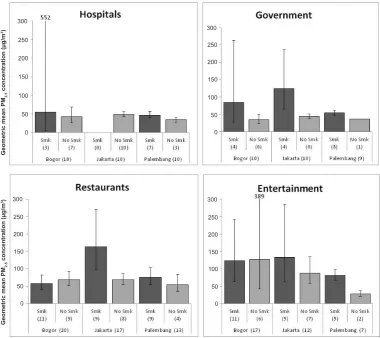
(53 μg/m3, p < 0.001). The overall lowest PM
Figure 1. Particulate matter (PM2.5) levels by venue-type, city, and active smoking. Error bars indicate 95%
conidence intervals. Numbers in parenthases indicate the number of rooms sampled. Smk = area with active smokers, No Smk = area without active smokers
19 μg/m3, was found in a hospital in Bogor and the
highest value, 1,030 μg/m3, was found in a restaurant in
Jakarta. Figure 1 shows the geometric mean and 95%
conidence intervals for the PM2.5 levels by venue, city,
and active smoking.
Airborne nicotine in Jakarta
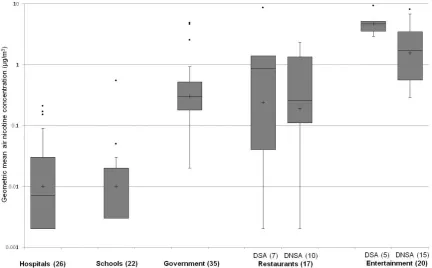
Results show that the highest geometric mean (GM)
air nicotine values were in designated smoking areas
(DSA, 4.71 μg/m3) and designated non-smoking areas
(DNSA, 1.55 μg/m3) of entertainment venues. These were
followed by government ofices (0.30 μg/m3), DSA (0.24
μg/m3) and DNSA (0.19 μg/m3) of restaurants, hospitals
(0.01 μg/m3), and schools (0.01 μg/m3). Using ANOVA,
these values were statistically signiicantly different (p < 0.001). Using the Bonferroni pairwise test across venue types for air nicotine, the statistically signiicant differences were DNSA vs entertainment-DSA (p = 0.007), government vs entertainment-DNSA (p = 0.001), hospitals vs entertainment-DNSA (p < 0.001), restaurants-DNSA vs entertainment-DNSA (p = 0.026), schools vs entertainment-DNSA (p < 0.001),
government vs entertainment-DSA (p < 0.001), hospitals vs entertainment-DSA (p < 0.001), restaurants-DSA vs entertainment-DSA (p = 0.001), restaurants-DNSA vs DSA (p < 0.001), schools vs entertainment-DSA (p < 0.001). Nicotine was detected in 90% of the
measurements taken in non-smoking areas of restaurants
and 100% of the non-smoking areas of entertainment venues (Figure 2).
DISCUSSION
This study found high levels of SHS in many indoor venues in these Indonesian cities, as indicated by both PM2.5 and air nicotine measurements. The study results show that SHS is present even in designated non-smoking areas. Thus, having designated smoking and non-smoking areas
in a venue does not suficiently protect public health.
Levels of SHS were highest in entertainment venues,
followed by restaurants, government ofices and hospitals (although the statistical signiicance of these differences was limited). These indings are consistent with other
particulate matter and air nicotine studies in Asia which
tend to ind the highest levels in bars, entertainment
Geometric mean PM
2.5
concentration (µg/m
3)
0
0 0
0 50
50 50
50 100
100 100
100 150
150 150
150 200
200 200
200 250
250 250
250 300
300 300
300
Geometric mean PM
2.5
concentration (µg/m
venues, and restaurants, and the lowest levels in schools and hospitals.12,13,19 The levels of SHS found in restaurants and entertainment venues in this study were high (PM2.5 levels up to 1,030 μg/m3). At these levels a person may have more PM2.5 exposure in 40 minutes
than is acceptable for an entire day by WHO guidelines.20
Based on work exposure (8 hours) an employee would
probably be exceeding the WHO guideline for PM2.5 (by
being exposed to over 75 μg/m3) in 45% (13/29) of the
sampled venues in Bogor, 50% (15/30) of the sampled venues in Jakarta, and 26% (7/27) of the sampled venues
in Palembang. A recent study found geometric mean PM2.5 levels in Southeast Asian and Paciic countries
(excluding Indonesia) of 159 μg/m3 in indoor areas with
active smokers and 22 μg/m3 in areas without active
smokers.12 Comparatively, in Indonesia we found higher
PM2.5 (53 μg/m3) in areas without active smoking, and
lower PM2.5 in areas with active smoking (85 μg/m3). The levels of SHS found in hospitals and schools were quite low, indicating that smoke-free policies in these
locations have generally been successful. Compliance checks in Bogor in 2013 found the smoke-free law was
working well in most places, but there was still a need for strengthened implementation efforts in restaurants, entertainment places, and hotels.
This study is among the irst to report SHS measurements
in public places in Indonesia. The strengths of the study
are that standardized methods were used and air nicotine monitoring was used to support the indings of the particulate matter monitoring (air nicotine is speciic to
tobacco smoke). This study was limited by its moderate
sample size and convenience sampling approach. Therefore, the indings may not be fully representative or generalizable. However, the purpose was not to estimate
exposure using a representative sample but to measure SHS levels in a predetermined number of policy-relevant venues. As a second limitation, some measurements in
Bogor were made during Ramadan, when Muslims are
forbidden to smoke during the day. A third limitation was that the PM2.5 collection method is not speciic to tobacco smoke and may include particulate matter from cooking stoves and ambient air pollution. In the air nicotine component of the project, the measurements were made on a continuous basis and therefore likely underestimate smoke concentrations at the time of occupancy.
In conclusion, together with proven techniques of
determined leadership, community organizing, and
education campaigns, SHS monitoring can be a tool to support smoke-free advocacy efforts. The sharing of preliminary results of this study contributed to the
enactment of 100% smoke-free policy in Jakarta, Bogor,
and Palembang. There is a need for more widespread
comprehensive 100% smoke-free laws in Indonesia,
without exceptions for designated smoking areas. Air Figure 2. Air nicotine concentrations in Jakarta by venue-type (logarithmic scale). Limit of detection (LOD) for nicotine
varied from 0.0042 µg/m3 to 0.0064 µg/m3 in different samples. Measurements below the LOD were assigned
a value of one half of the LOD. “+” indicate the Geometric Mean. DSA = Designated smoking area, DSNA =
monitoring data and compliance checks can be used effectively to make the case for such laws and ensure that they are effective in protecting public health.
Acknowledgments
This work was supported by an award from the
Bloomberg Initiative to Reduce Tobacco Use. We greatly
appreciate the assistance of Swisscontact Indonesia
Foundation, Jakarta Environmental Management Board, Bogor City Health Ofice, No Tobacco Community in Bogor, and Palembang City Health Ofice. Thanks also to
the International Union Against Tuberculosis and Lung
Disease for technical coordination and organization of
the survey.
REFERENCES
1. US Department of Health and Human Services. The health
consequences of involuntary exposure to tobacco smoke:
A report of the Surgeon General. Atlanta, GA: US DHHS Centers for Disease Control and Prevention, Ofice on Smoking and Health; 2006.
2. WHO. Protection from exposure to second-hand tobacco
smoke: Policy recommendations. Geneva: World Health
Organization; 2007.
3. WHO. WHO Framework Convention on Tobacco Control. Geneva: World Health Organization; 2005 updated reprint. 4. WHO [Internet]. Parties to the WHO Framework
Convention on Tobacco Control. 2013 [updated 2013 June 25; cited 2013 July 29]; Available from: http://www.who.
int/fctc/signatories_parties/en/index.html.
5. Eriksen M, Mackay J, Ross H. The tobacco atlas. 4th ed. New York: World Lung Foundation; 2012.
6. WHO. Global Adult Tobacco Survey: Indonesia report 2011. Geneva: World Health Organization; 2012.
7. WHO. Global Youth Tobacco Survey: Indonesia 2009 factsheet (ages 13-15). Geneva: World Health Organization; 2009.
8. Brinson B. A good match: Sampoerna continues to thrive following its acquisition by Philip Morris. Tobacco
Reporter. 2008 Nov:54.
9. Euromonitor. Cigarettes - Indonesia. London: Euromonitor International; 2010.
10. Ministry of Health, Republic of Indonesia. Factsheet No.4. Indonesians strongly support establishment of 100% smoke-free environments. Ministry of Health, Republic of Indonesia, Directorate General of Disease Control and Environmental Health, Directorate of Non-Communicable Disease Control, 2011.
11. Wipli HL, Fujimoto K, Valente TW. Global tobacco control diffusion: The case of the Framework Convention on Tobacco Control. Am J Public Health. 2010;100(7):1260-6.
12. Hyland A, Travers MJ, Dresler C, Higbee C, Cummings KM. A 32-country comparison of tobacco smoke derived particle levels in indoor public places. Tob Control. 2008;17(3):159-65.
13. Lee J, Lim S, Lee K, Guo X, Kamath R, Yamato H, et al.
Secondhand smoke exposures in indoor public places in seven
Asian countries. Int J Hyg Environ Health. 2010;213(5):348-51. 14. Kim S, Sohn J, Lee K. Exposure to particulate matters
(PM2.5) and airborne nicotine in computer game rooms after implementation of smoke-free legislation in South
Korea. Nicotine Tob Res. 2010;12(12):1246-53.
15. Navas-Acien A, Peruga A, Breysse P, Zavaleta A, Blanco-Marquizo A, Pitarque R, et al. Secondhand tobacco smoke in public places in Latin America, 2002-2003. JAMA. 2004;291(22):2741-5.
16. Hammond SK, Leaderer BP. A diffusion monitor to
measure exposure to passive smoking. Environ Sci Technol.
1987;21:494-7.
17. Avila-Tang E, Travers MJ, Navas-Acien A. Promoting
smoke-free environments in Latin America: a comparison of methods to assess secondhand smoke exposure. Salud
Publica Mex. 2010;52 Suppl 2:S138-48.
18. Hornung R, Reed L. Estimation of average concentration in the presence of nondetectable values. Appl Occup Environ Hyg. 1990(5):46-51.
19. Stillman F, Navas-Acien A, Ma J, Ma S, Avila-Tang E,
Breysse P, et al. Second-hand tobacco smoke in public places
in urban and rural China. Tob Control. 2007;16(4):229-34. 20. WHO [Internet]. WHO air quality guidelines for particulate
matter, ozone, nitrogen dioxide, and sulfur dioxide:
Summary of risk assessment. Geneva: World Health