UNIVERSITI TEKNIKAL MALAYSIA MELAKA
DEVELOPMENT OF KNEE BRACES FOR OSTEOARTHRITIS
PATIENT
This report submitted in accordance with requirement of the Universiti Teknikal Malaysia Melaka (UTeM) for the Bachelor Degree of Manufacturing Engineering
Technology
(Product Design) with Honours.
by
MUHAMAD HUSNI BIN HUSSEIN B071110369
890131-01-5577
DECLARATION
I hereby, declared this report entitled “DEVELOPMENT OF KNEE BRACES FOR OSTEOARTHRITIS PATIENT” is the results of my own research except as cited in
the references.
Signature :
Author’s Name : MUHAMAD HUSNI BIN HUSSEIN
APPROVAL
This report is submitted to the Faculty of Engineering Technology of UTeM as a partial fulfillment of the requirements for the degree of Bachelor of Manufacturing Engineering Technology (Product Design) with Honours. The member of the supervisory committee is as follows:
(Signature of Supervisor)
APPROVAL
This report is submitted to the Faculty of Engineering Technology of UTeM as a partial fulfillment of the requirements for the degree of Bachelor of Manufacturing Engineering Technology (Product Design) with Honours. The members of the supervisory committee are as follows:
(Signature of Principal Supervisor)
i
ABSTRAK
ii
ABSTRACT
There is a need, to redesign and improve the mechanism and functional of rehabilitation device for knee functional weakness. The purpose is to help the knee functional weakness, patient in the process of rehabilitation. Literature study used to identify the problems and solutions of the existing design andto collect specification data and patent of an existing device before the development process of conceptual design is implemented. The conceptual designs have been developed based on product design criteria. The final design has been selected by using suitable methods which are screening and scoring methods. By using software Solidwork, the model of the final design has been successfully developed and used to analyze the critical component of the device. Result from the analysis of critical part indicates that the proposed design is possible to use safely.
iii
DEDICATION
I would first like to express heartfelt thanks for the warmth of love to my adored Parents:
Mr. Hussein Bin Daing Diduk Mrs. Siti Asnah Binti Hj Daeng Matata
And for my respected Brother and Sister:
Siti Norhidayah Binti Hussein Mohd Taufiq Bin Hussein Muhammad Hanif Bin Hussein
Haziq Aiman Bin Hussein
Thanks you for the endless support and loves to me..
iv
ACKNOWLEDGEMENT
First of all, I would like to thank to my supervisor, Engr Hassan Bin Attan for giving me a lot of knowledge and a lot of information during this final year project period. Without his support and encouragement I can’t afford to complete this final year project
I also would like to thank all of my lecturers in Universiti Teknikal Malaysia Melaka (UTeM) who have helped me from the beginning until the end of this final year project period. Without their support and advice I can never complete this technical report with success.
Special thanks to my fellow friend, for helping me most in getting the information and detail about everything that related to this final project. They give full commitment in helping me finding the solution to my problem and solve it together. Not to be forget to all my family members because they had given a lot of support and attention to me in doing and finishing with success on this final year project. I really appreciated for what you guys have done for me.
Not to be forget to all my family members because they had given a lot of support and attention for me to finish with success on this final year project. I really appreciated for what you guys have done for me.
vii
4. RESULT AND DISCUSSION 57
4.1 Discussion of Final Design 57
4.2 Analysis on Critical Part 58
4.2.1 Thigh Frame (Critical Part) 59
4.2.2 Loading, Boundary Conditions and Mesh Geometry 59
4.2.3 Material and Mass Properties 62
4.2.4 Setup Fixture 64
4.2.5 Setup Force 64
4.2.6 Select Material 65
4.2.7 Run Simulation 66
4.3 Result and Analysis 66
5. CONCLUSION AND RECOMMENDATION 69
5.1 Conclusion 69
5.2 Recommendation of Future Work 71
viii
LIST OF TABLE
2.1 Tibia femoral motion in the sagittal plane 11
2.2 Specifications of Zcanner 700 cX 21
2.3 Pattern existing products 25
2.4 Pattern improvement product 26
3.1 Concept Screening 43
3.2 Concept Scoring Matrix 45
3.3 Bill of Material for Final Design 54
ix
LIST OF FIGURE
2.1 The normal gait cycle of body 5 2.2 The traditional nomenclature for describing eight main events,
emphasizing the cyclic nature of human gait. 7 2.3 Location of each joint angle and electro goniometry method
experiment to has shown human walk profile 8 2.4 Diagram showing the relation between gait speed and knee angle
and hip flexion, extension 9
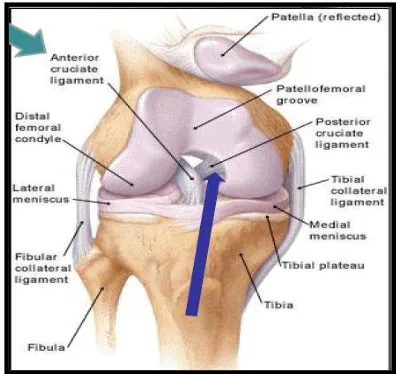
2.5 Knee Structure 10 2.6 Partial tears of the anterior cruciate ligament are rare; most ACL injuries Are complete or near complete tears 15
2.7 Z Scanner 700 cX 20
2.8 The concept flow process of ZScanner 22
2.9 Positioning the scan to the surface of the object 23
2.10 Image scan 24
2.11 Object with no limitations size of the part and image after editing 24 2.12 A two degree of freedom motor powered gait orthosis:
A, motor; B, screw; C, nut (joint); D, knee joint. 25
3.1 Flowchart 29
3.2 Existing rehabilitation device 31
3.3 The maximum angle of knee flexion 31
3.4 Design Concept 1 34
3.5 Design Concept 2 35
3.6 Design Concept 3 36
3.7 Design Concept 4 38
3.8 Final Design of Rehabilation Device 47
3.9 Perspective View of the Rehabilitation Device 48
3.10 Waist Holder 49
3.11 Thigh Frame 50
x
3.18 Exploded View of Rehabilitation Device 53
4.1 Dimension and 3D view of Rehabilitation Device 58
4.2 Thigh Frame as Critical Part 59
4.3 Mesh Geometry 60
4.4 Total Nodes and Total Elements 60
4.5 Critical Part 63
1
CHAPTER 1
INTRODUCTION
1.1
Background of Study
Most of the patients that are concerned about the function of knee braces already have a ligament injury. The patients are usually concerned about the functioning of knee braces because it can help them using the knee braces in proper ways. The functional knee braces are designed to compensate for a torn knee ligament. The functional knee braces is not as effective as the normal knee ligaments, but it can help patients who have the ligament injury.
2
1.2
Problem Statement
a) The rehabilitation for knees injury is commonly by using the knee braces. There are a lot of knees braces types in the market. The knee braces is used to support the knees after the injury happens. The existing product is not so reliable to use and costly. The biggest issue with existing design is, the strap is normally open by its own and the knee braces will slip. It can cause the person to feel not comfortable when they walk.
1.3
Objective
The objective for the improved design of the knee braces are:
a) To redesign a device that support and help knee movement b) To make an improvement to the existing product
c) To analyze and simulate the functional movement of devices
1.4
Scope of Project
To make sure that the project goes smoothly, the scopes of the project are being identified as follows:
a) To redesign knee braces using Reverse Engineering and Cad Tool
b) To make an improvement to the knee braces and eliminate the difficulty that people face when using the existing knee braces.
3
1.5
Outline of report
This report will be segmented into four chapters. The first chapter is the introduction of the report. It generally discusses about the background of study, problem statement, scope, objectives as well as the limitation of the study, importance of study, and research methodology. On chapter two is the literature review, which will be done based on journals, books, internet resources and previous studies done on the related topics. As for chapter three, the methodology to construct the research will be explained. All relevant data collection method as well as the analysis will be recorded. Lastly, the details and information on the knee braces will be included in chapter 4, the case study chapter.
1.6
Result expectation
4
CHAPTER 2
LITERATURE REVIEW
The literature review is a process, reviewing written and published knowledge on a topic which is included in the research through books, journal, thesis and other resources that can be applied which is related to knee braces.
2.1 Gait Cycle
Gait cycle is a term that describes the patterns of motion that make up the gait, or the way in which one walks or runs. Scientists study the gait cycle to learn about the movement of various animals, while physical therapists have often studied it in order to detect muscle or bone problems in patients. While walking seems like a simple task, it is actually divided into several different actions or phases and requires the proper coordination of many muscles and bones. A comprehensive understanding of the gait cycle of humans or of other animals requires a deep understanding of all of these factors.
5
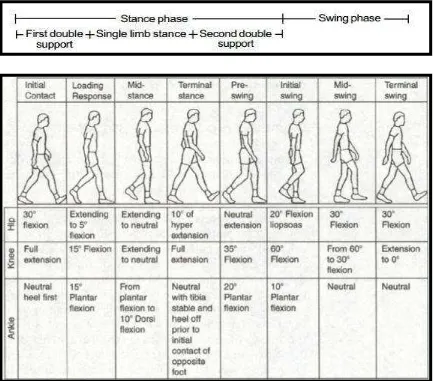
Figure 2.1:The normal gait cycle of body. Vaughan, Davis, & O'connor, (1992)
6 These divisions or phases are the primary parts of the gait cycle, but they are far from being the only important concerns in a study of the cycle. At any given point in the cycle, different muscles are in use and different joints are bent and straightened. The positions of the hips, knees, ankles, and feet are all highly important. A skilled physical therapist can often diagnose problems in particular muscles, bones, or joints based on, or at least supported by, an analysis of an individual's particular gait cycle. Factors such as the position of the muscles, position of the joints, and external concerns such as terrain and gravity are all necessary to draw such conclusions from an individual's walk.
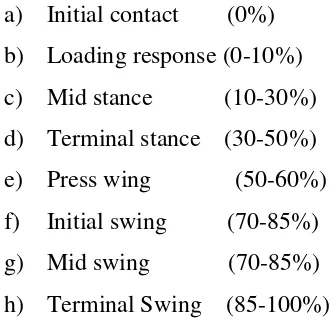
In other research, traditionally the gait cycle has been divided into eight events or periods, five during stance and three during the swing. According to (Christoper L et al, 1999), the names of these events are self descriptive and are based on the movement of the foot. In the traditional nomenclature, the stance phase events are following:
a) Heel strike initiates the gait cycle and represents the point at which the body’s center of gravity it at its lowest position.
b) Foot-flat is the time when the plantar surface of the foot touches the ground.
c) Mid stance occurs when the swinging (contralateral) foot passes the stance foot and
the body’s center of gravity is at its highest position.
d) Heel-off occurs as the heel, loses contact with the ground and push off is initiated via the triceps muscles which plantar flex the ankle.
e) Toe-off terminates the stance phase as the foot leaves the ground.
The swing phase events are as follows:
a) Acceleration begins as soon as the foot leaves the ground and the subject activates the hip flexor muscles to accelerate the leg forward.
b) Mid swing occurs when the foot passes directly beneath the body, coincidental with mid stance to the other foot.
7
Figure 2.2: The traditional nomenclature for describing eight main events, emphasizing the cyclic nature
of human gait. Vaughan, Davis, & O'connor, (1992)
The traditional nomenclature best describes the gait of normal subjects. However, there are a number of patients with pathologies, such as ankle equines secondary to plastic cerebral palsy, whose gait cannot be described using this approach. An alternative nomenclature is shown in the lower part of Figure 2.2. There are eight events, but these are sufficiently general to be applied to any of gait:
8
The study’s aim is to provide an assistive device for human leg movement;
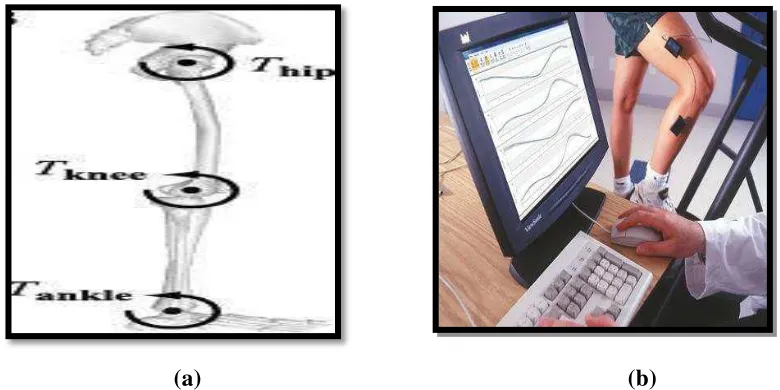
therefore it is important to know the pattern of gait cycle. Generally, the pattern or profile of the gait cycle of normal walking condition is identical, however, if a joint involved in the gait cycle is stiff and not properly functioning. There are three joints of the lower extremity that contribute to the profile of leg movement; hip joint, knee joint and ankle joint. Each of the joint has different profile of angle as shown in Figure 2.3a.
Electro goniometry represents a simple and reliable method for measuring joint motion during gait (Figure 2.3b). The most frequent methods of presenting such data are as figures of total joint excursion during gait, as a plot of joint angle against time, or as angle/angle diagrams. The gait laboratory has a 10-meter long walkway, including acceleration and deceleration distances. Two photocells with 5.5 m intervals, self-aligning electro-goniometers, a computer, and a plotter constitutes the equipment.
(a) (b)
Figure 2.3 (a) and (b): Location of each joint angle and electro goniometry method experiment to shown
9
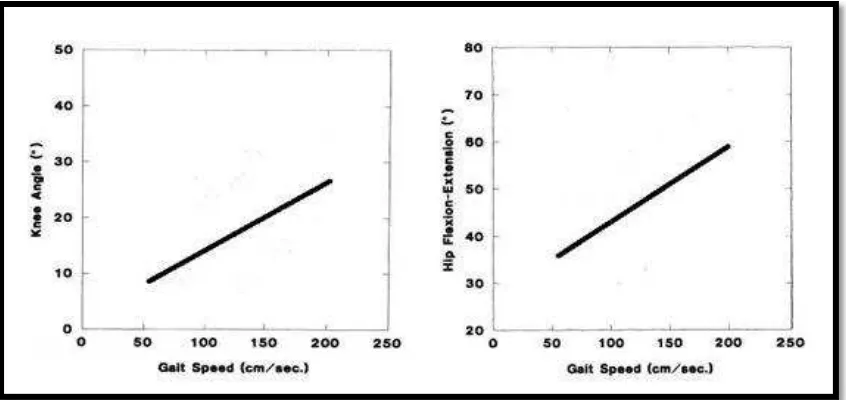
Figure 2.4: Diagram showing the relation between gait speed and knee angle and hip flexion extension
10
2.2 Anatomy of the Knee
To improve the design of knee braces, must have a knowledge about anatomy of the knee. According to Niitsu,(2013), the knee is one of the largest and most complex joints in the body. The knee joins the thigh bone (femur) to the shin bone (tibia). The smaller bone that runs alongside the tibia (fibula) and the kneecap (patella) are the other bones that make the knee joint.
Tendons connect the knee bones to the leg muscles that move the knee joint. Ligaments join the knee bones and provide stability to the knee:
a) The anterior cruciate ligament prevents the femur from sliding backward on the
tibia (or the tibia sliding forward on the femur).
b) The posterior cruciate ligament prevents the femur from sliding forward on the tibia (or the tibia from sliding backward on the femur).
c) The medial and lateral collateral ligaments prevent the femur from sliding side to side.
Two C-shaped pieces of cartilage called the medial and lateral menisci act as shock absorbers between the femur and tibia. Numerous bursae, or fluid-filled sacs, help the knee move smoothly.