THE CORRELATI
ON BETWEEN THE CHILDREN’S
GENDER AND THEIR COMMUNICATIVE COMPETENCE
AT KUMON VILA NUSA INDAH
A Thesis
Submitted to Letters and Humanities Faculty In Partial Fulfillment of the Requirement for
The Strata One Degree
Nailis Sa’adah
104026000927
ENGLISH LETTERS DEPARTMENT LETTERS AND HUMANITIES FACULTY
STATE ISLAMIC UNIVERSITY SYARIF HIDAYATULLAH JAKARTA
i
ABSTRACT
Nailis Sa’adah, The Correlation between the Children’s Gender and Their Communicative Competence at Kumon Vila Nusa Indah, Thesis. English Letters Department, Letters and Humanities Faculty, State Islamic University (UIN) Syarif Hidayatullah, Jakarta 2011.
According to some researches, the development of children‘s language is influenced by some factors, and one of them is gender factor. The purpose of this thesis is to predict ―the significant correlation between the childrens‘ gender and their communicative competence at Kumon Vila Nusa Indah‖. Communicative competence in this thesis is only limited on children‘s competence to convey
information effectively. The last researches indicated that girls were more conspicuous than boys in verbal competence. Based on the result of those researches were assumed that girl‘s and boy‘s competence to convey information would be different, so the girl should be more informative than the boy. Data collecting was conducted by recording every student‘s word description at communicative competence test. Then, the writer asked to the evaluator to
evaluate how informative are the students‘ word description. To prove the
correlation between the childrens‘ gender and their communicative competence,
the writer used phi coefficient.
The result of this research indicated that there are no significant differences between girl‘s words descriptions and boy‘s words descriptions. It
means that there are no significant correlation between the childrens‘ gender and
iv
v
ACKNOWLEDGEMENT
In the Name of Allah, Most Gracious, Most Merciful
First and foremost, the writer would be especially grateful to Allah SWT,
the Lord of human and everything in the sky and the earth. Peace and salutation
be upon the Greatest Prophet Muhammad SAW who has guided to be a good and
successful man in this world.
The writer would like to convey her thanks to beloved father, mother,
husband, sister, and brother, thank you so much for love, affection, support,
advice, help, and facilities during her study and finishing this thesis. The writer
also thanks to her children ―Nabila and Naira‖ for colouring her days with their
love and laugh. The writer cannot fail to mention her advisor Sholikatus Sa‘diyah,
M.Pd. for her guidance, correction, and contribution in finishing this thesis. May
Allah SWT bless her family with the fields of joys.
The writer wishes to say gratitude to the following persons:
1. Dr. H. Wahid Hasyim, M.Ag. the Dean of Letters and Humanities
vi
2. Drs. A. Saefuddin, M.Pd. the Head of English Letters Department.
3. Elve Oktafiyani, M.Hum. the Secretary of English Letters Department.
4. All lecturers of English Letters Department.
5. The writer‘s classmates: Mela, Meiva, Nova, Iqbal, Bayu for giving me
support.
6. All her best friend: Waode Qiqit, Devi, Lia, Ida, Cak Habibi. They
always give me support everytime.
May Allah bless us. Finally, the writer realizes that this thesis is far from
being perfect. Constructive critic and suggestion would be acceptable to make this
thesis better.
Jakarta, August 2011
vii
TABLE OF CONTENTS
ABSTRACT ………...… i
APPROVEMENT ..………... ii
LEGALIZATION…..………...………... iii
DECLARATION…...………... iv
ACKNOWLEDGMENT.………... v
TABLE OF CONTENTS………..………….……... vii
LIST OF TABLES………..……... x
LIST OF FIGURES………...………... xi
LIST OF APPENDIXES…...………... xii
CHAPTER I INTRODUCTION…………... 1
A. Background of the Study…………... 1
B. Focus of the Study………... 4
C. Question of the Research ……... 4
D. Objectives of the Study………... 5
E. Significances of the Study………... 5
CHAPTER II THEORETICAL FRAMEWORK, CONCEPTUAL FRAMEWORK, AND HYPOTHESIS …... 7
viii
1. The Language Acquisition Stages of Children………... 7
2. The Growth of Vocabulary………... 11
3. The Acquisition of Concept………...……... 13
4. The Other Influent Factors in Language Development of of Children ... 15
B. The Egocentricity of Children………... 16
C. Communicative Competence………... 18
1. The Definition of Communicative Competence………... 18
2. The Development of Communicative Competence of Children... 20
D. Gender ………...…………... 21
1. The Definition of Gender………...…... 21
2. The Influences of Gender in Language Development of Children…... 22
E. Conceptual Framework ... 22
F. Hypothesis ... 24
CHAPTER III RESEARCH METHODOLOGY………... 25
A. Method of the Research………... 25
B. Place and Time of the Research………. 25
C. Population and Sample of the Research……...…... 25
D. Variable of the Research………...………. 26
ix
F. The Technique of Data Collecting………...… 27
G. The Technique of Data Analysis……….… 28
CHAPTER IV RESEARCH FINDING ………...…………....…. 30
A. The Data Description... 30
B. The Data Analysis... 32
C. The Interpretation of Data ... 37
CHAPTER V CONCLUSIONS AND SUGGESTIONS………... 38
A. Conclusions...………... 38
B. Suggestions………... 39
BIBLIOGRAPHY…..……...………...…….. 40
x
LIST OF TABLES
1. Students‘ Gender and Grades of Students‘ Communicative Competence .... 31
2. Students‘ Communicative Competence Value According to
Gender... 33
3. Contingency Table of Data... 34
xi
LIST OF FIGURES
1. The graph of informativeness average value data of every gender
xii LIST OF APPENDIXES
1. Profil of Kumon ... 42
2. The Sheet of Students‘ Communicative Competence Test
Value ... 45
1
CHAPTER I
INTRODUCTION
A. Background of the Study
Language is quintessentially human. We use spoken language every day,
face-to-face, as a means of communication and written language allows us to
record and hold on to our history across generations. Language allows us to
express innumerable ideas, describe events, tell stories, recite poems, buy, sell, or
bargain in markets, administer legal systems, make political speeches, and do the
myriad other activities that make up the societies we live in. It allows us to
coordinate what we do with others, relay information, find out answers, and carry
out every day activities. Language calls for an intricate web of skills we usually
take for granted. It is an integral part of everyday life that we relay on to convey
wants and needs, thoughts, concerns, and plans. Using language seems as natural
as breathing or walking.
However, the people commonly don‘t think that using language is a very
complex competence. Using language seems usual because a baby will grow
together with his language competence development although nobody teaches
him. A baby begins produce a sound that can be identified as a word since he at
1-1, 5 years of age. This one word of utterance will increase to two words and
2 Getting adult, we use language as if unthinkingly. When we want to
convey something, we produce the sound that is language at that time. If we really
reflect on it, we will feel that the language using is the reflection of the only
human‘s competence.1 Based on statement above, there are two important aspects,
first, the acquisition how a person especially the children are getting language.
Second, the application, it means using language by an adult normally.
Language acquisition describes a process where the children are being
the first user of their language. This process can be described as a learning process
how to convey their opinion, so it can be understood, or it is called ‗learning how
to mean‘. To convey the opinion is not easy for children (sometimes for the adult
also). The difficulties are caused by some matters, among of them is know
absolutely nothing about grammatical structure or limited vocabularies. In the
book The Language and Thought of the Child, Piaget suggested another case why
the children have difficulties to convey their opinion informatively. He suggested
that it‘s caused by the children egocentric.2
1 Soenjono Dardjowidjojo. Psikolinguistik Pengantar Pemahaman Bahasa Manusia.
(Jakarta: Yayasan Obor Indonesia, 2005). p. 1
2 Piaget proposed the egocentric behavior in his some books, as in The Language and
Thought of the Child (1923), that was excerpted in Vygotsky (1962: 11-20) translated and edited by Eugenia Hanfmann and Gertrude Vakar.
Jean Piaget [ʒɑ̃ pjaʒɛ] (9 August 1896 – 16 September 1980) was a Swissphilosopher
and natural scientist, and is well known for his work studying children. His theory of cognitive development and epistemological view is together called "genetic epistemology
3 The egocentric describes about a person disability to understand his
interlocutor‘s point of view. Generally, we can find this behavior at the children
that is caused by the children preference to consider all of people in the world
have same perception with them or in other word ‗overestimate‘ of shared
knowledge between him and the audience. The egocentric will decrease in
accordance with the children become older. The decrease of egocentric causes the
increasing of the ability to consider the audience‘s point of view. So, the ability to
convey the information effectively will increase too. According to Krauss and
Glucksberg in ―The Development of Communicative Competence as a Function
of Age.‖ Child Development it was called as ‗communicative competence‘3. We
can conclude, therefore, communicative competence expand in accordance with
the person become older. It needs the ability to produce the utterance at certain
form and situation which are able to convey the speaker‘s ideas to the audience.
The development of communicative competence is one of language
acquisition aspects. The one of thing that is being the attention is the differences
at communicative competence development system because of gender difference.
If the gender difference influences the language acquisition development of
children, so the gender has to influence the communicative competence
development.
Some of psychology researches showed that there is difference between
girl and boy. The girl is inclined to communicate using the words faster than the
boy. Physically, the girl is getting adult faster than the boy; and because of the
3Krauss, R. and Glucksberg S, ―The Development of Communicative Competence as a
4 intellectual aspects development depend on related physic structure development,
it can be called that some of competences development are develop faster at the
girl. At these researches, it can be expected that the development of
communicative competence at the boy is different with the development of
communicative competence at the girl.
B. Focus of the Study
Based on the background of study above, it can be assumed that the
children communicative competence development is closely related with gender
difference factor. The study is focused on searching empiric evidences effort
related to the correlation between the childrens‘ gender and their communicative
competence at Kumon Vila Nusa Indah Bogor. The communicative competence
in this study is specified on the children competence to convey the information
(description) effectively at communicative competence measuring test at Kumon
Vila Nusa Îndah Bogor.
C. Questions of the Research
The formulation of problem in this paper is formulated as follows ―Is there
significant correlation between the children‘s gender and their communicative
5
D. Objectives of the Study
Generally, the study aims to get the empirical data about the correlation
between the children‘s gender and their communicative competence at Kumon
Villa Nusa Indah Bogor.
E. Significances of the Study
Theoretically, the study result is expected to be able to enrich the
knowledge at psycholinguistic. In social point of view, the study is also expected
to give an input to the parents in order to be more understand about their
children‘s development that have same age with the children at Kumon Villa Nusa
6
CHAPTER II
THEORETICAL FRAMEWORK, CONCEPTUAL
FRAMEWORK, AND HYPOTHESIS
A. Language Development of Children
When babies were born, they were crying. This birth cry is their reaction
for the transition of condition and their discomfort. They express at some
conditions; when they are hungry, at sudden change (for example when they were
taken a bath, and were gone into bath tub) or even, they cry to express their dislike
to some people around them. This cry is their first communication to the world1.
According to George A. Miller in the book Language and Communication,
the birth cry is evidence that the baby enters the world with the rudimentary
respiratory and laryngeal equipment he will need later for speaking, and it is
produced as well by a child without a cerebrum as by a child with one.2 At the
beginning of their life, they began to indicate their reaction for the sounds that
they heard. The first reaction can be a crying (example, when they heard loud
sound) or trying to follow source sound with their eyesight. They began to
indicate their happiness after they get their willingness (example, after they were
given a bottle of milk when they were hungry).
Commonly, a mother can understand what the meaning of this crying with
taking a note of the crying patterns: whether it is crying of hungry or crying of
1 Abdul Chaer, Psikolinguistik Kajian Teoretik, (Jakarta: PT. Rineka Cipta, 2003), p. 226 2 George A. Miller, Language and Communication, (USA: McGraw-Hill Book Company,
7 discomfort.3 Sound pattern, intonation, and pitch for the mother have certain
meaning. It can be said that it is a based communication form, on the other hand
the one makes a statement, and the other one understands it. Bloomfield
concluded in his book, Language, that language enables one person to make a
reaction (R) when another person has the stimulus (S).4
1. The Language Acquisition Stages of Children
There are so many studies that discuss the stages in language
acquisition, among them Fromkin (1978), Clark (2003), and Baraja (2007).
The development of language acquisition can be divided into some stages.
This division is based on age. Nevertheless, this age distribution is not
absolute, because the development of every child as an individual is different.
The age limitation is purposed to make the division of the language
acquisition development easily. The division of language acquisition stages is
based on the language development generally also.
The first year is paralinguistic stage, because before age one, most of
children has not said one word anymore. This stage includes 3-10 months at
around. Clark explained that infant don‘t produce their first words until age
one or later, but when they get three or four years of age, they can talk quite
fluently about some topics. This development is one we take as much for
3 Ibid, p. 231
4 Bloomfield, L.. Language, (New York: Holt, Rinchart and Winston, 1933), p.26.
8
granted as the infant‘s transition from lying supine in the first few months to
walking and running around by age one to two. 5
The paralinguistic stage is divided to cooing stage and babbling stage.
Cooing stage is the stage where the very young baby utters far more vowels
than consonants and the sound that is like velar sounds /k/ and /g/. This stage
persists at 3-6 months of age. When the baby gets 8-11 months of age, he goes
in to the next step, is babbling stage. The main characteristic of this stage is
the syllable reduplication, for example babababa, dadadada, or mamamama.
The sound produced by baby in this period can be called as the sound play.
The parents usually consider that these utterances as like as they are
conversing with their babies. The baby is considered as the active addressee
although they haven‘t produced the understanding utterances. The
conversational exchange between an infant and a parent may be minimal at
first, in the sense that the adult participant may be effectively to supply all the
turns, as in the ―exchange‖ between three-month-old Ann and her mother
(Snow 1977:12):
Mother and Ann (aged three months) Ann: (smiles)
Mother: oh, what a nice little smile Yes, isn’t that nice?
There
There’s a nice little smile Ann: (burps)
Mother: what a nice little wind as well Yes, that’s better, isn’t it?
Yes
5 Eve V. Clark, First Language Acquisition, (Cambridge: Cambridge University Press,
9 Yes
Ann: (vocalizes)
Mother: there’s a nice noise6
The mother considers that the sound is produced by her baby is the answers of
her questions. This interaction between the mother and the baby is very
important for the development of children language.
The paralinguistic stage is followed by the holophrastic stage. This
stage persists at 12-18 months of age. In this stage, the children begin to use
the same string of sounds repeatedly to mean the same thing. By this time,
children have learned that sounds are related to meanings, and they are
producing their first words. Most children seem to go through the one word =
one sentence stage. These one-word ―sentences‖ are called holophrastic
sentence (from holo ―complete‖ or ―undivided‖ and phrase ―phrase‖ or
―sentence‖) because the one word that is uttered by children can be a phrase.
For example the word [Pu] for ―cat‖ can have the meaning ‗look, a cat‘,
‗there‘s a cat,‘ or the question ‗is that a cat?‘ Phonologically, the children first
words were generally monosyllabic with a CV (consonant-vowel) form; the
vowel part may be diphthongal, depending on the language being acquired. 7
Children sometimes overextend or underextend the meanings of the
words they use. Their earliest words typically refer to objects that interest
them. As explained by Lester and Cheryl in their book 'Psychology' that in
using words, the children exhibit overextension, applying words too broadly.
6 Ibid, p. 30
7 Fromkin and Rodman, An Introduction to Language, 6th ed, (USA: Harcourt Brace
10 Consider a child who refers to her cat as "kitty". If she also refers to dogs,
cows, horses, and other four- legged animals as "kitty", she would be
exhibiting overextension. In contrast, if she refers to her cat, but no other cats,
as "kitty", she would be exhibiting under extension, applying words too
narrowly. As children gain experience with objects and language, they rapidly
learn to apply their words to the correct objects.8
After the holophrastic stage, the children enter to the next stage, is the
two-word stage. This stage is begun at the age around month 18th up to month
20th. In this stage, the children begin to put two words together. There are no
syntactic or morphological markers-that is, no infections for number, person,
tense, and so on. Pronouns are rare, although many children use me to refer to
themselves, and some children use other pronouns as well. For example, two
nouns can be used to show a subject-locative relation, as in sweater chair to
mean "the sweater is on the chair," or to show conjunction, to man "sweater
and chair."9
When the children begin to produce more than two words, they begin
to enter into the next step, is telegraphic speech stage. The characteristic of
speech in this stage is longer than two word speeches; consist of
morpheme-morpheme lexical and the function words (grammatical morpheme-morphemes) such as
to, the, can, is, and so on are missing; only the words that carry the main
message—the open-class content words—occur. Through utterances are
described as telegraphic, the child does not deliberately leave out the no
8 Lester and Cheryl, Psychology, 5th ed, (USA: McGraw-Hill Book Company, Inc, 2002),
p. 291
11 content words as does an adult sending a telegram. The sentences reflect the
child's grammar at that particular stage of language development. They begin
to use syntactic or grammatical function words and also to acquire the
inflectional and the derivational morphemes of the language. 10 And finally
the children produce sentences that more and more closely approximate the
adult grammar.
2. The Growth of Vocabulary
The growth of vocabulary includes to language acquisition
development. The children vocabularies grow rapidly after the first year of
age. At the last of age 1, generally, a child can use 10 words. At the second
year, the children vocabularies grow about 300 words. The figure below
shows the increase in vocabulary size during the preschool years.
On the following figure, the number on horizontal line shows the age
at years and months and the number on vertical line shows the average of
words. We can see the growth of children vocabulary from 1 until 6 –year-old.
The fastest growth is between 1, 5 and 2 –year-old, which the vocabulary
grows until teen times increase (from 30 words at 1, 5 year old and 300 words
at 2 –year-old).
12
THE AVERAGE GROWTH OF CHILDREN VOCABULARY FROM 1 UNTIL 6 –YEAR-OLD
The age at years and months
(Crystal, 1987:232)11
After children enter school, their vocabularies grow rapidly, owing to
direct teaching, new experiences, leisure reading, and radio and television
listening. It is estimated that the average first grader knows between 20,000
and 24,000 words, or 5 to 6 percent of the words in a standard dictionary. The
sixth grader knows approximately 50,000 words, and the child entering high
school about 80,000 words, or 22 percent of the words in a standard
dictionary.12
11 Laila Fidelina, Pengaruh Gender pada Perkembangan Kompetensi Komunikatif,
(Depok: Universitas Indonesia,1995), p. 27
12 Elizabeth B. Hurlock, Child Development, (USA: McGraw-Hill Book Company, INC,
1978), p. 172 0 500 1000 1500 2000 2500 3000
13 Individual differences in vocabulary size at every age are due to
differences in intelligence, environmental influences, learning opportunities,
and motivation to learn. According to Miller in the book Language and
Communication, although there are large individual differences, in the average
child the vocabulary appears to increase rather slowly at first, then rapidly
between the ages of two and eight years, and then more slowly until
maturity.13 Girls on the average, it has been reported, have larger vocabularies
and also have the speech was better than boys‘.
3. The Acquisition of Concept
The concept, according to Vygotsky, is an active part of the
intellectual process, constantly engaged in serving communication,
understanding, and problem-solving.14 It also can be explained as one thing
that has the correlation with another thing. There is no understood concept
without understanding its relationship with another concept. For example; if
the one is asked to explain the word ‗tomato‘, he will explain that tomato is a
fruit that has red color, fresh, and can be eaten. To understand these
explanations, we had to have the understanding for the concept ‗fruit‘, ‗red‘,
‗eat‘, ‗fresh‘, etc.
Generally, the children‘s concepts are formed by his everyday
experience, while the adult‘s concepts are referred to principles and definition.
13 George A. Miller, Language and Communication, (USA: McGraw-Hill Book
Company, INC, 1951), p. 148
14 L. S. Vygotsky, Thought and Language, (Massachusetts: The M.I.T Press , 1962), p.
14 It can be said that the child‘s concepts have the idiosyncratic meaning and the
focus is the special event which correlates with the word.15
In this case, we can take the example of ‗fish‘ concept acquisition. At
the first time, may be the children assumed that fish is the animal in the water
that can be eaten as like as chicken. This concept is based on their everyday
experience. After their age became increasingly, they would begin to
understand the general concept of ‗fish‘ word. Let‘s discuss two definition of
‗fish‘ word below that was given by two 7-year-old students in
communicative competence measure test of Kumon Vila Nusa Indah students:
Fathur: I like chicken, have tail, have eyes, I can find it in the water, it is animal, I can eat this animal
Tyas: the color is blue, it’s animal, it’s in the water, I can eat this animal16
In his description, Fathur described that fish is the animal like chicken
and he can eat it. And as we know, fish is very different with chicken.
Whereas Tyas described that fish is the animal that has blue color. These two
definitions cannot be conducted generally because it has the idiosyncratic
meaning; not social meaning that is common knowledge.
Concept can change according to the development of science or
everyday experience. According to Vygotsky, concepts change from overall
15 Ibid, p. 84
16The children’s description word at Communicative Competence Test of Kumon Villa
15 similarity categories to especial characteristic categories. It can be occurred to
the children in the holophrastic stage.
As in the explanation above, the children at 12-18 –month-old are
inclined to exhibit overextension, applying words too broadly. Consider a
child who refers to her cat as "kitty". If she also refers to dogs, cows, horses,
and other four- legged animals as "kitty", she would be exhibiting
overextension. These animals have overall similarity. The example, all of
these animal have four- legged. With the increasing of their age, they will able
to distinguish every animal based on its characteristics.
4. The Others Influent Factors in Children Language Development
The children language development is influenced by some factors,
among of them is the children ordinal position in the family. Age for age, the
speech of firstborns is superior to that of later-born in the same family. This is
because parents can spend more time teaching and encouraging them to talk
than they can for later-born children.17
The information that is related to this factor cannot be reached from
the data of communicative competence measure test of Kumon Vila Nusa
Indah. So, in this thesis process of writing, that factor wasn‘t included. And it
was assumed that the student communicative competence of Kumon Vila
Nusa Indah was not influenced by this family ordinal position factor.
16 The other factor is socioeconomics status.Hurlock explained that:
Children from the higher socioeconomic groups learn to
talk earlier, they express themselves better, and they talk more than
those from the lower socioeconomics groups. This is mainly
because those from the higher groups are given more
encouragement to talk and more guidance in learning how to do
so.18
As like the ordinal position factor above, the information about
socioeconomics status cannot be reached from the data of communicative
competence measure test of Kumon Vila Nusa Indah students. So, it can be
assumed that this factor didn‘t correlated to children communicative
competence in Kumon Vila Nusa Indah.
B. The Egocentricity of Children
Most of the young child‘s speech is egocentric. Hurlock has explained that
in egocentric speech, the children make no attempt to exchange ideas or to pay
attention to the other person‘s point of view. In other word, the egocentric speech
is monologue and there is no real communication present.19
Firstly, the egocentric theory was introduced by Piaget. According to him,
the egocentricity is the characteristic of the children at 2 until 7 –year-old. After 7
18 Ibid. p. 171
17 year-old, the egocentricity will decrease. This egocentric theory refers to two
factors:
a. The children are not able to differentiate their view point with their
environment and the people around them. For example, if a child sees
that there is candy in a box, he assumes that someone else walking into
the room also knows that there is candy in that box. He implicitly
reasons that "since I know it, you should too"20
b. The children inclination to consider that the world is revolving around
them. For example, a child said that the moon is walking to follow
him.
It caused children aren‘t able to understand the point of view of other
people. The children are unaware that the people point of view is influenced by
the position of that people to things. The child assumed that what he sees is same
with the other sees.
To investigate the children egocentrism, Piaget did a test that was called
the three mountains problem. He put children in front of a simple plaster mountain
range and then asked them to pick from four pictures the view that he, Piaget,
would see. Younger children before age 7 picked the picture of the view they
themselves saw and were therefore found to lack the ability to appreciate a
viewpoint different from their own. In other words, their way of reasoning was
20 Piaget J & Inhelder B (1948/1956) The Child's Conception of Space. London:
18 egocentric. Only when entering stage at age 7-12, children became capable of
decentring and could appreciate viewpoints other than their own.21 In this case,
it‘s clearly enough that a child‘s ability to describe something is not only
influenced by his ability to understand the view point of other people but also is
influenced by his knowledge about that thing.
C. Communicative Competence
1. The Definition of Communicative Competence
The term of communicative competence was introduced by Hymes.
He explained that to take communication, it‘s not enough if we just
understand the linguistics of language. But, we must have the ability how to
use language appropriately.22 Explaining what communicative competence
definition, Gleason and Ratner described, ―Communicative competence is the
ability to use language appropriately and strategically in social context. That
is, it involves knowing what, where, how, and with whom one should
communicate.‖23
21 Ibid.
22 Leung, C. Convivial Communication: recontextualizing communicative competence.
(International Journal of Applied Linguistics,2005). Vol. 15, No.2, 119-143 (http://en.wikipedia.org/wiki/Communicative_competence, may,9,2009)
23 Jean Berko Gleason and Nan Bernstein Ratner, The Development of Language, 7th ed,
19 In language acquisition process, the children not only get ability to
apply and use grammatical rules, but also to form correct utterances, and know
how to use these utterances appropriately.
“....a normal child acquires knowledge of sentences, not only as
grammatical, but also as appropriate. He or she acquires competence
as to when to speak, when not, and as to what to talk about with
whom, when, where, in what manner.” 24
Canale and Swain (1980) defined communicative competence in terms
of four components25:
1. Grammatical competence: words and rules
It was seen to encompass ―knowledge of lexical items and of rules of
morphology, syntax, sentence-grammar semantics, and phonology‖.
2. Sociolinguistic competence: appropriateness
It was defined as involving knowledge of the sociocultural rules of
language and of discourse.
24 Alessandro Duranti, Linguistic Anthropology: A Reader, (Wiley-Blackwell, 2001), p.60
(
http://books.google.co.id/bkshp?client=firefox-a&rls=org.mozilla:id:official&hl=id&tab=wp&q=communicative%20competence%20by%20hym es, may 9, 2009)
25 http://www.carla.umn.edu/assessment/VAC/research/theory.html 1 juli 2009
20 3. Discourse competence: cohesion and coherence
It was defined as the ability to connect sentences in stretches of
discourse and to form a meaningful whole out of a series of utterances.
4. Strategic competence: appropriate use of communication strategies
It was seen to refer to ―the verbal and nonverbal communication
strategies that may be called into action to compensate for breakdowns
in communication due to performance variables or due to insufficient
competence‖ (Canale & Swain, 1980, p. 30).
There are some important communicative behaviors for children to
acquire communicative competence, because it helps children succeed in
school, predicts later literacy skills and also it is associated with popularity
among peers. And those communicative behaviors include routines, polite
terms, conversational skills, and language varieties such as dialects and
registers.26
2. The Development of Communicative Competence of Children
Every child is difference in the stage of language acquisition
development, it includes the ability to communicate effectively. Actually,
acquiring communicative competence is difficult, but children have some help.
There are a number ways families and schools contribute to the acquisition
21
process. Furthermore, children‘s knowledge and their efforts to learn about
communication also facilitate their communicative development.
D. Gender
1. The Definition of Gender
Sally Wehmeier had described the definition of gender in Oxford
Advanced Learner‘s Dictionary. According to him, gender is fact of being
male or female.27 And although ―gender‖ is popularly used interchangeably
with ―sex‖, actually, social scientists distinguish between sex differences and
gender differences. If sex differences refers to biological differences between
males and females, so gender differences refers to culturally imposed
differences in the roles and behavior of males and females.28
Based on the description above, the gender is classified into two
aspects. These two aspects are gender identity and gender role. Gender
identity is sense to be male or female, which is gotten by most of children at
three years of age.29 In other words, gender identity is how a person identifies
him/her self in terms of their gender. It is not necessarily based on the person's
sexual orientation. Gender identity may be male or female, or neither.
27 Sally Wehmeier, Oxford Advanced Learner’s Dictionary, (Oxford: Oxford University
Press, ), p.
28 Kathleen Stassen Berger,
The Developing Person Through Childhood and Adolescence, 6th ed, (New York: Worth Publishers, 2002), p. 315
29 John W. Santrock, Life-Span Development, Perkembangan Masa Hidup, ed ke-5,
22 Meanwhile, gender role is set of expectation that prescribes how male and
female should think, act, and feel.30 It refers to the attitudes and behaviors that
class a person's stereotypical identity, e.g. women cook and clean, men fix
cars, women make good nurses, men make good mechanics, etc.
2. The Influences of Gender in Language Development of Children
Some researchers in psychology have observed that generally, boys
lag behind girls in language acquisition. Boys and girls grow up in different
worlds of talk (parents, siblings, peers, teachers, and others talk with boys and
girls differently). Girls begin to talk at earlier age than boys. At every age,
boys‘ sentences are shorter and less grammatically correct, their vocabularies
are smaller, and their pronunciations are less accurate than girls‘.31
In other side, boys have faster motor skills development. Boys are
generally more active than girls. This is certainly cultural and hormonal, but it
may be neurological as well, because young girls‘ brains seem to mature faster
than those of young boys even before birth.
E. Conceptual Framework
Language is a form of communication, both spoken and written, that is
based on a system of symbols. We need language to speak to others, listen to
others, read, and write. Our language enables us to describe past events in detail
30 Ibid.
23 and to plan for the future. Language lets us pass down information from one
generation to the next and to create a rich culture heritage.
To take communication, it‘s not enough if we just understand the
linguistics of language. But, we must have the ability how to use language
appropriately and how to convey the information effectively. And in other word, it
can be called as communicative competence. Communicative competence
developes together with a person becomes older.
The development of communicative competence is one of language
acquisition aspects. The one of thing that is being the attention is the differences
at communicative competence development system because of gender difference.
If the gender difference influences the language acquisition development of
children, so the gender has to influence the communicative competence
development.
Some of psychology researches showed that there is difference between
girl and boy. The girl is inclined to communicate using the words faster than the
boy. Physically, the girl is getting adult faster than the boy; and because of the
intellectual aspects development depend on related physic structure development,
it can be called that some of competences development are develop faster at the
24
F. Hypothesis
Based on the conceptual framework, the writer formulates the hypothesis
of this research as follows:
1. Null Hypothesis (Ho) = there is no correlation between the childrens‘
gender and their communicative competence.
2. Alternative Hypothesis (Ha) = there is a correlation between the childrens‘
gender and their communicative competence.
25
CHAPTER III
RESEARCH METHODOLOGY
A. Method of the Research
In writing this research, the writer used a survey method through
correlational technique. She analyzed the research by using Phi Coefficient to
know the result.
B. Place and Time of the Research
The research was conducted at Kumon Vila Nusa Indah Ruko Vila Nusa
Indah 2, Blok W3 No.18 Gunung Putri, Bogor 16969. It was carried out from
February – April 2011.
C. Population and Sample of the Research
The population of the study are the whole students either girls or boys who
were 7-9 years of age at Kumon Villa Nusa Indah Bogor. The writer picked 5
couples girls and boys of every level of age (30 students) from 150 students of
Kumon Villa Nusa Indah Bogor. It is 20% of the research population. Suharsimi
has explained in his book, that:
Selanjutnya, jika jumlah subjeknya besar dapat diambil antara 10-15% atau 20-25% atau lebih, tergantung setidak-tidaknya dari:
26 b. Sempit luasnya wilayah pengamatan dari setiap subjek, Karena hal
ini menyangkut banyak sedikitnya data.
c. Besar kecilnya resiko yang ditanggung peneliti. Untuk penelitian yang resikonya besar, tentu saja jika sampel besar, hasilnya akan lebih baik.1
So, because of the researcher‘s time, fund, and power limitedness, she took 20%
of the research population only.
D. Variable of the Research
There are two variable in this research:
1. Independent variable is the variable that influences another variable. In
this research, the independent variable is gender of the children at Kumon
Villa Nusa Indah Bogor.
2. Dependent variable is the variable that is influenced by another variable.
In this research, the dependent variable is communicative competence
(informative description) of children at Kumon Villa Nusa Indah Bogor.
E. Instrument of the Research
To collect the data, the writer used communicative competence test to
measure the competence of understanding and producing the utterance
communicatively.
1 Suharsimi Arikunto, Prosedur Penelitian Suatu Pendekatan Praktek, ed.5, (Jakarta: PT.
27
F. The Technique of Data Collecting
At Kumon Vila Nusa Indah, there is English English (EE) program. This
program is designed for the students that use the English as mother language
everyday. The English English (EE) program consists of 18 levels; begin from 7A
level until L level. At every level, the students were allowed to get communicative
competence measure test. The researcher recorded the descriptions that were
given by the students in communicative competence measure test and use it as the
corpus of the research. She used this test as the corpus of the research because in
this test some of children 7-9 years of age were asked to define daily vocabularies.
Their communicative competence to convey the information effectively can be
seen from every definition.
Data collecting was conducted with recording every student‘s description
and noting their identity. From collected data, the researcher chose the definition
of things of two students that are same at the age but different at gender. Then,
every definition was transcribed and grouped according to their age and gender.
Then, the writer asked to the evaluator to give grade for every description.
The evaluator were asked to read the description and to grade how
informative the descriptions are (on a scale 1-5; 1 being the least informative
description and 5 being the most informative description).
The evaluator were chosen randomly and if they were not native speaker,
they had to have ‗good‘ level English competence at the least (see the example of
questioner answer sheet below). The grade of English competence was submitted
28 of their English competence. English competence less than good were considered
could influence the evaluator grade to the description at the questionnaire. The
researcher didn‘t use evaluator who had homogeny English background, it caused
that every one had different English background.
In this research, the evaluator profession was assumed wouldn‘t influence
their evaluation to the students‘ description. Thus, the evaluator could come from
various background included student, teacher, lecturer, worker, etc. It wasn‘t
limited on State Islamic University scope.
G. The Technique of Data Analysis
This analysis is to see wheter there is correlation between children‘s
gender and their communicative competence.
In this analyze, the writer used Phi coefficient correlation formula.2
The formula is: �= ��2
Note:
∅ = correlation coefficient between children‘s gender and their
communicative competence.
�2 = the chi-squared statistic
N = the total number of observations
Significant critical value : 5% and 1%
29 Criteria: if ∅ > rt means there is correlation and Ha is accepted, Ho is
rejected.
If ∅< rt means there is no correlation and Ha is rejected, Ho is accepted.
Ho: there is no significant correlation between children‘s gender and their
communicative competence
Ha : there is a significant correlation between children‘s gender and their
communicative competence.
30
CHAPTER IV
RESEARCH FINDING
A. Data Description
As mentioned in the previous chapter, to get the data, firstly the writer
conducted the communicative competence test to the students of Kumon Vila
Nusa Indah. The collected data from the students of Kumon are the description of
35 words by 47 students. In this thesis, the researcher used some words by some
couples of students with different gender but in the same age. After collecting
some words, the researcher got 20 words by 30 students that fulfilled the terms of
the thesis necessity.
These words are: sun, cow, carrot, fish, rabbit, bee, banana, orange, cat,
ear, ice cream, umbrella, chair, book, apple, bag, horse, elephant, star, and shoes.
The description of every word above that was conveyed by the children would be
followed by the evaluator‘s evaluation. The evaluation of evaluators was used to
account the value of description informativeness (communicative competence) of
every children on a scale 1-5; 1 being the least informtive description and 5 being
the most informative description.
In this case, student‘s gender is as independent variable (X) and student‘s
communicative competence is as dependent variable (Y). To know it, the writer
gave communicative competence test to 30 students as a sample. The following
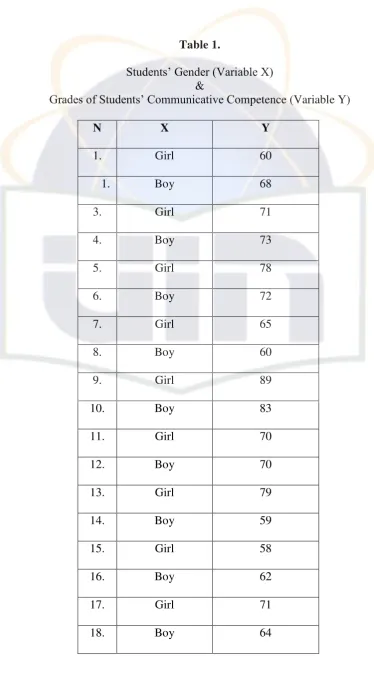
31
Table 1.
Students‘ Gender (Variable X)
&
Grades of Students‘ Communicative Competence (Variable Y)
N X Y
1. Girl 60
1. Boy 68
3. Girl 71
4. Boy 73
5. Girl 78
6. Boy 72
7. Girl 65
8. Boy 60
9. Girl 89
10. Boy 83
11. Girl 70
12. Boy 70
13. Girl 79
14. Boy 59
15. Girl 58
16. Boy 62
17. Girl 71
32
19 Girl 63
20. Boy 63
21. Girl 64
22. Boy 66
23. Girl 69
24. Boy 57
25. Girl 65
26. Boy 68
27. Girl 66
28. Boy 61
29. Girl 62
30. Boy 57
N=30 2013
Mean 67,1
From the table above, we can see the total grade from 30
respondents is 2013. And the mean is 67,1.
B. Data Analysis
The writer analyzed the data to see the correlation between student‘s
gender and their communicative competence by applying the formula of Phi
Coefficient Correlation. In this case, both the students‘ gender and students‘
33
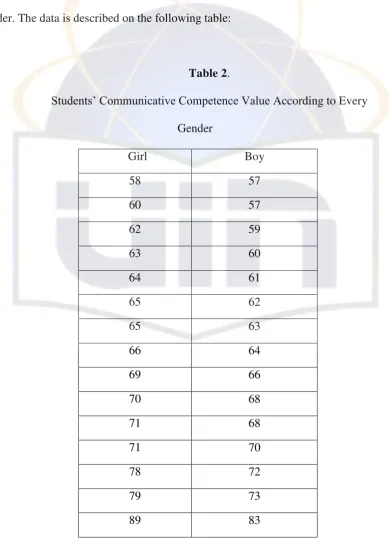
Based on the data above, students‘ communicative score were grouped into every
gender. The data is described on the following table:
Table 2.
Students‘ Communicative Competence Value According to Every
Gender
Girl Boy
58 57
60 57
62 59
63 60
64 61
65 62
65 63
66 64
69 66
70 68
71 68
71 70
78 72
79 73
34
Criteria: if students‘ communicative competence value < 67 means
the student is not competent.
If students‘ communicative competence value > 67 means
the student is competent.
Girl: Competent 7 students
Not competent 8 students
Boy: Competent 6 students
Not competent 9 students
Then, the data is inputed on the following 2x2 contingency table:
Table 3.
Contingency Table of Data
Girl Boy
Competent
Not Competent
7
8
6
9
13
17
15 15 30
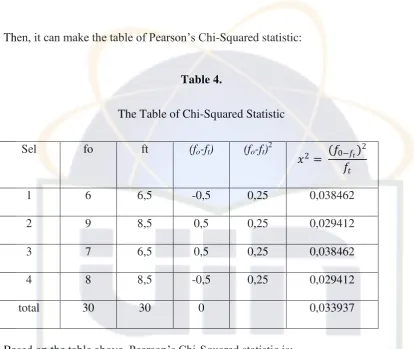
Based on the data above,the writer can count Pearson‘s Chi-Squared test with the
following formula1: �2 = (�0−��)2 ��
35
Then, it can make the table of Pearson‘s Chi-Squared statistic:
Table 4.
The Table of Chi-Squared Statistic
Sel fo ft (fo-ft) (fo-ft)2
�2 = (�0−��)2
��
1 6 6,5 -0,5 0,25 0,038462
2 9 8,5 0,5 0,25 0,029412
3 7 6,5 0,5 0,25 0,038462
4 8 8,5 -0,5 0,25 0,029412
total 30 30 0 0,033937
Based on the table above, Pearson‘s Chi-Squared statistic is:
�2 = (�0−��)2 ��
�2 = 0,033937
Determining Chi-Squared distribution table in 1 degree of freedom and
significance level 5% = 3,841 and level 1% = 6,635. Comparing the Chi-squared
statistic with each values of the degree of significance, the result is 3,841 >
0,033937 < 6,635. It means there is no significant differences of communicative
36
Then, the writer has to seek the correlation between childrens‘ gender
and their communicative competence by using formula Phi coefficient correlation
as follow:
� = ��2
= 0.033937 30
=0.033634
To know the correlation between variables in 5% and 1% significance,
the writer used ―r‖ table with df formula.
df = N-nr
df : degrees of freedom
N : total number of respondets
nr : number of variables (x and y)
df = N-nr → df = 30-2 = 28 (―r‖ value consultation table)
df = 28
at the degree of significance of 5% = 0,361
37 5% = ∅: rt = 0,033634 < 0,361
1% = ∅: rt = 0,033634 < 0,463
Phi (∅) is smaller than r table obtained from the result of calculating, so Ha is
rejected and Ho is accepted.
C.The Interpretation of Data
In this paper, the writer used the degree of significance of 5% and 1%. In
the table of significance, df 5% = 0,361 and df 1% = 0,463 and comparing to with
each values of the degree of significance, the result is 0,361 > 0,033634 < 0,463.
According to the axplanation about the analysis of the result on the tables above,
we can interpret that there is no significant correlation between childrens‘ gender
38
CHAPTER V
CONCLUSSIONS AND SUGGESTIONS
A. Conclussions
Based on the data that have been collected from the test hypothesis and
analysis, the writer concludes that there is no significant correlation between
childrens‘ gender and their communicative competence. It means that alternative
hypothesis (Ha) of the research is rejected and null hypothesis (Ho) is accepted. In
other words, there was no correlation between childrens‘ gender and their
communicative competence at Kumon Vila Nusa Indah.
At the last time, some researches indicated that there are some differences
in the pattern of communicative competence development between girls and boys.
These differences include some language aspects, for example commonly; the
girls begin to talk earlier than the boys. But, based on the writer research at
Kumon Vila Nusa Indah, the childrens‘ gender did not influence their
communicative competence. Perhaps, it is caused by the Kumon Method. The
Kumon Method is an individualized learning method. The starting point for each
Kumon student is determined individually. Students start with the level where
they can attain a perfect score by studying on their own. So, all of students can
39
B. Suggestions
After the writer made conclussion, she tried to make suggestion especially
to the teachers, the students, and the parents. There are some factors that influence
the development of language acquisition of children, among of them are gender
and age. When children become older, their language acquisition will also
develop. Commonly, the girl‘s development of language acquisition is faster than
boy‘s development of language acquisition. But, the parents shouldn‘t let their
children‘s development of language acquisition without guidance, because it
should influence their communicative competence. And also, as adult, we must
lead the children around us to increase their potential according to their
competence.
The writer is aware that so many things were not discussed in this study
because of the limitedness of time and place. The other studies were still able to
do to measure the influence of social economy class and intelligence on the
development of communicative competence.
Besides that, this study‘s result prevails to Kumon Vila Nusa Indah only.
The same result has not sure to prevails to others children. The study with same
approach can be done with using the other corpuses to know will these differences
of communicative competence development prevail to other children. This study‘s
result is expected to interest another researcher to do the same study in order to
study the influence of gender on the development of language acquisition.
42
BIBLIOGRAPHY
Arikunto, Suharsimi. Prosedur Penelitian Suatu Pendekatan Praktek, ed.5, (Jakarta: PT. Rineka Cipta, 2002), p. 112
Berger, Kathleen Stassen. The Developing Person Through Childhood and Adolescence, 6th ed, (New York: Worth Publishers, 2002)
Chaer Abdul. Psikolinguistik Kajian Teoretik, (Jakarta: PT. Rineka Cipta, 2003)
Clark, Eve V. First Language Acquisition, (Cambridge: Cambridge University Press, 2003)
Dardjowidjojo, Soenjono. Psikolinguistik Pengantar Pemahaman Bahasa
Manusia. (Jakarta: Yayasan Obor Indonesia, 2005)
Fidelina Laila, Pengaruh Gender pada Perkembangan Kompetensi Komunikatif, (Depok: Universitas Indonesia,1995)
Fromkin and Rodman, An Introduction to Language, 6th ed, (USA: Harcourt Brace College Publishers, 1998)
Gleason, Jean Berko and Nan Bernstein Ratner. The Development of Language, 7th ed, (USA: Pearson, 2009)
Hurlock, Elizabeth B. Child Development, (USA: McGraw-Hill Book Company, INC, 1978)
Lester and Cheryl, Psychology, 5th ed, (USA: McGraw-Hill Book Company, Inc, 2002)
Levine, Gustav. Introductory Statistics for Psychology, (New York: Academic Press, 1981)
Miller, George A. Language and Communication, (USA: McGraw-Hill Book Company, Inc, 1951)
Natsir, Ph.D, Moh. Metode Penelitian, (Jakarta: Ghalia Indonesia, 1988)
43 Vygotsky, L. S. Thought and Language, (Massachusetts: The M.I.T Press , 1962)
Wehmeier, Sally. Oxford Advanced Learner’s Dictionary, (Oxford: Oxford University Press, )
WEBSITE
http://en. wikipedia.org/wiki/egocentrism. Accessed on April 19, 2009.
http://en.wikipedia.org/wiki/Communicative_competence. Accessed on May 9,2009
http://books.google.co.id/bkshp?client=firefox-a&rls=org.mozilla:id:official&hl=id&tab=wp&q=communicative%20competence
%20by%20hymes. Accessed on May 9, 2009
http://www.carla.umn.edu/assessment/VAC/research/theory. Accessed on Juli 1,2009
http://en.wikipedia.org/wiki/Phi_coefficient.. Accessed on Oktober 20, 2011.
http://eprints.undip.ac.id/6796/1/CHI-KUADRAT.pdf. accessed on October 21, 2011.
1
Profile of Kumon
The Kumon Method that began from a father's love for his child is now
available in 46 countries and regions with 4.23 million subject enrollments (as of
March 2009). The Kumon Method has remained consistent for over fifty years
and has been accepted in many countries despite differences in lifestyle,
educational system, and culture. Kumon is an individualized method suitable for
all ages. Placing great importance on the ability of each student, Kumon aims to
foster and nurture each individual's character and learning potential. The first
Kumon Center outside of Japan was set up in New York in 1974. Since then,
Kumon Centers have spread to 46 different countries and regions.
1. Kumon’s Mission
By discovering the potential of each individual and developing his
or her ability to the maximum, Kumon aims to foster sound, capable
people and thus contributes to the global community.
2. Kumon’s Long Term Vision
Kumon wishes all people in all countries and regions in the world
will have the opportunity to learn with the Kumon Method, and each
individual in the world will be enthusiastically self-learning and making
2
3.Kumon’s Center Flow
The Kumon Method is an individualized learning method. The
starting point for each Kumon student is determined individually. Students
start with the level where they can attain a perfect score by studying on
their own. The following are Kumon‘s center flows:
a. Diagnostic test,
b. Go to Kumon enter twice a week,
c. The instructor support self learning,
d. The worksheets are completed by students independently, and
e. Enjoy doing homework daily.
Kumon Method has three program studies. They are Math
Program, English English (EE) Program, and English Foreign Language
(EFL) Program. Because of the sample of research were the students of
English English Program, so the writer discussed about English English
Program only. English English program for native speakers aims to
improve student‘s reading comprehension skills and nurture an interest in
reading, which will enable them to read widely and with confidence. The
EE Program begins by enriching student‘s vocabulary and teaching basic
reading skills. Students go on to learn about sentence structure, paragraph
3 The below is organization structure of Kumon Vila Nusa Indah:
THE INSTRUCTURE (Tyas Anggraini)
MATHEMATIC COORDINATOR (Annimatuz Zakdiyah)
15 Assistants
ENGLISH COORDINATOR (Esther Katarina
Item soal
Responden (Gender: Girl and Boy) Mean
1 2 3 4 5 6 7 8 9 10 11 12 13 14 15 16 17 18 19 20 21 22 23 24 25 26 27 28 29 30
G B G B G B G B G B G B G B G B G B G B G B G B G B G B G B
Sun 4 3 4 5 4 4 3 3 5 5 4 4 4 5 3 3 2 2 1 4 2 3 3 4 4 3 2 4 2 3
Cow 2 3 2 2 5 5 2 1 5 4 3 3 4 3 4 3 4 3 2 3 2 1 3 3 3 4 2 3 2 2
Carrot 3 3 5 3 4 2 2 2 5 2 4 2 3 2 2 2 4 3 3 2 3 3 3 4 4 4 2 1 2 3
Fish 2 2 2 3 5 1 2 2 4 4 5 2 3 5 4 4 2 3 2 2 3 4 2 2 4 3 3 1 3 3
Rabbit 3 5 5 5 4 2 5 2 5 3 5 3 3 2 3 2 5 3 4 3 5 4 3 2 4 2 3 1 5 2
Bee 3 3 5 5 5 4 3 5 4 5 2 5 4 3 3 3 4 2 3 3 4 4 2 4 3 4 5 5 3 4
Banana 5 3 3 4 4 5 5 5 5 5 4 5 5 4 3 2 4 5 5 5 3 4 4 3 4 5 3 4 5 3
Orange 2 5 5 5 5 5 3 2 4 4 4 3 4 3 2 3 4 4 3 2 2 4 5 2 2 2 3 3 4 3
Cat 5 4 2 5 4 5 3 5 5 5 5 5 4 4 2 2 5 5 2 4 4 5 3 3 3 5 4 3 2 3
Ear 5 4 5 3 3 2 4 3 5 3 4 4 5 3 5 5 3 3 5 3 4 3 3 2 2 2 4 3 5 2
Ice
cream 1 2 3
3 2 5 2 4 4 5 3 5 4 2 5 2 2 3 1 2 2 3 3 3 4 5 2 3 2 4
Umbrell
a 3 4 5 3 5 5 4 4 5 4 3 2 5 4 3 4 4 4 5 3 4 3 4 4 3 3 5 4 3 2
Chair 5 3 4 4 3 4 4 3 4 4 4 4 2 3 2 3 3 3 4 5 3 3 2 3 4 4 3 4 2 4
Book 3 4 1 2 2 3 3 3 4 5 3 4 5 2 3 3 5 3 3 4 2 3 5 2 3 3 4 5 3 2
Apple 2 3 2 3 4 4 3 3 4 4 3 3 4 3 3 4 4 4 2 3 4 4 3 3 3 4 2 2 3 3
Bag 1 1 4 3 4 2 3 2 5 4 3 3 4 3 1 3 5 2 3 2 1 2 5 3 2 1 4 3 3 3
Horse 3 2 4 5 3 2 2 2 3 3 3 2 2 1 2 3 2 3 4 5 3 2 2 2 3 4 2 3 2 3
Elephant 5 5 3 2 5 5 5 3 4 5 3 4 4 2 4 4 4 5 5 3 4 3 5 2 3 2 5 5 4 3
Star 1 4 3 5 2 4 3 3 4 4 2 3 5 3 2 3 3 2 3 3 5 4 4 4 2 4 5 3 4 3
Shoes 2 5 4 3 5 3 4 3 5 5 3 4 5 2 2 4 2 2 3 2 4 4 5 2 5 4 3 1 3 2
Skor
total 60 68 71 73 78 72 65 60 89 83 70 70 79 59 58 62 71 64 63 63 64 66 69 57 65 68 66 61 62 57 67.1
[Type the company name] | 1 The Transcribe of Children’s
Informative Word Description
1. Wiyah
My name is Wiyah. I‘m eight years
old.
Wiyah: the sound is….the sound…
Mrs. Ester: you can chance the description
Wiyah: the sound is guggug
Mrs.Ester: guggug, okey…
Wiyah: it is eat a meat.
Mrs.Ester: ooh, I see. It must be a
dog. Isn‘t it?
Wiyah: yes.
Mrs.Ester: okey, you can try another one.
Wiyah: I‘am drink it.
Mrs. Ester: drink. Okey, continue.
Wiyah: ehm, ehm….
Mrs. Ester: how about the taste?
Wiyah: …..
Mrs. Ester: okey, you can say pass if you want to pass. And miss lisa will give another picture. Do you want to pass?
Wiyah: pass.
Mrs. Ester: okey. That‘s okey.
Wiyah: the sound is mooo.
Mrs. Ester: the sound is mooo. Okey. Wiyah: it is eat the grass.
Mrs. Ester: it eats the grass. Ehm, okey, I got it. It must be a cow. Wiyah: yes.
Wiyah: it is like running.
Mrs. Ester: like to run. Okey, continue.
Wiyah: and he lives in the forest. Mrs. Ester: he lives in the forest. Okey. Give one more sentence please.
Wiyah: the sound is….ehm…
M: is it barking? Is it hissing? W: the sound is hissing.
M: hissing. Oh, that must be a snake. Wrong? What? okey, you can continue to another explanation. W: it is eat the grass.
M: oow, I know, it must be a horse. W: yes.
M: yes, good.
[Type the company name] | 2
M: it is something to hear. Okey, and
then…. How many do you have?
W: two.
M; oow, okey. It something to smell. To smell and I only have one. Correct?
W: yes.
M: it is my nose. W: yes.
M: okey. Enough. Thanks wiyah…
[Type the company name] | 3
D: ehmm, white, brown M: okey
D: ehmmm…
M: is it an animal? Plant? Or human? D: animal.
M: animal!! Okay, continue. D: ehmm..
M: where does the animal lives? Where does he lives?
D: pass.
D: white, and healthy, and smart. M: smart. Is it also animal? D: drink.
M: smart, white, drink. Is it a boy or an animal?
d: animal.
M: animal. Okay. Continue.
d: white, drink, and bisa bikin pinter. M: make you smart. Oow, I see. Is it a cow?
D: no, it‘sn‘t.
M: no? an animal that makes you smart.
D: berasal dari binatang.
M: hemmh, in English. Made of
D: white, clean the body, udah. M: just that? Oh, miss butuh any smell? Smell good?
D: yes.