ABSTRACT
The Use of Small Group Discussion Technique to Increase Students’ Reading Comprehension Achievement Using Anecdote Text at the Third Years of SMPN 1
Karya Penggawa Krui Pesisir Barat
By Yulisa Putri
English is one of the languages that must be learned by all of students from elementary school to university level. But in fact that most of junior high school students cannot acquire the skills of language well, especially reading skill. Therefore, the objective of the research was to find out whether there is any significant increase of students’ reading comprehension achievement after being taught anecdotes text by using small group discussion technique. The Population of this research was the students of the third years of SMPN 1 Karya Penggawa Krui Pesisir Barat in 2013-2014 of academic year. The sample of the reseah was class IXB that consisted of 26 students. The research design was independent one group pretest posttest design and data were taken from the test and then they were analyzed by using Repeated Measure t-test with Statistically Package for Social Science (SPSS) version 17.0.
The result of the data shows that the students’ achievement in reading comprehension of anecdote text by using small group discussion technique increased. It has been proved by the gain of the students’ mean score was 13.61. The students’ mean score in posttest was higher than the mean score in pretest. The increase of the mean was from 51.80 in the pretest up to 65.42 in the posttest. Based the calculation of t-test, it can be seen that the result of the computation shows that t-value was higher than t-table (11.191>2.492). The two tail significance show that p=000, it means that p<0.05. Referring to the criteria, that is, H1 is accepted if t0> ttab and p<0.05. Meaning that H1 was accepted and H0 was rejected.
Based on the result, the difference of students’ reading comprehension achievement between pre test and post test shows that small group discussion has positive effect toward the students score. It can be concluded that there is a significant increase of students’ reading comprehension achievement after they are taught by using small group discussion technique.
vi
LIST OF APPENDICES... viii LIST OF GRAPHS... 1. INTRODUCTIONS...
1.1 Background of the problems... 1.2 Identification of the Problems... 1.3 Limitation of the Problems... 1.4 Formulation of the Reserach Question... 1.5 Objective of the Research... 1.6 Uses of the Research... 1.7 Definition of Terms...
vii 3.7 Scoring System...
3.8 Data Analysis... 3.9 Hypotesis Test...
29 29 30
IV. RESULT AND DISCUCSSION... ... 31
4.1 Result of the Research... 31
4.1.1. Result of Try Out Test... 32
4.1.2 Result of Pretest... 33
4.1.3 Result of Posttest... 34
4.1.4 Result per Aspect... 36
4.1.5 Increase of Students Reading Comprehension... 40
4.1.6 Result of observation... 42
4.1.7 Normality Test... 44
4.1.8 Hypothesis Testing... 45
4.2 Discusion of Product... 48
4.3 Discussion of Proses... 50
V. CONCLUSSIONS AND SUGGESTIONS... 56
A. Conclusion... 56
B. Suggestion... 57 REFERENCES
CHAPTER I INTRODUCTION
This chapter discusses introduction of the research dealing with background of the problems; identification of the problems; limitation of the problems; research question; objective of the research; uses of the research and definition of terms.
1.1Background of the Problems
English is one of the languages that must be learned by all of students from elementary school to university level. There are four skills of language, i. e, listening, reading, speaking, and writing. Reading is very important in teaching and learning process because every activity in the classroom always has relationship with reading. Therefore, the researcher focused on reading as a component of general second language. So, reading is still regarded as the most effective to increase both students’ competence and performance. Reading always come along with comprehension.
students are boring, they did not enjoy in learning and their achievement became reduce. They need some activities which can make them amuse with the reading learning process. So, they can achieve the main objective of the learning process, the activity used by the researcher is discussion.
As a matter of fact, reading comprehension is defined as the level of understanding of a text. This understanding comes from the interaction between the words that are written and how they trigger knowledge outside the text. The students can read an English text but they cannot comprehend what is the content of the text that they have read. Proficient reading depends on the ability to recognize words quickly and effortlessly. If word recognition is difficult, students use too much of their processing capacity to read individual words, which interferes with their ability to comprehend what is read. For this reason the researcher applied the technique for teaching reading that is “small group discussion technique”. This technique was expected to be able to increase
students’ reading comprehension achievement, because small group discussion technique make the students interest in learning English especially reading skill. The students discuss their problem with their friends in group work. The group discussion make them shared their opinions actively, solve problems and answer the questions given by the teacher.
Therefore, The researcher conducted the research with the topic ”the use of small group discussion technique to increase the students’ reading comprehension achievement using anecdotes texts at the third grade of SMPN 1 Karya Penggawa Krui”.
1.2Identification of the problems
Based on the background of problems above, the researcher would like to identify the problems as follow:
1. The students’ achievement in reading was still low. 2. The students’ vocabularies were still low.
3. The students got bored in learning English.
4. Teaching techniques in learning process were not interesting. 5. Teaching media was not sufficient.
6. The teaching materials were not suitable. 7. The classroom was not comfortable.
1.3 Limitation of the Problems
In line with the identification of the problems above, the researcher focused on two issues to find out the influence of using small group discussion technique to increase students’ reading comprehension achievement at the third grade of SMPN 1 Karya Penggawa Krui:
1.4 Formulation of the Problems
Giving the limitation of problems above, the writer formulates the research question was: “is there any significant increase of students’ reading comprehension achievement after being taught by using small group discussion technique?”
1.5 Objective of the Research
The objective of the research was to find out whether there is any significant increase of students’ reading comprehension achievement after being taught by using small group discussion technique?
1.6 The Use of the research
The uses of the research are as follows:
1. Theoretically, the finding of this reseach is expected to support the existing theory on the rule of group discussion and to measure students’ achievement.
1.7 Definition of Terms
There are some terms used by researcher. The researcher gives some definitions are as follows:
Anecdote text
Anecdote text is a text that retells funny and unusual incidents in factually or imaginatively. Its purpose is to entertain the readers.
A small group
A small group is a small member of human, drawn together through interaction whose interdependent relationship allow them to achieve a mutual goal ( Kenz and Greg, 2000:4).
Reading
Reading is the process of constructing meaning through the dynamic interaction between the reader's existing knowledge, the information suggested by the text being read, and the context of the reading situation.
Small group discussion
CHAPTER II FRAME OF THEORIES
This chapter presents the review of the previous research and review of related literature which covers the concepts of reading, small group discussion, anecdotes text, and procedures of teaching reading using small group discussion technique.
2.1Review of Previous Research
The researcher showed several results of previous studies, they have been applied each of their technique and method in their research. The previous studies were as follow:
First, Afrilianti (2012) did her research at SMA Al-Azhar 3 Bandar Lampung. She was interested in finding out whether KWHL (know, want, how, learn) technique could improve students reading comprehension achievement. As the result, she found that KWHL technique was be able to improve the number of students who were the active in reading of report text activity during the teaching and learning process. The teachers’ performance in reading class improved when KWHL
and learning process. They actively asked question, answer the teacher’s question enthusiastically and every steps of KWHL. Especially in group activity when they have to find out their own questions related to the topic and decision.
Second one, Refilda ( 2012) conducted her research at SMPN 5 Bandar Lampung. She investigated the students reading comprehension achievement through SQ4R (survey, question, read, recite, relate, review) strategy. She found that there was significant increase in students reading comprehension of recount text taught through SQ4R method at the second year of SMPN 5 Bandar Lampung before and after being taught SQ4R Strategy. As seen from the result of the hypothesis showed that at significant level of p<p=00). The students mean score in pre test is 59.64 which have increased to 72.50 in post test. It means after implementing SQ4R the students are able to comprehend recount text quite well.
Then, Betaria (2012) conducted her research at SMAN 1 Krui. She investigated the students’ achievement in reading comprehension using jigsaw technique. She
seen from the improvement of the students scores from cycle 1 (53.33%) and 2 (83.33%) after implementing jigsaw technique.
And then, Allaydrus (2009) did his research at SMAN 1 Kota Bumi. He was interested to find out whether questioning technique can increase students’ achievement in reading comprehension. He found that there was a significant difference of students achievement in reading comprehension skill in class XI IPA 3 before and after being taught through questioning technique ( p<0.05, p=0.000). it is taken from hypothesis testing. It indicates that the hypothesis proposed is accepted. In other words, questioning technique can be used to increase students reading comprehension skill. The increase can be seen by comparing the mean score between the pre test and post test.
Based on the studies above, the following has been found that the students’ reading comprehension achievement can increase by using QWHL technique, SQ4R technique, jigsaw technique, questioning technique, and discovery inquiry. However, there is still one issue which has not been found, that is whether how can the use of small group discussion technique increase the students’ reading comprehension achievement significantly? Therefore, the researcher expected that small group discussion technique can decrease the difficulties in reading comprehension.
2.2Review of Related literature
2.2.1 Concept of Reading
Reading is one of the four skills of language. All people cannot understand a text without reading. So, the students’ reading achievement and these reading skills
should be increased. According to Wixson, Peters, Weber, & Roeber, (1987) reading is the process of constructing meaning through the dynamic interaction among: (1) the reader's existing knowledge; (2) the information suggested by the text being read; and (3) the context of the reading situation. According to Hill (1997:58), reading is a process to understand a written text which means extracting the required information from it as efficiently as possible. The students did not feel bored when they read an entertain and curious passage.
Small group discussion is a technique that has been chosen by the researcher. She was interested to increase students’ reading comprehension by using small group discussion technique.
2.2.1.2 Five Aspects of Reading
According to Suparman (2012), there are several aspects of reading. But in this research, the reseacher focus on five aspects namely topic sentence, making inference, multiple meaning (vocabulary), interpreting problem, and characters view.
a. Topic Sentence
Topic sentence is a helpful guide for both writer and reader. Three important points to remember about the topic sentence are as follow: - It is a complete sentence containing a subject, a verb, and (usually) a
complement.
- It contains both topic and controlling idea
- It is the most general statement in the paragraph because it gives only the main idea. (Suparman, 2012:132)
b. Interpreting Problem
c. Multiple Meaning (vocabulary)
Multiple meaning is called Vocabulary. According to Suparman (2012:129), many words have multiple meaning. Some of readers may be unfamiliar with and may need to look them up in a dictionary if the meaning you know doesn’t make the sense. The readers have to analyze and determine the meaning that applied in the sentence given from multiple meaning for familiar word.
d. Inference
Inference is one of comprehension strategies to make conclusion about what is not directly stated in the text based on clues given. To making
inference is to come to a conclusion after considering all the fact ( Suparman, 2012: 35). In addition, inference is educational guess or
prediction about something unknown based on available fact and information, Kathleen (1986:31).
e. Characters View
Characters view is the similar with point of view. Characters view is the feeling or emotional of characters in a story. Everyone has his or her own view of the world. Authors share their point of view through their writing. Recognizing point of view is an important previewing skill, Suparman (2012:132).
readers have meaningful in their reading. In other word, their reading is not useless. Reading comprehension is defined as the level of understanding of a text.
This understanding comes from the interaction between the words that are written and how they generate knowledge outside the text. Dallman (1982: 23) states that reading is more than knowing what each alphabet stands for; reading involves more than word recognition; that comprehension is an essential of reading, without comprehension no reading takes place. It is also supported by Simanjuntak (1988: 4) states that the first point to be made about reading process is comprehension and the meaning is the basic element for comprehension. She also adds that comprehending a text is an interactive process between the readers’
background knowledge and the text itself. Reading comprehension is the ultimate goal of learning to read and it is the foundations for education.
2.2.2 Concept of Small Group Discussion
Small group discussion is one of the cooperative learning techniques in which students work in groups of four or five. A small group is a small member of human, work together through interaction whose interdependent relationship allows them to achieve a mutual goal (Kenz and Greg, 2000:4). Sagala (2008: 20) says that group discussion team is more effective if the group consists of 3-4 students, enable students gives their opinions or ideas to other students easily. Supporting this, Slavin (1995: 75) argues that group contingency is essential if a small group structures are to enhance achievement.
They will be more creative in thinking to give opinion in solving problems of the topic. According to Johnson et al (1998: 14), a teacher should asses each student’s performance and return the result to the students as soon as possible in order to ascertain who needs more assistance, support, and encouragement in completing the assignment. The students can works together in solving their problem or answer the question from the teacher. In a group, the students are free to talk in discussing to solve problem and answer the question because they do not finish their task individually. It is why the researcher chosen this technique to increase students’ reading comprehension.
technique is always where teacher gives opportunity to the students to the scientific discussion in giving and answering the question based on the topic. According to Brihart (2001:8), discussion is primarily verbal exchange among member though which the work of the group is accomplished.
In discussion as a way of teaching, Brookfield and Preskill (1999) state that discussions tend to increase motivation, promote engagement with difficult material, and give people appreciation for what they can learn from one another and for what can be accomplished as a group. By using small group discussion, the students did not learn individually. The following are several characteristics of small group discussion proposed by Brihart (2001:9):
1. A small group member of human to be aware and have some reaction to each other.
2. A mutually interdependent purpose, making the success of one number contingent on the success of all.
3. Each person having a sense of belonging, of being part of the group.
4. Interaction verbal and nonverbal channels, within word conveying the contents of the discussion. Members continually responded to and adapt their action to each other.
2.2.3 Concept of Anecdotes Text
According to Bima and Cicik (2005:14) anecdotes text is a kind of text which deals with something unexpected or out of the ordinary. It usually contains some unusual or amusing incident. Its purpose is to entertaining the readers. Sometimes humorous, anecdotes are not jokes because their primary purpose is not simply to evoke laughter, but to reveal a truth more general than the brief tale itself, or to delineate a character trait or the workings of an institution in such a light that it strikes in a flash of insight to their very essence. The researcher is interest to use anecdote text because the communicative purpose of anecdote text is retelling the unusual incident of someone. So the text makes the students curious to read and comprehends the text.
The structure of anecdote text, Bima and Cicik (2005:93) consists of :
1. Abstract : signals the retelling of an unusual incident 2. Orientation : sets the scene, characters in the story 3. Crisis : provides details of the unusual incident 4. Reaction : reacts to crisis
5. Coda : reflects on or evaluates the incident ( optional )
Language features of anecdote text:
5. Verbs of action : sit, laugh, scream, etc. 6. Verbs of thinking and feeling : feel, think, seem, etc.
7. Words reflecting the writer’s attitude : find out, shock, surprise, etc.
Hasnova (2011:19) says that using anecdote means a media used for teaching and learning by using funny story, anecdote is a media in order to make the students both understands and comprehends the text easily and effectively they can be asked to understand the contents of the anecdote stories given and retell it to their friends by using their own words. Based on the theory above, the researcher used anecdote text in applied small group discussion technique.
Example of anecdote text
A Face on the Window
Nasreddin heard news that the richest man in town would give charity to all poor people there. Nasreddin wanted to come there soon but he also had to finish his job at home. First he did his job quickly and then run the rich man’s house.
When he arrived there, there was no people outside the house. He tough he was late. He looked at the house from a distance. Because he saw the rich man through the window, he knocked at the door.
A moment later, the servant came up and said, “Sorry, sir. My master is out now.”
Nasreddin was very disappointed. He knew that the rich man had lied to him. He wanted to get angry but there was no reason for him.
He said to the servant, “That’s alright. Although he could not give me charity, I will give him advice. Tell him later, if he wants to go out, he should not leave his face on the window otherwise somebody will steal it.
2.5 Teaching Procedure
Reading can be taught in a variety of way, many opportunities for teaching reading skills and strategies can be included into daily classroom language experience.
The procedure of teaching reading using anecdote text on small group discussion as follow:
Pre activity:
a. Greeting
b. The teacher checks the attendant list.
c. The teacher asks to students about anecdotes and small group discussion. d. Brainstorming between the teacher and students.
While activity
a. Students are divided into several groups based on small group discussion technique rules with three or four students within a group.
b. The teacher gives the material for the students.
c. Students listen to the rules of small group discussion technique told by the teacher.
d. Before starting to work in a group, the students receive a brief explanation about the printed materials and answering several questions given by the teacher orally.
f. Some representative students from each groups present their discussion in front of class while discusses it together with the teacher.
g. The teacher monitors the student’s activity while they are presenting and discussing the materials together.
h. The teacher gives rewards to the best group in order to appreciate their work. This scoring methods reward students for improvement (Slavin, 1986). The use of improvement points is shown to increase student’s
academic performance even without teams (Slavin, 1986), and it is an important component of student team learning (Slavin 1986; 1995).
Post activity:
CHAPTER III RESEARCH METHOD
This chapter discusses the research method used which consists of research design, population of sample, data collecting technique, research procedures, research instrument, the criteria of good test, level of difficulty, discrimination power, scoring system and data analysis.
3.1 Research Design
And the research design as follow:
T1 X T2
Note;
T1 : Pre-Test
X : Treatment by using small group discussion use anecdotes text T2 : Post-Test
(Setiyadi, 2006:131)
The first activity, the researcher administered pretest to the experimental class in order to find out the students’ reading comprehension achievement before they get the treatment. Then, the researcher conducted the treatments three times by using small group discussion technique to increase the students’ reading comprehension achievement. After that, the researcher administered the posttest to experimental class to find the result of the treatments.
3.2 Population and Sample
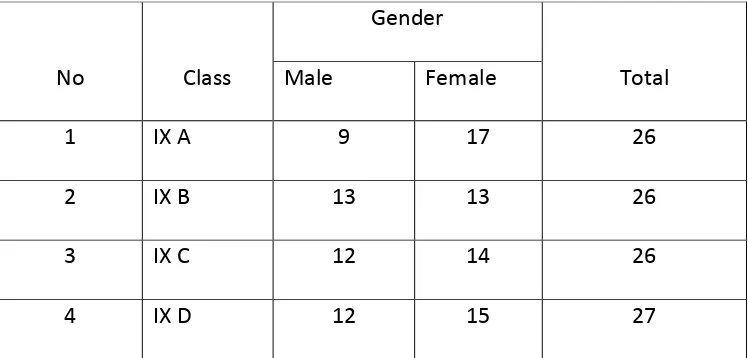
Table 1: The Number of Students of the Third Grade of SMPN 1 Karya
Penggawa Krui Pesisir Barat
So that, the class have been chosen randomly by using lottery. After the researcher random the class, IXA as the control class and IXB as the experimental class.
3.3 Data Collecting Technique
In this research, the researcher used the data which come from:
1. Try out test was done to know the quality of the test instrument of the research. The test was multiple choices that consist of 50 items. Try out test had given to the control class.
2. Pretest was done to know the students’ ability before the treatment. The test was multiple choices that consist of 40 items and the students should answer the question in the answer sheet. The scoring based on the correct answer. The result of the test had written in the scoring column on the paper.
No Class
Gender
Total
Male Female
1 IX A 9 17 26
2 IX B 13 13 26
3 IX C 12 14 26
3. Treatment was done to apply small group discussion. In order to assess the teacher in applying the technique. For experimental class the researcher was taught anecdote text by using small group discussion technique. 4. Post test done to know the students’ reading comprehension achievement
after being taught anecdote text by using small group discussion technique. The system and the difficulty of post test have been the same as the pretest, because both of them used to measure the students’ reading comprehension in anecdote text by using small group discussion in order to know the development of the students’ reading comprehension after
small group discussion technique was applied.
3.4Research Procedure
The researcher used the following steps in order to collect the data: a. Determining the population and sample of the research
To determining the population of this research, the researcher choose one class from four classes of the third grade of SMPN 1 Karya Penggawa Krui by using small group discussion technique.
b. Administering tryout test
Tryout test had given to the students in order to know the quality of the test as instrument of the research.
c. Analyzing the test
The result of tryout test analyzed to know which items were good to be use in pretest
Pretest had given to find out the students’ basic ability in comprehend the anecdote text before using small group discussion technique.
e. Conducting treatment
In this research, the treatments were conducted in three times. In treatments, the researcher explained about anecdote text and small group discussion to help students to comprehend anecdote text. After explain anecdote text and small group discussion, the researcher ask the students to divide them into some group work. Then, the researcher gave an anecdote text to each group.
f. Giving posttest
The posttest had given to know how far the students’ increase after they receive the treatment. Multiple choices applied in the test.
g. Analyzing the test result
After giving the pretest and posttest, the researcher analyzed the data. The data was analyzed using one group pretest and post-test design. It had been used to know whether small group discussion suitable to increase students’ reading comprehension significantly or not. The data was computed through SPSS Program.
h. Reporting the result
3.5 Research instruments
The research instrument was used as part of the data collecting process. The research instruments were as follow:
3.5.1 Try out of instrumentt
A try out test carried out before conducting pre-test and pos-test. This test was given to determine the quality of the test instrument of the research. Try out test had been given to control class. The researcher prepared 50 items of multiple choices test. The question had four alternative answers for each (A, B, C, and D). 3.5.2 Criteria of Good Test
A test or a measuring would become a good test if the test had four criteria of good test, namely validity, reliability, level of difficulty, and discrimination power 3.5.3 Validity
A test will be said be valid if the measures the object to be measured and suitable with the criteria (Hatch and Farhady, 1982:250). According to Setiadi (2006), he says that “validity is used to measure perception, language behavior, motivation, even the language ability”. A valid instrument has a high validity. On the other
hand, the instrument which is lack of goodness has a low validity”. An instrument can be called valid if it can show the data of variable are researched correctly. There were three types of validity be used in this research: namely construct validity, content validity, and face validity.
1.Construct Validity
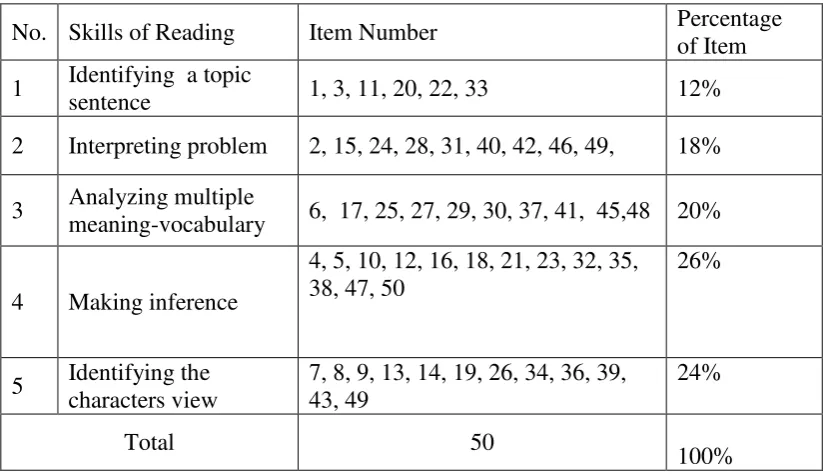
performance. A measure must relate construct to the real world observation. so, construct validity is concern with whether the test is actually in line of the theory of what reading comprehension means or not. The content of the result test is presented in the following table:
Table 2. Specification of Data Collecting Instrument
No. Skills of Reading Item Number Percentage of Item Hatch and Farhady (1981:250) say that this kind of validity concern on adequacy of the sample, not simply on the appearance of the test.
3.Face validity
3.5.4 Reliability
Setiadi (2006) says if the data is true based on the facts, how many data will be taken the result will be same. Reliability shows the degree of mainstays about something. Reliability means the data can be believed so it can be relied on. knowing the reliability of test, the researcher used the following steps:
1. Giving try out test
2. Giving pre-test and post-test items to 30 students out of sample 3. Collecting the result and analyzing it.
4. Analyzing the difference between the pre-test and post-test result.
Reliability of the test in this research can be determined by using split half method in order to estimate the reliability of the test. Reliability is divided into two half group; the first half group and the second half group. The researcher used the following formula:
Notes:
r1 : The coefficient of reliability between first half group and the second half group
x : total number of the first half group y : total number of second half group x2 : square of x
y2 : square of y (Lado in Hughes, 1989)
And then to find out of reliability of the test, the researcher used “Spearman Brown Prophecy Formula” ( Hatch and Farhady, 1982:286).
rk=
Notes:
rk : The reliability of the test r1 : The reliability of half test
And the criteria of the reliability as follow: 0.80-1.00 = very high
0.60-0.79 = High 0.40-0.50 = Average 0.20-0.39 = low
0.00-0.19 = very Low
( Hatch and Farhady, 1982:246)
3.5.5. Level of difficulty
To know the level of difficulty of the test, the researcher used the following formula:
LD=
Notes:
LD :Level of Difficulty
R : Number of the students answer correctly N : Total number of the students
Here the criteria of the level of difficulty <0.30 : Difficult
0.30-0.70 : Average >0.70 : easy (Shohamy, 1985: 79)
3.5.6 Discrimination Power
Here is the formula used by the researcher:
DP=
Notes:
DP : Discrimination Power
U : Number of upper group who answer correctly L : Number of lower group who answer correctly N : Total of the students
And here there are the criteria of the discrimination power: DP : 0.00-0.19 : Poor
DP : 0.20-0-39 : Satisfactory DP : 0.40-0.69 : Good DP : 0.70-100 : Excellent
DP : - (Negative) : Bed items (be omitted)
When the result is zero and the item has no discrimination power. The worst is when the result will be negative because the lower students can answer more many than upper students, if the result positive, it will have discrimination power because upper students can answer while poor students cannot answer.
3.6Scoring System
In this research, the researcher used Arikunto’s formula in scoring the result of the test. The highest score is 100 and will use 40 multiple choice in order to find the objective of the result in this test. To scoring the result of the test, the researcher use Henning’s Formula (1987).
The formula is as follows:
Note:
3.7Data Analysis
Knowing is there any significant increase of the students’ reading comprehension achievement after they taught by using small group discussion technique use anecdotes text, the researcher computed the student’s score using the following steps:
Firstly, the researcher scored the result of pre-test and post-test. After the scoring, she calculated the score of pre-test and post-test and tabulate the result of the test. Then, the last steps is showing the conclusion from the tabulate result of the pre-test and post-pre-test order, the data was statistically analyzed using statistical computerization i.e. Statistical Package for Social Science (SPSS) version 17.0 for windows to test whether the increase of students gain is significant or not.
3.8 Hypothesis Test
After collecting the data, the researcher analyzed the data in order to find out whether there is significant increase of students’ ability in reading comprehension by using small group discussion technique or not after the treatment.
There are two hypotheses; Zero hypotheses (HO) and Progressive hypotheses (H1). H0: There is no significant increase of students’ reading comprehension after taught anecdote text use small group discussion technique at the third grade students of SMPN 1 Karya Penggawa Krui.
CHAPTER V
CONCLUSIONS AND SUGGESTIONS
This chapter describes the conclusions of the result of this research. It also describes the suggestions from the writer to the readers who want try to apply small group discussion technique in teaching reading comprehension.
5.1Conclusions
Based on the result of the data analysis and discussions, the researcher concludes that there is significant increase of students’ reading comprehension achievement after the treatments using small group discussion technique. Small group discussion technique give the students to share their opinion in comprehend the texts given by the teacher enthusiastically. It can be seen in the students’ pretest and posttest score in experimental class. The result of this research indicated that the increase of students’ reading comprehension scores in the experimental class
5.2Suggestions
From the conclusions above, the researcher would like to give some suggestions as follows:
1. For the teachers
a. They should apply small group discussion technique because it is one of alternative technique for teaching reading.
b. The teacher should give more chance to the students to be more active, and let the students do several practices. The teacher should give the students more chance to help them when they meet difficulties.
2. For the students
a. The students should learn and be more active in solving problems in reading comprehension in order to develop their abilities in reading English.
b. They should practice the language they have learned with their friends or teachers.
3. For the school
a. The school should provide more English books to the students so that they can increase their knowledge to comprehend a text
REFERENCE
Afrilianti. 2012. Improving Students Reading Comprehension Achievement Through KWHL Technique at SMA Al-Azar 3 Bandar Lampung. Lampung: Lampung University
Allaiydrus, F. 2009. Increasing Students’ Reading Comprehension Through Questioning Technique at the Second Year of SMAN 1 Kota Bumi. Lampung: Lampung University
Arif, M. S. 2011. The Effectiveness of Teaching Reading Comprehension Through Small Group Discussion. Jakarta: Islamic University
Arikunto, S. 1997. Dasar-dasar Evaluasi Pendidikan, Jakarta: Bina Aksara
Bennett J, Lubben F, Hogarth S, Campbell B. 2004. A systematic review of the use of small-group discussions in science teaching with students aged 11-18, and their effects on students’ under standing in science or attitude to science. In: Research Evidence in Education Library. London: EPPI-Centre, Social Science Research Unit, Institute of Education, University of London.
Betaria, E. 2012. The Implementation of Jigsaw Technique in Teaching Reading Comprehension at the Second Year Students of SMAN 1 Krui. Lampung: Lampung University
Bima, M. and Kurniati, C. 2005. Let’s Talk Grade VIII. BANDUNG: Pakar Raya Brilhart, J. K., Galanes, G. J., and Adams, K. 2001. Effective Group Discussion.
Theory and Practice. New York: Mc Grow- Hill International
Brookfield, S. and Preskill, S. 1999. Discussion as a Way of Teaching. SRHE & Open University Press: Buckingham.
Brown, HD. 1994. Teaching by Principle an Interactive Approach to Language Pedagogy, San Fransisco State University.
Grabe, W., and Stoller, F. L. 2002. Teaching and researching reading. New York: Longman.
Hararit. 2007. Teaching Reading Comprehension Strategies to Student with Learning Disabilities: A Review of the Research. Review of Educational Research. Cambridge: Cambridge University Press.
Hasnova, S. 2011. The Influence of Using Anecdote Towards Students Speaking Ability at the Second Semester of the Seventh Grade of SMPN 1 Adiluih Pringsewu in 2010/2011. IAIN: Bandar Lampung.
Hatch, E. And Farhady, H. 1982. Research Design and Statistics for Applied Linguistics. Los Angeles: Newbury House Publisher.
Henning, G. 1987. A guide to Language Testing. Los Angeles: New Bury House Publisher
Hill. D. B. 1994. Teaching by Principle and interactive approach to Language Pedagogy. San Fransisco: State University
Hill, L. A. 1980. Elementary Anecdotes in American English. New York: Oxport University Press.
http://cte.uwaterloo.ca/teaching_resources/tips/group_work_types_of_small_grou ps.htmlhttp://cte.uwaterloo.ca/teaching_resources/tips/group_work_types_of_ small_groups.html acsessed on Saturday on November, 22, 2013 09:00 pm Hughes, A. 1989. Testing for Language Teaching. Great Britain, Glasgow:
combridge University Press
Johnson, D., Johnson, R. and Holubec, E. 1981. Cooperative in the classroom. Edina, MN: Interaction Book Company.
Kathleen, Mc Worther. 1986. Guide to college reading. New York: Little Brown and Company.
Kenz, M. A. and Greg, J. B. 2000. Effective in Theory and Practice. Massachusetts: A Person Education Company.
Klingner, J. K., & Vaughn, S. 1998. Using Collaborative Strategic Reading. Teaching Exceptional Children. TESOL Quarterly.
Refildha, O. 2012. Increasing Students Achievement in Reading Comprehension of Recount Text Through SQ4R Strategy at The Second Year of SMAN 5 Bandar Lampung. Lampung: Lampung Univesity
Vaughn, S., Chard, D., Bryant, D. P., Coleman, M., Tyler, B., Linan-Thompson, S., & Kouzekanani, K. 2000. Fluency and comprehension interventions for thirdgrade students: Two paths to improved fluency. Remedial and Special Education. TESOL Quarterly.
Sagala, S. 2007. Konsep dan Makna Pembelajaran. Bandung: Alpabeta
Setiadi, B. 2006. Metode Penelitian Untuk Pengajaran Bahasa Asing, pendekatan kuantitatif dan qualitatif. Yogyakarta: Graha Ilmu
Shahamy, E. 1985. A Practical Handbook in Language Testing for the Second Language Teachers. Tel-Aviv: Tel- Aviv University.
Sihombing, B. 2012. Increaseing students’ reading comprehension through discovery inquiry method at grade V11 of smp dirgantara bandar lampung. Lampung: Lampung University.
Simanjuntak, E. G. 1998. Developing Reading Skill for ESL students. Jakarta: Depdikbud.
Slavin, R. 1986. Student team learning: An overview and practical guide. Washington, DC: Professional Library National Education Association. Slavin, R. 1995. Cooperative Learning: Theory, Research, and Practice.
Massachusetts: Allyn and Bacon.
Slavin, R. E. 1995. Cooperative Learning: Theory, Research, and Practice, 2nd ed. Boston: Allyn and Bacon.
Standish, L. G. 2005. The Effect of the Collaborative Strategic Reading and Teaching Exceptional Children. TESOL Quarterly.
Sugiono. 2012. Metode Penelitian Kuantitatif Kualitatif dan R&D. Bandung: Alfabeta
Suparman, U. 2012. Developing Reading Comprehension Skills and Strategies. Bandung: CV Arfino Raya
Texas Reading Initiative. 2002. Comprehension Instruction (2002 Online Revised Edition). Texas Education Agency. Retrieved December 19, 2011, from http://www.netxv.net/pm_attach/67/TRI-Comprehension_Instr.pdf
Appendix 1
Research Schedule
Name :Yulisa Putri
SRN : 0913042022
Place of Research : SMPN 1 Karya Penggawa Krui
Script Title : The Use of Small Group Discussion Technique to Increase TheStudents’ Reading Comprehansion
Achievement Using Anecdote Text at the Third Grade of SMPN 1 Karya Penggawa Krui Pesisir Barat
Script Advisors : 1. H. Ujang Suparman, M. A., Ph. D 2. Drs. Ramlan Ginting Suka
No. Date Activities
1 September 16th-18th, 2013 Observation
2 Saturday, September 21th, 2013 Try out test in 1X A 3 Wednesday, September 25th, 2013 Pre test in 1XB 4 Saturday, September 28th, 2013 1sttreatment in 1XB 5 Wednesday, October 2th, 2013 2ndtreatment in 1XB 6 Saturday, October 5th, 2013 3rdtreatment in 1XB 7 Wednesday, October 9th, 2013 Post test in 1XB
Krui, September 2013 Writer
Appendix 2
The number of group in the experimental class
No Group member
Group 1 1. Aria Saputra
2. Eci Yunita 3. Hendri Gunawan
Group 2 1. Arrapi Arip
2. Asda Yani 3. Eprina
4. Iwan Naga Putra
Group 3 1. Arif Saputra
2. Novi Yanti 3. Lekat Hasanah
Group 4 1. Cindi Aguszaman
2. Nur Wahyuni 3. Emilia Wati
Group 5 1. Dedi Rahmat
2. Yunita Sari 3. Beni Saputra
Group 6 1. Endodi
2. Mia Sopia 3. Hedi Yana
Group 7 1. Wawan Ariansyah
2. Patma Wati 3. Meza Elia 4. Idza Mahendra
Group 8 1. Yanuar
Appendix 3
The students’ score of Try Out Test
NO STUDENT'S NAME TOTAL CORRECT SCORE
1 Odd 1 0 1 0 1 1 1 1 1 1 1 1 1 0 1 0 1 1 1 1 1 1 1 1 0 0 38 18 20
Reliability Analysis of Lower Group Tryout Test
256 169 289 169 289 225 225 225
15 Odd 1 0 0 1 1 1 1 0 0 0 0 1 0 0 1 1 1 0 0 1 0 0 1 1 0 1 27 13 14 225 169
Even 1 1 0 1 1 1 1 1 1 1 0 1 0 1 0 1 1 0 1 0 1 1 0 0
16 Odd 0 1 1 0 1 0 0 1 0 0 0 1 1 1 0 1 1 1 0 0 0 1 0 0 1 0 27 12 15 169 196
Even 1 1 1 0 1 1 0 0 1 0 1 0 1 0 1 1 0 1 1 0 1 1 0 1
17 Odd 1 1 1 0 1 0 1 1 0 0 0 1 0 0 1 0 1 0 1 0 1 1 1 1 0 1 26 16 10 144 225
Even 0 1 0 0 0 1 0 1 0 0 1 1 0 0 0 1 1 0 0 1 0 0 1 1
18 Odd 1 0 1 0 0 1 1 1 1 0 0 0 1 1 0 1 0 1 1 0 0 1 1 1 0 1 26 15 11 256 100
Even 1 0 1 1 1 0 0 1 0 0 1 0 0 0 1 0 1 0 0 1 0 1 0 1
19 Odd 0 1 1 0 0 1 1 1 1 0 0 0 1 0 0 1 0 1 1 0 1 1 0 1 1 1 25 15 10 225 121
Even 0 1 0 1 0 1 1 1 1 1 0 0 0 0 1 0 1 0 0 0 1 0 1 0
20 Odd 1 0 1 1 1 0 0 0 0 0 1 0 1 1 0 1 1 1 1 0 0 0 0 0 0 0 25 14 11 225 100
Even 0 1 0 1 1 1 0 1 1 1 0 0 0 0 0 1 0 1 0 0 0 0 0 0
21
Odd 0 1 0 0 1 1 1 0 0 1 0 0 1 0 0 1 0 1 1 0 0 1 1 1 0 1 24 13 11 196 121
Even 1 1 1 0 1 1 0 0 0 0 0 0 0 1 0 0 0 0 0 1 1 0 0 1
Even 1 1 1 0 1 1 0 0 0 0 0 0 0 1 0 0 0 0 0 1 1 0 0 1
22 Odd 0 1 1 1 0 1 1 0 0 0 0 1 1 1 0 1 1 1 0 1 1 1 0 0 0 1 24 12 12 169 121
Even 0 1 0 0 0 0 1 1 1 0 0 0 1 0 1 1 1 0 1 0 0 0 1 1
23 Odd 1 1 1 1 1 0 0 0 0 0 1 0 1 0 1 0 1 0 0 1 1 0 0 0 0 0 22 10 12 144 144
Even 0 1 0 0 1 0 1 1 0 0 1 1 0 0 1 0 1 1 0 0 0 1 1 0
24 Odd 1 0 0 1 0 1 0 1 0 0 0 1 1 0 0 1 0 1 1 1 0 1 1 0 1 0 22 12 10 169 100
Even 1 1 1 0 1 0 0 1 1 0 0 0 0 1 1 0 0 0 0 0 0 0 1 0
25 Odd 1 0 0 0 1 0 0 1 1 0 1 0 1 1 0 1 1 0 0 1 1 0 0 0 1 0 20 11 9 121 81
Even 1 1 1 1 0 1 0 1 1 0 0 0 0 0 0 1 0 0 0 0 0 0 0 0
26 Odd 0 1 0 0 1 0 1 0 1 0 1 1 0 0 1 0 0 0 0 1 0 1 0 0 1 0 19 9 10 81 100
Even 0 1 0 1 1 1 0 1 0 1 1 0 0 1 1 1 0 1 0 1 1 1 0 1
Appendix 6
Level of difficulty and Descrimination power of Try Out Test
N
1 13 7 0,76 easy 0,46 good revised
2 12 10 0,84 easy 0,15 satisfactory administered
3 10 5 0,57 average 0,38 satisfactory administered
4 12 6 0,69 average 0,46 good revised
5 9 7 0,61 average 0,15 satisfactory administered
6 4 3 0,26 difficult 0,07 poor droped
7 11 8 0,73 easy 0,23 satisfactory administered
8 9 8 0,65 average 0,07 poor revised
9 10 8 0,69 average 0,15 poor revised
10 9 6 0,57 average 0,23 satisfactory administered
11 9 11 0,76 easy 0,15 poor revised
12 5 2 0,26 difficult 0,23 satisfactory dropped
13 15 9 0,92 easy 0,46 good revised
14 10 2 0,46 easy 0,61 good administered
15 8 7 0,73 easy 0,07 poor droped
16 11 7 0,69 average 0,30 satisfactory administered
17 8 9 0,65 average 0,07 poor revised
18 6 1 0,26 difficult 0,38 satisfactory droped
19 12 8 0,76 easy 0,30 satisfactory administered
20 14 8 0,84 easy 0,30 satisfactory administered
21 4 3 0,26 difficult 0,07 poor droped
22 12 5 0,65 average 0,53 good administered
23 12 7 0,73 easy 0,38 satisfactory administered
24 13 5 0,69 average 0,61 good administered
25 9 9 0,69 average 0,00
no
descrimination administered
26 11 4 0,57 average 0,23 difficult revised
27 13 4 0,65 average 0,69 good administered
28 13 2 0,57 average 0,69 good administered
29 10 6 0,61 average 0,30 satisfactory administered
30 10 7 0,65 average 0,23 satisfactory administered
31 4 2 0,23 difficult 0,15 poor droped
32 13 7 0,76 easy 0,27 bad droped
33 9 6 0,57 average 0,11 poor revised
34 10 8 0,69 average 0,15 poor revised
35 9 6 0,57 average 0,11 poor revised
37 12 5 0,65 average 0,53 good administered
38 9 3 0,46 average 0,46 good administered
39 10 4 0,53 average 0,46 good administered
40 12 7 0,73 easy 0,38 satisfactory droped
41 8 7 0,57 average 0,07 poor revised
42 8 8 0,61 average 0,00
no
descrimination revised
43 11 6 0,65 average 0,84 excelent administered
44 10 6 0,61 average 0,30 satisfactory administered
45 12 9 0,80 easy 0,23 poor revised
46 3 4 0,26 difficult 0,07 bad droped
47 7 7 0,53 average 0,00
no
descrimination administered
48 8 5 0,53 average 0,23 satisfactory administered
49 9 5 0,53 average 0,30 satisfactory administered
Appendix 7
Reliability analysis of Try out
No.
Appendix 8
The Reliability Computation of the Data Collecting Instrument
a. Reliability of the half test:
=
= 5450
5991[5163]
= 5450
30931533
= 5450 5561.61
= 0.97993207
b. Reliability of the whole test
= 2
1 +
= 2(0.97993207) 1 + 0.97993207
= 1.95986414 1.97993207
Appendix 11
The distribution of students’ score(pretest-posttest)
Appendix 12
The increase of students’ scoreof pre test and post test
NO
STUDENT'S
CODE PRE TEST POST TEST GAIN NOTE
1 1 1 0 1 1 1 1 1 1 0 1 1 1 0 1 1 1 0 1 1 1 1 0 1 0 1 1 0 1 r hitung 0.5383 0.315 0.28 -0.19 0.1093 0.387 0.424 0.24845 0.41786 0.21307 0.5951219 -0.09214 -0.1314 0.3636965 0.301292 0.05083 0.082438 0.4314506 0.3012923 0.2543097 0.548 0.511854 0.0454791 0.116383 0.0650791 0.2380965 0.400987 0.3143301 0.2253887
0 1 1 1 1 0 0 1 1 1 0 0 0 1 1 1 0 1 1 0 1 37
1 0 0 1 1 0 1 1 1 1 1 1 1 0 1 1 0 1 0 1 1 36
1 1 1 1 1 0 1 0 1 1 0 1 1 0 1 1 0 1 1 1 1 36
1 1 1 0 1 0 0 0 1 1 0 1 1 0 0 1 1 0 1 1 0 34
1 0 0 1 1 0 1 1 1 1 0 1 0 1 1 1 1 1 1 1 1 33
0 0 0 1 1 0 1 1 1 1 0 1 1 0 1 0 0 0 1 1 0 33
1 1 0 1 0 0 1 1 0 0 1 0 1 0 1 1 1 0 1 1 1 32
1 1 1 0 0 0 0 0 1 1 0 1 1 0 0 1 1 1 1 1 1 32
0 1 1 1 1 0 1 1 1 1 0 1 0 0 0 0 1 1 0 1 0 30
0 1 0 1 1 1 0 0 0 0 0 1 1 0 1 0 0 1 0 1 1 30
0 1 1 0 0 0 1 0 1 0 0 1 1 0 0 1 0 1 0 0 0 29
1 1 0 0 0 0 1 1 1 1 0 1 0 0 0 0 1 1 1 1 1 29
1 0 1 0 1 0 0 0 1 1 0 1 1 0 0 0 0 0 0 1 0 28
1 0 0 1 1 0 0 1 0 1 1 1 0 0 1 1 0 0 0 1 0 27
1 0 0 1 1 1 1 0 1 1 1 1 0 1 1 1 1 1 0 0 0 27
0 1 0 0 0 0 1 1 1 0 0 1 1 0 0 1 0 0 1 1 1 26
0 0 0 0 0 0 1 0 0 0 1 0 0 1 0 1 0 0 0 1 0 26
0 1 0 1 0 0 0 0 1 0 0 0 0 0 1 0 1 0 0 0 1 25
0 0 0 0 1 1 1 0 1 1 0 0 1 1 0 0 0 1 0 0 1 25
0 0 0 0 1 1 1 0 1 1 0 0 1 1 0 0 0 1 0 0 1 25
0 0 1 0 1 0 1 0 1 0 1 1 0 0 0 0 1 1 1 1 1 24
1 0 1 1 0 1 1 0 0 0 0 1 0 0 0 0 0 1 1 1 1 24
0 1 0 1 1 1 0 1 1 0 0 0 1 0 0 0 0 0 1 0 0 22
1 1 0 0 0 1 0 0 0 0 0 1 0 1 1 0 0 0 0 1 1 22
0 0 1 1 1 0 1 0 0 1 1 0 0 0 0 0 0 0 0 1 1 20
0 0 0 0 0 0 1 1 1 0 0 0 0 0 0 0 1 0 1 0 1 19
0.41739936 0.3928852 0.3577709 0.4330127 0.41218935 -0.1471383 0.0497 0.3551139 0.407726 0.373395 0.23 0.357076 0.35431975 0.024077 0.3636965 0.55653247 0.1298002 0.3636965 0.298298 0.4413 0.2764093 0.38 0.38 0.38 0.38 0.38 0.38 0.38 0.38 0.38 0.38 0.38 0.38 0.38 0.38 0.38 0.38 0.38 0.38 0.38 0.38 0.38
code 1 2 3 4 5 6 7 8 9 10 11 12 13 14 15 16 17 18 19 20 ★✩ 22 23 24 25 26 27 28 29 30 31 32 33 34 35 36 37 38 39 40
1 ✪✫ 1 1 1 0 0 1 1 0 1 0 0 1 1 0 1 1 0 0 0 1 1 1 0 1 0 0 0 1 1 0 1 0 1 0 0 1 0 1 0 0
2 ✪✫✬ 1 1 1 0 0 1 0 1 0 1 0 1 0 1 1 0 1 1 1 1 0 1 0 1 0 1 1 1 0 0 0 0 1 1 0 0 0 0 1 0
3 ✪ ✪ 0 0 1 0 0 0 1 0 1 0 0 1 0 1 0 0 1 0 1 0 1 0 1 0 0 1 0 1 0 1 0 1 1 0 1 0 0 1 0 1
4 ✪✭ 1 1 0 0 1 0 0 1 0 1 0 1 0 1 1 1 0 0 1 1 0 0 1 0 1 1 1 0 1 0 1 1 1 0 1 0 1 1 1 1
5 ✮✫ 1 0 1 1 1 0 0 0 1 0 1 0 1 0 0 1 1 0 0 0 1 1 0 1 0 0 0 1 0 1 0 0 1 1 1 1 1 1 1 1
6 ✯✪ 0 1 1 0 0 1 1 0 1 1 1 0 0 0 0 0 1 0 1 1 0 1 1 0 1 1 1 0 1 1 1 1 1 1 1 0 0 1 0 1
7 ✰✬ 1 0 0 1 1 0 0 1 0 1 0 1 1 0 0 1 0 1 1 1 1 0 0 1 0 1 0 1 0 1 0 0 1 0 1 0 1 1 1 0
8 ✱✭ 1 1 1 0 1 1 1 0 0 1 0 0 0 1 1 0 0 0 1 1 1 1 1 0 1 1 0 0 1 1 0 1 1 0 1 0 0 1 1 1
9 ✮ ✲ 0 1 1 0 1 1 1 0 1 1 0 1 1 1 0 1 1 1 0 1 0 1 0 1 1 1 0 1 1 0 1 1 0 1 0 1 1 0 0 1
10 ✱✳ 1 0 1 0 1 0 0 1 0 0 1 0 1 0 1 0 1 0 1 0 0 1 1 0 1 0 0 1 0 0 0 1 1 0 0 1 0 1 1 1
11 ✱ ✬ 0 0 1 0 0 1 0 0 1 0 0 0 1 1 0 1 0 1 0 1 0 0 1 0 1 0 0 0 0 1 0 0 1 0 0 0 1 0 1 0
12 ✴✵ 1 1 0 0 1 1 0 1 0 1 0 0 1 0 1 0 1 0 1 0 1 1 0 0 1 0 1 1 1 1 0 1 1 1 1 1 0 1 0 1
13 ✶✭ 0 1 1 0 0 1 1 0 1 0 1 0 0 1 0 1 0 1 0 1 1 1 1 1 1 0 1 0 1 1 0 0 1 0 0 0 0 0 1 1
14 ✶✷ 0 0 0 1 0 1 1 0 0 1 0 1 1 1 1 0 1 0 1 1 0 0 `1 0 0 1 0 1 0 0 1 0 0 1 0 1 0 1 0 1
14 ✶✷ 0 0 0 1 0 1 1 0 0 1 0 1 1 1 1 0 1 0 1 1 0 0 `1 0 0 1 0 1 0 0 1 0 0 1 0 1 0 1 0 1
15 ✸✵ 0 0 1 0 1 0 0 0 1 0 1 0 1 0 0 0 1 0 0 0 0 1 0 0 0 1 0 0 1 0 0 1 1 0 0 1 0 1 0 1
16 ✸ ✲✹ 1 0 0 1 0 1 1 1 0 0 1 1 0 1 1 1 0 1 1 1 1 1 0 1 0 1 0 1 1 1 0 1 1 1 1 1 0 1 1 1
17 ✺✶ 1 0 1 0 0 1 1 0 1 1 1 0 1 0 0 1 1 0 1 1 0 1 1 0 1 0 1 0 1 0 1 0 1 0 1 1 1 1 1 0
18 ✵✪ 0 1 0 1 1 0 1 0 0 0 1 1 0 1 0 0 0 1 1 0 1 1 0 1 0 1 0 1 0 1 1 1 1 1 1 1 0 1 0 1
19 ✵✱ 0 0 1 0 0 1 0 0 0 1 0 0 1 0 0 1 1 0 0 1 1 0 1 0 0 1 0 0 1 1 0 1 1 0 1 1 0 1 1 1
20 ✵✫ 1 0 1 0 1 0 0 1 1 0 1 0 0 1 0 0 0 1 0 1 0 1 0 1 1 0 0 1 0 0 0 1 0 1 0 0 0 1 0 0
21 ✳✭ 0 1 0 0 1 0 1 0 1 0 0 1 0 1 0 0 1 1 0 0 1 1 1 0 1 0 0 1 0 1 0 0 0 1 0 0 1 1 0 1
22 ✳✲ 0 0 0 1 0 1 1 0 0 1 0 1 1 0 0 1 0 1 0 1 1 0 0 1 1 1 1 1 1 0 1 0 1 0 1 1 1 1 1 1
23 ✹✲ 0 0 1 0 1 0 0 1 0 1 0 1 0 1 1 1 1 1 1 1 0 1 1 0 0 0 0 0 1 0 0 0 1 1 0 0 1 1 0 0
24 ✹✪ 1 0 1 0 1 0 1 0 0 1 1 1 0 0 1 0 1 1 1 1 0 0 1 1 1 1 0 1 1 1 0 0 1 0 0 1 0 1 0 1
25 ✭✲ 0 0 0 1 0 1 1 0 1 0 1 1 0 0 1 0 0 0 1 0 1 1 0 0 0 1 0 1 0 0 0 1 1 0 1 1 0 1 1 0
26 ✭✫ 0 0 0 1 1 0 0 0 0 1 0 0 1 0 0 1 1 1 1 1 0 1 1 1 0 1 1 1 1 1 0 1 1 1 1 0 0 0 0 1
Appendix 16
Prequensi of Pre test and Post Test
Statistics
PRETTEST
N Valid 26
Missing 0
Statistics
POSTTEST
N Valid 26
Missing 0
PRETTEST
Frequency Percent Valid Percent
Cumulative Percent
Valid 32.00 1 3.8 3.8 3.8
35.00 2 7.7 7.7 11.5
40.00 1 3.8 3.8 15.4
45.00 3 11.5 11.5 26.9 47.00 3 11.5 11.5 38.5
50.00 2 7.7 7.7 46.2
52.00 2 7.7 7.7 53.8
55.00 2 7.7 7.7 61.5
60.00 8 30.8 30.8 92.3
65.00 1 3.8 3.8 96.2
70.00 1 3.8 3.8 100.0
POSTTEST
Frequency Percent Valid Percent
Cumulative Percent Valid 50.00 1 3.8 3.8 3.8
52.00 1 3.8 3.8 7.7
55.00 3.8 3.8 11.5
Appendix 17 Hypotesis testing
Descriptive Statistics
N Minimum Maximum Mean Std. Deviation
POSTTEST 26 50.00 80.00 65.4231 7.85454
PRETEST 26 32.00 70.00 51.8077 9.74482
Valid N (listwise) 26
Paired Samples Statistics
Mean N Std. Deviation Std. Error Mean
Pair 1 POSTTEST 65.4231 26 7.85454 1.54040
PRETEST 51.8077 26 9.74482 1.91112
Paired Samples Correlations
N Correlation Sig.
Pair 1 POSTTEST & PRETEST 26 .772 .000
1 AS Group 1 10 100 10 100 10 100 First Meeting Second Meeting Third Meeting No Students’
No. Student'
s Code Gender Score Category Group
1 AY Female 70 upper 2
2 ASR Male 70 upper 3
3 MA Female 68 upper 8
4 AS Male 66 upper 1
5 BS Male 66 upper 5
6 CA Male 62 upper 4
7 DR Male 62 upper 1
8 EY Female 60 upper 1
9 BW Female 60 upper 4
10 EN Male 60 upper 6
11 ER Female 58 upper 3
12 FM Male 56 upper 8
13 NY Female 56 upper 3
14 HG Male 54 lower 3
15 IM Male 54 lower 7
16 IWP Male 54 lower 2
17 LH Female 52 lower 3
18 NW Female 52 lower 4
19 ME Female 52 lower 7
20 MS Female 50 lower 6
21 HY Female 48 lower 6
22 AA Male 44 lower 2
23 PW Female 44 lower 7
24 WA Male 40 lower 7
25 YW Male 40 lower 8
Appendix 21. T-Table that is Used to Prove Whether The Data will be Significant or Not.
NILAI-NILAI DALAM DISTRIBUSI t £ untuk uji dua pihak (two tail test)
Dk 0.50 0.20 0.10 0.05 0.02 0.01
£ untuk uji satu pihak one tail test)
Dk 0.25 0.10 0.05 0.025 0.01 0.005
1 1.000 3.078 6.314 12.706 31.821 63.657
2 0.816 1.876 2.920 4.303 6.965 9.925
3 0.765 1.638 2.353 3.182 4.541 5.841
4 0.741 1.533 2.132 2.776 3.747 4.604
5 0.727 1.476 2.015 2.570 3.365 4.032
6 0.718 1.440 1.943 2.447 3.143 3.707
7 0.711 1.415 1.895 2.365 2.998 3.499
8 0.706 1.397 1.860 2.306 2.896 3.355
9 0.703 1.383 1.833 2.262 2.821 3.250
10 0.700 1.372 1.812 2.228 2.764 3.169 11 0.697 1.363 1.796 2.201 2.718 3.106 12 0.695 1.356 1.782 2.179 2.681 3.055 13 0.692 1.350 1.771 2.160 2.650 3.012 14 0.691 1.345 1.761 2.145 2.624 2.977 15 0.690 1.341 7.753 2.131 2.602 2.947 16 0.689 1.337 1.746 2.120 2.583 2.921 17 0.688 1.333 1.740 2.110 2.567 2.898 18 0.688 1.330 1.734 2.101 2.552 2.878 19 0.687 1.328 1.729 2.093 2.539 2.861 20 0.687 1.325 1.725 2.086 2.528 2.845 21 0.686 1.323 1.721 2.080 2.518 2.831 22 0.686 1.321 1.717 2.074 2.508 2.819 23 0.685 1.319 1.714 2.069 2.500 2.807 24 0.685 1.318 1.711 2.064
t-table
2.492 2.797 25 0.684 1.316 1.708 2.060 2.485 2.787 26 0.684 1.315 1.706 2.056 2.479 2.779 27 0.684 1.314 1.703 2.052 2.473 2.771 28 0.683 1.313 1.701 2.048 2.467 2.763 29 0.683 1.311 1.699 2.045 2.462 2.756 30 0.683 1.310 1.697
2.042
t-table 2.457 2.750 40 0.681 1.303 1.684 2.021 2.423 2.704 60 0.679 1.296 1.671 2.000 2.390 2.660 120 0.677 1.289 1.658 1.980 2.358 2.617
LESSON PLAN 1
Unit of education : SMP
Subject : English
Class/Semester : IX/I
Skill : Reading
Genre : Anecdotes text
Time Allocation : 2 x 45 minutes
I. Standard Competence
Understanding the meaning of the texts monologue / essay form anecdote, accurately, smoothly, and acceptable in the context of everyday life and access to science.
II. Basic Competence
Understand and respond to the meaning of the text monologue / essay that uses variety of written language accurately and fluently in anecdote
III. Indicators
a) Identifying the topic sentence of the text. b) Interpreting the problem of the text.
c) Analyzing the multiple meaning (vocabulary) of the text. d) Making the inference of the text.
e) Identifying the problem from the text.
1V. Learning Objectives 1. Process
a. Students try to find out the topic sentence from the text. b. Students try to attain the problem of the text.
c. Students understand the multiple meaning (vocabulary) of anecdotes text.
2. Product
a. Students are able to find out the topic sentence from the text. b. Students are able to attain the problem of the text.
c. Students are able to understand the multiple meaning of the text. d. Students are competence to find out the inference of the text. e. Students are capable to converse the characters view of the text.
IV. Learning Material
Teddy ‘sDream
It was Saturday morning in May, when Mrs. Edward opened her curtains and looked out, say.” he smiled and said, “it’s going to be beautiful day.” She woke
her small son up at eight-thirty and said to him, “ get up Teddy, weare going to the zoo today. Wash your hands and face, brush your teeth and eat your breakfast
quickly. We’re going to go New York by Train.”
Teddy was six years old. He was very happy now, because he liked going to the
zoo very much, and he also like going by train. He said “I dreamed about the zoo
last night, Mommy.”His mother was in a hurry, but shestopped and smiled at her
V. Time Allocation 2 x 45 minutes
- Pre activity : +10 minutes - Whilst activity : +70 minutes - Closure activity : + 10 minutes
VI. Teaching Procedures
Pre–activity (±10 minutes)
1. Braindstorming between the teacher and students to construct their background knowledge that related to the topic with answering several questions as
stimulant. For example:
T: “Do you know aboutanecdote text?”
“Have you ever readanecdotes text?”
It is used to build the students’ though before they learn further about anecdotes text.
2. Students listen to the teacher’s explanation about material they are going to learn – that is about “Teddy’s dream”, the goals of learning to achieve, and
reading strategies the students use.
While–activity (±70 minutes)
1. Students are divided into several groups based on small group discussion technique rules with three or four students within a group. (Step I)
2. The teacher gives the material for the students.(Step 11)
3. Students listen to the rules of small group discussion technique told by the teacher. (Step II1).
5. The teacher asks the students to discuss the materials and do the assignment in a group. (Step V).
6. Some representative students from each groups present their discussion in front of class while discusses it together with the teacher. (Step VI).
7. The teacher monitors the students activity while they are presenting and discussing the materials together.
8. The teacher gives rewards to the best group in order to appreciate their work.
Post actvty (±10 minutes)
1. Students ask the teacher about the difficulties in understanding the lesson. 2. The teacher gives homework to the students.
VII. Evaluation
Reading comprehension by answering questions is given by the teacher that should be done in a group.
Authentic Assessment : Form : Eessay
Answer the following questions based on story above!
1. What is the topic sentence of the text above? (topic sentence) 2. Why was Teddy happy? (inference)
3. Who are the characters of the text? (characters view)
4. “Because helikedgoing to the zoo very much (see line 6), the anthonym of the bold word is..? (multiple meaning)
5. How old Teddy was and who are the characters of the story? (characters view) 6What did Mrs. Edward’s ask Teddy?(inference)
7. Wash your hands and face (see line 4).
The underlined word is refers to? (multiple meaning)
8. What is the topic sentence of the last pharagraph? (Topic sentence) 9. Why does Teddy was happy? (interprating problem)
Answer Key:
1. Teddy’s tell his dream to his mother.
2. Because he liked going to the zoo very much and he also liked going by train. 3. Teddy, Teddy’s mother(Mrs. Edward).
4. Hated
5. six years old. The characters of the story are Teddy and His mom
6. “you did, Teddy?”she said.” And what did you do in the zoo in your dream?”
7. Clean
8. Ted was very happy with his dream.
LESSON PLAN 2
Unit of education : SMP
Subject : English
Class/Semester : IX/I
Skill : Reading
Genre : Anecdotes Text
Time Allocation : 2 x 45 minutes
I. Standard Competence
Understanding themeaning of the textsmonologue/essayform ofanecdotes text,spoofandhortatory expositionaccurately,smoothly, andacceptablein the context ofeveryday lifeandaccess toscience.
II. Basic Competence
Understand andrespond tothe meaningof the textmonologue/essaythat usesvarietyof written languageaccurately, fluentlyin anecdotes text.
III. Indicator
a) Understanding the topic sentenceof the text. b) Identifyingcharacters view of the text. c) Determining the problem from the text d) Identifying the inference of the text.
e) Understanding multiple meaning (vocabulary) of the text.
IV. Learning Objective
1. Process
a. Students try to find out the topic sentence from the text. b. Students try to interpreting problem from the text.
d. Students try to find out the inference of the text. e. Students converse the characters view of the text.
2. Product
a. Students are able to find out the topic sentence from the text.
b. Students are capable to converse characters view/main character of the text.
c. Students are able to interpreting the problem from the text. d. Students are competence to find out the inference of the text. e. Students are able to understand multiple meaningof the text.
V. Learning Material
Mike hated soap and water
Mike was a small boy, and he hated soap and water. Three or four times every day his mother said to him, “Mike your hands are very dirty again. Go and wash them. “But Mike never really washed them well. He only
put his hands in water for a few seconds and took them out again.
Mike’s uncle and aunt lived in another city. One day they came to stay
with Mike’s parents, and they brought their small son, Ted, with them.
Tedd was a younger than Mike, and he didn’t like soap and water, either.
The boys sat with their parents for a few minutes, but then they went
outside. When they were alone, mike looked at Ted’s hands and then said
proudly, “my hands dirtier than yours!”
“Of course they are, “Ted answered angrily. “you are a year older than
VI. Time Allocation
2 x 45 minutes
- pre activity : +10 minutes - Whilst activity : +70 minutes - Closure activity : + 10 minutes
VII. Teaching Procedures
Pre–activity (±10 minutes)
1. Brainstorming between the teacher and students to construct their background knowledge that related to the topic with answering several questions as stimulant. For example:
T: “Have you ever heard about topic sentence?
“What is the meaning of topicsentence?”
It is used to build the students’ though before they learn further about anecdotes text.
2. Students listen to the teacher’s explanation about material they are
going to learn – that is about “Mike hated soap and water”, the goals
of learning to achieve, and reading strategies the students use.
While Activity (± 65 minutes)
1. Students are divided into several groups based on small group discussion rules with three or four students within a group. (Step I) 2. The teacher gives the material for the students.
3. Students listen to the rules of small group discussion technique told by the teacher.
(Step II)