School of Graduate Studies
Universiti Teknologi Malaysia
VALIDATION OF E-TBESIS PREPARATION
UfM(PS)-J/02
Title of the thesis: THERMAL ANALYSIS OF MICRO CHANNEL HEAT SINK
Degree: MASTER OF ENGINEERING Faculty: MECHANICAL
yセイ Z@ セR]セセMMMMMMMMMMMMMMMM
I F ATIMAH AL-ZAHRAH BINTI MQHD SA' AT (CAPITAL LETTERS)
declare and verify that the copy of e-thesis submitted is in accordance to the Electronic Thesis and Dissertation's Manual, School of Graduate Studies, UTM
(Signature of the student)
Permanent address: 42, Lorong TU23,
Taman Tasek Utama,
75450 Ayer Keroh,
Mel aka.
(Signature of supervisor as a witness)
Name of supervisor:
Assoc. Prof. Dr. Normah Mohd. Ghazali
"1 hereby declare that I have read this thesis and in
my opinion this thesis is sufficient in terms of scope and
quality for the award of the degree of Master of Engineering
Signature
ᄋセᄋ
ᄋᄋᄋᄋᄋᄋᄋᄋ ᄋᄋ ᄋᄋᄋᄋᄋᄋ ᄋ@
THERMAL ANALYSIS OF MICROCHANNEL HEAT SINK
FA TIMAH AL-ZAHRAH BINTI MOHD SA' AT
A project report submitted in partial fulfillment of the requirements for the award of the degree of
Master ofEngineering
Faculty of Mechanical Engineering
Universiti Teknologi Malaysia
I declare that this thesis entitled "Thermal Analysis ofMicrochannel Heat Sink" is the
result of my own research except as cited in the references. The thesis has not been accepted for any degree and is not concurrently submitted in candidature of any other degree.
Signature
Name
Date
: FA TIMAH AL-ZAHRAH BINTI MOHD SA' AT : 4 DECEMBER 2006
111
lV
ACKNOWLEDGEMENT
In preparing this proposal, I was in contact with many people, researchers, academicians and practitioners. They have contributed towards my understanding and thoughts. In particular, I wish to express my sincere appreciation to my supervisor, Associate Professor Dr. Nonnab Mohd Gbazali, for encouragements, guidance, critics and friendships.
I am also indebted to Kolej Universiti Teknikal Kebangsaan Malaysia (K.UTKM) for funding my master study. Librarians and staff of Aerodynamic Laboratory at Universiti Teknologi Malaysia (UTM) also deserved special thanks for their assistance in supplying the relevant literatures and software manual guides.
My fellow postgraduate students should also be recognized for their support. My sincere appreciation also extends to all my colleagues and other who have provided assistance at various occasions. Their views and tips are useful indeed. Unfortunately, it is not possible to list all of them in this limited space. I am grateful to all my family members.
v
ABSTRACT
Microchannel heat sink is now one of the most effective cooling techniques. As micropump works under pulsation regime and influenced by the possibility of heat transfer enhancement through pulsation, the goal has been to study the effect of pulsation to thermal behavior of microchannel heat sink. A computational model for studying pulsatile flow in microchannel had been developed using FLUENT. The meshes generated had been tested for grid independency and the results numerically iterated by FLUENT had been validated and compared to various published data. The pulsating flow pressure amplitudes were 50%, 70% and 90% of mean pressure and the flow regime is laminar. Pulsation tested was with frequencies in the range 500Hz to 1.5 kHz. The results of pulsating flow simulations had been analysed and
vi
ABSTRAK
Pembebasan haba melalui saluran bersaiz mikro telah dibuktikan sebagai salah satu teknik penyejukan yang efektif. Kajian literature menunjukkan pam bersaiz mikro bekerja secara denyutan. Kemungkinan penyerlahan pemindahan haba dan aliran melalui aliran denyutan di dalam saluran telah memperkuatkan keinginan terhadap pemyelidikan ini. Model komputer bagi mengkaji kesan aliran dedenyut di dalam saluran bersaiz mikro telah dibina menggunakan FLUENT. Grid yang
digunakan telah diuji untuk ketidak bergantungan dan data yang diperolehi dari penyelesaian berangaka menggunakan FLUENT diuji kesahan dan dibandingkan dengan jurnal yang kukuh. Aliran dedenyut dihasilkan pada amplitude 50%, 700/o dan 90% daripada tekanan purata dengan frekuensi dalam julat 500 Hz hingga 1.5 kHz. Aliran dianggap laminar. Keputusan untuk aliran dedenyut dibandingkan dengan aliran tenang melalui nisbah pemindahan haba dan nisbah pekali pemindahan haba. Nisbah pemindahan haba adalah kurang dari I manakala nisbah pekali pemindahan haba didapati kurang dari satu pada keadaan masukan dan meningkat melebihi satu
vii
TABLE OF CONTENTS
CHAPTER TITLE PAGE
DECLARATION ii
DEDICATION iii
ACKNOWLEDGEMENT iv
ABSTRACT v
ABSTRAK vi
TABLE OF CONTENTS vii
LIST OFT ABLES ix
LIST OF FIGURES X
LIST OF SYMBOLS xiv
LIST OF APPENDICES xvii
1 INTRODUCTION
1
1.1
Background1
1.2
Literature Review2
1.2.1
Flow and heat transfer in microchannelheat sink
2
1.2.2
Thermal analysis of a microchannelheat sink 9
2 MATHEMATICAL MODELING
15
2.1
Problem Definition15
2.2
Study Scope16
2.3
The Physical Model and Computational Domain 172.4
Boundary conditions 193 COMPUTATIONAL MODELING
3.1
Numerical Method3.1.1
Geometry setup in Gambit3.1.2
Methods of Solution in Modeling3.1.3
User Defined Function (UDF)3.1.4
Mesh Adaption3.2
Model Validation4 RESULTS AND DISCUSSION
4.1
Comparison of temperature distribution between steady and unsteady case4.2
Effect of pulsation amplitude4.3
Effect of pulsation frequency4.4
Pulsation vs Hydrodynamic responseCONCLUSION
REFERENCES
APPENDICES
26
26
28
33
39
41
46
56
56
6469
73
75
81
82
LIST OFT ABLES
TABLENO. TITLE
1.1 Nondimensional numbers commonly used in heat and fluid flow.
2.1 Geometric dimensions of the unit cell under consideration.
2.2
2.3
4.1
Estimates ofT, Re, and Wo for a typical flow of water for Dh= 86.58 セュN@
Constant thermophysical material properties at300K.
Calculations of 't, Re, and Wo number for typical flow of water with セ@
=
86.58 セュ@lX
PAGE
6
18
22
22
LIST OF FIGURES
FIGURE NO. TITLE
2.1 Structure of a rectangular microchannel heat sink
2.2 Structure of the unit of cell
2.3 Domain of numerical simulation.
3.1 Basic Program structure.
3.2 Compressed grid near the wall boundaries shown at the
fluid cross section.
3.3 Concentrated grid system of fluid and solid region near
entrance
3.4
Pave meshing of the rectangular holJow solid channel surrounding the fluid region in cut section view3.5
Notation for meshing parameters at fluid cross section3.6 Temperature distribution along the flow direction using
different grid setup in Gambit
3.7
Boundary zones defined in Gambit3.8 Segregated solution Method
X
PAGE
17
18
19
27
28
29
30
30
31
33
xi
FIGURE NO. TITLE PAGE
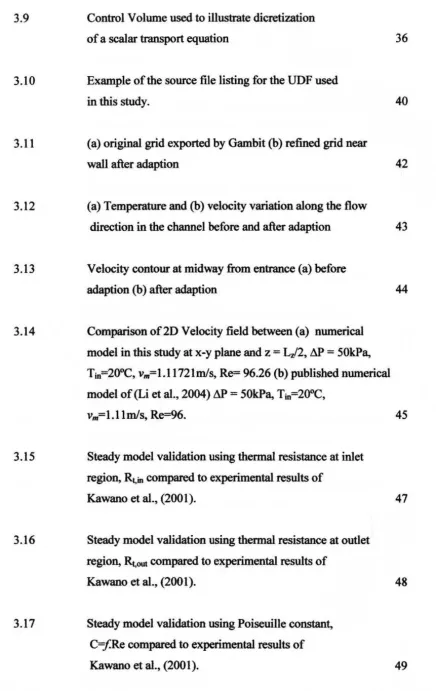
3.9 Control Volume used to illustrate dicretization
of a scalar transport equation 36
3.10 Example of the source file listing for the UDF used
in this study. 40
3.11 (a) original grid exported by Gambit (b) refined grid near
wall after adaption 42
3.12 (a) Temperature and (b) velocity variation along the flow
direction in the channel before and after adaption 43
3.13 Velocity contour at midway from entrance (a) before
adaption (b) after adaption 44
3.14 Comparison of2D Velocity field between (a) numerical
model in this study at x-y plane and z = Lz/2, M> = 50kPa,
Tm=20"C, vm=1.1172lm/s, Re= 96.26 (b) published numerical
model of (Li et al., 2004) L\P = 50kPa, T m=20"C,
vm=l .llm/s, Re=96. 45
3.15 Steady model validation using thermal resistance at inlet
region, Rt.m compared to experimental results of
Kawano et al., (2001). 47
3.16 Steady model validation using thermal resistance at outlet
region, Rt.out compared to experimental results of
Kawano et al., (2001). 48
3.17 Steady model validation using Poiseuille constant,
C=fRe compared to experimental results of
Xll
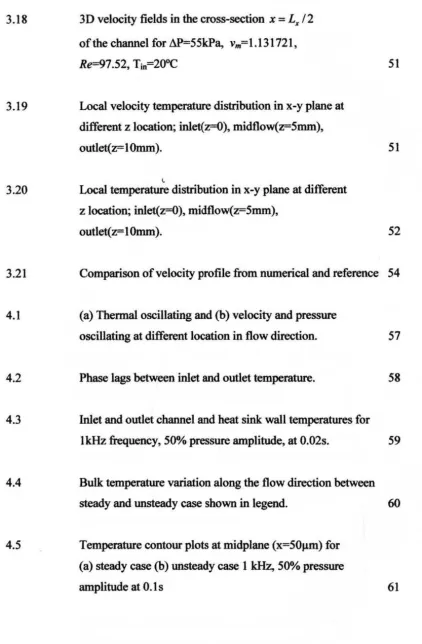
FIGURE NO. TITLE PAGE
3.18 3D velocity fields in the cross-section x =
Lx I
2of the channel for M>=55kPa, vm=l.l31721,
Re=91
.52, Tin=200C 513.19 Local velocity temperature distribution in x-y plane at different z location; inlet(z=O), midflow(z=5mm),
outlet(z=10mm). 51
\.
3.20 Local temperature distribution in x-y plane at different z location; inlet(z=O), midflow(z=5mm),
outlet(z=10mm). 52
3.21 Comparison of velocity profile from numerical and reference 54
4.1 (a) Thermal oscillating and (b) velocity and pressure
oscillating at different location in flow direction. 57
4.2 Phase lags between inlet and outlet temperature. 58
4.3 Inlet and outlet channel and heat sink wall temperatures for 1kHz frequency, 500/o pressure amplitude, at 0.02s. 59
4.4 Bulk temperature variation along the flow direction between steady and unsteady case shown in legend. 60
4.5 Temperature contour plots at midplane (x=50J.Lm) for (a) steady case (b) unsteady case 1kHz, 500/o pressure
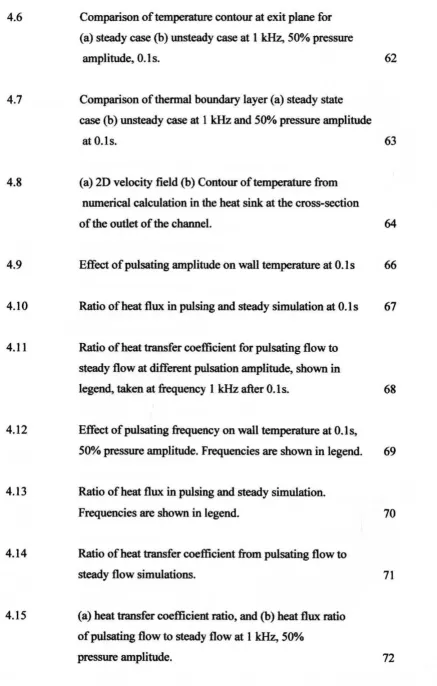
FIGURE NO. TITLE PAGE
4.6 Comparison of temperature contour at exit plane for
(a) steady case (b) unsteady case at 1 kHz, 50% pressure
amplitude, 0.1 s.
4 .7 Comparison of thermal boundary layer (a) steady state
case (b) unsteady case at 1 kHz and 500/o pressure amplitude at 0.1s.
4 .8 (a) 2D velocity field (b) Contour of temperature from
numerical calculation in the heat sink at the cross-section
of the outlet of the channel.
4.9 Effect of pulsating amplitude on wall temperature at 0.1 s
4.10 Ratio of heat flux in pulsing and steady simulation at O.ls
4 .11 Ratio of heat transfer coefficient for pulsating flow to
steady flow at different pulsation amplitude, shown in
legend, taken at frequency 1kHz after O.ls.
4.12 Effect of pulsating frequency on wall temperature at 0.1s,
50% pressure amplitude. Frequencies are shown in legend.
4.13 Ratio of heat flux
in
pulsing and steady simulation.Frequencies are shown in legend.
4.14 Ratio of heat transfer coefficient from pulsating flow to
steady flow simulations.
4.15 (a) heat transfer coefficient ratio, and (b) heat flux ratio
of pulsating flow to steady flow at 1 kHz, 50%
[image:15.537.64.501.71.757.2]XIV
LIST OF SYMBOLS
Nomenclature A a, b Br
c
CpCFD
-Dh
DSMCEDL
-F
f
g h K k Kn L M MEMS-Nu pPML
-Pr
Q
r
velocity amplitude
length of the two side of a rectangular duct Brinkman number
Pouiseulle Constant
specific heat at constant pressure Computational Fluid Dynamics hydraulic diameter
Direct Simulation Monte Carlo Electric Double Layer
external body forces vector friction factor
gravitational acceleration heat transfer coefficient constant in equation (3-14) thermal conductivity Knudsen number length of channel
relative part of conductive axial heat transfer in walls in equation (1-3) micro-electro-mechanical
Nusselt number pressure
Porous Medium Layer Prandtl Number
heat
fluxRe Reynolds number
Rt thermal resistance
T
temperaturet time (s)
TDMA- Tri-Diagonal Matrix Algorithm
u velocity in x-direction v velocity in y-direction
w
velocity in z-directionWo Womersley number
Greek symbols Jl
p
u
A. () 't fr
(i) Cl> •a
Subscripts e m 1 m st viscosity density kinetic viscosity mean free path of gas lattice spacing of liquid time scalestress tensor
periphery of the inner wall of channel oscillating frequency
viscous dissipation
duct aspect ratio
entrance
at inlet of channel liquid
mean steady
xvi
unst unsteady
w substrate wall
XVII
LIST OF APPENDICES
APPENDIX TITLE PAGE
A-I Temperature contour at z=lOmm, 500Hz, 50% pressure
amplitude, time=0.005s 82
A-2 Temperature contour at z=lOmm, 500Hz, 50% pressure
amplitude, time= 0.02s 83
A-3 Temperature contour at z=lOmm, 500Hz, 50%pressure
amplitude, time = 0.05s 83
A-4 Temperature contour at z=lOmm, 500Hz, 500/o pressure
amplitude, time= O.ls 84
B-1 Temperature contour at z=10mm, 1kHz, 50% pressure
amplitude, time = 0.005s 85
B-2 Temperature contour at z=lOm.m, 1kHz, 50% pressure
amplitude, time = 0.02s 86
B-3 Temperature contour at z= 1 Om.m, 1kHz, 500/o pressure
amplitude, time = 0.05s 86
C-1 Temperature contour at z=10mm, 1.5kHz, 50% pressure
amplitude, time=0.005s 87
C-2 Temperature contour at z= l Om.m, 1.5kHz, 500/o pressure
XVlll
APPENDIX TITLE PAGE
C-3 Temperature contour at z=l0111I11, 1.5kHz, 500/e pressure
amplitude, time
=
0.05s 88C-4 Temperature contour at z=IOmm, 1.5kHz, 500/o pressure
CHAPTER I
INTRODUCTION
1.1 Background
The advantages of compact structure and high heat transfer performance make the micro-scale heat exchangers showing a strong foreground on microelectronics, micro-devices fabrication, bioengineering, micro-electromechanical system (MEMS) and so on, thus becoming popular, both for commercial purposes and in scientific research. The recent trend in the electronic equipment industry toward denser and more powerful products requires higher thermal performance from a cooling technique. Thermal management is, and will continue to be, one of the most critical areas in electronic product development. It
will have a significant impact on the cost, overall design, reliability and performance of the next generation of microelectronic devices.
Thermal management is required whenever power dissipation is involved in the operation of any system. The present computer technology owes much of its progress to the miniaturization of circuits of silicon chip. The demand for faster circuits and increased capacity, however, has led to an increase in power densities and a need for continuous improvement in the methods of heat removal. Microchannel heat sink is known for an excellent cooling capacity due to the high surface to volume ratio that enhances the heat removal. A study by Belhadj et al. (2003) on the temperature distribution in the active region using
2
The expected life of a solid-state device depends on the operating temperature and the temperature cycling, making the cooling problem very challenging. An efficient cooling system is required to maintain an isothermal environment in the presence of highly transient thermal loads. As a micro fluidic device (i.e. micro pumps) essentially work under a pulsed regime, it is necessary to consider unsteady flows in microchannels.
The understanding and evaluation of steady and unsteady flows with transient forced convection have recently become more important in connection with the precise control of modem high-performance heat transfer systems. Accurate prediction of the transient response of thermal systems is important for the understanding of such adverse effects as reduced thermal performance and severe thermal stresses that they can produce, with eventual mechanical failure.
In spite of the rapid development in the micro-fabrication technologies for MEMS devices, a fundamental understanding of fluid flow and heat transfer in microchannel is not satisfactory. A study of unsteady heat transfer in micro-flow is rarely found while most previous theoretical or numerical works regarding micro-systems have concentrated on the flow characteristics. Practically, a detailed analysis of micro-flow with heat transfer would be very helpful in designing an efficient and reliable micro-device.
1.2 Literature Review
1.2.1 Flow and heat transfer in microchannel heat sink.
3
the cooling fluid which is forced to flow through the channels (Qu and Mudawar, 2002).
The use of silicon in the cooling system is critical. Because photolithographic and etching technologies are so well developed for silicon, arrays of precision microchannels can be easily and inexpensively fabricated in this material. It also allows multiple bars to be located on a single substrate, with an equal number of cylindrical microlenses, all attached in a single fabrication step.But why use silicon rather than materials with higher thermal conductivities, such as copper? In compact heat sink structures with flowing water, the best way to control the overall temperature rise is to minimize the thickness of the boundary layer where stagnant water meets flowing water. It is in this boundary layer that the largest temperature rise occurs. Because boundary-layer thickness scales relative to channel width for the flow conditions in microchannel, the best material for the cooling system is one that permits easy fabrication of narrow channels. It turns out that better thermal performance is gained by using a material that permits tiny microchannel fabrication (silicon) rather than a material with higher thermal conductivity.
Microchannels had been classified as channels with hydraulic diameter, Dh,
ranging from 1 0 J.1lll to 200 J.Ull. The Reynolds number for flows in microchannels is generally very low as the flow velocity in these small hydraulic diameter passages is quite small. The friction factors and pressure gradients are both quite high in microchannels flows since the available surface area for a given flow volume is high (Kandlikar, 2003).
Fluid flow and heat transfer in microchannels is a developing knowledge that is not well understood. The critical issue is the small length scale of microchannel heat sink and what that might imply about modelling transport phenomena.
4
(1) Compressibility effect. The compressibility is significant when the Mach
number approaches unity. In a microchannel, the high Mach number and
large pressure drop can be reached even at low Reynolds numbers. As a
result, the variation of fluid density and acceleration can occur along the
channel, which will lead to an increase in friction factor. In addition, the local Nusselt number increased along the channel due to the compressibility effect.
(2) Rarefaction effect. As the channel dimension becomes smaller, it approaches
the mean free path between the molecules in a fluid flow and the continuum
assumption starts to break down. A measure of the departure from the
continuum is introduced through the Knudsen number, Kn, defined as:
K
]セ@
n
D
h(1-1)
where Dh is the hydraulic diameter of the flow channel, and A. is the mean free path of the gas. For rectangular ducts, the hydraulic diameter Dh is given by:
Dh
=
4ab=
4b. (1_2)a+b 1+a
where 2a and 2b are length of the two sides of a rectangular duct with 2a > 2b
and the duct aspect ratio a· = 2b I 2a . Liquid molecules do not have mean
free path, but the lattice spacing,
o,
may be used as similar measure. Forwater, the lattice spacing is 0.3 nm. Rarefaction effects can be neglected for
Kn less than 0.001. When the Knudsen number is in the range from 0.001 to
0.1, the flow can not be considered as a continuum flow. Velocity slip and
temperature jump occur at the wall surface. As the Knudsen number getting
higher, the flow becomes rarefied and the motion of individual molecules
must be modelled and then treated statistically.
(3) Electric Double Layer (EDL). Most solid surfaces have electrostatic charges
on their surface. When liquid containing even a small number of ions flows
over the surfaces, the electrostatic charge on non-conducting surfaces attracts
counter ions (Mohiuddin Mala et al., 1997). The balancing charge in the
liquid is called the EDL. The thickness of this layer is very small, on the
order of a few nm. This effect becomes important only for small diameter