l6
AminuLlah et al Med J IndonesThe
role
of
plasma C-reactive
protein
in
the
evaluation
of
antibiotic
treatment
in
suspected
neonatal
sepsis
Asril Aminullah, Djaja
Noezoeliastri
Sjachroel,Sri
RezekiHadinegoro,
BambangMadiyono
Abstrak
ABSTMK
Dilakukan analisis serial terhadap kadar C-reactive protein (CRP) untuk menguji perannya dalam tata laksana pasien yang tersangka menderita sepsis neonataL. Penelitian dilakukan pada 35 pasien tersangka sepsis neonatal yang dirawatdi
Bagian IImu Kesehatan Anak, Fakultas Kedokteran UI/
RS Cipto Mangunkusumo, Jakarta, antaraApril
sampai September 1999. Dari 35 pasien,l8
menunjukkan biakan darah positif, I0 di antaranya dengan kadar CRP meningkat pada saat diagnosis. Di antara 17 pasien dengan biakan darah negatif, 9 juga menunjukkan l<sdar CRP negatif. Pemeriksaan serial CRP pada kasus-kasus berat dengan CRP meningkat menunjukkan l<ndar CRP tetap tinggi, sedangkan pada kasus dengan CRP negatif kadamya terus meningkat sampai hari ke-4. Pasien yang sembuh dan mempunyai kadar CRP awal yang rendah temyata kndar CRP-nya tetap rendah padahai
ke-4. Penelitian inimenunjukknn keuntungan pemeiksaan CRP serial dalam evaluasi pemberian atibitotik pada pasien tersangka sepsis neonatal. (Med
J
Indones 2001 ; l0: 16-2 1)
Abstract
Analysis of serial C-reactive protein (CRP) Ievels was done to evaluate the effectiveness of antibiotic teatment
in
35 suspected neonatal sepsis (SNS) patients who were hospitalizedat
Cipto Mangunkusumo Hospital, Jakarta. This cross sectional study was conducted from April to September 1999. Among 35 SNS patients, 18 had positive blood culture,l0
of which had positive CRP leve! at the time of diagnosis. Among 17 patients with negative blood cuhure,t
had negative CRP level. Serial CRPin
severe cases wilh positive CRP titer showed persistent high CRP level, and in those with negative CRP titer rose up to day 4 of teatment. On the other hand patients who were discharged and have negative blood culture demonstated low CRP level in day 4. This study confirms the benefit of serial CRP examination in the evaluation of antibiotic treatment in SNS. (Med J Indones 2001; 10:16-21)Keywords: neonatal sepsis, antibiotic treatment, serial CRP level measurements, prognosts.
neural system
disturbances.3-6Positive culture
which
is
a
'gold
standard'
for
confirming the
diagnosis
of
infection usually
takes
time (at least
72
hours)
andalso
with
relatively
low
positive
rates.a-6For those
reasons, to
gain good
outcome,
many clinics initiate
antimicrobial therapy
in
neonatal infections
on
thebasis
of
presumptive
diagnosis.5-7On
the other
hand,the detrimental effects
of
antibiotic
to
the
flora
of
individual infants
and
the
rapid and
widespreademergence
of
multidrug
resistance
among
bacterial
pathogens
dictates
the
need
for
juducious use of
antibiotic
treatment.
This condition
becomes
adilemma
in
terms
of which
infants should
receiveantibiotic
andhow long
it
is needed.To
solve
the
problem,
different
strategies have
beenadopted
in
different
institutions;
these
include
determining
serial C-reactive
protein (CRP) level
in
every
high risk
newbom babies. CRP
is
a
protein
synthesizedby
hepatocytecells
andexcreted
into
theThere have been significant improvements
in the
overall health
of
children during
the
past
decade.Infant mortality
has been
decreasing
steadily,
but
change
in
neonatal
mortality
hasbeen
much
slower.Almost two
thirds of newbom
deathsoccur
in
thefirst
week
of life. In
developing countries almost
4OVoof
death
are due
to
infectious
diseasessuch
as
sepsis,neonatal tetanus, pneumonia,
and
diarrhea.
This
problem occurs usually
in
low-birth weight
infantsand
infants who have various perinatal
risk factors
such
as deficiency
of
the
immune
system,
factorsrelating
with
monitoring devices,
and therapeutic
proceduresin
the nursery.r'2Early identification of
thetnfected
newbom
is
essential
but this effort
is often
difficult
because symptoms and signs areusually
non-specific
and may
resemble
many other neonatal
diseases,
e.g.,
metabolic, hematological
or
centralVol I 0, No I , January
-
March 200I
blood;
its
Ievel
increases
after
systemic
or
local
responsesto
int-ection.t'oCRP levels
will
elevate
andcan be
detected
at
6-18
hours
after
inflammatory
responses,and reaches
maximum level within
48-72hours;
the
half
life of
CRP
is
5-7 hours.'o-"
So*"
investigators also
find
that
serial
CRP
levels
decline aspatient
condition
improves. This
finding
leadto
theconclusion
that
serial CRP
examination
can
beemployed
as aparameter
in
de
ing
the duration
of
antibiotic administration
in
r-ra Furthermoreit
is also suggested that
antibiotic
treatmentshould
bediscontinued
if
blood culture
shows negative
result, and serialCRP level
showssimilar
results.The aim
of
this
study was
to
evaluate serial
plasmaCRP
level
in
SNS andto
assessits
levelsbefore and
after antibiotic
treatmentin
patientswith
SNS.METHODS
This
was
a
prevalence
study
with
cross-sectionaldesign
to
assess
serial plasma
CRP
levels
in
35 patientswith
SNS.All
subjects were patients admittedto
the neonatal
ward
andneonatal intensive
careunit
of
the
Department
of
Child Health, Cipto
Mangun-kusumoHospital,
Jakarta,from
April
until
September1999
who were
diagnosed as
having SNS.
Subjectswere
included to the
study
if
the
birth weight
was >
1000
g,
did
not
suffer from fatal
congenital
malformation,
and
did not
receive previous antibiotic
treatment.
Informed
consent
was
obtained from
parents.
The
samples
size was
calculated based
oniample fbrmula
foi
singleproportion
estimation.r5The
patients
were divided into 2
groups,
i.e.,
infantswith early
sepsis(age less
than
72
hours), and
thosewith
late
sepsis (age
more than
72
hours).
Thediagnostic
criteria
of
early
sepsis dependedupon
therisk
factors
and
clinical
manifestations.
The
risk
factors included
premature
rupture
of
the
membraneof
more
than
l8
hours, maternal
temperatureof
morethan 38"C, prematurity
(gestational age less than
37completed weeks),
and
unpleasant
odor
of
amniotic
t-luid. Theclinical
mainfestations
\ryererespiratory
rate>60/minute,
unstable temperature (temperature <36oCor
>
37.5"C), lethargy
or irritability,
dyspnea/cyanosis,poor sucking reflex, vomiting,
apnea.An
infant
was suspectedto
have neonatal
sepsisif
he
or
she had 2risk
factors
or
had one
risk
factor and one clinical
manifestation.5In
late
sepsis the diagnosis was establishedif
one or
more
of the
following clinical
signs were
fbund:PLasma CRP in neonatal sepsis 17
lethargy, unexplained
low Apgar
scores,
unstabletemperature,
apneic attacks, unexplained
cyanosis,gastrointestinal disturbances,
respiratory
disorder,hepatomegaly,
diarrhea,
vomiting,
skin
lesions
and unèxplainèd abnormalhematologiôal
parameter.a'r 3Blood culture, CRP, and peripheral blood examination
were done upon the inclusion
into
the study.
CRPlevel
was re-examinedon
day 2,
4,
andif
the patient
died or
discharged
from
hospital.
The
assessmentof
CRP was done semi-quantitaively
with
the
cut-off
point
of
12
mgldl.
In
babies
with
early
sepsisamoxicillin
and gentamicin were given,while
thoseof
late
sepsisthe antibiotic given were
cefotaxime
andamikacin. Important
clinical
findings
which
wererelevant to sign
of
sepsis was also recordedevery day
until
the patient died
or
discharged.
All
data
wererecorded
in
the
casereport form,
performed
by
Epi
info
program.RESULTS
During
the
study period,
35
cases
of
SNS
wereenrolled. Among the
35
cases,
18
showed positive
culture (Table
l).
Table
l.
Etiology ofl8
cases positive blood culture*Microorganism
Citobacter frewtdii S t ap hi I o c o c c us ep ide rmidi s
Serratia marcescens Klebsiella pneumoniae
Stap hilococcus sitre us Acinobacter anitreus Eschericlia coli Ente robacter aero gene s
Pseudomonas sp
5
4
2 2
Total
*=n=35cases
At
the time
of
diagnosis,
only
19
showed positive
CRP level
(CRP>
12mg/dl), in which
10 were babieswith
positive
blood culture and
9
were those with
negative
culture.
The remaining
l6
patients
showedCRP level
of
lessthan
12mg/dl,
andthey come
from
8
babies
with
positive
blood
culture
and
8
from
negativeblood culture.
Assessment
of
serial CRP levels
in
patients
who
werethen
died
showed that
either
in
positive
or
negativeblood culture
the level
of
CRP was persistent
or increased up to day4
(Tables2
and 3).l8
Aminullah et alTable 2. Patterns of serial CRP levels in death cases with positive blood culture
Med J Indones
No No
case
Age CRP
(day of examination)
Microorganism in blood culture
Therapy
&
NoteRecistency test
DO D2 D4
Dt
I 2
12
l5
18
22 days 0 hours
0 hours
24
2412
t2<12
48C*G*
A**G**
A**G**
f
days-3f
days-4f
days-6 9648
48P seudomonas aero ginase
Serratia marcescens
Klebsiella peneumonia
96 96
Note: A= Amoxillin; G=Gentamicin; C= Cefotaxim; Am=Amikacin; T= Tienam; F=Flagyl; * = sensitive;
**
= resistant D0 = day null, D2 = day-2,D4 = day-4,Dt
= day of deathTable 3. Patterns of serial CRP levels in death case with negative blood culture
CRP (day
of
examination)Note
No No
AgeCase
DI
D4 D2 DOt7
29
3t6
419
529
6
3r4
hours
<
125
hours
244
days
< 1218
hours
<12 2days
96l0
hours
96t
first dayI
days- 27f
days-4t
days-8t
days-2t
days-23 24 48 48 96 96 96 48 96 t2 96 48 96 96 96 96Note: D0 = day null, D2 = day-2, D4 = day-4,
Dt
= day of deathTable 4. Patterns of serial CRP levels in survive cases with positive blood culture
No
No caseAge CRP
(days of exarnination)
Microorganism in blood culture
Therapy
&
Length of Resistencytest
hospitalization D4 D2 DO DDt2
23
35
I
I
hoursI 4 hours 25 days
A**G*
A**G*
C*Am*A**G*
A**G*
A**G*
A**G*
C*Am*c*A**G*
A**G**
A*G*C*
c*Am**
A**G*
c***Am*A***
A**G**
<12 48 <12 12 48 96 48 <12 <12 <12 24 <12 96 48 <12 48 48 t2 48 48 96 48 24 24 <12 48 96 96 48 <12 <12 <12 4842
24 4842
12 t2 <12 <12 48 12 48 <12 60 29 7 96 96 96 48 24 96 48 24 24 <12 48Citrobacter freundii Stap hy lococcus citreus
Staphilococcus epidermidis Serratia marcescens
Citrobacter freundii Citrobacter freundii Citrobactcr freundii Klebsiella pneumonia
Citrobacter freundii
Staphylococcus
epidermidis Staphylococcus
epidermidis Acinebacter anitratus
Enterobacter
aerogenes
Escherichia coLIi
Staphylococcus 4 5 6 7 8 9
l0
l0
20 hours1l
I9hoursl3
I
days14
17 hours17
0 hours20
0 hours21
0 hours22
3 days26
19 days28
7 days25
t0
7 t5 t4 42 4 23 8 17 45 2il
t2 l314
3215
3496 48
48
6 days
3 days
Note: A=Amoxillin; G=Gentamicin; C= Ceforaxim; Am=Amikacin; D0 = day nol, D2 = day-2,D4 = day-4, DD = day of discharged
*
[image:3.612.45.498.103.200.2] [image:3.612.53.378.259.364.2] [image:3.612.57.540.421.671.2]Vol 10, No
I,
January-
March2001In
survivors
with
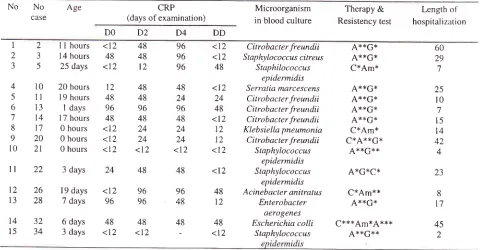
positive blood culture, CRP levels
remained
high
until
day
4 of
treatment (Table
4). In
contrary,
in
patients
who
were
discharged from
hospital
with negative
blood culture,
the seriallevel
of
CRP examination
tended
to
decline
until
day
4
of
treatment(Table
5).DISCUSSION
As
mentioned
before, bacterial
sepsis
is
one
of
themost
common diagnostic challenges
in
neonatalmedicine.
The
ability
to
make
a definitive diagnosis
by
blood cultured
not only
complicated
by delayed
in
having positive
results,but also due
to
thedifficulties
in
obtaining
large
samples
to
detect
positive
blood
cultures,
the
increasing
use
of
prenatal
antibiotics
administered to
themother
and relatively lowpositive
results.
In
our
seriesof 35
caseswith
suspected sepsis,only
18
cases
were found
to
have positive
blood
culture.
The Coliform bacteria (i.e Citrobacter
spp;Klebsiela spp,
E. coli
etc)
seem
to
play
a
role
in
bacteremia
found in our clinic. Klebsiella
andE. coli
are usually common bacteria
find in
the
newbom
sepsis.
The
finding
of
Citrobacter
freundii
as a causeTable 5. Patterns of serial CRP levels in survived case with n"gutiu"
.ultur"
Plasma CRP in neonatal
sepsis
19of
neonatal
sepsisshould
be
done
a further
studies, since it isvery
rare reportedin the
literature.
As
already mentioned
before,
it
is
now
generally
acknowledged that in neonatal sepsis there is a
rise
of
CRP values as
a response
of
inflammation
or
tissue necrosis.This
will
be
seenespecially
if
a
serial
CRPdetermination are done.
In
this
study,
at the time of
suspectedneonatal
sepsiswas diagnosed,
in l8
caseswith
positive
blood
culture babies
only
l0
casesindicated
increase
in
CRP
finding.
In
the
other
8babies, the CRP begin
rising at
day
two
when
serial CRPexamination
were done exceptin one
casewith
Sepidermidis.
This
common
skin bacteria may have
been a
contaminant
to
the blood cultureand
this
canexplain the normal CRP
finding
in
that
particular
case.
In
this
study,
the increase
of
CRP finding was
also seenin babies with negative
blood culture.
Therewere
9 babies
with increased
CRP values at the time
of
diagnosis
and
8
babies
were normal.
From
this
series,
a
serial determinations
of
CRP indicate
an increasing values except on 3 casesin
which
one babydied
in the first
day and theother
2 cases werenormal
until discharge.
No No
Agecase
CRP (days of examination)
D-0
D-2D-4
DDNote
Days of hospitalization
48
48
<1296
96
9696
48
t224
96
4848
961t
24
36
48
523
42
48 48 24 12
725
827
930
l0
330 hours 25 days
2 days
t
hours0 hours
I 6 hours
9 days 10 hours
1 6 hours
8 hours
24 <12
<12 <12
24 <12
<12
<12
96 12 12 96
42
12
<r2
24
<12
9 days 13 days 7 days 30 days
2 days
Clinical condition was good 6 days
Clinical condition was good 5 days
28 days 6 days 7 days
Clinical condition was good 48
48 48 48
1
1
35
4days <12 <12
<12
<12
4 davsNote; D0 = day nol, D2 = day-2,D4 = day-4, DD = day discharged
Table 6. Diagnostic value of serial CRP in SNS cases
CRP value DO D2 D4
Proportion Sensitivity
Positive predictive value Negative predictive value
19/35 (54 Eo)
10118 (56 Vo)
10lt9 (53 Eo)
8116 (50 Vo)
31135 (89 7o)
16118 (89 Ea)
r6l3t
(52 Ea)214
(50 Va)2',7t31 (87 Eo)
l5ll7
(88 Eo)15127 (56 Ea)
314
(75 Vo) [image:4.612.42.448.426.606.2] [image:4.612.42.441.656.713.2]20
AminuLlah et alIt
seemsthat
in this
study,
aserial
CRP determinationplay an important role and have
some
value
in
thediagnosis
of
neonatal sepsis
not only
in
provenpositive blood culture
babies
but
also
in
suspectedneonatal sepsis as also seen
in
the studiesby
others.It
is
also
seen
in
this
study
at
different
finding
innegative
predictive
value
of
the
CRP examination in
day
4 compared
with
at the time
of
diagnosis.
The plasmaCRP examination
at thetime of
diagnosis andat
day4
were
5OVo and 757orespectively.
In
anotherstudy,
on
the day
of diagnosis,
Squire
at
al
found
negative
predictive value
of
82Vowhere as
Ng et
alfound
75Va
in
their
studied.r3'r6
These
different
finding not only might be
due
to different
in
samplesize,
but
thetime of
diagnosisof
baby
with
suspectedneonatal sepsis
should also took
into
consideration.All
the normal value
of
plasma
CRP
were
found
in babieswhere
thediagnosis
were done soon afterbirth
(i.e. case
16,20,21
of
Table
5). This
early
detectionof sepsis
before the infant
respond
by
elevation of
CRP
level might
be
responsible
for
the
different
finding of predictive
value
atthe
time of
diagnosis inour
study.
This
different was
not
found
on
day
4 where there were already an increasing valuesof
CRPlevel
(Tables 4 and 5).Determination
of
serial C-reactive protein,
in cases
with
positive blood culture (Table
I
and Table
3),show that the pattem
of
the
level
was
high
till
dayfour. This
result
differed
with
the
finding
of Ng
et al
or
Hidoncha
et al
studies.t+'t6Ng
et
al
fJuncl that the
peak
of
serial
plasma
CRP levels was on day
two.While
Hindoncha
etal
tn
12 neonateswith
septicemia treatedby
combined antibtotrc
found
the plasma CRPlevels
reached
maximum
on
day
two
then
declinedonwards.
In
our
study, whether
inadequateantibiotic
treatment together
with
less
optimal
managementmight play
a rolein
thedifferent
finding
of
the patternof
CRP level strll
need
further elaboration.rt''t
Themultiple problems
seen in some
cases(like
rn
casenumber
l9)
in
which
thebaby's
clinical
condition
wasworse,
although
theantibiotic
treatment was adequate,there
was
a
delay
in response to
therapy and
thrsmight
be also the causeof
thedelay
in
lowenng
of
C-reactiveprotein
levels.In
the seriesof
survivors
with
positive culture
we also see anincreasing tendency
or
persistenthigh level of
thepattern
of
serial CRP level
in
day4
(Table 4). But
at the
time
of
discharge, the
level
was
decreasing ornormal.
In
a
seriesof
caseswith
suspected neonatalsepsis,
where
as
the
concentration
of
CRP
wasanalyzed
in
detail after the beginning
of
treatment,Med J lndones
Ehl et al found that
there
was
initial
increase
in
theCRP level
which
occurred
until
l0-48
hours after
thebeginnrng
of
treatment
and then
decreasing
thereafter.re
This
decreasing
pattern
of
serial
CRp
level was usedin
other
studies as asupportive
criterion tbr
discontinuing
of
antrbiotic
therapy.r2''uThit
was
clueto the
fact
thatin
a seriesof
cases using CRP as singlecriterion
of
suspectedneonatal
infection,
Ehl et
all12mentioned
that
there
was a
low
relapse rates.
of
theprimary infection within
4
weeks
after
discontinuing
antibiotic
therapy.As a
conclusion,
it
seems
that
C-reactive
proteinlevels
can be used as amonitoring
guide
of
antrbiotic
administration
in sepsis.
However,
to
prove
eitherclinically
or
statistically result, more studies
with
greater sample size are needed.
REFERENCES
1.
Stoll BJ. The global impactof neonatal
infection. Clin Perinatol 199'1 : 24:1 -21.2.
Monintja HE. Infeksi sistemik pada neonatus. In: Yu VY,Moninda HE, penyunting. Beberapa masalah perawatan
intensif
neonatus. Jakarta:Balai
Penerbit Fakultas
Kedokteran Universitas Indonesia, 1997 . p. 217 -30.3.
PerezEM,
LE
Weisman.Novel
aproachesto
theprevention and therapy of neonatal bacterial sepsis. Clin Perinatof 199'7 ; 242:213 -29.
4.
Hoffman DJ, HarrisMC. Diagnosis of neonatal
sepsis.In:
Spitzer AR, editor. Interrsive careof
the fetus and neonatus. St Louis: Mosby Year Book, 1996. p. 940-8.5.
KaftanH,
Kinney JS.Early
onset neonatal bacterialinfecti ons. Semin Perinatol 1998 ; 22:1 5 -24.
6.
Hickey
SM,
McCrackenG
Jr.
Post natal bacterial
infections. In: Fanaroff AA, Martin RJ, editor. Neonatal-
perinatal medicine. Diseases of the fetus and infant. StLouis: Mosby Year Book, 1997. p, 717-800.
7.
Radetsky M. The new born at risk for serious infections. Clin Perinatol 1998; 25 :327 -3348.
Oliveira EB, Gotschlich EC, Liu TY. Primary structureof
human.
J
Biochem 1979;254:489-502llorens XS, McCrackenG.
Sepsis sindrome and septick shock in pediatrics current concept of terminology patophysiologyand management. The J of Pedi atrics 1993 ; 1 23 :497 - 508.
9.
KushnerI, Gewurz
H, BensonMD. and the
acute-phase response. J Lab Clin Med 1981; 9'7:'739-49.10.
Posen R, delemos RA. levels in the extremely prematureinfant: case studies and literatures.
J
Perinatol 1998;1 8:1 38-41.
I
l.
Pourcyrous M, Bada HS, Korones SB, Baselski V, WongSP. Significance of serial responses in neonatal infection
and other disorders. Pediatrics 1993 : 92:43 1 -5.
-t
Vol 10, No
I,
January-
March200lt3 Ng PC, Cheng SH, Chui KM, Fok TF, dkk. Diagnosis of
late
onset neonatal sepsiswith
cytokines, adhesionmolecule, and in preterm very low birth infants. Arch Dis Hindocha P, Campbell CA, Gould JDM, Wojciechowski
A,
Wood CBS. Serial study ofin
neonatal septicaemia.Arch Dis Child 1984; 59:435-8.
Madiyono B, Moeslichan S, Sastroasmoro S, Budiman I, Purwanto SH. Perkiraan besar sampel.
In:
Dasar-dasarmetodologi penelitian klini s. S astroasmoro S,
Ismael S, editor. Jakarta: Binarupa aksara, 1995. p.
187-212. Squire EN, Reich HM, Merenstein GB, Favara BE,
Todd
JK.
Criteria
for
discontinuationof
antibiotic15.
Plasma CRP in neonatal
sepsis
2l
therapy
during
presumptive treatmentof
suspected neonatal infection. Pediatr Infect Dis J 1982:1:85-90.Perez
EM,
WeismanLE.
Novel
approachesto
theprevention and therapy of neonatal bacterial sepsis. Clin Perinatol 1997 :242:213 -29.
Jenson
HB,
Pollock
BP. The role
of
intravenous immunoglobulinfor
the
preventionand
treatment of neonatal sepsis. Semin Perinatol 1998:22:50-63,Ehl
S,
GehringB,
PhlandtF.
A
detailed analysis of changesin
serumC
reactive protein levelsin
neonatestreated
for
bacterialinfection.
Eur
J Pediatr
1999;156:238-42.
l7
18
19 14