Singh, et al.
240 Med J Indones
Breast cancer and depression: issues in clinical care
Thingbaijam B. Singh,1 Laishram J. Singh,2 Bhushan B. Mhetre1
1 Department of Psychiatry, Regional Institute of Medical Sciences, Imphal, India 2 Department of Radiotherapy, Regional Institute of Medical Sciences, Imphal, India
Abstrak
Pasien dengan kanker payudara banyak yang mengalami gangguan dan hampir seluruhnya mengalami depresi yang dapat memperberat gejala isik, meningkatkan gangguan fungsional, dan membuat kepatuhan berobat menjadi rendah. Kami melakukan tinjauan pustaka yang tersedia di PubMed tentang prevalensi, besar gangguan, kemampuan coping, dan metode penatalaksanaan depresi berat pada wanita dengan kanker payudara dari tahun 1978 sampai 2010. Diagnosis dan penatalaksanaan episode depresi pada wanita dengan kanker payudara merupakan tantangan karena gejala yang tumpang tindih dan kondisi penyerta. Depresi berat sering disepelekan dan penatalaksanaan tidak adekuat pada pasien kanker payudara. Tinjauan ini menekankan pada masalah dalam identiikasi dan pengelolaan depresi pada pasien kanker payudara dengan latar klinis. (Med J Indones. 2012;21:240-6)
Abstract
Many of breast-cancer patients experience distress and most of them experience depression which may lead to ampliication of physical symptoms, increased functional impairment, and poor treatment adherence. We did a review on available literature from PubMed about prevalence, distress magnitudes, coping styles, and treatment methods of major depression in women with breast cancer from 1978 to 2010. Diagnosis and treatment of depressive episodes in women with breast cancer is challenging because of overlapping symptoms and co-morbid conditions. Major depression is often under-recognized and undertreated among breast cancer patients. This review highlighted the issues on identifying and managing depression in breast cancer patients in clinical settings. (Med J Indones. 2012;21:240-6)
Keywords: Breast cancer, coping, depression, distress
Correspondence email to: [email protected]
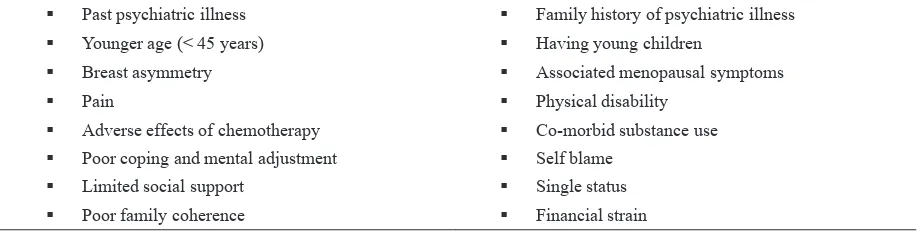
These variations may be due to differences in coping strategies, personality proiles, and available social supports, and to an extent of consultation skills with her medical providers, especially the surgeon who does the breaking of the bad news.4 Most women undergo concerns and fears about physical appearance and disigurement, moreover the uncertainty regarding recurrence and fear of death. Among sexually active women, signiicant body-image-problems are associated with mastectomy, hair loss from chemotherapy, weight gain or loss, and the dificulty of partners in understanding her feelings.5 In 10-30% of women, the diagnosis of breast cancer may lead to increase vulnerability to depressive disorders which include adjustment disorders with depressed mood, major depressive disorder, and mood disorders related to the general medical condition.6 The risk of developing a depressive disorder is highest in the year after receiving diagnosis of breast cancer 7 (Table 1).
There is more psychological distress in young women than older women. Older patients appear to cope better and this may be due to their prior exposure to the current threats leading to development of appropriate coping mechanisms. Additional concerns, especially to the young women include hair loss induced by chemotherapy, weight gain, and abrupt onset of menopausal symptoms, as well as decreased sexual Nowadays, breast cancer is one of the most common
malignancies and the leading cause of cancer mortality in women in developed and developing countries.1 The diagnosis of breast cancer should not only include physical condition but also social and psychological condition. This is due to the importance of breast in the women’s body image, sexuality and motherhood. The 5-year survival rates of patients with breast cancer have increased to the extent of 89%.1 The important concern today is to improve the quality of life (QoL) among survivors. Survivors of breast cancer often experience aversive symptoms like fatigue, cognitive problems, and menopausal symptoms. Psychological distress among patients with breast cancer is linked with a worse clinical outcome and at the same time advanced stages of cancer seem to be most stressful and have higher risk for emotional distress.
Prevalence of major depression increases with cancer progression, from 11% associated with early-stage, node-negative breast cancer to as great as 50% in women with metastatic breast cancer undergoing palliative therapies.2 Psychological distress due to anxiety and depression are known to predict subsequent quality of life or overall survival in breast cancer patients even years after the disease diagnosis and treatment.3
desire and vaginal dryness resulted by hormonal therapy. Moreover, they also feel fears for the future of their children and anxiety about the future ability to conceive and raise their children.8
Risk for women to develop a depressive disorder does not only depends on the stage of breast cancer, but also the type of cancer treatment received. Women with breast asymmetry after surgical treatment had increased fear of cancer recurrence and feelings of self-consciousness.9 Chemotherapy, particularly at high doses is a separate factor for depression in patients with breast cancer.10,11
Self-blaming and coping
Coping efforts involve a person’s perceived adjustment to illness when confronting distressing symptoms referring to psychological, physiological, social, and existential response to illness.12 Self-blame because of breast cancer may affect mood. They blame themselves for various reasons including treatment delays, poor coping skill, and also limited awareness about their health.13
A study of newly diagnosed breast cancer patients showed the scoring > 5 of distress thermometer was most commonly reported due to ‘‘emotional causes’’ related to the disease itself, followed with distress related to uncertainty in treatment, physical symptoms, practical life problems, family problems, and spiritual crises.14 Thus, nature of problems faced after knowing the diagnosis of cancer is determinant of coping dimensions. Mental adjustments to cancer diagnosis can be discussed in various dimensions of coping styles. Factors like compliance of medical therapy, information of the disease, and social support inluence coping strategies.15 Acceptance and positive reframing of altered body image improve self-esteem and reduce psychological morbidity like depression.16
Depressive symptoms, breast cancer, and cancer treatment
Depressive symptoms can be emotional e.g.: feeling sad, hopelessness, suicidal thought; and physical e.g.: vague bodily pains, lack of energy, loss of sleep, loss of appetite. Depression with predominant in physical symptoms is called depression with somatoform symptoms. The disease itself and breast cancer treatment interact with expression of both emotional and physical symptoms of depression. Depressive symptoms also modify the symptoms related to breast cancer and treatment side effects.
Subjective side effects of cancer treatment is intensiied if depression co-exists with breast cancer.11 Also somatic symptoms of depression may be mistakenly considered as side effects of the treatment.17 Depressed patients are more likely not to adhere to the recommended treatment because of desperation or forgetfulness in treatment associated. Understanding recommended treatment and remembering daily treatments’ goals are challenging task for cancer patients with co-morbid depression.11
Depressive symptoms are exacerbated by ongoing cancer treatment, either by side effects of anti-neoplastic drugs or direct effect of those drugs on CNS neurotransmitters. Repeated administration of chemotherapy results in progressively worse and more enduring impairments in sleep-wake activity rhythms.18 Moreover, the anti-estrogenic effects of tamoxifen at postsynaptic receptors have been found to contribute to depressive symptoms.19
Depression, immune response, and cancer
Chronic stress and depression give rise to persistent activation of the hypothalamic-pituitary-adrenal and sympathetic-adrenal-medullary axis which will impair immune response and contribute in the development and progression of certain types of cancer. Behavioral Past psychiatric illness
Family history of psychiatric illness
Younger age (< 45 years)
Having young children
Breast asymmetry
Associated menopausal symptoms
Pain
Physical disability
Adverse effects of chemotherapy
Co-morbid substance use
Poor coping and mental adjustment
Self blame
Limited social support
Single status
Poor family coherence
Financial strain
Table 1. Associated factors of psychological distress in breast cancer
Singh, et al.
242 Med J Indones
strategies, psychological, and psycho-pharmacological interventions that enhance effective coping and reduce psychological distress showed beneicial effects in cancer patients.20
In some human study, they showed stress affects pathogenic processes in cancer, such as antiviral defenses, DNA repair, and cellular aging. Moreover, there are many data emphasize on breast cancer. The reason of lack of consistent results might be many cancers are diagnosed only after they have been growing for many years, resulted in one-way-association between stress and the disease onset was dificult to demonstrate.21 On the other hand, research based on animal models clearly demonstrated the effect of stress on metastasis and tumor growth.22
Identifying depression in breast cancer patients
The diagnosis of major depression by DSM-IV (Diagnostic and Statistical Manual of Mental Disorders - fourth edition) criteria includes physical symptoms that may be indistinguishable from the symptoms that occur with the cancer itself or the side effects of treatments. Insomnia, loss of appetite, lack of energy, and loss of concentration play role as confounding factors in the assessment of patient with depression. The proposed solution is by eliminating somatic symptoms from measuring depression in patients with cancer to emphasize psychological symptoms of distress. These symptoms include suicide, guilt, helplessness, and hopelessness.23 Thus, diagnosing depression in breast cancer needs assessment from mental health professionals.
Cancer treating teams use screening tools for identifying depressive symptoms. Many depression screening tools are available, but only common tools for depression in cancer patients are elaborated. The Proile of Mood States Questionnaire, sixty-ive items questionnaire is often used in several studies of mood disturbance and breast cancer. It has Likert-scale in subcategories i.e. depression-dejection, tension-anxiety, anger-hostility, confusion-bewilderment, vigor-activity, and fatigue-inertia. Patient rates his/ her symptoms over the past week and a total mood disturbance score is calculated by adding the scores in subcategories.24
Another tool is a visual analogue, from 0–10, made by the National Comprehensive Cancer Centre Distress. It rates overall distress level over the past week. This thermometer is validated for different cancers and in different areas of the world. A score of > 7 on this scale mandates a complete psychiatric evaluation.25,26
The Hospital Anxiety and Depression Scale (HADS) is a reliable and sensitive screening consists of 14 item scale. It is the most common scale to study anxiety and depression in breast cancer patients. Four points Likert-scale is asked to the patients and they need to respond it quickly in order to avoid thinking too long before answering.27
Management of depression in breast cancer patients
Management of depression in breast cancer patients includes psychotherapy, pharmacotherapy or combination if necessary (Table 2). Type of treatment depends on severity of depression, patient’s compliance, and nature of interactions between antidepressants and anti-neoplastic agents.
Psychotherapy A.
Behavioral therapies alone can diminish the symptoms of depression in cancer patients. Intervention group with encouraging group cohesion, members’ connection, and more sessions are associated with decrease in psychological distress.28 Couple-based psychosocial interventions for women with their partners may be a particular assistance to both partners in their relationship and emotional support from the partner is important in women’s adjustment.11
Psychoeducation
Psychoeducation provides medical information about causes, prognosis, and treatment strategies of cancer. These educational programs help to improve problem solving skills and communication between medical team and the patient. Randomized controlled trial (RCT) showed reduction in depression, anger, and fatigue (p < 0.001, p < 0.001, p = 0.069, respectively) in cancer patients who received psychoeducation.29
Cognitive behavior therapy
Br
east cancer and depr
ession: issues in clinical car
e
243
Intervention Subjects Method Results Studies Year Ref Remark
PSYCHOTHERAPY
0.001), and fatigue (p = 0.069), an improvement in vigor (p = 0.109), interpersonal relationships (p = 0.166), emotional and role functioning (p = 0.006), in health status and fatigue level (p = 0.141) among group participants.
Dolbreault
S, et al 2009 29
To improve problem solving skills and communication.
Hot lushes and night sweats reduced signiicantly following the treatment (38% reduction in frequency, p ˂ 0.03 and 49% in problem rating, p ˂ 0.001)
and improvements were maintained at 3 months follow-up (49% reduction in
frequency, p = 0.02 and 59% in problem rating, p ˂ 0.001).
Hunter, et al 2009 30
To identify and reduce negative thoughts and eventually increase adaptive positive behaviors.
There was neither a main effect for treatment in the model using imputed data [F (1,252) = 0.85, p = 0.36] and in the reduced model [F (1,211) = 1.8, p = 0.18], nor an interaction effect for treatment by level of distress in the model with imputed data [F (18,252) = 0.46, p = 0.50] and the reduced model [F (15,211) = 0.52, p = 0.47].
Classen CC,
et al 2008 31
Social support is an important predictor of better health-related QoL.
To increase social support thereby improving symptoms control. 485 women with
advanced breast cancer RCT
SET ameliorated and prevented new DSM-IV depressive disorders (p = 0.002), reduced hopeless-helplessness (p = 0.004), trauma symptoms (p = 0.04), and improved social functioning (p = 0.03).
Kissane patients for 6 week of MBSR
RCT
Compared with usual care, subjects assigned to MBSR (Breast Cancer) had
signiicantly lower (two-sided p < 0.05) adjusted mean levels of depression (6.3
vs 9.6), anxiety (28.3 vs 33.0), and fear of recurrence (9.3 vs 11.6) at 6 weeks.
Lengacher,
et al 2009 34
Yoga and meditation are used to learn visualization, breathing exercises, and to become aware of the body’s reaction to stress and ways of regulating it.
PHARMACOTHERAPY
Practice guidelines for the treatment of patients with major depressive disorder.
Gelenberg
AJ, et al. 2010 38
SSRIs are irst line agents.
SSRI with minimal effect on CYP2D6 metabolism, such as escitalopram preferred.
RCT The average daily pain intensity as reported in the diary (primary outcome) was
not signiicantly reduced by venlafaxine compared with placebo. (p < 0.05). Tasmuth T, et al 2002 40
Preferred in post operative pain
Signiicant decrease in the incidence of chest wall pain (55% vs. 19%, p =
0.0002), arm pain (45% vs. 17%, P = 0.003), and axilla pain (51% vs. 19%, p = 0.0009) between the control group and the venlafaxine group, respectively.
Reuben SS,
There were no clinically signiicant differences between the groups.(p = 0.996)
In total, 47 (53.4%) patients in the paroxetine group and 53 (59.6%) patients in the amitriptyline group had adverse experiences, the most common of which were the well-recognized side-effects of the antidepressant medications or chemotherapy. Anticholinergic effects were almost twice as frequent in the amitriptyline group (19.1%) compared with paroxetine (11.4%).
Pezzella G,
et al 2001 42
Singh, et al.
244 Med J Indones
Supportive expressive therapy
It includes supportive techniques as well as expressive techniques to enhance the client’s sense of mastery in relation to on-going problems and hence primarily targets symptomatic relief. This therapy aims to increase social support thereby improving control of symptom and to enhance communication between medical team and the patient. Affective expression helps leading the therapist to problems that should be addressed. Evidence of the effectiveness of supportive expressive therapy (SET) in breast cancer patients showed inconsistent results. A study of 353 breast cancer women at University of Toronto, Canada with 12 week of SET found no evidence in reducing distress,31 while in New York, a study of 485 advanced breast cancer women with SET showed an improvement of the quality of life (QoL) (p = 0.003).32
The quality of the social support received by survivor is also an important predictor of better health-related QoL. Thus, psychosocial intervention that was aimed at increasing social support beyond the acute phase of the treatment may have a vital role in on-going care of breast cancer survivors.33
Mindfulness based stress reduction
It is a standardized form of yoga and meditation where patients learn visualization, breathing exercise, and becoming aware of the body’s reaction to stress and ways of regulating it. In an RCT of 84 female breast cancer patients, a 6-weeks mindfulness based stress reduction (MBSR) improved physical functioning and reduced distress related to cancer as well as fear of cancer recurrence.34
Pharmacotherapy B.
Selective serotonin reuptake inhibitors
Expert consensus guideline on treating depression and related symptoms speciically in women with breast cancer recommended selective serotonin reuptake inhibitors (SSRIs) as the irst line agent.35 The interaction between SSRIs and chemotherapeutic agents is a concern. Tamoxifen (10 mg twice daily or 20 mg once daily orally for 5 years) decreased the rate of death from breast cancer in hormone receptor positive breast cancers.36 Endoxifen, a potent antiestrogen, is an active metabolite of tamoxifen via cytochrome P450–2D6 (CYP2D6). SSRIs can varyingly inhibit CYP2D6. Paroxetine and luoxetine were found to be strong inhibitors of CYP2D6 which led to low levels of endoxifen. Weaker inhibitors are sertraline
and escitalopram (10-20 mg/day, oral).37 According to American Psychiatric Association’s guideline for treatment of major depressive disorder (MDD), depressed breast cancer patients who received tamoxifen should be generally treated with an antidepressant that has minimal effect on CYP2D6 metabolism.These medications are usually given till remission and continued up to 6-9 months to prevent relapse.38
Serotonin norepinephrine reuptake inhibitors
Venlafaxine (75-375 mg/day, oral) and desvenlafaxine (50-400 mg/day, oral) are SNRIs. These medications are started with low dose and gradually increased to optimal level. Starting dose of venlafaxine is 75 mg/day orally and desvenlafaxine is 50 mg/day.38 Post-operative pain syndrome which occurs in almost half of the patients undergo mastectomy or breast reconstruction is characterized by burning, stabbing pain in the axilla, arm and chest wall of the affected side. It also has poor response to opioids.39 In a study, venlafaxine signiicantly improved pain relief compared to placebo and is associated with lower incidence of pain in the chest wall, arm and axillary region. But, it has shown mixed results in minimizing anxiety or depression in different studies.40,41
Tricyclic antidepressants
Though tricyclic antidepressants (TCAs) are proved to be effective in treating depression in breast cancer patients, their side effects notably cholinergic effects, limit their use as antidepressants, especially when compared with SSRI treatments.42
In all stages of breast cancer, patients are at risk for depression. Symptoms and severity of depression depend on coping styles, family support, age at diagnosis of cancer, changes in appearance, as well as the anti-neoplastic treatment. Depression in cancer patients may mimic side effects of cancer therapy and often mislead the treating team. HADS scale is recommended for screening tools of depression in clinical settings. Psychotherapy and pharmacotherapy are effective for these patients. SSRIs that have effects on CYP2D6 metabolism will inluence the pharmacotherapy of the patients. Thus, antidepressants such as escitalopram, venlafaxine or desvenlafaxine are preferred. Moreover, desvenlafaxine has additional advantage in patients with post-operative pain syndromes.
women with breast cancer of any stage should be screened and treated for depression to increase survival and improve quality of life. Further research is needed to have a better insight into etiological factors and improvised treatment methods among these patients.
REFERENCES
1. American Cancer Society. Cancer facts and igure 2007. Atlanta: American Cancer Society; 2007.
2. Musselman DL, Somerset WI, Guo Y, Manatunga AK, Porter M, Penna S, et al. A double-blind, multicenter, parallel-group study of paroxetine, desipramine, or placebo in breast cancer patients (stages I, II, III, and IV) with major depression. J Clin Psychiatry. 2006;67:288-96.
3. Montazeri A. Health-related quality of life in breast cancer patients: a bibliographic review of the literature from 1974 to 2007. J Exp Clin Cancer Res. 2008;1:27-32.
4. Mahapatro F, Parkar SR. A comparative study of coping skills and body image: mastectomised vs lumpectomised patients with breast carcinoma. Indian J Psychiatry. 2005;47:198-204.
5. Fobair P, Stewart SL, Chang S, D’Onofrio C, Banks PJ, Bloom JR. Body image and sexual problems in young women with breast cancer. Psychooncology. 2006;15:579-94.
6. Stanton AL. Psychosocial concerns and interventions for cancer survivors. J Clin Oncol. 2006;24(32):5132-7. 7. Fann JR, Thomas-Rich AM, Katon WJ, Cowley D, Pepping
M, McGregor BA, et al. Major depression after breast cancer: a review of epidemiology and treatment. Gen Hosp Psychiatry. 2008;30:112-26.
8. Axelrod D, Smith J, Kornreich D, Grinstead E, Singh B, Cangiarella J, et al. Breast cancer in young women. J Am Coll Surg. 2008;206(6):1193-203.
9. Waljee JF, Hu ES, Ubel PA, Smith DM, Newman LA, Alderman AK. Effect of esthetic outcome after breast conserving surgery on psychosocial functioning and quality of life. J Clin Oncol. 2008;26(20):3331-7.
10. Lee KC, Ray GT, Hunkeler EM, Finley PR. Tamoxifen treatment and new onset depression in breast cancer patients. Psychosomatics. 2007;48:205-10.
11. Thornton LM, Carson WE, Shapiro CL, Farrar WB, Andersen BL. Delayed emotional recovery after taxane based chemotherapy. Cancer. 2008;113(3):638-47. 12. Sarenmalm EK, Ớhlẻn J, Jonsson T, Gaston-Johansson
F. Coping with recurrent breast cancer: predictors of distressing symptoms and health-related quality of life. J Pain Symptom Manage. 2007;34:24-39.
13. Friedman LC, Romero C, Elledge R, Chang J, Kalidas M, Dulay MF, et al. Attribution of blame, self forgiving attitude and psychological adjustment in women with breast cancer. J Behav Med. 2007;30:351-7.
14. Hegel MT, Moore CP, Collins ED, Kearing S, Gillock KL, Riggs RL, et al. Distress, psychiatric syndromes, and impairment of function in women with newly diagnosed breast cancer. Cancer. 2006;107:2924-31.
15. Ali NS, Khalil HZ. Identiication of stressors, level of stress, coping strategies, and coping effectiveness among Egyptian mastectomy patients. Cancer Nurs 1991;14:232-9.
16. Thomas SF, Marks DF. The measurement of coping in breast cancer patients. Psychooncology 1995;4231-7.
17. Spiegel D, Riba M. Psychological aspects of cancer. In: DeVita VT, Lawrence TS, Rosenberg SA, editors. Principles and practice of oncology. 8th edition. Philadelphia, PA: Lippincott Williams and Wilkins; 2008. p. 2817-26. 18. Savard J, Liu L, Natarajan L, Rissling MB, Neikrug AB, He
F, et al. Breast cancer patients have progressively impaired sleep-wake activity rhythms during chemotherapy. Sleep. 2009;32(9):1155-60.
19. Lee KC, Ray GT, Hunkeler EM, Finley PR. Tamoxifen treatment and new-onset depression in breast cancer patients. Psychosomatics. 2007;48:205-10.
20. Reiche EM, Morimoto HK, Nunes SM. Stress and depression-induced immune dysfunction: implications for the development and progression of cancer. Int Rev Psychiatr. 2005;17(6):515-27.
21. Cohen S, Janicki-Deverts D, Miller GE. Psychological stress and disease. JAMA. 2007;298(14):1685-7.
22. Thaker PM, Han LY, Kamat AA, Arevalo JM, Takahashi R, Lu C, et al. Chronic stress promotes tumor growth and angiogenesis in a mouse model of ovarian carcinoma. Nat Med. 2006;12: 939-44.
23. Weinberger T, Forrester A, Markov D, Chism K, Kunkel EJ. Women at a dangerous intersection: diagnosis and treatment of depression and related disorders in patients with breast cancer. Psychiatr Clin North Am. 2010;33:409-22.
24. Lorr M, McNair DM, Droppleman LF. POMS proile of mood states [Internet].[cited 2012 Jan 10]. Available from: http://www.mhs.com/product.aspx?gr=cli&id=overview &prod=poms.
25. National Comprehensive Cancer Network. Practice guidelines in oncology - distress management [Internet]. [cited 2012 Jan 10].Available from: http://www.nccn.org / professionals/physician_gls/f_guidelines.asp#supportive. 26. Hegel MT, Collins ED, Kearing S, Gillock KL, Moore
CP, Ahles TA. Sensitivity and speciicity of the distress thermometer for depression in newly diagnosed breast cancer patients. Psychooncology. 2008;17:556-60. 27. Zigmond AS, Snaith RP. The hospital anxiety and depression
scale. Acta Psychiatr Scand. 1983;67:361-70.
28. Andersen BL, Shelby RA, Golden-Kreutz DM. RCT of a psychological intervention for patients with cancer: I. mechanisms of change. J Consult Clin Psychol. 30. Hunter MS, Coventry S, Hamed H, Fentiman I, Grunfeld EA.
Evaluation of a group cognitive behavioural intervention for women suffering from menopausal symptoms following breast cancer treatment. Psychooncology. 2009;18(5):560-3.
31. Classen CC, Kraemer HC, Blasey C, Giese-Davis J, Koopman C, Palesh OG, et al. Supportive expressive group therapy for primary breast cancer patients: a randomized prospective multicenter trial. Psychooncology. 2008;17:438-47.
Singh, et al.
246 Med J Indones
33. Ganz PA, Desmond KA, Leedham B, Rowland JH, Meyerowitz BE, Belin TR. Quality of life in long-term, disease-free survivors of breast cancer: a follow-up study. J Natl CancerInst. 2002;94:39-49.
34. Lengacher CA, Johnson-Mallard V, Post-White J, Moscoso MS, Jacobsen PB, Klein TW, et al. Randomized controlled trial of mindfulness-based stress reduction (MBSR) for survivors of breast cancer. Psychooncology. 2009;18:1261-72.
35. Altshuler LL, Cohen LS, Moline ML, Kahn DA, Carpenter D, Docherty JP, et al. Treatment of depression in women: a summary of the expert consensus guidelines. J Psychiatr Pract. 2001;7(3):185-208.
36. Early Breast Cancer Trialists’ Collaborative Group (EBCTCG). Effects of chemotherapy and hormonal therapy for early breast cancer on recurrence and 15-year survival: an overview of the randomized trials. Lancet. 2005;365(9472):1687-717.
37. Borges S, Desta Z, Li L, Skaar TC, Ward BA, Nguyen A, et al. Quantitative effect of CYP2D6 genotype and inhibitors on tamoxifen metabolism: implication for
optimization of breast cancer treatment. Clin Pharmacol Ther. 2006;80(1):61-74.
38. Gelenberg AJ, Freeman MP, Markowitz JP, Rosenbaum JF, Thase ME, Trivedi MH, et al. Practice guidelines for the treatment of patients with major depressive disorder. 3rd ed. Arlington, VA: American Psychiatric Publishing Inc.; 2010. 39. Vadivelu N, Schreck M, Lopez J, Kodumudi G, Narayan D.
Pain after mastectomy and breast reconstruction. Am Surg. 2008;74(4):285-96.
40. Tasmuth T, Hartel B, KalsoET. Venlafaxine in neuropathic pain following treatment of breast cancer. Eur J Pain. 2002;l6:17-24.
41. Reuben SS, Makari-Judson G, Lurie SD. Evaluation of eficacy of the perioperative administration of venlafaxine XR in the prevention of post-mastectomy pain syndrome. J Pain Symptom Manage: 2004;27(2):133-9.