ABSTRACT
TEACHING VOCABULARY THROUGH PICTIONARY GAME TO FIRST GRADE STUDENTS OF SMP AL-KAUTSAR BANDAR
LAMPUNG
By
Shirtha El Rusyda
The purposes of this research are to find out students’ vocabulary achievement after being taught by using Pictionary Game, and to describe the process of the implementation of Pictionary Game in teaching vocabulary. The research was qualitative, and quantitative one. This research was conducted to the first grade students of SMP Al-Kautsar Bandar Lampung. One class was chosen as the sample of the research. In collecting the data, the researcher used vocabulary test, and observation. The data were analyzed by using Repeated Measures T-test in SPSS 17.0 with significant level of 0.05.
The result of the research showed that there is a significant difference of the students’ vocabulary achievement after the implementation of Pictionary Game. The students’ mean score of pretest and posttest increased 24 points after the implementation of Pictionary Game. Furthermore, the researcher found that the T-value is 7.199 and T-table is 2.056. Thus, it can be concluded that the students’ vocabulary achievement significantly increased after the implementation of Pictionary Game.
TEACHING VOCABULARY THROUGH PICTIONARY GAME TO FIRST GRADE STUDENTS OF SMP AL-KAUTSAR
BANDAR LAMPUNG
(A Script)
By
Shirtha El Rusyda
FACULTY OF TEACHER TRAINING AND EDUCATION UNIVERSITY OF LAMPUNG
TABLE OF CONTENTS
2. 2. Review of Related Literature 2. 2. 1. Vocabulary ... 10
2. 2. 2. Teaching Vocabulary ... 14
2. 2. 3. Game ... 15
2. 2. 4. Teaching Vocabulary through Game ... 17
2. 2. 5. Pictionary Game ... 18
2. 2. 6. Teaching Vocabulary through Pictionary Game ... 19
2. 2. 7. Advantages and Disadvantages of Pictionary Game ... 20
2. 2. 8. Theoretical Assumption ... 21
III. RESEARCH METHODS
3. 1. Research Design ... 22
3. 2. Population and Sample ... 23
3. 3. Setting ... 23
3. 4. Data Collecting Techniques ... 24
3. 5. Research Procedures for Collecting Data ... 25
3. 6. Research Instruments ... 27
4. 3. Results of the Students’ Vocabulary Achievement 4. 3. 1. Students’ Vocabulary Achievement before the Implementation of Pictionary Game ... 39
4. 3. 2. Students’ Vocabulary Achievement after the Implementation of Pictionary Game ... 40
4. 4. Hypothesis Testing ... 43
4. 5. Results of the Process of the Implementation of Pictionary Game in Teaching Vocabulary ... 44
4. 6. Discussions 4. 6. 1. Students’ Vocabulary Achievement ... 49
ACKNOWLEDGEMENTS
Alhamdulillahirabbil’alamin, the writer would like to acknowledge her countless
thanks to the Most Gracious and the Most Merciful, Allah SWT who always gives
her all the best of this life and there is no doubt about it to finish this research.
Shalawat and Salaam is addressed to the Prophet Muhammad SAW and his family.
I would like to present my thanks to everyone who has helped me, especially in
completing this script. Alhamdulillah, all of honors are just for Allah Azza Wajalla,
the almighty,
Then I want to express my sincere thanks to:
1. The writer’s first advisor, Ujang Suparman, M.A., Ph.D. for his advice, suggestions, encouragement, patient, and valuable guidance which are very
helpful in finishing this script. Thank you very much for your time to share
your great knowledge and experiences to me.
2. The writer’s second advisor, Drs. Sudirman, M.Pd., who has guided me with his worthy corrections and suggestions to improve the quality of this script.
3. Dr. Ari Nurweni, M.A. as the examiner who has given suggestions and critics
to the script. It will be hard for the writer to make the script become perfect
4. Dr. Muhammad Fuad, M.Hum. as the chairperson of Language and Art
Education Department for his contribution and attention.
5. All lecturers of English Education Study Program of FKIP UNILA, who have
transferred much knowledge to me, for guidance, instruction, and help during
study at the university.
6. The writer’s beloved parents, Riyanto and Suhartini. Thank you so much for your prayer, support, affection, advices, guidance, and help in all my life,
your love is beyond any words.
7. The writer’s sister, Sabila Rusyda, who often encourages me to learn and try many new things, so that I will not regret my life. Thank you for everything.
8. My Gratitude to the Headmaster of SMP Al-Kautsar Bandar Lampung, Dra.
Hj. Sri Purwaningsih who has given me permission, and helps for present
study. Mr. Arismun, S.Pd. as an English teacher, who has allowed me to
conduct a research in his class, and Mr. Ade Adriansyah, M.Pd., who has
helped me during the observation. The seventh grade students of SMP
Al-Kautsar Bandar Lampung, who helped me during my research, especially 7A
class.
9. My partners in craziness: Yenny Ramadhani, Iga Apriliana Mahardika, Intan
Permata Sari, Pipit Ashari, Nurmala Putri, Ayu Widjaya Andari, Dias
Permata Sutji, Nia Wahyuningtyas, and Aprilia Damayanti. There is not any
10.Special thanks are to the writer’s best friends: Aria Safitri, Indah Nurhasanah, Logi Bellamari Puspita, Maulini Rizki, Puspa Aprilia Ningtias, Ria Sukanti
Effendi, Yulia Agustiara Putri, Desi Rahayu, Reza Ramanda, Resti Febtrina,
Rizki Amalia, Karina Rabiula, Wisnu Wijaya, Putra Mahardika, Devy Emsa,
Garsinia Dwiranu, Rima Mauli, Fitriah Wirani, and Titik Oktavia who
always be by the writer’s side during ups and downs. Thank you for the motivation and suggestion that you have given to me.
11. The writer’s beloved friends in English Education Study Program 2010. Thank you for all unforgettable memories.
12.My wonderful friends at KKN and PPL, Desti Wahyuning and Prabawati
Ningtyas who always supported and attended the writer’s seminar.
13.The last, this script is far from being perfect, but it is expected that this script
will be useful not only for the researcher, but also the readers. For this
reason, constructive thought which full of suggestions and critics is welcome
to make this script better.
Finally, may Allah SWT receive all their works and kindnesses. Amin.
Bandar Lampung, August 24th, 2014 The Writer,
CURRICULUM VITAE
The writer was born in Bandar Lampung on April 9th, 1992. She is the second
child of Drs. Riyanto and Ir. Suhartini. She is the youngest child with an older
sister named Sabila Rusyda.
She graduated from TK Al-Kautsar in 1998. Still in the same year, she continued
her study at SD Kautsar and graduated in 2004. In 2004, she entered SMP
Al-Kautsar and finished her study in 2007. After graduating from junior high school,
she continued her study at SMAN 5 Bandar Lampung and graduated in 2010.
In the same year, she was registered as a freshman in English Education Study
Program at Teacher Training and Education Faculty, University of Lampung.
From July 1st to September 17th, 2013, she carried on Teaching Practice Program
(PPL) at SMA PGRI 1 Tumijajar, West Tulang Bawang. She did her research at
SMP Al-Kautsar, Bandar Lampung from April 21st to May 14th, 2014.
DEDICATION
This script would proudly be dedicated to:
My beloved father and mother Riyanto & Suhartini
My beloved older sister Sabila Rusyda
My grandmothers who always pray for me
My big family
My awesome friends
And
LIST OF APPENDICES
Appendix Page
Appendix 1. Lesson Plan 1 until Lesson Plan 3 ... 62
Appendix 2. Reliability of Tryout Test ... 74
Appendix 3. Level of Difficulty and Discrimination Power of Tryout Test ... 75
Appendix 4. Coefficient of Reliability ... 77
Appendix 5. The Analysis of Tryout Items (Upper Group) ... 78
Appendix 6. The Analysis of Tryout Items (Lower Group) ... 79
Appendix 7. Tryout Test ... 80
Appendix 8. Pre-test ... 85
Appendix 9. Post-test ... 88
Appendix 10. Table of Frequency of Pretest ... 91
Appendix 11. Table of Frequency of Posttest ... 92
Appendix 12. The Increase of Students’ Vocabulary Achievement ... 93
Appendix 13. The Analysis of Hypothesis Testing ... 94
Appendix 14. T-Table ... 95
Appendix 15. The Gain Score between Students’ Pretest and Posttest ... 96
Appendix 16. The Increase of Noun and Verb ... 97
Appendix 17. The Normality of Pretest and Posttest in Experimental Class ... 98
Appendix 18. The Random Test of Pretest and Posttest in Experimental Class ... 100
LIST OF TABLES
Table Page
Table 1. Table of Specification (Tryout Test) ... 29
Table 2. Table of the Normality Test of Pretest ... 37
Table 3. Table of the Normality Test of Posttest ... 38
Table 4. Table of the Random Test of Pretest ... 38
Table 5. Table of the Random Test of Posttest ... 39
Table 6. Table of Specification (Pretest) ... 40
Table 7. Table of Distribution Frequency of Pretest Scores ... 40
Table 8. Table of Specification (Posttest) ... 41
Table 9. Table of Distribution Frequency of Posttest Scores ... 41
Table 10. Table of the Gain Score between Students’ Pretest and Posttest ... 42
MOTTO
“You may be disappointed if you fail, but you are doomed if you don’t try.”
I.
INTRODUCTION
This chapter discusses the background of the problem, identification of problems,
limitation of problems, formulation of problems, objectives of the research,
significances of the research, and definition of terms.
1. 1. Background of the Problem
Vocabulary is an important aspect of language in which the students should learn
and acquire in order to master a foreign language, such as English. By having a
great amount of English vocabulary, it is easier for the students to be able to
speak, to read, to write, and to listen to the words which are related to the target
language.
By mastering English vocabulary, the students may be able to choose proper
words to be spoken during a conversation with different people, in different
environment, and situation. In reading skill, the students require to learn various
vocabularies to be able to comprehend what message is delivered by the author in
the written material. It is also essential for the students to have numerous
vocabularies to write sentences which are good, appropriate, and highly varied.
Additionally, in order to be a good listener who can understand what someone or
2
However, many students who have learnt English for several years in school still
face some difficulties when they have to memorize and understand English
vocabulary. The writer found this problem during her Teaching Practice Program
(PPL). She found that although the students who were taught by her were already
in their second grade of secondary school, most of them could not understand the
English words in the textbook during reading activity and the English words
which were said during teaching learning process. For example, when the students
were asked to do an assignment in the textbook, they did not do it immediately
nevertheless they opened the dictionary to translate the questions first, and then
translated their answers from Bahasa into English word-by-word.
When the writer discussed about the students’ problem in memorizing and understanding English vocabulary to the teacher, he explained that the students’ interest in learning English was low. Consequently, it was difficult to make the
students understand about the importance of studying English vocabulary.
Students’ disability to memorize and understand English vocabulary, and their
reliance on dictionary continually may cause a great problem for them while
studying in the school, especially when they have to do an assignment or an
examination. Using dictionary in language learning process only make the
students dependent learners. If they do not have the dictionary with them, they
will get confused easily toward the language that they find.
The students’ problems in learning and memorizing vocabulary may also happen
3
conventionally. For example, based on the writer’s experiences during her study in high school, she found that the teacher would only give assignment to the
students to translate English texts in order to find and learn new vocabularies by
themselves without motivating them by applying various teaching techniques or
fun games which can help them in remembering the vocabularies further.
During her pre-observation, the researcher found that the classroom activity was
mostly teacher-centered. The teacher explained the learning material to the
students. When the teacher asked some questions, not all students were active in
responding the questions. The students who actively participated were those who
sat at the front and middle rows. Meanwhile, the students who sat behind were not
very active in responding the teacher’s question and did not pay attention to what the teacher said. Some of them even laid their head down on the table and chatted
with their friends without getting any reprimand from the teacher.
Moreover, in reviewing new words which had been found, the teacher ordered the
students to make a note. However, some students did not exactly do what the
teacher had instructed. The teacher faced a difficulty to attract whole students in
recalling English vocabulary.
Less interactive classroom and the use of conventional teaching technique only
make the students become uninterested in becoming active participants in learning
process. At last, it may become the biggest obstacle for the students’ to learn English vocabulary. The teacher may also face a difficulty to know whether the
4
passiveness in language learning process may also occur because the teacher
rarely holds fun activity for reviewing new English vocabulary which obstructs
students’ success in memorizing, maintaining, and understanding the vocabulary
that they have learnt in their mind for a long time.
Pictionary Game is one of fun activities which can be used by the teacher to make
the students interested in learning English vocabulary. Pictionary Game is
considered as a suitable technique to be implemented in the classroom for
teaching vocabulary, especially in reviewing vocabularies which are studied by
the students, since the teacher allows the students to be active participants in
recalling English vocabulary by describing the vocabulary through their own
drawings. Based on that consideration, the writer is interested in conducting a
research related to the implementation of Pictionary Game in teaching vocabulary.
In this research, the researcher focused on finding out students’ vocabulary achievement after they were taught by using Pictionary Game and describing the
process of the implementation of Pictionary Game to teach vocabulary.
1. 2. Identification of Problems
In reference to the background of problem, the following problems can be
identified:
1. Classroom activity is mostly teacher-centered.
2. The process of learning English vocabulary may not be interactive.
3. The teacher may find a difficulty in attracting whole students to recall English
5
4. The teacher may find a difficulty in motivating the students to follow the
lesson seriously.
5. The students may find a difficulty in memorizing, maintaining, and
understanding English vocabulary which they have learnt.
6. Most teachers may rarely review new English vocabulary.
7. Most teachers may not use fun techniques for reviewing new English
vocabulary.
8. The teacher may let the students to use dictionary continually.
9. Some students may not actively participate in teaching learning process.
1. 3. Limitation of Problems
This research is concentrated on investigating the following issues:
1. Teacher’s technique for reviewing English vocabulary.
2. Teacher’s difficulty in attracting whole students to recall English vocabulary. 3. Students’ passiveness during teaching learning process.
1. 4. Formulation of the Problems
In line with the limitation of problems above, the research problems can be
formulated as follows:
1. How is the students’ vocabulary achievement after being taught by using Pictionary Game?
2. How is the process of the implementation of Pictionary Game to teach
6
1. 5. Objectives of the Research The objectives of this research are:
1. To find out the students’ vocabulary achievement in SMP Al-Kautsar Bandar Lampung after being taught by using Pictionary Game.
2. To describe the process of the implementation of Pictionary Game in teaching
vocabulary in SMP Al-Kautsar Bandar Lampung.
1. 6. Significances of the Research
The findings of this research are expected to be beneficial theoretically and
practically:
1. Theoretically
The findings of this research may contribute useful information for future
research regarding the implementation of Pictionary Game in teaching
vocabulary.
2. Practically
To give the teacher an overview about the students’ vocabulary achievement after being taught through Pictionary Game, and the process of the
implementation of Pictionary Game in the classroom, and to be taken into
consideration to develop interactive teaching learning process.
1. 7. Definition of Terms
In order to have the same perception about the terms used in this study, the
7
1. Vocabulary is defined as the words of a language, including single items and phrases or chunks of several words which convey a particular meaning, the
way individual words do.
2. Teaching Vocabulary is an activity to get the students interested in playing with words and language, so that they acquire words.
3. Game is a form of play with goals and structure. In every game, there should be a goal which will be achieved by the players at the end of the game. The
goals can be achieved if the players follow the structures of the game.
4. Pictionary Game is a guessing word game invented by Robert Angel with graphic design by Gary Everson and first published in 1985 by Angel Games
II. FRAME OF THEORIES
Chapter two discusses things related to review of previous research and review of
related literature. This frame of theories is presented in the following points:
2. 1. Review of Previous Research
This part describes some works which are relevant to this research. The researcher
reviews some previous researches to find out what have been studied by the other
researchers. First is a research which was conducted by Fadhilah in 2011. In this
research, experimental design was used by the researcher to find out the
effectiveness of Pictionary Game to facilitate students in learning English
concrete nouns. The data was collected through test which was given to the
experimental and control class after the treatment. The researcher used two classes
as the experimental and control class. Each class consisted of twenty students.
Documentation, pre-test, post-test, and observation check list were used as the
instruments to collect the data by the researcher. From the data analysis, the
researcher found that the mean value pre-test from experimental class was 53.6
and post-test was 80.70. On the other hand, the mean value pre-test from control
class was 53.0 and post-test was 73.75. Furthermore, the test of hypothesis using
9
that the value of t-test was higher than the critical value. Thus, it can be concluded
that using Pictionary Game is more effective than without using Pictionary Game
in teaching concrete nouns.
In 2013, Rhahima also did research about Educational Pictionary Guessing Game.
The samples were 82 seventh grade students of SMP Negeri 8 Palembang in the
2012/2013 Academic Year which were divided into two groups, experimental and
control group. The experimental group was consisted of 41 students and the
control group was also consisted of 41 students. The researcher collected the data
by using vocabulary test (pre-test and post-test), and also by giving questionnaire
to the samples at the end of the meeting. EPGG was implemented to the
experimental group whereas the control group did not use EPGG. The results of
vocabulary test were analyzed by using independent and paired samples t-test
SPSS program, and the questionnaire were analyzed by using percentage formula.
The first results of the analysis showed that EPGG was an effective medium to
improve the students’ vocabulary achievement. In the second results of the
analysis, she found that there was also a significant improvement in vocabulary
achievement between the students who were taught by using EPGG and those
who were not. The questionnaire also showed that EPGG was really helpful for
the students in learning English vocabulary since the result of questionnaire
showed that EPGG could motivate them in learning vocabulary.
.
From the results of research reviewed above, it can be inferred that Pictionary
10
students in memorizing previous English vocabulary and improving their
vocabulary achievement. In this research, the researcher decided to not only focus
on finding out students’ vocabulary achievement after they were taught by using
Pictionary Game, but also on the process of the implementation of Pictionary
Game to teach vocabulary in the classroom.
2. 2. Review of Related Literature
Review of related literature is used by the researcher to support her in composing
the research theoretically. It contains definition of terms and theories which are
related to the topic of this research.
2. 2. 1. Vocabulary
Lessard-Clouston (2013:2) defines vocabulary as the words of a language,
including single items and phrases or chunks of several words which convey a
particular meaning, the way individual words do. It means vocabulary is not
limited only for single words, but also phrases which contain more than two or
more words. It is necessary for someone who wants to learn English as a second
language to have a great amount of vocabulary in order to be able to use it in the
social interaction. Wilkins as quoted by Thornbury (2002:13) states that without
grammar very little can be conveyed; without vocabulary nothing can be
conveyed. This idea shows us how vocabulary has such a vital role in the process
of learning a new language. It will be difficult for us to present our ideas in
written or oral form clearly in a society if we do not have a great amount of
11
According to Lessard-Clouston (2013:3), the concept of a word can be defined in
various ways, but three significant aspects that the teachers need to be aware of
and focus on are form, meaning, and use. Nation (2001) as quoted by
Lessard-Clouton (2013:3) states that the form of a word involves its pronunciation (spoken
form), spelling (written form), and any word parts that make up this particular
item (such as a prefix, root, and suffix). The word unacceptable is an example of
word parts. Prefix un- means „not’ or „reverse action’, accept is the root, and –
able is the suffix which means „ability’ or „worth’. Thus, the word unacceptable
means something wrong which cannot be accepted.
Moreover, meaning encompasses the way that form and meaning work together,
in other words, the concept and what items it refers to, and the associations that
come to mind when people think about a specific word or expression (Nation,
2001 as noted by Lessard-Clouton, 2013:3). For example, when the word love is
thought, we can imagine about color pink, shape of heart, boyfriend, girlfriend,
and other things which is associated with the word love.
Nation (2001) as quoted by Lessard-Clouton (2013:3) states that use involves the
grammatical functions of the word or phrase, collocation that normally go with,
and finally any constraints on its use, in terms of frequency, level, and so forth.
For example, the word kids in grammar can be used as a subject in a sentence, the
word play is used as verb, and the word handsome is used as an adjective in a
12
Based on the statement above, it can be inferred that in learning vocabulary, the
students should know how to form the words, understand the meaning of the
words, and how to use them. Understanding the meaning of English vocabulary is
essential for the students to be able to form and use the word properly. It is also
useful for the students to help them in doing assignment in the textbook or when
they have to explain about something to other people.
Furthermore, for acquiring a foreign language, the students should learn
vocabulary well. By mastering a great number of vocabularies, the students will
learn foreign language easily. It means that the more vocabulary that the students
master, the better result in learning process they will get. Brett and Mckay (2012)
states that by building vocabulary, we can get the ability to say what we mean;
help us in understanding other people, in understanding what we read, in
becoming a more informed and involved citizen, in communicating effectively;
can bolster the ability to grasp ideas and think more logically and incisively;
boosts powers of persuasion; and help us in making a good impression on others.
Therefore, the learners of foreign language should think more about building
vocabulary as many as possible before starting to master language skills.
Fries (1974) as cited in Asliaty (2012:9) classifies vocabulary into four types:
1. Content words represent the name of subject or things that is nouns; action
down by with those things, which is verbs; qualities of things, which is
adjectives; and the indication such meanings as frequency, degree, manner and
13
For examples:
- I want to buy a guitar.
Noun
- Ajeng drinks her coffee.
Verb
- Sonia has a cute puppy.
Adjective
- Heru did his job carefully.
Adverb
2. Function words are those words which are used as a means of expressing
relation of grammar or structure, such as conjunction, article, and auxiliaries.
For examples:
- Jimmy and Neutron are best friends.
Conjunction
- Selvie is a smart girl.
Article
- I don’t know you.
Auxiliary
3. Substitution words are those which represent the individual things or specific
action as substitutes for whole form classes of words, that is, indefinites.
For examples:
- Someone is watching you from behind.
14
4. Distributed words, those are distributed in use according to grammatical
matter as the presence or absence of a negative.
For example:
- Neither you nor I should be here.
- Either the girls or the boys are planning to leave.
Based on the explanation above, there are four types of English vocabulary. In
this research, the vocabularies which were used in Pictionary Game were content
words. Content words, such as nouns and verbs, were used due to their capability
to stand by themselves and could be associated with other words.
2. 2. 2. Teaching Vocabulary
In teaching vocabulary, the teacher should be able to find various methods and
some teaching techniques which are suitable according to the situation of the
students. It is really important to make the students become interested in learning
vocabulary. Graves (2000) in Diamond and Gutlohn (2006) states that if we can
get students interested in playing with words and language, then we are at least
halfway to the goal of creating the sort of word-conscious students who will make
words a lifetime interest. This means that it is very important for the teacher to
make the students eager in learning new vocabularies by using enjoyable teaching
technique.
In preparing the vocabularies that will be used as the learning materials during
15
According to Nation (1990:5), there are four considerations that can be used to
know about what kinds of vocabulary need to be taught to the students:
1. The word is very frequent and very important for the learners.
2. The word causes particular difficulty.
3. The word is needed for another activity, such as a game, a reading or listening
exercise, a talk.
4. The word contains features of regular patterns. Knowledge of these patterns
will help learners master other words easily.
It is also essential for the teacher to select the learning material based on the
curriculum. Therefore, it will be suitable with the ages, level, and needs of the
students. Without using a suitable learning material to students’ competence and
level, it will be very hard for the students to be successful in evolving their
vocabulary. In this research, the vocabularies that the researcher used were nouns
and verbs which were taken from the procedure texts in students’ handbook and
textbook.
2. 2. 3. Game
Maroney (2001) defines a game as a form of play with goals and structure. In
every game, there should be a goal which will be achieved by the players at the
end of the game. The goals can be achieved if the players follow the structures of
the game. According to Maroney (2001) these structures consist of define actions
that the players take, method for resolving the consequences of each action, and
16
about playing something endlessly without getting anything and without going
through some steps. Every game is created with different purposes and ways to
achieve it.
Simpson (2011) states that teacher should be encouraged to use games to help
practice new language in the classroom. He also states that games can indeed
teach the students, and they offer a way to practice new structures and add
genuine enjoyment to a lesson. In addition, Shaptoshvili (2002:36-37) states that
games can be important and enjoyable ways of practicing vocabulary for learners.
This means that using games in the teaching learning process, especially in
teaching English vocabulary, will help the students learn English vocabulary in a
less stressing way. Khan (1996) in Hong (2002) states that teachers need to
consider which games to use, when to use them, how to link them up with the
syllabus, textbook or program and how, more specifically, different games will
benefit students in different ways. It means that before deciding to implement
some games in the classroom, the teacher should do some preparations in order to
create fine teaching learning process and create positive atmosphere. The teacher
should also use learning materials which are derived from the syllabus for the
game, thus the implementation of the game will be beneficial for the students.
Kim (1995) states that there are many advantages of using games in the
classroom:
1. Games are a welcome break from the usual routine of the language class.
17
3. Learning a language requires a great deal of effort. Games help students to
make and sustain the effort of learning.
4. Games provide language practice in the various skills- speaking, writing,
listening, and reading.
5. They encourage students to interact and communicate.
6. They create a meaningful context for language use.
Based on the statement above, it can be inferred that game is a great solution for
the teacher to emerge the positive atmosphere during the teaching learning process
and it can help the students to be active, creative, and communicative learners in
the classroom.
2. 2. 4. Teaching Vocabulary through Game
In teaching vocabulary, the teacher can use various methods to make the students
become attracted in the learning process; one of them is through game. Neyadi
(2007) found in her research that using games and activities to practice vocabulary
enhances students’ ability to memorize words, encourages student interaction, and
enhances student motivation. This means that game can be a great solution for the
teacher who wants to make the students become more active in the classroom.
In addition, games can make the students to be more focus in learning, because
they do not feel that they are forced to learn (Azar, 2012:253). Learning
vocabulary can be tough for the students to do. The students have to acknowledge
many English words and remember them in a limited time; consequently, they
18
vocabulary, the pressure which the students feel may decrease during teaching
learning process.
Furthermore, Azar (2012:255-256) found in his research that teaching vocabulary
through games can bring relaxation and fun for the students, thus help them learn,
and retain new words more easily; games create motivation for the learners to get
involved and participate actively in learning activities; and vocabulary games
bring real context in the classroom, and enhance students’ use of English in
flexible, communicative way. The games may help the teacher to create
interactive classroom, and the students can be helped to remember English
vocabulary without feeling any pressure. In simple words, it can be explained that
teaching vocabulary by using games are really helpful for both of teacher and
students.
2. 2. 5. Pictionary Game
Pictionary Game is a guessing word game invented by Robert Angel with graphic
design by Gary Everson and first published in 1985 by Angel Games Inc.
(Ravulur, 1997). For a long time, Pictionary Game has been an enjoyable family
game because it can be played anywhere with nearly any set of words (Zeiger,
2006-2013). She states that excelling at Pictionary Game is not about artistic
talent but it is about thinking outside the box and coming up with unique ways to
get a point across without speaking or using written word. This means that in
playing Pictionary Game, the player who is chosen as an artist does not have to be
someone who likes drawing or a master in art. It is free for the artists to visualize
19
rules which should be obeyed during the implementation of Pictionary Game. The
rules are explained as follows:
1. An X can only be used to cross something out, or to indicate an area (like on a
map). Never use an X as a letter, like brand-X.
2. Players cannot use secret or pre-arranged clues-like drawing an ear for “sounds
like,” or dashes for the number of letter in each word.
3. The students can draw mail for male, or blew for blue, etc.
4. The sketches may not include letters or numbers.
(Hasbro, 1993)
2. 2. 6. Teaching Vocabulary through Pictionary Game
Pictionary Game nowadays has been adapted into game which can be applied in a
classroom. Ku (2004) states that Pictionary Game is a board game about
communication among team members and we need at least two teams to play.
Pictionary Game involves the students guessing words or phrases from drawings.
Thornbury (2002:104) states that the steps to play Pictionary Game to teach
vocabulary are:
1. The teacher divides the students into teams.
2. The teacher asks each group to choose one person as an artist.
3. The teacher tells the artists to go in front of the class where the teacher shows
them a word on a card.
4. At a cue, the artists quickly return to their group and try to get their group to
correctly guess the word by drawing it.
20
6. Three new „artists’ have a turn with another word.
2. 2. 7. Advantages and Disadvantages of Pictionary Game
In playing Pictionary Game, the students have to make their own pictures or
drawings based on the English vocabulary which is showed on card. Hinebaugh
(2009:188-193) states that playing Pictionary Game has several advantages, such
as:
1. Pictionary Game can be used as excellent teaching tool for developing
communication and creative thinking skills.
2. It is suited to reinforce ideas in other subject matters for those students who are
visual learners.
3. It can develop and reinforce any number of facts, figures, or concepts.
4. Pictionary rules will focus the development of creativity and corollary
thinking. Players not only must be creative but also must choose sketches that
will effectively communicate the association to the rest of their team.
5. It is well suited for developing specific grammar and vocabulary skills.
On the other hand, Fadhilah (2011:16) states that the disadvantages of the
implementation of Pictionary Game are it might make the students become too
noisy in the classroom and teaching learning activity might not give any
conducive atmosphere at all. Before starting to play Pictionary Game, the teacher
should remind the students that the team which makes loud noises or being rude
during the game will get minus one point. This reminder will help the teacher in
21
2. 2. 8. Theoretical Assumption
Vocabulary is an important aspect of language that should be learned by the
students. The students who do not have various vocabularies will be difficult to
use and understand the language during listening, reading, speaking, and writing.
It is important for the teacher to help the students in learning new vocabulary and
recalling it. The researcher assumes that Pictionary Game can be a great game to
help the students in learning English vocabulary because the teacher allows the
students to be active participants in recalling English vocabulary by describing the
vocabulary through their own drawings. By using Pictionary Game, it will be
easier for the students to memorize and understand the English vocabulary, thus
the students will get better achievement in vocabulary.
2. 2. 9. Hypothesis
Based on the theories and theoretical assumption above, the researcher formulates
the hypothesis as follows: there is a significant difference of the students’
III. RESEARCH METHOD
This chapter discusses how the researcher conducted the research. Everything
related to the model of research, such as research design, population and sample,
setting, data collecting techniques, research procedures, research instruments, try
out test, data analysis, and hypothesis testing are described as follows:
3. 1. Research Design
This research was administered through qualitative quantitative design.
Qualitative design was used to describe the process of the implementation of
Pictionary Game in the classroom. Meanwhile, the quantitative design was used to
find out students’ vocabulary achievement after the implementation of Pictionary
Game. In this research, the writer used one group pretest-posttest design to
calculate students’ vocabulary achievement before and after the treatment. The
research design is as follows:
T1 X T2
T1 : Pre-test
X : Treatment
T2 : Post-test
23
The pretest was administered to the students in order to know the students’
vocabulary achievement before the treatment. After that, the treatment of teaching
vocabulary through Pictionary Game was given to the students. The posttest was
administered in order to find out the students’ vocabulary achievement after the
treatment.
3. 2. Population and Sample
The population of this research was all seventh grade students of SMP Al-Kautsar
Bandar Lampung in the second semester of 2013/2014 academic year. In relation
to the design, the researcher took only one class as the sample out of eight classes
in seventh grade. The researcher chose the class randomly, and 7A class, which
consisted of 31 students, was chosen to be given a treatment. Meanwhile, the
students of 7B class were given the tryout test.
3. 3. Setting
This research was conducted at SMP Al-Kautsar Bandar Lampung. The research
was conducted from April 21st to May 14th, 2014. The schedules are described as
follows:
Activity Time
24
3. 4. Data Collecting Techniques
The researcher used several techniques in collecting the data:
1. Vocabulary Test
Vocabulary test was used for collecting the data by the researcher. It was used
to measure students’ vocabulary achievement. The test consisted of pretest and
posttest. The pretest was given to find out students’ vocabulary achievement
before the treatment. Meanwhile, the posttest was given to know students’
vocabulary achievement after the treatment.
Before administering the pretest, the researcher gave tryout test which
consisted of 30 multiple choice questions in another class. The result of tryout
test was analyzed to find out which items that should be eliminated and which
should not for pretest and posttest. In pretest and posttest, the questions
consisted of 15 items which were divided into 7 vocabularies of noun, and 9
vocabularies of verb.
2. Observation
In order to collect the data during the process of the implementation of
Pictionary Game, the researcher used observation. In this research, the
researcher became a participant observer because she did not only observe the
students’ activities but also taught them during the research. The researcher,
along with the English teacher, observed the students’ behavior during the
25
Appendix 19) was used by the researcher and the English teacher in the middle
of teaching learning process.
3. 5. Research Procedures for Collecting Data
In collecting the data, the researcher conducted the following procedures:
1. Determining the research problems
The problems of the research were intended to find out whether students’
vocabulary achievement can significantly increase after being taught by using
Pictionary Game and to investigate the process of the implementation of
Pictionary Game in the classroom.
2. Preparing the instruments for collecting the data
The researcher prepared vocabulary test, which consisted of tryout test,
pretest, and posttest. Observation sheet was also prepared for investigating
the teaching learning process.
3. Determining the class for the sample
The population of this research was all seventh grade students of SMP
Al-Kautsar Bandar Lampung in the second semester of 2013/2014 academic
year. 7A class was chosen as the sample of this research.
4. Administering tryout test
The tryout test was administered to choose which items that should be
presented in the pretest and posttest. The tryout test consisted of 30 multiple
choice items with four alternative answers (A, B, C, and D) for each, one was
the right answer and the others were the distracters. The test was conducted in
26
5. Administering the pretest
The pretest was given to find out students’ vocabulary achievement before
being taught through Pictionary Game. The test consisted of 15 multiple
choice items. It had four alternative answers (A, B, C, and D); one was the
right answer, and the others were the distracters. The test was conducted in 30
minutes.
6. Conducting the treatment
After giving the pretest to the students, the researcher conducted the treatment
for three times by using Pictionary Game. The treatment was conducted in 40
minutes.
7. Administering the post-test
The posttest was given to find out students’ vocabulary achievement after
being taught through Pictionary Game. The test consisted of 15 multiple
choice items which were similar to the items in pretest. It had four alternative
answers (A, B, C, and D); one was the right answer, and the others were the
distracters. However, the formation of the items was distinguished from the
pretest. The test was conducted in 30 minutes.
8. Analyzing the data
The data from pretest and posttest were analyzed by using SPSS (Statistical
Package for Social Sciences) 17.0 for Windows to find out whether students’
vocabulary achievement can significantly increase after being taught by using
Pictionary Game or not. Meanwhile, the data from observation sheet were
analyzed to investigate the process of the implementation of Pictionary Game
27
9. Reporting the result of data analysis
After analyzing the data, the result was reported in the script.
3. 6. Research Instruments
In this research, the instruments that were used by the researcher were as follows:
1. Pretest
The pretest was administered before conducting the treatment to find out
students’ vocabulary achievement before the implementation of Pictionary
Game was given to them. It consisted of 15 items, and was conducted in 30
minutes.
2. Posttest
The posttest was administered to the students after the treatments to find out
students’ vocabulary achievement after the implementation of Pictionary
Game. There were 15 items in the posttest and the questions were the same as
those in pretest but the order of the questions was changed.
3. Observation Sheet
Observation sheet was used during the treatment to find out students’ activity
during the implementation of Pictionary Game. There were 10 things that were
observed by the researcher and the English teacher, they are (1) respond to the
game enthusiastically, (2) attentively focus on listening to the explanation, (3)
ask some questions to the teacher, (4) pay attention to the teacher’s instruction,
(5) are well-regulated and have a well-mannered, (6) follow the teacher’s order
28
to participate in playing Pictionary Game, (9) discuss the answer with their
groups seriously, and (10) work cooperatively in the group.
3. 7. Tryout Test
Tryout test was used to find out the quality of the test that was used as the
instrument of the research. The researcher could determine which items in tryout
test that should be revised for pretest and posttest.
3. 7. 1. Data Validity 1. Vocabulary Test
The validity of the test is the extent to which it measures what it is supposed to
measure (Heaton, 1991: 159). There are two types of validity based on Hatch and
Farhady (1982:281), they are content validity, and construct validity. These
validities were used in this research in order to measure whether or not the test has
a good validity.
a. Content Validity
Content validity is the extent to which a test measures a representative sample
of the subject matter content (Hatch and Farhady, 1982: 251). In content
validity, the material given is based on the curriculum. In this research, the
test was based on KTSP curriculum, and the syllabus for first grade of junior
high school students. The material that was learnt by the students at that time
was procedure text, thus the researcher used vocabularies which were based
on the material that had been taught by the teacher. The material was content
29
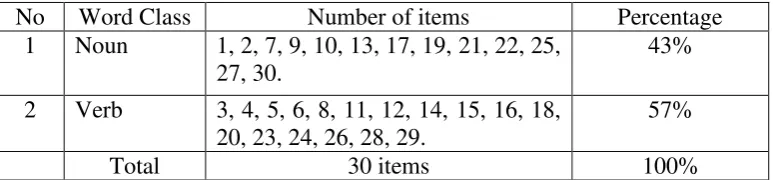
Table 1. Table of Specification (Tryout Test)
No Word Class Number of items Percentage
1 Noun 1, 2, 7, 9, 10, 13, 17, 19, 21, 22, 25,
content of the test before administering it to the students.
b. Construct Validity
Construct validity focuses on kind of the test that is used to measure the
ability. According to Setiyadi (2006), if the instrument measures one aspect,
for example vocabulary; the construct validity can be measured by evaluating
all items in the test. If all items have measured students’ vocabulary
achievement, then the instrument has fulfilled the construct validity. In order
to make sure the construct validity of the test, the researcher also asked the
colleagues to evaluate the test before it was administered to the students.
2. Process
For the data validity of the process, the researcher used triangulation. In this
research, the researcher used time and methodology triangulation. The observation
was conducted in different time (time triangulation), and the researcher also used
30
3. 7. 2. Data Reliability
According to Hatch and Farhady (1982: 243), reliability of a test can be defined as
the extent to which a test produces consistent result when administered under
similar conditions. To estimate the reliability of the test, this research used
split-half technique which requires the researcher to split the test in two similar parts,
first and second half (Hatch and Farhady, 1982:246). To measure the coefficient
of the reliability between odd and even group, this research used Spearman Brown
Formula as follows:
√
Note:
rxy : coefficient of reliability between odd and even groups
N : number of the students
: square of x
: square of y
: total score of odd group
: total score of even group
(Hatch and Farhady, 1982:245)
Then, this research used Spearmen Brown’s Prophecy Formula to know the
coefficient correlation of whole items. The formula is as follows:
Note:
rk : the reliability of the test
31
The criteria of reliability are:
0.90 – 1.00 : high 0.50 – 0.89 : moderate 0.0 – 0.49 : low
(Hatch and Farhady, 1982: 246)
The result of the calculation by using the formulas above showed that the
reliability of the test was 0.70 (see Appendix 4). It can be believed that the
reliability of the test was moderate in which the criterion of moderate reliability is
in the range of 0.50 – 0.89 (Hatch and Farhady, 1982:246).
3. 7. 3. Level of Difficulty
A test is considered as a good test if it is not too easy or too difficult to be
answered by the students. To find out the level of difficulty, this research used this
following formula:
LD =
Note:
LD : level of difficulty
R : the number of pupils who answer correctly
N : the total number of pupils following the test
The criteria are:
LD < 0.30 : difficult
LD = 0.30 – 0.70 : average
LD > 0.30 : easy
32
After calculating the level of difficulty by using the formula above, the researcher
found that there were 19 easy items (1, 4, 5, 6, 7, 8, 9, 12, 13, 14, 15, 17, 18, 19,
21, 22, 26, 29, and 30); 10 average items (2, 3, 11, 16, 20, 23, 24, 25, 27, and 28);
and 1 difficult item (number 10) in the test (see Appendix 3).
3. 7. 4. Discrimination Power
Discrimination power is used to indicate the discrimination of the failure and the
success of the students. To find out the discrimination power, the researcher used
this following formula:
DP =
Note:
DP : discrimination power
U : the proportion of upper group students
L : the proportion of lower group students
N : total number of students
The criteria are:
1. If the value is positive discrimination, there are a larger number of more
knowledgeable students then poor students who get the item correct. If the
value is zero, it means that there is no discrimination.
2. If the value is negative, it means that there are more low level students than the
high level students who get the correct item.
3. In general, the higher the discrimination index, the better. In classroom
situation, most items should be higher than 0.20 indexes.
33
By calculating through the formula of discrimination power above, the researcher
found that there were 9 poor items (1, 6, 7, 12, 14, 20, 22, 26, and 30) and 6 bad
items (4, 5, 9, 10, 15, and 17) which means that those items were not good to
discriminate between smart and poor students; and there were 11 satisfactory
items (2, 3, 8, 11, 13, 18, 19, 21, 23, 25, and 27) and 4 good items (16, 24, 28, and
29) which means that those items were good to discriminate between smart and
poor students.
The items which had difficult and easy level of difficulty level but had satisfactory
and good discrimination power were revised and administered. The items which
were average in difficulty level and had satisfactory discrimination power were
administered. Meanwhile, the items which were bad and poor discrimination
power were dropped. The calculation of the discrimination power of the tryout test
can be seen on Appendix 3.
3. 7. 5. Scoring System
In this research, Tayler-Powell’s formula was used to score the students’ test
result. The formula is as follows:
S =
Note:
S : the score of the test
R : the total of the right answers
N : the total items
34
In order to know the students’ vocabulary achievement, the writer calculated the
students’ scores by doing three steps:
1. Scoring the pretest and posttest
2. Tabulating the result of the test and finding out the mean of the pretest and
posttest by applying this formula:
X =
Note:
X : mean
∑X : the total score of the students
N : number of the students
3. Making conclusion from tabulated results of the test given that were
statistically analyzed by using SPSS (Statistical Program for Social Sciences)
17.0 for Windows.
3. 8. Data Analysis 3. 8. 1. Vocabulary Test
After conducting the pretest and posttest, the data were analyzed to find out
whether there is an increase of students’ vocabulary achievement after being
taught by using Pictionary Game or not. The following steps were used to
examine students’ score:
1. Scoring the pretest and posttest
2. Tabulating the score of students’ vocabulary test result using Repeated
Measures t-test. The formula is as follows:
35
Note:
X1 : mean of the pretest
X2 : mean of the posttest
S : standard error of differences between two means (denominater)
SD : standard deviation
n : number of students
(Hatch and Farhady, 1982: 116)
3. Making conclusion from tabulated results of the test given that were
statistically analyzed by using SPSS (Statistical Program for Social Sciences)
17.0 for Windows to test whether or not the increase of students’ vocabulary
achievement was significant.
3. 8. 2. Process
The researcher used several steps to analyze the data from observing students’
activities, they are:
1. Count the total score
The researcher counted the total score of students’ activities. There were 10
activities that the researcher and the English teacher observed, they are (1)
respond to the game enthusiastically, (2) attentively focus on listening to the
explanation, (3) ask some questions to the teacher, (4) pay attention to the
teacher’s instruction, (5) are well-regulated and have a well-mannered, (6)
follow the teacher’s order well, (7) act orderly and do not make impolite
36
discuss the answer with their groups seriously, and (10) work cooperatively in
the group.
2. Making description from the data
The researcher made the description based on the collected data from
researcher’s observation and the English teacher’s observation.
3. 9. Hypothesis Testing
The hypotheses of this research are:
a. H0 : There is no significant difference of the students’ vocabulary achievement
after being taught through Pictionary Game.
b. H1 : There is a significant difference of the students’ vocabulary achievement
after being taught through Pictionary Game.
In order to test the hypotheses, Repeated Measures t-test was used through
Statistical Package for Social Sciences (SPSS) 17.0 for Windows at the
V. CONCLUSIONS AND SUGGESTIONS
This chapter describes the conclusions of the research and also the suggestions to
other researchers and teachers who want to apply Pictionary Game in teaching
vocabulary.
5. 1. Conclusions
Based on the research findings and discussion, the conclusions can be stated as
follows:
1. There is a significant difference of the students’ vocabulary achievement after
the implementation of Pictionary Game. It was proved by looking at students’
mean score from pretest to posttest, and the t-value. The mean score of pretest
was 65.15, and the mean score of posttest was 89.15. After Pictionary Game
was implemented, the students’ mean score of pretest and posttest increased
24 points. Moreover, the students’ increase in noun was 27.5, and the
students’ increase in verb was 21.5. They got higher increase in noun than
verb. Based on the calculation through Repeated Measures t-test for SPSS
17.0, it was found that the t-value was 7.199 which was higher than the t-table
(7.199>2.056). Thus, after the implementation of Pictionary Game, the
students’ vocabulary achievement increased significantly.
2. By using Pictionary Game, the process of learning vocabulary could be an
56
does not only boost students’ motivation to memorize and understand the
meaning of vocabulary, but also influences the students to be the
problem-solvers, to be active and independent learners, and helps them to be creative
thinking learners. Furthermore, the students could also teach and learn from
each other, and form good interaction with their friends.
5. 2. Suggestions
Based on the conclusions above, the researcher suggested the following things:
1. To the teacher
a. It is suggested that the English teacher implement Pictionary Game for
teaching vocabulary, especially during reviewing activity, since it is more
enjoyable for the students.
b. It is recommended that the English teacher use whiteboard rather than
paper in Pictionary Game. This will prevent any group to cheat with their
teammates during picturing the vocabulary.
c. It is suggested that the English teacher give some time to the students to
remember the word that they are going to draw.
2. To the other researchers
a. It is suggested that the other researchers implement Pictionary Game in
Senior High School, since this research was already done in Junior High
School.
b. The other researchers can try to implement Pictionary Game in reviewing
57
Since in this research, Pictionary Game was already implemented in
REFERENCES
Arnone, M. P. 2013. Fostering Curiosity in Your Students. Creativity Now!, Vol. 70, No. 5, 36-40. http://www.educationoasis.com/resources/Articles/foster ingcuriosity.htm. Retrieved on May 26th, 2014.
Asliaty. 2012. Increasing Students’ Vocabulary Achievement by Using Picture through Silent Way Technique at Grade VII of SMP Muhammadiyah 3 Bandar Lampung. Unpublished Script. Bandar Lampung: Lampung University.
Azar, A. S. 2012. The Effect of Games on EFL Learners’ Vocabulary Learning
Strategies. International Journal of Basic and Applied Science, Vol. 01, No. 02, 252-256. https://www.academia.edu/1787034/The_Effect_of Games_on_EFL_Learners_Vocabulary_Learning_Strategies. Retrieved on November 13th, 2013.
Brett and Mckay, K. 2012. The Importance of Building Your Vocabulary (And 5 Easy Steps to Doing It). http://www.artofmanliness.com/2012/10/03/the-importance-of-building-your-vocabulary-and-5-easy-steps-to-doing-it/. Retrieved on February 27th, 2014.
Diamond, L. and Gutlohn, L. 2006. Teaching Vocabulary. http://www.reading rockets.org/article/teaching-vocabulary. Retrieved on October 3rd, 2013.
Fadhilah, S. 2011. Teaching English Concrete Nouns Using Pictionary Game: An Experimental Study With the Fourth Graders of SDN 01 Donowangun Talun Pekalongan in the Academic Year 2010/2011. Semarang: IAIN Walisongo.http://library.walisongo.ac.id/digilib/files/disk1/104/jtptiain-gdl -sitifadhil-5192-1-fileskr-h.pdf. Retrieved on November 6th, 2013.
Gentner D, Boroditsky L. 2001. Individuation, relativity, and early word learning. In: Bowerman, M., Levinson, S.C. (Eds.), Language acquisition and conceptual development, pp. 215–256. UK: Cambridge University Press.
59
Hatch, E. and Farhady, H. 1982. Research Design and Statistics for Applied Linguistics. Massachusetts: Newborry House Publisher, Inc.
Heaton, J. B (ed). 1991. Writing English language test. New York: Longman Inc.
Hinebaugh, J. P. 2009. A Board Game Education. Lanham: R&L Education.
Hong, L. 2002. Using Games in Teaching English to Young Learners. The Internet TESL Journal, Vol. VIII, No. 8. http://iteslj.org/Lessons /Lin-UsingGames.htm. Retrieved on December 12th, 2013.
Huyen, N.T.T. & Nga, K.T.T. 2003. Learning Vocabulary through Games: The Effectiveness of Learning Vocabulary through Games. The Asian EFL Journal. http://asian-efl-journal.com/quarterly-journal/2003/12/31/learning -vocabulary-through-games-the-effectiveness-of-learning-vocabulary-thro ugh-games. Retrieved on May 13th, 2013.
Kim, L. S. 1995. Creative Games for the Language Class. Forum, Vol. 33, No. 1. http://dosfan.lib.uic.edu/usia/E-USIA/forum/vols/vol33/no1/P35.htm. Retrieved on February 25th, 2014.
Ku, A. 2004. Pictionary Tactics. Bon Journal. http://www.bonjournal.com/entries/ j041228.htm. Retrieved on November 13th, 2013.
Lessard-Clouston, M. 2013. Teaching Vocabulary. In Farrell, T. S. C. (Ed.),
English Language Teacher Development Series. Alexandria: TESOL International Association. https://www.academia.edu/2768908/Teaching Vocabulary. Retrieved on February 25th, 2014.
Maroney, K. 2001. My Entire Waking Life. The Games Journal.
http://www.thegamesjournal.com/articles/MyEntireWakingLife.shtml. Retrieved on February 25th, 2014.
Nation, I. S. P. 1990. Teaching and Learning Vocabulary. Boston: Heinle & Heinle Publishers.
Neyadi, O. S. A. 2007. The Effects of Using Game to Reinforce Vocabulary Learning. Action Research and Initial Teacher Education in the UAE. http://marifa.hct.ac.ae/files/2011/07/The-Effects-of-Using-Games-to-Reinforce-Vocabulary-Learning.pdf. Retrieved on November 30th, 2013.
Ravulur, N. 1997. Game Boys. Puget Sound Business Journal.
60
Rhahima, A. 2013. Teaching Vocabulary to the Seventh Grade Students of SMP Negeri 8 Palembang through Educational Pictionary Guessing Game. Palembang: Sriwijaya University. http://www.akademik.unsri.ac.id/ paper4/download/paper/TA_06091401014.pdf. Retrieved on November 15th, 2013.
Setiyadi, B. 2006. Teaching English As a Foreign Language. Yogyakarta: Graha Ilmu.
Shaptoshvili, S. 2002. Vocabulary Practice Game. English Teaching Forum, Vol. 40, No. 2, 34-37. http://americanenglish.state.gov/resources/english-teaching-forum-2002-volume-40-number-2. Retrieved on February 25th, 2014.
Shohamy, E. 1985. A Practical Handbook in Language Testing for The Second Language Teacher. Tel Aviv: Tel Aviv University.
Simpson, A. J. 2011. Why Use Games in the Language Classroom. Humanizing Language Teaching, Vol. 13, No. 2. http://www.hltmag.co.uk/apr11/ mart02.htm. Retrieved on February 25th, 2014.
Thornbury, S. 2002. How to Teach Vocabulary. In Harmer, J. (Ed.). Edinburgh Gate: Pearson Education Limited.
Tylor-Powell, E. 1996. Program Development and Evaluation: Analyzing Quantitative Data. Madison: University of Wisconsin-Extension. http://learningstore.uwex.edu/assets/pdfs/G3658-6.pdf. Retrieved on October 23rd, 2014.