AN ANALYSIS OF UNIT SHIFT IN TRANSLATION OF A NARRATIVE TEXT
AT FIFTH SEMESTER STUDENTS’ OF ENGLISH EDUCATION
DEPARTMEN STKIP PGRI BANDAR LAMPUNG IN THE ACADEMIC YEAR OF 2017/2018
A Thesis
Submitted as a Partial Fulfillment of The Requirement for S1-Degree
By
Prima Dwi Saputra
NPM. 1311040149
Study Program : English Education
TARBIYAH AND TEACHER TRAINING FACULTY
STATE ISLAMIC UNIVERSITY RADEN INTAN LAMPUNG
AN ANALYSIS OF UNIT SHIFT IN TRANSLATION OF A NARRATIVE TEXT
AT FIFTH SEMESTER STUDENTS’ OF ENGLISH EDUCATION
DEPARTMEN STKIP PGRI BANDAR LAMPUNG IN THE ACADEMIC YEAR OF 2017/2018
A Thesis
Submitted as a Partial Fulfillment of The Requirement for S1-Degree
By
Prima Dwi Saputra
NPM. 1311040149
Study Program : English Education
Advisor : Dr. Mohammad Muhassin, M. Hum
Co-Advisor : Fithrah Auliya ansar, M. Hum
TARBIYAH AND TEACHER TRAINING FACULTY
STATE ISLAMIC UNIVERSITY RADEN INTAN LAMPUNG
ABSTRACT
An Analysis of Unit Shift in Translation of A Narrative Text At Fifth
Semester Students English Education DepartmentSTKIP Bandar Lampung In Academic Year
20117/2018 By:
Prima Dwi Saputra
This research focuses on unit shift that occur in the English- Indonesia in a narrative text a title Pinocchio that translate student English Education Department of STKIP Bandar Lampung. This research aimed to identify the type unit shift occurring in the narrative text a title Pinocchio.
The methodology applied in this research is a qualitative descriptive. The source of the data in this research is document translation a narrative text a title Pinocchio that translate by students fifth semester English education of STKIP Bandar Lampung. In this research applied immediate constituent analysis to analyze phenomenon unit shift.
After analyzing the data, the researcher found 170 phenomenon’s of unit shift in document of student’s translation. They are upward and downward unit shift. The first, researcher found 129 (76%) of phenomenon’s upward unit shift occur change rank language from word into phrase. The upward shift consist of 79(46%) noun into noun phrase,35(21%) adjective into adjective phrase and 15(9%) verb into verb phrase. The second, the researcher found 41(24%) phenomenon of downward occur change rank language from phrase to word. The phenomenon consist of 31(18%) verb phrase into verb and 10(6%) from adjective phrase into adjective.
ii
ABSTRACT
An Analysis of Unit Shift in Translation of A Narrative Text At Fifth
Semester Students English Education DepartmentSTKIP Bandar Lampung In Academic Year
20117/2018 By:
Prima Dwi Saputra
This research focuses on unit shift that occur in the English- Indonesia in a narrative text a title Pinocchio that translate student English Education Department of STKIP Bandar Lampung. This research aimed to identify the type unit shift occurring in the narrative text a title Pinocchio.
The methodology applied in this research is a qualitative descriptive. The source of the data in this research is document translation a narrative text a title Pinocchio that translate by students fifth semester English education of STKIP Bandar Lampung. In this research applied immediate constituent analysis to analyze phenomenon unit shift.
After analyzing the data, the researcher found 170 phenomenon’s of unit shift in document of student’s translation. They are upward and downward unit shift. The first, researcher found 129 (76%) of phenomenon’s upward unit shift occur change rank language from word into phrase. The upward shift consist of 79(46%) noun into noun phrase,35(21%) adjective into adjective phrase and 15(9%) verb into verb phrase. The second, the researcher found 41(24%) phenomenon of downward occur change rank language from phrase to word. The phenomenon consist of 31(18%) verb phrase into verb and 10(6%) from adjective phrase into adjective.
iii
KEMENTERIAN AGAMA RI
UNIVERSITAS ISLAM NEGERI RADEN INTAN LAMPUNG FAKULTAS TARBIYAH DAN KEGURUAN
Alamat : Jl. H. Letkol Endro Suratmin Sukarame Bandar Lampung (0721)703260
APPROVAL
Title : AN ANALYSIS OF UNIT SHIFT IN TRANSLATION OF
A NARRATIVE TEXT AT FIFTH SEMESTER
STUDENT’S OF ENGLISH EDUCATION DEPARTMENT STKIP PGRI BANDAR LAMPUNG IN THE ACADEMIC YEAR 2017/2018
Student’s Name : PRIMA DWI SAPUTRA Student’s Number : 1311040149
Study Program : English Education
Faculty : Tarbiyah and Teacher Training APPROVED
To be tested and defended in the examination session
At Tarbiyah and Teacher Training Faculty, the State Islamic University, Raden Intan Lampung
Advisor, Co-advisor,
Dr. M. Muhassin, M.Hum Fithrah Auliya Ansar, M.Hum
NIP.19770818 200801 1 012 NIP.198910312015032002
The Chairperson of English Educational Program
iv
KEMENTERIAN AGAMA
UNIVERSITA ISLAM NEGERI RADEN INTAN LAMPUNG FAKULTAS TARBIYAH DAN KEGURUAN
ADMISSION
A thesis entitled: An Analysis of Unit Shift In Translation of A Narrative Text At Fifth Semester Student’s English Education Department STKIP Bandar Lampung in Academic Year 2017/2018. By: Prima Dwi Saputra, NPM: 1311040149, Study Program: English Education was tested and defended in the examination session held on: Wednesday, january 10th, 2019
Boards of Examiners:
The Chairperson : Meisur, M.Pd (...)
The Secretary : Nunun Indahsari, M.Pd (...)
The primary Examiner : Dewi Kurniawati, M.Pd (...)
The Secondary Examiner : Dr. M Muhassin, M. Hum (...)
The advisor : Fithrah Auliya Ansar, M.Hum (...)
The Dean of
Tarbiyah and Teacher Training Faculty
Prof. Dr. H. Chairul anwar, M. Pd. NIP: 19560810 1987031001
Alamat: Jl. Letkol. H. Endro Suratmin Sukarame Bandar Lampung (0721)703260
v
DECLARATION
The researcher is a student with the following identity:
Name : Prima Dwi Saputra Student’s Number : 1311040149
Thesis Title : An Analysis of Unit Shift In Translation of A Narrative Text At Fifth Semester Student’s English Education
Department STKIP Bandar Lampung in Academic Year 2017/2018
I hereby this thesis is definitely my own words. I am completely responsible for the content of this thesis. Other people’s opinions or findings included in the thesis are quoted or cited in accordance with ethical standards.
Bandar Lampung, 10 January 2019 Declared by,
vi
DEDICATION
This thesis is dedicated to everyone who cares and loves me. I would like to dedicate this thesis to:
1. My beloved parents, Mr. Mujiran and Mrs. Suwarti, who always educate me in doing good thing, give me support. They are my hero, thanks for all generosity, finance, and encouragment, and also thanks for your love, trust, everlasting praying. Allah bless you mom and dad.
2. My beloved brothers and sister (Sutrismi Eka Wati, Hely Marzuki, Rio Cahyono Saputra), I do love you all thanks for your kindness, support, and togetherness.
3. My best friends (Zantoni, Satria, Ari, Yuda prastiyo, Assidiki, Hanan, Galeh, Albert, Teguh, Yuda, Keling, Nur Yadi, Dika, Dion, Doni, Septy, Juli, Nazwar, Wahyu) thanks for your togetherness, thank you always beside me in anything situation and don’t leave me what ever the reason, keep like that and I proud to call you my best friends.
4. My friends class C English Education, thank you always cheer her up sincerely.
5. My all family thanks for togetherness and care.
6. My friends PPL, KKN. Thanks for all
vii MOTTO
. Meaning: And of His signs is the creation of the heavens and the earth, and the difference of your languages and colours. Lo! Herein indeed are portent for men of knowledge.1
viii
CURRICULUM VITAE
The name of the researcher is Prima Dwi Saputra. He was born in Rawa Jitu on 02th November 1994. He is the second child of three children of Mr. Mujiran and Mrs. suwarti. He has one brother and one sister. The name of his brother is Rio Cahyono Saputra the name of his sister Sutrismi Eka Wati.
ix
ACKNOWLEDGEMENT
Praise be to Allah, the Almighty God, the Most Merciful and the Most Beneficent, for blessing me with His mercy and guidance to finish this thesis. The peace is upon our prophet Muhammad SAW, with his family and followers. This thesis entitled “An Analyis of Unit Shift In Translation of A Narrative Text At Fifth Semester Students of English Education Department STKIP Bandar Lampung Year 2017/2018” is submitted as a compulsory fulfillment of the requirements for S1 degree of English Study Program at Tarbiyah and Teacher Training Faculty, the islamic university (UIN) of Raden Intan Lampung. When finishing this thesis, the researcher has obtained so much help, assistance, aid, support and many valuable things from various sides. Therefore, the writer would sincerely thank:
1. Prof.Dr. H. Chairul Anwar, M.Pd, the Dean of Tarbiyah and Teacher Training Faculty, UIN Raden Intan Lampung with his personnel, who has given an opportunity and for bearance to the researcher when on going the study until the accomplishment of this thesis.
2. Meisuri, M.Pd, the chairperson of English Education Study Program of UIN Raden Intan Lampung.
3. Dr. Mohammad Muhassin, M. Hum, the advisor for giving guidance and helping to finish this thesis.
x
5. All excellent lecturers of English Department in UIN Raden Intan Lampung who have taught the researcher since the first of her study.
6. All her best friends English Education 2013 batch, especially students of class C who always cheer her up sincerely.
Finally, the researcher is fully aware that there are still a lot of weaknesses in this thesis. Therefore, the researcher sincerely welcomes criticisms and suggestions from the readers to enhance the quality of this thesis.
Bandar Lampung,10 january 2019 The researcher
Prima Dwi Saputra
xi
TABLE OF CONTENTS
page
COVER ... i
ABSTRACT ... ii
APPROVAL ... iii
ADMISSION ... iv
DECLARATION ... v
DEDICATION ... vi
MOTTO ... vii
CURRICULUM VITAE ... viii
ACKNOWLEDGEMENT ... ix
TABLE OF CONTENTS ... xi
LIST OF TABLES ... xiv
LIST OF APPENDICES ... xv
CHAPTER I INTRODUCTION A. Background of the Problem... 1
B. Limitation of the Problem ... 8
C. Formulation of the Problem ... 8
D. Objective of the Research ... 8
E. Uses of the Research ... 9
xii
CHAPTER II REVIEW OF LITERATURE
A. Concept of Translation ... ... 11
B. Type of Translation ... 14
C. Concept of Shift ... 18
1. Level shift ... 19
2. Category shift ... 19
a. Structure shift ... 20
b. Class shift ... 20
c. Unit shift ... 21
d. Intra system shift ... 22
D. Immediated constituent analysis... .... 23
E. Concept of semantic... . 24
F. Concept of text ... 24
G. Type of Text... 25
H. Concept of Narrative... . 29
CHAPTER III RESEARCH METHOD A. Research Design ... 32
B. Data source ... 33
C. Data Collecting Technique ... 33
D. Research of procedure ... 34
E. Data Analysis... …. 35
CHAPTER IV RESULT AND DISCUSSION A. Type unit shift occurring in the translation a narrative text ………. 37
B. The most dominant of unit shift in translation ……… 44
xiii
CHAPTER V CONCLUSION AND SUGGESTION
A. Conclusion………...` 48
B. Suggestion……… 49
xiv
LIST OF TABLE
xv
LIST OF APPENDICES
Appendix 1. Interview for teacher in premily research
Appendix 2. Table number of sentence unit shift
Appendix 3.Table of Phenomenon Upward Unit Shift
Appendix 4. Text narrative
Appendix 5.documen translation
1
CHAPTER I INTRODUCTION A. Background of Problem
People do not live alone in this world. Allah created humans not only in one place, but in different place also. The different place make them have their own language to know each other. It is like what Allah stated in Holy Qur‟an about the diversity of language and group in Surah Al-Hujurat: 13.1
“O people ! we created you from one man and woman and made you branches and
tribes that you may recognize one another.(QS.Al Hujarat:13)”.
In this verse, Allah states that human created being as male and female. However, even they live in different places; they use language to communicate and to know each other. Language is important thing in our life, because everyone needs language as a part of communication or communication activity with other people. According Sanggam Siahaan language is a unique human inheritance that plays the very important role in human life, such as in thinking, communicating ideas, and negotiating with the other.2 It means that language is a tool of communication
1Holly Qur‟an , Qs .Al Hujarat:13 2
2
to express what we thought. Language is also make us possible for giving and receiving some information.
Talking about the language there are some languages in the world. one of them is English. English is one of the international language used by many people in the world and in many areas of everyday life. According to Hutchinson, English becomes accepted international language of technology and commerce, it creates a new generation of learners who knows specifically why they are learning English.3 It means that English has been used by almost all countries in the world either as native, second, or foreign language. Therefore, using English is the easiest way to communicate with people from other countries in many aspect of human life such as technology, economy, social, politic and also education.
Sometime, Indonesia people want to know about something in English. But they do not master it. The translation is key to understand it, because translation is process to translate one language to others. It is a difficult process because translator has to know both languages well, like translation English to Indonesia. A translation process makes the readers know about message in the source text. According to Newmark “translation is a craft consisting in the attempt replace a written message and/or statement in one language by the same message and/or
3
3
statement on another language”.4 It means that translation is a effort in process transfer or replace a written message or statement from one language to another. In translation, a translator have to look for the same meaning between source language and target language.
The important thing in translation is message from source language to target language. Translation product good when translator able to represent the same idea and meaning. Translating sometimes is not easy task. When someone became a translator, they must be careful in translating the text. The message or idea from source language (SL) must be delivered well into target language (TL).
The purpose of translation is to deliver the clear message reader or listener in another language. However, it is so difficult for the translator to find the proper diction in the target language. So, the shift occurs in the translation.
According to Catford, “shift we mean the departure from the formal correspondence in the process of going from the source language to the target language.5 It means that shift is form of source language and change form to target language in the process shift.
Catford divide shifts into two major types. They are level shift and category shift. Level shift happen when (TL) have different linguistic level from (SL).
4
Langgeng Budianto and Aan E. Fardhani, A Practical Guide for Translations Skill, Malang, Uin –Maliki Press, 2005, p.2
5
4
Meanwhile, category shift focuses on equivalent of translation between (SL) into (TL) for being approximately normal or free translation. Catford classified it into four types. They are: structure shift, class shift, unit shift and intra-system shift. Based on the preliminary research on October 15th, 2017 at the fifth semester of English Education Department in STKIP PGRI Bandar Lampung. The researcher interviewed the lecturer there Siti Rohimah M.Pd.6 The researcher got the data document translation from students fifth semester of English Education Department. The document is narrative text titled “Pinocchio” that translated by students.
Phenomenon 1
English text (SL):
There was a carpenter called Geppetto Indonesia text (TL):
Ada seorang tukang kayu bernama Gappeto
SL text : Carpenter TL text : Tukang kayu
6
5
Immediate constituen analysis:
SL: word TL: NP N N N Carpenter Tukang Kayu
Based on the immediate constituent analysis carpenter in English language (SL) carpenter is word. And Indonesia language (TL) carpenter translated tukang kayu (noun phrase).
From data above, unit shift can be found at source text (SL) is carpenter (word) that translated into target text (TL) is Tukang kayu (noun phrase). It means that shift from word to phrase. It means the data is upward unit shift low rank to higher rank.
Phenomenon 2
English text: A selfless boy Indonesia text:
Seorang anak laki-laki tanpa pamrih
SL text : selfless
6
Immediate constituen analysis:
ST: word TL: adjective Phrase adj adj adj Selfless Tanpa Pamrih
Based on the immediate constituent analysis selfless is word in English language (SL). And Indonesia language (TL) translated tanpa pamrih (adjective phrase). It means that data above change rank from word to phrase.
From data above, unit shift can be found at source text (SL) selfless is word, that translated into target text (TL) Tanpa pamrih is (phrase). It means that shift from word to phrase. it means the data is upward unit shift low rank to higher rank. The use of translation shifts especially unit shift has been previously discussed by some researchers, Siti Munawaroh (2017), A Unit Shift Analysis of English Indonesian Translation of „Brisingr‟ by Christopher Paolini. The result of the research shown unit shift in Brisingr are phrase to word, morpheme into phrase, word into phrase and morpheme into word.7
Noviyana Hidayati (2016), A Translation Analysis of Unit Shift in Study in Scarlet Sherlock Holmes Novel and its Translation. The result of the research shown that there are 8 types of unit shift which occurs in (1) word translated into phrase in
7
7
230 data or 67,45%, (2) phrase translate into word in 79 data or23,17%, (3) phrase translated into sentences in 2 data or 0,59%, (4) clause translated into word in 2 data or 0,59%, (5) clause translated into phrase in 6 data or 1,76%, (6) sentences translated into word 2 data or 0,59%, (7) sentence translated into phrase in 18 data or 5,28%, (8) sentence translated into clause in 2 data or 0.59%.8
Deris Prasetya (2016), A Analysis of Unit shift In English-Indonesia Subtittle of Animated Movie The Adventures of Tintin. The result of the research shown that there are two type of unit shift, upward and downward unit shift.9
Based on the discussion of previous studies, it can be concluded that there was unit shift that found in target text. In This research, the researcher focus to analyze unit shift in narrative text from English into Indonesia that transleted by students fifth semester of English Education Department of STKIP PGRI Bandar Lampung. Referring the explanations above, the researchers interested analyze the translation shifts especially in unit shifts students translation work. Based on the background the researcher conducted a research entitled: “An Analysis of unit shift in Translation of a Narrative Text at the Students Fifth Semester of English Education Department of STKIP PGRI Bandar Lampung in the Academic Year of 2017/2018.”
8
Noviyana Hidayati, A Translation Analysis of Unit Shift in Study in Scarlet Sherlock Holmes Novel and Its Translation, Universty Muhammadiyah, Surakarta., 2016
9
8
B. Limitation of the Problem
In this research, the researcher focused on analyzing of translation shift especially, unit shift in a narrative text at Fifth Semester of English education of STKIP PGRI Bandar Lampung in the academic 2017/2018. The researcher used the theory of translation shift provided by John Cunnison Catford in his book A Linguistic Theory of Translation.
C. Formulation of the Problem
Based on the background before, the researcher formulated the problem as follows:
1. What are types unit shift occur in a narrative text at students fifth semester of English Education Deparetment of STKIP PGRI Bandar Lampung in the Academic Year of 2017/2018?
2. What are type unit shift most dominant in a narrative text at student fifth semester of English Education Department of STKIP PGRI Bandar Lampung in the Academic Year of 2017/2018?
D. Objective of the Research
9
2. To find out most dominant unit shift in a narrative text at student fifth semester of English Education Department of STKIP PGRI Bandar Lampung in the Academic Year of 2017/2018?
E. Uses of the Research
After doing the research, the researcher expected that the results of this research useful for as the followings:
Theoretically, this research aims to prove theory of translation, especially shift theory. Besides, this research enriches the knowledge for researcher and reads in translating English text to Indonesia text.
The practically, the example of the data from this research can be used or applied in teaching about unit shifts in translation studies. This research is also valuable for new research concerning on translation since it provides reference about translation studies especially on unit shifts.
F. Scope of the Research
The researcher determines the scope of the research as follow : 1. Subject of the Research
10
2. Object of the Research
The target language (document) narrative text that translated by fifth semester of student English education department of STKIP PGRI Bandar Lampung in the academic year of 2017/2018 on narrative text was the object the research. 3. Place of the Research
The reserch was conducted at STKIP PGRI Bandar Lampung . 4. Time of the Research
The research was conducted at Fifth Semester of students English Education Department of STKIP PGRI Bandar Lampung in Academic Year of
11
BAB II
LITERATURE REVIEW A. Concept of Translation
There are many different definitions of translation, although there are similarities on the main points. Many experts of translation give different explanations about translation but they only focus on translating source language (SL) into other target languages (TL). Newmark states “translation is mastery in transfering written message from one language into written message of another language”1 It means that translation is ability, where translator able to transfer written message from source language to target language.
According to Calford translation is replacement of textual material in one language (SL) by equivalent textual material in another language (TL).2 It means that translation is some way in change a language to another language from source language in text to target language text.
Nida and Taber in Langgeng explain that translation consists in reproducing the receptor language the closed natural equivalence of a source language message, firstly in term of meaning in secondly in terms of style.3 It means that in process of
1
Newmark Peter. Approachesto Translation, Oxford, Pergamon Press. 1981, p.7
2
J.C. Calford, A Linguistic Theory of Translation, Oxford University Press, 1965, p.20
3
12
translating translator must see equivalent between meaning and style from source languages to target language.
Basically, all the statements above explain that translation have the same ideas, in the sense that translation is a process of replacing or transfering message, thoughts, ideas, meaning or information from the source language to the target language. The main point in the translation is that the translator must not change the meaning of the message of the original text.
Based on explanation above, a translation is a process of replacing or transferring message.Therefore, in translation, there are procedures or types. The process of translation needs to be understood by translator because by that process they can take good way in the translation. The process of translation can be understand as activity that is done by the translator when they transfer a meaning from the source language to target language. Nida and Taber divide the process of translation consists of three steps as follows
SOURCE LANGUAGE
TARGET/ RECEPTOR LANGUAGE
Text I Text II
Surface structure Analysis
Reconstructing Message/ Idea
Message/Idea
13
SL Transferring message (an internal process in mind)RL/TL
1) Understanding the meaning/message of SL text, through analyzing its words, pharases, and sentence structures or grammar used on the sentences.
2) Transferring the analyzed message in SL into the TL message by finding out the equivalent meanings of the text/this step is called an internal proccess.
3) Restructuring the equivalent meanings of SL to TL with accepted forms/sentence patterns. The messages in TL must be the same with the message in SL. Some adjustments of lexical or grammatical are done, transformation happens. Both steps (2-3) are called deep structure everithing still happeans in one‟s mind. When the result is already fit
between SL text and TL text, translation is written.4
Based on the explanation above, the process of translation consist of three steps, that have to do by translator. The firsly, a translator have to understanding the meaning or message from source language. The second steps is translator transfering meaning/message to target language. And the last step a translator reconstructing meaning/message, the target must be equivalent meaning.
4
14
B. Types of Translation
Translation has several types. Larson proposes two main kind of translation, namely modified literal and idiomatic translation.5 Catford proposes type of translation according to the extent (full and partial), levels (total and restricted) and ranks (rank bound and word for word, literal and free).6 While Newmark proposes right types of translation, there are: 7
1. Word for word translation
Word for word translation is usually shown as words that inserted between the lines of the text with the source language is following exactly the same as the target language words. Usually word for word translation is used to translate culture words.
Example:
a) I love you (Source Language )
b) Aku mencintai mu (Target Language) 2. Literal Translation
Form based translation attempt to follow the form of source language and are known as literal translation. Form based translation here means translations that follow exactly the form of the source language or like word by word
5
Ibid, Langgeng Budianto, Aan E. Fardhani, p.7
6
Op.Cit J,C Catford, p.21
7
15
translation. Larson also stated literal translation will be efective for someone who learns or studies the original meaning of source language.
Example:
a) By the way (Source Lannguage )
b) Dengan jalanan ( Target Language)
3. Faithful Translation
A faithful translation attempts to produce the precise contextual meaning of the original within the constraints of the target language gramatical structures. Example :
a) I have quite a few friends. ( Target Language)
b) Saya mempunyai sama sekali tidak banyak teman (Target Language)
4. Semantice Translation
In general semantic translations is written based on the author style of his or her language and follow the author‟s thought. Semantic translation usually was done by interpreting the text. Semantic translation is feer than faithful translation.
Example :
a). He is bookworm( Source Language)
16
5. Adaptation Translation
The process of adaptation translation is the source language was tranlated into target language by adopting the culture of target language. Example: cinderella story was adapted into Bawang Merah Bawang Putih. The story was adapted by adjusting the cultural of the reader.
Example :
a) His leg felt like a stone (Target Language)
b) Tungkai kakinya seperti terpaku (Source Language)
6. Idiom Translation
Idiomatic translation reproduces the message of the original but tends to change vocabulary of meaning by referring colloquialisms and idioms where these do not exist in the original.
Example:
a) The accident killed 55 people, mostly school girls from Yapenda senior high school in Sleman regency Yogyakarta (Source Language)
b) Kecelakaan itu menewaskan 55 orang korban yang kebanyakan dari
mereka adalah para siswi SMU Yapenda kabupaten Sleman Yogyakarta (
17
7. Communicative Translation
Communicative translation attempts tp render the exact contextual meaning of the original in such a way that both content and language are readily acceptable and comprehensible to the readership.
Example :
a) Shift (Source Language)
b) Hijrah (Target Language)
8. Free Translation
Free translation reproduces the matter without the manner, or the content without the form of the original. They all agree and confess that there are three popular types of translations. They are free, literal, word for word. Among the three popular types of translation here, the researcher will focus on free translation.
Example:
a) Killing two birds with one stone ( Source Language)
b) Menyelam sambil minum air ( Target Language )
18
puts emphasis on the context and intend to the target language. For example, rearrgement, omission, and additions are allowed if those have meanings for the sake of comprehansion. In short, translation is not linear process but a more complex one. Firsty, we have to look for the closet equivalence of meaning in the target language. In addition, we have to restructuret this equivalence according to the rules and conventions of the target language.
C. Concept of Shift
Based on oxford advance Leaner‟s dictionary in Herman” Shift is change position
or place, subtation of one thing to another”.8
It means that shift is process which change position or place from source language to target language.
Catford states that a shift we mean the departure from the formal correspondence in the process of going from the source language to the target language.9 It means that shift is form of source language and change form to target language .
In adition Catford classified the translation shift into two major types of shift are identified: Level shift and Category Shift.10
8
Herman, M.Pd, Category Shifts In the English Translation of Harry Potter and the
Philosopher’s Stone Movie Subtitle into indonesia (an applied Linguistics study),vol:19, 2014, p.33
9
J.C. Catford, A Linguistic Theory of Translation, London, Oxford University Press, 1965, p.73
10
19
1) Level shift
Level shift means that a source language (SL) item at one linguistic level has a target language(TL) translation equivalent at a different level.11 Example of shift at linguistic level is the shift from grammar to lexis. Actually, this kind of shift frequently occurs in translation. For example:
SL: Sam has eaten.
TL: Sam sudah makan.
The form of „has eaten (has + past participle)‟ is grammatical form in English,
which indicates a period that continues until now or to indicate a recent happening, while its translation in Indonesian is using „sudah‟, which is a
lexical form. Here, shift at one linguistic level (grammar) to different linguistic level (lexis) occurs.
2) Category shift
Category shift refer to unbounded and rank-bounded translation. The first being approximately normal or free translation in which source language and target language equivalent are up at whatever rank is appropriate.12
According to Catford, there are four fundamental categories of linguistic theory, unit shift, structure shift, class shift and intra- system shift.13
11
Ibid J.C. Catford. 73
12
Ibid, J.C. Catford p.76
13
20
a. Structure- Shift
Structure shift ,which involve a gramatical change between the structure MH ( Modifier + Head) into HM (Head + Modifier).
Exmple of structure shift is as follows: SL text: Giant contract
TL text: Kontrakan besar
From the example above it is clear there is a shift from MH(Modifier + head) to HM ( Head + Modifier) between the two version above.
b. Class- Shift
Class shift occurs when the translation equivalence of an SL item a member of a different class from the original item.14 It means that class shift is a change word class from source language to target language.
Example:
SL: Medical student (adj + noun)
TL: Mahasiswa kedokteran (noun + noun)
In the example above, the word medical in SL (English) is an adjective, while its translation in Indonesian (kedokteran) is a noun. Here, the translation equivalent has different class from the original item.
14
21
c. Unit shift
Unit shift means changes of rank, that is, departures from formal correspondence in which the translation equivalent of a unit at one rank in the SL is a unit at a different rank in the TL.15 It means that unit shift is change rank of form language from source language to target language with equivalent meaning.
Example of unit shift is as follows: SL: Imposible
TL: Tidak mungkin
From example above, unit shift can be found at source text(ST) is imposible (word), that is transleted into target text (TT) tidak mungkin ( phrase).Unit shift also can be from low level to higher level or from high level to lower level. It is caused by the defferemces of the amount of meaning component in different concept.
1) Low rank to Higher rank (upward) Example :
ST: housckeeper
TT: Pengurus rumah tangga
From the example above, it is translation in term low level to higher level. It means that in the source language there is one word but after translated
15
22
into target language became more than one word. It can be seen on word”
housekeeper” which is consists of one word was translated into “ pengurus
rumah tangga” which is consists of three words.
2) High rank to lower rank (downward) Example:
ST: Ultimate betrayal. TT: Pengkhianat
From example above, it is translation in term high level to lower level is the opponent of low level to higher level. In this case, the source language consists of more than one word and then translated become just one word. d. Intra-System Shift
Intra system shift for those cases where the shift occurs internally within a system that is for those cases where SL and TL possess system which approximately correspond formally as their constitution, but when translation involves selection of a non-corresponding term in the TL system. 16
Example :
SL: A pair of trousers (plural)
TL: Sebuah celana (singular)
From example above, the word trousers in the source language is a plural form. It is translated into celana in the target language in a singular form.
16
23
Based on the explanation above, the researcher focused only unit shift in narrative text English into Indonesia which translated by students at fifth semester of English Education Department of STKIP PGRI Bandar Lampung.
D. Immediate constituent analysis
Immediate constituent analysis is an implicit assumption that linguistic structure, especially syntactic structures are layered structures amenable to analysis by progressive dichotomous cuting.17
In another word immediate constituent is that system of grammatical analysis that breakup sentences into sequential layers, or constituents until in the final layer, and every constituent consists of only a word or meaningful part of a word.18 Immediate constituent analysis is a sentence analysis by cutting into smaller units.19
Based on the definition above the researcher concludes that immediate constituent analysis is a method analysis structure of sentence in the text. In the sentence cutting into smaller units and every units consist only a word and one meaning of word. In this research the researcher use the immediated constituent analysis to analyze the form of word in the text to found shift of word.
17
Badri Abdulhakim.D.M.Mudhsh, Ayman Hamid Al-Takhayinh, Othman Aref Al-Dala‟ien, Immediate Constituent Analysis, Aligarh University,2015
18 ibid 19
24
E. Concept of Semantic
According Palmer semantic is the technical term used to refer to the study of meaning, and since meaning is part of language, semantic is a linguistic.20 It means that semantic is study about meaning in a language and semantic is part of linguistic.
Semantic is the science of the meaning of words and sentences; knowledge of the ins and outs of the meaning of words.21 It means that semantic is study that explain about meaning of word.
Based on the explanation above the researcher concludes that semantic is part of linguistic that study about meaning in the language.
F. Concept of text
Text is a unit which has the meaning in the context. According to Hartono, text is a unit of meaning which is coherent and appropriate for its context.22 It means Text is a human readable sequence of characters and the words they form that can be encoded into computer readable formats.
In other words, the text has the meaningful in linguistic. According to Siahaan, text is a meaningful linguistic unit in a context. A text of language is unique. Some language may have some similarities in a text and they also have some
20
Palmer. F.R, Semantics. 2nd Edition, Cambridge university press. 1976
21
http://kbbi.co.id/arti-kata/semantik
22
25
differences.23 Text can be concluded that it has the meaningful in linguistic and the unique language.Furthermore , Derewianka says ,”
text is any meaningful stretch of language oral or written. Every text is not same. Text is structured in defferent ways to avhieve their purposes. The purpose or genre of a text is partly determined by the culture in which the text is used, since different cultures achieves their purposes through language in different way. But, text differs not only in terms of their porpose (genre) but also differs according to the particular situation in which they are being used”.24
Based on explanation above, the researcher concluded that text is a unit meaningful linguistic which coherent and appropriate in a context. In addition, text is a meaningful in linguistic. It can be a word or a phrase or a sentence or a discourse.
G. Type of Text
Text are divided into several types, they are narrative, recount, descriptive, report, explanation, analytical exposition, hortatory, exposition, prodiscussion, review, anecdote, spoff, and news. These variation are known as genre.25
23
Sanggam Siahaan, generic Text Structure, Pematangsiantar, Graha Ilmu, 2007, p.1
24
Derewianka, Beverly, Exploring How text Work, Primary Teaching English Assosiation, New South Wales, 1992, PP.17-18
25
26
1) Narrative
Narrative text is a text to amuse or entertain the readers and to tell a story and always use simple past tense. The generic structure of narrative text are orientation, complication, resolution, reorientation.
2) Recount
Recount text is text to retell something that happeand in the past and to tell a series of past event. The generic structure of recount are orientation, event, reorientation
3) Descriptive
Descriptive text is a text to describe a particular person, place or thing in detail. The generic structure of descriptive text are identification, description. 4) Report
Report text is a text to present information about something, as it is. The generic structure are general clasification, description.
5) Explanation
27
6) Analytical Exposition
Analitycal Exposition text is text to reveal the readers that something is the important case. The generic structure are thesis, argument, reiteration or conclusion.
7) Hortatory Exposition
Hortatory exposition is a text to persuade the readers that something should or should not be the case or be done. The generic structure are thesis, argument, recommendation.
8) Procedure
Procedure text is a text to help readers how to do or make something completely. The generic structure are goal/aim, materials/ equipments, steps/method.
9) Discussion
Discusion text is a text to present information and options about issues in more one side of an issue ( For/pros and Against/Cons). The generic structure are: issue, arguments for and against, conclusion.
10) Review
28
11) Anecdote
Anecdote text is a text to share with others an account of an unsual or amusing incident. The generic strucure are abstract, orientation, crisis, reaction, coda.
12) Spoof
Spoof text is a text to tell an event with a humorous twist and entertain the readers. The generic structure are orientation, event (s), twist.
13) News item
News item text is s text to inform readeer about event of the day which are considered newsworthy or important. The domaint generic structure are news worthy event (s), background event (s), sources.
29
H. Concept of Narrative Text
Narrative is kind of the text that content of story problematic, climax and solution as the end of the story (denounement).26 The story is as not only story of fiction, such as legend, short story, myth, or other stories, but also story of real life story. Usually the students like to read legend text of the country or fairy talesof the world for example snow white and maling kundang. The people know this kind of the text is called narrative.
According Mark and Kathy, narrative text type tells a story. Its purpose is to present a view of the world that entertains or informs the reader or listener.27 It means that narrative text is a text which tell a story to another people to given a informs about story.
Based on the explanation above, the researcher concludes that narrative text was a kind of text that used tell story that happen in the past. It was content of story problematic, climax and solution as the end of story. The basic purpose of narrative text is to intertain and makes the readers‟ interest. But narrative also seek to teach or inform, anybody the writers reflections on experiences, and perhaps most important to nourish and extend the readers imagination. There are many types of narratives. They are typically imaginary but can be factual. They include fairy stories, mysteries, and science fiction.
26
Pradiyono, The Art of Teaching, Technique of Classing Handing as Food-like service. Andi, Yogyakarta, 2010, p.30
27
30
a) The function of narrative text
The narrative text to amuse, entertain and to deal with actual or vicarious experience in the different ways: narrative deal with problematic event which lead to a crisis or turning point of some kind, which in turn finds a resolution. b) Generic structure
1. Orientation: introducing the participants and informing the time and the place
2. Evaluation: A stepping back to evaluate plight
3. Complication :Describing the rising crises which the participants have to do
4. Resolution: Showing the way of participant to solve the crises, better or worse
5. Re-orientation: Optional c) Example of Narrative Text
The Magic Miror
Once, there was a king of Granada kingdom who decided to marry. To find a worthy woman, the court barber told an idea to the king. “I have a magic mirror. If any woman who is not kind looks into the mirror, there will many spots on the mirror surface.”
31
Then, the barber told the king that there was a brave shepherdess on the mountainside. The king asked him to invite the shepherdess to the palace. Also, the royal hall was full of ladies and knights.
The king told the shepherdess to look into the mirror. The shepherdess answered that everyone made mistakes. However she was not afraid to look into the mirror. The ladies surrounded her and found that it was not a magic mirror. The ladies complained and felt being tricked.
Finally, the king stated that there was no trick. The kin bride who was confident about
32
CHAPTER III RESEARCH METHOD A. Reseach Design
In this research, the research used descriptive qualitative method. This consideration derived from Lodico et. Al who suggested that qualitative research trie to found out a meaning, to examine processes, and to get insight in great detail understanding of an individual, group, or situation.1
Bodgan and Taylor in Setiyadi state that “qualitative research is research that produces descriptive data in form of written words or oral from the subject and its behaviors that can be observed, therefore the goal is an individual understanding
and its background completely.”2
It means that this research was qualitative, because, the writer produced descriptive data.
Considering the statement above, the researcher just saw the phenomenon of research of the moment at certain time. In this case, the researcher took the document English translation subject is narrative text. And analysis unit shift in narrative text which translated by students fifth semester English education department of STKIP Bandar Lampung.
1
M.G Lodico, D. T Spaulding, and K.H Voegtle, Methodes and Education Research, from Theory to Practice, Ca:John Wiley and Sons.Inc, San Francisco, 2006, p.269
2
33
B. Data Source
The term data refers to the kinds of information researchers obtain on the subject of their research.3 Data of the research is sentence containing phenomenon unit shift by using purposive sampling technique. The sources of data in this research were all the result of the translated narrative text by 20 students of English education department of STKIP PGRI Bandar Lampung.
Table1
Student’s translation of English department of STKIP PGRI Bandar Lampung
No Semester /Class Male Female Total
1 V A 6 14 20
Total 6 14 20
Source: English department STKIP PGRI Bandar Lampung
C. Data Collecting Technique
In this research the researcher used documentation to collect the data. the document it self is the source that take from written forms as : books, newspaper, articles, magazines, regulations, etc.4
3
Jack R. Fraenkel, How to Design and evaluate research in education, New York, McGraw-Hill, 2009, p.105
4
34
In this research to collecting the data, the researcher used document research. The document took from narrative text have been translated by students fifth semester of English education departmen of STKIP PGRI Bandar Lampung. And the data were analyzed based on immediate constituent analysis.
D. Research Procedure
In conducting this research, the researcher applied the procedureas follows:
1. The researcher permission to chairperson of english education department at STKIP PGRI Bandar Lampung.
2. The researcher permission to English translation lecturer.
3. The researcher took and copy the document translation that tranlated by students fifth semester English education department at STKIP PGRI Bandar Lampung.
4. The researcher analyze the data using immediate constituent analysis to find unit shift.
35
E. Data Analysis
Sugiyono states that data analysis is the process of systematically searching and arrange the interview transcripts, field notes and other materials that you accumulate to increase your own understanding of them and to anable you to present what you have discovered to others.5
After collecting data, the researcher used the following step as part of data analysis:
1. Take data from document
There was a carpenter called Geppetto
Ada seorang tukang kayu bernama Gappeto
SL text : Carpenter TL text : Tukang kayu
2. Analyze the data using Immediate constituen analysis ST: word TL: NP
N N N Carpenter Tukang Kayu
5
36
Based on analyze the data using immediate constituent analysis above, unit shift can be found at source text (ST) carpenter (word), that translated into target text (TT) is Tukang kayu (noun phrase). It means that shift from word to phrase. Therefore, the data is upward unit shift of lower rank to higher rank.
3. Describing phenomenon unit shift
After the unit shift is classified, then researcher describes and explains it. 4. Calculating the percentage
In accordance with the stage of analyzing the data, the researcher calculated each unit shift by using the following formula:
P= F x 100% : N P= Percentage
F= frequency of unit shift
37
CHAPTER IV
FINDINGS AND DISCUSSION
In this chapter, the researcher presented the result and discussion of the research about shift in translation. Especially unit shift in narrative text that translated by student from English to Indonesia
A. Type unit shift occurring in the translation a narrative text a title Pinocchio that translatesfrom English to Indonesia
The researcher found that there were 170 phenomenon unit shift. Based on the theory by J. C Calford, unit shift is changes of rank, that is departures from formal correspondence in which the translation equivalent of a unit at one rank in the SL is a unit ata different rank in the TL. The researcher classified the phenomenon unit shift into upward and downward.
There two different types of unit shift. They were upward and downward unit shift:
1. Upward unit shift occurs when there is a change from lower rank into higher rank.
38
The example of phenomenon unit shift on translation result presented in the below:
1) Upward unit shiftword into phrase
Upward unit shift is phenomenon shift occur when there a change from lower rank into higher rank. It would discuss as follows.In this case, the researcher found phenomenon upward unit shift in translation result from word into phrase.
a) Noun into Noun phrase
1) (1) SL text: There was carpenter called Gappett
TL text :Ada seorang tukang kayu yang bernama Gappetto
Immediate constituent analysis:
Word Noun Phrase
N N N
Carpenter Tukang Kayu
39
2) (7) SL text: The coachman told him that he was directed to Toyland, where the kinds could do whatever they wanted.
SL text: Pelatih anak anak mengatakan kepadanya bahwa mereka
akan ke taman bermain,dimana anak anak bias melakukan
apapun yang mereka inginkan.
Immediate constituent analysis:
Word Noun Phrase
Noun Noun Noun
Toyland Taman bermain
Based on the data and immediate constituent analysis, toyland SL text is word and in TL text. Indonesia taman bermain is noun phrase. It means that the data is unit shift because from low rank to high rank (upward), from word into noun phrase.
40
Immediate constituent analysis:
Word Noun Phrase
N N N
Whale Ikan paus
Based on the data above, whale in SL text is word and in TL text Indonesia ikan paus is noun phrase. It means that the data is unit shift because from low rank to high rank(upward), from word into phrase.
The data above is example from phenomenon unit shift from noun into noun phrase. It proved with immediate constituent analysis.
b) Adjective into adjective phrase 4) (57) SL text: wood inanimate
TL text: Kayu yang tidak bernyawa Immediate constituent analysis:
Word adjective phrase
Adjective adjective adjective
41
Based on the data above, in source language English text inanimate is adjective which translate into target language text Indonesia tidak bernyawa is adjective phrase. It means that the data is phenomenon unit shift from lower rank into higher rank from word into phrase.
5) (4) SL: Pinocchio be always a good, brave and a selfless boy
TL: Pinocchio jadilah anak yang selalu baik, berani dan anak laki laki
tanpa pamrih
Immediate constituent analysis:
Word adjective Phrase
adj adj adj
selfless Tanpa Pamrih
Based on the data above, selfless in SL text is word and in TL text Indonesia tanpa pamrih is adjective phrase. It means that the data is unit shift because from low rank to high rank (upward), from word into phrase.
42
Immediate constituent analysis:
.Word Adjective Phrase
Adjective adjective adjective
Desperately Dengan putus asa
Based on the data above, desperatelyin SL text is word and in TL text Indonesia Dengan putus asa is adjective phrase. It means that the data is unit shift because from low rank to high rank (upward), from word into phrase.
c) Verb into verb phrase
7) (10) SL: Pinocchio and Geppetto escaped in a raft.
TL: Pinokio dan Geppetto melarikan diri dari atas rakit 8) (126) SL: Pinocchio and Geppetto escaped in a raft.
TL: Pinokio dan Geppetto melarikan diri dari atas rakit 9) (178) SL: Pinocchio and Geppetto escaped in a raft.
43
Word Noun Phrase
Verb verb N
Escaped Melarikan diri
Based on the data above, escaped SL text is word and in TL text Indonesia melarikan diri is verb phrase. It means that the data is unit shift because from low rank to high rank (upward), from word into phrase.
2) Downward unit shift
Downward unit shift occurs when there is a change from higherrank into lower rank.
d) Verbphrase into word.
10)(8)SL text: Pinocchio come back! Jiminy cricket ran after him TL text: Pinokio kembali! jiminy cricket berlari mengejarnya.
11)(16)SL text: Pinocchio come back! Jiminy cricket ran after him TL text: Pinokio kembali! jiminy cricket berlari mengejarnya 12)(24) SL text: Goodbye son come back soon
44
Immediate constituent analysis:
verb phrase word
verb adjective verb
come back kembali
Based on the data above, come backin SL text is verb phrase and in TL text Indonesia kembali is a word. It means that the data is unit shift (downward) from verb phrase into verb.
B. The most dominant of unit shift in translation result
After analyzed the type of unit shift used immediate constituent analysis, the researcher would like to answer the research question in the formulation of the problem and revealed to objective of the problem at chapter one. The distribution of the unit shift every type would be presented in the following table.
Table
Recapitulation of research data
No. Total sentence Percentage
1 unit shift 170 45%
2 Not unit shift 210 55%
45
The Table above shows that there are 170 (45%) sentence contain phenomenon unit shift and 210 (55%) sentence not contain phenomenon unit shift from 380 (100%) sentence.
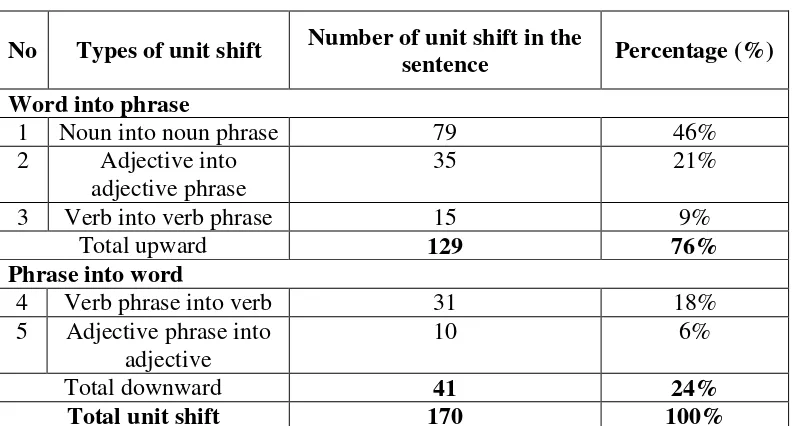
Table
The percentage of type unit shift in the sentence
No Types of unit shift Number of unit shift in the
sentence Percentage (%)
Word into phrase
1 Noun into noun phrase 79 46%
2 Adjective into adjective phrase
35 21%
3 Verb into verb phrase 15 9%
Total upward 129 76%
Phrase into word
4 Verb phrase into verb 31 18%
5 Adjective phrase into adjective
10 6%
Total downward 41 24%
Total unit shift 170 100%
46
C. Discussion
Based on the theory by J.C Calford shift we mean the departure from formal correspondence in the process of going from the source language to target language. Nida andTaber state that shift can occur when a translator is translating a text from SL to TL by concerning some adaptations namely structural adaptation which causes the shift of form and semantic adaptation which causes the shift of meaning.
According Calford unit shift is departures from formal correspondence in which the translation equivalent of a unit at one rank in the SL is a unit ata different rank in the TL. It means that unit shift change rank unit language from source language into target language.
Based on the analysis data of research finding, the researcher found phenomenon unit shift. Unit is changes of rank, that is, departures from formal correspondence in which the translation equivalent of a unit at one rank in the SL is a unit ata different rank in the TL. From analyze source language into target language, used immediate constituent analysis. The researcher found 170 phenomenons that contain unit shift from 20 document student’s translation.
47
Based on research finding, the researcher found unit shift phenomenon in narrative text that translated by student fifth semester English education departmen STKIP Bandar Lampung.
First (upward) there were 129 (76%) unit shifts which the most common change of this rank was from the word to phrase. Consist of 79 (46%) unit shift from noun into noun phrase, 35 (21%) unit shift from adjective into adjective phrase and 15(9%) unit shift from verb into verb phrase.
Second (downward) there were 15 (9%) unit shift which the most common in this rank phenomenon was phrase to word. Consist of 31(18%) is unit shift from verb phrase into verb and 10(6%)unit shift from adjective phrase into adjective.
CHAPTER V
CONCLUSION AND SUGGESTION
A. CONCLUSION
After finding and analyzing the data, the result will be delivered in this chapter IV. This research is done based on the theory by J.C. Catford about shift in translation, especially unit shift . There two type unit shift that found in a narrative text had been translated by students fifth semester English Education Department STKIP Bandar Lampung. Based on the theory J.C. Calford, the patterns of unit shifts that researcher found was upward unit shift from word into phrase and downward from phrase into word.
1. The researcher found 129(76%) upward unit shift phenomenon from word to phrase in narrative text a title Pinocchio that had been translated English
to Indonesia by students fifth semester English education department
2. The researcher found 41 (24%) downward unit shift phenomenon from phrase into word in narrative text a title Pinocchio that had been translated
English to Indonesia by students fifth semester English education
department STKIP Bandar Lampung. The unit shift consist of verb phrase into verb 31(18%) and from adjective phrase into adjective 10 (6%). B. SUGGESTION
The researcher given some suggestions for someone who is interested in doing translation. The important thing of translation is to keep the message from source language (SL) to target language (TL), because the divergence in cultural background of the two languages, a translator may not find the best equivalent with similar form or unit in the target language, then shift of form must be conducted.
REFERENCES
Arikunto Suharsimi,2013.Prosedur Penelitian suatuPpendekatan Praktik, Jakarta, Rinekacipta.
Budianto Langgeng , Fardhani .Aan E, A Practical Guide for Translations Skill. Malang:Uin –Maliki Press.
Calford .J.C.1965,A Linguistic Theory of Translation, Oxford University Press. Derewianka, Beverly. Exploring How text Work, Primary Teaching English
Assosiation, New South Wales.
Hammer. Jeremy. 2004, How to Teach Writing,.Person Education limited. Harmer Jeremy.2001, How teach English,. London : Longman.
Hartono Rudi. 2005, Genre of Text. Semarang:UNNES
Herman, M.Pd, Category Shifts In the English Translation of Harry Potter and the Philosopher’s Stone Movie Subtitle into indonesia (an applied Linguistics
study),vol:19, 2014.
Hutchinson, Tom. 1987, English For Spesific Purposes-A Learning- Central
Approuch. New York:Press Syndicate.
Isdaryanto,TypesofText,Availableon:http://understandingtext.blogspot.com/2008/03/t ext-types-complete overview.html, Accesssed on mei 12, 2017
Jan McAllister and Jim Miller, 2013, Introductory Linguisrics for Speech and
Language Therapy Practice, Wiley blackwell, New Delhi, India
Jane Lewis ,Jane Ritchie,2003. Qualitative Research Practice, London.
Mark Anderson and Kathy Anderson,2003.Text Types in English, MC Millan, Australia.
Nida.Aeugene and Charles Taber A. 1974, Theory and Practice of translation.Den Haag:Brill.
Peter Newmark. 1981, Approachesto Translation, Oxford, Pergamon Press.
Rukaesih Maalani, Ucu Cahyana,2015. Metodologi Penelitian Pendidikan, Jakarta, Raja Grafindo Persada.
Siahan Sanggam.2007, Issues In Linguistics, Pematangsiantar: Graha Ilmu Siahan Sanggam. 2007, Generic Text Structure. Pematangsiantar: Graha Ilmu.
Sugiyanto, Metode Penelitian kuantitatif, Kualitatif dan R&D,(Bandung : ALFABETA
Susanto, Leo. 2007, Essay Writting .Yogyakarta:Andi Yogyakarta.
Yosa Abduh alzuhdy, Analysis Translation Shift dalam penerjemahan Bilingual
Bahasa enggris-Bahasa Indonesia, vol:22, 2014.
Yosua Maynas, available on http://maynas25.blogspot.com/2013/11/narrative, accesed on July 29, 1017.
Oxford Advanced Learner’s Dictionary,2010