HOW TO DELIVER A FUNDING ASSISTANCE FOR RURAL
COMMUNITIES?
A CASE OF BLM PROJECTS IN SUMATRA ISLAND
(Bagaimana menyalurkan bantuan dana untuk masyarakat pedesaan? Studi kasus Proyek BLM di Pulau Sumatera)
Rudy Febriamansyah*), Rahmat Syahni*), Mahdi*), dan Ifdal*)
ABSTRAK
Banyak studi telah membuktikan bahwa petani Indonesia tidak memiliki kemampuan yang cukup dalam mengakumulasikan modal untuk kegiatan usahatani. Ketidakmampuan tersebut kemudian memaksa mereka untuk mendapatkan pinjaman dari tengkulak atau rentenir dengan bunga tinggi. Dalam usaha mengatasi masalah ini, pemerintah Indonesia sejak zaman orde baru telah menerapkan berbagai program untuk membantu petani agar mandiri dalam berusahatani. Belakangan ini, pemerintah menerapkan program bantuan kredit yang dikenal dengan kredit usaha tani (KUT) untuk membantu aktivitas usahatani tanaman pangan. Akan tetapi program ini dinyatakan tidak berhasil karena tingkat pengembalian kredit yang sangat rendah dan beberapa pengamat menemukan adanya indikasi ketidak beresan dalam setiap tingkat pengelolaan program. Berdasarkan kenyataan tersebut, sejak awal tahun 2000, pemerintah telah menghentikn program KUT dan menerapkan bentuk baru yaitu Bantuan Langsung kepada Masyarakat (BLM). Bantuan ini tidak hanya untuk tanaman pangan melainkan juga untuk usahaternak dan hortikultura. Secara teoritis, studi ini mencoba menerapkan perspektif ekologi budaya untuk mengungkapkan faktor-faktor yang mempengaruhi dinamika kelompok tani dalam memanfaatkan bantuan dana BLM. Studi dilaksanakan pada 7 propinsi dan mencakup tiga aspek evaluasi yaitu aspek input, proses, dan dampak. Disamping itu, studi ini juga mengelaborasi temuan-temuan penting, khususnya yang terkait dengan perspektif konseptual pemberian bantuan kepada masyarakat pedesaan.
Key words: funding assistance, rural communities
INTRODUCTION
Most farmers in Indonesia, especially rice farmers, are small-farmers that have relatively low capital for farming activities. As a result, in order to survive their farming activities, farmers used to go to local creditors, known as tengkulak. Sometimes, the money from this tengkulak are not primarily used to buy farming inputs but often used only for household consumption. Farmers then return the credit with their harvests bought by the tengkulak with relatively low price, compared to the market price.
Since the early of New Order in 1960s, the government has seen the importance to help rice farmers especially in order to guarantee the achievement of food self-reliance (swa-sembada pangan). Here, through the intensification and extensification programs, the credit programs were introduced to help farmers providing their farm inputs. Although, in one side Indonesia has achieved the swasembada pangan, but on another side, most farmers are still depends on the government assistances. Moreover, the credit program (the KUT program1) for instance), itself was not really successful, because most farmers did return the credit, and some observers indicated financial malpractices at almost all level.
Considering these realities, the government then stopped the KUT program for the year of 2000. However, small farmers are still needs the external assistances, especially funding for their farm inputs. As proposed by the People Representative (DPR-RI), the government finally implemented a new program of funding assistance for rural communities, not only for rice farming but also for horticulture, small-scale animal husbandries, small-scale fruit plantations, and others.
In the early 2000, the first project is called
Proyek Pengembangan Ketahanan Pangan2) or PKP 2000 (Sekjen Deptan, 2000) that is focused on the sustainability of rice farming activities. In the early 2001, this program was followed by two programs, are; Proyek Pemberdayaan Kelembagaan Pangan di Pedesaan3)or PKPP 2001 and Proyek Pemberdayaan Petani Agribisnis4)or PPA 2001 (Sekjen Deptan, 2001). The PKPP 2001 is also concentrated for rice and other food-crops (including food storage system or lumbung and processing), while PPA 2001 is given only to support other agribusiness farming systems, such as horticulture, small-scale animal husbandries, small-scale plantations and commercial food-crops.
*) Fakultas Pertanian Universitas Andalas Padang
1) KUT is stand for Kredit Usaha Tani or Farming Credit.
2) Literally means Food Security Development Project.
3) Literally means Empowerment Project for Food Institution in Rural areas.
Unlike the KUT program, this new program provides fund assistance directly to the farmers, where farmers or group of farmers (Kelompok Tani or KT) are able to receive the funding from their bank account. The program is then known as BLM program or Bantuan Langsung Masyarakat5). There are at least two differences of BLM compared to KUT; (1) Farmers or
Kelompok Tani have a right to decide the use of their money and (2) The fund given to the group are not to be returned to the bank or to the government agencies but they should be used by the group for their own benefit. The KT has to distribute and circulate the funding for the whole members in terms of credit. Members of KT have to return the credit to the KT, so that KT may able to accumulate capital for their activities.
For those three projects, the government has distributed more than Rp.900 million for farmers in Indonesia. However, beside those who agree with the project, there are also contra with the project. Those who disagree with the project argue that farmers of KT will not able to manage the funding effectively, and they will not able to keep the funding for long.
Therefore, there is a need to evaluate the implementation of these projects. Although, internally the relevant agency6) has evaluated these projects last year (end of 2001), the evaluation was not entirely cover the situation (BPK Deptan, 2001). At that moment, the implementation of the project was on the period of distributing the funding to the KT. The evaluation has not covered the dynamic of KT in using the BLM fund. Further evaluation is then needed to assess the performance of KT after receiving the fund for about one or two years. By doing so, the central government may able to make suitable adjustments about “how to give
funding assistance for small farmers” in the next years.
Analytical Framework
Basically, this evaluation study is focused on two aspects; practical and conceptual aspects. Practically, the study evaluated the whole implementation process that consists of 4 (four) critical phases: selection of KT, delivering fund to the account of KT, fund withdrawal by the KT, and fund utilization. In this regard, the framework of study is based on the evaluation concept of Isaac and Michael (1990) that divided the aspect of evaluation into three; (1) Input evaluation that focused on the analysis of the readiness of farmers (or KT) before they received the BLM fund (2) Process evaluation that focused on the entire process of implementation, and (3) Output evaluation that focused on the analysis of the performances of KT after they received the BLM fund.
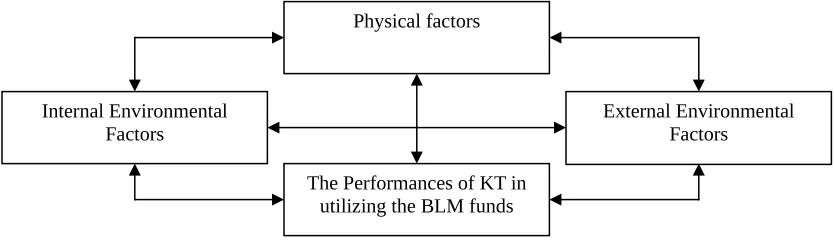
To analyze the conceptual aspect of the project, this study deeply assessed factors affecting the dynamic of farmers or KT in utilizing the BLM fund. Here, the study used the cultural ecology perspective (Steward, 1955) that sees the interrelationship of environmental condition with the human characteristics (see also Rambo, 1979). As seen on Figure 1., this study has tried to find factors affecting the successful or failure of KT in utilizing the BLM fund.
In terms of research methodology, this evaluation study combined three methods; sample survey of KT, secondary data assessment, and in-depth study for the implementation process. The percentages of KT sample for the whole Sumatra are 5% to 15%, 5% of KT PKP2000 (195 of 4121), 10% of KT PPA2001 (36 of 375), and 15% of KT PKPP2001 (49 of 322).
5) Literally means Direct Fund Assistance for the Community.
Physical factors
Internal Environmental
Factors External Environmental Factors
The Performances of KT in utilizing the BLM funds
6) Department of Agriculture, Republic of Indonesia Overview of the Project in the Sumatra Island
Due to the political situation in the province of Aceh, this study covered only seven provinces in Sumatra Island. The overview of the BLM project in these provinces explains of the description of the technical concept of the project according to the General Guidance (Pedoman Umum) from the Department of Agriculture.
Technically, the mechanism of the project implementation follows the flowcharts blow. Flowchart A describes the flow where the KT will receive the funding assistance directly from the government through their bank account. However, the KT must obtain the approval of their proposed activity (called RUK or Rencana Usulan Kelompok) from the project leader at the District Level. The local field officers are assigned to help the KT in constructing suitable activities to be proposed.
Flow chart B describes the mechanism of repayment from members to the organizers of KT. It stated that farmers might repay their credit in forms of harvest or in cash. Flowchart C explains the procedure for the KT to withdraw the bank account of the BLM funds. This flowchart display that the KT has to show the proposed activities approved by the whole members and local officers or PPL to get the money from the bank. This flowchart displays also the requirement for KT to perform the mechanism of control and reporting.
The Results of the Evaluation
Based on the result of sample survey (Tim UPPM Faperta Unand, 2002), the assessment is then concentrated on the three aspects of evaluation; input evaluation, process evaluation and output evaluation. Several important points of these evaluations are as follows:
Input Evaluation
(a) The farmers did not substantially absorb the purposes of the project during the socialization process. The socialization process done by the project implementer was only focused on socializing the mechanism of the assistance. Farmers, generally, then realized that the fund they received could be classified as “a grant” that should not be returned to the government.
(b) The reality that the time period for socialization process was relatively short (especially for PKP2000) has made the project implementer less of awareness. The
project leader at the district level has focused only to the distribution of fund as schedule according to the General Guidance (Pedoman Umum) from the central government. As a result, they concentrated only on the process of selection and less awareness on the preparation of the KT before they receive the fund.
(c) Due to the pattern of the budgeting period from the central to the district level, the BLM arrived late in the bank account of KT. For the PKP and PKPP projects, almost a half of KT in all provinces received the farm inputs while the planting season has started a month ahead.
Process evaluation
(a) Due to the limitation time period to make the preparation, the transparences of the selection process are not exactly clear at all provinces. The KTs did not exactly know the entire criteria of selection. They know that the selected KTs should not have any different with the procedure, where the RUK is one of the requirements for the selection. (c) During the process of constructing the RUK,
the agriculture field officers actively assisted the KUT, and for many cases, they also involved in negotiating the process of farm input acquisition (especially PKP and PKPP projects). Therefore, as a result, most of KT realized that this project is just like a package of assistance from the government where they just have to wait for the farm-input package in front of their door. Here, it can be also said that the process did not really explore the empowerment agenda of the projects.
of KTs who got the PPA and PKP funds for cattle are successful in their business. (e) In terms of repayment system from the
members to the KT, as required by the district technical team, most of KTs have written agreement about the interest rate, the time period of repayment and other important agreements. However, due to ineffectiveness of socialization process, the motivation of farmers to return the farm inputs or fund assistance was relatively low. They never think that the government will ask the money to be returned.
(f) The empowerment agenda in these projects are relatively unstructured. Although there are some budget funding allocated for the empowerment of the KT, the approach of empowerment was done only through the short training in class or in the field. There are no continual or comprehensive processes of empowerment during the activities of KT utilizing the BLM funds.
(g) In terms of monitoring and evaluation, low budget allocation for the project implementers has constrained the effectiveness of these activities. The district team has just assigned the local officers to monitor the activities of KT during their regular visits or their routine duties. The KT have to make formal report when they received the money (or farm inputs) and after they finished distributed to the members. After that, there is no requirement for them to make regular report of their activities.
Output evaluation
The output evaluation was not only focused on the performance of KT as indicated by the project but also assess their opinion of the overall project.
(a) Although most of KTs stated that the projects are successful, but the indicators are just in terms of funding delivery pattern done by the government. Very few farmers (or KT) that mentioned the successful of project in terms of rice productivity or income. Especially for KT that receive the BLM funds for cattle, most of them mentioned the successful of project in terms of weight or numbers of cattle they have after one-year period.
(b) The pessimistic of project outputs is mainly on the repayment of fund from the farmers to the KT. Due to the weaknesses of their accounting system, the study did not
able to assess the repayment and the circulation of fund in the KT.
(c) In terms of the adoption of new technology
and the partnership in businesses activities, the study did not find significant changed for the whole activities of most KTs.
Factors affecting the farmers using the fund assistance
Based the framework on Figure 1 this study has indicated important factors affecting the physical condition of their farming systems are conducive, such as their land resource, water resource and the climatic conditions of the environment. The local officers who have the task the proposed the KT within their region have prioritized the KT in the central production of commodities targeted by the projects. They were chosen to guarantee the successful of the production of the commodities.
Internal environmental factors
The main internal environmental factor is the organization performance of the KT itself, either the organizers or the members. Although most of the KT have been established for more than 10 years, formally or informally, their
organizational pattern are still weak, either in terms of their knowledge or their ability in organizing the use of BLM funds that relatively big amount of money for them. These KTs have a big constraint especially in accounting system that able to control and motivate the members to follow the rule of repayment agreement within the KT. As a result the organizers have difficulties to ask the repayment from the members. However, the factors that obstacle the repayment also involved the socialization of the funding assistance that influences the motivation farmers to pay back their credit of farm inputs to the KT.
External environmental factors
The external environmental factors related to the social factors outside the KT, such as the role of governmental institutions from the village up to the district level, especially in terms of control system of fund utilization at farm level. The structure of fund delivery systems did not systematically create the control system from relevant agencies to the KT who receives the BLM funds. Conceptually, the project did not assign the third actor to create the control system independently. As a result, this did not create good motivation of KT and farmers to utilize the funding effectively and accountably. Although there are some funds allocated for the District Technical Team for monitoring and evaluation, the amount of funds seems not too sufficient to create a systematical control to the whole activities of KT every season. The task of monitoring and evaluation is then assigned to the local officers during their routine activities in the agricultural extension.
Conclusions and Recommendations
Conclusions
Although there are some weaknesses and constraints on the effectiveness of the BLM program, this study proposed to the government to continue the projects in the next years. This conclusion is mainly based on several arguments as follows:
The numbers of small farmers with low capital inputs are relatively big in the whole provinces in Sumatra. Most of them are difficult to grow up without external assistance.
The project implementers from the District to the Village level have got enough experiences of these BLM projects. The numbers and the ability of local officers who could work together with farmers or KTs are relatively sufficient.
The BLM projects have proved significantly a successful partnership with the Governmental Budgetary Office (kantor KPKN) and Banking agencies. There are no indications of “a leak” along the delivery system of money from the government to the farmers account.
In order to implement the autonomy programs, the central government has explicitly explored the policy to give a bigger chance to the provincial governments to evaluation, further BLM funding assistance for rural community should be modified according to the following viewpoints:
The socialization process should be implemented effectively so that the whole stakeholders (from the district level to the farmers level) will have similar perception about the status of funding assistance.
Conceptually, the status of funding could not interpreted as a grant, but should be clearly said as a credit (without interest rate) for the KT that will be delivered to another KT in turn.
Conceptually, there should be a clear control system of funding utilization done by the KT. The accounting system of KT should be improved systematically with several simplicities suitable for small farmers with low level of education. The banking agencies could be involved in controlling the KT especially by assigning the regular repayment system with clear sanction system.
The period of fund transfer by the KTs could be extended to be more than two periods. The fund for farm input should not be given in full amount according to the needs of farmers, but better in periodical way where farmers could get the farm input for a half for the first planting season, and then increase for the next season if they able to return the credit with their harvest yield.
REFERENCES
Biro Perencanaan dan Keuangan Departemen Pertanian (BPK Deptan). 2002. “Kumpulan Informasi Proyek BLM (PKP 2000, PPA dan PKPP 2001)”. Biro Perencanaan dan Keuangan Departemen Pertanian, Jakarta.
Isaac, S., and W.B. Michael. 1990. “Handbook in Research and Evaluation (Second Edition)”. EdITS Publishers:
Sekretariat Jenderal Departemen Pertanian (Sekjen Deptan). 2000. “Pedoman Umum Proyek Pengembangan Ketahanan Pangan TA2000”. Sekretariat Jenderal Departemen Pertanian, Jakarta.
________________________________________________. 2001. “Pedoman Umum Proyek Pemberdayaan Kelembagaan Pangan di Pedesaan TA2001”. Sekretariat Jenderal Departemen Pertanian, Jakarta.
dan Agribisnis di Pedesaan TA2001”. Sekretariat Jenderal Departemen Pertanian, Jakarta.
________________________________________________. 2001. “Pemberdayaan Masyarakat Melalui Penguatan Kelembagaan Pangan dan Agribisnis. Proyek PKPP Pusat TA2001”. Jakarta.
Tim UPPM Faperta Unand, 2002. “Evaluasi Kinerja: Program Pemberdayaan Petani Melalui Usaha Kelompok Pola BLM di Pulau Sumatra”. Kerjasama antara Proyek
Pemberdayaan Agribisnis dan Kelembagaan Pangan di Pedesaan Departemen Pertanian dengan Fakultas Pertanian Universitas Andalas, Padang.
Other references/reports from the case site, including:
Petunjuk Teknis (Technical guidance) dan Petunjuk
Pelaksanaan (Implementation Guidance)proyek PKP, PKPP dan PPA, dan
Laporan Tahunan (Annual Reports) proyek PKP, PKPP
dan PPA