Simulation Method for Measuring Multitasking
Proficiency
Abstract: Multitasking is defined as conducting several tasks simultaneously. There are three characteristics of multitasking. First, multitasking has circular characteristic and demand the performance of several tasks. Second, there is a shift of attention from one task to another. Third, the performance happens in limited time. Many companies apply multitasking to make their human resources more effective and efficient. If this proficiency can be predicted, companies will be able to reduce their expenses by appropriate selection or potential review to their human resources particularly in Indonesia. Therefore, this study attempted to create computerized simulation program as the measurement methods of multitasking performance. Simulation have reflected the real situation by: the existence of various types of matter in the three sets of tasks that must be done within a certain time limit, the subject can move or choose task that they want, and the presence of dual task. Measurement conducted in a quiet room, adequate temperature and lighting, and adjustable workstation. The result of this study built practical implication that the multitasking performance measurement method by using computerized simulation could create the multitasking condition. Therefore, companies or industrial practitioners can use the simulation method to measure the multitasking proficiency of their employees.
Keywords: simulation, multitasking
I. INTRODUCTION
Multitasking is defined as several tasks done together at the same time. The characteristic of multitasking is not only the presence of more than one task or activity, but more on the shift of attention between the tasks. The limitation of time to complete the tasks also force individuals to share their time and attention [1]. Multitasking is often practiced among executives because it is regarded as more efficient than only focused on one task at one time. Multitasking becomes important because many institutions need personnels with this proficiency. There are a lot of companies that apply multitasking to make their human resources more effective and efficient. The need of multitasker revealed in a survey in 2009 done by Career Builder and Robert Half International. The result showed that companies want employees who have multitasking proficiency (36%), initiative (31%), dan creativity (21%), beside the skills that suit the offered positions.
Recently, the trend is diversion of tasks. Multitasking implies efficiency to obtain the desired outcomes. Employees who can answer phone call and e-mail at the same time are hopefully can also do more tasks in a day than if they do those
two tasks in series. In other words, multitasking is done to increase productivity. The main issue in bussiness and psychology industries is how to get the most productive workers [2]. If multitasking proficiency can be predicted, companies will be able to reduce their costs by appropriate selection or potential review. One of the implications is the individual who has tendency to be inappropriate or predicted to be incapable of multitasking is more suitable placed in working situation that facilitates concentration ability and execution of only one task at a time (single task). Wrong prediction makes individual potentials could not be optimized, the company would suffer disadvantages because the purpose of the tasks could not be obtained effectively. Extra cost had to be paid by the company if there is a mistake in placing the workers and to organize a training. On the opposite, if the selection and the placement of the workers suit the individual’s capability and personality, condusive and productive working situations could be achieved. The placement of the right employee to perform multitasking will benefit not only the individual but also the organization. The purpose of the tasks can be achieved effectively, and the employee will enjoy to do the tasks, so it will minimize mistakes or even working accidents. It is clearly necessary that the prediction of multitasking proficiency should be included in the selection of employees.
Workers’ characteristics and working situations are important to explain the behaviors, because behavior is a collaboration of the two functions or person-situation interaction. Individual characteristic that suits the task characteristis also becomes the aim of the Person-Organization Fit perspective [3]. In other words, this theory also produced the Person-Job Fit theory, or Person-Task Fit theory, that the employee’s characteristic should fit the demands of the job. Therefore, the aim of this study is to develop tools to measure multitasking proficiency which is not developed yet in Indonesia.
II. METHODOLOGY
This study used 324 undergraduate students of Udayana University Bali, Indonesia as the sample. The sampling method was the simple random sampling. The criteria of the sample were: 1) willing to be completely involved in the whole research process by filling the informed consent; 2) had the ability to operate simple programs on computer, 3) not Swasti Wulanyani
DOI: 10.5176/2345-7872_2.1_29
GSTF Jour nal of Psychology ( JPsych) Vol.2 No.1, August 2015
being occupied at the moment or involved with formal management tasks.
The study took place at the computer laboratorium of Faculty of Medicine, Udayana University, so the environment such as room temperature, lighting, and the usage of working equipments could be controlled.
This non-experimental study was using multitasking simulation and parametric statistical approach. Since the multitasking simulation was computerized, the whole programs could be administered individually and classically. The time and condition of the room where the data was collected were the same for every subject complied with the ergonomics principles.
III. RESULT AND DISCUSSION
Multitasking in this simulation is consist of social and cognitive tasks by audio-visual in computerized program. The social-cognitive was chosen because it could reflect the managerial tasks [4]. The social-cognitive tasks were presented in three sets of questions that consist of speed-accuracy test, cognitive questions, and managerial questions (situational judgement and ‘in basket’ test).
According to the validation test, this simulation was consisted of 40 valid questions and four questions through telephone simulation at the 3rd, 6th, 9th, and 12th minutes as
shown in Figure 1. The questions that had not been found in the previous multitasking studies is the in basket test. The scores were 2, 1, and 0 according to the standard of competency by Spencer & Spencer [5]. The whole tasks had to be done in 30 minutes. The benefit of computerized method was creating same situations, reducing the costs, and free from the influence of the tester condition so the tests’ standard condition could be maintained and the reability would be as good as the conventional test. The allowed time to do the tasks was 30 minutes, determined by the validation result and Ergonomic principle. As comparison, the multitasking research by Bauer et al. designed 15 minutes time allowance [6], Delbridge 45 minutes [7] and Konig et al. 32 minutes [8].
Figure 1. Simulation program
Generally, simulation consists of written and video-based situational tests (including situational judgment test) and a work sample test. In situational judgment test, the subjects were given an overview of a work situation and then asked their responses in that situation. Sometimes subjects were asked to choose the most likely and least likely to be done.
Work sample actually placing candidates in the actual situation then assessed. One kind of work sample is ‘in basket or in tray’ technique. Although it is difficult to make work sample of management tasks but in-basket/in-tray can be considered as a method that is quite valid. This test contains a set of materials that usually accumulate in the 'basket' of managers when they were not in the office. These materials are letters, phone messages, reports, and other records. Some of this material requires the attention of workers and should be handled as soon as possible, while others are routine tasks.
In analyzing the simulation method, the approach taken is the verification and validation [9]. Verification is a process to determine whether a simulation model reflect the appropriate conceptual model. Computer-based model verification is also carried out to ensure that the computer programming and implementation of the conceptual model is correct [10]. Validation is the process that determines whether the conceptual model accurately reflects the real system. However, there is no standard method to perform verification and validation [11].
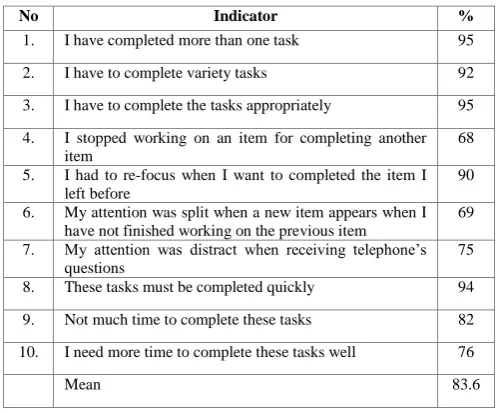
The verification results show that the computer program was running the simulation as expected. The material that presented in a simulation of speed and accuracy (administration), and also cognitive and management items have reflected the concept of management task. Validation results showed that the conceptualization or abstraction of simulation is an accurate representation of the real system, namely multitasking situations. This is indicated by the confirmation of mental processes that experienced by subjects during the simulation, both in validation test and during the measurement. The results confirm that the subjects in the simulation have experienced 83.6% of those aspects of multitasking situations. The results of previous validation showed an average of 80%. Table 1 shows the mental processes in detail.
TABLE 1. The subjects’ characteristics and intelligence levels
No Indicator %
1. I have completed more than one task 95
2. I have to complete variety tasks 92
3. I have to complete the tasks appropriately 95
4. I stopped working on an item for completing another item
68
5. I had to re-focus when I want to completed the item I left before
90
6. My attention was split when a new item appears when I have not finished working on the previous item
69
7. My attention was distract when receiving telephone’s questions
75
8. These tasks must be completed quickly 94
9. Not much time to complete these tasks 82
10. I need more time to complete these tasks well 76
Mean 83.6
Mental processes in statement number 1 to 3 reflects the presence of more than one problem, number 4 to 7 reflects distracted attention, and number 8 to 10 reflect time limitation. These data indicate that the simulation method has succeeded in creating a situation of multitasking. Simulation in this study
GSTF Jour nal of Psychology ( JPsych) Vol.2 No.1, August 2015
have reflected the real situation by: the existence of various types of matter in the three sets of tasks that must be done within a certain time limit, the subject can move or choose task that they want, and the presence of dual task.
Tools and simulation process has been applying Ergonomics principles; the computer screen is quite large (17"), viewing distance from the screen to the subject's eyes were approximately 30 cm up to 50 cm, and the letters type font 2.4 mm with black and white background for such distances. The task must be held maximum for 30 minutes because mental abilities for cognitive tasks will be dropped after 30 minutes. The arrangement has been determined based on the validation results and in accordance with Ergonomic principles recommended by Kroemer & Grandjean [12]. The seats have an adjustable system so that the subject had natural posture. Lighting and room temperature can be adjusted, the volume of telephone questions can also be adjusted to the needs of the subject as using head phones individually. It can be concluded that the performance measures of multiple tasks in this study taking place in a comfortable working environment.
Companies or industry practitioners can use this simulation method to measure multitasking performance of their workers. However, it should be noted that the simulations in this study performed in a comfortable working environment. Measurement conducted in a quiet room, adequate temperature and lighting, and adjustable workstation. In reality, not all working conditions have such a comfortable physical environment. Ergonomic work situation setting is intended to be subject to display optimum performance. This can be a consideration for the company in order to increase the productivity of their workers according to their capacity.
The result of this study built practical implication that the multitasking performance measurement method by using computerized simulation could create the multitasking condition. Therefore, companies or industrial practitioners can use the simulation method to measure the multitasking proficiency of their employees.
REFERENCES
[1] Schottner, A. (2007). Relational contracts, multitasking, and job design. The Journal of Law, Economics & Organization, 24(1).
doi:10.1093/jleo/ewm044.
[2] Kaplan. R. M., & Saccuzzo, D. P. (2005). Psychological testing. Principles, applications and issues (ed.6). New York: Wadsworth, a division of Thompson Learning, Inc.
[3] Hedge, J.W. & Borman, W.C. (2006). Personnel selection. In Salvendy, G. (ed.). Handbook of human factors and ergonomics, 3rd edition. New Jersey: John Willey & Sons, Inc.
[4] Fleishman, E.A. & Quaintance, M.K. (1984). Taxonomies of Human Performance. The Description of Human Tasks. Toronto: Academic Press, Inc.
[5] Spencer, L.M. & Spencer, S.M. (1993). Competence at work. Models for superior performance. New York: John Wiley & Sons, Inc.
[6] Bauer, K., DeVincentis, D., & Taber, J. (2008). Gender Differences in the Effects of multi-tasking performance. PSY 220. Research design and statistics. Hanover college
[7] Delbridge, K.A. (2000). Individual differences in multi-tasking ability: exploring a nomological network(Doctoral dissertation, Michigan State University, Department of Psychology). Available from ProQuest Dissertations and Theses database. (UMI No.3000529).
[8] Konig, C.J., Buhner M. & Murling, G. (2005). Working memory, fluid intelligence, and attention are predictor of multitasking performance, but polychronicity and extraversion are not. Human Performance, 18(3), 243-266. London: Lawrence Erlbaum Association, Inc
[9] Sargent, R.G.(1998). Verification and validation of simulation models. Proceeding of The 1998 Winter Simulation Conference,121-130. Toronto
[10] Hoover, P. (1989). Simulation, aproblem-solving approach. New York: Addison-Wesley
[11] Harrell, C., Ghosh B.K., & Bowden, R.O., (2003). Simulation Using Promodel (ed.2). Singapore: McGraw-Hill.
[12] Kroemer, K. H. E., &. Grandjean, E. (2000). Fitting the task to the man (ed.5) London: Taylor & Francis.
AUTHOR’S PROFILE
Dr. Ni Made Swasti Wulanyani, S.Psi., M.Erg., completed Bachelor and professional program at Faculty of Psychology, Gadjah Mada University in 1998, Master of Ergonomic in 2004 at Udayana University, and in 2014 completed the doctoral program at Faculty of Psychology, Gadjah Mada University. Dr. Ni Made Swasti Wulanyani is interested in the field of psychology related to health and cognitive. Several studies have produced: Individual differences on mental workload in multitasking, Factors affect multitasker on managerial task, Cognitive development of children with cochlea implant. She has worked as a lecturer since 1999 in Psychology Department, Faculty of Medicine, Udayana University, Bali- Indonesia.
GSTF Jour nal of Psychology ( JPsych) Vol.2 No.1, August 2015