PHYTOCHEMICAL STUDY OF
OLIGORESVERATROL FROM
SOME SPECIES OF
HOPEA
Sri Atun
Hopea
is one the main genus of
Dipterocarpaceae, consisting of
approximately 100 species and
widely distributed in Indonesia
specially in Kalimantan
The local name is “ cengal,
merawan hitam or pengarawan”.
The plant ussually can be used
as material building, plywood etc.
This family of plant is known to
produce a variety of resveratrol
oligomer
These structures are very
interesting and showed
interesting biological activity, such
as antibacterial, anticancer,
Objective
The following discussion will focus on the
structure diversity of oligoresveratrol that have
been found, biogenetic relationship, and
Activity test
elusidasion structure by spektroskopi methode (UV, FT-IR, NMR, MS)
STRUCTURE MOLECULE Repeated Chromatography
EKSTRAK
Extraction by organic solvent : acetone or methanol
Sample: milled dried stem bark
BIOACTIVE COMPOUNDS
Pure compounds
S-1, S-2, … dst
By fractionated (VLC)
HOW TO ISOLATED COMPOUNDS FROM NATURAL PRODUCT
Maserated by
organic solvent removal of the
solvent under reduced
pressure
1
2
3
4
5
Spectrum
1H and
13C NMR of vaticanol B
O O
HO HO
HO
HO HOHO
OH OH
OH
H H
H H HH
H H
Table 1. Oligoresveratrol compounds from some species of Hopea
Species Oligoresveratrol
H. odorata (Cogon, 1970), Hopheaphenol
H. cardifolia (Sotheesswaran, 1983)
copaliferol A; stemonoporol
H. jucunda (Diyasena, 1985) Hopeaphenol
H. malibato (Dai, 1998), malibatol A; malibatol B ; dibalanokarpol
H. parviflora (Tanaka, 2000), (-)-ε-viniferin ; (-)-ampelopsin A; balanocarpol; (+)-parviflorol ; hopeaphenol
H. utilis (Tanaka, 2001) vaticanol B; hopeaphenol
H. sangal (Sri Atun, 2004), (-)-ampelopsin A ; (-)-ε-viniferin ; vaticanol B; hopeaphenol
H. bancana (Tukiran, 2004) (+)-α-viniferin ; hopeaphenol
H. mengarawan ( Sri Atun, 2006)
Balanocarpol; heimiol A; vaticanol G; vaticanol B;
H. odorata ( Sri Atun, 2005-2006)
balanokarpol; hopeafenol; ampelopsin H; hemlesyanol C
Diversity structure oligoresveratrol from
Hopea
Monomer and dimer resveratrol
O H H HO OH HO OH HO HO HO OH O OH OH H H H OH H HO OH OH Resveratrol
(H. utilis)
ε-viniferin (H. parviflora)
(-)-ampelopsin A
(H. parviflora, H. sangal )
HO HO OH O OH OH H H H OH H (-)-balanokarpol
(H. parviflora)
HO OH O HO OH HO H OH H (+)-parviflorol
(H. parviflora)
HO HO HO O OH OH H OH H HO HO OH O OH OH H OH H HO
Malibatol A malibatol B
Trimer resveratrol
OH OH OH OH HO OH HO HO H H H H OH OH OH OH OH HO OH HO HO H H H HH H OH
O O O HO HO HO HO OH H H H H H H OH Stemonoporol
(H. cardifolia)
Kopaliferol A
(H. cardifolia)
α-viniferin
Tetramer resveratrol
O O HO HO HO HO HOHO OH OH OH H HH H HH H H OH O HO HO HO OH OH H H H O OH OH HO HO HO H H H H H HO HO O OH OH OH H H OH H HO HO O HO HO OH H H HO H Vatikanol B
(H. sangal, H. utilis)
Dibalanokarpol
(H. malibato)
(-)-hopeafenol
O O HO HO OH H H OH OH H H HO HO OH OH OH H H H H A1 A2 B1 B2 1a 4a 7a 8a 10a 12a 7b 8b 1b 4b 12b 14b
Ampelopsin H (H. odorata) (Sri Atun, 2005)
O O H H HO OH HO OH OH H H H H H H OH HO OH OH OH A1 A2 B2 B1 C1 C2 D1 D2 1a 4a 7a 8a 10a 12a 7b 8b 4b 12b 7c 8c 12c 7d 8d 4d 12d 4c
Hemlesyanol C (H. odorata) (Sri Atun, 2006)
HO HO OH O H H HO OH HO OH HO COOH HO NH2 COOH Carbohydrate OH OH OH OH HO OH HO HO H H H H
H H OH
O O O HO HO HO HO OH H H H H H H OH HO HO OH O OH OH H H H OH H HO HO HO O OH OH H OH H HO HO OH O OH OH H OH H HO HO OH O HO OH HO H OH H O O HO HO HO HO HOHO OH OH OH H H
H H HH H H OH O HO HO HO OH OH H H H O OH OH HO HO HO H H H H H
Biological activity of oligoresveratrol compounds from
Hopea
HO OH OH O H H HO OH HO OH HO HO HO OH O OH OH H H H OH H HO HO OH O OH OH H H H OH H Resveratrol anticancerε –viniferin
antibacterial
(-)-ampelopsin A
sitotoxic
Malibatol A malibatol B
Table 2. Data activity test as hydroxyl radical scavenger
Sample
IC
50( g/ml)
Note
Balanocarpol
1802,3
Less active
Heimiol A
4575.3
Less active
Vaticanol G
683.96
active
Vaticanol B
2146.6
Less active
Hopheaphenol
61,8
High active
Ampelopsin H
4840,0
Less active
Hemlesyanol C
425,5
active
Ascorbat acid
83,9
High active
Butylated Hydroxy Toluene
(BHT)
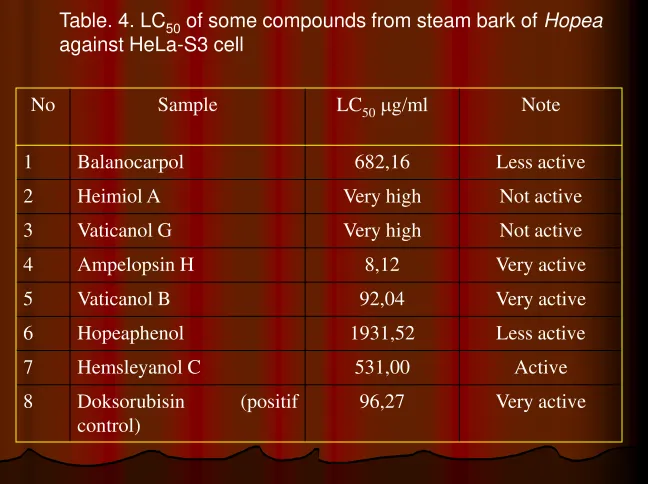
Table. 4. LC
50of some compounds from steam bark of
Hopea
against HeLa-S3 cell
No
Sample
LC
50g/ml
Note
1
Balanocarpol
682,16
Less active
2
Heimiol A
Very high
Not active
3
Vaticanol G
Very high
Not active
4
Ampelopsin H
8,12
Very active
5
Vaticanol B
92,04
Very active
6
Hopeaphenol
1931,52
Less active
7
Hemsleyanol C
531,00
Active
8
Doksorubisin
(positif
control)
Table. 5. LC
50of some compounds from steam bark of
Hopea
against Raji cell
No
Sample
LC
50g/ml
Note
1
Balanocarpol
277,58
Active
2
Heimiol A
Very high
Not active
3
Vaticanol G
11050,96
Not active
4
Ampelopsin H
91,07
Very active
5
Vaticanol B
107,00
Very active
6
Hopeaphenol
135,64
Active
7
Hemsleyanol C
166,84
Active
Hela S3 cell lines Hela S3 cell lines
before experiment after experiment
Raji cell lines Raji cell lines
before experiment after experiment
FITOFARMAKA ANTIHEPATOTOKSIK EKSTRAK TUMBUHAN H. MENGARAWAN
Uji aktivitas antihepatotoksik (Uji Farmakologi)
-Dosis 75 – 300 mg/kg BB -Dosis 10-50 mg/kg BB
Uji keamanan :
• Toksisitas acut
• Toksisitas subkronis
• Teratogenik
• Mutagenik
Standarisasi :
• Bahan baku
• Proses ekstraksi
• Senyawa aktif
(balanokarpol)
Formulasi Shelf life produk
Uji Praklinik Produk Jadi
• Toksisitas acut
• Toksisitas subcronis
Uji Klinik (Fase 1, 2,3,4)
Analisis proses produksi;
pemasaran Obat herbal
terstandar (Pendaftaran
Conclusion
Molecular structure of oligoresveratrol have ben found in the Hopea
genus included dimer, trimer and tetramer with resveratrol. The structures of the oligoresveratrol isolated contain a heterocyclic ring namely trans -2-aryl-2,3-dihydrobezofuran, originated from oxidative coupling between two unit of resveratrol to produce (-)-ε-viniferin (2) and other compounds. These structures are very interesting and showed interesting biological activity, such as antibacterial, anticancer, antihepatotoxic, and anti-HIV
Acknowledgements
This work was supported by Competitive research (HB 2004-2005); Fundamental research (2006-2007; Rapid (2007-2009) from Directorate General Higher
Education, Republic of Indonesia; competitive grant (Insentif Riset Dasar, Ristek-2008), Ministry Research and Technology, Republic of Indonesia The authors are grateful to my teamwork Prof. Dr. Nurfina Aznam and Retno Arianingrum, M.Si