MOH. SHOHIBUDDIN (editor)
Ranah Studi Agraria
P
enguasaan
Tanah dan Hubung
an A
gr
aris
RANAH
Studi Agraria
Sekolah Tinggi Pertanahan Nasional (STPN) Jl. Tata Bumi No.5, Banyuraden, Gampingan, Sleman,
Studi-studi Survei Agro Ekonomi (SAE) pada pertengahan 1960-an hingga awal 1980-1960-an berada dalam konteks ketika strategi pembangunan Indonesia “berbalik arah”: dari kebijakan Reforma Agraria yang menekankan pada perubahan struktural, menjadi kebijakan Revolusi Hijau yang menekankan pada perubahan teknologi. Bagaimana dampak dari pergeseran strategi pemba-ngunan ini pada hubungan kerja, penguasaan tanah, dan pem-bentukan kelas di pedesaan digambarkan secara rinci dalam laporan-laporan studi SAE yang ditulis oleh Gunawan Wiradi dan para koleganya dalam buku ini. Laporan-laporan itu sampai sekarang masih tetap relevan karena berbagai masalah yang diungkapkannya merupakan masalah kronis dan persisten yang sampai kini pun masih dihadapi oleh bangsa ini.
__________________
“In all the work of the SAE … from 1972 onwards we can feel the constant presence of Gunawan Wiradi, 'leading from behind'. His quiet wisdom, knowledge, his historical perspective and his great attention to detail and method, as exemplified in the chapters collected in this book, have earned him the enduring respect of all those interested in the struggle against agrarian poverty and inequality in Indonesia.”
— Prof. Ben White (Institute of Social Studies, The Hague)
“Tulisan-tulisan berdasarkan penelitian empirik mengenai hubungan antara Revolusi Hijau dengan percepatan dinamika sosial-ekonomi pedesa-an ypedesa-ang dipersembahkpedesa-an buku ini datpedesa-ang tepat waktu. Sudah saatnya kita menelaah kembali dinamika hubungan produksi dan penguasaan sumber-daya di pedesaan dan mengalihkan orientasi penelitian pada aspek-aspek mendasar ini karena bayang-bayang Revolusi Hijau kedua merangsek bertambah dekat dan kita dihadapkan pilihan-pilihan yang menentukan.” —Dr.Satyawan Sunito (Departemen Sains Komunikasi dan
Pengembangan Masyarakat, Fakultas Ekologi Manusia IPB)
Gunawan Wiradi
Benjamin White
William L. Collier
Soentoro
Makali
Chris Manning
Penguasaan
Tanah dan Hubung
an Agraris
“Pemahaman utuh meng
enai masalah-masalah agr
aria yang hendak ditang ani
melalui Reforma A
graria mutlak diperluk
an, apalagi dalam k
onteks keragaman
sosial, budaya, dan tenurial y
ang mencirikan masy
arakat kita.Kumpulan tulisan
Gunawan Wiradi dan par
a koleganya ini mengulas masalah-masalah agr aria
yang mencuat ketika “jalan pin
tas” Revolusi Hijau digia
tkan, sementara
ketimpangan agraria w
arisan sistem feodal dan k
olonial tidak dipersoalk an.”
— Prof.Endriat
mo Soetarto (Re
ktor Sekolah Tinggi Pe
rtanahan Nasional)
Undang-undang Republik Indonesia Nomor 19 Tahun 2002 tentang Hak Cipta
Lingkup Hak Cipta
Pasal 2 :
1. Hak Cipta merupakan hak eksklusif bagi Pencipta atau Pemegang Hak Cipta untuk mengumumkan atau memperbanyak ciptaannya, yang timbul secara otomatis setelah suatu ciptaan dilahirkan tanpa mengurangi pembatasan menurut peraturan perundang-undangan yang berlaku.
Ketentuan Pidana
Pasal 72 :
1. Barangsiapa dengan sengaja atau tanpa hak melakukan perbuatan sebagaimana dimaksud dalam Pasal 2 ayat (1) atau Pasal 49 ayat (1) dan ayat (2) dipidana dengan pidana penjara masing-masing paling singkat 1 (satu) bulan dan/atau denda paling sedikit Rp 1.000.000,00 (satu juta rupiah), atau pidana penjara paling lama 7 (tujuh) tahun dan/atau denda paling banyak Rp 5.000.000.000,00 (lima milyar rupiah).
Editor: Moh. Shohibuddin
Sekolah Tinggi Pertanahan Nasional, 2009
Gunawan Wiradi
Benjamin White
William L. Collier
RANAH STUDI AGRARIA:
PENGUASAAN TANAH DAN HUBUNGAN AGRARIS
©2009 Gunawan Wiradi dkk.
Reproduksi tulisan-tulisan dalam buku ini dilakukan atas seizin para penerbitnya.
Editor : Moh. Shohibuddin
Cover : Ronny Agustinus (TINTA Creative Production) Layout : Eja Art Design
355 + lxvii hlm, 14 x 21 cm ISBN : 978-602-8129-54-1
Cetakan pertama, Mei 2009
Diterbitkan oleh:
Sekolah Tinggi Pertanahan Nasional Jl. Tata Bumi No. 5
Sleman, Yogyakarta
Telp. 0274-587239 Fax. 0274-587138
Bekerja sama dengan
Kata Sambutan
Ketua Sekolah Tinggi Pertanahan Nasional
“Reforma Agraria Membutuhkan
Pengumpulan Data yang Lengkap”
Dalam mukadimah UUD 1945 yang ditegaskan kembali
dalam pasal 33 UUD 1945, ditemukan ada jejak kesadaran sejarah yang direkam dengan sangat baik. “Bumi, air dan
keka-yaan alam yang terkandung di dalamnya dikuasai oleh negara
dan dipergunakan sebesar-besarnya untuk kemakmuran rak-yat”. Dengan kata lain, urgensi Reforma Agraria (RA)1 yang
menggagas tentang perlunya perubahan tata agraria yang lebih
1 Esensi Reforma Agraria adalah restrukturisasi (penataan ulang
Ranah Studi Agraria
berkeadilan, bermakna pokok sebagai sebuah proses
pembe-basan. Pembebasan dari sejarah kelam rakyat Indonesia yang begitu panjang sejak masa kerajaan-kerajaan lokal, kolonial,
dan bahkan pasca kemerdekaan.
Secara singkat, ada tiga bentuk ketimpangan yang
dimun-culkan oleh struktur agraria yang bercorak kolonial dan feodal tersebut. Pertama, ketimpangan dalam hal struktur
“pemi-likan”/”penguasaan” tanah dalam skala besar oleh swasta asing
dan tuan tanah feodal. Kedua, ketimpangan dalam hal “perun-tukan” tanah, misalnya dengan adanya penetapan hutan-hutan
produksi untuk kepentingan ekstraksi hasil hutan oleh
peme-rintah kolonial. Dan ketiga, ketimpangan yang timbul akibat incompatibility dalam hal persepsi dan konsepsi mengenai
agraria, yaitu antara penguasa kolonial yang menggunakan konsep-konsep hukum positif dari Barat dengan komunitas
lokal atau masyarakat adat yang mengenal hak atas tanah
ber-basis tradisi dan budaya mereka (Wiradi, 2000).
Pengalaman pahit hidup di bawah penjajahan agraria
bang-sa asing maupun para penguabang-sa feodal itulah yang telah me-numbuhkan kesadaran para founding fathers untuk
mendob-rak tatanan agraria lama yang menindas dan mewujudkan tatanan baru yang menjamin kemakmuran bangsa. Inilah salah
satu tujuan pokok “revolusi kemerdekaan”. Hal itu berarti,
perjuangan agraria langsung atau tak langsung menjadi agenda utama dalam proses pembentukan karakter bangsa yang
Kata Sambutan
bebaskan, termasuk dalam hal ini bagi perjuangan membangun
ekonomi bangsa yang bertumpu pada kekuatan nasional, mau-pun bagi konfigurasi baru hukum dan kelembagaan agraria
yang hendak ditata di masa kemerdekaan. Di sinilah tepatnya perbincangan mengenai politik agraria nasional mengemuka,
yakni bahwa pada awalnya ia merupakan bagian penting dari perjuangan kemerdekaan (nasionalisme), dan selanjutnya
sebagai bagian dari upaya pembangunan untuk mengisi
kemer-dekaan (nationhood).
Perubahan ekonomi politik selama satu dasawarsa terakhir
ini, pasca reformasi, ternyata belum mewujudkan trend
ke-adilan sosial bagi rakyat Indonesia. Persoalan struktural yang dihadapi, seperti: kemiskinan, pengangguran, konsentrasi
penguasaan aset oleh sekelompok kecil orang, sengketa dan konflik agraria, krisis pangan dan energi, penurunan kualitas
lingkungan hidup, dan krisis finansial global yang terjadi
akhir-akhir ini disertai efek dominonya di sektor ekonomi riil, sung-guh-sungguh makin melemahkan akses lapisan masyarakat
bawah terhadap hak-hak dasar mereka.
Data kemiskinan dari BPS pada Maret 2007 menunjukkan
bahwa jumlah orang miskin di Indonesia mencapai 37,17 juta jiwa atau 16,58 persen dari total populasi tingIndonesia. Di
kawasan perkotaan, percepatan kemiskinan tersebut adalah
13,36 persen, sedangkan di kawasan perdesaan mencapai 21,90 persen. Ini menunjukkan bahwa kemiskinan paling
banyak dialami oleh penduduk pedesaan. Dari total penduduk miskin di Indonesia, sekitar 66 persen berada di pedesaan dan
56 persen di antaranya menggantungkan hidup dari pertanian,
Ranah Studi Agraria
Jika negara ini hendak mengentaskan kemiskinan di
pede-saan, maka mau tidak mau harus memberikan aset tanah pada rakyat miskin. Selanjutnya, tentu saja harus diikuti dengan
peningkatan akses kepada modal, teknologi, dan pasar. Dalam kerangka inilah pentingnya menjalankan RA sebagai jalan ke
luar untuk mengatasi persoalan struktural yang dihadapi oleh petani. RA penting dijalankan sebagai agenda bangsa dan
strategi dasar negara untuk membangun struktur politik,
eko-nomi dan sosial yang berkeadilan.
Pelaksanaan RA yang berhasil mustahil dilakukan tanpa
didasari oleh penelitian yang serius, teliti dan terus menerus.
Pemahaman yang utuh mengenai masalah-masalah agraria yang mau ditangani, apalagi dalam konteks keragaman (sosial,
budaya, tenurial) yang mencirikan masyarakat kita, mutlak diperlukan sebagai dasar untuk menetapkan kebijakan dan
program RA yang mau dijalankan. Kalau RA merupakan
ja-waban, maka tentunya masalah-masalah yang mau dipecahkan melalui RA harus dikenali terlebih dulu dengan sebaik-baiknya.
Bagaimana ketimpangan penguasaan tanah yang terjadi, apa karakter kemiskinan dan sumber pendapatan rumahtangga di
pedesaan, bagaimana situasi ketenagakerjaan dan lapangan pekerjaan di desa, bagaimana hubungan desa-kota, krisis
so-sial-ekologi dan krisis produktivitas apa yang sedang
berlang-sung, apa akar permasalahan di balik konflik dan sengketa agra-ria yang mencuat, kecenderungan-kecenderungan global
se-perti apa yang sedang berlangsung di pedesaan seiring dengan perluasan modal dan investasi, dst. dst.
Kumpulan tulisan Gunawan Wiradi dan para koleganya
penelitian-Kata Sambutan
penelitian tingkat mikro yang mengungkapkan salah satu
ba-gian dari permasalahan agraria di atas. Dalam hal ini adalah terkait dengan proses sosio-agraria yang berlangsung di
tengah-tengah masyarakat ketika intensifikasi usahatani padi sawah skala rumahtangga digenjot melalui “jalan pintas”
revolusi hijau yang padat modal, sementara konteks ketim-pangan agraria warisan feodalisme dan kolonialisme tidak lagi
dipertanyakan dan dianggap given. Pengalaman menunjukkan
bahwa “jalan pintas” semacam ini telah gagal menciptakan lan-dasan pembangunan yang kokoh, dan dengan sendirinya gagal
mewujudkan arah “transformasi agraria” seperti dicita-citakan
para pendiri bangsa dalam Pasal 33 UUD 1945.
Sekolah Tinggi Pertanahan Nasional sebagai lembaga
pen-didikan keagrariaan di bawah BPN RI menganggap penting penelitian-penelitian yang dapat menggambarkan dinamika
pedesaan dan berbagai permasalahan agraria yang terjadi
dalam tarikan waktu yang panjang, sebagaimana dilakukan oleh Gunawan Wiradi dan para koleganya. Oleh karena itu, satu jenis
penelitian yang bersifat berulang dan kontinyu menjadi sebuah kebutuhan sendiri di STPN khususnya maupun di kalangan
lembaga pendidikan dan penelitian pada umumnya. Bagi STPN sendiri, jenis penelitian inilah yang dalam program penelitian
STPN disebut sebagai “penelitian sistematis” yang
mencermin-kan penelitian institusi yang berjangka panjang, sementara penelitian mandiri oleh para dosen disebut sebagai “penelitian
individual”. Dengan pengembangan dua jenis penelitian ini maka STPN dengan posisinya yang strategis sebagai institusi
pendidikan kedinasan berharap dapat mengaitkan secara
kebi-Ranah Studi Agraria
jakan di lingkungan BPN RI.
Penghargaan khusus perlu disampaikan kepada sang “guru” agraria Gunawan Wiradi yang telah menyumbangkan
karya-karya tulisnya dalam buku ini, maupun dalam kontri-businya yang terus menerus kepada STPN selaku anggota
Dewan Penyantun.
Yogyakarta, 10 Mei 2009
Ketua Sekolah Tinggi Pertanahan Nasional,
Kata Pengantar Ben White
1Gunawan Wiradi, The Agro Economic
Survey and Indonesia’s Green Revolution
A. Introduction: Gunawan Wiradi and the Agro Economic Survey
It is an honour and a pleasure to introduce this second
volume of studies by Gunawan Wiradi,2 published on the
occa-sion of his receiving the degree of Doctor Honoris Causa at his alma mater Bogor Agricultural University.
1 Institute of Social Studies, The Hague ([email protected]). Parts of this
chapter draw on earlier publications of the author, particularly White 2000 and White 2005.
2 The first volume, contained Wiradi’s works on research
Ranah Studi Agraria
The seven studies on land tenure and agrarian relations
by Gunawan Wiradi collected in this book were originally pub-lished between 1972 and 1989, and are all based on field
re-search carried out during 1972–1983. This was the period of Indonesia’s ‘green revolution’, a time in which Indonesia
trans-formed its smallholder rice economy from being the world’s biggest rice importer to a situation of near self-sufficiency. All
the chapters in this book result from the work carried out by
Gunawan Wiradi as a staff member of the Agro Economic Survey (Survei Agro Ekonomi—SAE), which at that time was the most
important source of information on the social and economic
impact of intensification in Indonesian smallholder rice farming. In this introduction I will try to set the work of the SAE in
broader context and explain the important role it played in furthering the understanding of—and debates
about—pro-cesses of agrarian change in Indonesia. I will try to trace the
evolution of studies based on SAE data from mainly descrip-tive accounts of change to more analytically systematic
at-tempts to explain change, in which we can see the influence of three main traditions: neo-populism, the neo-classical induced
institutional innovation theory, and political economy ap-proaches. This includes some discussion of the role of the
pres-ence and influpres-ence of foreign sponsorship, foreign consultants3
and visiting scholars during this period in the history of SAE, a presence whose impact was often stimulating but perhaps not
always completely positive.
3 Including this author, who was assigned full-time to the SAE as
Kata Pengantar
B. Beginnings 1963 – 1969: from Agrarian Reform to “Getting Agriculture Moving”
Although many of us remember the SAE’s role during the
first half of the Suharto ‘New Order’ regime, the SAE was actu-ally a creation of the last “years of living dangerously” of Sukarno’s ‘Old Order’. The SAE was established in 1965 by the
Indonesian government “to compile data on and assess agri-cultural resources and the condition of rural society, and to evaluate programmes already in operation and their effects
on agricultural production and rural society” (de Vries 1969: 73).
Discussions on establishing the SAE has been held with the UN Food and Agricultural Organisation in 1963 but were
inconclusive. In 1964 the government approached the Ford Foundation for assistance, which was originally provided through the Institute of Social Studies in The Hague under the
coordination of the Institute’s Rector Professor Egbert de Vries. The SAE was formally established in February 1965, administered by a Working Body (Badan Kerja) chaired by
Professor Kampto Utomo (Sajogyo). Within a few years more than one hundred university-based researchers, and another hundred fieldworkers (mainly students from agricultural facul-ties of IPB, UI, Unpad and UGM) had become recruited and
involved in seventeen different research projects. Reflecting on the SAE’s first years, Professor de Vries pointed to the crea-tive and flexible organization created by Professor Sajogyo,
Ranah Studi Agraria
approaches to research” which Professor Sajogyo had set out,
according to de Vries:
“That the Indonesian peasant acts rationally in an economic sense, although within very narrow sociological, economic and administrative constraints; that detailed knowledge about this ‘operational climate’ of the peasant is not currently available, and that […] new data were urgently needed; and that students and staff members of agricultural institutions with real interest in the welfare of the village can earn the confidence of the inhabitants and obtain honest and realistic answers” (de Vries 1969: 75).
It is important to remember the policy context of these early years; this is the period in which the focus in agricultural
development, in Indonesia and many other countries, shifted
from structural change through “agrarian reform” to techno-logical change through the “green revolution”. At the time of
the discussions leading to SAE’s establishment, the issue of agrarian reform was still firmly on the agenda, among both the
political parties and the agricultural faculties. It was also on
the agenda of donor organizations such as USAID, the World Bank, the Ford Foundation and the (Rockefeller-funded)
Agri-cultural Development Council (ADC) who saw agrarian reform as a necessary anti-communist strategy. This may be seen, for
example, in the three consultancy visits to Indonesia made by
the US-based, anti-communist land reform adviser Wolf Ladejinsky, sponsored by the Ford Foundation and the
Agri-cultural Development Council in 1961, 1962 and 1963.4
4 Two of Ladejinsky’s reports from these visits, originally written in
Kata Pengantar
In 1965 the ADC staff in Indonesia had been removed from
their posts in Bogor (J. Price Gittinger and Ralph Allee) and Medan (David Penny) as the result of “persistent anti-Western
pressures”,5 but by late 1966 the ADC (like the Ford Founda-tion and Asia FoundaFounda-tion) were being urged by USAID to
re-sume their presence in Indonesia. ADC had sought the reac-tions of various groups in IPB, in the government and in the
military and reported that IPB’s new rector was enthusiastic,
and,
“most IPB staff were favourable, appreciating the Council’s support for research projects during Indonesia’s ‘difficult pe-riod’ [though] some criticism was made to former foreign ‘ad-visor’ types who did no research, no teaching, but merely handed out gratuitous advice on what the Indonesian ought to do to imitate America”.6
Already in 1966 the Ford Foundation’s representative in In-donesia was discussing the possibility of ADC’s assuming
res-ponsibility for their support to the SAE, in place of the ISS. The Ford Foundation was “most anxious for ADC to take over the
programme in place of the Netherlands Institute”.7 The ADC had already for some years been supporting various training
and research activities at IPB.
5 ADC Board of Trustees Agenda, 11 January 1967 (Rockefeller Archive
Centre [RAC] , ADC IV 3 B 1.11, Box 5 Folder 32).
6 ADC Board of Trustees Agenda, 11 January 1967 (RAC, ADC IV 3 B
1.11, Box 5 Folder 32). The critical remarks possibly refers to staff of the University of Kentucky who had been assigned to IPB in a much-criticised project.
7 Agricultural Development Council, Meeting of the Board of
Ranah Studi Agraria
The reasons for the Ford Foundation’s turning to ADC
rather than ISS are not clear. ISS at the time represented a relatively broad spectrum of theoretical and political views
on development issues, emphasizing interdisciplinarity and with very few adherents of mainstream neo-classical
economics. The ADC was more homogeneous, and rather heavily biased towards training in Agricultural Economics in
the neo-classical mode, though also recognizing and
supporting other disciplines such as rural sociology. The ADC’s general ‘philosophy’ at the time is perhaps best encapsulated
in (ADC Executive Director) A.T. Mosher’s Getting
Agricul-ture Moving: Essentials for Development and Modernisation (Mosher 1965) which was widely distributed free in Indonesia
and other Asian countries.8 This book, with its emphasis on the “five essentials” and the “five accelerators” of agricultural
modernization, reflects the shift away from politically
diffi-cult measures like land reform and the new focus on “green revolution” productivity-enhancing innovations, in the
frame-work of then-dominant ‘modernization theory’ in rural develop-ment discourse. Land reform is not develop-mentioned in the book.
While it is often thought that discussion of land reform and its implementation stopped abruptly with the change of
regime in 1966/67, it is interesting to note that the SAE was
still engaged in one study on “Evaluation of the Land Reform on Java and Bali” in 1969/70 (Sajogyo 1970: 2).9 And when
8 40 copies were donated to the SAE, 62 to IPB, 20 to other
agricul-ture faculties in Indonesia, and 10 to MIP (Leknas). (Correspon-dence R. Allee to R. Borton, 1 September 1966. RAC, ADC IV 3 B 1.4).
Kata Pengantar
the IPB hosted a major “Symposium on Rural Modernization”,
which had as its aims to test the main concepts of Mosher’s Get-ting Agriculture Moving among a heterogeneous group of 80
experts, running for a total of 16 days spread over a period of ten weeks during September-November 1968, one full day was
de-voted to “Land reform, agricultural land and land use” among all the specialized sessions devoted to production, processing, soils,
water, fertilizer, farmer incentives and ‘accelerators’.10
In 1967 the ADC received a new grant from the Ford Foun-dation to appoint a full-time “Participating Consultant” to the
SAE. The new consultant, the agricultural economist Dr.
Willi-am L. Collier, arrived soon thereafter and played an impor-tant role in the SAE’s work in tracing the social and economic
impacts of Indonesia’s green revolution, to which we now turn.
C. Tracking the Green Revolution: the IPS and SDP Surveys, 1969 - 1983
In 1969 the SAE initiated a major, multi-year study of the
“Factors Affecting the Production Impact of the High-Yielding Rice Varieties” (commonly shortened to the “Rice
Intensifi-cation Surveys”, Intensifikasi Padi Sawah or IPS), with the objective of identifying “the crucial factors that affect the
farmer’s use of the high-yielding varieties and the acceptance
of the new technology that accompanies these new varieties”.
10 ‘Symposium on Rural Modernization, in Relation to the National
Ranah Studi Agraria
A sample of 1100 farmers was selected in 37 sample villages in
the major irrigated rice-producing areas of Indonesia (20 in Java, 13 in other islands) and re-visited at the end of each rice
harvest season, for four years. There was no other systematic, multi-village study at this time, and the SAE series of “Research
Notes”, written as soon as possible after the conclusion of each survey round and widely circulated in ‘stencil’ form, became
the most important source of information on what was
happe-ning in smallholder rice agriculture during these early years of the Bimas rice intensification programme.
From the very first years foreign scholars were involved
in the SAE’s work. One full-time consultant was provided by ADC and others came as short-term consultants; meanwhile
many other scholars came to use SAE data and villages for their own research. One of the first of these was Richard Franke,
whose Harvard University PhD The Green Revolution in a
Javanese Village based on research in 1970-71 in a single SAE village in Pemalang, was one of the first English-language studies
to point to the contradictions emerging when Bimas credit, new rice varieties and inputs came in contact with “village social
relations of production” (Franke 1972; see also Franke 1974). The IPS project was, in its original conception, firmly
production-oriented. The first rounds of the surveys covered
only “farmers” (about 30 farmers per village, including a spe-cial sample of five “large farmers” per village) and were
fo-cused on the problems of technology adoption. In 1971 howe-ver the project conducted an “agricultural census” of about
200 households in each village, this time including the
Kata Pengantar
which had no rice-fields (averaging, in the sample villages,
more than 40 percent in West Java, 27 percent in Central Java and 50 percent in East Java), and the large numbers of both
landless and near-landless who depended on agricultural wages for part of their incomes (AES 1972; Collier and Sajogyo
1972b). From this point onwards the SAE combined its sur-veys on production and marketing problems with a
consis-tent interest in the impact of smallholder intensification on
agricultural employment and labour relations.
The SAE’s first report on employment impacts had been
rather optimistic, noting that nearly all the sample farmers
used hired labour as well as family labour and that those using the HYV’s used about 50 more person-days of hired labour
per hectare than those using local varieties. Collier and Sajogyo concluded:
“If the IR and Pelita varieties are adopted on a majority of the rice farms in irrigated areas on Java, the employment of hired labour will definitely increase, maybe even attracting people who have migrated to the cities” (Collier and Sajogyo 1972a: 8).
In another report from the same period, however, the same authors were less optimistic, concluding that
Ranah Studi Agraria
It was at this time that Gunawan Wiradi joined the SAE
after some years in intellectual ‘exile’, and immediately became involved in the SAE’s field research and publications. He joined
the SAE exactly at the moment when the SAE researchers first began to attempt more systematic research, through the
village re-studies, on the implications of the green revolution and the Bimas programme for income distribution and the
role of institutional changes.
From the early 1970s onwards reports had begun to emerge of changing harvesting practices in the main rice
pro-ducing areas of Java. Among these were the shift from
open-entry to closed systems of labour recruitment, through vari-ous means of restricting the numbers of harvesters allowed to
enter the field and earn a harvest wage; the rise and spread of tebasan (the sale of the standing crop before the harvest,
allowing the buyer to bring his/her own harvesters), and
vari-ous other forms of exclusionary labour arrangements such as kedokan or ceblokan in which the worker, to get access to a
harvest wage, must perform one or more of the pre-harvest tasks (such as transplanting or weeding) without pay; and shifts
in the technology of harvesting—from the ani-ani to the arit (sickle)—and from storage in bundles (untilan) of stalk padi to
immediate threshing in the field or at the owner’s house. These
changes were also considered responsible for shifts on the gen-der division of labour, with men being increasingly seen in
harvest work which had previously been reserved for women.11
11 Various studies on these changes from the 1970s and early 1980s
Kata Pengantar
One of the first of these reports is reproduced as Chapter 1
of this book, ‘Recent changes in rice harvesting methods—some serious social implications’ (Collier, Wiradi and Soentoro
1973). These changes were further analysed, in more system-atic form, in the article reproduced as Chapter 2 of this book ,
‘Sistim Tebasan, Bibit Unggul dan Perubahan Agraria di Pedesaan Jawa’, also published internationally as
‘Agricul-tural technology and institutional change in Java’ (Collier,
Soentoro, Wiradi and Makali 1974a and 1974b).
These reports were very influential, both in Indonesia and
outside, because information at the time was so scarce and the
SAE’s multi-sited sample methodology provided more sys-tematic information than other studies in single villages. The
report on the “rather explosive changes” which the SAE re-searchers traced to 1972 in various areas in Java was in fact
based on their finding tebasan in only four of the SAE’s 20
sample villages in Java, and reports from other researchers who had encountered tebasan in some other districts. But
this was enough, for example, for one Jakarta-based Ford Foun-dation adviser who had read the reports to report to a meeting
of BAPPENAS in 1975 that “tebasan is spreading like a wild fire across the plains of Java”.12 These early studies also
stimu-lated many other researchers, both Indonesian and foreign,
to explore the dynamics of labour relations in rice agriculture (Budhisantoso 1975; LPIS 1976; Sairin 1976; Stoler 1975).
To a present-day researcher in Indonesia’s rice-growing villages, where few people are absolutely destitute or hungry,
12 Personal communication from the adviser concerned to the
Ranah Studi Agraria
where non-farm incomes are growing in importance and where
many people (especially the younger generation) are not in-terested in agricultural work, it may seem odd that so much
importance was attached—by villagers and researchers—to the ways in which rice was harvested, and rice harvesters
rec-ruited and paid. The way in which labour is recrec-ruited and paid for harvest work is an important determinant of the division
of the agrarian product between those who control land, and
those who provide labour. The rice harvest, in particular, is one of the key agrarian ‘moments’ at which these divisions are
clearly visible; these moments are also arenas of tension and
potential conflict, of interest not only in themselves but also because of what they reveal about the internal dynamics of
the communities in which they happen.
We must remember that in the 1960s and 1970s, for
land-less and land-poor households harvest labour often
repre-sented the household’s single most important source of house-hold income. Researchers were not exaggerating when they
described women harvesters lining up at the edges of the fields hours before a harvest was due to begin, often in their
hun-dreds, waiting for access to a crowded harvest which might be finished in 15-20 minutes, or the harvesters’ reactions of
fusion, indignation and sometimes open violence when
con-fronted with restrictions on what they saw as their ‘communal right’ to harvesting work and wages.
These early reports usually lacked historical depth, and sometimes reported as “new” phenomena which were not new
at all. They reflected and contributed to a rather static and
Kata Pengantar
which the new arrangements were thought to be displacing,
based on the Geertzian, poverty-sharing model of an inclusio-nary agrarian system operating “to provide everyone with some
niche, however small, in the overall system”.13 Collier, Wiradi and Soentoro (in Chapter 1 of this book) suggested that “by
tradition, Javanese and Sundanese rice farmers do not restrict anyone who wishes to participate in the harvest of their rice
fields.“, and “the traditional shares were seven, eight or nine
for the owner to one for the harvester” (Collier et al. 1973: 36-7). A review of studies of rice harvesting in Java prior to the
“green revolution” of the 1970s, however, suggests that the
idea of a timeless tradition of open harvests and high, fixed bawon shares is to a large extent a myth; while some elements
were stable and near-universal, others were flexible, variable and contested. The relatively stable features were the use of
the ani-ani, the system of labour payment in kind rather than
in cash,14 and the prevalence of women in harvest work. More variable and volatile were the modes of labour recruitment
and payment, which varied from place to place and also changed over time, in response to changes in the larger
eco-nomy and to local, short-term changes in labour supply and demand; we may find open and closed harvests appearing and
13 Geertz 1963, p. 82.
14 Even these, however, were not completely universal or
Ranah Studi Agraria
disappearing, and enormous variations in the level of bawon
payments, from as high as ¼ and 1/3 to as low as 1/36.15 The careful work of some SAE researchers on specific
as-pects of harvesting and other labour relations in the sample villages serves to confirm this wide variation and to warn us
against the assumption of a single, unchanging traditional sys-tem. Gunawan Wiradi’s research Note “Proses Panen dan
Alat-alat yang Digunakan” (‘The harvest system and harvesting
technology’ (Wiradi 1974) and Soentoro’s “Sistim Perburuhan Ngepak-ngedok di 6 Desa Sample di Jawa” (Soentoro 1973)
are examples of the patient groundwork done by the SAE
re-searchers, showing the complexities of labour relations in rice agriculture and their relationship to village social structure,
whose details sometimes escaped the attention of the foreign researchers and economists generally. Gunawan Wiradi’s note
on harvesting, for example, is one of the first to explain how
social relationships influence the level of bawon payments, with close kin earning harvest shares of as much as 1:2, tied
workers who had contributed pre-harvest labour 1:5, and ca-sual harvesters sometimes as little as 1: 23 (Wiradi 1974: 3), a
theme further elaborated by Ann Stoler (1977).
D. The SAE and Debates on Land, Labour and Class Formation
In 1975 the SAE initiated a new research programme
known as the ‘Rural Dynamics Study’ (Studi Dinamika Pede-saan or SDP). The SDP was a deliberate effort to place more
Kata Pengantar
explicit attention on issues of resource access, labour and
em-ployment and income distribution, and the ‘rural institutions’ linked to these processes, in both the farm and non-farm
sec-tors and in both lowland and upland villages. Due mainly to donor interest the SDP’s first and main efforts were
concen-trated on a single river basin in West Java, with later expan-sion on a smaller scale to East Java and South Sulawesi.
The SDP project got off to a rather slow start, since it had
been decided to begin with a massive survey of all 795 villages in the Cimanuk River Basin, with 1045 questions. The resulting
data were difficult to handle with the still primitive computer
facilities available at the time, and one of the few studies to make good use of them was Gunawan Wiradi’s M.Soc.Sc. thesis
at University Sains Malaysia (Wiradi 1978). In this thesis Wiradi takes a balanced, historical perspective on labour
arrangements, which helped to put the rise and decline of
tebasan, kedokan, ijon, maro/mertelu, gadai and similar prac-tices in perspective, in the context of the 1970s in which
“everything was happening at once”, as he puts it, in the rural areas of Java.
Besides this study, the SDP only began to produce interes-ting work after the team had selected a small number of sample
villages and initiated seasonal or annual surveys on the old
IPS model, but with broader scope (with more focus on insti-tutions, land tenure, nonfarm sector, etc. and increasingly
combining quantitative and qualitative work). The re-studies of SDP sample villages in 1983, and of some IPS villages in
1981 have provided two sets of multi-village re-studies, which
Ranah Studi Agraria
debate on agrarian changes. In the late 1970s and 1980s more
explicitly theoretical accounts began to emerge, and there-fore the possibility of more systematic debate on the causes
and consequences of change. Virtually all the important con-tributions to this debate were based on the SAE villages.
These debates have revealed several competing theoreti-cal frameworks, which were set out for the first time in Gillian
Hart’s Power, Labour and Livelihood: Processes of Change in
Rural Java (1986), derived from her 1978 PhD Thesis based on research in one of the SAE sample villages in Kendal
Dis-trict, Central Java.
While Gillian Hart was developing her ideas in a political-economy framework in one SAE village, the Japanese
agricul-tural economist Yujiro Hayami (former PhD student of Vernon Ruttan, who had replaced Art Mosher as the ASC’s Executive
Director in the early 1970s) went to two other SAE villages, at
the other end of Java, in search of data to support his theory of “induced institutional innovation”, a variant of the
neo-classi-cal “induced technologineo-classi-cal innovation” theory. Hayami’s re-search was designed to counter the approach of the Collier et
al. paradigm as represented in Collier at al. 1974a and 1974b, which Hayami called the “radical political economy
perspec-tive” although Hart is more accurate to describe it as
‘neo-populist’.
Hayami’s framework shared with the neo-populist (Collier
et al.) paradigm the idea that population pressure is a major force behind changing agrarian relations, but ascribes a
total-ly different role to the new green revolution technology. In
Kata Pengantar
the main factor in promoting inequality and class
differentia-tion, Hayami and his co-authors argued that the new techno-logies can counteract the decreasing returns to labour
rela-tive to land, and consequent concentration of land, which would otherwise follow from population pressure. In 1978, to
test these two contrasting paradigms Hayami and associates undertook detailed re-studies of two SAE sample villages in
Subang (West Java), one technologically stagnant and the
other technologically progressive. In both villages, it was argu-ed, the institutional changes in harvesting systems had
func-tioned to bring the implicit wage for harvesting down to the
level of the marginal productivity of labour, which is where neoclassical theory predicts it ought to be; the “induced
insti-tutional innovation” of ceblokan or kedokan was interpreted as a means of restoring equilibrium to the labour market. Based
on these findings and a parallel study in the Philppines, Hayami
and associates claimed a benevolent role for the ‘green revo-lution’ technologies, and by implication for the international
agricultural research system which had developed and pro-moted them; the same agricultural research system had also
provided support for Hayami’s research, as a project of the Agricultural Economics Programme of the Internatioal Rice
Research Institute (Hayami and Hafid 1979; Hayami and
Kikuchi 1981). One evening in 1981, while drinking whisky with Professor Hayami, I asked him why he was so keen to defend
the green revolution and counter the earlier conclusions of the SAE researchers. He explained that his target was actually
left-wing students, scholars and activists in Japan, who were
Ranah Studi Agraria
reports as evidence.
Five years later, both the ‘Collier et al.’ and the ‘Hayami et al.’ approaches were criticized by Gillian Hart. Her main
con-tribution was to underline the need to view the dynamics of agrarian relations in their broader social, and particularly their
socio-political context, by introducing the dimension of power (as in the title of her book Power, Labour and Livelihood,
1986a). Neither the neo-populist explanations of Collier et al.,
nor the neoclassical arguments of Hayami et al., she argues, can explain the timing and rapidity of the changes in Java
beginning in the late 1960s. Hart argued that kedokan/
ceblokan and other forms of interlocking agrarian transac-tions should be seen primarily as a means of social control,
involving principles of selectivity and exclusion to elicit labour compliance and create and reinforce relations of dominance
and dependency, as well as providing a cheap and effective
means of managing the labour process. Citing the evidence of Gerwani’s earlier campaign against ceblokan, and the efforts
of local officials in Krawang to ban the practice as a security threat, Hart argued that,
“the transformation of agrarian labour arrangements is a con-sequence not just of changing technology, labour availability and commercialization, but also of changing political condi-tions and the tensions and contradiccondi-tions which the institu-tional arrangements themselves generate” (Hart 1986b: 197).
Hart also introduced a novel argument about “state pa-tronage” in which the Indonesian New Order state was seen as
Kata Pengantar
forces), which together made it possible for landowners both
to invest cheaply in ‘green revolution’ production and at the same time to reduce costs and control labour through
exclu-sionary labour arrangements, in exchange for the political support of the rural elites who benefited from these
arrange-ments (Hart 1986b and 1989).
The SAE sample villages in Subang were the site of further
studies by Jonathan Pincus (in 1989-90) and Jan Breman
(1990, with Gunawan Wiradi—see Breman and Wiradi 1992 and 1995).16 Pincus—like Hayami and Hart, an agricultural
economist—directed his critique at the neoclassical theory of
“induced innovation” and particularly Hayami et al.’s version of it, and included the two villages studied by Hayami in his
three-village sample. He pointed to four weakness of the “in-duced institutional innovation” approach. It assumes wrongly
that “population pressure” is responsible for agrarian
inequali-ties; it ignores specific local agrarian histories, assuming that Javanese villages share a common past as “homogeneous
villa-ge communities”; it assumes a “closed” villavilla-ge community in which migrant labour plays no importanrt role, and it fails to
specify the mechanisms through which population growth is held to result in greater inequalities, or how the labour market
“disequilibria” induced by this process determine changes in
real wages, assuming that these links are automatic or me-chanical and ignoring the complex power relations involved
16 This collaboration has continued beyond the period described
Ranah Studi Agraria
(Pincus 1996: 48). Like Hart, the key factors in Pincus’
alterna-tive model are class power, relaalterna-tive bargaining power, and the struggles between contending classes (Pincus 1996: 136-7).
Where did Gunawan Wiradi and the SAE researchers place (or find) themselves in these theoretical debates, which on the
whole have been dominated by foreign scholars? The SAE’s own major synthesis volume Prospek Pembangunan Ekonomi
Pedesaan Indonesia (Faisal Kasryno ed. 1984), based on
re-studies in 1981-1982 of the SAE sample villages in West, Cen-tral and East Java and South Sulawesi conducted with the
sup-port of USAID, shows a variety of perspectives in the various
chapters, representing the different viewpoints of the SAE re-searchers themselves. Faisal Kasryno, an agricultural
econo-mist, relies firmly on the “induced (institutional) innovation” theories of Binswanger and Ruttan and Hayami and Kikuchi in
the analytical framework provided in Chapter 3, but is himself
critical of the declining shares of labour in the division of agri-cultural incomes in Chapter VI. Gunawan Wiradi and Makali in
the Chapter on land tenure and agrarian institutions (repro-duced in the present volume as Chapter V) take a rather
diffe-rent perspective, including some of the neo-populist arguments but also referring to a process of agrarian “class
differentia-tion” in the Javanese countryside and implicitly distancing
themselves from the Hayami et al. approach. Issues of agrarian differentiation and class formation were again discussed in
more detail in a further analysis of the same SAE re-study date from 9 villages in West, Central and East Java in White and
Wiradi’s (1989) contribution to the book on Agrarian
Kata Pengantar
(Hart, Turton and White eds 1989) which is reproduced as the
final chapter of this volume.
Thus, in the literature on impacts of intensification in
Java’s rice producing villages we can find a whole spectrum of theoretical perspectives, from neo-classical at one end of the
continuum to neo-marxist political economy at the other, with the neo-populist ideas of the early SAE publications
some-where in the middle, and all of them relying to a large extent
on the SAE village data. In this way the SAE sample villages have provided the ammunition for both the critics and the
apologists of Indonesia’s green revolution. 17
E. The SAE, Gunawan Wiradi and Land Reform
Towards the end of the 1970s it became possible, after some years of enforced silence, to raise issues of land reform
in Indonesia. The period 1978-1982 saw a revival of public interest in agrarian reform (as seen in the statements of public
officials, in academic writing and in the press media) which
later lost its initial momentum, followed by another period of quiet, roughly until the early or mid-1990s. The SAE, before
its dissolution as an independent research organization in 1982, was able to make a significant contribution to the
begin-ning of the new agrarian reform discourse, and as we may
ex-pect Gunawan Wiradi was a prime mover in these activities.
17 It is interesting to compare this with the role of Russian zemstvo
Ranah Studi Agraria
Around the time of the 1978 ‘Sumitro report’ on agrarian
problems in Indonesia and the participation of the Indone-sian delegation in the FAO’s World Congress on Agrarian
Reform (1979) the SAE initiated a series of five research train-ing workshops on ‘land tenure and agrarian relations’. Land
was also a core topic in the SAE-sponsored Workshop on Rural Social Economic History (1979), to which Gunawan Wiradi
and I contributed a study of “Patterns of Land Control in the
Cimanuk River Basin” (White and Wiradi 1980, reproduced as Chapter IV in the present volume). These experiences, and
the increasing authority of the SAE as a source of information
on land issues led to the initiative of a new collaboration between the SAE and its original partner the Institute of Social Studies, in
a comparative study of agrarian reform and our subsequent collaboration in the 1981 ‘Policy Workshop on Agrarian
Re-form in Comparative Perspective’. The report resulting from
this workshop (White and Wiradi 1984) is republished as a third volume in this series of selected works of Gunawan Wiradi.18
In all the work of the SAE during the period I have described, from 1972 onwards we can feel the constant
presence of Gunawan Wiradi, ‘leading from behind’. His quiet wisdom, knowledge, his historical perspective and his great
attention to detail and method, as exemplified in the chapters
collected in this book, have earned him the enduring respect of all those interested in the struggle against agrarian poverty
and inequality in Indonesia.
18 This third volume translated into Indonesian with new title:
Kata Pengantar
References
Agro Economic Survey (1972) ‘Agricultural Census in Thirty Three Villages Located in the Major Rice Producing Areas of Indonesia’. Bogor: Agro Economic Survey, Research Notes No. 6.
Breman, Jan (1992) ‘Kerja dan kehidupan buruh tani di pesisir Jawa’. Prisma 21 (3): 3-34.
Breman, Jan (1995) ‘Work and life of the rural proletariat in Java’s coastal plain’. Modern Asian Studies 29 (1): 1-44.
Breman, Jan and Gunawan Wiradi (2002) Good Times and Bad Times in Rural Java. Leiden: KITLV Press. Budhisantoso, S. (1975) Rice Harvesting in the Krawang
re-gion (West Java) in Relation to High-Yielding Varie-ties. Melbourne: Centre for Southeast Asian Studies, Monash University.
Collier, William L. and Sajogyo (1972a) ‘Employment oppor-tunities created by the high-yielding varieties in seve-ral areas of Java’. Bogor, Agro Economic Survey Indonesia, Research Notes No. 8.
Collier, William L. and Sajogyo (1972b) ‘Villagers’ employ-ment, sources of income, use of high yielding varie-ties, and farm labourers in the major rice producing regions of Indonesia’. Bogor, Agro Economic Sur-vey Indonesia, Research Notes No. 11.
Collier, William L., Gunawan Wiradi and Soentoro (1973) ‘Re-cent changes in rice harvesting methods: some seri-ous social implications’. Bulletin of Indonesian Eco-nomic Studies 9 (2): 36-45.
Ranah Studi Agraria
Collier, William L., Soentoro, Gunawan Wiradi and Makali (1974b) ‘Agricultural technology and institutional change in Java’. Food Research Institute Studies 13: 169-194.
Franke, Richard W. (1972) The Green Revolution in a Javane-se Village. Unpublished PhD thesis, Harvard Univer-sity.
Franke, Richard W. (1974) ‘Miracle seeds and shattered dreams in Java’. Natural History, January 1974.
Geertz, Clifford (1963) Agricultural Involution. Berkeley: Uni-versity of California Press.
Hart, Gillian (1986a) Power, Labour and Livelihood: Processes of Change in Rural Java. Berkeley: University of Cali-fornia Press.
Hart, Gillian (1986b) ‘Interlocking transactions: obstacles, precursors or instruments of agrarian capitalism?’ Journal of Development Economics 23: 177-203. Hart, Gillian (1989) ‘Agrarian change in the context of state
patronage’ in G. Hart, A. Turton and B. White (eds) Agrarian Transformations: Local Processes and the State in Southeast Asia. Berkeley: University of Cali-fornia Press: 31-49.
Hayami, Yujiro and Anwar Hafid (1979) ‘Rice harvesting and welfare in rural Java’. Bulletin of Indonesian Econo-mic Studies 15 (2): 94-112.
Hayami, Yujiro and Masao Kikuchi (1981) Asian Village Economy at the Crossroads: An Economic Approach to Institutional Change. Tokyo: Tokyo University Press.
Kasryno, Faisal ed. (1984) Prospek Pembangunan Ekonomi Pedesaan Indonesia. Jakarta: Yayasan Obor Indo-nesia.
Kata Pengantar
as they Apply to the Cultivation of Rice. Batavia: Institute of Pacific relations, National Council for the Netherlands and the Netherlands Indies.
LPIS (1976) Tebasan dan beberapa perubahan sosial ekonomi lain di pedesaan Jawa Tengah (Tebasan and other social-economic changes in rural Central Java). Sala-tiga: Lembaga Penelitian Ilmu-Ilmu Sosial, Univer-sitas Kristen Satya Wacana.
Mosher, Art T. (1965) Getting Agriculture Moving: Essentials for Development and Modernization. New York: Praeger Publishers for the Agricultural Development Council.
Pincus, Jonathan (1996) Class, Power and Agrarian Change. London: Macmillan.
Sajogyo (1970) ‘Summary of Agro-Economic Survey Activi-ties from September 1968 to October 1969’. New York: The Agricultural Development Council, No-vember.
Sairin, Sjafri (1976) ‘Beberapa masalah derep: studi kasus Yogyakarta’ (Problems in harvest labour: a case study of Yogyakarta). Prisma 5 (9): 59-67.
Soentoro (1973) ‘Sistim perburuhan ngepak-ngedok di enam desa sample di Jawa’. Bogor: Agro Economic Sur-vey.
Stoler, Ann (1975) ‘Some socio-economic aspects of rice har-vesting in a Javanese village’ Masyarakat Indonesia 2 (1): 51-88.
Stoler, Ann (1977) Rice Harvesting in Kali Loro: a Study of Class and Labour in Rural Java. American Ethnolo-gist 4(4), pp. 678-698.
Vries, E. de (1969) ‘The Agro-Economic Survey of Indonesia’. Bulletin of Indonesian Economic Studies 5 no 1: 73 -7 -7 .
Busi-Ranah Studi Agraria
ness: The Selected Papers of Wolf Ladejinsky. Ox-ford: Oxford university Press for the World Bank. White, Ben and Gunawan Wiradi (1980) ‘Pola-pola penguasaan
tanah di DAS Cimanuk dulu dan sekarang: beberapa catatan sementara’. Prisma 8.
White, Ben and Gunawan Wiradi (1984) Agrarian Reform in Comparative Perspective: Policy Issues and re-search Needs. The Hague and Bogor: Institute of So-cial Studies and Agro Economic Survey Foundation. White, Ben (1989) ‘Java’s green revolution in long-term
perspective’. Prisma (English edition) 48: 66-81. White, Ben and Gunawan Wiradi (1989) ‘Agrarian and
non-agrarian bases of inequality in nine Javanese villages’, in G. Hart, A. Turton and B. White (eds) Agrarian Transformations: Local Processes and the State in Southeast Asia. Berkeley: University of California Press: 266-302.
White, Ben (2000) ‘Rice harvesting and social change in Java: an unfinished debate’, The Asia-Pacific Journal of Anthropology 1 (1): 79-102.
White, Ben (2005) ‘Between apologia and critical discourse: agrarian transitions and scholarly engagement in Indonesia’. In Vedi R. Hadiz and Daniel Dhakidae eds, Social Science and Power in Indonesia. Jakarta and Singapore: Equinox Publishing /ISEAS, pp. 107-141. Wiradi, Gunawan (1974) ‘Proses panen dan alat-alat yang digunakan’. Bogor: Agro Economic Survey, Memo-randum Survey March 1974.
Daftar Isi
Kata Sambutan Ketua STPN ~ v Pengantar Prof. Benjamin White ~ xi Daftar Tabel ~ xl
Daftar Lampiran ~ xlviii Daftar Peta ~ li
Pengantar Penyunting ~ lii
BAGIAN PERTAMA: PERUBAHAN KELEMBAGAAN
I. RECENT CHANGE IN RICE HARVESTING METHODS Oleh: William L. Collier, Gunawan Wiradi, and Soentoro A. Traditional Harvesting Methods ~ 4
B. Ceblokan and Tebasan ~ 7 C. Sickles and Scales ~ 11 D. Social Implications ~ 15
II. SISTEM TEBASAN, BIBIT UNGGUL DAN PERUBAHAN AGRARIA DI PEDESAAN JAWA
Oleh: William L. Collier, Soentoro, Gunawan Wiradi dan Makali A. Arti Tebasan dan Lokasinya ~ 18
Ranah Studi Agraria
D. Bawon dan Pola Ikatan Patron Klien: Cara Tradisional ~ 26 E. Kesempatan Kerja ~ 36
F. Pendapatan Petani ~ 48 G. Kesimpulan ~ 52
III. CHANGES IN THE KEDOKAN SYSTEM: INSTITUTIONAL ADAPTATION OR EXPLOITATION?
Oleh: Gunawan Wiradi A. Introduction ~ 57
B. Kedokan System in the Nineteenth Century ~ 58
C. Changes in its Function and Arrangement: The General Trend in 1968-1978 ~ 59
D. What Happened After 1978 ~ 62 References ~ 68
BAGIAN KEDUA: PENGUASAAN TANAH
IV. POLA-POLA PENGUASAAN TANAH DI DAS CIMANUK: BEBERAPA CATATAN SEMENTARA
Oleh: Benjamin White dan Gunawan Wiradi A. Pendahuluan ~ 71
B. Perubahan Pola Penguasaan Atas Tanah Selama 100 Tahun Terakhir: Pendekatan Makro ~ 74
C. Studi Kasus di Enam Desa Contoh: Pendekatan Mikro ~ 91 D. Penutup ~ 97
Daftar Pustaka ~ 100
V. PENGUASAAN TANAH DAN KELEMBAGAAN Oleh: Gunawan Wiradi dan Makali
A. Pengantar ~ 102
B. Bentuk Penguasaan Tanah Tradisional dan Pelapisan Masyarakat Desa ~ 107
C. Distribusi Penguasaan Tanah ~ 113
D. Pemilikan Tanah dan Tingkat Kemiskinan ~ 124
Daftar Isi
Daftar Pustaka ~ 177 Lampiran ~ 179
VI. LANDOWNERSHIP, TENANCY AND SOURCES OF HOUSEHOLD INCOME: COMMUNITY PATTERNS FROM A PARTIAL RE-CENSUS OF EIGHT VILLAGES IN RURAL JAVA
Oleh: Gunawan Wiradi and Chris Manning A. Introduction ~ 199
B. Data Sources, Sampling and General Characteristics of the Sample Villages ~ 205
C. Patterns of Sawah Ownership and Relationship to Economic Status ~ 213
D. Sawah Cultivation and Tenancy ~ 233
E. Sawah Ownership, Tenancy and Employment Structure ~ 256 F. Conclusion ~ 275
References ~ 279 Appendixes ~ 282
VII. AGRARIAN AND NONAGRARIAN BASES OF INEQUALITY IN NINE JAVANESE VILLAGES
Oleh: Benjamin White and Gunawan Wiradi A. Introduction ~ 296
B. General Description of the Nine Villages ~ 300
C. Changes in Paddy Technology and Productivity: 1971-1981 ~ 302 D. Changes in the Paddy Earnings of Farmers and Hired
Labor ~ 306
E. Land Tenure and Land Markets: 1971-1981 ~ 308 F. Changes in Hired Labor Use, Wage Rates, and Labor
Arrangements ~ 319
G. Agricultural and Nonagricultural Bases of Inequality and Differentiation ~ 328
H. Notes ~ 339 References ~ 342
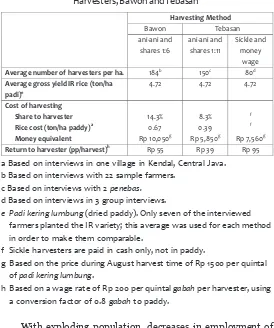
Calculations of Costs of Harvesting and Re-turns to Harvesters, Bawon and Tebasan Persentase Petani Sampel di Kabupaten Kendal dan Pemalang yang Menjual Panen Padinya Kepada Penebas Pada Tiap Musim Ketika Mere-ka Diinterview
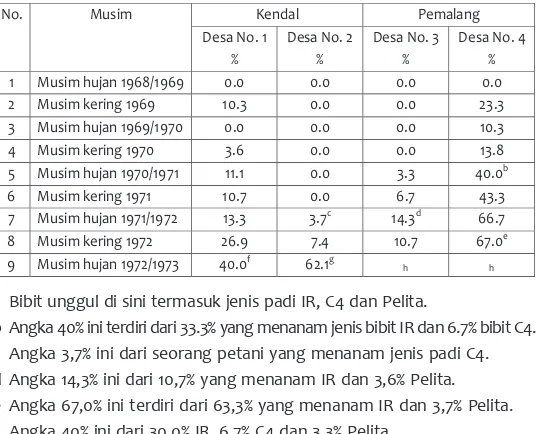
Persentase Petani Sampel di Kabupaten Kendal dan Pemalang yang Menanam Jenis Padi Bibit Unggul (Dari Musim Hujan 1968/1969 Hingga Musim Hujan 1972/1973)
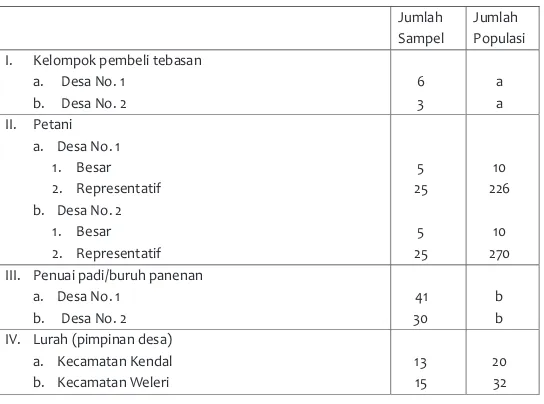
Persentase Mereka yang Menanam Padi Bibit Unggul (IR, C4, Pelita) dari Petani Sampel yang Menjual kepada Penebas, Menurut Musim Besarnya Sampel dan Jumlah Populasi pada Dua Desa di Kabupaten Kendal, April 1973 Persentase dari Petani yang Menjual Panen Padinya kepada Penebas dan Pesentase
Daftar Tabel
1.1.
2.1.
2.2.
2.3.
2.4.
2.5. No. Tabel
1 4
22
24
2 5
26
Daftar Tabel
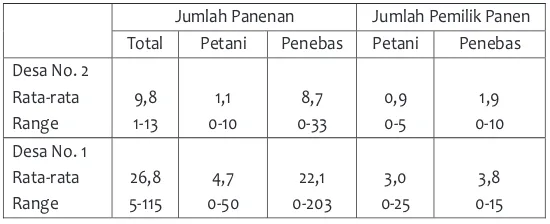
Jumlah Padi Desa yang Dijual Menurut Lurah Desa pada Dua Kecamatan, Musim Hujan 1972/1973
Daerah Asal Penebas Menurut Lurah Desa di Kedua Kecamatan, Musim Hujan 1972/1973 Frekuensi Buruh Pemotong Padi yang Ikut Serta dalam Panen yang Dilakukan oleh Petani dan oleh Penebas, Musim Hujan 1972/1973 Daerah Operasi dan Jumlah Hari yang Dipakai Buruh Tani untuk Menggarap Panen pada Desa-Desa Sampel di Kabupaten Kendal, Mu-sim Hujan Panenan 1972/73
Perbandingan Penghasilan Petani dari Panen Padi Bibit Unggul, Tebasan dan Non-Tebasan, Musim Hujan 1972/73, Kabupaten Kendal Various Task to be Done by Pengedok. The Case of Kebanggan Village, Banyumas, Cen-tral Java
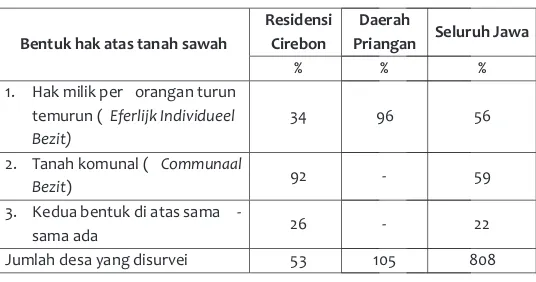
Cost and Return to Farmer/Landowner in Kedokan and Pracangan System (Kebanggan Case, September 1973 and December 1981) Presentase Desa Menurut Bentuk-Bentuk Hak atas Tanah Sawah di Daerah Priangan, Cirebon dan Seluruh Jawa, Tahun 1868/1869
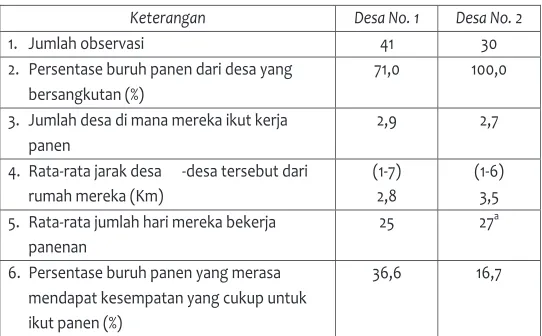
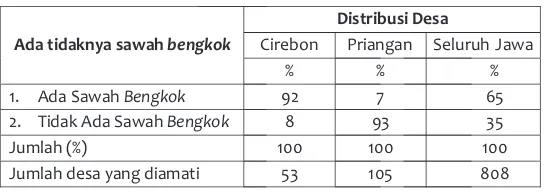
Penyebaran Tanah Sawah Bengkok di Desa Daerah Priangan, Cirebon dan Seluruh Jawa, Tahun 1868/1869
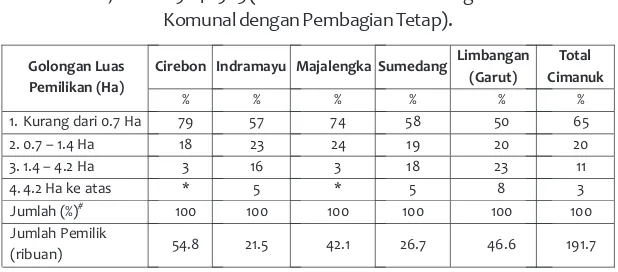
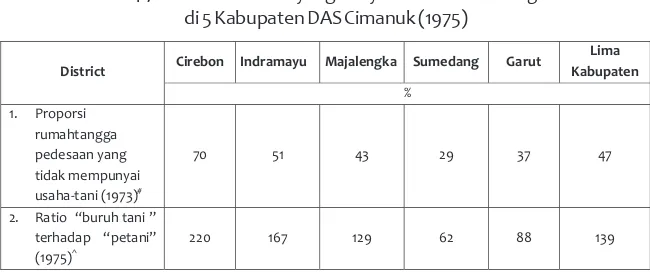
Persentase Desa yang Punya Tanah Sawah Bengkok di 5 Kabupaten DAS Cimanuk (1975) Penyebaran Luas Pemilikan Tanah di Lima District DAS Cimanuk (1904/1905) (Tanah Hak Milik Perseorangan dan Tanah Komunal Dengan Pembagian Tetap)
Ranah Studi Agraria
paten DAS Cimanuk (1973)
Tingkat Ketunakismaan Menurut Berbagai Indikator di Lima District DAS Cimanuk (1905) Persentase Desa yang Punya Tanah Sawah Bengkok di 5 Kabupaten DAS Cimanuk (1975) Tingkat Penyakapan di Lima Kabupaten DAS Cimanuk (1973)
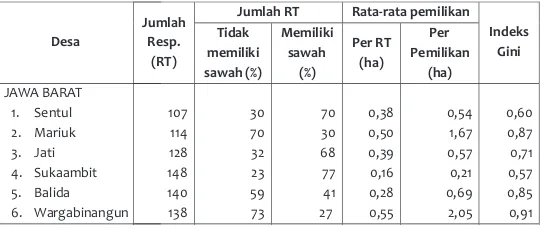
Penguasaan Tanah oleh Orang Terkaya di 6 Desa Sampel SDP, 1978
Keadaan Berbagai Hubungan Penyakapan di 6 Desa Sampel SDP, 1978
Banyaknya Rumahtangga yang Memiliki Sawah dan Rata-Rata Luas Pemilikannya di 15 Desa di Jawa dan Sulawesi Selatan, 1982 Tingkat Ketunakismaan di 12 Desa di Jawa (1979/1981) dan Tiga Desa di Sulawesi Selatan (1982)
Perubahan Jumlah Tunakisma 10 Tahun (1970/71 S/D 1980/81) di 12 Desa di Jawa dan 3 Desa di Sulawesi Selatan
Distribusi Rumahtangga Menurut Strata Sosial Berdasarkan Pemilikan Tanah di 8 Desa di Jawa Tingkat Penyakapan Menurut Luas Garapan di 15 Desa Sampel: 12 Desa Di Jawa (1979, 1980, 1981) dan 3 Desa Di Sulawesi Selatan (1982)
Tingkat Penyakapan Berdasarkan Indikator Distribusi Rumahtangga Menurut Status Garapanya di 12 Desa di Jawa dan 3 Desa di Sulawesi Selatan, 1979-1972
Proporsi Pendapatan Menurut Sumber dapatan, Pendapatan Rumah-tangga, dan Pen-dapatan Per Kapita Per Tahun di 12 Desa di Jawa dan 3 Desa di Sulawesi Selatan
4.6. 4.7. 4.8. 4.9. 4.10. 5.1. 5.2. 5.3. 5.4. 5.5. 5.6. 5.7. 85 8 7 89 94 96
1 1 4
1 1 7
118
1 1 9
122
123
Daftar Tabel
Distribusi Rumahtangga, Pendapatan, dan Rata-Rata Pendapatan Per Rumahtangga, Me-nurut Golongan Luas Pemilikan Tanah Sawah di 3 Desa di Jawa
Banyaknya Rumahtangga yang Menggadai-kan Sawahnya, Luas Sawah yang DigadaiMenggadai-kan, dan Penggunaan Uang Hasil Gadai di Desa Penelitian di Jawa dan Sulawesi Selatan, 1982 Banyaknya Rumahtangga Menurut Pekerjaan Gadai dan Luas Sawah yang Digadai di 9 Desa Penelitian di Jawa dan Sulawesi Selatan, 1982 Jumlah Penyewa, Luas Sawah yang Disewa, Nilai Sewa Per Ha dalam Kuintal Gabah Kering Pada Tahun 1971 dan 1981 dan Perubahannya di Desa-desa Penelitian SDP di Jawa
Proporsi Rumahtangga Penyekap Menurut Jenis Bagi Hasil dan Menurut Jenis Beban yang Ditanggung, di 12 Desa di Jawa dan 3 Desa di Sulawesi Selatan, 1980/81
Presentase Rumahtangga Penggarap Menurut Kewajibannya Membayar Ipeda dan Menye-diakan Saprodi dalam Sistem Maro dan Mer-telu di 12 Desa Jawa dan 3 Desa di Sulawesi Selatan
Luas Tanah Menurut Status Dan Penggunaan-nya Setelah Rekonsolidasi, Desa Kebanggan, 1981
Banyaknya Responden, Penggarap, dan Pre-sentase Penggarap Menurut Macam Tenaga Kerja untuk Semua Kegiatan Usahatani di Desa-desa Penelitian di Jawa dan Sulawesi Selatan
Rata-Rata Upah Nyata Membajak atau Meng-garu Pada MH 1970/71 dan MH 1980/81 dan 5.8. 5.9. 5.10. 5.11. 5.12. 5.13. 5.14. 5.15. 5.16. 126 132
1 3 5
1 3 7
140
143
1 5 0
1 5 3
Ranah Studi Agraria
Perubahannya di Desa-desa Penelitian di Jawa dan Sulawesi Selatan
Rata-Rata Upah Nyata Membajak Pada MH 1970/71 dan MH 1980/81 dan Perubahannya di Desa-Desa Penelitian di Jawa dan Sulawesi Selatan
Rata-Rata Upah Nyata Buruh Warisan Pada MH 1970/71 dan MH 1980/81 dan Peru-bahannya di Desa-Desa Penelitian di Jawa dan Sulawesi Selatan
Kewajiban Penceblok dan Besarnya Bawon Pada MH 1980/81 di 5 Desa Penelitian di Jawa Rata-Rata Besar Bawon, Produksi Kotor dan Jumlah Bawon dalam Kg Per Ha Pada MH 1968/69 dan MH 1980/81 dan Perubahannya di Desa-Desa Penelitian di Jawa dan Sulawesi Selatan
Baseline Census And Re-Census Sampling Units and Households Sample
Topography and Transportation in the Sam-ple Villages
Agricultural Production Patterns on Sawah Land by Village Land Type
Overall Distribution of Sawah Owned, Re-Cen-sus, 1983
Gini Indices by Sawah Ownership and by Vil-lage, Wet Season, 1982/1983
Pearson Product Moment Correlation Coeffi-cients between Area of Sawah Owned and Sev-eral Other Indicators of Economic Status by Village (All Households)
Overall Mean Values of Dry Land, of Farm Ani-mals, and of Consumer Durables, by Area of Sawah Owned, 1983
5.17. 5.18. 5.19. 5.20. 6.1. 6.2. 6.3. 6.4. 6.5. 6.6. 6.7.
1 6 1
162
166
168
2 0 7
208
2 1 1
2 1 7
220
2 2 7
Daftar Tabel
Gini Indices of Sawah Owned and of Sawah Cultivated by Village, Wet Season, 1983 Overall Distribution of Households in All Vil-lages by Sawah Cultivated and by Sawah Owned, Wet Season, 1982/1983
Distribution of Households, Sawah Owned and Sawah Cultivated by Tenancy Status (Wet Sea-son 1982/1983)
Distribution of Households by Tenancy Sta-tus And Village (Wet Season 1982/1983) Tenancy Status in Wet Season 1982/1983 and Dry Season 1983
Tenancy Status by Type of Tenancy Contract (Wet Season) 1982/1983
Distribution of Households by Tenant Status, Type of Tenancy Contract and Village, Wet Season 1982/1983
Distribution of Households by Sawah Owner-ship Group and Tenancy Status (Sawah Owners, Wet Season 1982/1983)
Area of Sawah Owned by Tenancy Status and Type of Tenancy Contract (Owners Only, Wet Season 1982/1983)
Mean Sawah Cultivated by Cultivation Status and Tenancy Status (Cultivators Only, Wet Season 1982/1983)
Total Area of Sawah Tenanted-In and Total Area Leased Out by Types of Tenancy Con-tracts, Wet Season 1982/1983
Distribution of Households According to Ma-jor Family Income Sources by Area of Sawah Owned
Ranah Studi Agraria
Distribution of Households According to Ma-jor Source of Family Income by Sawah Area Owned
Distribution of Households According to Family Income Status, Tenancy Status and Sawah Area Owned
Distribution of Sawah Operators by Family Income Status and Area of Sawah Operated Distribution of Households According to Ma-jor Income Source by Tenancy Status and Sawah Area Operated
General Data on The Nine Case Study Villages: 1981
Changes in Paddy Cultivation Practices and Yields: 1971-1981
Changes in Paddy Income Shares (Per Hec-tare) of Farmers and Hired Laborers: 1971-1981
Changes in Size Distribution of Operated Sawah Holdings: 1971-1981
Sawah Ownership Distribution: 1981 (Wet Sea-son 1980-1981)
Tenure Status of Sawah (1981) and Changes in Real Land Rents (Wet Season 1971-1981) Sawah Tenure Status of Households (Percen-tage of All Households): 1981 (Wet Season) Changes in Labor Use in Paddy Cultivation: 1971-1981 (Person-Hours Per Ha Per Crop, Pre-harvest, Wet Seasons 1970-1971 and 1980-1981)
Changes in Real Wage Rates for Casual Daily Labor (Wet Seasons 1970-1971 and 1980-1981) and Wages Paid to Harvesters
Models of Labor Recruitment and Payment 6.21. 6.22. 6.23. 6.24. 7.1. 7.2. 7.3. 7.4. 7.5. 7.6.
7 . 7 .
7.8. 7.9. 7.10. 266 268 269
2 7 1
302
305
3 0 7
3 1 0
3 1 1
312
318
321
323
Daftar Tabel
in Paddy Cultivation: 1981 (Wet Season 1980-1981) Use by Percentage of Employers Summary: Distribution of Farm and Nonfarm Incomes Among Households by Sawah Own-ership Class: 1981
Income Sources of ‘Landless Agricultural La-bor’ Households (Percentage of a Total An-nual Household Income): 1981
Income Sources of Households Owning More Than 1.0 Hectare of Sawah (Percentage of To-tal Annual Household Income): 1981 7.11.
7.12.
7.13.
330
334
Daftar Lampiran
No. Lamp. Judul Lampiran Hlm.
Distribusi Rumahtangga Menurut Luas Pemi-likan Sawah dan Garapan Sawah di 15 Desa Di Jawa dan Sulawesi Selatan, 1982
Persentase Rumahtangga Pemilik Sawah dan Perubahannya Selama 10 Tahun Menurut Go-longan Luas Sawah Milik Di Jawa Di Sulawesi Selatan, 1982
Banyaknya Rumahtangga Menurut Status dan luas Garapannya di 15 Desa di Jawa dan Sula-wesi Selatan
Presentase Petani Menurut Besar Bawon yang Diberikan Kepada Buruh Panennya pada Mu-sim Tanam MH 1970/71 dan MH 1980/81 di Desa-desa Penelitian di Jawa dan Sulawesi Selalatan
Distribusi Rumahtangga Menurut Golongan Luas Pemilikan dan Menurut Pendapatan Per Kapita Rumahtangga Setahun Ekuivalen Beras 5.1.
5.2.
5.3.
5.4.
5.5.
179
182
185
190
Daftar Lampiran
di 15 Desa Di Jawa dan Sulawesi Selatan, 1982 Banyaknya Penyakap, Luas Tanah yang Disa-kap dan Variasi Kewajiban dan Hak PenyaDisa-kap pada MH 1980/81 di Desa-desa Penelitian di Jawa dan Sulawesi Selatan
Distribution of Households by Sawah Owned, and by Village, Re-census, 1983
Pearson Product Moment Correlation Coeffi-cients between Area of Sawah Owned and Se-lected Indicators of Economic Status by Villa-ge (Sawah Owners Only)
Mean Area of Dry Land (DL) Owned and Per-centage of Household who Own 0.25 ha or More of Dry Land, by Area of Sawah Owned and by Village, Re-census, 1983
Mean Value of Consumer Durables (CD), Per-centage of Household Owning CD Less than Rp 25.000,-, and Those Owning More than Rp 150.000,-, by Sawah Owned and by Villa-ge, Re-Census, 1983
Mean Value of Farm Animals (FA) Owned and Percentage of Households who Own FA Equi-valent to Rp 50.000,- or More, by Area of Sawah Owned and by Village, Re-census, 1983 Distribution of Households by Area of Sawah Cultivated, and by Village, Wet Season 1982/ 83
Distribution of Households by Sawah Owned and by Sawah Cultivated, Wet Season, 1983 Distribution of Households in Sawah Cultiva-tion by CultivaCultiva-tion and Tenancy Status (Culti-vators, Wet Season, 1982/1983)
Ranah Studi Agraria
Village (Tennant-in, Wet Season, 1982/83) Distribution of Households by Sawah Owner-ship Class and Tenancy Status
Mean Sawah Leased Out by Tenancy Status and Type of Tenancy Contract
Mean Sawah Cultivated by Tenancy Contracts Status and by Area of Sawah Owned (Sawah Owners Only), Wet Season, 1982/1983 Mean Sawah Cultivated in Sharecropping Rental and Mortgage Contracts by Tenancy Status (Cultivators, Wet Season, 1982/83) Distribution of Trade Activities Undertaken by Household Head and Wife of Household Head by Sawah Area Owned
Distribution of Sources of Income According to Minor Sources of Family Income by Area of Sawah Owned
Distribution of Households According to Family Income Status, Village and Area of Sawah owned
Distribution of Households According to Ma-jor Source of Income by Village and Area of Sawah Owned
6.10.
6.11.
6.12.
6.13.
6.14.
6.15.
6.16.
6.17.
291
291
291
292
293
294
294
Daftar Peta
No. Peta Judul Peta Hlm.
Desa-desa Sampel SAE di Pulau Jawa dan Lokasi yang Dibahas dalam Buku Ini
Desa-desa Sampel SAE di Provinsi Sulawesi Selatan dan Lokasi yang Dibahas dalam Buku Ini
Skema DAS Cimanuk, Batas-batas Kabupaten, dan Lokasi Desa-desa Studi Kasus
lxvi
lxvii
7 5 1
2
Pengantar Penyunting:
Jejak Panjang GWR Sebagai Peneliti Agraria
dan Babak Baru “Debat Agraria”
Terutama di kalangan generasi muda, Gunawan