Mada Mariana Lakapu and Nurul Widiastuti
* Corresponding author.
Email address : [email protected]
DOI: 10.22146/ijc.25162
Synthesis of Zeolite-X Supported on Kapok Fiber for CO
2Capture Material:
Variation of Immersion Time during Fiber Activation
Mada Mariana Lakapu and Nurul Widiastuti
*Department of Chemistry, Institut Teknologi Sepuluh Nopember (ITS), Jl. Arif Rahman Hakim, Surabaya 60111, Indonesia
Received May 22, 2017; Accepted November 8, 2017
ABSTRACT
Zeolite-X is a potential material for CO2 adsorption. To increase the performance of zeolite-X, kapok fiber was
used as a support material. The growth of zeolite-X on the surface of kapok was affected by activation of the surface. This research aims to optimize the immersion time of kapok fiber using NaOH in order to achieve high crystallinity of the zeolite-X. The Zeolite-X supported on kapok fiber was synthesized by the simple hydrothermal method at immersion time variation of 12 to 36 h. XRD results show that zeolite-X on kapok surface has the highest crystallinity at immersion time of 24 h. The topography of kapok surface from AFM indicates that the surface was damaged due to peeling reaction of NaOH. SEM results show that zeolite-X has grown on the kapok surface in considerable amounts. From TGA analysis, it was shown that the thermal stability of zeolite-X supported on kapok surface was up to 300 °C. Adsorption of CO2 measured by gravimetric method shows that CO2 adsorption capacity
was up to 15.097 wt.% at room temperature.
Keywords: zeolite-X; kapok fiber; CO2 capture; adsorption
ABSTRAK
Zeolit-X merupakan salah satu material yang berpotensi untuk mengadsorpsi CO2. Untuk meningkatkan
performa zeolit-X, maka digunakan serat kapuk sebagai material pendukung. Pertumbuhan zeolit-X pada permukaan kapuk dipengaruhi oleh aktivasi permukaan serat. Penelitian ini bertujuan untuk mengoptimasi waktu perendaman serat kapuk dengan NaOH untuk memperoleh zeolit-X dengan kristalinitas yang tinggi. Zeolit-X berpendukung serat kapuk disintesis dengan metode hidrotermal sederhana pada variasi waktu perendaman dari 12-36 jam. Hasil XRD menunjukkan bahwa kristalinitas zeolit-X tertinggi pada permukaan serat kapuk dengan waktu perendaman 24 jam. Topografi serat kapuk dari hasil AFM menunjukkan perubahan permukaan serat hingga rusak akibat bereaksi dengan NaOH. Hasil SEM menunjukkan bahwa zeolit-X tumbuh dipermukaan serat dalam jumlah yang cukup banyak. Zeolit-X berpendukung serat kapuk memiliki stabilitas termal hingga 300 °C yang ditunjukkan oleh data TGA. Kapasitas adsorpsi CO2 ditentukan dengan metode gravimetri dengan kapasitas adsorpsi mencapai
15.09% berat pada suhu ruang.
Kata Kunci: zeolit-X; serat kapuk; penangkapan CO2; adsorpsi
INTRODUCTION
The increased use of fossil fuel has increased the concentration of CO2 (a greenhouse gas) in the
atmosphere, contribute significantly to global warming. Over the past two decades, CO2 concentration has
increased from 280 ppm to 400 ppm, more than the normal limits of about 350 ppm [1-3]. Therefore, specific technologies are required to solve this problem.
Carbon capture and storage (CCS) is an alternative method to decrease CO2 emissions from fossil fuels [4],
one of which is physical adsorption. Advantages over others separation-based CCS technologies includes high adsorption capacity, low cost, the low energy requirement for regeneration and able to use low-cost
porous materials as an adsorbent [5-7]. Zeolite-X is a potential material for CO2 capture. The pore diameter of
zeolite is 0.4 nm [8], which is sufficient for CO2 kinetics
diameter of 0.33 nm [9], thus, CO2 diffusion into zeolite
is fast. In addition, zeolite has overall net negative charge, due to the substitution of aluminum for silicon in the crystalline lattice structure of the zeolite. Zeolite-X has low Si/Al ratio, thus the negative charge of the zeolite is high. The negative charge of the zeolite is neutralized by cations such as sodium, magnesium, and potassium. As a result, zeolite has a high affinity for polar molecules like CO2. CO2 quadrupole moment
Mada Mariana Lakapu and Nurul Widiastuti
However, synthesized zeolite-X is typically encountered in powder form. As a result, the adsorption-desorption process at an industrial scale faces difficulties in applications. Addition of supporting material such as fiber is required to solve this problem. The advantages of fiber as a supporting material includes easily forming and high desorption capacity, up to 92.93% at first cycle [11-12]. Currently, synthetic fibers such as glass, carbon, and aramid are being widely used as supporting materials. However, these fibers have serious drawbacks in terms of biodegradability, initial processing cost, recyclability, energy consumption, health hazards and production of CO2 emissions during the production
process. Therefore, natural fibers are required to avoid the negative impact of using synthetic fibers. Natural fibers are environmentally friendly, renewable and low cost [13].
Kapok fiber (Ceiba petandra B.) is a kind of natural fiber that is being developed as a zeolite support material. It is obtained from the fruit of the kapok tree and is yellowish-brown and slightly lustrous in appearance [14-15]. Kapok fiber has hydrophobic cement matrix composed of lignin, hemicellulose, and other impurities. This matrix will eventually cause a reduction in fiber strength, cover the functional groups of the fiber and act as a barrier to interlocking with inorganic materials. To effectively optimize interfacial bonding between fiber and matrix zeolite-X, the fiber surface needs to be modified by activation with NaOH [13,16-17]. According to previous research [16,18-19], an immersion time of fiber activation can affect the growth of zeolite-X on the fiber surface and the crystallinity of zeolite. Therefore, this research aims to optimize the immersion time of kapok fiber using NaOH in order to achieve high crystallinity of the zeolite-X. Variation of NaOH immersion time during activation process of the fiber was studied to determine the effect of zeolite-X crystallinity on the fiber surface and its CO2
adsorption capacities.
EXPERIMENTAL SECTION
Materials
Sodium aluminate powder (anhydrous, Sigma-Aldrich), sodium silicate solution (contains Na2O7Si3
Sigma-Aldrich), NaOH (99%, Merck), and demineralized water were used as starting materials for synthesis zeolite-X. Kapok fiber was used as a supporting material to grow the zeolite.
Instrumentation
Hotplate-stirrer, the hydrothermal reactor (stainless steel autoclave), oven, X-Ray Diffraction (XRD), the 3D
atomic force microscopy (AFM) images and the scanning electron microscopy (SEM) images were taken by NEOS N8 microscope and TM 3000, Hitachi, respectively. Thermal Gravimetric Analysis (TGA) and adsorption furnaces set (gravimetric method) were used to characterize the zeolite and to examine the CO2 adsorption capacity of the zeolite.
Procedure
Activation of kapok fiber
Kapok fiber (± 1 g) was immersed in 20 mL NaOH 4 M solution at polypropylene container. The activation process was conducted at various immersion times for 12, 18, 24, 30, and 36 h at room temperature. Samples at various immersion times were the named of KAPOK 12H (12 h), KAPOK 18H (18 h), KAPOK 24H (24 h), KAPOK 30H (30 h) and KAPOK 36H (36 h).
Synthesis of zeolite-X supported on kapok fiber Zeolite-X was synthesized from the mixed solution at a molar ratio of 4 Na2O: 0. 2 Al2O3: SiO2:
200 H2O. The solution was stirred for 3 h in
polypropylene bottles, then, it was put into an autoclave. The activated kapok fiber was added the amount of 0.024 wt.% into the solution. The temperature of hydrothermal was 100 °C for 24 h. The synthesized zeolite-X supported on fiber was filtered and washed with demineralized water to reach pH 8 and then dried at 100 °C overnight. Samples at various immersion times were then named as ZX-KAPOK 12H, ZX-KAPOK 18H, ZX-KAPOK 24H, ZX-KAPOK 30H and ZX-KAPOK 36H.
Characterizations
The obtained samples were characterized by a variety of characterization techniques. X-ray diffraction (XRD) patterns were obtained using a Panalytical X’Pert Pro MPD diffractometer with Cu Kα radiation to confirm type and crystallinity relative. The Atomic Force Microscopy (AFM) images were taken on a NEOS N8 microscope to show damaged of the fiber surface topography. The scanning electron microscopy (SEM) images were taken on a ZEISS EVO MA 10 microscope to confirm the growth of zeolite-X crystals on the fiber surface and thermal stability were analyzed by thermal gravimetric analysis (TGA) STAR S 10.00.
CO2 capture capacity
Zeolite-X and zeolite-X supported on kapok fiber were examined in order to determine CO2 capture
Mada Mariana Lakapu and Nurul Widiastuti
Each sample of zeolite-X and zeolite-X supported on kapok fiber were dried at 105 °C for 2 h, then cooled down to room temperature and stored in a desiccator. Afterward, 1 g of the adsorbent material was placed on the sample holder inside the tubular furnace, then degassed for 3 h at temperature of 350 °C for zeolite -X sample and 250 °C for zeolite-X fiber, then cooled down to room temperature. After degassing process, CO2 gas
flowed into the sample at a flow rate of 20 mL/min controlled by MFC. The mass change was recorded every 1 min until it reached an equilibrium condition. CO2
adsorption capacity was calculated using Eq. (1). This experiment was conducted 3 times for each adsorption sample.
t 0
2
0
m m
CO adsorbed (wt.%) 100%
m
−
= × (1)
Scheme 1. Schematic diagram of adsorption using
gravimetric method
Fig 1. The topography of kapok fiber surface: (a) before activation, (b) 12 h of immersion time, (c) 24 h of immersion
time and (d) 36 h of immersion time
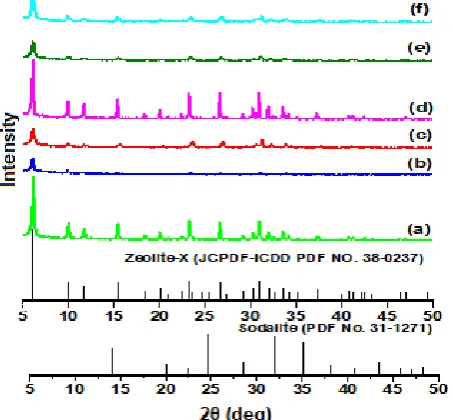
Fig 2. X-ray diffraction patterns of samples at various immersion time: (a) Zeolite-X without supporting material,
Mada Mariana Lakapu and Nurul Widiastuti
RESULT AND DISCUSSION
Influence of Immersion Time with NaOH
Kapok fiber mainly consists of crystalline cellulose in the inner layer and noncellulose like lignin and hemicellulose in the outer layer. Fig. 1(a) shows that the smooth surface of raw kapok without NaOH treatment, while Fig. 1(b) and 1(c) show the roughness surface after NaOH treatment due to dissolved cellulose of fiber surface [13,15].
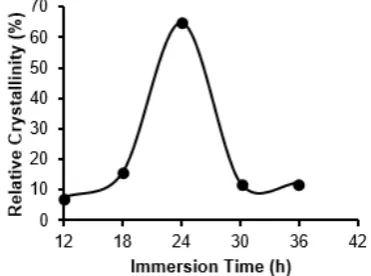
XRD patterns of samples at various immersion time were shown in Fig. 2. It can be seen that all samples at immersion time from 12 h to 36 h have characteristic peaks of zeolite-X at 2θ = 6.1°; 9.9°; 11.7°; 15.4°; 23.3°; 26.68° and 30.9° according to the identification table of zeolite [14]. The characteristic peak intensity was decreased at various immersion times from 30 days to 36 h. Sample ZX-Kapok 24H has highest relative crystallinity characteristic peaks of zeolite-X (Fig. 3). These result supporting the result of AFM that shown the increase of surface roughness, resulting in better adhesion between fiber surface and zeolite-X and also increase the amount of cellulose on the fiber surface, thus increasing the number of possible reaction sites [20]. It is also supported by the result of SEM in Fig. 4, shown that zeolite-X crystal was grown on most of the
fiber surface with a hexagonal crystal form at 24 h immersion time.
Thermal stability of zeolite-X supported on kapok fiber at 24 h immersion time is shown in Fig. 5. There are two stages in this curve of TGA-DTG. At the first stage about 200 °C, the sample has weight loss 21 wt.% because of decomposition of lignin and hemicellulose of fiber. It was then followed by a second stage with 30 wt.% of loss, at temperature of 350 °C because of decomposition of cellulose crystalline and
Fig 3. Influence of immersion time during kapok fiber
activation toward crystallinity of zeolite-X supported on kapok fiber
Fig 4. SEM images of sample ZX-Kapok 24H (a) 100 µm, (b) 30 µm and (c) 20 µm
Fig 5. TGA-DTG of zeolite-X supported on kapok fiber at
24 h immersion time
Fig 6. Adsorption Capacity (a) ZX-Kapok 24 h,
Mada Mariana Lakapu and Nurul Widiastuti
zeolite-X on fiber surface [20]. Therefore, this sample has stability thermal up to 300 °C.
CO2 Capture Capacity
Carbon dioxide capture capacity on zeolite-X supported on kapok fiber was found up to 15.1 wt.%. This result is smaller than zeolite-X without support material, which reached up to 21.5 wt.% as presented in Fig. 6. It may occur because zeolite-X crystals attached to the surface of kapok fiber is not completely homogeneous and full coverage on the fiber surface. Zeolite-X supported on kapok fiber has CO2 capture
capacity up to 15.1 wt.%. For further experiment, it would be better to understand the interaction between zeolite-X and kapok by comparing the FT-IR spectra of zeolite-X, kapok, and zeolite-X kapok fiber as well as CO2 gas adsorbed on the materials.
CONCLUSION
Zeolite-X supported on kapok fiber was successfully synthesized by hydrothermal method at various immersion times using NaOH 4 M solution. The growth of a zeolite-X crystal on kapok fiber surface has the highest crystallinity at immersion time of 24 h, it has thermal stability up to 300 °C and also CO2 capture
capacity up to 15.1 wt.%.
ACKNOWLEDGEMENT
Authors wish to thanks Indonesia Ministry of Research, Technology and Higher Education for providing research funding under “Hibah Penelitian
Unggulan ITS” No. 078/SP2H/LT/DRPM/II/2016 and also
providing affirmation LPDP scholarship for Mada to pursue Master Degree.
REFERENCES
[1] Herzog, H., Meldon, J., and Hatton, A., 2009, "An RD&D "Pipeline" for Advanced Post-Combustion CO2 Capture Technologies" in Coal Without Carbon, An Investment Plan for Federal Action,
Clean Air Task Force, Boston-MA, 37–58.
[2] Leung, D.Y.C., Caramanna, G., and Maroto-Valer, M.M., 2014, An overview of current status of carbon dioxide capture and storage technologies,
Renewable Sustainable Energy Rev., 39, 426–443.
[3] Kumar, G.S., Viswandham, M., Gupta, A.V.S.S.K.S, Kumar, G.S., 2013, A review of pre-combustion CO2
capture in IGCC, Int. J. Res. Eng. Technol., 2 (5), 847–853.
[4] Songolzadeh, M., Ravanchi, M.T., and Soleimani, M., 2012, Carbon dioxide capture and storage: a
general review on adsorbents, World Acad. Sci.
Eng. Technol., 70, 225–232.
[5] Hedin, N., Andersson, L., Bergström, L., and Yan, J., 2013, Adsorbents for the post-combustion capture of CO2 using rapid temperature swing or
vacuum swing adsorption, Appl. Energy, 104, 418–433.
[6] Wang, M., Lawal, A., Stephenson, P., Sidders, J., and Ramshaw, C., 2011, Post-combustion CO2
capture with chemical absorption: A state-of-the-art review, Chem. Eng. Res. Des., 89 (9), 1609– 1624.
[7] Yu, L., Gong J., Zeng, C., and Zhang, L., 2013, Synthesis of binderless zeolite X microspheres and their CO2 adsorption properties, Sep. Purif. Technol., 118, 188–195.
[8] Siriwardane, R., Shen, M., Fisher, E., Poston, J. and Shamsi, A,. 2001, Adsorption and desorption of CO2 solid sorbents, J. Energy Environ. Res., 1
(1), 19–22.
[9] Deng, H., Yi, H., Tang, X., Yu, Q., Ning P., and Yang, L., 2012, Adsorption equilibrium for sulfur dioxide, nitric oxide, carbon dioxide, nitrogen on 13X and 5A zeolites, Chem. Eng. J., 188, 77–85. [10] Hardie, S.M.L., Garnett, M.H., Fallick, A.E,
Rowland, A.P., and Ostle, N.J., 2005, Carbon dioxide capture using a zeolite molecular sieve sampling system for isotopic (13C and 14C) studies
of respiration, Radiocarbon, 47 (3), 441–451. [11] Liu, W., Misra, M., Askeland, P., Drzal, L.T., and
Mohanty, A.K., 2005, ‘Green’ composites from soy based plastic and pineapple leaf fiber: Fabrication and properties evaluation, Polymer, 46 (8), 2710– 2721.
[12] Liu, J., Jiang, G., Liu, Y., Di, J., Wang, Y., Zhao, Z., Sun, Q., Xu, C., Gao, J., Duan, A., Liu, J., Wei, Y., Zhao, Y., and Jiang, L., 2014, Hierarchical macro-meso-microporous ZSM-5 zeolite hollow fibers with highly efficient catalytic cracking capability, Sci. Rep., 4, 7276.
[13] Kabir, M.M., Wang, H., Aravinthan, T., Cardona, F., and Lau, K.T., 2011, Effects of natural fibre surface on composite properties: A review,
Proceedings of the 1st International Postgraduate
Conference on Engineering, Designing and Developing the Built Environment for Sustainable Wellbeing (EDDBE2011), Queensland University
of Technology, 94–99.
[14] Prachayawarakorn, J., Chaiwatyothin, S., Mueangta, S., and Hanchana, A., 2013, Effect of jute and kapok fibers on properties of thermoplastic cassava starch composites, Mater.
Des., 47, 309–315.
Mada Mariana Lakapu and Nurul Widiastuti
absorbing material: A mini review, J. Environ. Sci., 27, 21–32.
[16] Liu, J., and Wang, F., 2011, Influence of mercerization on micro-structure and properties of kapok blended yarns with different blending ratios,
J. Eng. Fibers Fabr., 6 (3), 63–68.
[17] Witono, K., Irawan, Y.S., Soenoko, R., and Suryanto, H., 2013, Pengaruh perlakuan alkali (NaOH) terhadap morfologi dan kekuatan tarik serat mendong, Jurnal Rekayasa Mesin, 4 (3), 227–234 [18] Pejic, B.M., Kostic, M.M., Skundric, P.D., and
Praskalo, J.Z., 2008, The effects of hemicelluloses and lignin removal on water uptake behavior of
hemp fibers, Bioresour. Technol., 99 (15), 7152– 7159.
[19] Pothan, L.A., George, J., and Thomas, S., 2002, Effect of fiber surface treatments on the fiber– matrix interaction in banana fiber reinforced polyester composites, Compos. Interfaces, 9 (4), 335–353.