THE RELATIONSHIP OF ENVIRONMENTAL FACTORS
TO RUBBER CORYNESPORA LEAF FALL DISEASES
Nurhayati
Department of Plant Pest and Disease, Agriculture Faculty, University of Sriwijaya Palembang
Abstract
A study on Corynespora leaf fall disease and its relations to enviromental factors had been conducted. This research is aimed at: 1). evaluating clon resistency to Corynespora leaf fall disease in rubber plantation, and 2) study the relation of environmental factors with Corynespora cassiicolainfection and the severity of the disease in the rubber nursery. The study was carried out in tree location rubber nursery in Banyuasin Regency. The study was the combination of experimental study and field studies. In this study direct observation was done on nurseries.. Observation was carried out in each appearance of new stalk in the rubber plants. In addition, weather condition and meteoroligal data were observed both directly and indirectly. Parameters observed were connidia distributed in the air and disease severity.
The result showed that there was a strong relationship between the amount of spore of
Corynespora cassiicola in the air with enviromental factors. The amount of spore was vary from month to month. On average, amount of spore ranged from 1.07 connidia/cm²/day till 4.68 connidia/cm²/day. The variation of spore in the air was believed to be the concequence of variations of weather condition such as number of raindays, rainfall amount and length of radiation. Severity of PGDC in this study tabulatedly is closely related to the amount of spore distributed in the air. In this study it was found that there exist differences in relation pattern in every clon studied namely clons of GT 1, RRIM 600 and PB 260. Relation pattern for clon PB 260 is negligible for the severity is very low (the most resistant clon).
Keyword: Corynespora leaf fall diseases; enviromental factor; rubber
Hubungan antara Faktor Lingkungan dengan Penyakit Gugur dun Corynespora pada Tanaman karet
Abstrak
dilakukan pengamatan terhadap suhu dan kelembaban serta keadaan cuaca (mendung, cerah, hujan dan berawan). Parameter yang diamati adalah jumlah konidia yang terdistribusi di udara dan keparahan penyakit. Hasil penelitian menunjukkan bahwa terdapat hubungan yang erat antara faktor lingkungan dengan jumlah spora Corynespora cassiicola di udara. Jumlah spora sangat beragam, rata-rata tiap bulan pengamatan berkisar dari 1.07 konidia/cm²/hari sampai 4.68 konidia/cm²/hari. Keragaman spora/konidia yang terdistribusi di udara tersebut ditemukan sebagai konsekuensi dari beragamnya faktor cuaca terutama jumlah hari hujan, curah hujan dan lama penyinaran. Keparahan PGDC yang ditemukan dalam penelitian ini secara tabulasi terlihat berkaitan erat dengan jumlah spora terdistribusi di udara. Dalam penelitian ini ditemukan adanya perbedaan tren hubungan tersebut pada setiap klon yang diteliti yakni Klon GT 1, RRIM 600 dan PB 260. Tren hubungan untuk klon PB 260 dapat diabaikan karena keparahannya sangat rendah (klon paling resisten).
1. INTRODUCTION
Rubber (Hevea brassiliensis Muel.Arg.) is one of potential comodities for Indonesia because it contributed significantly to the country’s economy. Export value of rubber, as reported by Central Bureau for Statistic, in 2003 was US $ 2,23 billions and became US $ 2,92 billions in 2004. Export of the rubber commodity for the country, as counted by Indonesian Association for Rubber Exporters, continually invrease from year to year. In 2004 the export volume for the commodity was 1.88 million tones, while a year before was just 1.66 million tonnes (Tempointeraktif, 2005)
Rubber plantation acreage in Indonesia is around 3.6 millions hectares, of which 80% was owned by small farmers, 20% by country owned estate and private companies. Rubber estate was at large found in Sumatra island (around 70%), followed by Borneo (20%, Java (5%) and other islands (5%). In South Sumatra the acreage of rubber plantation continually increase from time to time. The rubber plantation acreage at this time is around 850.000 hectares (Direktorat Jendral Perkebunan, 1998; Statistik Perkebunan Indonesia, 2004).
Rubber plantation productivity in Indonesia is relative low. The productivity of state-owned Estate in Indonesia at this time is around 1.260 kg per hectares per year, while that of private estate is 1,050 kg per hectare per year and that of small farmers rubber plantation is just 590 kg per hectare per year. The cause of low productivity of the rubber plantation is due to disease present (Suhendry dan Alwi, 1990).
The leaf fall disease is caused by a pathogen calledCorynespora cassiicolawhich is one of the important rubber diseases. This disease can cause rubber plants have no leaves all year round. Such occurrence can slow down plant growth, tapping cannot be carried out and even can cause the death of the plants. Apart from attacking plants in the field that disease can create problem for rubber seedling. It means that this disease can cause a significant loss. This disease is attacking young as well as old rubber leaves (Situmorang dan Budiman, 1984).
months caused the reduction of yield as much as 40% the normal production. Heavy attack by the leaf fall disease for rubber plants of clons PPN 2058 and PPN 2447 in Central Java can cause reduction of latex production between 24 and 62 percent (Pusat Penelitian dan Pengembangan Perkebunan Tanjung Morawa, 1988).
Productivity reduction was also reported to happen on RRIM 600 clon which was attacked by C. cassiicola. Productivity reduction was ranging from 30 and 40 percent causing a consequent loss as much as billions rupiah each year (Anwar et al., 2000). Information mentioned earlier in the prove that the leaf fall disease caused by a fungi is one of the important diseases on rubber plants and considered as endemic in Indonesia. If the environmental factors such as weather become more suitable then the endemic phase will easily change to be endemy (Darmono, 2006).
There are three main factors which support the epidemy of the leaf fall disease, namely the existence of susceptible rubber plants, the existence of virulent pathogen, and environmental factors which help the development of the disease (Zadock dan Schein, 1979). Indonesia posseses a very suitable weather condition for the Corynespora caused leaf fall disease. The factors include temperature, leaf moisture or wetnesses and rain, all of which can help the epidemy of the disease which can be utilized in forecasting the epidemy of the disease (Situmorang, 1998).
2. METHODOLOGY
This research was a combination of experimental work and survey. In this study a field observation was carried out in rubber plant nursery in Banyuasin Regency. Observation was carried out at the time the new rubber leaves emerge. In addition, observation was also done towards the environmental conditions such as temperature and witnesses as well as the daily weather conditions.
The count of spore amount was carried out as to know the distribution of C. cassiicola
spores in the air in the study period. At the nursery ground was placed as many as 10 spore traps. The traps were made from object glasses which were at first given glycerin jelly (40 g gelatin + 130 ml glycerin + 150 ml water). The trap was placed in a nest made of round zinc plat ( 30 cm) at 20 cm apart. At the centre was supported by a wood (Figure 2). Every day as many as 4 object glasses were put at 07.00 am inside the trap laid horizontally in accordance with wind rose and taken after 24 hrs.
Results of the attack scale evaluation were put into the following equation: I =( n1x v1)/(N x V) x 100%
Where; I = percentage of disease severity
n = number of observation i-th at level of attack of (v) and level j N = the overall observations
V = the highest level of attack.
Data of weather conditions such as rainfall, raindays, relative humidity, air temperatures, wind velocity, radiation intensity, length of sun radiation and evaporation during the study period were collected from the neighbouring climatology station. In addition, the actual weather condition on day to day basis was also recorded including sunny, hot, cloudy, raining, ets.
3. RESULTS AND DISCUSSION
In this study it was found that amount of conidiaCorynespora cassiicolain the air varied from month to month. On average the amount ranged from 1.07 conidia/cm²/day till 4.68 conidia/cm²/day. The variation of the amount of conidia in the air was found as the consequences of varoiation of weather factor especially number of rain days, rainfall amount and length of radiation. The relationship among a number of factors with the amount of spore in the air as a whole can be seen in Table 1.
Table 1
Relationship among weather factors and amount of spore in the air with
C. cassiicolathe cause of Corynespora leaf fall disease on rubber tree
Month Length of Radiation Temperature Humidity Wind velocity Number of Rainfall Amount of
(hour) (oC) (%) ( km/hour) rain days (mm/days) spore/cm2/day
May 7.30 28.3 77.2 1.83 1 1.83 4.68
June 7.26 27.8 85.4 2.44 2 3.33 4.07
July 6.38 27.2 83.2 2.31 4 10.83 2.79
August 7.47 27.6 71.6 3.36 0 0 2.07
September 5.82 27.7 73.4 2.85 6 39.1 1.07
0
Relationship between Amount of Spore of C.cassiicolain the Air with Amount of
Rainfall
The bigger the amount of water the lower the amount of spore in the air. This is suggested as a result of conidia washing on rubber leaves or the spore was dead. According to Monroe et al (1997), the spore that was released to the air generally happened after rain took place and their distribution was low in the rainy season. According to Chee (1988), the attack of C. Cassiicola was lower in areas which have higher rainfaal compared to those of lower in rainfall amount. The same was applied to the number of raindays in a time was closely related with amount amount of spore in the air (Figure 2).
Relationship between number of raindays with amount of spore of C. cassiicola
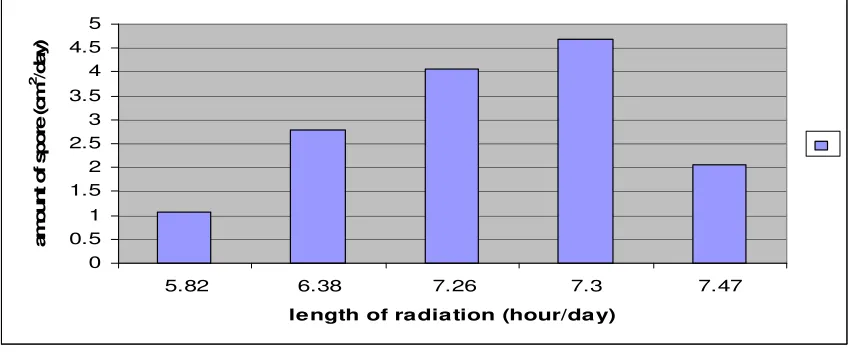
Amount of spore in the air was found in the study to be closely related with the length of radiation. Up to length of radiation as long as 7.3 hours or less the amount of spore in air increaseed linearly with the length of radiation. However, on the day with 7.3 hours of length of radiation the amount of spore in the air decreased drastically. The amount of spore in the air was only 2 spore per cm2if the length of radiation was 7.47 hours.
0
Relationship between Length of Radiation with Amount of Spore of C. cassiicola
in the Air.
Results of observation of amount of spore in the air using spore traps showed that amount of spore in the air ranged from 1.07 spora/cm2 and 4.68 spoea/cm2. Trend in severity of Corynespora leaf fall disease on three rubber clons in this study followed the trends of amount of spore in the air. A clear trend between the amount spore in air for the three rubber clons in this study can be seen in Figure 4.
0
4.68 4.07 2.79 2.07 1.07
am ount of s pore (cm2/day)
The severity of CLFD found in the study in a tabulated form was found to be closely related with amount of spore in the air. However, each rubber clon possessed a different trend of relationship. For example on clon GT 1 visually can be seen that in the time where the amount of spore in the air ranging from 2.07 and 4.07 spore/cm2 the severites of CLFD were relatively the same being about 25 percent. An increase of amount of spore in the air around 0.60 spores only caused an increase of the disease severity 5%. However, experts agreed that a severity of the disease as high as 25% can be a serious threat for rubber plantation (Situmorang, 1994).
On the other rubber clons being RRIM 600 and PB 260 can be seen that the amount of spore in the air linearly related with the severity of CLFD. The higher the amount of spore in the air the higher the disease severity. Up to present time clon PB 260 was the most resistant to the pathogen. In the case of clon RRIM 600 can be seen that the higher the spore in the air the higher the severity of the disease. Disease severity for the clon was exceeding of 35 percent at a time that the amount of spore in the air was found to be around 4.68 percent.
4. CONCLUSION
Based on results and discussion in this study can be concluded as follows:
1. There existed a close relationship among weather factors with infection and development of Corynespora leaf fall disease on rubber clons investigated.
2. Number of rain days, amount of rainfall and length of radiation were found to be the most important weather factors and closely related with the amount of conidia in the air.
REFRENCES
Chee, K. H. 1988. Studies on sporulation, pathologenicity and epidemiology of
Corynespora cassiicolaonHeveaRubber. J. Nat. Rubb. Res. 3(1):21-29. Direktorat Jendral Perkebunan. 1996. Statistics for Indonesian estate, Direktorat
Perkebunan Perkebunan, Ministry of Agriculture, Jakarta. 56 p.
---. 1998. Statistics of Indonesian estate. Direktorat Jendral Perkebunan, Ministry of agriculture, Jakarta.
Monroe, J. S, Santini, J. B., dan Latin, R. 1997. A model defining the relationship between temperature and leaf wetness duration and infection of watermelon by
Colletotrichum orbiculare. Plant Dis. 81:739-742.
Pawirosoemardjo, S. 2004. Managing of controlling for important disease in trying to saveguard the targeted national rubber production in year 2020. Proc. Technical meeting. Center for Rubber Research Sembawa.
Perkebunan Wilayah-1 dan P4TM, 14-16 November 1984 di Medan. P4TM. 10p.
Situmorang, A. 1998. Relationship model for microclimate and epidemiology of leaf fall disease on rubber. Program study of Entomology and Phytopathology Fakulty of Postgraduate IPB. Bogor. 15p.
Soepena, H. 1986. Corynespora leaf fall disease on rubber tree. Meeting on Rubber and Coconut. Semarang 6-7 Februari 1986. Research Centre Getas. PN/PT
Perkebunan Salatiga.
Suhendry, I dan N. Alwi. 1990. Productivity and production trend for clons. Paper presented in a national conference on rubber in 18-20 September 1990. Tempointeraktif. 2005. Vietnam asked to control prices of rubber.
www.tempointeractiqve.com/hg/ekbis.