Original scientific paper Accepted 30. 11. 2016.
G
UNTER
W
EISS
Special Conics in a Hyperbolic Plane
Special Conics in a Hyperbolic Plane
ABSTRACT
In Euclidean geometry we find three types of special con-ics, which are distinguished with respect to the Euclidean similarity group: circles, parabolas, and equilateral hyper-bolas. They have on one hand special elementary geomet-ric properties (c.f. [7]) and on the other they are strongly connected to the “absolute elliptic involution” in the ideal line of the projectively enclosed Euclidean plane. There-fore, in a hyperbolic plane (h-plane) – and similarly in any Cayley-Klein plane – the analogue question has to con-sider projective geometric properties as well as hyperbolic-elementary geometric properties. It turns out that the classical concepts “circle”, “parabola”, and “(equilateral) hyperbola” do not suit very well to the many cases of con-ics in a hyperbolic plane (c.f. e.g. [10]). Nevertheless, one can consider conics in a h-plane systematicly having one ore more properties of the three Euclidean special conics. Place of action will be the “universal hyperbolic plane”π, i.e., the full projective plane endowed with a hyperbolic polarity ruling distance and angle measure.
Key words: conic section, hyperbolic plane, Thales conic, equilateral hyperbola
MSC2010: 51M09
Specijalne konike u hiperboliˇcnoj ravnini
SAˇZETAK
U euklidskoj ravnini s obzirom na euklidsku grupu simetrija razlikujemo tri tipa specijalnih konika: kruˇznice, parabole i specijalne hiperbole. S jedne strane, one imaju spe-cijalno euklidsko svojstvo (vidi [7]), a s druge su strane ˇcvrsto vezane uz apsolutnu eliptiˇcnu involuciju na ideal-nom pravcu projektivno proˇsirene euklidske ravnine. Zbog toga, u hiperboliˇcnoj ravnini (h-ravnini) – i sliˇcno u svakoj Cayley-Kleinovoj ravnini – treba promatrati i projek-tivna geometrijska svojstva i elementarno-hiperboliˇcna ge-ometrijska svojstva. Pokazuje se da u brojnim sluˇcajevima konika u hiperboliˇcnoj ravnini klasiˇcni koncepti “kruˇznica”, “parabola” i “(jednakostraniˇcna) hiperbola” nisu primje-njivi (vidi npr. [10]). Unatoˇc tome, mogu´ce je sustavno promatranje konika u h-ravnini koje imaju jedno ili viˇse svojstava triju euklidskih specijalnih konika. Prouˇcavanje ´ce se vrˇsiti na “univerzalnoj hiperboliˇcnoj ravnini” π, tj. projektivnoj ravnini u kojoj su udaljenost i mjera kuta definirani apsolutnim polaritetom.
Kljuˇcne rijeˇci: konika, hiperboliˇcna ravnina, Talesova konika, jednakostraniˇcna hiperbola
1
Introduction
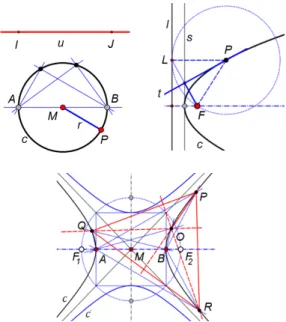
We consider conics in a hyperbolic plane (h-plane) hav-ing one ore more properties of the three Euclidean special conics “circle”, “parabola” and “equilateral hyperbola”. In the projectively enclosed and complexified Euclidean plane circles are conics passing through the (complex con-jugate) absolute pointsI,Jon the ideal lineuof that plane, parabolas touch this absolute line u, and equilateral hy-perbolas intersect the absolute line u in points harmonic toI,J. Besides these projective geometric properties, the three special conics have many Euclidean properties and generations.
Circles are e.g. generated as distance curves of a point, the midpoint, but they are also generated by directly congruent pencils of lines, what results in the remarkable inscribed angle theorem and the theorem of Thales as its special case.
Parabolas are e.g. generated as envelope of a leg of a right angle hook sliding along a line, while the other leg passes through a point. The fixed line and point turns out to be vertex tangent and focus of the generated parabola. As a Euclidean conic, a parabola is of course also defined via the Apollonius definition of a conic.
An equilateral hyperbola has orthogonal asymptotes. It is (directly and indirectly) congruent to its conjugate hy-perbola, it is generated by indirectly congruent pencils of lines. But the most strange property is that each triangle of points on the hyperbola has its orthocentre on this equi-lateral hyperbola. The pencil of conics with the vertices of a triangle and its orthocentre as base points consists only of equilateral hyperbolas; (the singular conics are the pairs consisting of the altitude and the corresponding side of the given triangle).
In Figure 1, these three Euclidean cases and their well-known main properties are visualised symbolicly:
Figure 1: (Symbolic) visualisation of projective and met-ric properties of a Euclidean circle, a parabola, and an equilateral hyperbola
In the following, we shall study conics in a hyperbolic plane being defined by one of the mentioned projective and Euclidean properties. Place of action will be the “univer-sal hyperbolic plane”π, i.e. the full real projective plane endowed with a hyperbolic polarity, see e.g. [15]. This “absolute (regular) hyperbolic polarity” is usually given by the real conic ω and rules orthogonality, h-distance, and angle measure. F. Klein’s point of view considers h-geometry as a sub-h-geometry of projective h-geometry while a puristical point of view allows only the inner domain of ω for being a proper h-plane. In the following, we try to have both points of view in mind, but we will use F. Klein’s projective geometric model of a h-plane.
The standard graphic representation ofωis that of a Eu-clidean circle and this allows us to use e.g. the graph-ics software “Cinderella” (see [11]), which has the feature “(planar) hyperbolic geometry”.
As a first and well-known example we consider circles: In a hyperbolic plane with the (real) “absolute conic”ωa cir-clecis a conic touchingωtwice in algebraic sense (what means disregarding reality and coincidence of the touch-ing points). This projective geometric approach results al-ready in three types of hyperbolic circles: (1) proper cir-cles touchingωin a pair of complex conjugate points, (2) limit circles which hyperosculate ω, and (3) distance cir-cles touchingωin a pair of real distinct points. While the elementary Euclidean definition of a circle as the planar set of points having equal distance from a centre point, the
analogue in hyperbolic geometry is true only for h-circles of type (1) and can be modified for h-circles of type (3). For h-circles of type (3) the radius length is not finite, a property, which connects this type rather with Euclidean parabolas than with circles. Euclidean circles can be gen-erated via directly congruent pencils of lines, which ex-presses the property of a constant angle at circumference and especially the property of Thales. In an h-plane two pencils of orthogonal lines with proper base points gener-ate the so-called “Thales conic” (resp. “Thaloid”, as it is called by N. J. Wildberger, see [15]), which is never an h-circle of type (1) and (2), while h-h-circles of type (3) occur if, and only if the vertices of the h-orthogonal pencils both are ideal points onω.
Conics with the properties of a Euclidean parabola are treated in [1], where the place of action again is the “uni-versal hyperbolic plane”π. But, for the sake of complete-ness, we also repeat some of the details here.
A great part of this article will deal with h-conics derived from properties of the Euclidean equilateral hyperbola fol-lowing the above presented systematic treatment for cir-cles. This results in two special sets of h-conics, the set of “h-equilateral conics” having a harmonic quadrangle of ideal points and the set of h-conics defined by the property that each triangle of conic points has its h-orthocentre also on this conic.
2
Projective geometric classification
of h-conics
A given conicc, together withω, defines as well a pencil of conicsp·c+q·ωas well as a dual pencil of (dual) conics and we distinguish 5 different types of pencils according to the sets of singular conics resp. the sets of common base points and base tangents (see Figures 2 and 3).
Figure 2: Conic pencils I and II and its dual pencils I∗and II∗
Figure 3: The self-dual pencils of conics III, IV, and V If we take the reality of base points or base lines into ac-count and consider the pencils I and I∗, then we have three subcases each, the pencils of type II, II∗and III have two such subcases each and there is only one case of pencils of type IV and V. A further distinction can be made con-cerning the reality of the common polar triangle ofcand ω, which acts as the h-midpoint triangle ofc: An h-conic can have either one or three real midpoints.
An overview of all possible cases can be found in [5], [6], [9], and [10]. This classification shows that the Eu-clidean names “ellipse”, “parabola” and “hyperbola” need strong modifications (as e.g. “semi-hyperbola”, “convex resp. concave hyperbolic parabola” and so on) to express the type of an h-conic, which becomes obvious by its visu-alisation in some model of the h-planeπ.
Pencilsp·c+q·ωof the two subtypes III define h-circlesc. They have the well-known property of being distance loci of either points or lines, see Figure 4. h-Conics to type V have no finite radius lenght and are called “limit h-circles” or “horocycles”. But as they have similar properties as Eu-clidean parabolas they can also be considered as special cases of h-parabolas, Figure 5.
Figure 4: The different types of h-circles within concentric pencils of h-circles
Figure 5: Pencil of “horocycles” showing the property of Euclidean parabolas, which are translated along their common axis
Conicsc defining pencils of type II and IV can be con-sidered as analogs to Euclidean parabolas and they will be studied in Chapter 5 with respect to their h-metric proper-ties.
Conics c defining pencils of type I are “h-hyperbolas”, “semi-hyperbolas” or “h-ellipses” according to the reality of the pencil’s base points, which furtheron will be called the “ideal points” ofc.
3
Classification with respect to
h-orthogonality
We start with an h-conicc, which, together withωdefines a pencil p·c+q·ωof type I. The quadrangle of its ideal points can be special with respect to the h-orthogonality structure defined by the absolute polarity to ω. There might be h-orthogonal pairs of opposite sides of this base quadrangle (Figure 6). For dual pencils p·c∗+q·ω∗one can find similar special cases, see Figure 7. Quadrangles (resp. quadrilaterals) with this special property are called “harmonic quadrangles” (resp. “harmonic quadrilaterals”) as their (non-trivial) symmetry group is generated by har-monic homologies.
Figure 6: Pencils p·c+q·ωwith h-orthogonality proper-ties of the base quadrangle (and its degenerate case pencil IV)
Figure 7: Dual pencils p·c∗+q·ω∗ of type I∗ with h-orthogonality properties of the base quadrilat-eral
Figure 6 shows that there occur only h-hyperbolas and semi-hyperbolas and, as a degenerate case, there are h-parabolas, but no h-ellipses. The dual case (Figure 7) con-tains h-ellipses c, when seen as point conics. It makes sense to define an h-conic possessing a real harmonic ideal quadrangle as “h-equilateral hyperbola” and we will have a closer look to these h-conics in Chapter 6.
4
h-Conics with metric properties of
Euclidean circles
We start with the concept of a Euclidean circle and its dif-ferent Euclidean generations. We have already mentioned that projective h-conics of type III are also a h-distance cir-cles (Figure 4). But they have neither the Thales-property nor the property of the constant angle at circumference. The generation of a conic by h-orthogonal pencils delivers the “Thales conic”xover a segment[A,B], which turns out to be one of the axes of the conic (Figure 8). There is one exeption: Thales-conics over a segment [A,B], A,B∈ω, are h-circles and their radius turns out to be 1/√2, (Fig-ure 9).
Figure 8: Different cases of Thales-conics x generated by two h-orthogonal pencils of lines
Figure 9: The exceptional case of a Thales-conic over a segment with endpoints on the absolute conicω in a h-circle of radius1/√2
Connecting the construction of a Thales-conic x with a kinematic mechanism allows us to construct of points and tangents ofx, see [14] and Figure 10.
Figure 10: Kinematic generation of a Thales-conic x ap-plied to construct its tangents
Arbitrarily chosen direct congruent pencils of lines gener-ate a conic, too. It is simply the Steiner generation of a conic by projective pencils, but this delivers no h-circles, see Figure 11, and it has not the property of inscibed angle theorem either!
Figure 11: Conic generated by two directly congurent pen-cils of lines
Curves defined by a constant angle at circumference differ-ent from a h-right angle, socalled “isoptics of a segmdiffer-ent”, turn out to be algebraic of degree four! To visualize this one can consider the inverse motion, namely to keep the angle and its legs fixed and move the segment. In the Eu-clidean plane this motion is the well-knownellipse motion,
as all points which are fixed connected with the moving system and which are different from the points on the legs of the fixed angle have ellipses as orbits. In the h-plane these orbits turn out to be of order four, too, see Figure 12.
Figure 12: The h-analog of the Euclidean ellipse motion delivers orbits ciof degree 4
Another way to visualise this motion is to start with the Thales-motion and consider the envelop of a line fixed to Thales’s right angle hook and passing through its vertex, Figure 13. In the Euclidean case, the envelope is a point of the Thales-circle, in the h-case it is a curve of degree 6.
Figure 13: Moving a fixed angle hook along a Thales-conic such that one leg passes through a bases point A of Thales’s construction, the 2nd leg envelops
a curve of degree 6.
5
h-Conics with metric properties of
Euclidean parabolas
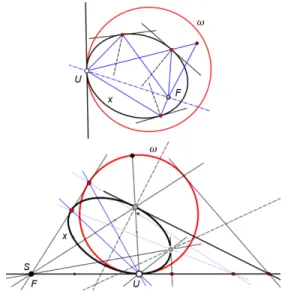
In this chapter, we strongly refer to [1]. From the pro-jective geometric point of view, we have to distinguish h-parabolas of type II, IV, and V, the latter having also prop-erties of a circle. If one considers the analog of the Eu-clidean slider crank, there occur h-conics, but they are (in general) not projective h-parabolas, (Figure 14). The proof for the fact that the envelop of the second legtof the crank slider is a h-conicxis trivial: The linetconnects two pro-jectively correlated point series, namelysand the absolute
polar line f of F. This line f is also the second vertex tangent of the h-conicx.
Figure 14: The h-analog of the Euclidean crank slider mo-tion, defines a conic x with focus F and vertex tangent s.
Also the h-analog to the construction of a parabola accord-ing to Apollonius’s definition does in general not deliver h-parabolas in the projective geometric sense, see Figure 15. (Proof: xis Steiner-generated by two projective pen-cils of lines with centreF, the focus ofx, and the absolute PoleLof the directrix linelofx.)
Figure 15: The h-analog of Apollonius’s definition of a Eu-clidean parabola delivers a conic x.
Figure 15 also shows thatxfulfills a “reflection property” similar to the Euclidean parabola. But while, in the Eu-clidean case, the diameters of the parabolacare reflected atx, and then pass through the focus ofx, in the hyperbolic
case the lines through the absolute pole Lof the directrix linelare reflected atxand pass through a point, the h-focus F1. The pointsLandF1act, therefore, as a pair of foci of
x.
As all h-conics with two real focal points have the “reflec-tion property”, it seems to be obvious that the projective h-parabolasxhave the “reflection property”, too, i.e., the h-reflections of “diameters” atxpass through a point, the focus ofx. It turns out that this is true for all cases, Fig-ure 16. For the limit case of pencil type V it seems to be trivial, as the diameters intersect the “limit circle”x h-orthogonally, a property, which we connect rather to circles then to a parabola and which justifies to call that special h-conic alimit circle(horocycle) and not alimit parabola.
Figure 16: Reflection property of h-parabolas of the projec-tive types II and IV
6
h-Conics with properties of Euclidean
equilateral hyperbolas
6.1 h-equilateral conics
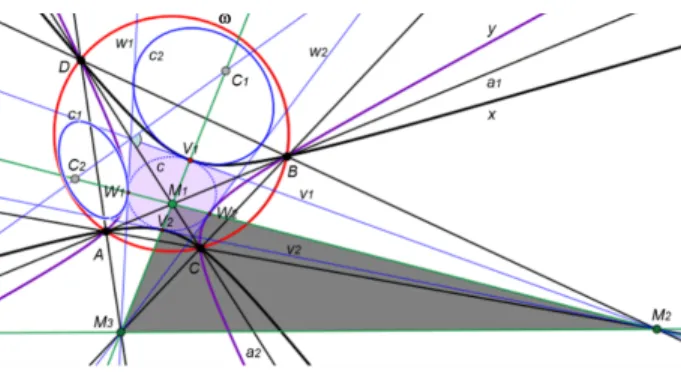
Here, we continue chapter 3: An “h-equilateral hyperbola” xis an h-conic with a (real) harmonic quadrangleΩof ideal points, i.e. x∩ω=A,B,C,D and CR(A,B,C,D) =−1. Similarly we call an h-equilateral conic x with two real and two conjugate imaginary ideal points an “h-equilateral semi-hyperbola”, see Figure 6. For both cases exactly one real pair of sides of the ideal harmonic quadrangle Ω is h-orthogonal and we will call this pair the “asymptotes” a1,a2of x, c.f. also [10]. The other two (real or
conju-gate imaginary) pairs of sides of the complete quadran-gle Ω shall be named as “singular h-equilateral conics” Σ1,Σ2. The vertices of the diagonal triangle ofΩare the h-midpointsMiofx, Figure 17.
Figure 17: Concentric h-equilateral hyperbolas x1, x2, x3
with their common asymptotes a1, a2, and
h-midpoints Mi
A h-equilateral semi-hyperbola can be visualized in the classical, but projectively closed plane of visual perception as aEuclidean pencil of circles, see Figure 18.
Figure 18: Left: Euclidean model of h-equilateral semi-hyperbolas, Right: A more projective visualisa-tion of these special h-conics
Figure 19 shows that even a Thales-conic can be an h-equilateral hyperbola.
Figure 19: A Thales-conic can be an h-equilateral hyper-bola
Figure 20: Dual pencil of h-equilateral dual conics c∗ Figure 20 illustrates the case of a dual pencil of h-equilateral dual conics c∗ touching a harmonic (ideal) quadrilateralΩ∗. (“Dual conic” means the set of tangents of a conicc, which is given as a point set.) The three pairs of intersection points of the complete harmonic quadrilat-eral Ω∗act as the pairs of focal pointsFi of the conicsc.
Again, there exists one real pair of absolute conjugate fo-cal pointsF1,F2, and we call these points the “asymptote
points” ofc∗. The diagonal points ofΩ∗are the midpoints of the conicsctoc∗.
If one applies an h-reflection to an h-equilateral hyper-bola cin one of its asymptotes, one receives another h-equilateral hyperbolac, which is h-congruent toc. This re-peats a property of Euclidean equilateral hyperbolas. In the Euclidean case candcare “conjugate hyperbolas”. This gives a hint to define h-conjugate conics, too, see Figure 21:
Definition 1 The “h-conjugate conic” y to conic x is concentric with x, has the same ideal points, and thus, the same asymptotes a1, a2, and it has the same
“axis-quadrangle” Λ. The axis-quadrangleΛ of x has its ver-tices in the intersection points of vertex tangents w1, w2, of
x with its asymptotes a1, a2.
Figure 21: The h-conjugate conics x and y in the case of x being h-equilateral
Figure 22: The h-conjugate conics x and y in the case of x being not h-equilateral
The special case visualised in Figure 21 also reveals the construction of the hyper-osculating h-circlesciat the
ver-ticesW1of xandV1ofy, which is identical with the
Eu-clidean construction for equilateral hyperbolas. Figure 22 shows the general case of (real) h-conjugate conics. There, too, the classical Euclidean construction of the hyperoscu-lating circles at the vertices is possible. So, we can state the following
Result: If in an arbitrary Cayley-Klein plane (CK-plane)π a conicxhas a well-definded real pair of asymptotsa1,a2,
then it has a real CK-conjugate conicy. The CK-normals in vertices of the “axis-quadrangle” ofx(defined above) to the asymptotes intersect the axes ofx(andy) in the h-centresCiof the hyperosculating circlesciofxandy.
6.2 Special h-conics generated by h-congruent pencils of lines
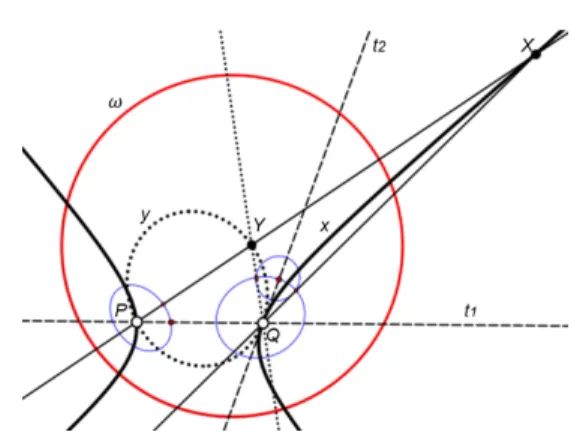
Euclidean equilateral hyperbolas have the property that they can be Steiner-generated by two indirect congruent pencils of lines. Obviously, the result of the analog con-struction in the h-planeπdelivers a conicx, but this conic is, in general, not h-equilateral, see Figure 23. As also a Thales conic can have four real ideal points, see e.g. Figure 19, the sense of the congruence between the two pencils of lines is not essential for receiving a hyperbola as the result of the Steiner-generation.
Remark 1 In Figure 23 the basis points of both Steiner-generations, the direct and indirect one, are labelled with P, Q. It turns out that the segment [P,Q] is a diameter of the indirectly generated h-conic x as well as of the di-rectly generated h-conic y. It is still an open question, whether any arbitrary h-conic x can be Steiner-generated by h-congruent pencils of lines. In the Euclidean case this is not true.
Figure 23: Generation of a conics x, y via h-congruent pen-cils of lines. The h-congruence is given by the sense (indirect or direct) and the pair of corre-sponding lines t1, t2. The dotted conic y is the
result of directly congruent pencils while the x stems from indirectly congruent pencils.
6.3 Special h-conics with the “triangle orthocenter property”
It is well-known that Euclidean equilateral hyperbolasxare characterised by the remarkable property that any triangle ∆of hyperbola points has its orthocentre onx. We abbre-viate this property as the “triangle orthocentre property” of (Euclidean) equilateral hyperbolas and pose the question whether there exist h-conics with this property, too. We start with an arbitrary but not right-angled triangle ∆= (APQ)withObeing its h-orthocentre, and we add an arbitrarily chosen fifth point X for defining an h-conicx through these 5 points. We assume xto be regular, see Figure 24.
Theorem 1 A h-conic x through A,O,P,Q,X , with O the h-orthocentre of ∆= (APQ) passes also through the h-orthocentre OXof triangle∆X= (X PQ).
Proof. Using the labelling of Figure 23 with a1=PA,
a2=QA, b1=PX, b2=QX and c1=PO, c2=QO,
d1=POX,d2=QOX, we have the following pairs of
h-orthogonal lines:
a1⊥c2, b1⊥d2, c1⊥a2 and d17→b2. (1)
The two ordered quadruples(a1,b1,c1,d1),(c2,d2,a2,b2)
belong to h-orthogonal pencils, which Steiner-generate the Thales conictover the segment[P,Q]. Therefore, we can state that
CR(a1,b1,c1,d1) =CR(c2,d2,a2,b2). (2)
By applying permutation rules for cross ratios (see e.g. [2, p. 34]), we infer
CR(a1,b1,c1,d1) =CR(c2,d2,a2,b2) =CR(a2,b2,c2,d2),
(3) such that also the ordering a17→a2, b17→b2, c17→c2,
d17→d2defines projective pencils, which Steiner-generate
the conicxthroughP,Q,A,X,O. Since (2) holds, we also
haved1∩d2=OX∈x.
Figure 24: An h-conic x through A,O,P,Q,X , with O the h-orthocentre of∆= (APQ)passes also through the h-orthocentre OX of the triangle ∆X = (X PQ).
Applying Theorem 1 to different points Xi∈xallows us
to go from the basic triangle(A,P,Q)to any other triangle
(X1,X2,X3)of conic points, and also this new triangle must
have its h-orthocentre onx. So we can state
Theorem 2 A (regular) h-conic x passing through A,O,P,Q, with O being the h-orthocentre of triangle
(A,P,Q)has the triangle orthocentre property, i.e. any tri-angle of points of x has its h-orthocentre on x.
One can extend Theorem 1 by the following statement, (see Figure 25):
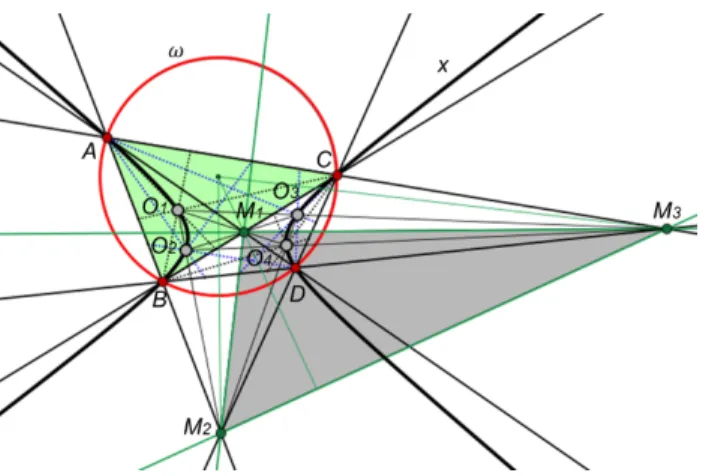
Theorem 3 Any conic x through points A,B,C,D and passing through the h-orthocentre O1 of triangle(ABC)
passes also through the h-orthocentres Oi of (BCD), (ABD), and (ACD). Especially, if A,B,C,D∈ ω and
(A,B,C,D) is not harmonic, then the diagonal trian-gle of the quadrantrian-gle (O1, ...,O4) coincides with that of
(A,B,C,D), which is the midpoint triangle of x.
Proof. The first part of theorem 3 is simply a conse-quence of theorem 2. Now we consider a quadrangle Ω = (A,B,C,D) of ideal points. Let O1,O2 be the
h-orthocentres of the triangles (ABC)and(ABD), see Fig-ure 26. The quadrangleΩ admits the h-reflections in the sides of its diagonal triangle(M1,M2,M3). Thereby, the
maps triangle (ABC) to the triangle (ABD)and, as σ is an h-congruence, it maps also O1 to O2 which implies
that O1,O2,Z are collinear. Applying the other possible
h-symmetries with centres Mi and axes MjMk to the
h-orthocenters of the remaining partial trianglesΩcompletes
the proof.
Figure 25: An h-conic x through A,B,C,D,O1with O1the
h-orthocentre of(ABC)also passes through the h-orthocentres Oi of the remaining partial
tri-angles of(A,B,C,D).
Remark 2 The h-symmetry argument used in the proof above suggests an extension of Theorem 3: Each quadran-gle(A,B,C,D)admitting three h-symmetries would suit as start figure such that the quadrangle of h-orthocentres of the partial triangles has the diagonal triangle in common with(A,B,C,D).
Figure 26: Applying the h-symmetry σ: (A,B,C,D) 7→
(A,B,D,C)proves that O1,O2,Z are collinear.
Remark 3 Both, the set of h-equilateral hyperbolas pos-sessing one pair of h-orthogonal asymptotes and the set
of conics with the triangle orthocentre property (“top-conics”) are four-parametric with a three-parametric fam-ily of h-conics having both properties, while in Euclidean geometry the two four-parametric families coincide.
7
Final remarks and conclusion
Conics in Euclidean and non-Euclidean geometries are al-ready widely studied since decades, see e.g. [3], [5], [6] and also the reference list in the monograph on conics [7]. Many references mainly deal with the classification and normal form problem and less with explicite constructions or properties of conics, see e.g. [10], [12]. Explicit con-structions can be found e.g. in [1] and [14].
This article aims at a systematic treatment of what can be called “special conics” in a hyperbolic plane. This means that we have to base the investigation on usual classifica-tions of conics from the (projective) universal hyperbolic point of view as well as on the basis of special properties which are non-Euclidean adaptions of properties one can find at Euclidean conics. As one can interpret many of these adaptions simply as Steiner-generations of conics (or its dual), one can widely omit calculations and use syn-thetic reasoning instead.
Because of the used projective geometric point of view, it is an easy task to transfer the presented results resp. the constructions also toelliptic geometry. In an elliptic plane (or its Euclidean spherical model), there are no parabolas even so the constructions for Euclidean parabolas can be performed. Each general conic in the elliptic plane is an ellipse, but a spherical conic allows both, the Apollonius-definition of an ellipse and (seen from the complementary side in the spherical model) also that of a hyperbola. As special projective types of (real) conics, one finds one type of “e-circles”. All the other metric definitions (as e.g. by the triangle-orthocentre-property) deliver “e-ellipses” with special properties or curves of higher degree.
We conclude with open questions:
It remains open, whether there exist additional special con-ics in hyperbolic geometry, which have properties one did not consider in Euclidean geometry. One such property which makes no sense in Euclidean geometry but is mean-ingful in hyperbolic and elliptic planes, is the dual to the Apollonius definition of a conic:
“The tangents of a conic intersect two given lines in angles of constant sum.”
For elliptic resp. spherical geometry, this results in a nice application: Given two lines a,b intersecting in C, find pointsB∈a,A∈b, such that the spherical triangleABC has a given area.
As a second open problem occurs, whether each h-conic can be Steiner-generated via two congruent pencils of lines. For h-special hyperbolas the generation via
congru-ent pencils leads to pencil vertices on a diameter of the hyperbola. As there is a 5-parametric set of h-conics in the h-plane, and there is also a 5-parametric set of congruent pencils, (namely 2 times two for the vertices and one for the rotation given by start linet2 to a fixed start linet1),
this question might be answered with “yes”, even so it is wrong in Euclidean geometry. But if “yes” is true, how can one find these vertices and the angle of rotation to a given h-conic?
A third question concerns the “h-isoptic curves of a seg-ment”, which generalise the incribed angle theorem in Eu-clidean geometry. Is it possible that the h-isoptic curve, which is irreducible of degree 4 in geneneral, can be re-ducible in some special cases? This would be similar to the Euclidean case, where the resulting curve of degree 4 always splits into two circular arcs?
A fourth problem might concern the hyperbolic versions of some generalisations of Euclidean Thales-constructions as presented in [13].
Final remark. Even so the topic of dealing with special conics a specific CK-plane only seems to be what can be called “advanced elementary geometry”, it could stimu-late research of conics - namely as curves of degree 2 - in arbitrary metric planes, so-called Minkowski planes. Until now “Minkowski conics” are defined only via the Apollo-nius definition, see e.g.[4], [8].
Acknowledgement
The author thanks Prof. Moln´ar and Prof. Horv´ath [9] for hints and references and Prof. Norman Wildberger for fruitful discussions.
References
[1] A. ALKHALDI, N. J. WILDBERGER, The Parabola in Universal Hyperbolic Geometry I,KoG17(2013), 14–42.
[2] H. BRAUNER,Geometrie projektiver R¨aume II, BI-Wissenschaftsverlag, Mannheim, Wien, Z¨urich 1976. [3] P. CHAO, J. ROSENBERG, Different definitions of
conic sections in hyperbolic geometry,
https://arxiv.org/pdf/1603.09285v1.pdf
[4] A. FANKHANEL¨ , On Conics in Minkowski Planes, Extracta Math.27/1 (2012), 13–29.
[5] K. FLADT, Die allgemeine Kegelschnittsgleichung in der ebenen hyperbolischen Geometrie,Journ. f. d. Reine u. Angew. Math.197(1957), 121–139. [6] K. FLADT, Die allgemeine Kegelschnittsgleichung
in der ebenen hyperbolischen Geometrie II,Journ. f. d. Reine u. Angew. Math.199(1958), 203–207. [7] G. GLAESER, H. STACHEL, B. ODEHNAL, The
Universe of Conics, Springer Spectrum, Berlin-Heidelberg, 2016.
[8] ´A. G. HORVATH´ , H. MARTINI, Conics in normed planes,Extracta Math.26/1 (2011), 29–43.
[9] ´A. G. HORVATH´ , Constructive curves in non-Euclidean planes, 19th Scientific-Professional Col-loquium on Geometry and Graphics, Starigrad-Paklenica, 2016.
[10] E. MOLNAR´ , Kegelschnitte auf der metrischen Ebene,Acta Math. Acad. Sci. Hungar.31/3-4 (1978), 317–343.
[11] U. RICHTER-GEBERT, U. H. KORTENKAMP, Cinderella, https://plus.maths.org/content/ interactive-geometry-software-cinderella-version-12.
[12] A. SLIEPCEVIˇ C´, I. BOZIˇ C´, H. HALAS, Introduction to the Planimetry of the Quasi-Hyperbolic Plane,KoG
17(2013), 58–64.
[13] G. WEISS, F. GRUBER, Den Satz von Thales verall-gemeinern - aber wie?,KoG12(2008), 7–18. [14] G. WEISS, Elementary Constructions for Conics in
Hyperbolic and Elliptic Planes,KoG19(2015), 24– 31.
[15] N. J. WILDBERGER, Universal Hyperbolic Geom-etry I: TrigonomGeom-etry, Geometriae Dedicata 163/1 (2013), 215–274.
Gunter Weiss
e-mail: [email protected] University of Technology Vienna, Karlsplatz 13, 1040 Vienna, Austria University of Technology Dresden,