Pemodelan
Rekayasa Kebutuhan
REKAYASA PERANGKAT LUNAK
Tujuan & Agenda Perkuliahan
Tujuan
Memahami konsep pemodelan dalam rekayasa kebutuhan
Memahami konsep pendekatan terstruktur dan berorientasi objek dalam pemodelan kebutuhan
Agenda
Konsep pemodelan kebutuhan Pemodelan terstruktur
Pemodelan berorientasi objek
Ke
Konsep Pemodelan Kebutuhan
Model kebutuhan menjembatani antara deskripsi
sistem secara umum dengan model
perancangan
Tujuan utama model kebutuhan:
Menjelaskan apa yang dibutuhkan oleh customer Menjadi dasar bagi perancangan PL
Menjadi referensi dalam melakukan validasi kebutuhan
Metode
Terstruktur (structured analysis – SA) &
berorientasi objek (object oriented analysis – OOA) odelan kay asa Ke butuhan
Prinsip Pemodelan Kebutuhan
Model yang dibuat harus fokus pada kebutuhan
yang relevan dengan domain permasalahan
(
WHAT)
Setiap model kebutuhan harus bisa dilacak ke
model perancangan (
traceability)
Setiap elemen dalam model kebutuhan harus
mampu memperjelas pemahaman secara utuh
terhadap kebutuhan PL
Domain masalah, fungsionalitas dan perilaku sistem
Minimalisasi kopling antar klas
Memastikan bahwa model kebutuhan memiliki
Ke
Tipe – Tipe Model Kebutuhan
Scenario-based models
Berdasarkan sudut pandang aktor
Data models
Menjelaskan domain informasi dari masalah
Class-oriented models
Merepresentasikan klas-klas yang relevan dengan kebutuhan PL
Flow-oriented models
Merepresentasikan proses dan data dari sistem
Behavioral models
Merepresentasikan perilaku sistem berdasar event odelan kay asa Ke butuhan
Ke
butuhan
Konsep
Pertama kali dipopulerkan oleh T. DeMarco
(1979)
Structured Analysis and System Specification
Perluasan notasi untuk kebutuhan real-time
systems oleh Hatley dan Pirbhai (1987) – SA/RT
Strategies for Real-Time System Specificationodelan kay asa Ke butuhan Processes Data Behavior
Elemen – Elemen Pemodelan
Ke butuhan Data Dictionary Data Flow Diagram (DFD) ER Diagram State Transition Diagram (STD) Process Specification (PSPEC) Data Object DescriptionData Dictionary
odelan kay asa Ke butuhan Representasi Simbol : = : composed of + : and { } : iterations of [….|…] : selection / or ( ) : optional “ “ : literal * * : comment/description Vend product (partly) :Name Element Type
object [coin | slug](product) data
product [ice cream | coffee | candy] data coins 0{[quarter | nickel | dime]}8 data product available [TRUE | FALSE] control
[“YES” | “NO”]
quarter *25 cents US currency*
Data Model : ER Diagram
Entitas (atribut dan nilai atribut)
Modalitas : tingkat mandatory (minimal)
Kardinalitas : tingkat relasi (maksimal)
Bentuk relasi
Ke
butuhan
Data Model : ER Diagram
Data object
Represents a composite information
Consists of a number of different attributes or properties
Encapsulates data only : no operation applied to its data
Can be external entity, thing, occurrence/event, role, organizational unit, structure, etc.
e.g. dimensions (height, weight, depth), cars (make, model, ID, body type, color, owner)
Can be represented in a tabular representation
odelan
kay
asa
Ke
Process Model : DFD
Useful for analyzing existing as well as proposed
systems
Process decomposition
Focus on the movement of data between external
entities and processes, and between processes
and data stores
A relatively simple technique to learn and use
Model elements: terminator, process, data flow,
control flow, storage, control bar
The highest level (0) : Context diagram
Single process Terminators
Data flows, control flows
Ke
Process Model : Elemen – Elemen
DFD
Terminator
Representasi entitas eksternal Notasi: persegi panjang
Tidak memproses data
Data flow
Representasi aliran data Notasi: anak panah penuh Umumnya satu arah
Hubungkan terminator, process dan storage
Control flow
Representasi aliran kontrol proses Notasi: anak panah putus2
Hubungkan terminator, process dan control bar
odelan kay asa Ke butuhan
Customer
data controlProcess Model : Elemen – Elemen
DFD
Process
Representasi aktifitas sistem Notasi: lingkaran
Memproses data
Storage
Representasi tempat penyimpanan data Notasi: dua garis paralel
Data flow in = diubah, data flow out = dibaca
Control bar
Representasi spesifikasi kontrol Notasi: garis tegak
Ke
butuhan
1 ProsesA
Jumlah proses dalam satu diagram DFD : 4 ± 2
Maks. 4 level dekomposisi (DFD/CFD)
Dekomposisi fungsional (DFD) :
fungsi-fungsi yang saling berhubungan dikelompokkan
fungsi-fungsi yang tidak berhubungan dipisahkan setiap fungsi dispesifikasi hanya sekali
Data flow membawa informasi yg diperlukan
oleh sebuah proses untuk transformasi, control
flow membawa informasi yang harus
diinterpretasikan untuk merubah perilaku sistem
dan/ aktifasi proses
Proses pemodelan DFD/CFD adalah proses
iterasi, tidak sekali jadi
Penjenjangan CFD harus sesuai dengan DFD
odelan
kay
asa
Ke
butuhan
Identify data first rather than control
To know what you are controlling first Continuous signals, and processes that act on
them, are always categorized as data
Discrete signals, and processes that act on them,
are usually categorized as control
Terms like activate, turn on, engage and execute
are usually associated with control requirements
Ke
butuhan
Must be consistent
odelan kay asa Ke butuhanKe
butuhan
Data / Control Context Diagram
(DCD/CCD)
Vend
product
Customer
returned coins 0*Customer
product object customer selection slug coin return request product availableodelan
kay
asa
Ke
butuhan
Data / Control Flow Diagram
(DCD/CCD Level 1)
1* Get customer payment 2p Get product price 3p Validate payment 4p Get valid selection 5* Dispense change 6p Dispense product price table coins products returned coins product object customer selection slug coin return request payment price valid selection change due valid selection coin detected sufficient payment product dispensed product available product availableKe
butuhan
Data / Control Flow Diagram
(DCD/CCD Level 2)
5.1p Get change coin coin return request 5.2p Get payment coin product available change due coins payment payment coinschange coins returned
coins
odelan
kay
asa
Ke
butuhan
Process Model : Process
Specification
PSPEC – Validate payment (Process 3)
Inputs : payment (data in)price (data in)
Outputs : change due (data out)
sufficient payment (control out)
Body :
IF payment >= price THEN
change due = payment – price sufficient payment = TRUE ELSE
change due = 0
sufficient payment = FALSE END IF
Ke
butuhan
State Transition Diagram (STD)
Behavior Model
Waiting for a coin Waiting for selection Dispensing Returning payment initial accept new coinpayment returned accept new coin coin detected accept customer request product dispensed accept new coin
sufficient payment dispense product product available=FALSE return payment coin return request return payment
odelan
kay
asa
Ke
butuhan
CSPEC – Dispense change : Process Activation
Table
Behavior Model
coin return request product available get change coin get payment coin TRUE TRUE 1 0 D/C FALSE 0 1Ke
butuhan
Pemodelan Berorientasi
Objek
Object Oriented Approach
Mulai populer akhir ’80an – ’90an (Booch,
Rumbaugh-OMT, Jacobson-OOSE,
Coad+Yourdon, Wirfs-Brock) :
Elisitasi kebutuhan customer Identifikasi skenario / use-case (use-case diagram)
Identifikasi klas berdasarkan kebutuhan customer Identifikasi atribut dan operasi setiap klas
Definisi struktur klas (class diagram) Definisi model relasi antar klas
(collaboration/sequence diagram)
Definisi perpindahan status sistem (statechart diagram)
1996 : UML (Unified Modeling Language) –
Grady Booch+James Rumbaugh+Ivar Jacobson
odelan
kay
asa
Ke
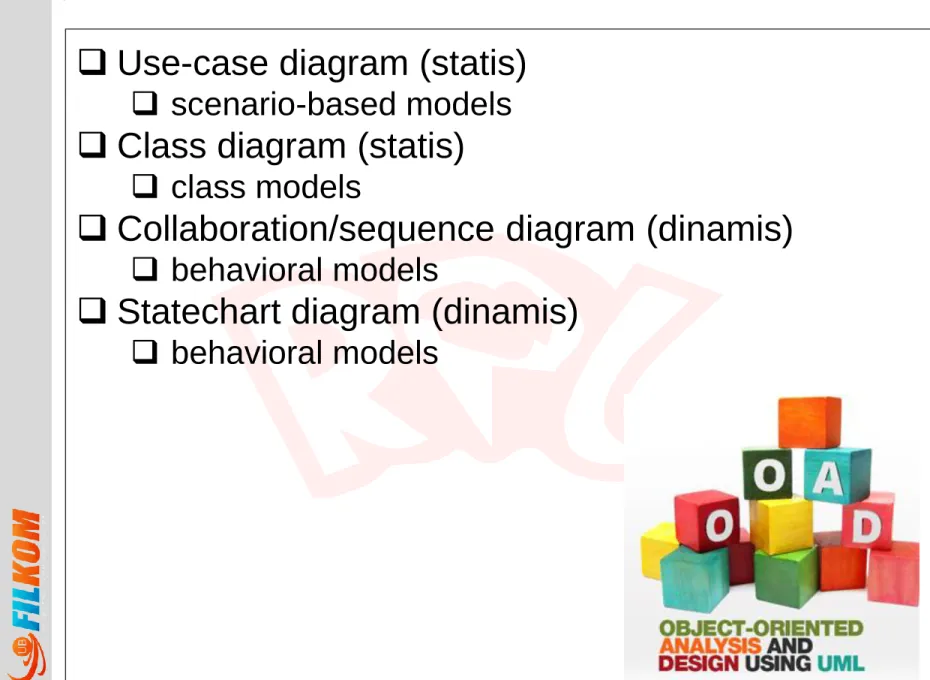
Diagram UML
Use-case diagram (statis)
scenario-based models Class diagram (statis)
class models
Collaboration/sequence diagram (dinamis)
behavioral models Statechart diagram (dinamis)
behavioral modelsKe
Keuntungan UML
Sangat natural, sesuai dengan cara berpikir
manusia
improve analyst and problem domain expert interaction
Meningkatkan konsistensi hasil analisis
abstraksi atribut-operasi dalam sebuah objek
Konsep penurunan klas memberikan kemudahan
dalam generalisasi objek
Kemudahan dalam perubahan
Terjaganya konsistensi model antara analisis dan
perancangan
Konsep reusability
odelan kay asa Ke butuhanObject & Class
Objek (Object) :
A concept, abstraction, or thing with crisp
boundaries and meaning for the problem at hand [Rumbaugh]
Benda (tangible & intangible thing)
Contoh : Andi, Eko, Susi (sistem akademik) Sebuah objek memiliki karakteristik : identity
(identitas-pembeda), state (sekumpulan atribut) &
behavior (sekumpulan operasi, aksi, servis)
Ke
butuhan Nama Objek
Object & Class
Klas (Class) :
A description of one or more objects with a
uniform set of attributes and services, including a description of how to create new objects in the class [Yourdon]
Gambaran umum (template, blue-print) yang menjelaskan sekumpulan objek yang memiliki kesamaan karakteristik (atribut dan operasi) Merupakan cetakan dari objek
Digunakan untuk menginstansiasi objek yang memiliki identitas yang berbeda
Contoh : Klas Mahasiswa objek Andi, Eko, Susi Abstract & concrete class
odelan
kay
asa
Ke
Object & Class
Ke butuhan Mahasiswa - NIM - Nama - Buat skripsi - Ujian Mahasiswa - NIM : 001 - Nama : Andi Mahasiswa : Andi Mahasiswa - NIM : 002 - Nama : Eko Mahasiswa : Eko Mahasiswa - NIM : 003 - Nama : Susi Mahasiswa : Susi Instansiasi : penciptaan objekWhere to look ?
Investigasi domain masalah
Langkah-langkah:
Observe first-hand observasi langsung ke lap. Actively listen to problem domain experts what,
who, why, when and how Check previous OOA results
Check other systems comparison
Read, read, read getting some more information odelan kay asa Ke butuhan
What to look for ? Nouns
Structures
Relasi antar objek generalisasi, agregasi
Other systems
Sistem lain yang berinteraksi dg proposed system
Things or events remembered
Data, status, kejadian yang harus disimpan
Roles played
Identifikasi peran manusia dalam sistem
berinteraksi langsung, tidak berinteraksi tetapi informasinya disimpan sistem
Sites
Informasi lokasi/posisi yang harus diingat oleh sistem
Ke
Identifikasi Atribut
Some data (state information) for which each
object in a class has its own value [Yourdon]
Langkah-langkah
Identifikasi atribut umum (adjectives, possessives) Identifikasi atribut yang relevan dg domain
masalah
Identifikasi atribut yang relevan dg peran atau tanggung jawab dalam sistem
Restrukturisasi atribut sehingga atomic kemudahan
Reposisi atribut yang sesuai dengan hirarki klas nya pewarisan klas
Spesifikasi atribut presisi, nilai default, batasan, dll. odelan kay asa Ke butuhan
Identifikasi Operasi / Servis
A specific behavior that an object is responsible
for exhibiting [Yourdon]
Langkah-langkah
Identifikasi tanggung jawab umum sebuah klas (verbs) Identifikasi operasi yang spesifik untuk domain masalah
Identifikasi operasi yang relevan dg peran atau tanggung jawab dalam sistem
Spesifikasi operasi argumen, batasan/aturan, logika/algoritma
Ke
Use Case Diagram
Menjelaskan perilaku sistem dari tampak luar
Menyediakan fungsi-fungsi yg harus dipenuhi
sistem sesuai dengan aktornya
Elemen: actor (orang, sistem lain) dan use-case
Setiap use-case dilengkapi dengan skenario
(deskripsi)
Langkah-langkah
Identifikasi aktor Identifikasi use-case per aktor
odelan
kay
asa
Ke
Use Case Diagram
Ke
butuhan
Select product
Get return coins Customer
Use Case Scenario
odelan kay asa Ke butuhanFlow of events for the Select product use-case
Objective Allow customer to select a certain product to dispense
Actors Customer
Pre-condition Coin detected and valid
Main flow 1. The customer selects a button product.
2. The system displays an entry prompt of number of product to order.
Alternative flows 1. If the selected product is not available, the system will
display a message “Your selected product is not available”. 2. If the selected product is available but there isn’t enough
number to order, the system will display a message “The
number isn’t enough, max. x”. X is the existing number of the
Use Case Association
Include
A use case uses another use case (functional decomposition) reuse
A function in the original problem statement is too complex to be solvable immediately describe the function as the aggregation of a set of simpler functions (mandatory)
Extend
A use case extends another use case
The functionality in the original problem statement needs to be extended
The extended case plays an optional use-case
Ke
Use Case Association
odelan kay asa Ke butuhanActor Generalization
Two/more sub-actors generalized into a
super-actor
Have both behavior and attributes in common –
described under the super-actor
Super-actor should interact with use cases when
ALL of its sub-actors interact in the same way
Sub-actors should interact with use cases when
their individual interactions differ from that of the
super-actor
Ke
Actor Generalization
odelan kay asa Ke butuhanClass Diagram
Menggambarkan struktur statis dari sistem
Terdiri dari node (klas) dan relasi
Jenis relasi
Generalization (‘is a’ – inheritance) Association
Aggregation (‘part-of’) Composition
Ke
Association
For “real-world objects” is there an association
between classes?
Classes A and B are associated if:
An object of class A sends a message to an object of B
An object of class A creates an instance of class B An object of class A has an attribute of type B or
collections of objects of type B
An object of class A receives a message with an argument that is an instance of B (maybe…) will it “use” that argument?
Does an object of class A need to know about
some object of class B?
odelan
kay
asa
Ke
Aggregation - Composition
Aggregation represents a part-whole or part-of
relationship
Aggregation can occur when a class is a
collection or container of other classes, but
where the contained classes do not have a
strong life cycle dependency on the container –
essentially, if the container is destroyed, its
contents are not
Composition is more specific than aggregation
Composition usually has a strong life cycle
dependency between instances of the container
class and instances of the contained class(es)
Ke
Class Relationships
odelan kay asa Ke butuhanClass Stereotypes
Boundary classes
model the interaction and manage communication between the computer system and its actors, but don’t directly represent the specific interface
object in the implementation
used to identify the main logical interfaces with users and other systems (including e.g. other software packages, printers)
main task is to translate information across system boundaries
partition the system so that interface is kept separate from business logic
Ke
Class Stereotypes
Entity classes
used to model data and behavior of some real life system concept or entity e.g. member, bank
account, order, employee
these will sometimes require more persistent
storage of information e.g. a student’s details are ultimately stored as a student record
Control classes
represent coordination, sequencing, transactions and control of other objects
glue between boundary elements and entity
elements, describing the logic required to manage the various elements and their interactions
roughly one per use case
odelan
kay
asa
Ke
Class Stereotypes
Ke
butuhan
Model interaction between the system and its environment
Actor 1 <<boundary>>
<<control>>
<<boundary>>
<<entity>> <<entity>>
Sequence Diagram
An interaction diagram that emphasizes the time
ordering of messages
Shows a set of objects and the messages sent
and received by those objects
Elements
Object represented in a box
Dashed line called the object lifeline, and it represents the existence of an object over a period of time
Message rendered as horizontal arrows being passed from object to object as time advances down the object lifelines
odelan
kay
asa
Ke
Statechart Diagram
A statechart diagram shows the behavior of
classes in response to external stimuli
This diagram models the dynamic flow of control
from state to state within a system
odelan
kay
asa
Ke
Statechart Diagram
Ke butuhan Waiting for a coin Waiting for selection Dispensing Returning payment initial accept new coinpayment returned accept new coin coin detected accept customer request product dispensed accept new coin
sufficient payment dispense product product available=FALSE return payment coin return request return payment
Penutup
Pemodelan kebutuhan diperlukan untuk
meningkatkan pemahaman terhadap kebutuhan
yang sedang dianalisis
Pemodelan terstruktur meliputi pemodelan data
models, process models dan behavioral models
dari sistem yang sedang dikembangkan
Pemodelan berorientasi objek mencakup
scenario-based models, class models dan
behavioral models dari sistem yang sedang
dikembangkan
Alat bantu yang digunakan dalam pemodelan
terstruktur dan berorientasi objek terdapat
perbedaan
odelan kay asa Ke butuhanKe
butuhan