© Author(s) 2017. CC BY-NC-ND Attribution 4.0 License.
The Relationship between Total Income and Groundwater
Utilization on Fluviomarine Landform Area in Jakarta
Cahyadi Setiawan*, 1, Suratman2, Muh Aris Marfai2
1 Program Studi Pendidikan Geografi, Fakultas Ilmu Sosial, Universitas Negeri Jakarta, Gedung K Lantai 2, Jalan
Rawamangun Muka Jakarta Timur 13220
2 Fakultas Geografi, Universitas Gadjah Mada, Sekip Utara Jalan Kaliurang, Bulaksumur, Yogyakarta 55281
* Corresponding author (e-mail: [email protected])
Received: 19 December 2016 / Accepted: 17 June 2017 / Published: 01 July 2017
Abstract.Approximately 40% of Jakarta is below sea level when the tide is in, which is referred to as a fluviomarine landform. This study aims: (a) to analyse the relationship between total income and household water demand, and (b) to analyse the relationship between total income and the proportion of groundwater utilisation. It uses quantitative and qualitative analysis survey methods, as well as sampling methods, to represent the population. The population of this research is comprised of households that use groundwater on land units made from two classes of landform, two classes of settlement pattern, and three classes of settlement density. To determine the 30 wells, samples with proportional random sampling of the land units formed with groundwater samples have been taken at a radius of 100m from each well sample of 110 households. Quantitative and qualitative approaches have been used to prove the research aims. The analysis of this study indicates that the total income is proportional to household water demand but that it is inversely proportional to the share of groundwater utilisation. The results also show that groundwater is not the only source to fulfil household water demand, and that it is necessary to utilise other sources of water.
Keywords:Fluviomarine Landform; Water Demand; Groundwater Utilization; Jakarta.
Abstrak. Jakarta memiliki 40% wilayah yang berada di bawah permukaan air laut pada saat air pasang, yang secara geomorfologis disebut bentuklahan fluviomarin. Tujuan penelitian ini adalah untuk mengetahui hubungan antara pendapatan total rumah tangga dengan kebutuhan air dan juga untuk mengetahui hubungan antara pendapatan total rumah tangga dengan proporsi pemanfaatan airtanah bebas untuk memenuhi kebutuhan air rumah tangga pada bentuklahan fluviomarin di Jakarta. Penelitian ini menggunakan survei dengan analisis kuantitatif dan kualitatif serta menggunakan sampel untuk mewakili populasi. Populasi yang diteliti adalah masyarakat pengguna airtanah bebas pada berbagai unitlahan yang dibuat berdasarkan kombinasi dari dua kelas bentuklahan, dua kelas pola permukiman dan tiga kelas kepadatan permukiman, sedangkan untuk menentukan 30 sumur sampel dengan proporsional random sampling dari unitlahan yang terbentuk dengan sampel pengguna airtanah diambil pada radius 100 m dari masing-masing sumur sampel yaitu sebanyak 110 rumah tangga. Pendekatan kuantitatif dan kualitatif dengan korelasi non-parametrik digunakan untuk menjawab semua tujuan penelitian. Hasil analisis menunjukkan bahwa semakin besar pendapatan total semakin besar kebutuhan air rumahtangga. Semakin besar pendapatan total semakin kecil proporsi pemanfaatan airtanah untuk memenuhi kebutuhan air rumah tangga. Hasil penelitian juga menunjukkan bahwa airtanah bukan satu-satunya sumber pemenuhan kebutuhan air rumah tangga, maka perlu diupayakan untuk menambah sumber pemenuhan kebutuhan air selain dari airtanah.
1. Introduction
The population of Jakarta grew 4.4% between 2000 and 2010, increasing from 8.3 million to 9.6 million, and the city accounted for 1.41% of the population growth rate. This condition has resulted in an increase in habitation that will generally reduce the amount of open space (Badan Pusat Statistik, 2010). Jakarta experienced a rapid development of land-use change, from a vegetation region into a developed region. The increasing number of
residential developments, industrial and office
areas, and infrastructure facilities to support the activities, have exploited many areas. The increase in population density has caused an excessive exploitation of groundwater, which still continues. The establishment of regional development and groundwater exploitation
caused an intensification of land subsidence,
caused by natural and human factors (Abidin
et al., 2011).
Jakarta is called a kampong city, where 60% of the city consists of informal settlements. Most of the settlements in Jakarta have a high density of 600 peoples per hectare. These settlements grow naturally without any clear control and direction even to the riverbanks or around the railways, and are inhabited by people who are generally in the middle to lower economic classes. Village relocation from riparian areas has been a prolonged problem since the 1990s (Steinberg, 2007). When housing prices are not affordable, informal settlements become the most realistic option (Zhu and Simarmata, 2015). Population concentration has resulted in the inevitable and excessive exploitation of groundwater (Abidin et al., 2011; Setiawan et al., 2011).
The city of Jakarta grew over a very long period of time and became a silent witness to development in Indonesia (Hutabarat, 2002; Hutabarat Lo, 2010). It has become the largest metropolitan city, as well as the most dense and important city in Indonesia, being the centre of state administration and business (Steinberg, 2007; Firman, 2009; Brunn et al., 2012). The city of Jakarta also plays an important role in national and international trade, becoming an investment centre for foreign investors, not
only in manufacturing but also construction and service. This has boosted Jakarta’s economy and has made it a popular site of urbanisation. Economic and social changes have also had an impact on changing land use patterns. Settlements in downtown Jakarta have turned
into commercial areas, offices, and elite
settlements such as apartments. In addition, the expansion of the city of Jakarta has caused several major problems such as congestion, slums, environmental pollution, and an increasing gap between the rich and poor, while the management and planning of the city still needs to be addressed. Development in
downtown Jakarta influences the development
of satellite cities in the vicinity such as Depok, Bogor, Tangerang and Bekasi. These satellite cities grew in terms of service, residential and industrial sectors, in order to support the city of Jakarta (Steinberg, 2007; Brunn et al., 2012).
Approximately 40% of Jakarta below sea level when the tide is in, in addition to the presence of coastal swamps, which increase
the possibility of floods (Gunawan, 2010).
This region is called a fluviomarine landform
(Marsoedi et al., 1997), as it is influenced by
fluvial as well as marine processes (Tamod et al., 2016). Floods in Jakarta occur in the basin, alluvial plains and coastal environments (Aerts
et al., 2009; Marfai et al., 2009; Ward et al., 2010; Marfai et al., 2013). Utilisation of urban space
with physical development and a significant
increase in population, can also affect the
repeated periods of flood-stricken areas.
Land conditions with borders of land in the
form of floods are not suitable for developing
regions, and have been designated as wetlands
used to hold water during floods since the
1960s; until now, however, such areas have been utilised for various purposes of the city. The channel system was unsuccessful due to
Jakarta’s flat topography, meaning that water could not flow by gravity alone. The presence
of mud sedimentation also clogged the water
flow, so the channel development is only to tackle the flood in a moment (Gunawan, 2010; Sakethi, 2010). This condition is coupled with
the infiltration of water into the soil and very
of flood scenario modelling in Jakarta show
that the use of land has increasingly affected
settlements, with widespread floods with that
have also exhibited an increasing depth (Marfai
et al., 2013). Tamod et al. (2016) mentioned that this area might be the meeting point of rain water (runoff and percolation) and sea water,
which allows the entry of sea water to fill the
aquifer.
This study is important because population growth and Gross Regional Domestic Product (GRDP) tend to increase over time, followed by an increase in water demand. The level of prosperity in Jakarta is relatively higher than other provinces in Indonesia, and shows positive economic growth. Jakarta’s GRDP was 125,533.8 in 2011 and increased to 174,824.1 in 2014. This is also reinforced by the reduction of the unemployment rate in Jakarta, which was 10.83% in 2011 and dropped to 9.84% in 2014 (Bappenas, 2015). During the last three years, households consuming plumbing and bottled water have continued to increase to more than 85% (BPS Provinsi DKI Jakarta, 2015). The use of groundwater through drilling wells and
pantek wells in Jakarta is still high. This has an impact on land subsidence, which poses a serious threat to Jakarta residents. The amount of use of groundwater from drilling wells and
pantek wells in 2014 was 8,850,144 m3 from
4,473 wells. This is an increase from 7,864,787 m3 from 4,231 well points in 2011 (BPS Provinsi
DKI Jakarta, 2016).
Groundwater contamination is generally caused by human activity. The higher the level of human activity in a place, the higher the level of household waste produced and if not properly managed, this can cause a decrease in groundwater quality (Takem et al., 2009; Bahar et al., 2010; Rani and Sasidhar, 2010; Akoteyon et al., 2011; Hastuti and Wardiha 2012; Strohschön et al., 2012; Affum
et al., 2015). The sewage channel is the main cause of water contamination in Jakarta. This is due to the lack, or inadequacy, of facilities capable of handling the vast level of waste disposal, both from domestic and industrial activities. Agricultural activities in upstream areas also increase water pollution in the form
of pesticide and fertiliser sedimentation. This has impacted the condition of Jakarta Bay as the most polluted bay in Indonesia (Kantor Menteri Negara Lingkungan Hidup, 1997). In addition, excessive groundwater extraction in the coastal areas of Jakarta has led to seawater intrusion (Onodera et al., 2008; Setiawan et al., 2010).
The study demonstrated a relationship between the magnitude of water demand and the increase in the total household income. Similarly, modelling the relationship between total household income and the proportion
of groundwater utilisation for the fulfilment
of household water demand can illustrate the proportion of groundwater utilisation in line with the increase in the total household income. Therefore, this study has two objectives: to analyse the relationship between total income and household water demand; and to analyse the relationship between total income and the proportion of groundwater utilisation.
2. Research Method a. Study Area
The fluviomarine landform in Jakarta
is located in the northern part of Jakarta (6º5’13”–6 º14’5” S and 106 º41’9”–106 º58’42”
E), as presented in Figure 1.The region is in the form of alluvial plains and beach ridges
that are often hit by floods and groundwater
contamination caused by human activity and sea water intrusion. In this situation, there are many households that still use groundwater.
b. Datasets and Collection
The groundwater referred to in this study
is the unconfined aquifer. This study uses a
land units formed with groundwater samples were taken at a radius of 100m from each well sample of 110 households. The primary data
was conducted twice through interviews, during the dry season in August 2015 and the rainy season in January 2016.
Figure 1. Research Location
c. Analysis
The data was analysed using quantitative and qualitative techniques. The quantitative analysis technique was used for describing data input, the percentage of respondents’ answers, and non-parametric correlation analysis. The qualitative analysis technique was used to interpret the results of the non-parametric correlation. The results of this research will
be discussed alongside the findings of other
research projects.
3. Results and Discussion a. Total Household Income
The total household income is the total income of all employed household members. The average total household income is over 3.2 million rupiah (Rp). The greater the total household income, the more household needs
can be fulfilled, including the household water
demand. The small number of households that usually work in the informal sector, such as food stall, are self-employed households with a below minimum income in Jakarta. This group still depends on groundwater for most sources of water supply. This is in line with the statements of Muta’ali (2012) that the level of income affects the amount of water demand. Revenue is one of the parameters used to determine the socio-economic conditions of households. Increased economic capacity of the community will increase the water demand, along with the facilities owned and the increasing demands of life. According to Yunus (1987), relatively homogeneous socio-economic conditions usually appear in a single unit of residential environment. The total household income based on the type of settlement is presented in Table 1.
Table 1. Total Household Income Based on Type of Settlement
Type of Settlement Total Household Income (IDR 000,000) Total < 3.2 3.2 – 6.4 6.4 – 9.6 9.6 – 12.8 > 12.8
Organic settlements 14 40 26 5 1 86
Planned house 1 5 9 4 5 24
b. Household Water Demand
The household water demand is the
amount of water needed to fulfil the various
needs of households’ daily activities. The water demand increases with the increasing number of household members. The total household water demand depends on the number of household members and the various purposes of demand. The increase in the number of household members results in an increase in household water demand. Likewise, the
increased in the needs to be fulfilled results
in an increase in household water demand. Household water demand in the dry season is
approximately more than in the rainy season. This is associated with a number of activities that are carried out only in the dry season, such as watering the yard and gardening. However,
households that are often flooded have a greater
demand for household water needs in the rainy season especially the increase in water needed
to clean house following flooding. There are
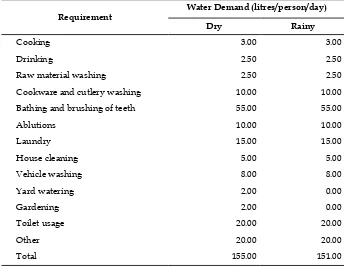
two types of household water demands, namely nuclear families who need less than 300 litres/ day and extended families who need more than 900 litres/day. The average household water demands according to the various needs are presented in Table 2.
Table 2. The Average Household Water Demands According to Various Needs
Requirement
Water Demand (litres/person/day)
Dry Rainy
Cooking 3.00 3.00
Drinking 2.50 2.50
Raw material washing 2.50 2.50
Cookware and cutlery washing 10.00 10.00
Bathing and brushing of teeth 55.00 55.00
Ablutions 10.00 10.00
The results of this research indicate that the water demand is much higher than the limit set by The National Standardization Agency of Indonesia (Badan Standardisasi Nasional, 2002), whereby the use of water for city residents is set at 120 litres/person/day (lpd). Compared to Wardhana’s (2004) finding that the total water requirement is 150 lpd, the
findings of this research show a little more than
155 lpd during the dry season and 151 lpd in the rainy season. The greatest water requirement is to meet the need for baths and the brushing of teeth, while the smallest demand is for watering the yard and gardening, which is only done
during the dry season.
was smaller compared to the planned houses. People who live in planned houses have more use for water because of many types of need, such as washing motor vehicles (including households that own multiple vehicles) and watering the wider yard. If water usage is reviewed with regards to settlement density, it is observed that high-density settlements tended to useless water than medium- or low-density settlements, because the watered yards were narrower and contained fewer plants.
c. Sources of Household Water Demand Fulfilment
Sources of water demand fulfilment
are not only from groundwater but also from rainwater, drinking water companies, water carts, and bottled water. Rainwater is collected in advance, in a tub, from the roof,
to fulfil various purposes. Drinking water
companies use water from Perusahaan Air Minum Jakarta Raya (PAM Jaya), which is distributed to households through pipelines at a price of IDR 7,200.00/M3. Water waggons
come from drinking water companies and are
first stationed in one place before distributing
water to homes that do not have a drinking water company network, with carts consisting of 10 jerry cans with 10 litres of capacity each, at a price of IDR 3,000.00/jerry can. The source of bottled water is gallons that come from the factories at the cost of IDR 16,000.00, and gallon
water refills cost IDR 6,000.00. Prices fluctuate
for cart water and bottled water, depending on the distance from the base to the house, and the amount of source available. The sources of
household water demand fulfilment are based
on various purposes, as presented in Table 3.
Table 3. Sources of Household Water Demand Fulfilment Based On Various Purposes
Requirement
Sources of Water Demand Fulfilment
Rainwater Ground-water PAM Jaya Water carts Bottled water
Cooking * ** *** *
Drinking * * *****
Raw material washing *** *** *
Cookware and cutlery washing **** **
Bathing and brushing of teeth **** ***
Ablutions **** **
Laundry ***** **
House cleaning * ***** *
Vehicle washing ***** *
Requirement
Sources of Water Demand Fulfilment
Rainwater
Ground-* : The least(< 20 respondents)
** : Less (20 – 40 respondents)
*** : Moderate (40 – 60 respondents)
**** : More (60 – 80 respondents)
***** : The Most (> 80 respondents)
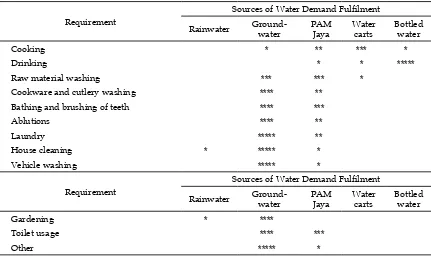
The least number of households that still use groundwater for cooking are in
use drinking water companies and water carts. Bottled water is used for drinking through more practical methods such as a dispenser. In addition, groundwater is still predominantly used to fulfil various household purposes that do not involve direct consumption, such as for sewage and cleaning the house. There were various household water fulfilment sources, indicating that groundwater is no longer able to fulfil the demand for household water.
There are seven source types of water demand fulfilment (Table 4). All of the types can be found in organic settlements, whereas in planned houses, only type 2 and type 4 can be found. This indicates that the
organic settlement has a more heterogeneous community, having more types of water need fulfilment, while planned houses are usually inhabited by a more homogeneous community. There are three source types of water demand fulfilment that exist only on organic settlements in the dry season (type 1, type 3 and type 5), while in the rainy season, these are type 1, type 3, type 5, type 6 and type 7. The use of rainwater had started to be used in households for house cleaning and watering pot plants. Although Kodoatie (2005) is of the opinion that the water requirement can be fulfilled by groundwater or surface water, this research shows that rainwater has been used to fulfil most household water needs.
Table 4. Source Type of Household Water Fulfilment in Rainy Season Based on Type of Settlement
Type of Settlement
Source of Household Water Demand Fulfilment
Total
Type 3 = Groundwater and drinking water company
Type 4 = Groundwater, bottled water, and drinking water company Type 5 = Groundwater, water carts, and bottled water
Type 6 = Groundwater, bottled water, and rainwater
Type 7 = Groundwater, bottled water, water carts, and rainwater
d. The Proportion of Groundwater Utilisation to Fulfil the Household Water Demand
Household water demand fulfilment
comes from a combination of groundwater, bottled water, water carts, drinking water companies, and rainwater. The proportion of groundwater utilisation is known by calculating the total water requirements jointly
fulfilled from various sources. Households
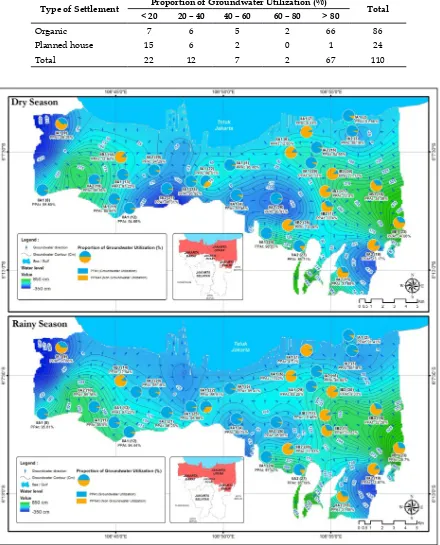
in organic settlements tend to have a greater proportion of groundwater utilisation compared to planned houses. High-density settlements also have a tendency to have a
In contrast to the proportion of groundwater utilisation in planned houses, however, few still use groundwater (< 20%). The proportion
of groundwater utilisation that meets the total water demand based on the type of settlement, is presented in Table 5.
Table 5. Proportion of Groundwater Utilization toward the Total Water Demand Based on Type of Settlement
Type of Settlement Proportion of Groundwater Utilization (%) Total < 20 20 – 40 40 – 60 60 – 80 > 80
Organic 7 6 5 2 66 86
Planned house 15 6 2 0 1 24
Total 22 12 7 2 67 110
Figure 2. Spatial Distribution of Groundwater Utilization and Water Level
Trends in the proportion of groundwater utilisation in organic settlements are still great, and many use groundwater. This condition is
water utilisation is still large. The water level in the area is concave and below sea level. This means that the intake and utilisation of groundwater in this area is still high. The decrease of water level indicates a change from
the effluent river to the influent river. This is
similar to that of Ahmad et al. (2009), who argue that the decrease of water level also occurs in the urban settlements near Kahota industrial triangle area, Islamabad, Pakistan.
d. Relationship between Total Income and Domestic Water Demand
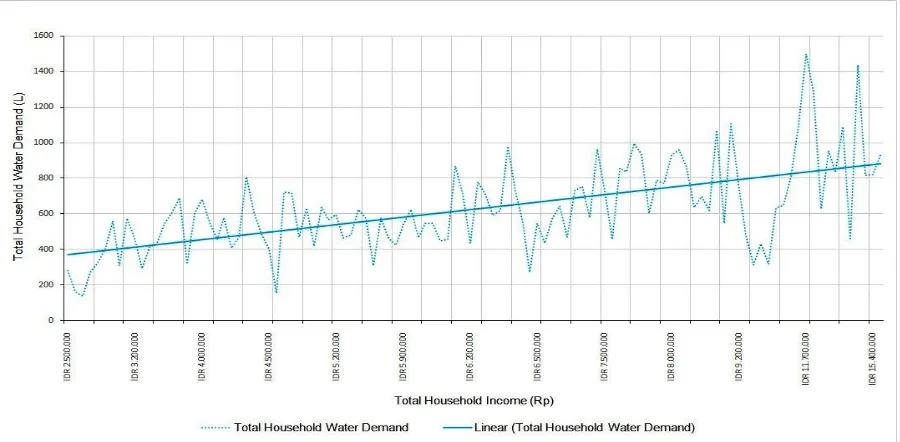
The results of the correlation analysis with SPSS demonstrate a relationship between total monthly household income and household water demand per day, based on the season. Based on the results of the correlation it is known that correlation
coefficients (r count) are 0.593 and 0.586 in the
dry season and the rainy season, respectively. The r count value is compared to the r table
with the error level of 1% (99% of confidence
level), and N = 110. The r table value for N = 110, which is located between the r table for N = 100 (i.e. 0.256) and N = 125 (i.e. 0.230). Evidently, both r count values are greater than the r table value, so that Ho is rejected and
Ha is accepted. There is a significant positive
relationship (p = 0.000), with moderate level of relationship (r count is between 0.40 and 0.599) between the total household income and the need for household water in the dry and rainy seasons. This means that the larger the total monthly household income, the greater the water needs of the household.
The determinant coefficient is obtained from the square of the correlation coefficient
(r2), which is 0.35 and 0.34 in the dry and rainy
seasons, respectively. This means that variants occurring in the variable of household water demand per day can be explained by variants that occur in the variable of total household income per month, which is 0.35 and 0.34 in the dry and rainy seasons.
Figure 3. The Relationship Model between Income and Total Household Water Demand
There is a relationship model between the total monthly household income and household water demand, whereby the greater the total household income per month, the greater the household water demand. The increase in total household income does not automatically increase the water demand, but an increase in
(Linsey and Franzini, 1972; Domene and Sauri´, 2006; March and Sauri´, 2010; March
et al., 2012). Water consumption is influenced by economic status; consumption per capita in poor areas is much lower than in richer regions. Rising prosperity and the welfare of the population will increase the demand for water.
This level of water consumption is still far below the United States, which has an average of 378.54 lpd (Mack and Wrase, 2017), while Canada has a water consumption level of 769 lpd (Chenoweth, 2008). This research shows that the minimum water usage of 134 lpd is already far above the estimate Gleick (1996), which is 50 lpd, but almost the same as that expressed by Saurí (2003), 131 lpd, and Chappells and Medd (2008), 130 lpd. The
research findings indicate that the greatest
water needs are as high as 172 lpd. This is almost the same level as found in research on the metropolitan region of Barcelona, 178 lpd (Saurí, 2003), but is still far below England’ level of 190 lpd (Chappells and Medd, 2008).
e. Relationship between Total Income and Proportion of Groundwater Utilization to Fulfil Households Water Demand
The results of the correlation analysis with SPSS demonstrate a relationship between total household monthly income and the proportion of groundwater utilisation
used to fulfil the household water demand
based on the seasons. Based on the results of the correlation between the total monthly household income and the proportion of
groundwater utilisation to fulfil household
water demand, it is known that correlation
coefficients (r count) are -0.501 and -0.494 in
the dry and rainy season, respectively. The r count value is compared to the r table with
the error level of 1% (99% of confidence level),
and N = 110. The r table value for N = 110 is located between r tables at N = 100 and N = 125, which are 0.256 and 0.230, respectively. Evidently, both r count values are greater than
the value of the r tables, so that Ho is rejected and Ha is accepted. In conclusion, there is a
significant negative correlation (p = 0.000)
with a moderate relationship level (r count is between 0.40 and 0.599) between the total monthly household income and the proportion
of groundwater utilisation needed to fulfil the
household water demand in the dry and rainy seasons. This means that the larger the total household income, the smaller the proportion
of groundwater utilisation needed to fulfil the
household water demand.
The determinant coefficient is obtained from the square of the correlation coefficient
(r2) which is 0.25 and 0.24 in the dry season
and rainy season, respectively. This means that variants that occur in the proportion of groundwater utilisation variable can be explained by variants that occur in the variable of total monthly household income, which is 0.25 and 0.24 in the dry and rainy seasons.
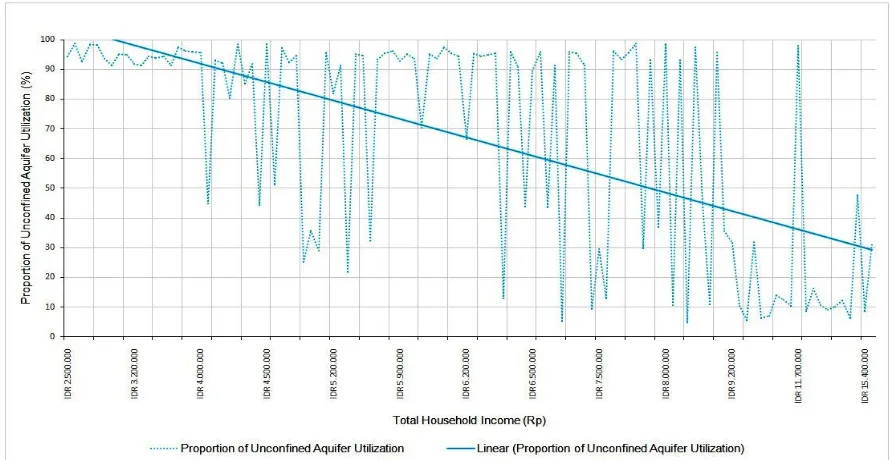
The magnitude of this standard deviation relates to the large variation in the proportion of groundwater utilisation at the same income level. In addition to income, habit factors also play a large role in selecting sources
of household water fulfilment. There is a
relationship model between total monthly household income and the proportion of
groundwater utilisation to fulfil the household
water demand, where the greater the total household income per month, the smaller the proportion of groundwater utilisation to
fulfil the household water demand. Increased
revenue affects households’ ability to choose alternative sources of water in addition to groundwater, such as drinking water companies, water carts, and bottled water.
Fulfilling water needs through sources other
than groundwater has resulted in increased household expenditure on water; for example, drinking water companies charge IDR 7,200/ m3; water carts charge IDR 3,000/jerry can;
Figure 4. The Relationship Model between Household Income and the Proportion of Groundwater Utilization Needed
to Fulfil Household Water Demand
The result is consistent with that expressed by Kamulyan (1996), that the types of sources ranging from raw water to clean water can come from rainwater, surface water, and
groundwater; however, this study did not find surface water to be a source of water fulfilment.
The use of excessive groundwater in coastal cities has caused seawater intrusion. Seawater intrusion has in turn caused the contamination of groundwater, resulting in decreased quality (Park et al., 2011; Chandrasekar et al., 2013; Jayalakshmi et al., 2014). One of the factors contributing to the use of excessive
groundwater is the influence of urbanisation
(Onodera et al., 2008; Hastuti and Wardiha, 2011).
4. Conclusion and Recommendation
Total income was proportional to water demand but inversely proportional
to the share of groundwater utilisation
on fluviomarine landform in Jakarta.
Groundwater was not the only source to
fulfil water demand, and it was necessary to
utilise other sources of water. Groundwater is
unable to fulfil all household water demands;
therefore, rainwater becomes an alternative
source of fulfilling the water demand. Additional sources are needed to fulfil
both the government and the community’s demand for water, such as expanding the PAM network to areas not currently served by PAM services, and the construction of rainwater treatment plants (IPAH).
5. Acknowledgements
We would like to thank all of the research
assistants who helped to gather fieldwork
data. We also thank the anonymous reviewers for comments on this manuscript.
6. References
Abidin, H.Z., Andreas, H., Gumilar, I., Fukuda, Y., Pohan, Y.E., and Deguchi, T. (2011) Land subsidence of Jakarta (Indonesia) and Its Relation with Urban Development, Nat Hazard, Springer-Verlag Berlin Heidelberg (2011), 59, pp. 1753–1771.
Aerts, J., Bowman, M., Dircke, P., Major, D., and Marfai, M.A. (2009) Connecting Delta Cities: About Global Coastal Cities and Future Challenges. Amsterdam: VU University Press.
of Multivariate Statistical Technique to Groundwater Quality, Environ Monit Assess (2015), 187, pp. 1–23.
Ahmad, Z., Kausar, R., and Ahmad, I. (2009) Implications of Depletion of Groundwater Levels in Three Layered Aquifers and Its Management to Optimize the Supply Demand in the Urban Settlement Near Kahota Industrial Triangle Area, Islamabad, Pakistan, Environ
Monit Assess, Springer Science + Business Media (2009), 166, pp. 41–55.
Akoteyon, S., Mbata, U.A., and Olalude, G.A. (2011) Investigation of Heavy Metal Contamination
in Groundwater Around Landfill Site in A Typical Sub-Urban Settlement in Alimosho,
Lagos-Nigeria. Journal of Applied Sciences in Environmental Sanitation, 6 (2), pp. 155–163. Badan Pusat Statistik (2010) Sensus Penduduk Indonesia 2010. Jakarta.
Badan Pusat Statistik Provinsi DKI Jakarta (2015) Statistik Daerah Provinsi DKI Jakarta 2015, Jakarta. Badan Pusat Statistik Provinsi DKI Jakarta (2016) Jakarta Dalam Angka 2016, Jakarta.
Badan Standardisasi Nasional (2002) Penyusunan Neraca Sumberdaya Bagian 1: Sumber Daya Air Spasial, SNI : 19-6728.1-2002, BSN, Cibinong.
Bahar, M., and Reza, S. (2010) Hydrochemical Characteristics and Quality Assessment of Shallow Groundwater in A Coastal Area of Southwest Bangladesh. Environ Earth Sci, Springer-Verlag
Berlin Heidelberg, 61, pp. 1065–1073.
Bappenas (2015) Pembangunan Daerah Dalam Angka 2014. Jakarta: Bappenas. URL: https://www. bappenas.go.id/index.php?cID=8636?cID=8636
Brunn, S.D., Hays-Mitchell, M., and Zeigler D.J. (2012) World Regional Urban Development,
Maryland: Rowman & Littlefield Education.
Chandrasekar, N., Selvakumar, S., Srinivas, Y., Wilson, J.S., Peter, T.S., and Magesh, N.S. (2013) Hydrogeochemical Assessment of Groundwater Quality Along The Coastal Aquifers of Southern Tamil Nadu, India. Environ Earth Sci, Springer-Verlag Berlin Heidelberg (2014), 71, pp. 4739–4750.
Chappells, H., and Medd, W. (2008) What is Fair? Tensions between Sustainable and Equitable Domestic Water Consumption in England and Wales. Local Environment, Vol. 13, No. 8 : pp. 725–741.
Chenoweth, J. (2008) Minimum water requirement for social and economic development.
Desalination 229 (2008) : pp. 245–256.
Daessl, L.W., Sanchez, E.C., Ibar, V.F.C., Espinosa, L.G., Carriquiry, J.D., Macias, V.A., and Castro, P.G. (2004) Geochemical Evolution of Groundwater in the Maneadero Coastal Aquifer During A Dry Year in Baja California, Mexico.Hydrogeology Journal, Springer-Verlag Berlin Heidelberg, 13, pp. 584–595.
Domene, E., and Sauri´, D. (2006) Urbanisation and water consumption: Influencing factors in the
metropolitan region of Barcelona, Urban Studies, 43, pp. 1605–1623.
Firman, T. (2009) the Continuity and Change in Mega-Urbanization in Indonesia: A Survey of Jakarta-Bandung Region (JBR) Development, Journal of Habitat International, 33, pp. 327–339. Gleick, P.H. (1996) Basic Water Requirements for Human Activities: Meeting Basic Needs. Water
International 21 (1996) : pp. 83–92.
Gunawan, R. (2010) Gagalnya Sistem Kanal: Pengendalian Banjir dari Masa ke Masa. Jakarta: Kompas Media Nusantara.
Hastuti, E., and Wardiha, M.W. (2012) A Study of Brackish Water Membrane With Ultrafiltration
Hutabarat, R., (2002) American freeways in Indonesia: federal road development in San Francisco and Jakarta. The Indonesian Town Revisited 57–75.
Hutabarat Lo, R (2010) The City as a Mirror: Transport, Land Use and Social Change in Jakarta. Urban Studies 47, 529–555. doi:10.1177/0042098009348557
Jayalakshmi, B., Ramachandramoorthy, T., and Paulraj, A. (2014) Statistical Interpretation on Seasonal Variations of Groundwater Quality in Ramanathapuram Coastal Tract, Tamil Nadu, India, Environ Earth Sci, Springer-Verlag Berlin Heidelberg (2014), 72, pp. 1271–1278. Kamulyan, B. (1996) Bahan Kuliah Teknik Penyehatan, Laboratorium Teknik Penyehatan dan
Lingkungan, Jurusan Teknik Sipil dan Lingkungan, Universitas Gadjah Mada, Yogyakarta. Kantor Menteri Negara Lingkungan Hidup (1997) Agenda 21 Indonesia: Strategi Nasional untuk
Pembangunan Berkelanjutan. Jakarta.
Khairy, H., And Janardhana, M.R. (2013) Hydrogeochemical Features of Groundwater of
Semi-confined Coastal Aquifer in Amol-Ghaemshahr Plain, Mazandaran Province, Northern
Iran. Environmental Monitoring and Assessment (2013), 185, pp. 9237–9264.
Kodoatie, R.J. (2005) Pengantar Managemen Infrastruktur, Yogyakarta : Pustaka Pelajar.
Kodoatie, R.J., dan Sjarief, R. (2008) Pengelolaan Sumber Daya Air Terpadu, Yogyakarta: Penerbit Andi.
Linsley, R.K., and Franzini, J.B. (1972) Water-Resources Engineering, New York: McGraw-Hill Book Company.
Mack E.A., and Wrase S. (2017) A Burgeoning Crisis? A Nationwide Assessment of the Geography of Water Affordability in the United States. PLoS ONE, 12(1): e0169488. doi:10.1371.
March, H., and Sauri´, D. (2010) The suburbanization of water scarcity in the Barcelona
Metropolitan Region: socio-demographic and urban changes influencing domestic water
consumption, Professional Geographer 62, pp. 32–45.
March, H., Perarnau, J., and Sauri´, D. (2012) Exploring the Links between Immigration, Ageing and Domestic Water Consumption: The Case of the Metropolitan Area of Barcelona,
Regional Studies, Vol. 46.2, pp. 229–244.
Marfai, M.A., Sekaranom, A.B., and Ward, P. (2013) Community Responses and Adaptation Strategies Toward Flood Hazard in Jakarta, Indonesia. Nat Hazard, Springer-Verlag Berlin Heidelberg (2013), 75, pp. 1127–1144.
Marfai, M.A., Yulianto, F., Hizbaron, D.R., Ward, P., and Aerts, J. (2009) Preliminary Assessment and Modeling The Effects of Climate Change on Potential Coastal Flood Damage in Jakarta,
Joint Research Report, Vree Univ Amsterdam and Gadjah Mada university.
Marsoedi, D.S., Widagdo, Dai, J., Suharta, N., Darul, S.W.P., Hardjowigeno, S., Hof, J. dan Jordens, E.R. (1997) Pedoman Klasifikasi Landform Versi 3.0. LREP II, Part C, Center for Soil and Agroclimatic Research, Bogor.
Muta’ali, L. (2012) Daya Dukung Lingkungan Untuk Perencanaan Pengembangan Wilayah, Yogyakarta:
Badan Penerbit Fakultas Geografi (BPFG) UGM.
Onodera, S., Saito, M., Sawano, M., Hosono, T., Taniguchi, M., Shimada, J., Umezawa, Y., Lubis, R. F., Buapeng, S., and Delinom, R. (2009) Effects of Intensive Urbanization on The Intrusion of Shallow Groundwater into Deep Groundwater: Examples form Bangkok and Jakarta,
Science of the Total Environment, 407, pp. 3209–3217.
Park, Y., Lee, J.Y., Kim, J.H., and Song, S.H. (2011) National Scale Evaluation of Groundwater Chemistry in Korea Coastal Aquifers: Evidences of Seawater Intrusion. Environ Earth Sci,
Pramono, I.B. (2016) Distribution of Water Infiltration Rate in Ciliwung Watershed, Forum
Geografi, Vol. 30 (1) : pp. 24–33.
Rani, R.D., and Sasidhar, P. (2010) Stability Assessment and Characterization of Colloids in Coastal Groundwater Aquifer System at Kalpakkam, Environ Earth Sci, Springer-Verlag
Berlin Heidelberg, 62, pp. 233–243.
Sakethi, T. (2010) Why are There Floods in Jakarta? Flood Control by the Government of the Province of DKI Jakarta. Jakarta: PT Mirah Sakethi.
Sauri´, D. (2003) Lights and shadows of urban water demand management: the case of the metropolitan region of Barcelona, European Planning Studies, 11(3), pp. 229–243.
Setiawan, C., Muzani, dan Parwata (2010) Kajian Intrusi Air Laut pada Estuaria Kali Sunter Jakarta Utara Sebagai Upaya Konservasi Lahan Wilayah Pesisir, Laporan Hibah Bersaing, Lembaga Penelitian Universitas Negeri Jakarta.
Setiawan, C., Muzani, dan Parwata (2011) Kajian Potensi Air Tanah Bebas untuk Kebutuhan Air Domestik di DKI Jakarta, Laporan Hibah Bersaing, Lembaga Penelitian Universitas Negeri Jakarta.
Steinberg, F. (2007) Jakarta: Environmental Problems and Sustainability. Journal of Habitat International, 31, pp. 354–365.
Strohschön, R.,Wiethoff, K., Baier, K., Bercht, A.L., Wehrhahn, R., and Azzam, R. (2012) Landuse and Water Quality in Guangzhou, China: A Survey of ecological and Social Vuhierability in Four Urban Units of the Rapidly Developing Megacity. International Jurnal Environment
Resources, Spring, 7 (2), pp. 343–358.
Takem, G.E., Chandrasekharam, D., Ayonghe, S.N., and Thambidurai, P. (2009) Pollution Characteristics of Alluvial Groundwater from Springs and Bore Wells in Semi-Urban Informal Settlements of Douala, Cameroon, Western Africa, Environ Earth Sci,
Springer-Verlag Berlin Heidelberg, 61, pp. 287–298.
Tamod, Z.E., Polii, B., and Sikome, R.M. (2016) Detection of Ground Water Availability at Buhias Island, Sitaro Regency, Forum Geografi, Vol. 30 (1) : pp. 45–57.
Ward, P., Marfai, M.A., Yulianto, F, Hizbaron, D.R., and Aerts, J. (2010) Coastal Inundation and Damage Exposure Estimation: A Case Study for Jakarta. Nat Hazard, Springer-Verlag Berlin Heidelberg, 56, pp. 899–916.
Wardhana, W.A. (2004) Dampak Pencemaran Lingkungan, Edisi Revisi, Yogyakarta: Penerbit Andi. Yunus, M., 1987. The poor as the engine of development. The Washington Quarterly 10, 139–145. Zhu, J., Simarmata, H.A. (2015) Formal land rights versus informal land rights: Governance for