UNIVERSITI TEKNIKAL MALAYSIA MELAKA
DEVELOPMENT OF LIQUID GAS PETROLEUM (LPG) LEAKAGE DETECTOR
This report is submitted in accordance with the requirement of the Universiti Teknikal Malaysia Melaka (UTeM) for the Bachelor of Electrical Engineering
Technology (Industrial Power) with Honours.
By
NOOR AZRIL FIRDAUS BIN JARI B071610840
950904-01-5731
FACULTY OF ELECTRICAL AND ELECTRONIC ENGINEERING TECHNOLOGY
2019
i
Tajuk: DEVELOPMENT OF LIQUID GAS PETROLEUM (LPG) LEAKAGE DETECTOR
Sesi Pengajian: 2019
Saya NOOR AZRIL FIRDAUS BIN JARI mengaku membenarkan Laporan PSM ini disimpan di Perpustakaan Universiti Teknikal Malaysia Melaka (UTeM) dengan syarat- syarat kegunaan seperti berikut:
1. Laporan PSM adalah hak milik Universiti Teknikal Malaysia Melaka dan penulis.
2. Perpustakaan Universiti Teknikal Malaysia Melaka dibenarkan membuat salinan untuk tujuan pengajian sahaja dengan izin penulis.
3. Perpustakaan dibenarkan membuat salinan laporan PSM ini sebagai bahan pertukaran antara institusi pengajian tinggi.
4. **Sila tandakan (X)
UNIVERSITI TEKNIKAL MALAYSIA MELAKA
BORANG PENGESAHAN STATUS LAPORAN PROJEK SARJANA MUDA
ii
☐
SULIT*Mengandungi maklumat yang berdarjah keselamatan atau kepentingan Malaysia sebagaimana yang termaktub dalam AKTA RAHSIA RASMI 1972.
☐
TERHAD* Mengandungi maklumat TERHAD yang telah ditentukan oleh organisasi/badan di mana penyelidikan dijalankan.☒
TIDAKTERHAD
Yang benar, Disahkan oleh penyelia:
... ...
NOOR AZRIL FIRDAUS BIN JARI DR. ALIZA BINTI CHE AMRAN
Alamat Tetap: Cop Rasmi Penyelia
N0 23, JLN ASTAKAJAYA 5, TAMAN ASTAKAJAYA,85010 SEGAMAT, JOHOR DARUL TA’ZIM
Tarikh: Tarikh:
*Jika Laporan PSM ini SULIT atau TERHAD, sila lampirkan surat daripada pihak berkuasa/organisasi berkenaan dengan menyatakan sekali sebab dan tempoh laporan PSM ini perlu dikelaskan sebagai SULIT atau TERHAD.
iii
DECLARATION
I hereby, declared this report entitled DEVELOPMENT OF LIQUID GAS PETROLEUM (LPG) LEAKAGE DETECTOR is the results of my own research
except as cited in references.
Signature: ………
Author : NOOR AZRIL FIRDAUS BIN JARI Date:
iv APPROVAL
This report is submitted to the Faculty of Mechanical and Manufacturing Engineering Technology of Universiti Teknikal Malaysia Melaka (UTeM) as a partial fulfilment of the requirements for the degree of Bachelor of Electrical Engineering Technology (Industrial Power) with Honours. The member of the supervisory is as follow:
Signature: ……….
Supervisor : DR. ALIZA BINTI CHE AMRAN
Signature: ……….
Co-supervisor: PN. AMALIA AIDA BINTI ABD HALIM
v ABSTRAK
Kini, terdapat beberapa kes di mana letupan berlaku disebabkan kebocoran gas di dalam rumah. Letupan bermula apabila seseorang menukar sebarang suis di dalam rumah tanpa menyedari gas memenuhi ruang di rumah mereka. Oleh itu, peranti projek ini sangat berguna dalam menghalang masalah daripada berlaku. Skop projek ini hanya dapat mengesan kebocoran Carbon Monoxide, Butana dan LPG. LPG juga merupakan jenis gas yang digunakan oleh kebanyakan pengguna untuk memasak. Mikrokontroler Arduino digunakan sebagai pengawal sistem. Sensor gas digunakan untuk mengesan kebocoran gas dan menghantar isyarat input analog kepada pengawal Arduino. Apabila isyarat melebihi tahap pencetus mikrokontroler, Arduino akan menghantar mesej peringatan kepada pengguna melalui modul GSM dan kipas ekzos akan melepaskan kebocoran gas dari kawasan yang tercemar ke udara luar untuk mengelakkan letupan berlaku. Objektif projek ini adalah untuk menghantar mesej amaran kepada pengguna apabila kebocoran gas berlaku di rumah mereka dan kipas ekzos secara automatik beroperasi untuk mengelakkan letupan akibat percikan elektrik apabila mengesan kebocoran gas.
vi ABSTRACT
Nowadays, there are some cases where an explosion occurs due to leakage of gas inside the house. The explosion starts when someone switches on any switches inside the house without gas noticing it fully filled the room in their home. Therefore, this project device is very useful in preventing problems from occurring. The scope of this project can only detect Carbon Monoxide, Butane and LPG leaks. LPG is also the type of gas most consumers use to cook. Arduino microcontroller is used as a system controller. Gas sensors are used to detect gas leaks and transmit analog input signals to Arduino controllers. When the signal exceeds the microcontroller's trigger level, Arduino will send a reminder message to the user through the GSM module and the exhaust fan will release the gas leak from the contaminated area to the outer air to prevent the explosion from happening. The objective of this project is to send someone a warning message when a gas leak occurs in their home and the exhaust fan automatically operates to prevent explosions as a result of electric splashes when detecting gas leakage.
vii DEDICATION
To my beloved parents,
Jari bin Wandi and Saadiah binti Liham Thankful for your supporting and the best wishes
viii
ACKNOWLEDGEMENTS
First of all, I want to thank God for giving me the strength I need to prepare this report.
With this opportunity, I would like to thank the Faculty of Electrical and Electronic Engineering (FTKEE), University Teknikal Malaysia Melaka (UTEM) and my supervisor, Ts Dr Aliza Bt Che Amran for the assistance, advice and guidance provided during this project. To my parents, thank you for supporting them with their prayers and love. Lastly, I would like to thank all my friends and I also want to thank those who supported and encouraged me in helping to complete this project.
Thank you
ix
TABLE OF CONTENTS
PAGE
TABLE OF CONTENTS xii
LIST OF TABLES xiiiii
LIST OF FIGURES xivv
LIST OF APPENDICES xvi LIST OF AMBREVIATIONS xvii
INTRODUCTION 1
1.1 Background 1
1.2 Problem Statement 2
1.3 Objective 2
1.4 Scope of Project 3
LITERATURE REVIEW 4
2.1 Introduction 4
2.2 Liquid Petroleum Gas (LPG) 4
2.2.1 LPG condition for ignition 6
2.2.2 Gas Propane 6
2.2.3 Gas Butane 7
x
2.3 Explosion 8
2.3.1 LPG low explosive level 9
2.3.2 Safety precaution when gas leak 10
2.4 Gas sensor necessity 10
2.4.1 The significance of gas sensors 11
2.4.2 Semiconductor gas sensor of the MQ series 12
2.4.3 Gas concentration 13
2.5 Overview past studies 14
2.5.1 Android based Automatic Gas Detection and Indication Robot 14
2.5.2 Dangerous Gas Detection using an Integrated circuit and MQ 9 16
2.5.3 GSM based Gas Leakage Detection System 18
2.5.4 A Security Alert System using GSM for Gas Leakage 20
2.5.5 Early Leakage Protection System of LPG based on ATMega 16 21
Microcontroller 2.5.6 Design and Development of Gas Leakage Monitoring system 22
using Arduino and ZigBee 2.5.7 Microcontroller based LPG Gas Leakge detector using GSM 26
Module 2.5.8 Comparison between past studies 28
METHODOLOGY 31
3.1 Introduction 31
3.2 Flowchart 31
xi
3.2.1 Flowchart of the project 34
3.2.2 Flowchart of the LPG Leakage Detector 35
3.3 System structure / Block diagram 37 3.4 LPG Leakage Detector component systems 38 3.4.1 Arduino Uno 39 3.4.2 MQ 6 Gas sensor 40 3.4.3 Global System for Mobile Communication (GSM) 41
3.4.4 LCD display 42
3.4.5 Buzzer 43
3.4.6 Dc Fan 44
3.5 Software development 45 3.5.1 Arduino (IDE) 45
3.5.2 Proteus software 46
3.5.3 SolidWork CAD 47
3.6 Gantt Chart 48
RESULT AND DISCUSSION 49 4.1 Introduction 49 4.2 Simulation of the circuit 49 4.3 Priliminary result 50 4.4 Prototype model 52 4.5 Assembling and testing 54
xii
4.6 Analysis implementation result 57
4.6.1 Level condition of safety 57
4.6.2 Sensitivity of gas sensor 60
4.6.3 Ventilation system when gas leak 64
4.7 Discussion 67
CONCLUSION 69 5.1 Introduction 69
5.2 Conclusion 69
5.3 Future work 70
REFERENCES 71
APPENDIX 73
xiii
LIST OF TABLES
TABLE TITLE PAGE
Table 2.1 Typical Liquid Peroleum Gas (LPG) data characteristics 5
Table 2.2 Properties of LPG 6
Table 2.3 Type of MQ series and their specifications 12
Table 2.4 Type of gas sensor and their gas concentration 13
Table 2.5 Comparison past studies 28 Table 3.1 Gantt Chart PSM 1 48 Table 3.2 Gantt Chart PSM 2 48 Table 3.3 Gas Concentration in Safe Level Condition 57
Table 3.4 Gas Concentration in High Level Condition 59
Table 3.5 Average Time Detection and Sending Message 61
Table 3.6 Different Sensing Distance 63
Table 3.7 Gas Concentration without Exhaust Fan 65
Table 3.8 Gas Concentration with Exhaust Fan 66
xiv
LIST OF FIGURES
FIGURE TITLE PAGE
Figure 2.1: Chemical structure Propane 7
Figure 2.2: Chemical structure Butane 7
Figure 2.3: An event tree showing typical consequence of accidental 8 releases of combustible gas or evaporating liquid into the
atmosphere
Figure 2.4: Robot Prototype 15
Figure 2.5: Block diagram of the user interactive gas leakage and fire alarm 16 Figure 2.6: Sensitivity features of the MQ 6 gas sensor for various gases 19
Figure 2.7: Block diagram the wireless gas leakage 24
Figure 2.8: Complete circuit diagram 26
Figure 3.1: Process flow of the project 34
Figure 3.2: Process flow of the Gas detection project 35
Figure 3.3: Block diagram of LPG leakage system 37
Figure 3.4: Arduino Uno 39
Figure 3.5: MQ 6 gas sensor 40
Figure 3.6: GSM module 41
Figure 3.7: Liquid crystal display (LCD) 42
Figure 3.8: Piezoelectric buzzer 43
xv
Figure 3.9: Dc Fan 44
Figure 3.10: Software of the Arduino 45
Figure 3.11: Proteus software 46
Figure 3.12: SolidWork software 47
Figure 4.1: Full circuit project 50
Figure 4.2: System not detect the gas 51
Figure 4.3: System detect gas 51
Figure 4.4: Prototype Model by using SolidWork 53
Figure 4.5: Prototype Model 53
Figure 4.6: Installation hardware 54
Figure 4.7: Testing box 55
Figure 4.8: Gas concentration when not detect gas 55
Figure 4.9: Gas concentration when detect gas 56
Figure 4.10: GSM sends to user 56
Figure 4.11: Range of gas in safe level condition 58
Figure 4.12: Range of gas in high level condition 59
Figure 4.13: Gas leakage detection against time and voltage 61
Figure 4.14: Distance against voltage and time detection 63
Figure 4.15: Graph of gas concentration without exhaust fan 65
Figure 4.16: Graph of gas concentration with exhaust fan 66
xvi
LIST OF APPENDICES
APPENDIX TITLE PAGE
Appendix 1 Datasheet MQ6 Gas Sensor 73 Appendix 2 Datasheet Buzzer 74 Appendix 3 Datasheet Dc Fan 75
xvii
LIST OF ABBREVIATIONS
GSM Global System For Mobile Communication LPG Liquid Petroleum Gas
LCD Liquid Crystal Display LEL Lower Explosive Limit UEL Upper Explosive Limit
V Voltage
I/O Input / Output
LED Lighting Emitting Diode
IDE Integrated Development Envirronment PCB Printed Circuit Board
CPU Central Processing Unit IC Integrated Circuit
TX Transmitter
RX Receiver
DC Direct Current
SIM Subscriber Identification Module
S Seconds
PPM Parts Per Million
1
INTRODUCTION
1.1 Background
High innovation and industry have led to an unbelievable increase in living norms in the present age. Moreover, this has also been followed by a multitude of severe issues, such as the unwanted discharge of multiple chemical pollutants, flammable and poisonous substances, etc. Most natural gas is a mixture of hydrocarbon gases and is formed of methane, ethane, propane and butane gas. A natural gas leak can be dangerous, because it increases the risk of fire or explosion. A leakage of natural fuel can be hazardous because it raises the danger of flames or explosion.
This chapter provides information about Gas detector and GSM System. This chapter covers important information so that anyone who read this chapter knows what this project is all about. Information that covered in this chapter is background of the project that will explain to the reader when read this report. Besides, it has Scope of the Project to see the limitation of the project and what this kind of project can do and also Scope of the Report that will explain how this project will operate. Other than that, in this chapter also has objective that must be achieve at the end of project.
2
Usually gas detectors only use alarms or buzzers to warn but in this project a new project design that uses GSM to send messages to owners about leaking gas. Therefore, owners are warned about leakage of gas around the house through this system. However, these gas detectors and GSM systems will be operated after the sensor detects gas leakage.
When a gas detector detects that there are some leaked gases, the system will send the message to the user and the exhaust fan works automatically to prevent the ignition electricity when the gas leak is detected. This issue can lead to the detection of gas leaks and will also prevent explosions at home, if there is no person at home. This gas detector is designed to follow the programmed instructions in Arduino. Arduino is the brain of the system, without this microcontroller the system will not functioning.
1.2 Problem Statement
Nowadays, Liquid Petroleum Gas (LPG) is a highly flammable chemical that is consist of several mixture of gases there is gas propane and butane. Mostly, the LPG is used for cooking at home, restaurant and certain of industry. They have certain weaknesses that make the gas leakage occur. If the gases is leaked at home or industry, the leakage of gases only can be detected by human nearby and if there is no human at surroundings, it cannot be detected and sometimes it also cannot be detected by human because human has a low sense of smell. Moreover, the gas leakage can cause fire that will to serious injury or death and also can destroy human properties. For this purpose, the LPG leakage detector device to sense that leakage and the system will send the messages to the user and the exhaust fan will operate to remove the leaking gas away from the leaking area. It is an early and precaution step to save assets also human lives.
3 1.3 Objective
1. To design the development of a Liquid Petroleum Gas (LPG) leakage detection system.
2. To build the (LPG) leakage detector prototype using Arduino Uno and Global System for Mobile Communication (GSM).
3. To simulate and analyze the operation of the LPG leakage detection system.
1.4 Scope of Project
In this project are used Arduino Uno, LPG sensor (MQ6), GSM module, LCD display and buzzer to make this project operated. All of this component will be combined their function such as detect the gas and sent the massage by using the GSM. This project is designed just to detect gas, it will be implant at home or an industry that using the dangerous gas. This project can help the person when they are busy with their work, travelling or people who always outstation. This project is design to meet the following scope:
1.2.1 The sensor will detect the gas leaking in particular range.
1.2.2 The GSM will send early warning text message to the owner.
1.2.3 The Arduino will function to operates the exhaust fan when detect gas leaking
4
LITERATURE REVIEW
2.1 Introduction
This chapter will present an overview of the previous research and existing project in order to get the idea of the design and any information related to improving the project. Although the literature covers a wide variety of such theories of LPG leakage detector and the theories of component that will be use also will be covered on this chapter.
2.2 Liquid Petroleum Gas (LPG)
According to Liquid Petroleum Gas (LPG) Storage Design, written by J.Jonatan (2012), Liquid Petroleum Gas consist of mixture propane and butane there is flammable mixture of hydrocarbon gases used as residential premises or industrial sector and the LPG is one of the alternate fuels used now days. LPG is a colorless, clean burning and non- toxic gas fuel that can readily available in market and it is also fuel for kitchen in the restaurant, fuel for heating, home cookware and used as fuel in transportation.
Petroleum gas is also known as LPG, LP gas, Auto gas etc. In Malaysia, the commercial LPG might contain hydrocarbons mixture of propane, propylene, butane (normal-butane
5
or iso-butane) and butylene (including isomers) (Malaysian Standard (MS) 830, 2003).
The mixtures ratio is different in countries around the world that having LPG (Prima Gas, 2011).
According to PETRONAS specifications in Malaysia in 2011, LPG as a propane can be used commercially referred to in most countries. Mixture of LPG products with the main component of propane at ratio 70:30 and with other major component butane are commercial LPG. Liquid in under pressure while the gas is at ambient condition known as LPG and for the commercial, LPG is distributed to the customers in liquid form.
The ratio for LPG in liquid form to the gas phase is 270:1. Thus, for safety and convenience of the operator, LPG liquid at moderate temperatures and stored in a storage tank of LPG. After that, LPG is stored in liquid state and is used in the gas phase.
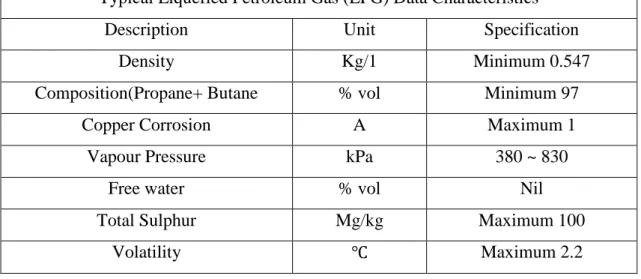
Moreover, to change the LPG in liquid state into gaseous state, the vaporizer must be installed. LPG is highly liquid products (National Institute of Standards and Technology, 2010) and features of LPG in Malaysia as in Table 2.1
Table 2.1: Typical Liquid Petroleum Gas (LPG) Data Characteristics (Gas Malaysia,2011)
Typical Liquefied Petroleum Gas (LPG) Data Characteristics
Description Unit Specification
Density Kg/1 Minimum 0.547
Composition(Propane+ Butane % vol Minimum 97
Copper Corrosion A Maximum 1
Vapour Pressure kPa 380 ~ 830
Free water % vol Nil
Total Sulphur Mg/kg Maximum 100
Volatility ℃ Maximum 2.2
6 2.2.1 LPG conditions for ignition
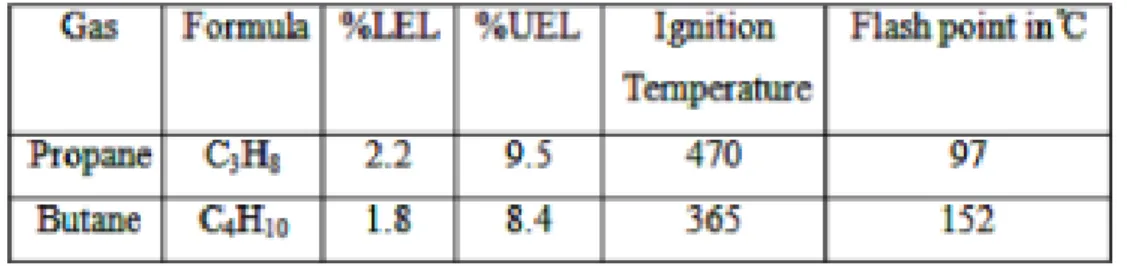
Table 2.2: Properties of LPG
The table 2.2 shows the properties of LPG gas and the explosion occurs when the conditions below are met:
The gas concentration is between LEL (lower explosive limit).
There is a sufficient amount of oxygen.
There's a source of ignition
2.2.2 Gas Propane
Colourless, odourless and combustible properties of Propane gas. There is particular gravity of 1.56 and is higher than air. An alkane hydrocarbon series with the C3H8 formula. Made from crude oil, natural gas as well as during petroleum refining as a by-product of the refinery cracking gases. Gas propane burns in the atmosphere at higher temperatures and produces carbon dioxide and water as the final products.