Strategic
Management
First published in 1993, authors James C Craig and Robert M Grant
Second edition published in Great Britain and the United States in 2003 by Kogan Page Limited, author Philip Sadler
Apart from any fair dealing for the purposes of research or private study, or criticism or review, as permitted under the Copyright, Designs and Patents Act 1988, this publication may only be reproduced, stored or transmitted, in any form or by any means, with the prior permission in writing of the publishers, or in the case of reprographic reproduction in accordance with the terms and licences issued by the CLA. Enquiries concerning reproduction outside these terms should be sent to the publishers at the undermentioned addresses:
120 Pentonville Road 22883 Quicksilver Drive London N1 9JN Sterling VA 20166–2012
UK USA
www.kogan-page.co.uk
© James C Craig and Robert M Grant, 1993 © Philip Sadler, 2003
The right of Philip Sadler to be identified as the author of this work has been asserted by him in accordance with the Copyright, Designs and Patents Act 1988.
ISBN 0 7494 3938 6
British Library Cataloguing in Publication Data
A CIP record for this book is available from the British Library.
Library of Congress Cataloging-in-Publication Data Sadler, Philip,
1930-Strategic management / Philip Sadler. – 2nd ed. p. cm. – (MBA masterclass series)
Rev. ed. of: Strategic management / James C. Craig. 1st ed. 1993. Includes bibliographical references and index.
ISBN 0-7494-3938-6
1. Strategic planning. I. Title. II. Series. HD30.28.S224 2003
658.4’012–dc21
2002154764
Typeset by Saxon Graphics Ltd, Derby
Printed and bound in Great Britain by Biddles Ltd, Guildford and King’s Lynn
Contents
The series editor ix
Introduction 1
Part 1
Strategic management and its context
7
1 Introduction to strategic management 9
The elements of strategy 9
Corporate and competitive strategy 13
Schools of thought in strategic management 15
Summary 24
2 The environmental context 27
Introduction 27
The impact of the ‘New Economy’ 28
The new agenda – sustainable development and 34 corporate social responsibility
Two kinds of pressure 41
Anticipating environmental change 44
Summary 44
Part 2
Corporate strategy
47
Introduction 49
3 Clarification of purpose or mission – the starting 51 point for strategic management
Introduction 51
Shareholder value 51
Aspirational purpose 57
Summary 59
4 The role of the parent company 60
Introduction 60
Adding value 60
Parenting styles 62
Sustaining competitiveness 65
Strategy and organization at corporate level 70
Reputation, image and brand identity 73
Summary 80
5 Building the portfolio (1): analyzing industry and 82 competition
Introduction 82
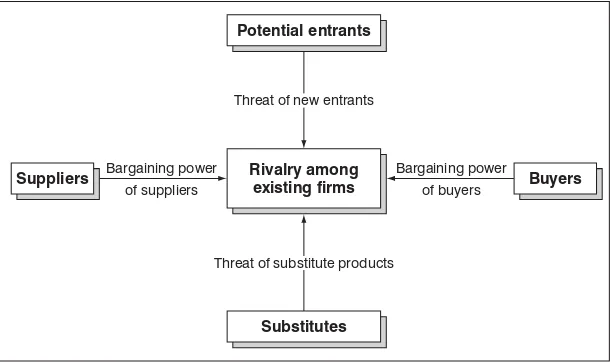
Analyzing industry attractiveness 82
The application of industry analysis: forecasting 89 profitability
Changing industry structure 91
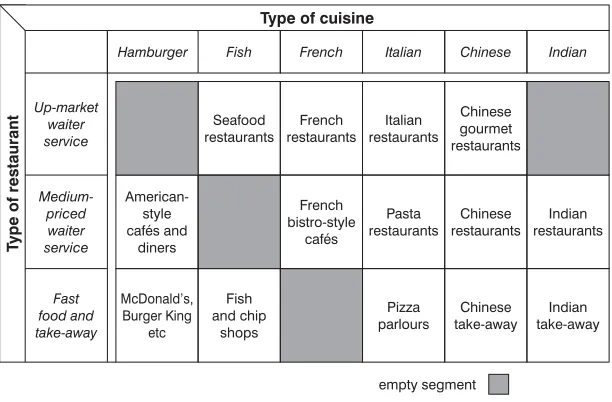
Market segmentation 91
Summary 93
6 Building the portfolio (2): vertical integration 95
Introduction 95
Costs of using the market 96
Long-term contracts and ‘quasi-vertical integration’ 99
Summary 102
7 Building the portfolio (3): diversification 103
Introduction 103
Conglomerate or unrelated diversification 103
The case for related diversification 108
Diversification and synergy 112
Diversification and performance 113
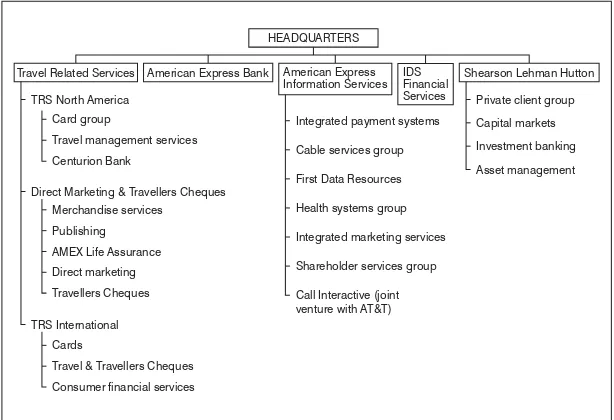
Managing the diversified corporation 115
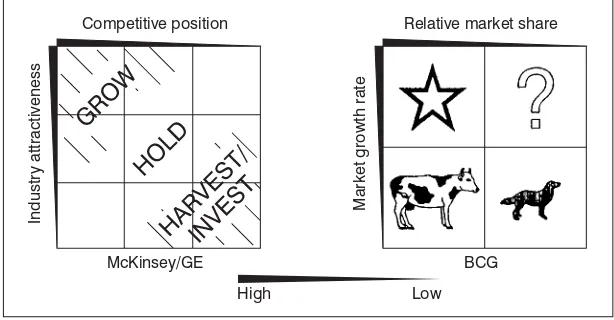
Portfolio planning models 118
Summary 120
8 Strategic options 123
Mergers and acquisitions versus organic growth 123
Outsourcing 131
Strategic alliances 132
Contents vii
Partnership sourcing 135
Summary 139
9 Functional strategies 140
Manufacturing strategy 140
Human resource strategy 148
Marketing strategy 152
Part 3
Competitive strategy
159
Introduction 161
10 The firm: resources, capabilities and competitive 163 advantage
Introduction 163
Resources, capabilities and strategy formulation 164
Fundamentals of resource analysis 166
Capabilities 171
Appraising capabilities 173
Managing capabilities 174
From resources and capabilities to competitive 175 advantage
Summary 177
11 Strategies for cost advantage and differentiation 179 advantage
Introduction 179
Creation and erosion of competitive advantage 180
Cost and differentiation advantages 183
Sources of cost advantage 185
Cost drivers 187
Analyzing costs 188
Differentiation and differentiation advantage 190
Analyzing differentiation 191
Tangible and intangible differentiation 191
The costs of differentiation 193
Value chain analysis of differentiation advantage 194
Summary 195
12 Competing in global markets 197
Introduction 197
Implications of internationalization for competitive 201 advantage
Strategies for exploiting overseas market 204 opportunities
Global versus multinational strategies 208 Location decisions and the value chain 209 Organizing the multinational corporation 210
The ‘transnational’ corporation 212
Summary 213
Part 4
Implementation
215
13 Managing strategic change 217
Introduction 217
Change objectives 218
Implementation 223
Evaluation 227
Recent trends in organizational change 228
Summary 229
Cases
231
Tesco 231
Marks and Spencer 243
Glossary 252
References 256
Further reading 261
Index 263
The series editor
Philip Sadler is a Vice President of the Ashridge Business School where he was chief executive for 20 years. He now divides his time between writing, speaking, consultancy and voluntary service. He is a Fellow of the International Academy of Management, a Companion of the Institute of Management, a Fellow of the Institute for Personnel and Development, a Fellow of the Institute of Directors, and a Patron of the Centre for Tomorrow’s Company.
He has been awarded the honorary degrees of DSc (City University) and DBA (De Montfort University). He holds the Burnham Gold Medal of the Institute of Management and was appointed CBE in 1986.
His recent books include Managing Change (1995), Leadership
THE MBA MASTERCLASSSERIES
The new MBA Masterclass series is designed to meet the needs of both MBA students and experienced managers looking for a refresher course in a particular subject.
Authoritative but practical, these titles focus on MBA core subjects as well as covering the latest developments in management thinking and practice.
Written by international academics, consultants and practitioners, this series is an ideal companion for any busy MBA student or manager.
Current titles published in the series:
Leadership
Intercultural Management Strategic Management
And still to be published:
Project Management Branding
Finance and Accounting Human Resource Management
To obtain further information, please contact the publisher at the address below:
Kogan Page Limited 120 Pentonville Road London N1 9JN
Introduction
This book is aimed at two overlapping audiences. For aspiring or actual MBA students I have tried to include references to the most important work by both academics and consultants since the topic of strategy first became salient in the 1950s. For practising managers facing strategic decisions I have tried to use common-sense language where possible, avoiding undue reliance on jargon. I have also tried to illustrate points in the argument with relatively recent and familiar examples of both good and bad practice.
On the surface the notion of business strategy would seem to be quite straightforward and uncomplicated. Surely it is just a matter of deciding some medium- to long-term goals, bringing together the resources, human and material, that will be required if they are to be achieved, devising a plan and schedule for implementation, and then just getting on with it.
In practice, however, and especially in large, multi-business companies, it is not at all straightforward. There are several reasons why this is the case.
First, by definition, a strategy is something that unfolds over time; during that time period the environment is changing with great rapidity and can invalidate the assumptions on which the plan was based.
Secondly, there are often sharp conflicts between the requirements of the strategy and the imperatives of short-term profitability or even survival.
Fourthly, there is the tendency of people with a high level of intelli-gence and formal education to eschew the simple approach and overcom-plicate things – a tendency symbolized by the growth of the use of jargon. Finally, implementation is certainly not always a smooth process; successful implementation is a function of many interacting variables among which the quality of leadership is paramount.
Unravelling this complexity has involved a massive output of writings by management experts in the business schools and management consultancies. A whole industry of strategy consultants has grown up, peddling a wide range of analytical techniques and methodologies. These consultants command fees commensurate with the importance of the issues they are dealing with, but which often seem extravagant when related to the outcomes. Fashion has followed fashion and no doubt there will be many more ‘flavours of the month’ in the future. Nowadays it is rare indeed for the directors of a major company to sit down and debate strategy and reach consensus without the aid of a large planning staff and a whole army of bright young MBA graduates from a consulting firm to aid them. It is considered impolite to ask what these highly rewarded directors are actually paid to do.
In the large, multi-business company a further source of complexity is that there are two distinct levels of strategy. At the level of the corporate head office or holding company some fundamental strategic decisions need to be made:
ᔡ
What is the company’s mission or purpose and what are the values and principles that should govern the behaviour of members of the organization?ᔡ
What are the desirable characteristics of the company’s culture?ᔡ
What industries or market segments should it enter or leave?ᔡ
What form of organization structure and what kind of control systems would best support the strategy?ᔡ
How can value be added through such things as brand strength, image and reputation?There are also some key decisions to be taken that have strategic implications, such as the appointment of the chief executives of the operating divisions.
level is generally known as business strategy or competitive strategy as distinct from what takes place at head office, which is referred to as corporate strategy.) It involves identifying correctly the critical success factors (CSFs) in a particular market and so managing the business as to meet these more successfully than competitors.
This book covers both corporate and competitive strategy. (In the case of a single-business company, of course, they merge into each other.)
As will be shown in Chapter 1, the literature on strategy falls into two broad groupings. On the one hand there is prescriptivewriting – the ‘how to do it’ approach. Prescriptions range from highly formal and analytical methodologies involving huge amounts of data collection and analysis to the ‘visionary’ approach that urges the importance of ‘dreaming ahead’ and going for BHAGs (big, hairy, audacious goals).
On the other hand there is the descriptiveliterature, which attempts to portray what actually goes on in the processes of strategy formu-lation and implementation. As with all human activities, different observers focus on different aspects of the activities they are observing.
Another useful distinction is that between ‘intended’ strategy and that which is actually implemented – usually referred to as the ‘realized’ or ‘emergent’ strategy. There are several reasons why the two diverge. One is simply a failure in implementation; another is the intervention of an unanticipated change in the environment such as the tragic events of 11 September 2001. More often, perhaps, it is simply an inherent quality of a process that takes place over time, involving large numbers of actors, many of whom change as the process unfolds. There is much to be learnt from both approaches. It is useful to study the various prescriptions on offer and to select that which appears best to meet the needs of a particular organization in a particular context. At the same time it is important to be aware that real life is always much messier than the theory and that the process of strategic management involves working through particular issues facing a particular company in a given business context rather than picking a ready-made approach off the shelf, no matter how illustrious its pedigree.
The changing context of strategy formulation
Back in the late 1960s and early 1970s a number of original thinkers such as Peter Drucker, Daniel Bell and Alvin Toffler drew attention to certain emerging trends that were going to result in radical changes to the structure of Western industrial economy and society. Among these trends the most important were:
ᔡ
the decline of ‘smokestack’ manufacturing industries and the growth of services, in terms of both employment and share of gross domestic product;ᔡ
the rise in the proportion of women in the active workforce;ᔡ
the increase in the proportion of the workforce who could be described as ‘knowledge workers’;ᔡ
the way in which information technology was ushering in a new industrial revolution;ᔡ
the increasing globalization of markets.These thinkers were not using crystal balls and peering into the future. They were looking at trends that were already established. Their ability to see how important these trends were for the future of business and to draw out their implications was a function of the fact that these thinkers were, in the words of Prahalad, ‘able to escape the gravitational pull of the past’. Regrettably, this is a mental capacity shared by very few people in the profession of management. Most managers cling to the conventional wisdom of the past in the same way that Linus clings to his security blanket. ‘If you want to escape the gravitational pull of the past, you have to be willing to challenge your own orthodoxies, to regenerate your core strategies and rethink your most fundamental assumptions about how you are going to compete’ (C K Prahalad, 1999, speech to annual conference of Chartered Institute of Personnel and Development).
Those with imagination and who think creatively are seeking to be ahead of the game. They are searching for tomorrow’s big idea. To be ahead of the game calls for the ability to think outside the box – indeed the ability to recognize that the box does not exist except in our minds. For managers to be able to think in this way their development needs to include processes that enhance and bring out their inherent ability to think creatively.
As we entered the 21st century there was a rush on the part of business to exploit the new opportunities thrown up by the Internet. Investors were scrambling to invest in dotcom companies that had yet to make a profit. Blue-chip companies in what has become known as the old economy were reeling as their shares went into relative decline. As we now know much of that investment was ill considered and was more to do with following the herd than thinking creatively. It is at times like these when almost everybody is looking in one direction that the creative mind starts looking elsewhere.
Clearly, the revolution in information technology has come about largely as a result of some highly creative thinking on the part of rela-tively few people. Yet its application to e-commerce may not, in the end, constitute its most important impact on our world. We may find that even greater consequences follow from its impact on the design of organizations and on the way they function. In traditional organization hierarchies some of the layers of management were not there to make decisions or supervise operations; their function was rather to act as relays for information, rather like boosters on a telephone cable to collect, amplify, interpret and disseminate information. Modern tech-nology does a better job and tomorrow’s techtech-nology will do it even better. A new principle, the span of communication, is taking the place of the old span of control. The number of people reporting to an exec-utive is now limited only by the subordinates’ willingness to take responsibility for their own communications and relationships. Those subordinates can be located in any part of the world. Being connected replaces being in control.
Turning from opportunities to threats, the dangers associated with climate change and depletion of natural resources may finally reach the top of the agenda in the coming decade. At the World Economic Forum at Davos in 2001 this issue came first in a delegate vote on the most important issues currently facing business – ahead of problems to do with the world’s financial systems.
Another important development in the past few years has been the growing acceptance by companies, particularly large global enter-prises, of the need to set objectives in the field of corporate social responsibility as well as financial ones and to measure and report on the extent to which they are being achieved.
This acceptance is reinforced by strong expressions of public opinion in anti-capitalist and anti-globalization demonstrations and by changes in company law.
Finally, events such as the collapse of the Enron empire and the associated demise of Andersen have reminded business leaders that failure to put shareholders’ long-term interests at the top of the agenda and failure to observe basic ethical principles can not only lead to corporate collapse but also to the very real possibility of prison sentences.
These developments mean that strategy formulation in the first decade of the 21st century is a very different process and has a very different agenda from those featuring in the classic writings on strategy in the last quarter of the 20th century. In today’s business environment the achievement of sustainable growth in shareholder
value is about much more than positioning in the market and portfolio selection. It is increasingly about good corporate governance, repu-tation building, the ability to attract and retain top talent and relation-ships with stakeholders. These important themes will be explored in depth at various points in what follows.
At the end of the book are two case studies, Tesco and Marks and Spencer, which have been chosen to illustrate best practice and worst practice respectively.
Part 1
Strategic
1
Introduction to strategic
management
THE ELEMENTS OF STRATEGY
Strategy is a highly complex concept and attempts to define it adequately within the compass of a sentence or two are almost certainly going to miss out some key elements. Among the many defi-nitions in the literature can be found a number of words and phrases that are all linked in some way with the notion of strategy:
ᔡ
purpose or mission;ᔡ
policies;ᔡ
defining what business the company is in;ᔡ
defining what kind of company it is;ᔡ
objectives or goals;ᔡ
strengths and weaknesses;ᔡ
opportunities and threats;ᔡ
key success factors;ᔡ
key decisions;ᔡ
capabilities or competences;ᔡ
planning and scheduling;ᔡ
implementation;10 Strategic management and its context
Purpose or mission
This is, in effect, a statement of why the company exists. Company statements of purpose tend to fall into three groups:
ᔡ
The purpose is to create shareholder value.ᔡ
The purpose is to meet the needs and expectations of all the stake-holders – employees, customers, suppliers and the community as well as investors.ᔡ
The purpose is of a higher order in that it is aspirational and ideal-istic, or challenging and inspiring.Each of these three approaches is discussed further in Chapter 3.
Policies
In the context of company strategy, policies are guiding rules or prin-ciples that are regarded as an integral part of the company’s ‘success model’; that is to say, they are practices or ways of doing things, often long established, that are seen as indispensable parts of the company’s formula for achieving a sustainable competitive advantage.
A simple example will make this clear. Marks and Spencer has long practised the policy of unquestioningly accepting returned goods and refunding customers’ money. This practice is one among a number that the company believes have been important factors in its long-term success.
It is also the case that until relatively recently the company refused to accept credit cards. This policy was believed by many outsiders to be seriously mistaken and a contributory factor in the company’s loss of market share in recent years.
Defining what business the company is in and defining
what kind of company it is
Decisions about corporate purpose and company policies are closely linked to two key sets of strategic decisions – what business the company is in or is to be in and what kind of company it is or is to be.
Decisions of the first kind are to do with choice of industry or indus-tries in which to operate and which sectors or niches within broad industry groups to focus on. Decisions of the second kind are to do with the difficult and intangible area of corporate culture.
Objectives or goals
These terms tend to be used interchangeably. Strategic objectives are normally ones to be achieved over the medium to long term. They may be financial such as a certain increase in earnings per share or non-financial such as a percentage increase in market share. In theory they should be capable of being quantifiable and hence susceptible to measurement.
Opportunities and threats
An important part of the strategic process is the identification of opportunities in the market-place. These are then matched with the company’s capabilities. The competitive environment is also scanned for potential threats to the competitiveness of the business.
Key success factors
These are the things that a business must be able to do exceptionally well if it is to attain a leading position in a particular market. For example, in the highly competitive world of the major supermarkets the key success factors include:
ᔡ
site location and acquisition;ᔡ
average store size;ᔡ
IT systems linking point of sale to logistics;ᔡ
accurate and rapid feedback from consumer research;ᔡ
purchasing power.Key decisions
Strategic decisions are ones that are of fundamental importance to the business, but will not prove to have been right or wrong for some considerable time. For example, the decision to make an acquisition of another company will normally take at least two to three years before a realistic view can be taken as to whether or not it was a sound decision. Strategic decisions are normally such that they are irre-versible or at least can only be reversed at considerable cost.
Among the most important decisions are ones to do with the allo-cation of resources, particularly the allocation of capital. An obvious example is the choice between funding organic growth and funding growth by acquisition.
Capabilities or competences
These are the distinctive competences that are difficult for competitors to copy and which are linked to the achievement of a competitive advantage in a particular market.
Hamel and Prahalad (1994) introduced the concept of core compe-tences. These are defined as bundles of skills and technologies that enable a company to provide a particular benefit to customers. To be considered a core competence a skill must pass three tests:
ᔡ
It must make a disproportionate contribution to customer value.ᔡ
It must be competitively unique.ᔡ
It must be applicable to a range of products.They argue that the firm should be regarded as a collection of core competences rather than a portfolio of assets.
Kay (1993) identifies four basic kinds of distinctive capability:
ᔡ
Architecture, ie a network of relationships within or around the company. Internal relationships are with or among employees; external ones are with suppliers, customers or joint venture partners. Architecture depends on the ability of the company to build and sustain long-term relationships and in this way to create a favourable operating environment that cannot easily be repli-cated by competitors.ᔡ
Reputation, which is particularly important in markets where product and/or service quality is important but can only be demon-strated over relatively long periods of time.ᔡ
Innovationand the ability to exploit it so as to gain a sustainable competitive advantage.ᔡ
Strategic assets. These are of three main types – natural monop-olies, cases where the costs of infrastructure have already been incurred so that new entrants benefit from an advantageous cost structure and cases where companies benefit from regulations or licensing requirements that restrict entry to the market.Implementation
decisions about such things as organization structure, the allocation of resources and the level of riskthat is acceptable. It also involves leadership as well as managerial skills, particularly when, as is often the case, the adoption of a particular strategy involves major organiza-tional change.
Sustainable competitive advantage
This is what the strategy is designed to achieve – a position in the market such that the company is not only able to earn a higher profit margin than its competitors, but is able to sustain that position over a significant period of time.
In the world of the 21st century the ‘significant period of time’ may be quite short, particularly in the case of industries characterized by rapid technological developments. The implication is that, depending on the speed of change that characterizes a market, companies will need to carry out strategic reviews at appropriately frequent intervals.
CORPORATE AND COMPETITIVE STRATEGY
In the large, multi-business company there are two distinct levels of strategy. At the level of the corporate head office or holding company some fundamental strategic decisions need to be made:
ᔡ
What is the company’s mission or purpose?ᔡ
What are the values and principles that should govern the behaviour of members of the organization?ᔡ
What are the desirable characteristics of the company’s culture?ᔡ
What industries or market segments should it enter or leave?ᔡ
What form of organization structure and what kind of control systems would best support the strategy?ᔡ
How can value be added through such things as brand strength, image and reputation?There are also some key decisions to be taken that have strategic implications, such as the appointment of the chief executives of the operating divisions.
Decisions of this type fall under the heading of corporate strategy.
At the level of the business unit or subsidiary, however, the main strategic issue is how to achieve a sustainable competitive advantage in the particular product/market field in which the division operates. This is generally known as business strategy or competitive strategy. It involves identifying correctly the critical success factors (CSFs) in a particular market and so managing the business as to meet these more successfully than competitors.
For example, the highly successful US commuter airline SouthWestern identified the following CSFs:
ᔡ
low-cost, no-frills fares leading to high load factors;ᔡ
friendly, courteous, cheerful staff with strong commitment to their company;ᔡ
high standards of teamwork without rigid job demarcations;ᔡ
remarkably quick turnround times giving increased aircraft utilization;ᔡ
an egalitarian culture symbolized by relatively modest (by US standards) top management remuneration;ᔡ
very careful screening of recruits at all levels from baggage handler to aircrew.Kay (1993) makes the distinction between corporate and business strategy clear by the examples he uses. He cites the following as typical issues at the corporate level:
ᔡ
Was Benetton, a knitwear manufacturer, right to move into retailing?ᔡ
Should Saatchi and Saatchi have attempted to build a global adver-tising business?ᔡ
What segment of the car market was the right one for BMW?At the business or competitive strategy level he mentions:
ᔡ
Should Eurotunnel offer a premium service or use its low oper-ating costs to cut prices?ᔡ
How should a European airline react to increasing deregulation?Introduction to strategic management 15
SCHOOLS OF THOUGHT IN STRATEGIC
MANAGEMENT
Having researched the literature thoroughly, Mintzberg, Ahlstrand and Lampel (1998) identified 10 key schools of thought, which they then classified into three groupings.
The first they call Prescriptive Schools, ones that are ‘more concerned with how strategies should be formulated than with how they necessarily do form’. This grouping comprises the Design,
Planningand Positioning Schools.
They then describe a second main group, which are termed
Descriptive Schools, comprising Entrepreneurial, Cognitive,
Learning, Power, Culturaland Environmental Schools. These set out not to prescribe how strategy should be made but rather to describe how it is made in practice.
The final group comprises just one school, the Configurational.
The Prescriptive Schools
The Design School
This approach sees strategy formulation as a conceptual process. It has been generally associated with the Harvard Business School. One of the earliest works was Selznick’s Leadership in Administration
(1957). Selznick introduced the notion of distinctive competencies. This school’s basic text is Business Policy: Text and cases (1965) by Learned et al. Better known today is Alfred Chandler’s Strategy and Structure(1962).
More recently this approach has been represented in the SWOT model (Strengths, Weaknesses, Opportunities, Threats), which effec-tively marks the position of this school in spanning the process of strategic management, from the recognition of environmental influ-ences on the business in the form of opportunities and threats, and the need for an objective appraisal of the strengths and weaknesses of the business compared to competitors.
Mintzberg, Ahlstrand and Lampel (1998) offer a number of critical comments on this approach:
ᔡ
It ignores the process of incremental learning and the ‘emergence’ of strategy.ᔡ
The role of the chief executive is overemphasized.ᔡ
It is questionable how far an organization can determine its own strengths and weaknesses.ᔡ
It leads to inflexibility and cannot cope with environmental turbulence.ᔡ
It creates an artificial separation between strategy formulation and implementation.The Planning School
This stems from the work of Igor Ansoff (1965) whose book
Corporate Strategyis another classic text in the field. Another major contributor is George Steiner (1969) with Top Management Planning.
The stages in the planning model are:
ᔡ
Set objectives.ᔡ
External audit, including scenario building, industry analysis and competitor analysis.ᔡ
Internal audit, ie strengths and weaknesses.ᔡ
Strategy evaluation. Several possible strategies are delineated and evaluated with the aim of selecting the best. The comparisons are made chiefly in financial terms using such techniques as risk analysis and the various methods associated with calculating shareholder value.ᔡ
Strategy operationalization. This involves a whole hierarchy of strategies and sub-strategies. Long-term plans sit on top, followed by medium-term ones and short-term annual operating plans, each with associated targets and budgets.ᔡ
Scheduling – the timetabling of the whole process.Along with the planning approach came the planners – new senior management positions – whose task was to prepare strategic plans for top management’s approval.
Mintzberg and his colleagues argue that the planning approach ‘ran into trouble in the early 1980’s when the activity was cut back in many companies. Most dramatic was its emasculation at General Electric, the company that “literally wrote the book on the subject”.’
Introduction to strategic management 17
Strategic Planning Society commands healthy support. Mintzberg’s book (1994) The Rise and Fall of Strategic Planning tells the full story.
The Positioning School
This approach dates from the publication, in 1980, of Michael Porter’s
Competitive Strategy. The new idea was that only a few key or generic
strategies are desirable or defensible in any given industry. Mintzberg summarizes the premises of this school:
ᔡ
Strategies are generic positions in a market-place.ᔡ
That market-place is economic and competitive.ᔡ
The strategy formulation process is therefore one of selection of a generic position based on analysis.ᔡ
Analysts (in practice usually consulting firms) play a key role.ᔡ
Strategies come out of this process ‘full blown’.Porter’s work includes, as well as his concept of generic strategies, a framework of analysis known as the Value Chain. The origins of this school are traceable to classic works on military strategy such as Sun Tzu’s The Art of War(1971) and Clausewitz’s On War, the link being the treatment of the market-place as a battlefield.
The development of this school is associated with the growth of specialized consulting firms in the strategy field, ones like The Boston Consulting Group with their Growth-Share Matrix and The Experience Curve and PIMs with its large empirical database.
In their critique of this school Mintzberg and his co-authors make the extreme assertion: ‘no one has ever developed a strategy through analytical technique. Fed useful information into the strategy-making process: yes. Extrapolated current strategies or copied those of a competitor: yes. But developed a strategy: never.’
The Descriptive Schools
Amongst the Prescriptive group of schools the Design Schoolis the one most characterized by having a single person as its central actor. Among the Descriptive approaches, the Entrepreneurial School
The picture of entrepreneurs leading their vision to a reality goes back as far as any of the other schools, indeed to classical times. So Schumpeter represents a relatively early champion for it, writing as he did in the 1930s, although it has its exponents lately in Drucker, Kaplan and Mintzberg himself.
The Entrepreneurial School
This school has as its central concept vision. The strategy formulation process is focused on the individual leader and involves intuition, judgement, wisdom, experience and insight.
The premises of this school are:
ᔡ
Strategy exists in the mind of the leader in the form of a vision of the organization’s future.ᔡ
Strategy formulation is only partly a conscious process.ᔡ
The leader promotes the vision single-mindedly and keeps close control over implementation, reformulating it as necessary.ᔡ
Thus the strategy is deliberate in overall vision and emergent in how its detailed implementation unfolds.ᔡ
The organization is similarly malleable.ᔡ
Entrepreneurial strategy tends to take the form of a niche, protected from forces of outright competition.The Cognitive School
This one focuses on the mind of the strategist. The school includes work on cognitive bias, the information-processing view of strategy and the idea of strategic cognition as a process of construction.
The picture here is one of an individual thinking through what is required and what the options are, and coming to a grand design all of his/her own.
Mintzberg and his fellow critics do not afford much credence to this school but recognize it as a distinct approach to strategy formation and it is perhaps significant that they do not acknowledge brainstorming amongst a group as a sufficiently viable alternative to the individual ‘mental giant’.
A more radical approach is represented by the idea of strategy as interpretation, based on cognition as construction. To proponents of this view the mind imposes some interpretation on the environment – it constructs its world.
The premises of the Cognitive School are summarized as follows:
ᔡ
Strategy formulation is a cognitive process that takes place in the mind of the strategist.ᔡ
Strategies thus emerge as perspectives – in the form of concepts, maps, schemas and frames.ᔡ
Inputs flow through all sorts of distorting filters before they are decoded by the cognitive maps or else are merely interpretations of a world that only exists in terms of how it is perceived.It is self-evident that the ideas of this school are less likely to find favour with practising managers than the preceding ones.
The Learning School
Proponents of this school see strategy as an emergent process. This school ‘took off’ with the publication, in 1980, of James Brian Quin’s
Strategies for Change: Logical incrementalism. The radical idea of this school is that the traditional image of strategy formulation was a fantasy, one that may have appealed to managers but did not correspond to what actually happens in organizations. Proponents of this approach ask how strategies actually get formed in organizations. Researchers found that in practice strategies could be traced back to a range of actions and deci-sions by people other than members of top management. A scientist in a laboratory might come up with a new product or a sales team’s efforts could change a company’s market position.
Mintzberg’s own work falls into this category. He defines strategy as a pattern or consistency in action and distinguishes deliberate from emergent strategy.
The seminal work of Hamel and Prahalad (1994) fits into this school. They conceive of strategy as a collective learning process aimed at developing and exploiting ‘core competences’. Their concept of ‘strategic intent’ is one of an approach that defines emerging market opportunities and provides a rallying cry for employees. (This concept might better fit the Entrepreneurial School, with its emphasis on visionary leadership.)
Hamel and Prahalad’s other concepts are ‘leverage’ and ‘stretch’. Stretch is to do with having high aspirations (BHAGs or big, hairy, audacious goals). Leverage is to do with various ways of making the most of available resources.
Hamel has also argued for ‘revolution’, the need for companies to seek to change the basis of competition in their industries.
The ideas of this school are closely allied with writings on the subject of the ‘learning organization’, such as Senge’s The Fifth Discipline(1990).
The premises of the Learning School are:
ᔡ
The complexity of the environment precludes deliberate strategy making. It must involve a process of learning over time in which formulation and implementation start to merge.ᔡ
There are many potential strategists in most organizations.ᔡ
The learning proceeds in emergent fashion as people think retro-spectively and make sense of actions.ᔡ
The role of leadership is not to create strategy but to manage the process of strategic learning.ᔡ
Strategies appear first as patterns out of the past, and only later as plans for the future or as perspectives to guide overall behaviour.The Power (or Political) School
The term ‘power’ is used here to refer to the exercise of influence beyond the purely economic, but including economic power used beyond accepted market-place competition. There is an important distinction to be made between ‘micro power’ and ‘macro power’. The former relates to the exercise of power within the organization in connection with the processes of strategic management. The latter is to do with the exercise of power by the organization in its external relationships. The Political School focuses partly on what goes on inside the firm – on the battles that are fought internally among line managers and staff professionals for resources, status and promotion. Given the complexity of organizations and the pressures on indi-viduals to perform, or at least to appear to do so, it is not surprising that many of the battles are fought at this level. What is surprising is that what emerges could be described as strategy. While Cyert and March recognized this in A Behavioral Theory of the Firm (1963), Mintzberg gives this added credibility by acknowledging the part that ploys and alliances within a firm can play in tracking its development. The importance of the exercise of micro power as a determinant of strategic direction is well illustrated by the case of Marks and Spencer in the late 1990s (see page 243).
national employer pressurizing a government for loans or preferential sourcing of state procurement orders.
Mintzberg’s team deal with stakeholder analysis under the macro power heading, describing it as an attempt to cope with political forces through a rational approach. They also bring strategic alliances and strategic sourcing under this heading, introducing at this point Hamel’s concept of ‘collaborative advantage’.
The premises of the Power School are summed up as:
ᔡ
Strategy formulation is shaped by power and politics. The strategies that result tend to be emergent and take the form of posi-tions or ploys rather than perspectives.ᔡ
Micro power is to do with strategy making among parochial interest and shifting coalitions.ᔡ
Macro power is the process by which an organization seeks to promote its own interests by controlling or cooperating with other organizations.The Cultural School
Organizational culture is defined as the shared beliefs that are reflected in traditions and habits as well as more tangible manifesta-tions – stories, symbols, buildings, the way employees dress and address each other etc.
Pettigrew’s study of ICI (1985) falls into this group, as does the work of Rhenman (1973) and Normann (1977) in Sweden. Kotter and Heskett’s (1992) study of the relationship between culture and business performance also fits in here.
The premises of this school are:
ᔡ
Strategy formulation is a process of social interaction based on the shared beliefs and values of the members of the organization.ᔡ
Individuals acquire these beliefs and values through a process of socialization that can be either tacit and largely non-verbal or can involve systematic indoctrination.ᔡ
Individuals cannot normally fully describe these beliefs and values; indeed they may be only partly conscious of them.ᔡ
Strategy is deliberate even though not fully consciously thought out and takes the form of a collective perspective.ᔡ
Culture and the ideology that goes with it do not encourage strategic change but rather the perpetuation of the existing strategy. An example of this is the way in which IBM’s tradi-tional mainframe culture stood in the way of early adoption of PCs.The Environmental School
Writers of this genre regard the organization as relatively passive, reacting to changes in the environment. Mintzberg asserts that at least this school helps redress the balance by positioning environment alongside leadership and the organization as the three central forces shaping strategy.
The origins of this approach lie in contingency theory, which argues that there is no one best way to manage an organization – it all depends on the situation.
The premises of this school can be summed up as follows:
ᔡ
The environment is the central actor in the decision-making process.ᔡ
The organization must adapt to the environment or perish.ᔡ
The role of leadership is to read the environment and help the organization adapt.ᔡ
Organizations end up clustered in distinct ecological-type niches, where they remain until conditions become too hostile.Surprisingly, Mintzberg and his fellows do not cite the work of the Tavistock Institute as representing this group. The emphasis placed by Tavistock workers on the organization as an open system would seem to fit very well.
The Configuration School
This stands on its own, separate from the Prescriptive and Descriptive groups of theories.
The authors’ ambitious claim for this school is that it ‘offers the possibility of reconciliation, one way to integrate the messages of the other schools’ (Mintzberg, Ahlstrand and Lampel, 1998). The school has two aspects to it. One, configuration, describes the state of the organization and its context. The other, transformation, describes the process of making strategy.
The premises are:
ᔡ
At a given point in time an organization can be described in terms of some kind of stable configuration and structure that fits a particular context and gives rise to a particular strategy.ᔡ
From time to time a process of transformation to another configu-ration interrupts these stable periods.ᔡ
Over time these transformations may form a pattern or life cycle.ᔡ
The key to strategic management is to know when transformation is needed and to manage the process of transformation effectively.ᔡ
The various schools of thought on strategy represent various configurations. That is to say the process of making strategy can involve conceptual designing, planning, positioning, vision, learning etc, but each in its own time or context.ᔡ
Similarly, the resulting strategies can take the form of plans, perspectives, ploys, patterns or positions.Mintzberg offers his own classification of configurations. These are, briefly:
ᔡ
the entrepreneurial organization – informal, flexible, largely controlled by the entrepreneur;ᔡ
the machine organization – a well-oiled machine with a formal hierarchical structure involving line management, and a supporting set of staff functions;ᔡ
the professional organization – the professional workers dominate, with a small staff function, and line management is largely unnec-essary or ineffective;ᔡ
the diversified organization – a set of relatively autonomous units joined together by a loose administrative structure based on a head office;ᔡ
the adhocracy – brought into being to accomplish a particular task, eg a film crew;ᔡ
the missionary organization – one with a strong culture and strongly held and widely shared beliefs, which, at the extreme, is a cult;ᔡ
the political organization – the opposite of the missionary, an organization riven by dissent and conflict.Among the works that Mintzberg discusses under this heading the following are perhaps best known:
ᔡ
Alfred Chandler’s study of strategy and structure (1962). He iden-tified four stages in the life cycles of companies. First comes the initial acquisition of resources, the setting up of marketing and distribution channels and securing control over supplies (vertical integration). Secondly comes the drive for the efficient use of these resources, usually through a functional organization structure. Thirdly, there is another period of growth involving new product lines and/or diversification. Finally, there is a second shift in structure to a divisionalized form.ᔡ
Miles and Snow’s (1978) classification of configurations:– defenders – aiming at stability and defending a narrow range of products within a narrow market segment;
– prospectors – searching for new product and market opportunities; – analyzers – seeking to minimize risk while seizing opportunities,
a balanced approach;
– reactors – inconsistent and unstable, simply reacting to the environment.
ᔡ
Various studies of the process of organizational transformation:– Pettigrew’s (1985) study of change in ICI;
– studies of Jack Welch’s transformation of GE by leadership, such as Tichy and Sherman (1993);
– the work of Kotter (1995) on transformational leadership; – the work of Beer, Eisenstat and Spector (1990) on bottom-up
transformation.
24 Strategic management and its context
SUMMARY
Introduction to strategic management 25
it defined in aspirational terms as in the case of Merck’s ‘Medicine is for the patients, not for profits’?
What is in practice achievable will to a considerable extent depend upon a whole range of factors, including:
ᔡ
the organization’s ability to identify, objectively, its own strengths and weaknesses, coupled with its resolve in strengthening its capabilities;ᔡ
the extent to which opportunities and threats are thrown up by changes in the business environment and the organization’s ability to identify these and adapt to them in a timely way;ᔡ
the extent to which management is diverted from strategic decision making by short-term pressures;ᔡ
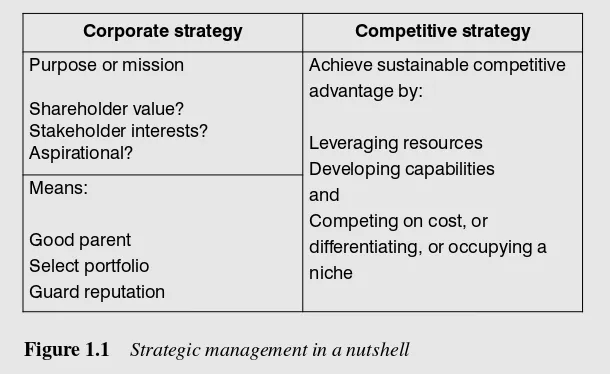
the ability to implement strategic change successfully.It is generally accepted that there are two types of strategic deci-sions to be made (see Figure 1.1). One type, known as corporate strategy, is to do with the overall strategic purpose and direction of a company; the other, known as business or competitive strategy, is to do with the achievement of a sustainable compet-itive advantage in a specific market. In the multi-business company these are distinct processes, but in the single-business firm they merge into one.
Corporate strategy Competitive strategy
Purpose or mission
Shareholder value? Stakeholder interests? Aspirational?
Achieve sustainable competitive advantage by:
Leveraging resources Developing capabilities and
Competing on cost, or differentiating, or occupying a niche
Means:
Good parent Select portfolio Guard reputation
26 Strategic management and its context
There is certainly no shortage of advice available to companies seeking to improve their strategic management processes. The prescriptions on offer vary, and over the past 50 years there have been waves of fashion in strategic thinking. In the early years there was a belief in the rationality and linearity of the process. The term ‘long-range planning’ was coined to describe an activity that involved large planning staffs and huge amounts of number-crunching and analytical activity, and culminated in the production of a substantial document – the strategic plan – which was out of date almost as soon as it was produced and which usually ended life in the bottom of a desk drawer.
2
The environmental context
INTRODUCTION
In the context of strategy formulation the business environment is taken into account in two ways. First, the effectiveness of a strategy, as it is played out over time, will to a large extent depend on what is happening in the wider or macroenvironment of economic and social change, political developments and technological progress. These developments may offer new opportunities; equally they may constitute threats.
The second way in which the environment is taken into account is to build into the strategy the company’s way of dealing with its imme-diate or transactional environment. This consists of its current and potential future competitors, its current and potential future customer base, its supply chain and its sources of capital. In this chapter, issues to do with the macro environment will be reviewed. The transactional environment will be considered in later chapters.
28 Strategic management and its context
THE IMPACT OF THE ‘NEW ECONOMY’
From the viewpoint of business strategists the most important recent and current trends in the macro environment are those that tend to be lumped together under the heading of the ‘New Economy’. The new economic era, by whatever name we call it, has been heralded for a long time; with the advent of the 21st century it has finally arrived. Its further development, however, has a long way to go.
There will always be a demand for a simple label by which to describe complex phenomena, but that should never be allowed to obscure the nature and depth of that complexity. The scope of the New Economy encompasses much more than dotcom companies and the Internet. It is not, in other words, the same as the ‘e-economy’ or the ‘dotcom economy’ although it embraces both these concepts. Clearly, the new information and communication technologies that have brought dotcom businesses into being are simultaneously restructuring global markets and whole industry sectors, challenging conventional economic thinking and redefining how business is done.
James D Wolfensohn, President of the World Bank, has emphasized the broad scope and impact of the New Economy (2001):
The New Economy is shorthand for nothing less than a revolution in the way business works, economic wealth is generated, societies are organized, and individuals exist within them. Today’s realities are tele-phone-based service centers in India serving US consumers, and new technologies underpinning extraordinary shifts in everything from food production to the health products addressing long standing tropical diseases. The knowledge and information revolution provides a historic opportunity, a new age with enormous potential in promoting competitiveness, new economic growth and jobs, better access to basic services, bigger impacts from education and health interventions and, most importantly, enhanced empowerment of local communities and stronger voices for poor people.
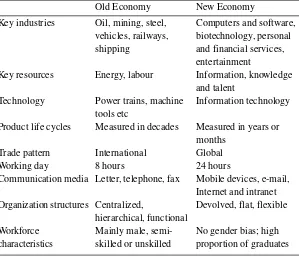
Table 2.1 summarizes the main differences between the ‘Old Economy’ and the ‘New’.
Aspects of the new economic environment
The environmental context 29
ᔡ
the steadily increasing globalization of business;ᔡ
the invisibility and intangibility of an increasing proportion of economic activity;ᔡ
the impact on business of opportunities created by new technology such as mobile communications, the Internet, the intranet, satellite communications and the like.Globalization
We are certainly a single global economy compared with thirty years ago, but we can say with equal certainty that we’ll be even more globalized in 2050, and very much more in 2100. Globalization is not the product of a single action, like switching on a light or starting a car engine. It is a historical process that has undoubtedly speeded up enormously in the last ten years, but it is a permanent, constant transformation. It is not at all clear, therefore, at what stage we can say it has reached its final destination and can be considered complete.
(Hobsbawm, 2000)
Table 2.1 Old Economy and New Economy comparisons
Manufacturing operations will continue to shift from Western economies to those countries that offer access to cheaper labour. Equally, technology is allowing more and more knowledge-based work such as software creation and call centre operation to be shipped to the lowest-cost environments such as India. This will bring jobs to emerging economies but will also create severe pressures for companies in the advanced economies to move operations overseas or to outsource more activities to lower-cost environments.
In recent years globalization has accelerated as a result of the increasing adoption of free-trade policies and the deregulation of markets, policies vigorously pursued by the member countries of the Organization for Economic Co-operation and Development (OECD) through the World Trade Organization (WTO).
The OECD/WTO view is that open trade has been a driving force for global economic growth, whereas the existence of barriers to trade in the 1930s was a major factor bringing about world-wide depression. Many activists in the fields of human rights and environ-mental protection are profoundly sceptical about its benefits.
The ‘death of distance’
‘The “death of distance” that is intrinsic to information networking is among the most important forces shaping society at the beginning of the 21st century’ (Cairncross, 1997). Teleworking across the time zones is steadily increasing.
The ‘working day’ has no meaning when communication via elec-tronic mail, voice mail, and facsimile transmissions can be sent or received at any time of day or night. This development has very considerable implications for the design of organizations and the business processes in use.
Invisibility and intangibility
When it comes to achieving business success, the traditional factors of production – land, labour and capital – are rapidly becoming restraints rather than driving forces. Knowledge or intellectual capital, and talent, which generates new knowledge and new products, have become the key resources.
A knowledge economy
billion worth of books, films, music, television programmes and other copyright products.
Knowledge, as a factor of production, has a number of distin-guishing features when compared with land and capital:
ᔡ
It cannot be used up. If one person or a single organization uses some land or some capital it is not possible for another person or organization to make use of the same resource. Yet in the case of knowledge any number of people can use the same piece of knowledge simultaneously without depleting it. And today, because of the existence of the World Wide Web, millions of people can have access to vast stocks of knowledge at nil or marginal cost.ᔡ
Knowledge as property is hard to protect. Patents cannot protect much of the valuable knowledge that companies possess. Much of it moves from one organization to another as people change jobs.ᔡ
Traditional accounting practices are not very much use when trying to quantify the impact of knowledge on wealth creation. Company balance sheets can give precise information about the value of a firm’s capital assets and land valuations, but it is much more difficult to assess the value of a firm’s stock of knowledge. The difference between the value of a company’s assets and its market value gives some indication, but the stock market valuation also reflects other factors such as the value of brands and, notably in the case of dotcom companies, expectations of future earnings. It is not only difficult to quantify the value of the stock of intel-lectual capital, but it is even more difficult to measure how effi-ciently the intellectual capital is being used, despite the fact that it is the major investment expenditure of many ‘New Economy’ firms as well as their key resource.Perhaps the first public acknowledgement of the key role of knowledge in wealth creation was the address given to the Annual General Meeting of the Anglo-Dutch company Unilever by the then chairman, Ernest Woodruffe, in 1972. Unilever, he said, had competitors with similar access to capital, which faced lower taxes and enjoyed government subsidies. What they lacked, however, was the
immense body of varied knowledge and commercial skills which Unilever has built up over the years.
32 Strategic management and its context
In every aspect of the business knowledge is vital; and much of the knowledge which is important to a firm like Unilever cannot be found in books; it has to be acquired often expensively, sometimes painfully, by experience and deliberate enquiry.
Knowledge is not cheap. Around the world we spend many millions in acquiring it. But without this expenditure we could not survive against competition.
The economies of using knowledge over and over again, everywhere adapting it to local needs, are very great. Knowledge has no marginal cost. It costs no more to use it in the 70 countries in which we operate than in one. It is the principle which makes Unilever economically viable. The knowledge Unilever has is both extensive and complex. It is the source of your profits and of the main benefits Unilever brings to the peoples of the countries in which it operates.
Knowledge management is, therefore, an important strategic capa-bility. Much of the literature that deals with this focuses on the role of information technology; but the implications for the management of people are equally important – particularly the treatment of the increasingly valuable and valued knowledge professionals. This brings into focus another important issue – the management of talent.
The role of talent in the ‘New Economy’
Sooner or later all knowledge is obsolete – and today it is likely to be sooner rather than later. Talent is the only remaining scarce resource and as such the true source of competitive advantage. The nature of the typical ‘New Economy’ enterprise, therefore, is better described as ‘talent-intensive’ rather than ‘knowledge-intensive’ (Sadler, 1993).
The economic value of talent is illustrated dramatically by the fact (according to Fortune magazine) that, in 2000, the US basketball player Michael Jordan’s personal economic value derived from copy-rights and merchandising exceeded the gross national product of the kingdom of Jordan. Much of the talent that creates the wealth of the ‘New Economy’, as in Jordan’s case, is not easily encapsulated by the term ‘intellectual capital’. The ‘knowledge-intensive industries’ such as software writing, pharmaceuticals, computers and aerospace are obviously key industries in the ‘New Economy’. At the same time, very rapid growth is taking place in such fields as music, the arts, sport, fashion and aesthetic design.
possessed by outstanding sports players, actors, musicians, writers, television presenters, chat-show hosts, architects and artists.
Peter Drucker (1992) has remarked that knowledge, like electricity, is a form of energy that exists only when it is being used. The same is true of talent. It follows that economic success will accrue increas-ingly to those companies that are most capable in identifying, educating, developing and exploiting the talents of their people. This is the true meaning of strategic human resource management.
The impact of new technology
New technology in the field of telecommunications is creating a whole new set of threats and opportunities for business organizations. In particular the watershed years bridging the 20th and the 21st centuries have seen explosive growth in a range of uses of the Internet and intranet – as an advertising medium, as a marketing tool that makes possible a greater degree of interaction between supplier and customer, as a means of communication with stakeholders and the public at large, and as a medium for learning and the integration of widely dispersed organizations.
It has resulted in large numbers of quick-off-the-mark new entrants into markets eating into the market shares of established businesses. Successful organizations now come in all shapes and sizes. A new source of competition could be a multinational corporation with huge financial resources; it could, however, be an enthusiastic young entre-preneur with an idea and a computer, who intuitively understands that it is now perfectly possible to become a one-person global enterprise. There is, in short, hardly a company in existence that is not vulnerable to the Internet’s potential to diminish the significance of, for example, size, location, time, distance and physical resources.
In The Death of Distance, Frances Cairncross (1997) describes how, by using technology creatively, small companies can now offer services that, in the past, only large corporations could provide. The cost of starting new businesses is declining, and so more and more small companies will spring up. Many existing companies will develop into networks of independent specialists; more people will therefore work in smaller units or alone.
Moreover, the technology is moving so fast that it’s all too easy to be either too early or too late. In such a world, the timing of an investment or a product launch is critical and it is how companies deal with this factor that determines who falls by the wayside and who moves through to the next round. The aim is to be ahead of one’s competitors, however briefly.
As an example of the speed of change in the technology, in September 2001 Motorola unveiled a microchip that is 40 times faster than existing technology. This will enable applications such as streaming video to mobile phones. Motorola’s chief technology officer claimed that the discovery had the potential to change the telecommunications and computer industries as radically as the invention of the first chips in 1958.
The old economy is not dead
To keep matters in perspective, these observations do not suggest that the economic order is being completely overturned – the ‘New Economy’ is an ‘add-on’ to the traditional economy; it does not take its place, just as the industrialized society was an add-on to the agri-cultural society that preceded it. The mature industries of the ‘Old Economy’ will continue to operate albeit in largely changed locations. The fact is that around the world the automotive industry remains the largest in terms of revenues and employment. There are more cars and aircraft being constructed than ever, more roads being built, more steel being made. The difference is that in the OECD countries these tradi-tional industrial activities comprise an ever-shrinking share of gross domestic product (GDP) relative to the newer industries providing communication, information, entertainment and professional and personal services.
Also, these industries are mature. They are characterized by slow growth and low margins. Companies seeking faster growth and higher margins will need to look increasingly at the newer industries.