ii
Proceeding 8
th
ADRI 2017
International Conference and
Call for Paper,
Surabaya, February 15-16, 2017
Published by:
iii
ISBN: 978-602-60736-4-8
Proceeding 8
th
ADRI 2017
International Conference and
Call for Paper,
Surabaya, February 15-16, 2017
Published by:
Perkumpulan Ahli & Dosen Republik Indonesia (ADRI)
Publisher Address:
Pasar Wisata Juanda Blok Q1, Jalan Raya Sedati, Pabean,
Sidoarjo, Jawa Timur, Indonesia, 61253
http://p-adri.or.id
iv
ISBN: 978-602-60736-4-8
Proceeding 8
th
ADRI 2017
International Conference and
Call for Paper,
Surabaya, February 15-16, 2017
x, 54 pages, 28 cm
Copyright Reserved
Copyright @ 2017
ISBN:
978-602-60736-8-6
Chief of Editor:
Prof. Dr. Supari Muslim, M.Pd. (UNESA, Jawa Timur)
Board of Editor:
Dr. H. Achmad Fathoni Rodli, M.Pd. (Ketua DPP ADRI)
Dr. H. Anton Muhibuddin, SP, MP. (Rektor Univ.Wahab Hasbullah, Jombang, Jawa Timur)
Dr. Meithiana Indrasari, ST., MM. (Universitas Dr. Soetomo, Surabaya, Jawa Timur)
Dr. Didi Sundiman, MT., MM. (UNDA, Sampit, Kalimantan Tengah)
Deffi Ayu Puspito Sari, Ph.D. (Universitas Bakri, Jakarta)
Reviewer:
Prof. Peter Newcombe, Ph.D. (University of Queensland Australia).
Prof. Seung Wook Kim. (Korea University, Korea Selatan).
Prof. Dr. Wahid Bin Razzaly (Universiti Tun Hussein Onn Malaysia, Malaysia).
Prof. Datuk H.Dr. Mohd. Dalimin, M.Sc. (UTM, Malaysia).
Prof. Assoc. Dr. I-Hsien Ting. (National University of Kaohsiung, Taiwan).
Prof. Assoc. Hunsa Punapayak. (Chulalongkorn University, Thailand).
Prof. Drs. Toho Cholik Mutohir, MA., Ph.D. (IKIP Mataram, Nusa Tenggara Barat)
Prof. Dr. H. Husain Dsyam, M.TP. (Universitas Negeri Makassar)
v
Prof. Dr. R. Partino (Universitas Cendrawasih, Irian Jaya).
Prof. Dr. Endry Boeriswati, M.Pd. (UNJ, Jakarta).
Prof. Dr. Ir. Suhardjono, M.Pd, Dipl.HE. (UNIBRAW, Jawa Timur)
Prof. Dr. Atmazaki, M.Pd. (Universitas Negeri Padang, Sumatera Barat)
Prof. Dr. Nasrudin Suyuti, M.Si. (UNU Sulawesi Teggara)
Prof. Dr. Agus Soegianto, M.Sc. (UNAIR, Surabaya, Jawa Timur)
Prof. Dr. Ir. Suprijanto (ITS, Surabaya, Jawa Timur)
Prof. Dr. Masriam Bukit, M.Pd. (UPI Bandung, Jawa Barat)
Prof. Dr. Bambang Suprianto, MT. (UNESA, Jawa Timur)
Prof. Dr. Amat Mukhadis, M.Pd. (UNESA, Jawa Timur)
Prof. Dr. Madlazim, M.Si. (UNESA, Jawa Timur)
Prof. Dr. Bambang Yulianto, M.Pd. (UNESA, Jawa Timur)
Prof. Dr. Sarmini, M.Hum. (UNESA, Jawa Timur)
Prof. Dr. Ismet Basuki, M.Pd. (UNESA, Jawa Timur)
Prof. Dr. Abdul Muin Sibuea, M.Pd. (UNIMED, Sumatra Utara)
Prof. Dr. Herminarto Sofyan, M.Pd. (UNY, Yogyakarta)
Prof. Dr. Harapin Hafid, M.Si. (Universitas Halu Oleo, Kendari, Sulawesi Tenggara)
Prof. Dr. H. Sofyan Sauri, M.Pd. (UPI, Bandung, Jawa Barat)
Prof. Dr. Aunurrahman, M.Pd. (Universitas Tanjungpura, Pontianak, Kalbar)
Prof. Dr. Drs. Junaidi H. Matsum, M.Pd. (Universitas Tanjungpura, Pontianak, Kalbar)
Prof. Dr. Edy Tandililing, M.Pd. (Universitas Tanjungpura, Pontianak, Kalbar)
Prof. Dr. Drs. Eddy Yunus, ST, MM. (Universitas Dr. Soetomo, Surabaya, Jawa Timur)
Prof. Dr. H. Achmad Slamet, M.Si. (UNNES Semarang, Jawa Tengah)
Prof. Dr. H. Maman Surachman, M.Sc. (UNNES Semarang, Jawa Tengah)
Prof. Dr. Sugiyo, M.Si. (UNNES Semarang, Jawa Tengah)
Prof. Dr. Ir. Ramatullah Rizieq, M.Si. (UPB Pontianak, Kalbar)
Prof. Dr. Ujianto, M.Pd. (UNTAG Surabaya, Jawa Timur)
Prof. Dr. Anna Permanasari, M.Si. (UPI, Bandung, Jawa Barat)
Prof. Dr. Suwatno, M.Si. (UPI, Bandung, Jawa Barat)
Dr. Andi Suhandi, M.Si. (UPI, Bandung, Jawa Barat)
Dr. Ibrahim Ingga, M.Ak. (UNTAG Surabaya, Jawa Timur)
Dr. M
.
Hasinuddin, S.Kep.Ns., M.Kep. (STIKES Ngudia Husada Madura, Jawa Timur)
Dr. M. Rif’at, M.Pd.
(Universitas Tanjungpura, Pontianak, Kalbar)
Dr. Ahmad Yani T, M.Pd. (Universitas Tanjungpura, Pontianak, Kalbar)
Dr. Ardi Marwan, S.pd., TESOL. (POLNEP, Pontianak, Kalbar)
Dr. Adnan Mahdi (IAI Sultan Syafiudin, Sambas, Kalbar)
Dr. H. Wajidi Sayadi (IAIN, Pontianak, Kalbar)
Dr. Sajiyo, ST., M.Kes. (UNTAG Surabaya, Jawa Timur)
Dr. Drs. Andreas Muhrotien, M.Si (ST Pastoral St. Agustinus Keuskupan Agung Pontianak)
Dr. Wida Kuswida Bhakti, S.Kep.,M.Kes. (STIKES Muhammadiyah Pontianak, Kalbar)
Dr. Siti Nurjanah, M.Pd. (Universitas Negeri Jakarta)
Dr. Yusnidar Yusuf, M.Pd. (UHAMKA, Jakarta)
Dr. Eri Sarimanah, M.Pd. (Universitas Pakuan, Surabaya)
Dr. Rosida Tiurma Manurung
, M.Hum. (Univ. Kristen Maranatha, Bandung, Jabar).
vi
Executive Editor:
M. Ikhsan Setiawan (Universitas Narotama, Surabaya)
Soeharto (STKIP Singkawang)
Eka Murdani (STKIP Singkawang)
Rosmaiyadi (STKIP Singkawang)
Haris Rusdianto (STKIP Singkawang)
Layout and IT Team:
Agus Kurniawan (STKIP Singkawang)
Muh. Ilham Baktiar (Universitas Negeri Makassar)
Muh. Barid Nizarudin Wajdi (STAI Miftahul Ula Nglawak Kertosono, Nganjuk)
Otto Fajarianto (ADRI)
Publisher Manager of Perkumpulan Ahli & Dosen Republik Indonesia (ADRI):
Andi Mursidi (STKIP Singkawang, Ketua DPD ADRI Kalimantan Barat).
Published by:
Perkumpulan Ahli & Dosen Republik Indonesia (P-ADRI)
Publisher Address:
Pasar Wisata Juanda Blok Q1, Jalan Raya Sedati, Pabean,
Sidoarjo, Jawa Timur, Indonesia, 61253
http://p-adri.or.id
vii
PREFACE
Praise being said to Allah Almighty God for all the grace and guidance that has been given
to us all, so the Proceedings of the 8
thADRI 2017 International Conference and Call for Papers
Surabaya, February 15-16, 2017 can be realized. Proceedings contains a number of articles and
research papers from lecturers, teachers, students, researchers and / or observer of the development
of science and technology.
Proceedings are published in book form only contains abstract, distributed to participants
in the form of compact disks (full paper) and published online at:
www.prosiding.p-adri.or.id
Hopefully, these proceedings may give benefit to us all, for the development of science,
technology, arts, culture, and sports. In addition, is also expected to be a reference for the nation
and state-building efforts so that science and technology become a strong pillar in the face of the
ASEAN Economic Community.
Lastly, there is no ivory that is not cracked. We are sorry if there are things that are less
pleasing.
Thanks you very much.
Surabaya, February 15, 2017.
Publisher Manager of Perkumpulan Ahli & Dosen Republik Indonesia (ADRI),
viii
D
AFTARI
SIStudy Of Organizational Behavior Independent Organization Rooted In Society For
Development Process Of Cultivating Organic Rice
...
...1-7
Agustin Sukarsono, Achmad Syaichu ,Ahsin Daroini
Setting Of Guidance And Counseling Services For “SMA/MA & SMK” In
Curicculum 2013...
...8-12
Galang Surya Gumilang
The Effect Of English Kampong On Society Social-Cultural Life In Pare-Kediri-
East Java. ...13-16
Putut Handoko, Cahyaningsih Pujimahanani
Competitive Dynamics In Micro: Analysis Of Perception About Competition In
Deafpreneurship...17-21
Bambang Raditya Purnomo
Domestic Violence (Domestic Violence) Is Opposed To Human Rights (Ham) In The
Village Of Ngembal Wajak... ...22-23
Cahyo Edi, Didik Iswahyudi
Domestic Violence (Domestic Violence) Is Opposed To Human Rights (Ham) In The
V Community Movement Of Sekelik Sedulur In Building Cultural Harmony Of
Lampung And Java Ethnics As Conflict Prevention In Central Lampung
...24-37
Dr.Ida Umami, M.Pd.Kons, Dharma Setyawan, Ma
Early Warning System For The Impact Of Industrial Development Waste By Using
Ph Control System ... ...38-46
Veronika Nugraheni, Sri Lestari Dwicahyono
Effectiveness Guidance Group Engineering Sociodramas To Improve The Ability Of
Self Adjustment Of Social In Class Vii In SMP State 2 Singosari District Of Poor
...,... ...47-50
Erik Teguh Prakoso, Tri Desy Rahayu
Haiku And Senryu In The Indonesian Cyber Literary...51-60
Gatot Sarmidi
Comparative Financial Performance Bank National Government And Private Banks
Listed In Indonesia Stock Exchange Period 2010-2014 By Using Camel ...61-68
Ida Nuryana, Sri Wilujeng, Retno Wulandari
Reviving Reading Culture:Promoting Free Voluntary Reading Among Students: The
Students’ Case Of Priveate University In Malang...69-75
ix
Study Of Behavior Organization Institute Self Ancient Roots In Society (LM3) In
The Raising Development Process Organic Rice...76-82
Agustin Sukarsono, Achmad Syaichu
The Multimedia Development Of Raden Mas Said Sites In Teaching History To
Improve The Attitude Of Local Wisdom...83-100
Alwan Hardianto
The Multimedia Development Of Raden Mas Said Sites In Teaching History To
Improve The Attitude Of Local Wisdom...101-118
Alwan Hardianto
Competitive Dynamics In Micro: Analysis Of Perception About Competition In
Deafpreneurship...119-123
Bambang Raditya Purnomo
Participatory Planning As Efforts To Empower The Community (Case Study Unit To
Perform Technical District Trowulan District Mojokerto)...124-130
Bambang Agoes Hermanto
DPR/DPRD, dan Kaitannya Dengan Peran Parpol Dalam Era Reformasi Di
Indonesia ...131-134
Benyamin Tungga
The Influence Of Economic Status Against The Environmental Sanitation In The
Village Of Ngadiluwih Rt 02 Rw 02...135-141
Nurhidayah
The Development Of Audio-Visual Media Song Terus Cave Site To Increase
Cultural Awareness In Sma Negeri 1 Pacitan ...142-157
Caraka Yoga Aprilya
Islamic Culture Impact Of Increasing Satisfaction And Performance Of Employees:
Study Of Educational Institutions Sabillilah Sampang...158-168
Dinda Fatmah, Chamdan Purnama
Developing Of Numbers Learning Module For Primary School Students
Bycontextual Teaching And Learning Approach...169-172
Dyah Tri Wahyuningtyas, I Ketutsuastika
Setting Of Guidance And Counseling Services For “SMA/MA & SMK” In
Curicculum 2013...173-177
Galang Surya Gumilang
Language Vocabulary As a Medium For Understanding Socio-Cultural Of Speech
Community ...178-181
x
The Acquisition Of Ritase Vehicles Againsts The Income Each Vehicle Freight
Transport (Case Study In Transport Company)...182-193
Indah Sari, Achmad Daengs Gs, Wiratna
The Role Of Social Capital Networks In The Economic Empowerment To
Sustainability Efforts Of Small Industry Batik Mangrove...194-197
Juliani Pudjowati
Effort For Improving Empathy Of SMP Muhammadiyah 1 Malang Student By Usage
Of Movie Therapy Technique...198-203
Leny Latifah, Romia Hari Susanti
An Application Of Online Branding Design With Customisation, Culture And
Communities Strategy : A Case Studies On Six Online Store Providers...204-214
Mahjudin, Achmad Daengs Gs, Retno Susanti
Economic Analysis Of Effect Cottage In The Presence Of Boarding Darul'ulum
Rejoso In Jombang...215-217
Adah
The Role Of Local Mass Media Attitude Against Corruption...218-221
Muhammad Suharto, Tatik Swandari
Pre-Service Elementary School Teacher’s Natural Science Misconceptions Of
Borneo Tarakan University...222-225
Muhsinah Annisa
Students Perception On Radio English Broadcasting Program...226-237
Ninik Suryatiningsih
The Effectiveness Of Two Stay Two Stray Strategy In Teaching Reading
Comprehension As Observed From Students With Different Learning
Styles...238-243
Rasyidah Nur Aisyah
Effect Of Leadership Style Principal And Teacher Performance Based Management
Of School In Mts Nurul Ulum Malang...244-249
Roni Alim.B.K, Agus Priyono, Riril Mardiana Firdaus
Unsur Budaya Dalam Novel Assalamualaikum Beijing Karya Asma
Nadia...250-259
Rerin Maulinda, S.Pd, M.Pd
Paikem Application On Proclamation Approach Of Indonesia’s Independence
Material (To Increase Study Activity And Result)...260-263
xi
The Effectiveness Of Direct Peer Feedback To Increase Students’ Writing
Performance...264-287
Sujito, Emilia Yunita
Analysis Of College Students Error In Solving Basic Mathematics Problem With
Newman...288-292
Tatik Retno Murniasih, Vivi Suwanti
Marriage Registration Mechanim Fornon-Muslim Citizens Of Indonesia...292-302
Dr. M. Zamroni, Sh, M.Hum.
Ways Of Using Global Market Expansion Strategy: A Study Of Smes...303-308
Fahruddin Salim
Effect Of Social Capital And Work Place Spirituality To Employee
Engagement...309-321
Setiabudhi, Eva Nur Rachmah
Analysis Of College Students Error In Solving Basic Mathematics Problem With
Newman...322-326
Tatik Retno Murniasih, Vivi Suwanti
Needs- Based Regional Organizationrestructuration (Case Study In The Nusa
Tenggara Timur Regional Government)...327-333
Indriyati
Safety Climate In Organizational Commitment, Effect Of Safety
Accident...334-338
Author M.Yusuf Arnol, Author Nyoman Gede, Suryadharma.
Sub District Head Efforts In Improving Civil Servants Discipline (A Study At
Tanjunganom Sub District Office, Nganjuk) ...339-348
Yenik Pujowati, S.Ap., M.Ap
Intrinsic Value Analysis For Forecasting The Expected Shares In Investment
Decision With Dividend Discounted Model And Price Earning Ratio...349-353
Januari Ayu Fridayani, Se, Mm
Islamic Culture Impact Of Increasing Satisfaction And Performance Of Employees:
Study Of Educational Institutions Sabillilah Sampang ...354-363
Dinda Fatmah, Chamdan Purnama
Sxdamage Status Assessment Of Agricultural Land As a Result Of Biomass
Production In Probolinggo Regency, East Java...364-379
Bambang Wicaksono Hariyadi, Mahrus Ali
Increasing Production With Tomato Plant Feeding Organic Fertilizer Vermicompost
...380-388
xii
Concept Of Welfare State In The Community Farmers ...389-400
Suciati
Total Quality Management & Flexibility ...401-408
Estik Hari Prastiwi, Irmayanti Hasan
Marriage Registration Mechanism For Non-Muslim Citizens Of Indonesia
...409-501
Curriculum Models Of Teacher Professional Education Based On The Indonesian
Qualifications Framework (KKNI) ... ...502-506
J. Priyanto Widodo
Efektivitas Media Pembelajaran Komik dan Model Pembelajaran Kooperatif Tipe
Group Investigation Terhadap Kesiapsiagaan Siswa Dalam Menghadapi Bencana
Gempabumi Pada Siswa Kelas X Di SMA Negeri 1 Wedi, Klaten ...507-511
Fajar Wulandari, Prof. Dr. Sigit Santoso, M. Pd2 , Dr. Sarwono, M. Pd2
Role Of Parents To Provide Incentives For Love Child Education ...512-514
Frahasini
Local Wisdom Representation In Babad Tulungagung ...515-525
Yasip
The Effectiveness Of Two Stay Two Stray Strategy In Teaching Reading
Comprehension As Observed From Students With Different Learning Styles
...526-530
Rasyidah Nur Aisyah
The Role Of Local Mass Media Attitude Against Corruption ...531--534
Muhammad Suharto, Tatik Swandari
Scaffolding-Aided Inquiry Learning For The Improvement Of Students’
Mathematics Literacy Skills ...535-538
Buyung
Gender Equality In The Political Field In West Kalimantan Singkawang
...539-542
Evinna Cinda Hendriana, Dina Anika Marhayani
Feasibility Assessment Of Investment In Public Infrastructure Development In
Determining The Economic Potential ...543-545
Yuniningsih, M. Taufiq, Marseto, Djohan Mashudi, Dwi
Suhartini
Creative Writing Class IV After Taught The Scientific Approach ...546-549
xiii
The Factors Affecting Stock Prices On Go Public Industry Company Listing Of
Indonesia Stock Exchange (Food And Beverages, Pharmaceuticals And Consumer
Goods ...550-560
Benny Setia
Build And Developing Leadership For Achieving Success ...561-571
Sedarmayanti, Herdi Risman
Corporate Governance: Will Moderate The Effect Accounting Consevatism Toward
Equity Valuatio...572-576
Ratna Wijayanti Daniar Paramita, Noviansyah Rizal
Model Analysis Wolter And Hilborn Capture Fisheries Case Study Rajungan In East
Java Pasuruan ...577-583
Samsul Huda, Siti Naviah
Analysis The Effect Of Human Resources Competence Toward Performance:
Studies In Economics-Based College In East Java Indonesia ...584-588
Fariz, Tutik Winarsih
Pengembangan Media Pembelajaran Komik Sejarah Berbasis Perjuangan Letkol
Slamet Riyadi Untuk Meningkatkan Nilai-Nilai Nasionalisme Siswa ...589-595
Raditya Jehan Andias
The Impact Of The Work Discipline And Remuneration (Compensation) On The
Performance Of Employees At H. Asan Airport Operating Unit Office ...596-602
Ansita Christiana, Yuli Fitriani
Relationship Between Self Esteem
And Aggressive Behavior State Class VIII SMP
01 Wagir ... ...603-608
Ch. Erghiezha N.I.K, M.Psi., Siadatul Munawaroh
Learning Strategy in Second Language Learning ...609-615
“2017 – ADRI -International Multidisciplinary Conference and Call for Papers”
A
NALYSIS
O
F
C
OLLEGE
S
TUDENTS
E
RROR
I
N
S
OLVING
B
ASIC
M
ATHEMATICS
P
ROBLEM
W
ITH
N
EWMAN
Tatik Retno Murniasih
1), Vivi Suwanti
2)1)Mathematics Education, Kanjuruhan University, Malang, Indonesia
E-mail: [email protected]
2) Mathematics Education, Kanjuruhan University, Malang,Indonesia
E-mail: [email protected]
Abstract.This study is done with intention to analyze college student error based on NEA (Newman’s Error Analysis). NEA is a
frame work with diagnostic procedure, they are (1) decoding, (2) comprehension, (3)transformation, (4) process skill,
and (5) encoding.This study take a place at odd semester of 2016/2017. The subject of this study are 6 college student of
2016C class of Mathematics Education that consist of 2 low ability learner, 2 average ability learner, and 2 high ability learner.The instruments of this study are a test sheet consist of 3 basic mathematics problems and an interview guidelines sheet to help discover and back tracking the college student error. The test sheet problems consist of 1 exponent problem, 1 function problem, and 1 permutation problem. The data were analyzed with descriptive qualitative methods. Results of the study shows that 11% of college student shows decoding error, 17% of college student shows comprehension error, 33% of college student shows transformation error, 50% of college student shows process skill error, and 67% of college student shows encoding error. The error often occur in process skill and encoding stage.This errors were caused by the college students low conceptual knowledge, especially low ability learner, so the college students couldn’t finish their works.
Keywords: Error analysis, basic mathematics, Newman’s Error Analysis
I. INTRODUCTION
Mathematics plays an important role in the development of science and technology as well as shaping the human personality [15]. Math could be said as a building whosehave a base, frame work, floor and some elements that attached to it. A building will remain strong when it built on a firm base or foundation. The foundation in learning mathematics for mathematics education college students called mathematical base course. This course serves to strengthen and sustain the mathematics building on student’s knowledge.
Mathematical base course is a compulsory course for mathematics education college students. It given to the students at their first semester.So it could said that the entrant of this course are students who hadfreshly graduated from high school. There aresome differences between high school and college students learning style. Students get more guidance and assistance from their teacherswhen learning at the school. But in the college, the students trained to leaning with minimum guidance and assistance from the lecturer. In other words, the college student will be faced with more independent learning style.
Based on the observations of the actual mathematical class,the students in their first semester are still carried out with their old high school learning style. They couldn’t accustomed their selves with the new learning environment and style. This problem also occurs with their reference books. High school students usually uses only one reference
book in almost all of their subject matter. Butthe college students are required to read more than one reference books for the sake of further student understandings and knowledge development. High school students are still afraid of the teacher, but after being a college student, they are required to be more active in express their opinion and ask what they don’t understand to the lecturers.
The course of Mathematical base is an abstract subject matter that containprior knowledge that must be mastered by the college students, even though they are still very simple basic concept of mathematics. The concepts that taught at mathematical base are sets, logics, exponents, functions, permutation, and mathematical induction. This study will analyze the students works at exponents, functions, and permutation matter. Many college students think that this material are the difficult one.
“2017 – ADRI -International Multidisciplinary Conference and Call for Papers”
According to Abdurrahman [1], error can be interpreted as anmistake or deviation from what is right, the procedures set forth previously, or deviation from what expected.Luneta and Makonye[13] state that, errors can be differentiate in tho two kind, they are unsystematic errors (such as calculation error) and systematic errors (which is known as misconception). Unsystematic errorsare an unintended mistake which students make and easily corrected by them selves. In other hand, systematic errorsare repeated wrong responses that constructed methodically and produced time by time. Students with systematic errors
There are many tools that can be used to analyse an error such as NEA procedures (Newman's Error Analysis). According to Newman [9], NEA is a framework with a simple diagnostic procedures, which include (1) decoding, (2) comprehension, (3) transformation, (4) process skills, and (5) encoding. Newman developed a diagnostic method that is used to identify and categorize studentserror at mathematical word problem.According to White [14], the inclusion of NEA was a powerful classroom diagnostic assessment and teaching tool for assessing, analysing and catering for student experiencing difficulties with mathematical word problems.NEA experienced a reawakening in Australia and has been included in a number of programs such as the Counting On program in the Australian state of New South Wales.According to Junaidi, et al[5], known that students errors in resolving discrete mathematics caused by: (1) the student did not know the meaning of a symbol or an existing term in the problem (Reading Errors), (2) the student did not
understandthe meaning of the problem, namely the student fails to write what is known and what is being asked (Comprehension Errors), (3) students forgot a formula that
will be used or strategy/procedure what to do (Transformation Errors), (4) students could not make the
problem-solving algorithms in sequence and correctly (Process Skills Errors), (5) the student could not answer
according to the question (Encoding Errors), and (6) the
student could not translate well, especially about which was written in English (Language Errors).
Newman [9] suggests the following questions used during the interview in order to classify students' mistakes in solving math word problems.
Newman’squestion:
1. Please read the problem. If there is a word you do not know, tell me!
2. Tell me, what is the problem want! 3. Say, how to find the answer!
4. Show me, what was done to obtain the answer. Talk loudly while you work so I can understand what you think. 5. Now, write down your answer.
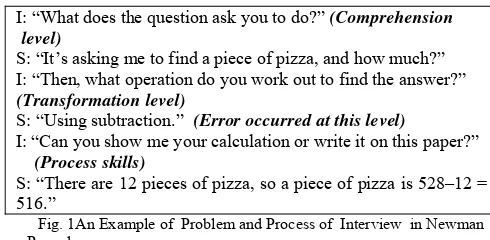
According to Prakitipong and Nakamura [10], the following conversation describes this method (See Figure 1). In the transcript below, “I” stands for interviewer and “S”stands for student.
(Problem)
A pizza of twelve pieces, costs five hundred twenty eight yen. How much will one piece of pizza cost?
(Process of Interview)
I:“Can you read the question?” (Reading level) S: (Student reads the whole question.)
I: “What does the question ask you to do?” (Comprehension level)
S: “It’s asking me to find a piece of pizza, and how much?” I: “Then, what operation do you work out to find the answer?” (Transformation level)
S: “Using subtraction.” (Error occurred at this level)
I: “Can you show me your calculation or write it on this paper?” (Process skills)
S: “There are 12 pieces of pizza, so a piece of pizza is 528–12 = 516.”
Fig. 1An Example of Problem and Process of Interview in Newman Procedure
Studentsdifficulties in understanding the material can be traced by looking at the error they made. According Soedjadi, et al [12],studentserrors in answering questions could be seen as an indicator of the difficulties that experienced by the students. Furthermore, according to Soedjadi, et al [12], there are two factors that cause students difficulties, they are intern and extern factors. Intern factors include attitudes, cognitive development, skill and gender. External factors include the teaching method, mathematics materials, and social environments.From the problems explained before, this studyintended to analyse the college students error in solving basic mathematic problems byNewman analysis.
II. RESEARCH METHOD
This study used descriptive qualitative method. Qualitative research is research that can reveal a phenomenon experienced by the subjects in the form of behavior, perception, motivation, action, etc in a holistic manner and descriptively in the form of words and language, in a specific natural context and using various scientific methods [6].According to Mustafa [8], the major purpose of descriptive survey is to describe the state of affairs as it exists.
This study conducted at the Mathematic education of KanjuruhanUniversity ofMalang. This study take a place at odd semester of 2016/2017. The subject of this study are 6 college student of 2016C class of Mathematics Education that consist of 2 low ability learner, 2 average ability learner, and 2 high ability learner.
The data collected proceduresin this study are: a) test and b) interview. The test problems are made in form of word problem essay to facilitate the tracking back procedure of college students errors. The college students errors are categorize based on NEA’s error category, they are : a) reading (decoding), b) comprehension, c) transformation, d) process skills, and e) encoding.
Researchers prepare research instruments, they are : a) test sheet and rubric, and b) structured interview guidelines as a reference to explore data from the subject after they do the test questions. The interviews are used to trackingback through the subject errors while solving the test problem and the factors that made the errors using Newman questions. Before the study take a place, the instrument (test sheet and interview guidelines) will be validated by mathematic education expert beforehand.
“2017 – ADRI -International Multidisciplinary Conference and Call for Papers”
describe the Newman’s procedures in diagram shown in Figure 2.
Question form errors are different from those in other categories just like shown in Figure 2 because of the difficulties derived essentially from the question itself is not interaction between learners with the question. Therefore in Figure 2 the question form categories placed next to the five hierarchy. The other two categories, namely careless and motivation, are also shown separately from the hierarchy. This indicated that errors could occur in any level of the hierarchy. For example, a careless mistake could have occurred at reading error, comprehension error, error transformation, and so on. Someone who can read, understand, and capable to transforming the problem into mathematical form may refuse to process further because of a lack of motivation.
Fig. 2Newmantechnique Diagram
Students Answers analyzed by water model of Miles and Hubermen (2007). The analysis in this study include: a) data reduction, b) data presentation, and c) conclusion. The errors categorize by NEA procedure. Based on the classification of the errors, the conclusion will be made. From the Writings of Singh, Rahman, and Hoon (2010), Jha (2012), Chinama, Nhamburo, and Sithole (2014) it can be concluded that the order of the cause of the error Newman student in solving math problems is as follows :
TABLE1
THE FACTORSTHAT CAUSEAN ERRORS
Errors Cause Errors
Decoding the cause of students can not read
because, in a sense can not understand the meaning of symbols, terms, or words used in the problem.
Comprehension the cause of students do not understand the meaning of the problem that characterized by students can not write what is known and what is being asked by the problem.
Transformation the cause of students fails to specify what formula is used or failed to find strategies or procedures to be used.
Process Skill the cause of students fails to work or student is not in accordance with the algorithm correctly.
Encoding the cause of students not able to answer according to what is being asked by the problem
III. RESULTS AND DISCUSSION
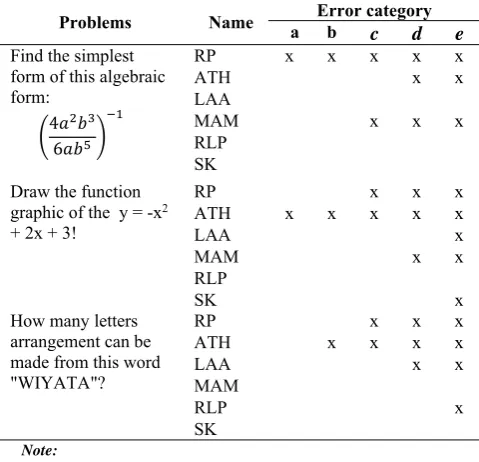
The data of this study consisted of quantitative and qualitative data. The quantitative data that used in this study is student test results score. The results of the average value 2016C exam class students is 71.4. Based on the test results can be traced to what extent the student conceptual understanding of the material foundation of mathematics. Qualitative data used in this study are the result of error tests analysis and interviews with students. From the error analysis, it can be examined the students error source and factors that causing them. So it can be addressed and sought to solve it so that the same error will not be repeated again. In this study there were 6 students working results in 3 problems that analysed. Each of them represent every level of the students ability, they are : low (RP and ATH), medium (LAA and MAM), and high ability (RLP and SK).
TABLE2
“2017 – ADRI -International Multidisciplinary Conference and Call for Papers”
Note: a = decoding b = comprehension c = transformation d = process e = encoding 1 = there is an error 0 = no errors
Based on the analysis of the chosen students errors in test sheets, it can described asfollowing:
1. Decoding Error
Based on NEA’s error analysis on second problem, ATH make a decoding errorbecause he don’t understand what is known in problem.
Fig.4Examples of ATH’s error on Decoding Stage
2. Comprehension Error
Fig. 5Examples of ATH error in Comprehension Stage
On third question, ATH also make an comprehension error. It because ATH don’t understand what is asked in the problem.
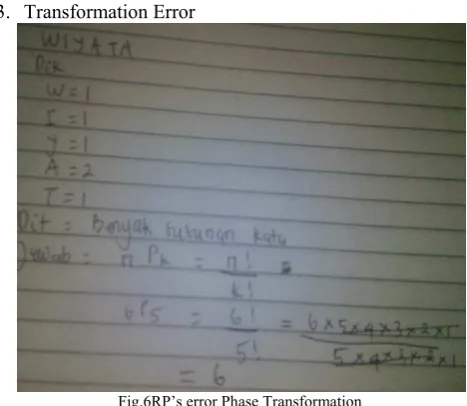
3. Transformation Error
Fig.6RP’s error Phase Transformation
Based on NEA’s analysis on RP’s work at third problem, the transformation error shows because he didn’t know the appropriate formula and algorithms to solve the problem. He wrongly wrote !! as the formula to solve the problem, but the right answershould have ! !.
4. Process Skill Error
Fig. 7LAA’s error in Process Skill stage
Based on NEA procedure, LAA make process skill error on third problem.It because LAA are not careful when outlining 6!.He wrote 6! = 6 x 4 x 3 x 2 but the right way is 6! = 6 x 5 x 4 x 3 x 2 x1. It make his final answer is also wrong.
5. Encoding Error
“2017 – ADRI -International Multidisciplinary Conference and Call for Papers”
Fig.8SK’s errorin Encoding stage
The interviews were conducted after the test ends and the subject work done with the checking step. The results of interviews showed that students who make decoding and comprehension errorbecause they confuse with what to write as the known and ask in the answer sheet. They forget with what they just learn in classroom. Based on the interviews results with the subjects who make transformation error, the subjects got an error because they forgot the appropriate formula to use. They only learn by rote learning and rarely have meaningful learning whichmake them didn’t understand the concept given. Based on the interviews results with the subjects who make process skill error, they got an error because they didn’t work carefully and lazy to correct the answer. The results of interviews with students who perform encoding errors shows that, they got an error because they don’t have enough time to correct the final answer and as the result they failed to give the final answer.
IV. CONCLUSIONS
From the Newman’s error analysis result, it showsthat : a) 11% of college student shows decoding error, b) 17% of college student shows comprehension error, c) 33% of college student shows transformation error, d) 50% of college student shows process skill error, and e ) 67% of college student shows encoding error. Based on the tests and interviews results, can be concluded that the cause of the college students errors in solving basic mathematics problems are: a) the they still didn’t understand the concept in that taught at mathematical base course, especially students with low ability, b) they didn’t know the appropriate formula and algorithms to apply in solving
problems, c) they won’t recheck or looking back their own work, and d) they fails to give final answers, make it a lot of them shows process skill and encoding error.
REFERENCES
Abdurrahman, Mulyono.Pendidikan Bagi Anak Berkesulitan Belajar.
Jakarta: PT Rineka Cipta. 2012.
Chinama, Emmanuel, Namburo, Vengai, Sithole, Mathias. Analysis of Students’ Errors on Linear Programming at Secondary School Level: Implications for Instruction. Zimbabwe Journal of Education Research. Vol 26 Num 1. 2014
Clement, M.N. Analyzing Childrens Error on Mathematical Taks. Education Studies in Mathematics. 11. 1-21. 1980
Jha, Shio Kumar. Mathematics Performance of Primary School Students in Assam(India): An Analysis Using Newman Procedure. International Journal of Computer Applications in
Engineering Sciences ol 2, Issue 1. 2012
Junaedi, Iwan, Suyitno, Amin, Sugiharti, Endang, Eng, Chin Kin.
Disclosure Causes of Students Error in Resolving Discrete Mathematics Problems Based on NEA as A Means of Enhancing Creativity. International Journal of Education. Vol 7 No 4. 2015
L.J. Moleong. MetodologiPenelitianKualitatif. Bandung: Remaja
Rosda-karya. Newman, M.A. 1983. Stra-tegies for Diagnosis and Remedia-tion.Sydney: Harcourt, Brace Jovanovich. 2009.
Miles, M. B danHuberman, A. M.Analsisis data Kualitatif: Buku SumberTantangMetode-MetodeBaru. Jakarta: UI Press. 2007.
Mustafa, A. Research methodology.New Delhi: A.I..B.S. Publishers.
2010.
Newman, M.A. Strategies for Diagnosis and Remediation.Sydney:
Harcourt, Brace Jovanovich. 1983.
Prakitipong, Nakamura. Analysis of Mathematics Performance of Grade Five Students in Thailand Using Newman Procedure. Journal of International Cooperation in Education, Vol 9, No 1. 2006
Singh, Parmjit, Rahman, Arba Abdul, & Hoon, Teoh Sian. The Newman Procedure for Analyzing Primary Four Pupils Errors on Written Mathematical Tasks:A MalaysianPerspective:
International Conference on Mathematics Education Research. 2010.
Soedjadi. R. Diagnosis Kesulitan Siswa Sekolah Dasar dalam Belajar Matematika. Team Basic Sciences LPTK Dikti. 1996
Suwanti, V. Comprehensive Mathematics Instruction (CMI) BerbantuanPuzzleAljabar untukMembangunPemahaman SistemPersamaan Linier DuaVariabelpadaSiswaKelas VIII
MTs Nurul Islam PunggingKabupatenMojokertoTahunAjaran 2012/2013.State University of Malang.Thesis. 2013.
White, A.L.Numeracy,Literacy and Newman’s Error Analysis.
Journal of Science and Mathematics Education in Shoutheast Asia. Vol 33 Num 2. 2010.
Yuhasriati. Pendekatan Realistik dalam Pembelajaran Matematika.