Teaching Multiplication and Division Realistically
in Indonesian Primary Schools:
A Prototype of Local Instructional Theory
Chairman: Prof. Dr. Jules Pieters ,University of Twente
Supervisors: Prof. Dr. Tjeerd Plomp ,University of Twente Prof. Dr. K.P.E. Gravemeijer ,University of Utrecht Dr. Ir. H.K. Slettenhaar ,University of Twente
Members: Prof. Dr. Jan de Lange ,University of Utrecht Prof. Jan van den Akker ,University of Twente Prof. Dr. Anne van Streun ,University of Groningen Prof. Dr. Thomas Romberg ,University of Wisconsin
Referee: Dr. Yansen Marpaung ,Universitas Sanata Dharma, Yogyakarta, Indonesia
CIP-GEGEVENS KONINKLIJKE BIBLIOTHEEK, DEN HAAG
Dian Armanto
Teaching Multiplication and Division Realistically in Indonesian Primary Schools: A Prototype of Local Instructional Theory
Thesis University of Twente, Enschede. - With refs. - With summary in Ducth ISBN 90 365 18 42 3
Lay-out: Sandra Schele
Press: PrintPartners Ipskamp - Enschede
© Copyright, 2002, Dian Armanto
T
EACHINGM
ULTIPLICATION ANDD
IVISIONR
EALISTICALLY INI
NDONESIANP
RIMARYS
CHOOLS:
A
P
ROTOTYPE OFL
OCALI
NSTRUCTIONALT
HEORYPROEFSCHRIFT
ter verkrijging van
de graad van doctor aan de Universiteit Twente, op gezag van de rector magnificus,
prof.dr. F.A. van Vught,
volgens besluit van het College voor Promoties in het openbaar te verdedigen
op woensdag 18 december 2002 om 10.15 uur
door
Dian Armanto
geboren op 11 oktober 1963
Assistant-promotor: Dr. ir. H.K. Slettenhaar
Referee: Dr. Yansen Marpaung
This dissertation is dedicated to: my wife (Erna Lindiawaty), my two sons (Haqim and Hilmy),
T
ABLE OFC
ONTENTSACKNOWLEDGEMENTS ix
1. ORIGINS OF THIS STUDY 1
1.1 Introduction 1
1.2 Rationale 2
1.2.1 An example of Indonesian mathematics education 3
1.2.2 The need of improvement 5
1.3 Theoretical roots 7
1.4 Aims of this study 8
1.5 Research design 10
1.6 Structure of chapters 14
2. MATHEMATICS EDUCATION IN INDONESIAN PRIMARY
SCHOOLS 15
2.1 Introduction 15
2.2 The 1994 mathematics curriculum 15
2.3 The teachers and teacher education 17
2.4 The goals of learning mathematics in Indonesia 19
2.5 The weaknesses in teaching and learning multiplication and division 20
2.6 Direction of improvement in the future 24
3. REALISTIC MATHEMATICS EDUCATION (RME) 25
3.1 Introduction 25
3.2 The teaching and learning mathematics 25
3.3 Realistic Mathematics Education (RME) 29
3.3.1 The principles of RME 30
3.3.2 The RME tenets of teaching 34
3.4 Teaching multiplication and division realistically: A conjectured
4. RESEARCH DESIGN 41
4.1 Introduction 41
4.2 Developmental research 42
4.2.1 Developmental research in curriculum 43
4.2.2 Developmental research in mathematics didactic 44
4.2.3 Developmental research in this study 46
a. Aim and insights 46
b. Characteristics of the RME prototype 46
c. Procedural activities 48
4.3 Prototyping phase 51
4.3.1 The first stage of prototyping phase 51
4.3.2 The second stage of prototyping phase 52
4.3.3 The third stage of prototyping phase 54
4.4 Assessment phase 56
4.5 The overview of the instruments and the data analysis 60
4.5.1 The instruments 61
4.5.2 Data analysis 65
4.6 Concluding summary 70
5. FIRST STAGE OF THE PROTOTYPING PHASE: STRUCTURING AN
RME DESK VERSION 71
5.1 Research design 71
5.2 Results 72
5.2.1 The content validity of the RME prototype 72
5.2.2 The construct validity of the RME prototype 76
5.2.3 Concluding summary 78
5.3 Designing the RME prototypical material 79
6. SECOND STAGE OF THE PROTOTYPING PHASE: ASSEMBLING
AN RME EARLY VERSION 87
6.1 Research design 87
6.2 Results 90
6.2.1 Teachers' general impression 90
6.2.2 Teachers' opinion toward the learning process 91
iii
6.2.4 Teachers' opinion toward the RME prototypical materials 93
6.3 Conclusion: Practicality of the RME prototype 94
7. THIRD STAGE OF THE PROTOTYPING PHASE: IMPROVING AN
RME TRY-OUT VERSION 97
7.1 Research design 97
7.2 Results 100
7.2.1 Implementability of the RME prototype 100
a. Introducing contextual problems 101
b. Interactive teaching approach 102
c. Socio-mathematical norms 105
d. Concluding summary 107
7.2.2 Initial effectiveness of the RME prototype 108
a. Pupils' learning progress 108
b. Pupils' level of understanding 110
c. Pupils' achievement 111
d. Concluding summary 113
7.3 Conclusion: improvements in the RME try-out version 113
8. ASSESSMENT PHASE: TOWARD THE ULTIMATE RME
PROTOTYPE 117
8.1 Research design 117
8.2 Results 120
8.2.1 Implementability of the RME prototype 120
a. Introducing contextual problems 120
b. Conducting interactive teaching approach 122
c. Establishing socio-mathematical norms 125
d. Concluding summary 130
8.2.2 The effectiveness of the RME prototype 132
a. Pupils' learning progress 132
b. Pupils' level of understanding 134
c. Pupils' learning achievement 136
d. Concluding summary 140
9. CONJECTURED LOCAL INSTRUCTIONAL THEORY FOR
TEACHING MULTIPLICATION AND DIVISION OF MULTI-DIGIT
NUMBERS IN INDONESIA 143
9.1 Introduction 143
9.2 Restructuring contextual problems 144
9.3 Pupils' initial strategies in the pretest 148
9.4 Pupil's learning trajectory 157
9.4.1 Learning multiplication of multi-digit numbers 158
9.4.2 Learning division of multi-digit numbers 173
9.5 Conclusions toward a real-life classroom 185
10. CONCLUSIONS AND RECOMMENDATIONS 191
10.1 Summary 191
10.2 Main findings 195
10.2.1 The characteristics of local instructional theory 195
10.2.2 The characteristics of the RME prototype 201
a. Validity 202
b. Practicality 203
c. Implementability 203
d. Effectiveness 204
10.3 Reflections 205
10.3.1 Reflections on pupils' performances 205
10.3.2 Reflections on teachers' performances 207
10.3.3 Reflections on developmental research design 209
10.4 Recommendations 211
10.4.1 Recommendations regarding policy makers 212
10.4.2 Recommendations relating teacher education and in-service
training 213
10.4.3 Recommendations for further research 214
10.5 Epilogue: A reform in Indonesian mathematics education 215
REFERENCES 217
v
INDONESIAN SUMMARY 237
DUTCH SUMMARY 245
APPENDICES
A. Teacher guide an pupil book 253
(The Teacher Guide consists of Pupil Book and Instruments such as Questionnaires, Logbook, Checklist, Quizzes, and Tests)
B. Examples from pupils'reinvented strategies 291
1. Daily quiz 2. Weekly quiz 3. Post-test
C. Analysis of the instruments and pupils'performances (using SPSS) 299 1. Reliability of the quizzes and the tests
2. Analysis of pupils' performances
LIST OF TABLES
2.1 Numbers of teachers in Indonesian schools 17
2.2 Numbers of unqualified teachers in Indonesian schools 18
2.3 Percentage of the highest degree earned by the Indonesian teachers 19 4.1 The links of quality aspects and curriculum representations 48
4.2 The phases and its emphasis in this study 51
4.3 Participants in the second stage of prototyping phase 54
4.4 The subjects of the third stage of prototyping phase 56
4.5 The subjects of the assessment phase 58
4.6 The overview of the data collection method in each phase 61
4.7 The teachers' level of conducting the RME learning activities 67
4.8 The degree of progress toward a valid solution 68
4.9 Level of pupils' achievement 69
4.10 Level of pupils' achievement in contextual and conventional problems 69
5.1 The content, the aims, and the hours to teach the content 80
5.2 The contents, objectives, and hours in RME approach 81
5.3 The learning route of teaching multiplication 82
6.1 Teachers' backgrounds 88
6.2 Pupils involved in the teaching experiments 89
6.3 Teachers' general impression of the lesson 90
6.4 Teachers' opinion toward the learning process 91
6.5 Pupils' engagement in the learning process 92
6.6 Teachers' opinion toward the teacher guide 93
6.7 Teachers' opinion toward the pupil book 94
7.1 Teachers' backgrounds 98
7.2 Pupils involved in the third stage 99
7.3 Overview of instruments used in the third stage of prototyping phase 100
7.4 Pupils' correct answers in the quizzes 108
7.5 Pupils' level of understanding in daily quiz for n = 94 110
7.6 Pupils' average score in the pre-test and the post-test 112
7.7 Pupils' level of achievement for n = 94 112
7.8 Pupils' shifting achievement from pre-test to post-test 113
8.1 Overview of instruments used in the assessment phase 119
8.2 Introduction activities in learning multiplication 121
8.3 Introduction activities in learning division 122
8.4 Instruction activities in learning multiplication 124
8.5 Instruction activities in learning division 125
8.6 Regulation activities in learning multiplication 129
8.7 Regulation activities in learning division 130
8.8 General impression in learning multiplication 131
8.9 General impression in learning division 132
8.10 The pupils' correct answers for the daily and weekly quiz 133
8.11 The progress toward the level of understanding 135
8.12 The progress toward the level of understanding (a summary) 136
8.13 Pupils' level of achievement for n = 291 137
8.14 Pupils' shifting achievement from pre-test to post-test 137
8.15 Pupils' mean score in the pre-test and post-test 138
9.1 Distribution of multiplication and division problems 145
9.2 Pupils' correct answers in each item of the pre-test 149
10.1 The objectives of teaching multiplication and division 196
10.2 The learning sequences for teaching multiplication 197
vii
LIST OF FIGURES
1.1 The pupils' valid procedure 4
1.2 The cyclic process of developmental research 11
2.1 The algorithmic model of teaching multiplication and division 21
2.2 Incorrect multiplication and repeated addition 22
2.3 The corrupt multiplication procedures 22
2.4 Incorrect addition and multiplication 23
2.5 The corrupt division procedure 23
3.1 The wheel of learning process 26
3.2 The conceptual mathematization process 29
3.3 The reinvention model 31
3.4 The emerged model of RME 33
3.5 The local RME model of teaching multiplication and division 36 3.6 Various strategies of repeated addition and standard multiplication
algorithm 38
3.7 Various strategies of repeated subtraction and standard division
algorithm 40
4.1 The cumulative cyclic process 45
4.2 The cyclic process of this study 49
7.1 Pupils' mistakes in adding solution and multiplying numbers in
daily quiz 109
7.2 Errors in adding numbers and forget to include the last subtraction 110
7.3 The pupils' incorrect in multiplication 111
8.1 Pupils valid multiplication solutions on the third day 127
8.2 The unstructured and structured division algorithm 128
8.3 The pupils' learning progress in the daily quiz 134
8.4 Multiplication and subtraction error 134
8.5 The addition errors and failed in including the last number 135
8.6 Pupils' mean score in each type of problems 139
8.7 Pupils' mean score difference in each type of problems 140
9.1 Pupils' repeated addition strategies 150
9.2 Pupils' addition strategies and standard algorithm 150
9.3 Pupils' incorrect repeated addition strategies 151
9.4 Incorrect operation, corrupt procedure, and error multiplication 151
9.6 Pupils' incorrect addition and multiplication 152
9.7 Pupils' correct strategies 153
9.8 Incorrect subtraction, error number, incorrect operations 154
9.9 Pupils' correct solutions 154
9.10 Incorrect multiplication and early impasse solutions 155
9.11 Pupils' correct strategies in solving conventional problems 155
9.12 Pupils' incorrect multiplication and addition 156
9.13 Pupils' correct solution and incorrect multiplication and procedure 156
9.14 Pupils' problem solving strategies 159
9.15 Pupils' repeated addition strategies in the first day 161
9.16 Pupils' addition errors in daily quiz 162
9.17 Pupils' multiplication by 10 in the second day 164
9.18 Pupils' error in multiplication and addition numbers in the second
day 165
9.19 Pupils' problem solving procedures in the third day 167
9.20 Pupils' multiplication by multiples of ten in the third day 168
9.21 Pupils' error in doing multiplication in the third day 168
9.22 Pupils' standard multiplication strategies in the fourth day 171
9.23 Pupils' multiplication errors in the weekly quiz 172
9.24 The pupils' unstructured and structured strategy 174
9.25 Pupils' unstructured and limited structured strategy 175
9.26 The pupils' weaknesses in the first day 175
9.27 The pupils' limited structured and its mistakes 177
9.28 The pupils' subtraction errors in the second day 178
9.29 Pupils' problem solving strategies in the third day 181
9.30 Pupils' strategies and its mistakes 182
9.31 Pupils' standard algorithm and multiplicational errors in the fourth
day 183 9.32 Pupils standard algorithm and multiplicational errors in weekly quiz 185
10.1 Various strategies of multiplication 198
A
CKNOWLEDGEMENTSIf I have seen further, it is by standing on the shoulder of giants (Isaac Newton)
It was very grateful to have such enormous contributions from many 'giants' for the realization of this dissertation. If there is a 'word' that is more honored than 'thank you very much', I will choose it to express my respects. Hartelijke bedank.
Prof. Dr. Tjeerd Plomp, my supervisor, 'the old wise guy' and my best critical friend. The first time I met him in Bandung in 1998, I predicted he is a good teacher and a helpful supervisor. I realize it whenever I become a student in this Faculty of Educational Science and Technology, University of Twente. He helped me a lot in reconstructing my thinking of being a researcher and a writer as well. He kept saying: "Story line and reasons". When he said: "It is coming", I knew he encouraged and motivated me. He outsmarted me in writing. We fought most of the times when discussing a subject. "I let you use your own reasons, but I don't like you to embarrass yourself. I am your critical friend, I should read as a good reader." Maybe, it was because I complained so much. Four years of being supervised by him made me understand of how to be a writer, a researcher, and for most, how to be an excellent supervisor. He always saw further than me.
Prof. Dr. Koeno Gravemeijer, my 'foreign' supervisor. He is an instantly smart supervisor. He helped me creating the cyclic developmental research process of my study only in ten minutes meanwhile I did not get it right in 2 months. It was a regretful to meet him only two days a month. However, he could make it worth and useful. The discussions with him made my knowledge plentiful and vivid, and my dissertation looks 'scientific'. He is my gigantic RME guru for nowadays, heretofore, and tomorrow.
decreased many confusing problems I faced. He taught me the 'easiest way' to deal with teaching conditions, being a researcher, and writing dissertation.
Dr. Yansen Marpaung, my Indonesian supervisor. In many respects I am honored to have him as Indonesian referent. Questioning the critical aspects of my research question made me elaborate its meaning deeper and understandable as it is now in my disertation.
Prof. Dr. R.K. Sembiring and the PGSM Project officers. Believing me to be one of the PhD candidates kept my motivation high and strong to struggle with the huge and frustrated working loads.
Prof. Dr. J.J.H. van den Akker, Dr. Annette Thijs, and Dr. Susan McKenney, Dr. Wilmad Kuiper, Dr. Nienke Nieveen, and Dr. Klaas Bos. It is an honored to have your assistance during my PhD study in the curriculum department, the faculty of TO (Toegepaste Onderwijskunde).
Jan Nellissen, Dionisa Loman, Lidwien. I had unforgettable memories with you all. Your kindness in helping me in all matters disremembered me that I was in Enschede, the Netherlands.
Sandra Schele, Petra Zuithof, and Paula Krupers. Three precious and compassionate secretaries helped me establishing some works of arts in my dissertation.
The young doctors: Zulkardi, Sutarto Hadi, Ahmad Fauzan. We fly away, guys. Thanks for being good friends of mine. Working together day and night will become such beautiful memories for me.
Mohammad Saleh and Salah Althuwaini. My Kuwaitian friends. Helping me moving out from Macandra, playing football together, sharing opinions, and discussing SPSS were some activities that I will never forget. What modest friends.
Tante Hadi, Om Stan, Mbak Yati-Om Proost.. Talking and discussing every aspects of life with you all made my way of thinking richer and colorful.
My PPIE'ers friends: Jamari, Reza, Rihard, Arlan, Anto, Sena, Didit, Hadi, Irwan, Aan, Denny, Peter, Jerry, Ibu Nurdiati, Pak Salman, Pak Misbah, and others. Proud to have such unforgettable friends. Keep up fighting for goodness, my dear friends. God blesses you all.
xi
Dra. Masitowarni Siregar, M.Ed. Thanks for your suggestions and comments for improving the English of this dissertation.
C
HAPTER1
O
RIGINS OF THIS STUDYThe challenging parts of implementing a new mathematics teaching approach in Indonesia are to construct a new formal curriculum, to influence teacher's beliefs about what is good mathematics teaching, and to change the pupils' habits and attitude toward learning. The struggle to meet these challenges is an important thread in this study. This chapter describes the rationale of those intriguing aspects in the Indonesian contexts as well as the aims of this study. It means that this book explores the drawbacks of the old mode of teaching mathematics (teaching by telling) and the inherent usefulness of a new teaching approach (teaching mathematics realistically) for the sake of teachers, pupils, and the community in the future. This book also explains the cyclic process of front-end analysis, expert reviews, teaching experiments, and reflections to the local instructional sequences process for developing, implementing, and evaluating the RME prototypical exemplary materials. The organization of the chapters is presented as well.
1.1 INTRODUCTION
This study is about developing, implementing, and evaluating prototypical instructional materials for teaching multiplication and division of multi-digit numbers in Indonesian primary schools. It is believed that this is an alternative strategy to improve the Indonesian mathematics education in primary schools; that is in a deep annoyance nowadays (see Haji, 1994; Jailani, 1990; and TIMSS Report, 1997). Particular sets of the instructional materials provide teachers opportunities to practice their teaching approach, to enlighten their knowledge, and to improve their competencies (Feiter & Van den Akker, 1995; Louck-Horsley, et al., 1996). The instructional materials are developed based on the RME approach.
ought not to be associated a well-organized deductive system, but to an activity of doing mathematics: an activity the greater part of which consists of organizing or mathematizing subject matter. The subject matter can be taken from reality and must be organized in relation with to mathematical patterns when solving problems from reality.
Freudenthal also argues that mathematics should never be presented to pupils as a ready-made product and that pupils should reinvent mathematics. This mean that pupils should not learn mathematics starting within the formal system of mathematics, but those concepts appearing in reality should be the source of concept formation (extracting the appropriate concept from a concrete situation). This theory has been developed in the Netherlands over the last thirty years (De Lange, 1994; Gravemeijer, 1997; Treffers, 1987; and Treffers & Goffree, 1985;). It dominates the Dutch teaching practice nowadays (Treffers, 1991), and has influenced the work of mathematics educators in many parts of the world (Becker & Selter, 1996; Cobb, Wood & Yackel, 1991; Romberg, 1994; Selter, 1995; and Wittman, 1991).
This study builds upon the RME theory in which a cyclic process of front-end analysis, expert reviews, teaching experiments, and reflections to the local instructional sequences has been conducted in developing, evaluating and implementing the RME prototypical materials for teaching multiplication and division of multi-digit numbers in Indonesian primary schools. This cyclic process (called 'developmental research') steers the development of each version of the RME prototype. This process will be elaborated in more detail throughout the eight chapters of this book. It includes the rationale of this study, the research design, and its results as well. The next section presents the rationale of this study.
1.2 RATIONALE
Origins of this study 3
interaction in the process. Each actor plays their role depends on the activities (traditional - teachers' centered or RME - pupils' centered) arranged by the teachers (Simons & Zuylen, 1995). In RME learning arrangement, the pupils should take more responsibility for their learning and actively engage in the learning process. Guided by the teacher, the pupils learn, discuss, and formulate the informal and formal mathematics forms in order to understand mathematics concepts and procedures. In contrast, in a 'traditional' learning process, the teacher takes control to each activity. The teacher extensively directs, explains, and gives questions in the context of whole-group instruction followed by pupils working on paper-and-pencil assignments.
The traditional learning process described above has been practiced in the Indonesian classrooms for years (elaborated in section 1.2.1). It is an integral part of the Indonesian mathematics education, which is trying to find an effective teaching method that conforms with the Indonesian condition and culture. Started in the 1975 curriculum in which the modern mathematics became the dominant materials to be learned by the pupils. Then the 1984 curriculum revision took place emphasizing on the set theory in teaching mathematics. Next and nowadays, the 1994 curriculum focuses on understanding arithmetic. The Pupils' Active Learning (Cara Belajar Siswa Aktif - CBSA) was introduced and emphasized in the instruction process. This method has been demanded to meet the teaching objectives, but in practice it was practically displeased because of the shortage of teaching aids and the lack of teachers' pedagogical competence (Suyono, 1996).
Considering the circumstances above, the problems of finding a proper mathematics teaching method that suits the Indonesian culture still remains. There are several questions emerging in relation to this study, such as; does the Indonesian mathematics education really need improvement? Is there any promising teaching approach that suits the Indonesian condition and culture? Why and how is this approach significant in improving the mathematics learning achievement of the pupils? The next section describes how those questions originated.
1.2.1 An example of Indonesian mathematics education
critical, honest, disciplined, efficient, and effective (Depdikbud, 1993). These goals drive the teachers to apply the mechanistic approach, practicing symbols and emphasizing on application of algorithm (Treffers, 1987). For instance, the short algorithm procedure is taught in learning multiplication and division (elaborated in section 2.5).
The teaching of multiplication and division using this model does not suit the goals of teaching mathematics mentioned above. This model focuses on memorizing abilities rather than on the pupils' understanding. Whenever the pupils apply this procedure and have difficulties (for instance, they forgot steps) they do not have anything to fall back on. Then they develop a corrupt procedure (see figure 2.3 and 2.5 in section 2.5).
From observation conducted in schools it was concluded that there are misconceptions of the pupils in doing the procedures after learning the standard algorithm (short model) in the classroom (Armanto, 2000). Some teachers argue that by teaching the pupils in this mechanistic approach, the pupils can understand and apply algorithms easily to solve other problems. This argument is hardly true because in answering a multiplication contextual problem given by the researcher, only one third (1/3) of pupils can solve the problem correctly. Meanwhile another two-third (2/3) of pupils has difficulties to the idea of multiplication algorithm. The following conversation gives an indication of this misconception.
The interviews:
Observer: Did you find the answer?
Pupil: Yes, sir. This is my calculation.
Observer: Why did you calculate like this?
Pupil: Because the teacher taught me to do that.
Observer: Why did you multiply 7 x 5 in the first place and not 3 x 5? (The observer points the numbers of the
multipliers).
Pupil: Because 7 is the last number of 37 and the teacher showed me to multiply it first.
Observer: The multiplication of 3 x 5 = 15. Why did you put 5 (from 735) under the second 1 of 1715?
Pupil: I don't know. The teacher did that. I think I should follow her. And it works. I got the right solution. Figure 1.1
Origins of this study 5
From the conversation above it can be seen that the pupil did not understand the meaning of the multiplication algorithm. They memorized the teachers' way of applying the algorithm. The problems occurred whenever they applied the algorithm to answer another problem. Not only did they have no concepts to fall back on but also they did not realize the connection between the numbers and the algorithm they applied when they solve a contextual problem (see some Figure 2.2 - 2.5 in section 2.5).
In learning division a similar misconception also occurred (Armanto, 2000). The following story describes what happened in the classroom. The researcher introduced a contextual problem to the pupils as follow and ask them to find the solution:
36 performances of Wayang Kulit (Shadow Puppets) were conducted in a RRI Auditorium. The tickets sold are 7416 tickets. How many tickets are sold for each performance in average?
The researcher found several mistakes made by the pupils. They used a mechanistic way of solving problem, the way they were taught by the teacher. The researcher asked several pupils to write their solutions on the blackboard. After five pupils wrote their solution, the researcher asked the class how many pupils got the same solution as each solution on the blackboard. The answers were surprising. Only two pupils got the right answer (206). Most pupils got 26 as the solution. Several pupils got 1106, 215 and 116.
Those two examples describe the pupils' weaknesses after learning multiplication and division in a mechanistic way. Other weaknesses of Indonesian mathematics education and its reasons will be illustrated in the next section, including a discussion of the need of improvement.
1.2.2 The need of improvement
learn and to understand and the pupils become afraid of mathematics. The results of National Examinations (EBTANAS) showed that mathematics was continuously the lowest score the pupils obtained compared to other subjects (Depdikbud, 1997). The TIMSS results (1999) showed that the Indonesian pupils score were in the 33rd
level from 37 countries involved in the TIMSS evaluation.
There are many reasons for this low achievement in learning mathematics, one of which is the low quality of teachers' competence of mathematics (BPPN, 1996). According to the educational statistics 1995/1996, 89% (1,049,468) of primary school teachers were not qualified as teachers because they had no minimum prerequisite to be teachers in primary schools (Depdikbud, 1997). It was found out that the primary school teachers have mastered only 57% of the concepts, facts and procedures of mathematics (Depdikbud, 1997).
Another weakness of teachers is due to teachers' competence in the pedagogical aspects. Suyono (1996) found that teachers: (1) have low ability in using variety of teaching methods, (2) teach the basic skills only for answering the tests (teaching for tests), and (3) teach using conventional methods without considering the logical thinking, critical and creativity aspects of the subject matter. The 3rd aspect is related
to the teachers' knowledge of students' learning cognition.
These facts show that the teachers conventionally teach mathematics with practicing mathematics symbols and emphasizing on giving information and application of mathematics algorithms (mechanistic algorithmic mathematics education, Treffers, 1987). The teachers taught ready-made mathematics rather than doing mathematics (Freudenthal, 1973). De Feiter and Van Den Akker (1995) state that this conventional method as over-dependence on lecture method ('chalk and talk'), passive nature of learners, only correct answers accepted and acted upon, lack of learner questioning, and whole-class activities of note-taking.
Origins of this study 7
1.3 THEORETICAL ROOTS
In learning mathematics in the mechanistic approach, many pupils will leave the classroom with a collection of well-practiced procedures and formulas but with only a hazy grasp of their meaning (see section 2.5). In another words, the pupils necessitate a better teaching model that gives opportunities to learn and understand mathematics they are learning. From research and other experiences in a variety of countries, it is known that a contingent approach of teaching can provide the desired result (Kilpatrick & Silver, 2000). This model suggests that the teacher orchestrates the discourse and sets up a situation and then responds to what the pupils are saying by building on their observations, seeking clarification, and challenging them to explain and justify. The goal is to help pupils to develop their own and one another's understanding. The contingent model is a core part of the RME approach.
Based on projects and studies in a number of countries (the Netherlands, Australia, the United Kingdom, Germany, Denmark, Japan, Malaysia, South Africa, and USA, see De Lange, 1996) it is known that the RME theory is a promising direction to improve and enhance pupils' understanding in mathematics. It is believed (see section 3.5) that the RME approach would be an effective approach to encounter the pupils' low performance problems in mathematics education in Indonesia that are caused by a number of factors, such as insufficiency of the teachers' mathematics knowledge and pedagogical approach, and the cultural aspects of the teaching and learning activity in the classroom (see further in Chapter 2).
acquire as their own, private knowledge; an understanding of which they themselves are responsible for. This theory will be elaborated in section 3.3.
The RME approach suggests facilitating the pupils' learning process by exploring the contextual problems in which the mathematics is embedded. Opportunity to do mathematics using their own understanding helps the pupils restructuring their own knowledge. Guidance from teacher supports the pupils reinventing informal and formal mathematics forms (concepts and procedures). These are the essential anchors of developing the pupils' learning attitude. Implementing this approach in Indonesia would be a promising direction toward the improvement of teachers' competence and students' understanding of mathematics.
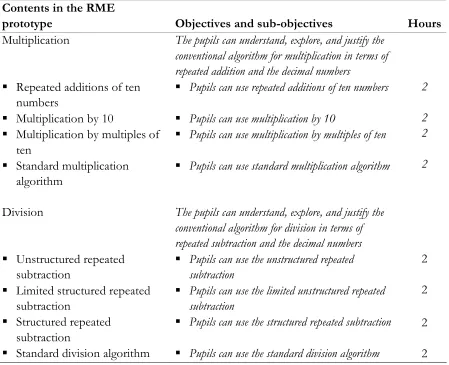
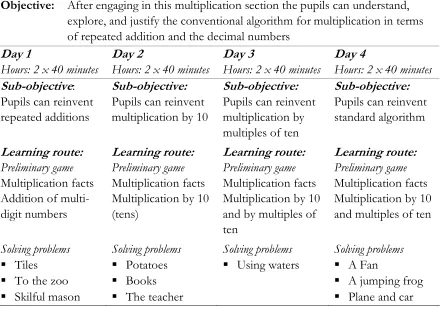
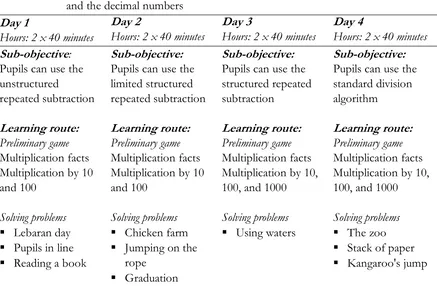
In this study learning multiplication and division in Grade 4 of Indonesian primary schools begins with introducing a contextual problem to encourage the pupils to use their understanding of repeated addition and repeated subtraction. This is the beginning of the learning trajectory towards the multiplication and division algorithm. In order to facilitate this RME teaching approach (elaborated in section 3.4) the study develops exemplary materials by considering the RME theory (from now on the RME materials are called 'RME prototype') and the Indonesian contexts. These materials guide the teacher as well as the researcher to apply the RME approach effectively in the classroom.
1.4 AIMS OF THIS STUDY
Origins of this study 9
teaching are complex in practice and it needs a specialized knowledge of the teachers in order to provide opportunity for pupils to explore their own and others' ideas individually and collectively.
These roles in the new vision drive teachers to be more professional in managing their classroom. It needs an alternative program, a sustainable reform agenda, to develop teachers' competence in the future. Loucks-Horsley, et al., (1996) suggests several possible alternatives of developing teachers to a new role of teaching mathematics. One of which is to conduct a new formal curriculum implementation. It is suggested to construct, learn, use, and refine a particular set of instructional materials in the classroom. Feiter and Van den Akker (1995) add that providing teachers with instructional materials and practicing a form of teaching approach are two alternatives that can be an effective alternative to improve the teachers' competencies. This study provides the RME exemplary materials with which the teachers can practice the RME teaching model under the guidance of the researcher. This study formulized characteristics of an RME prototype to teach multiplication and division of multi-digit numbers in Indonesian primary schools. The study was lead by the following research question:
What are the characteristics of the RME prototype for teaching multiplication and division of multi-digit numbers to Indonesian primary school pupils?
The characteristics of the RME prototype are seen in two different aspects: local instructional sequences and quality aspects of the prototype. In the matter of intervention of teaching and learning mathematics, the characteristics refer to the explicit formulation of local instructional activities that is made up of three components: (1) learning goals for pupils; (2) planned instructional materials; and (3) a conjectured learning sequence (Gravemeijer & Cobb, 2001). Meanwhile, the quality aspects are defined as the degree to which the RME prototype:
is in agreement with the state-of-the-art of the RME theory (validity); is usable and easy for the Indonesian teachers and pupils (practicality); can be used as intended by teachers and pupils (implementability);
improves the pupils' performance in learning multiplication and division of multi-digit numbers (effectiveness).
Validity of the RME prototype refers to the internal agreement of the prototype toward the RME theory. Two aspects of validity were analyzed in this study: content and construct validity. Content validity of the RME prototype refers to the presence of the state-of-the-art knowledge of the Indonesian mathematics education circumstances and the RME theory. Construct validity related to the consistent link of the components in the RME prototypical materials. Practicality of the RME prototype referred to the initial satisfaction of the target groups (pupils and teachers) toward the materials and the teaching model suggested in the RME. Implementability of the RME prototype refers the proper teaching organization established by the teacher in teaching multiplication and division in Indonesian setting. It is analyzed from three aspects: the use of contextual problems, the interactive teaching model, and the establishment of mathematical norms in the classroom. The proper implementability would be reached after the teachers had an intensive coaching and discussion with the researcher before the learning process begins. These three quality aspects lead the study to the first sub-research question:
To what extent is the RME prototype valid, practical, and implementable for teaching multiplication and division of multi-digit numbers in Indonesian primary schools?
The effectiveness of the RME prototype refers to the expected learning progress, understanding, and performance of the pupils in learning multiplication and division of multi-digit numbers. This lead to the second sub-research question:
To what extent is the RME prototype effective for teaching multiplication and division of multi-digit numbers in Indonesian primary schools?
Those sub-research questions steer the study to choose the fitting research method and to develop reliable appraisals to be involved in measuring and analyzing the variables (elaborated in section 4.2). The research questions also reflect on the materials' characteristics to obtain quality aspects and the development process of the prototypical materials.
1.5 RESEARCH DESIGN
Origins of this study 11
improvement of the prototypical product. In the field of curriculum, it is a formative research design (Van den Akker, 1999 and Van den Akker & Plomp, 1996) and a type 1 developmental research study (Richey & Nelson, 1996), in which the research activities were conducted, the products were analyzed during a cyclic developmental process, from exploratory phase through (formative and summative) evaluation phase. The design and activities will be elaborated in section 4.2.1.
In mathematics didactics, the developmental research aims at developing an instructional sequence for specific topic where the researcher constructs prototypical instructional activities in an iterative process of designing-testing and redesigning-retesting. It is a 'theory-guided bricolage' (Gravemeijer, 1994), of which its core is in the cyclic process of thought and teaching experiments (Freudenthal, 1991). Like a handyman, the researcher can make use of all the domain specific knowledge concerning mathematics education: classroom experience, textbooks, exemplary instructional activities, relevant research, and educational psychology. The activities begin with a preliminary design of the provisional instructional activities, followed by a cyclic teaching experiments, and end up with a retrospective analysis. The design and research activities of this process are elaborated in section 4.2.2.
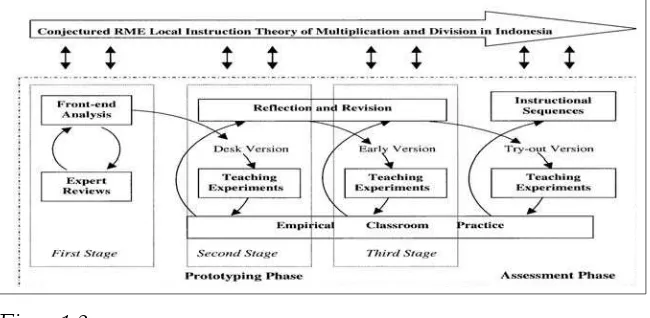
Based on those types of developmental research mentioned above, this study developed the RME prototypical materials in a cyclic process of front-end analysis, expert reviews, teaching experiments, and reflection to the local instructional sequences. These cyclic processes lead the study to build a conjectured local instructional theory of teaching multiplication and division of multi-digit numbers in Indonesian primary schools. The research design of this study is illustrated as follows.
Figure 1.2
During the front-end analysis the researcher analyzed the present condition of the Indonesian mathematics education and the prospective RME approach to improve the condition. Conducting the expert reviews two RME experts and an Indonesian mathematics education expert analyzed the prototypical materials being developed in several walkthrough sessions. Then, two cyclic processes of teaching experiments were carried out in which reflections and revisions of the instructional sequences took place consecutively. Next, the last teaching experiments were conducted to analyze the effect of the instructional sequences to pupils' performances. After all, this cyclic process of front-end analysis, expert reviews, teaching experiments, and reflections shaped the local instructional sequences toward a local instructional theory of teaching multiplication and division of multi-digit numbers for Indonesian primary schools. And in the other way the local instructional theory guided the cyclic process of the research activities. It is a reflexive relationship of the local instruction theory and the cyclic research activities in this study.
In line with the cyclic research activities mentioned above, this study was conducted in two consecutive phases. Firstly, prototyping phase focused on analyzing validity, practicality, and implementability of the RME prototype. To address those aspects, this phase was held in three stages. The first stage focused on validity of the RME prototype. It referred to the presence of the state-of-the-art knowledge of the Indonesian circumstances and the RME theory (content validity) and the consistent link of the components in the prototypical materials (construct validity). Held on a cyclic process of front-end analysis and expert reviews, the first stage created a desk version of the RME prototypical materials. The process involved two RME experts and an Indonesian mathematics education expert. This stage and its results are illustrated in chapter 5.
Origins of this study 13
aimed at having sense and insights of conducting the actual RME learning activities. Reflecting on these teaching experiments, revision of the instructional sequences was made. This reflection and revision activities involved the Indonesian and the RME experts. Analyzing the actual pupils' learning trajectory and teachers' impressions toward the RME teaching approach, the stage produced an early version of the RME prototype. This stage and its results will be elaborated in chapter 6.
The third stage of the prototyping phase focused primarily on the implementability of the RME prototype. Implementability referred to whether the teachers used the RME prototypical materials as intended. As an effect of the implementation, the initial effectiveness of the RME materials was also analyzed. It referred to whether the pupils improved on the intended level of understanding. The third stage began at August 2000 in Medan (SDN 101746 and 101748 Klumpang) and at October - November 2000 in Yogyakarta (SD Rejodadi and SD Sonosewu II). The stage developed and revealed a try-out version of the RME prototype. This stage will be elaborated in chapter 7.
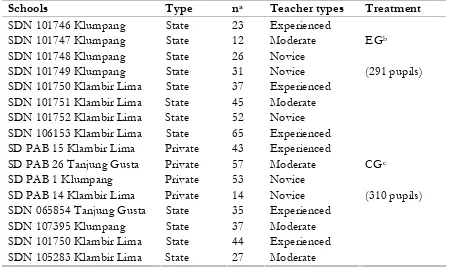
Secondly, assessment phase analyzed the implementability and the effectiveness of the RME prototype in teaching multiplication and division in Indonesian primary schools (elaborated in section 4.2.3). In this phase the non-equivalent pretest-posttest control group design was chosen (Krathwohl, 1998) because the schools were not formed by random assignment. Eight schools were chosen as the experimental group and another eight schools were chosen as the control groups. They were chosen purposively. The potential lack of comparability was taken into considerations in this phase (see section 4.4). The assessment phase was conducted in Medan on August – December 2001. The phase and its results are elaborated in chapter 8.
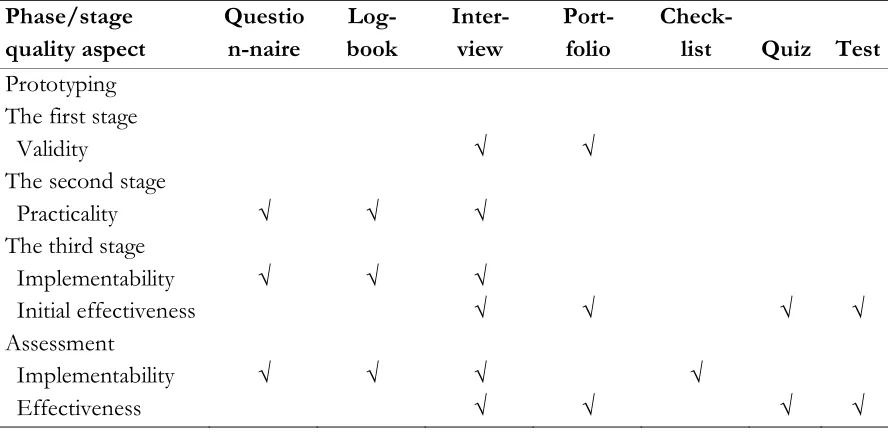
internal validity of the findings. It relates to the significance of various individuals participated in the study and variety methods of data collection selected and applied such as interviews, observations, logbooks, tests, and quizzes (the overview of instruments are elaborated in section 4.5).
1.6 STRUCTURE OF CHAPTERS
C
HAPTER2
M
ATHEMATICSE
DUCATION INI
NDONESIANP
RIMARYS
CHOOLSA concise picture of this study has been illustrated in the previous chapter, including the Indonesian mathematics education as the settings of research. This chapter explores the settings in more detail focusing on the teaching and learning of mathematics in Indonesian primary schools. The goals of learning mathematics in 1994 curriculum are to prepare the students to use and apply their mathematics understanding and thinking in solving problems in their life and in learning other different knowledge. These goals influence teachers to conduct the learning process mechanistically focusing on memorizing facts and procedures of mathematics. It effects on the pupils’ confusions and weaknesses. One of which is in learning multiplication and division of multi-digit numbers. This chapter illustrates variety of weaknesses found by considering its background (the curriculum, the goal of teaching, and the teacher education).
2.1 INTRODUCTION
The declaration of the Nine-year Basic Education in 1995 had an intense influence in the mathematics curriculum in Indonesia. It began by implementing the 1994 curriculum to all Indonesian schools from primary schools until senior high schools. It substitutes the learning time, the contents and the way of teaching them. This chapter describes the 1994 mathematics curriculum in primary schools (section 2.2), the teachers and teacher education (section 2.3), the goals of learning mathematics in Indonesia (section 2.4), the weaknesses in teaching and learning multiplication and division (section 2.5), and the direction of improvement in the future (section 2.6).
2.2 THE 1994 MATHEMATICS CURRICULUM
mathematics curriculum. The curriculum focused on teaching and learning arithmetic, where the pupils learned and studied basic arithmetic skills (addition, subtraction, multiplication and division). The teachers emphasized the operations using conventional teaching model, teaching how to do calculation, give an example and practice the calculation. The pupils imitate and do the calculation on their own. The teachers did not illustrate any means of the mathematics concepts for the benefit of students' understanding.
Secondly, the 1984 curriculum emphasized the use of set theory in teaching and learning mathematics in the classroom. The aim was to enhance the curiosity of the pupils to investigate mathematics concepts. This new direction was wanted by many mathematics educators because it expected to meet the goals. But it had been stirred up most criticism from the parents and society (Depdikbud, 1997). The curriculum itself was inspired by many movements all over the world such as the modern mathematics and the idea of teaching for understanding.
Designed by the ministry of Education and Indonesian mathematics education experts, the teachers were supported by a prescribed teaching guide, a prescription of what and how to teach for a certain week. For practical teaching process, the teachers obliged to create the lesson plan for each content. They constructed the instructional objectives, the methods and teaching aids used (in details), activities for pupils and teachers, and the test items to be applied in a definite time. In facilitating this activity, most teachers acquired a training session in their region (PKG or MGMP). Though they spent much time on writing the plan they hardly applied it in the classroom because it was only for the sake of administration. The daily practical lesson plan was actually “in the heads of the teachers” (Marsh & Willis, 1995).
Mathematics Education in Indonesian Primary Schools 17
not a priority anymore. Like in the 1975 curriculum, the pupils had to learn the arithmetic aspects. A new aspect was that the pupils’ understanding of mathematics became the key element to be taken into account in the teaching-learning process.
In implementing the 1994 curriculum, the teachers were not well prepared how to teach for understanding, how to do the learning process, how to work smoothly, how to turn for assistance, how to do consistently with the plan, and how to evaluate the effect on the pupils. They had minimum competencies and resources to make up a particular topic, were not able to spend the long period of time needed to prepare the instructional materials, and were not financially adequate to provide instructional aids. This low competence influenced teachers to teach the lower level of thinking by using paper-and-pencil strategy combine with the concepts-operations-example-drilling approach (Suyono, 1996). The teachers and its education are described in the following section.
2.3 THE TEACHERS AND TEACHER EDUCATION
According to the schooling statistics 1995/1996, there are more than one million primary school teachers in Indonesia (see Table 2.1. below). It is 0.5% of the 200 million Indonesian citizens. They have been spread all over Indonesia to be the self-content teachers; i.e. teaching all subject matters to the pupils in a classroom. In order to be the primary school teachers, they have to graduate from SPG (Sekolah Pendidikan Guru or School of teacher education), a senior high school where the pupils learn to be teachers in primary school.
Table 2.1
Numbers of teachers in Indonesian schools
School category Numbers of teachers Primary Schools (SD)
Junior High Schools (SLTP) Senior High Schools (SLTA)
1,179,177 413,910 331,946
Source: Indonesia Educational statistics in brief 1995/1996,Depdikbud, 1996.
the SPG was low and only the low ranking pupils applied for the SPG. Secondly, the lack of teaching aids influenced the teaching and learning process and the pupils’ preparation to be teachers was not effectively accomplished. These weaknesses produced poor quality teachers (see chapter 1.2.1 and table 2.2 below). Cipra (1992) also mentioned that since the pupils were not provided with enough mathematical learning experiences, they go to classroom to teach as they were taught.
It was in 1995 after the declaration of the nine years basic education that the policy in recruiting teachers in the Primary schools was changed. The teachers have graduate from a university (FKIP or Faculty of Education) or an institute of teacher training (IKIP - Since 1998, those 10 IKIPs have been changed to universities). A PGSD (Teacher Training for Primary School) program in a university prepares pupils to be primary school teachers. The Indonesian government subsidized this teacher training education program and there is a National examination entrance for this program. This program is delivered to all pupils who graduated from senior high school pupils.
There are two aims of this program. Firstly, the program is to increase the quality of the primary School teachers. According to the schooling statistics 1995/1996 (Depdikbud, 1996), 89% of the primary school teachers were not capable to teach subject matters (see Table 2.2. below). It is assumed that by giving the pupils more opportunity to study in the field of education in the university the prospective teachers could enhance their knowledge of subject matters and pedagogy.
Table 2.2
Numbers of unqualified teachers in Indonesian schools
School category Numbers of teachers Percentage Primary Schools (SD)
Junior High Schools (SLTP) Senior High Schools (SLTA)
1,049,468 235,929 86,306
89% 57% 26% Source: The schooling statistics 1995/1996, Depdikbud, 1996.
Mathematics Education in Indonesian Primary Schools 19
improving teachers’ qualification mentioned in Table 2.3 below. Most teachers (79.81%) graduated from the senior high school (SPG). It is very dispirited description of the Indonesian Primary school teachers when it is compared to the primary school teachers in United States where 52% of the teachers graduated from the university and 42% of the teachers graduated from Master Program (Digest of Education Statistics, 1997).
Table 2.3
Percentage of the highest degree earned by the Indonesian teachers
School category Percentage Graduate from Primary Schools (SD) 0,06%
6,33% 79,81% 3,47% 6,45% 3,87%
SD (Primary schools) SLTP (Junior high schools) SLTA (Senior high schools) PGLSP (Senior high Schools) BA (Diploma program, D2 or D3) Drs (University or institute)
Source: The schooling statistics 1995/1996, Depdikbud, 1996.
The teacher recruitment policy of Indonesian Education Ministry has been changed in order to restructure teacher education in Indonesia since the declaration of the nine years basic education in 1995. The declaration influenced the abolishment of the SPG as a school for teacher education. To be a teacher in primary schools one should graduate from a university. This policy is based on the teacher’s pre-requisites developed by Leinhardt (1988) and Carpenter & Fenneme (1992). They suggested that the teachers need a certain competence in doing mathematics themselves, a positive attitude towards mathematical activity, an understanding of the ways pupils think, and a specific didactical knowledge. Learning more about the mathematics contents and the pedagogical knowledge in a university would be an alternative to develop teachers' competencies in order to pursue the main goal of teaching mathematics. The goals are illustrated in the following section.
2.4 THE GOALS OF LEARNING MATHEMATICS IN INDONESIA
(Depdikbud, 1993). It means that the pupils should develop their counting ability, enhance their mathematics content knowledge, and structure their attitude to be critique, honest, disciplined, efficient, and effective.
In order to accomplish the goals of the 1994 curriculum, the conventional teaching and learning process (see section 1.3) needs to be changed to another approach where the teachers challenge the pupils with well-selected mathematical problems and a classroom culture that encourages and facilitates learning. Becker and Shelter (1996) believed that learning in this environment, pupils will improve their learning activities: learning actively, learning individually, learning cooperatively, and learning in strands and contexts.
In order to encourage the students to be self-active and responsible for their own learning, the learning process should take place in meaningful contexts, in which the inter-relatedness of mathematics and its connections with the real world exists. The teachers as facilitators accomplish the learning activities by selecting mathematical tasks to engage pupils’ interests and intellect, providing opportunities to deepen their understanding of the mathematics, orchestrating classroom discourse in ways that promote the investigation and growth of mathematical ideas (Romberg, 1998).
2.5 THE WEAKNESSES IN TEACHING AND LEARNING MULTIPLICATION AND DIVISION
To achieve the goals illustrated above, the learning process of mathematics was conducted by practicing the chalk and talk model or the concepts-operations-example-drilling approach (Suyono, 1996). The teachers explain the mathematics operation and procedures, give some examples, and ask the pupils to do the other similar problems. This model of teaching is called the mechanistic way of teaching (Treffers, 1987). The teachers teach mathematics with practicing mathematics symbols and emphasizing on giving information and application of mathematics algorithms.
Mathematics Education in Indonesian Primary Schools 21
1997), TIMSS (1997) proved this. It means that many pupils do not possess the knowledge, skills, beliefs, and motivation that are needed to efficiently solve mathematics problems and to effectively employ in their daily life.
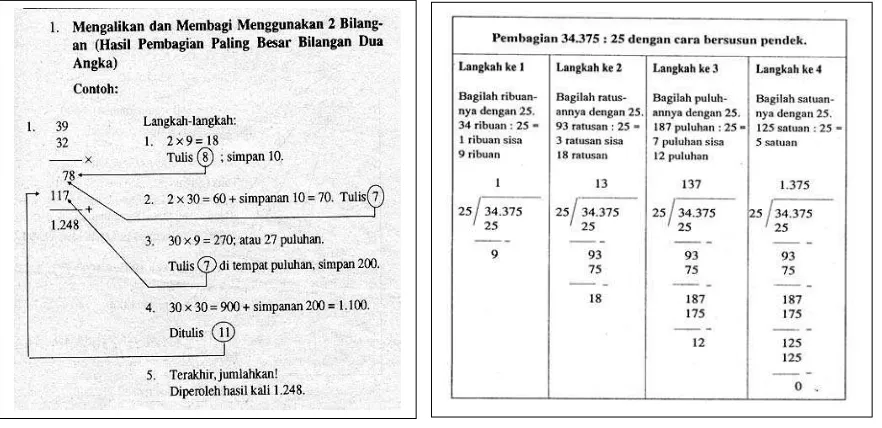
In learning multiplication and division of multi-digit numbers for instance, the teachers use teachers' guide from the books published by the ministry of National Education (i.e. "MARI BERHITUNG", Moesono & Sujono, 1994) or published by a private publisher such as Erlangga, Yudistira, Surabaya (i.e. "MATEMATIKA/ BERHITUNG", 1997). The books explain the algorithm way of teaching multiplication and division of multi-digit numbers as follows.
Figure 2.1
The algorithmic model of teaching multiplication and division
The mechanistic learning begins with teachers' explanation of each step of operations of multiplying and dividing multi-digit numbers and then the pupils imitate the step of operations as the teachers did. The starting point is in the formal level of the world of symbols where the instruction becomes the presentation and drill of rules and regulations or the algorithmic mathematics education (Treffers, 1991). It is a description of teaching the algorithm mechanistically by using place value, using mental algorithm, and using standard (column) algorithm. The pupils learn from the teachers’ explanation and imitate the strategy to solve another problem.
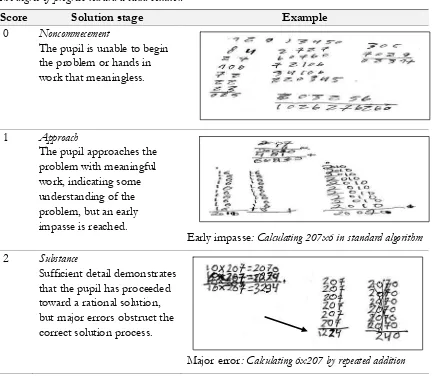
mixed procedure, incorrect place value, and guessing multiplication (Armanto, 2000). This observation was conducted in a classroom with 42 pupils in Yogyakarta during the first stage of the prototyping phase. The analysis showed that most pupils (60% out of 42 pupils) had a lack of memorizing multiplication facts. Some pupils applied the repeated addition, while others utilized their hands in adding numbers. Figure 2.2 followed illustrates the mistakes.
Figure 2.2
Incorrect multiplication and repeated addition (pointed by the author)
Both incorrect examples showed that the pupils incorrectly doing the multiplication of 7 x 8 by adding 8 seven times (the right picture) and by adding 7 eight times (the left picture). They got 50 rather than 56.
Other mistakes occurred because of the mechanistic way of learning the multiplication. The pupils memorized the operation procedures and tried to apply them in answering problem. Using their own understanding the pupils applied a corrupt operation procedure. Figure 2.3 below illustrates the mistakes.
Figure 2.3
Mathematics Education in Indonesian Primary Schools 23
In solving the division problems there were some mistakes identified such as incorrect multiplying numbers, incorrect adding numbers, a corrupt division procedure. Analyzing the pupils' log, it was found out that many pupils utilize the multiple addition in multiplying 1-digit and 2-digit numbers. It made the incorrect adding numbers. Figure 2.4 below illustrates the mistakes.
Figure 2.4
Incorrect addition and multiplication (pointed by the author)
The pupils also made mistakes in multiplying 1-digit numbers to 2-digit numbers (in the picture 7 x 86 ≠ 572 but 602). The right picture in Figure 2.4 above illustrates the mistakes.
Another mistake occurred when the pupils applied the standard division algorithm that they learnt mechanistically in the classroom. The pupils memorized the steps but incorrectly applied the procedure. The following figure illustrates the mistakes.
Figure 2.5
The corrupt division procedure (pointed by the author)
incorrect addition. Other weaknesses referred to applying procedures. Pupils depend on the explanation of the teacher. They did not understand other strategies because the teacher only taught the standard algorithm. These were the drawbacks that made pupils structure a "buggy procedure" in solving problems (Carroll & Porter, 1998). Pupils did not comprehend the means of the multiplication and division algorithm.
2.6 DIRECTION OF IMPROVEMENT IN THE FUTURE
The weaknesses mentioned above apparently show the necessity to improve the curriculum. The learning techniques for solving closely defined problems whose terms include a few key words giving the pupils the clue as to which mechanical process to apply should disappear. Meanwhile presenting pupils with a situation in which they can understand and explore many mathematics activities assumes a considerable change in the nature of teaching. The variety of questions in which mathematics occurs makes it possible to provide an exploratory attitude to the pupils in order to offer them a wide variety of techniques in solving mathematics problems.
Regarding these facts, the need of innovation in implementing mathematics curriculum for Indonesian schools becomes more important. Firstly, there has to be found a representative approach in teaching mathematics in the way that all pupils can understand and master the facts, concepts, and procedures in order to continue their study and solve problems of their everyday life. Secondly, there should be found a proper alternative program solution in order to improve the teachers' competences to teach mathematics in the classroom. Finding solutions for innovating mathematics teaching in Indonesian is the most important thing to be conducted to improve teachers' role in the classroom and to give pupils chances to do mathematics activities in favor of improving their own skill to answer the problems.
C
HAPTER3
REALISTIC MATHEMATICS EDUCATION (RME)
The Indonesian mathematics education has been described in the previous chapter, including its domain drawbacks (the teachers' understanding of the mathematics concepts, of the pedagogical aspects, and the pupils' learning cognition) that need to be improved. One of the promising strategies is the Realistic Mathematics Education (RME) approach. Rooted in Freudenthals' interpretation of mathematics as a human activity, the RME approach activates pupils to reinvent mathematics forms by encountering contextual problems. It also prepares the teachers to learn more about the didactical phenomenology and the pupils' learning trajectory. This chapter illustrates the teaching and learning mathematics in a general view and gives its focus on RME theory and its instruction model. An example of teaching multiplication and division realistically is also summarized concisely.
3.1 INTRODUCTION
As discussed in the previous chapter, the instructional materials and the teachers' competence should be improved in order to remediate weaknesses in the Indonesian pupils' mathematical understanding. It will be argued in this chapter that the RME approach would be a promising model to develop teachers' competencies. The following section (3.2) discusses in general terms of the mathematics teaching and learning. Next the principles of the RME approach are elaborated in section 3.3. Then the concepts of section 3.2 and 3.3 are combined in section 3.4 that illustrates RME local instructional approach for teaching multiplication and division (section 3.4). Then a conjectured learning example of teaching multiplication and division using RME approach is illustrated in section 3.5.
3.2 THE TEACHING AND LEARNING MATHEMATICS
Brummelhuis (1998). The horizontal dimension represents the relation between the actors in the learning process: the teacher and the learner. The vertical dimension represents the learning infrastructure, consisting of the content (and the goals), and of teaching and learning materials and assessment procedures. The outside circle represents the school organization and management that provides the context or environment of the arrangement of the learning process. The learning process takes place as a result of the interaction among the four forces: teacher, leaner, content, and materials. It is also a result of structural conditions derived from the learning infrastructure, the beliefs, and the personal characteristics of the actors involved, and their interaction in the process.
Source: Plomp and Brummelhuis, 1998.
Figure 3.1
The wheel of learning process
Realistic Mathematics Education (RME) 27
evaluating and taking recovery actions. The affective aspects include to maintaining motivation, generating feedback, and doing self-assessment.
In the "traditional" arrangement of the learning process (described in chapter 2), the teachers take control over each activity. In contrast, the RME approach suggests that the pupils are supposed to take responsibility for their own learning and actively engage in interactive discussion in the classroom. Guided by the teacher, the pupils reinvent informal and formal mathematics models in a process of mathematizing contextual problems. The pupils actively execute the instruction in order to understand the mathematics concepts and procedures.
In the learning process of mathematics, however, Koehler and Grouws (1992) mention that two factors involve interactively in the classroom processes, i.e. pupils' behavior and teachers' behavior (as like in Figure 3.1 above). In the classroom processes, pupils' own behaviors influence the outcomes of their learning process (achievement and attitudes) and the pupils' characteristics give some involvement in their behaviors. Pupils' confidence in learning mathematics, their belief of its usefulness, and their feelings of discovering mathematics are some components that influence pupils' behavior in the classroom.
Also influencing teachers' behaviors are the teachers' attitudes and beliefs about teaching and mathematics content. Ernest (1988) mentions that the research literature on mathematics teacher's beliefs indicates that teachers' approaches to mathematics teaching depend fundamentally on their systems of beliefs, in particular on their conceptions of the nature and meaning of mathematics and on their mental models of learning and teaching mathematics. For example, teachers who believe that pupils learn by explicit examples and repetition or by extensive practice, and who see their role as dispenser information, would behave differently in the classroom than teachers who believe pupils learn by reinvention and who see their role as the facilitator for the pupils. These later teachers might ask more open-ended questions, engage in more problem posing and are less tied to the textbook.
The CGI (Cognitively Guided Instruction) model (Fennema, Carpenter, & Peterson, 1989) suggests that the classroom process is based on "teacher decisions which are presumed to be based on their own knowledge and beliefs as well as their assessment of pupils' knowledge through their observation of pupils' behaviors". This classroom instruction model considers three tenets, i.e. that instruction must be based on what each pupil knows, it must take into consideration how pupils' mathematical ideas develop naturally, and pupils must mentally active as they learn mathematics. In implementing these tenets, the teacher might provide pupils time to solve problems and ask them to explain how they encounter the problem to find the solution. The emphasis of this activity is on the process of mathematizing the problem, rather than on the answer.
Realistic Mathematics Education (RME) 29
3.3 REALISTIC MATHEMATICS EDUCATION (RME)
The development of the RME (Realistic mathematics education) and its underlying educational theory evolved after thirty years of developmental research in teaching and learning mathematics in the Netherlands and is rooted in Freudenthal's interpretation of mathematics as a human activity (De Lange, 1994; Freudenthal, 1973; and Gravemeijer, 1994). According to Freudenthal, mathematics must be connected to reality, stay close to children and be relevant to society in order to be of human value. This point of view involves regarding mathematics not as subject matter but, rather, as a human activity. He argued that human beings have to learn mathematics not as a closed system, but rather as an activity, the process of mathematizing reality and mathematizing mathematics (Goffree, 1993).
Freudenthal (1971, 1973) also argued that as a mathematizing activity, mathematics can best be learned by doing. The mathematics should never be presented to pupils as a ready-made product and that pupil should reinvent mathematics. They should be treated as active participants in educational process, in which they themselves develop all sorts of mathematical tools and insights (Heuvel-Panhuizen, 1996). De Lange (1987) called this process as "conceptual mathematization". The process can be illustrated as follows:
Source: De Lange, 1987.
Figure 3.2
The conceptual mathematization process
among pupils and teachers and with social environment, the pupils can formulize and abstractize the mathematical concepts and their conceptual mathematization grows. These activities lead them to mathematizing different problems. This increases the reinforcement of the concepts after being structured and improves the readjustment of the perceived real world (De Lange, 1994). Note that mathematics itself will become part of the real world that gets mathematized.
3.3.1 The principles of RME
The first principle of RME is called "guided reinvention and progressive mathematization" (Gravemeijer, 1994). The pupils should be given the opportunity to experience a process of reconstructing or reinventing mathematical ideas and concepts through encountering many varieties of contextual problems. This principle assumed that knowledge cannot be instructed (transmitted) by the teacher, but it can only be constructed by the learners.
The reinvention of mathematical forms begins when pupils use their everyday language (informal description) to structure contextual problems into formal or informal mathematical forms. In learning multiplication for instance, they develop repeated addition whenever they solve the "Tiles" problems (see section 9.4.1 item a) and the "Playing cards" problem (see section 9.3 item 1). The pupils use their former knowledge to create a type of strategy in order to structure the contextual problems into mathematical ideas. When they use the mathematical tools (adding numbers, for example) to calculate the numbers and find the solution, they develop mathematical concepts and procedures in their understanding. These activities grow incrementally as many times as they encounter the contextual problems.