Jurnal Teknik Mesin
Volume 20- No. 2 – Oktober 2005
Kondensor Absorber Evaporator Generator Ekspansi Penukar Kalor Chiller LiBr-H2O
EDITOR
B. Sutjiatmo (Ketua), A. Suwono,
D. Suharto, K. Bagiasna,
S. D. Jenie, S. S. Brodjonegoro,
Abdurrachim, I. Nurhadi,
R. Suratman, P. S. Darmanto.
MITRA BESTARI
I. P. Nurprasetio (ITB)
I. S. Putra (ITB)
A. I. Mahyuddin (ITB)
Y. Yuwana (ITB)
Z. Abidin (ITB)
P. Sutikno (ITB)
T. Hardianto (ITB)
T. A. F. Soelaiman (ITB)
N. P. Tandian (ITB)
S. Wiryolukito (ITB)
A. Basuki (ITB)
REDAKSI PELAKSANA
A. D. Pasek (Ketua), I. G. W. Puja,
Indrawanto, W. Adriansyah,
A. Wibowo, I. N. Diasta.
ALAMAT REDAKSI
Gedung LITBANG Sarana dan Prasarana-Lt.III
Institut Teknologi Bandung Jalan Tamansari 126 Bandung 40132 Tel. :(022)-2502342 Fax: (022)-2502342 E-mail: [email protected]
CARA BERLANGGANAN
Permintaan berlangganan dapat
dikirimkan ke alamat redaksi di
atas.
Terbit 2 (dua) kali dalam satu tahun
Bulan April dan Oktober.
M E S I N
Jurnal Teknik Mesin
Vol. 20, No. 2, Oktober 2005
No. ISSN: 0852-6095
Diterbitkan oleh : Departemen Teknik Mesin, FTI
Institut Teknologi Bandung
Surat ijin
: STT No. 964/DIT-JEN/PPG/STT/1982.
E D I T O R I A L
Pada volume ini Jurnal Mesin terbit dengan lima buah makalah. Makalah pertama yang ditulis oleh I Gede Parwata dkk. berjudul Studi Numerik Pengaruh Jumlah dan Puntiran Swirler Vanes Pada Aliran Masuk Tabung dari Departemen Teknik Penerbangan ITB. Makalah ini membahas pengaruh jumlah dan sudut
vanes pada distribusi kecepatan axial dan swirl pada medan aliran di belakang Swirler Vanes. Kajian dilakukan secara numerik terhadap model medan aliran
yang dikembangkan sendiri. Salah satu kesimpulan dari hasil kajian adalah jumlah dan sudut vanes tidak mempengaruhi distribusi kecepatan aksial tetapi sangat mempengaruhi kecepatan swirl.
Makalah kedua berjudul Analysis Using Alternative Refrigerant for Energy Saving in Design Framework of Air-Conditioning System, ditulis oleh I Made Astina dkk. dari Departemen Teknik Mesin ITB. Makalah ini membahas tentang perbandingan karakteristik beberapa refrigeran alternatif pengganti refrigeran HCFC-22. Beberapa refrigeran dari kelompok refrigeran hidrokarbon, dan halokarbon non CFC dibandingkan performansinya pada temperatur kondensor dan evaporator yang tetap. Performansi refrigeran tersebut pada beberapa konfigurasi sistem refrigerasi kompresi uap juga ditunjukan dalam makalah ini. Agus Hermanto, mahasiswa program doktor Departemen Teknik Mesin ITB, beserta para pembimbingnya menulis makalah ketiga yang diberi judul: Pengembangan Metode Simulasi Sistem Pengkondisian Udara Energi Surya. Makalah ini berisi informasi parameter-parameter penting di pengumpul surya, penyimpan panas temperatur tinggi dan temperatur rendah, mesin refrigerasi absorbsi dan pengaruhnya terhadap sistem pengkondisian udara secara keseluruhan. Disamping itu dalam makalah ini juga dikemukakan perbandingan hasil-hasil simulasi dengan data pengujian.
Makalah keempat adalah makalah yang ditulis dalam bahasa Inggris oleh Phan Anh Tuan, mahasiswa program magister Departemen Teknik Mesin ITB, dan para pembimbingnya. Makalah ini berjudul Measuring and Compensating for Off-Line to Running Machinery Movement. Dalam makalah ini dibahas karakteristik ketidaksesumbuan poros dalam keadaan panas dan dingin dan cara-cara mengkompensasi pergerakan mesin dari keadaan diam hingga mesin berputar (OL2R). Hasil-hasil pengujian yang dilakukan menunjukkan bahwa kondisi ketidak seseumbuan poros berubah selama beroperasi dan hal tersebut sangat mempengaruhi tingkat getaran pada mesin-mesin rotasi. Kompensasi OL2R dapat dilakukan dengan merendahkan posisi kaki motor listrik penggerak relatif terhadap beban yang digerakan (generator).
Makalah terakhir ditulis oleh Amoranto Trisnobudi dari Departemen Teknik Fisika ITB. Makalah ini berjudul Analisis Frekuensi pada Uji Tak Merusak Ultrasonik. Dalam makalah dibahas kesuksesan analisis frekuensi pada prediksi cacat kecil dalam material yang posisinya miring terhadap berkas gelombang ultrasonik.
Akhir kata Redaksi mengucapkan selamat membaca semoga makalah-makalah dalam Jurnal Mesin ini memberi informasi dan pengetahuan yang bermanfaat.
DAFTAR ISI
Studi Numerik Pengaruh Jumlah dan Puntiran Swirler Vanes pada Aliran
Masuk Tabung
I Gede Parwatha, Firman Hartono, Hisar M. Pasaribu,
Djoko Sardjadi dan Aryadi Suwono
40
Analysis of Using Alternative Refrigerants for Energy Saving in Design
Framework of Air-Conditioning System
I Made Astina, Prihadi Setyo Darmanto, Warsito and Edwin Adryanto
49
Pengembangan Metode Simulasi Sistem Pengkondisian Udara Energi Surya
Agus Hermanto, Aryadi Suwono, Abdurrachim dan Ari D. Pasek
58
Measuring and Compensating for Off-Line to Running Machinery Movement
Phan Anh Tuan, Zainal Abidin and Komang Bagiasna
68
Analisis Frekuensi pada Uji Tak Merusak Ultrasonik
Amoranto Trisnobudi
73
M E S I N
Jurnal Teknik Mesin
MESIN Vol. 20 No. 2 68
MEASURING AND COMPENSATING FOR
OFF-LINE TO RUNNING MACHINERY MOVEMENT
Phan Anh Tuan
(1), Zainal Abidin
(2)and Komang Bagiasna
(2)(1)
Mechanical Engineering Departement - ITB
(2)Dynamic Laboratory, PAU-ITB
Ringkasan
Umumnya, mesin-mesin rotasi yang dihubungkan satu dengan yang lainnya akan mengalami perubahan posisi selama dijalankan dan kondisi ini akan mempengaruhi kesesumbuan poros selama beroperasi. Selama ini, karakteristik pergerakan mesin rotasi di industri dari keadaan diam hingga berputar belum pernah diukur. Padahal, besar pergerakan mesin yang terjadi sangatlah penting untuk diketahui sebelum menyimpulkan apakah pergerakan itu cukup siknifikan atau dapat diabaikan. Makalah ini akan memperlihatkkan karakteristik ketidaksesumbuan poros dalam keadaan panas dan dingin. Tujuan penelitian ini adalah untuk menganalisis pengaruh temperatur terhadap ketidaksejajaran pada mesin rotasi yang sudah pernah disebutkan pada beberapa referensi sebelumnya tetapi tidak pernah diselidiki. Tujuan utama penelitian ini adalah untuk memperoleh karakteristik ketidaksesumbuan panas dan untuk mengkompensasi pergerakan mesin dari keadaan diam hingga mesin berputar (OL2R). Hasil eksperimen dan analisis menunjukkan bahwa kondisi ketidaksesumbuan poros berubah selama beroperasi dan hal tersebut sangat mempengaruhi tingkat getaran pada mesin-mesin rotasi. Dalam kasus ini, semakin kecil nilai misalignment, semakin kecil tingkat getaran pada mesin rotasi.
Abstract
Actually, all rotating equipments which connected one to each other undergo a change in position during start-up (off-line) and this condition will affect the alignment of the shafts while running. The off-line to running movement characteristics of the vast majority of rotating machinery in industries have never been measured. It is very important to know how much movement occurred before concluding that it is insignificant and can be ignored. This paper will show the characteristics of both cold and hot misalignment. The purpose of this work is to analyze the influence of temperature to misalignment of rotating equipments that has been mentioned in some references but never been investigated. The objective of this work is to find out the characteristics of hot misalignment and to compensate for Off-Line to Running (OL2R) machinery movement. The results of the experiments and analysis show that the misalignment condition changes during operation and it strongly influences on the vibration level of the rotating machinery. In this case, the smaller the misalignment value, the smaller vibration level of the rotating machinery.
Key words: Misalignment, Off-line to Running (OL2R), Sag, Dial Indicator, Offset Misalignment, Angular Misalignment NOTATION x = Displacement m = Mass g = gravity M = Bending moment ∆ = Deflection U = Potential energy P = Weight l = Length E = Modulus of elasticity J = Inertial cross-section moment
1. INTRODUCTION
Coupling-connected machinery is popularly used in industries, in which misalignment always occurs and is unexpected. When excessive misalignment occurs, the machine will experience excessive axial and radial
forces on the bearings, which reduce bearing’s life under dynamic operating conditions. A previous research had shown that vibration due to misalignment is a strong function of machine speed and coupling stiffness [1].
Understanding how to determine and correct excessive misalignment in plant equipments is essential for machine reliability and smooth operation. Furthermore, the cost of doing alignment is typically very small when compared with the cost of the lost of the production of failing equipment [2].
The OL2R machinery movement is the movement of rotating shafts from stand still to running condition. This movement may be caused by many factors but the most influencing factor is considered to be temperature change.
MESIN Vol. 20 No. 2 69
In order for the shafts to run collinearly under normal operating condition, it is desirable to know the amount and direction of OL2R movement. Thus, allowing to position the machinery’s shafts under off-line condition so that they are align in running condition. This process is meant to compensate for off-line to running change.
2. METHODS FOR MEASURING MISALIGNMENT
Many years ago, people had to align only by dial indicators. Many setups could be used for measuring misalignment by this way. Generally, there are three methods: face – and – rim, reverse – indicator, and face – face – distance. The restriction of these methods is the way to get data in operating condition of the machine (high temperature).
One development in misalignment instrument is infrared tool. This tool allows to measure misalignment in high temperature condition [3]. However, due to developing of laser technology this type of instrument does not widely used nowadays.
In the 1980’s, the laser instruments became available and they are the good instruments for measuring machine’s alignment in both cool and hot conditions. There are two types of laser instruments used for alignment produced by Prüftechnik. One of those instruments is called OPTALIGN and the other one is called ROTALIGN.
3. EXPERIMENTAL APPARATUS AND PROCEDURE
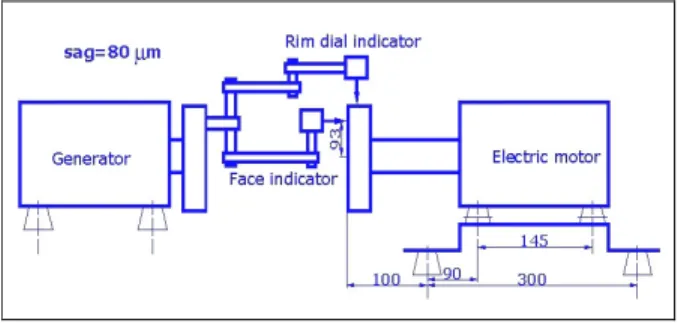
The setup for doing experiment is a pair of generator-electric motor. Hot misalignment experiment is measured by Face/Rim two dial indicators method. The setup for measuring misalignment using dial indicators is shown in Figure 3. For measuring misalignment by Rim/Face two indicators, the aligner has to read the value of the dial indicators at the angular shaft position of 0, 90, 180, 270 degrees. The data is taken when the temperature of the motor’s shaft reached to 24.6oC, 39.6oC, 63.8oC and 78.9oC.
Figure 3. Setup for experiments
The off-line to running machinery movement is measured by laser sensors. The movement of vertical and horizontal planes is measured in two different
occasions. Figure 4 shows the setup for measuring OL2R movement. Two laser sensors are used for measuring OL2R movement of shafts of the generator and the electric motor. Sensor 1 measures the movement of electric motor’s shaft and sensor 2 measures the movement of generator’s shaft.
Figure 4. Setup for measuring OL2R movement 4. RESULTS AND DISCUSSION 4.1 Hot Misalignment
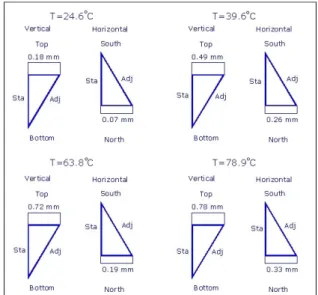
The results of measurement obtained in the hot experiment are shown in Figure 5. The numbers outside the circles are values of Rim indicator reading while the numbers inside the circles are values of Face indicator reading. Based on the values shown in Figure 5, the misalignment can be calculated as shown in Figure 6 and 7. Figure 6 is circles that show the values of misalignment while Figure 7 is triangles that show the detail of angular misalignment. Around the circles in Figure 6, the highest row numbers are the values of measurement and the lowest row numbers are the values for calculating misalignment. The offset misalignment is determined by dividing the value of Rim by two. In Figure 7, the direction of the triangles shows the wider positions (Top and North) of the angular misalignment. The values of angular misalignment shown in those triangles are got from the value of Face in the circles. In this figure, the word ‘Sta’ means stationary machine (the generator) and the word ‘Adj’ means machine to be adjusted for alignment (the motor). Finally, the offset misalignment is shown in Table 1 and the angular misalignment is shown in Table 2.
Based on the results appear in Table 1 and Table 2, two graphs that show the influence of temperature on misalignment could be drawn as in Figure 8 and Figure 9. Figure 8 demonstrate the influence of temperature on offset misalignment while Figure 9 shows similar influence on angular misalignment. The vertical axis of those graphs is the values of misalignment and the horizontal axis is the values of temperature.
MESIN Vol. 20 No. 2 70
Figure 5. Result of measuring hot misalignment
Figure 6. Hot misalignment
Table 1. Hot offset misalignment
Offset misalignment (µm) 24.6oC 39.6oC 63.8oC 78.9oC Vertical 210 280 350 370 Horizontal 15 130 85 85
Table 2. Hot angular misalignment
Offset misalignment (µm) 24.6oC 39.6oC 63.8oC 78.9oC Vertical 180 (T) 490 (T) 720 (T) 780 (T) Horizontal 70 (N) 260 (N) 190 (N) 330 (N) (T means wide at Top and N means wide at North)
Figure 7. Hot angular misalignment 4.2 OL2R Machinery Movement
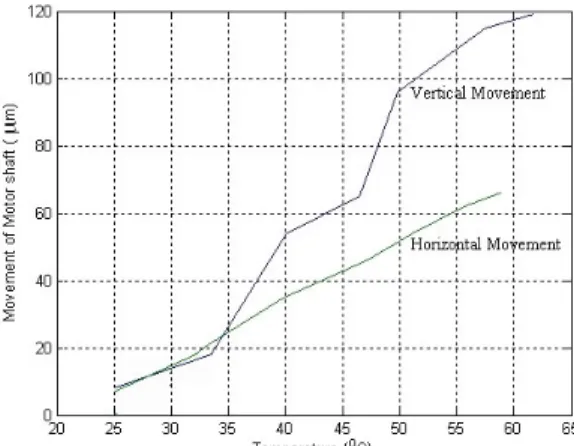
The OL2R movement is measured by laser sensors. The movement of shafts in vertical and horizontal planes is measured in two different occasions. The shaft movement in vertical plane as a function of running time and raising temperature is shown in Table 3 while in horizontal plane’s one is shown in Table 4.
Based on the results of measurements, some graphs that show the influence of temperature on movement are drawn as in following figures. Figure 10 shows the influence of temperature change on motor shaft movement. Figure 11 shows the influence of temperature change on movement of the generator’s shaft. Figure 12 shows the differential movement between electric motor’s shaft and generator’s shaft. This graphs show that the higher the temperature of the shafts, the higher the differential movement between electric motor’s shaft and generator’s shaft, and thus the misalignment between these two shafts.
MESIN Vol. 20 No. 2 71
Figure 9. Graph of angular misalignment Table 3. Shaft position of vertical plane
Electric Motor’s
shaft Generator’s shaft Time (minu te) Position (µm) Temperatu re oC Position (µm) Temperatu re oC 0 8 25.3 2 25.3 5 15 32.9 6 26.3 10 54 40.1 20 26.9 15 65 46.5 23 27.5 20 96 49.8 41 28.2 25 115 57.5 51 29.7 30 119 61.7 54 30.4
Table 4. Shaft position of horizontal plane
Electric Motor’s
shaft Generator’s shaft Time (minu te) Position (µm) Temperat ure oC Position (µm) Temperat ure oC 0 7 24.9 2 24.9 5 21 33.2 6 27.1 10 35 39.9 8 28.2 15 46 47.2 15 29.0 20 54 51.1 17 29.3 25 62 55.6 21 29.9 30 66 58.9 24 30.1
4.3 Compensating for OL2R Movement
The OL2R movement is compensated by lowering the position of the electric motor’s feet. The compensation method for OL2R movement in this way is shown in Figure 13. The inboard feet of the electric motor are reduced 200µm while the outboard feet are reduced 100µm.
Vibration levels of the system are measured in two conditions, before and after compensation, using a Multi-channels Spectrum Analyzer (MSA). Figure 14 shows the vibration spectrum before compensation while Figure 15 shows the vibration spectrum after compensation.
Figure 10. Position of electric motor’s shaft
Figure 11. Position of generator’s shaft
Figure 12. Differential movement between two shafts
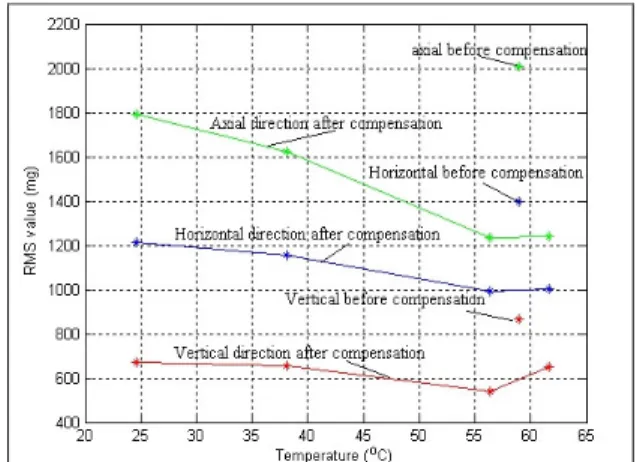
Based on the result shown on Figures 14 and 15, a comparison graph of vibration level obtained before and after compensation is drawn as in Figure 16. The separate star (*) points are RMS levels of power spectrum before compensation and the star (*) points on the lines are RMS levels of power spectrum after compensation. As shown in this figure, after compensation, the vibration level in vertical plane reduces by 31.5% while the vibration level of horizontal plane reduces by 28.5% and the vibration level of axial plane reduces by 38.4%.
MESIN Vol. 20 No. 2 72
Figure 13. Compensation for OL2R movement
Figure 14. Vibration spectrum before compensation
Figure 15. Vibration spectrum after compensation
Figure 16. Vibration levels between before and after
compensation
5. CONCLUSION
The experimental results show that misalignment always occurs in rotating machinery and the misalignment has strong influence on the vibration level of the machinery. In general case, the smaller the misalignment value, the smaller vibration level of the system.
The graphs in figures 10-12 have demonstrated that the increase of temperature cause the shaft movement during running time. Differential movement of the shafts causes of increasing of misalignment level thus raising vibration level.
It is possible to compensate for OL2R movement so that the vibration level reduces during operating condition.
6. REFERENCES
[1] S. Ganeriwala., The Truth behind Misalignment
Vibration Spectral of Rotating Machinery,
Richmond – VA 23228, www.spectralquest.com [2] VibrAlign magazine, Dynamic Movement White
Paper, VibrAlign Inc, Richmond – VA 232326,
www.vibralign.com 2002
[3] M.M James., Discovering Misalignment with Infrared: The damage is done, Technical Services