Synthesis of Oligoesters Plastic Film from Polylactic Acid
with Mono Ester Plasticizer of Wood Flour and Rice Bran and
its Hydro Degradation
Edwin Azwar*
Jurusan Teknik Kimia, Fakultas Teknik Universitas Lampung Jl. Prof. Dr. Soemantri Brojonegoro No.1 Bandar Lampung 35145
Abstract
Composites of polylactic acid (PLA) with mono ester plasticizer (MEP) from wood flour and rice bran were prepared to evaluate the effect of MEP filler content on the mechanical, functional, thermal, and morphological properties of the composites and its degradation. The SEM study provided evidence that there was sufficient interfacial adhesion between the PLA matrix and the MEP from wood flour and rice bran filler. This was likely a result of mechanical interlocking among them. An addition of 10 and 30% MEP from wood flour or rice bran resulted in an improvement of strain and tensile properties of the composite. The composites of PLA and MEP from wood flour and rice bran experienced degradation through hydrolysis of regions that have crystalline structure.
Keywords: polylactic acid, fiber, cellulose, wood flour, rice bran
Abstrak
Komposit dari polylactic acid (PLA) dan mono ester plasticizer (MEP) dari tepung kayu dan bekatul disiapkan untuk mengevaluasi pengaruh jenis bahan isian MEP terhadap sifat mekanis, fungsi, sifat termal, dan morfologis komposit tersebut beserta reaksi degradasinya. Hasil analisis dengan SEM menunjukkan bahwa terdapat
interfacial adhesion yang cukup besar antara matriks PLA dan MEP dari tepung kayu dan bekatul, yang dapat disebabkan oleh mechanical interlocking antara keduanya. Penambahan 10 dan 30% MEP tepung kayu dan bekatul menyebabkan perbaikan regangan (strain) dan tegangan tarik (tensile). Komposit PLA dan MEP dari tepung kayu dan bekatul mengalami degradasi dengan hidrolisis pada bagian yang berstruktur kristal.
Kata kunci: polylactic acid, serat, selulosa, tepung kayu, bekatul
Introduction
Plasticizers are widely used in polymer industry as additives to increase the mobility of polymer chains. The plasticizers occupy the intermolecular spaces between polymer chains. They reduce intermolecular interactions between polymer chains, thus, increasing the free volume and reducing the energy required for molecular motion. The plasticizers should also reduce the glass transition temperature of the material to under room or other temperature that results in a flexible material (Sejidov et al., 2005; Wypych, 2004). This leads to a decrease in intermolecular forces along polymer chains that improves the flexibility and chain mobility, decreases brittleness (Bordes et al., 2009; Guilbert et al., 1996; Markarian, 2008). The chemical structure, composition, molecular weight and functional groups of the plasticizer affect degree of plasticity (Moreno, 1992).
__________
* Alamat korespondensi: [email protected]
Changing in type and amount of a plasticizer will affect the properties of the film (Cao et al., 2009; Rahman, 2004). Effective plasticization and compatibility between plasticizer and polymer are determined by various parameters such as polarity, hydrogen bonding, dielectric constant and solubility parameters (Choi et al., 2004; van Oosterhout and Gilbert, 2003). Optimum stirring rate could uptake the insoluble plasticizer and cause better dispersion for the polymer (Bodmeier and Paeratakul, 1997). Glycols is the most lique-faction reagent that can give products rich in hydroxyl groups (Kobayashi et al., 2004;
Krzˇan et al., 2005; Zhang et al., 2009).
repeating units linked by 1,4-b-D-glycosidic linkages (Nevell and Zeronian, 1985), while hemicellulose contains several different sugar units that exhibit a considerable degree of chain branching containing pendant side groups giving rise to its non crystalline nature. Each repeating unit contains three hydroxyl groups and has ability to form hydrogen bond that plays a major role in directing the crystalline. Lignin is a highly cross-linked, three-dimensional aromatic polymer consisting of phenylpropane units linked together by C–C or other bonds. Hydrogen bonds among the macromolecules of the wood polymers within cellulose, the hemicellulose and the lignin are built by a large amount of the hydroxyl groups (– OH). Wood flour and rice bran, as fiber, can be liquefied by depolymerization of wood in a liquid reagent under elevated temperatures combined with solubilization (Balat, 2008; Behrendt, 2008; Bouvier et al., 1988). With the liquefaction process, the fibers are broken down into macrostructure that converts them into low molecular weight components and increases hydrogen/carbon ratio.
Mono ester plasticizer
can be synthesed from glycerol, diethylene
glycol, p-toluene-sulphonic acid and dibutyl
tin (IV) oxide and hexanoic acid
. Biopolymer-based films plasticiz-ers can be divided into water soluble and water insoluble (Smita et al., 2006). The type and the amount of plasticizer strongly affect dispersion of the polymeric film formation (Johnson et al., 1991).Polylactide has high strength, thermal plasticity, and biocompatibility (Tadashi and Masayuki, 2008). However, some physical properties of polylactide such as brittleness limit its application (Cohn and Salamon, 2005). Polylactide can be broke down thermally by hydrolysis. Hydrolysis degradation of the ester bonds results in monomers and the process depends on the molecular weight and the crystallinity of the polymer. The crystallinity plays an important role in the polymer hydrolysis where slow degradation occurs for crystalline polylactide but fast for amorphous of polylactide (Tsuji dan Ikada, 1997). The mode of scission in the hydrolysis of biodegradable polymers could be completely random regarding the backbone bonds. The hydrolytic degradation in aqueous solution proceeds through random cleavage of the ester bonds. The hydrolytic degradation is controlled by the amount of absorbed water, the diffusion coefficient of chain fragments within the polymer and the solubility of degradation
products (Schliecker et al., 2003). The mechanism of degradation of solid polymer matrix can proceed in surface and bulk (Siepmann et al., 1998). As we found from previous results, polylactide with liquefied wood flours and rice bran, as additives, lead to more water uptake concerning to a higher degree of cristallinity within the composite films.
The purpose of this research project was to prepare and analyze MEP from liquefied wood flour and rice bran, and to evaluate its dispersion to polylactic acid matrix in a composite.
Experimental
Materials
Polylactide materials were bought from Natural Work. Glycerol, diethylene glycol, p-toluenesulphonic acid, dioxane, hexanoic acid (HA), suberic acid (SA) and di-n-butyl tin oxide, chloroform (Aldrich) were commercially provided. The fiber fillers rice bran and wood flour were collected from local sources.
Films Preparation
1. Liquefaction of wood flour and rice bran Polyol mixture of glycerol (240 g) and diethylene glycol (60 g), p-toluene-sulphonic acid (9 g) were placed into a three-necked glass reactor equipped with a mechanical stirrer. The mixture is heated with a constant stirring to 160C. The wood flour or rice bran (100 g) was added gradually and the temperature was raised to 180C. The liquefaction reaction was carried out for 120 min. The degree of liquefaction was evaluated by determining the residue after dilution of the sample with dioxane and water (4: 1 v/v). The diluted sample was then filtered using Whatman fast flow filter paper. The residue on the filter paper was dried in an oven at 120°C to get a constant weight. The residue ratio was calculated as the weight percentage based on the starting wood material.
2. Synthesis of ester plasticizers of wood flour and rice bran
temperature of 180C for 7 hours. Products were washed out from the reaction vessel, precipitated and then separated by funnel separator.
3. Polylactide and MEP of Wood Flour and Rice Bran Film Preparation
4.5 mg polylactide with 0.5 mg MEP of wood flour or rice bran and 3.5 mg polylactide with 1.5 mg MEP of wood flour or rice bran are mixed
4. Hydrolitic Degradation
Pure polylactide 5 mg, PLA with 10% an 30% MEP from wood flour and rice bran were each material, each aging time, and each temperature). Polylactide composite films were taken out from the water, wiped with Kleenex and weighted the wet weight. The films were put in a vacuum oven for 1 week and weighted to get the dry weight.
1. Scanning Electron Microscopy (SEM)
SEM analysis was performed with Hitachi S-4800, which is a versatile platform comprising high resolution performance. Film pieces were mounted on metal studs and sputter-coated with gold-palladium using a Cressington 208HR sputter coater. All samples were examined using an accelerating voltage of 0.6 - 2.0 kV.
2. Fourier Transform Infrared Spectrometry (FTIR)
The FTIR spectra of the films were recorded with an IR spectrometer (Perkin Elmer Spectrum 200) in the wavenumber range of 4000−500 cm-1.
3. Mechanical Properties
Mechanical properties such as tensile strength, percentage elongation at break, and modulus value were measured using an Instron Universal testing machine (Model 5566), equipped with pneumatic clamps. The tests were performed with 500 N load cell with the cross head speed of 4 mm/min. The software program used was Bluehill. Prior to tensile test, all the samples were conditioned at 50% relative humidity and 23C. Before conducting test, five specimens with a rectangular shape (80.5 mm2) were prepared by using EP 04/80 (Elastocon AB, Sweden).
Results and discussion
Hydrolitic degradation
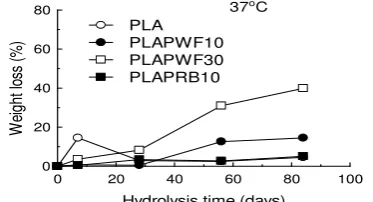
Figure 1 and 2 show that the hydrolyzed chains were fragmented to form lower molecular weight products that are more soluble causing faster erosion and higher weight loss. The decrease in mass percent during 28 day period is due to the steady loss of low molecular weight chain fragments that are produced from hydrolysis of the PLA with MEP of wood flour and rice bran backbone. Polylactide with MEP of wood flour and rice bran samples at 37C and 60C turned to whitish, due to crystallization.
Figure 1. Weight loss vs hydrolysis time polylactide with MEP from wood flour and MEP of rice bran at 37C.
Figure 1 also shows that at 37C first cracks started to appear after 28 days and after 56 days samples collapsed into several pieces. Meanwhile, as shown in Figure 2, at 60°C the samples had already started to crack in the first week and lost their weight. As degradation proceeds, number of carboxylic acid chain ends increases during the autocatalysed ester hydrolysis. Initially, hydrolysis of ester bonds occurs homogeneously through the matrix and water diffuses into the amorphous regions resulting in random hydrolytic scission of ester bonds. Before PLA with MEP of wood flour and rice bran are fully degraded, the soluble oligomers which are close to the surface can be leached out, whereas the core of the polylactide composite remains entrapped. As shown in Figure 1 the highest weight loss was achieved at 37C (polylactide with 30% wood flour MEP especially after 28 days), while the lowest weight loss was the polylactide with 10% rice bran MEP (its weight loss remained constant since 0 - 80 days of degradations). Compared with Figure 2, it was found that at 60C the weight loss of mostly all polylactid with monoester plasticizer with wood flour or rice brand increased drastically starting from 0 to 28 days. High temperatures seem to increase hydrolysis degradation.
Scanning Electron Microscopy (SEM)
Figure 3. SEM of pure polylactide.
Figure 4. SEM of polylactide with 30% wood flour MEP
Figure 5. SEM polylactide with 30% rice brand MEP
Polylactide with monoester plasticizer wood flour and rice bran film before hydrolysis shows spherulitic morphology. The inherent polar and hydrophilic nature of lignocellulosic fibers and the non-polar characteristics of most thermo-plastics results in compounding difficulties leading to nonuniform dispersion of fibers within the matrix, which impairs the efficiency of the composite. Crystalline and amorphous regions were found within the spherulite, meanwhile free amorphous region between the spherulites.
The fiber breakage indicates good interfacial adhesion between PLA and MEP from wood flour and rice bran. Some fiber fractures and fiber splitting can be seen, which demonstrate a strong fiber matrix adhesion. The interface between PLA with MEP from wood flour and rice bran particle is well formed. Macromolecules are very easy to form strong hydrogen bonds because the surface has plenty hydroxyl groups.
Surface changes
4000 3500 3000 2500 2000 1500 1000 500 0,0
0,2 0,4 0,6 0,8 1,0
Ab
so
rb
a
n
ce
Wave number (cm-2
) PLA
PLAPWF10
PLAPWF30
PLAPRB10
PLAPRB30
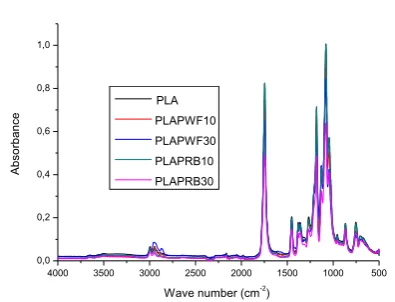
Figure 6. FTIR polylactide with MEP of wood flour and rice bran fillers
crystallinity of polylactide. The interaction wood flour and rice bran MEP. The peak at 1267 cm-1 was due to the -OH plane deformation, might be related to the phenol-lignin complex which is retained in the residue. Compared with the spectrum of neat PLA, the spectrum of the composite containing of wood flour fiber and rice bran shows the presence of OH groups at 2955 cm-1 and 2944 cm-1.
4000 3500 3000 2500 2000 1500 1000 500 0,0 flour before and after degradation 28 days, 370C
Figure 7 shows FTIR spectra of hydro-degradation of polylactide with monoester plasticizer wood flour or rice bran. The carbon acetyl hydrogen stretching vibration absorbance intensity ratio at 2995 cm1 decreased upon water. The small band at 1746 cm-1 is attributed to carbonyl groups of uronic acids from hemicellulosic contaminants, which are rapidly removed by hydrolysis.
Mechanical
Strength at break of polylactide with 10% and 30% MEP from wood flour decreases as compared to pure polylactide (31.37 Mpa), polylactide with 10% MEP from wood flour (15.84 Mpa) and polylactide with 305 MEP from wood flour (10.37) indicating an efficient stress transfer between polylactide and wood flour. Strong adhesion of the MEP from wood flour with polylactide interface is necessary for an effective stress transfer and load distribution throughout the interface which shows a more resilient matrix. MEP from wood flour and rice
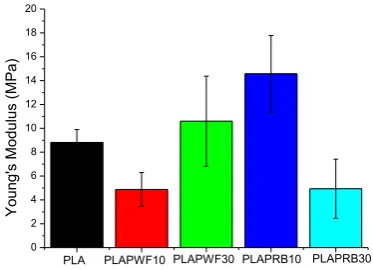
bran fiber contents led to the formation of fiber that compromised the ultimate strength of composites. The percentage of load carried by the fibers becomes higher for a higher ratio of elastic modules of fibers and matrix. The addition of MEP from rice bran by 10% improved the modulus from pure PLA 31.37 MPa to 42.06 MPa, while adding of MEP from rice bran by 30% had relatively the same modulus as that of pure polylactide (31.22 Mpa).
0
Figure 8. Tensile strength PLA with 10% and 30% MEP from wood flour and rice bran filler
0
Figure 9. Strain at break polylactide with 10% and 30% wood flour and rice bran MEP fillers
MEP were to inhibit polylactide crystallization and enhance the plasticizer effect, increase molecular mobility of starch chain, promote the interaction between polylactide and wood flour, and increase elongation at break. The adding of MEP from rice bran also increases strain at break polylactide, but the increase is not drastically as wood flour and rice bran filler 10% and 30%.
MEP from wood flour and rice bran improve the interfacial matrix fiber bonding resulting in the enhancement of tensile properties of the
composites. The Young’s modulus of the natural
fiber reinforced polymer composites increases with increasing fiber loading. The tensile strength of the natural fiber reinforced polymer composites increases with fiber content up to a maximum or optimum value, then the value will drop.
Adding of MEP from wood flour by 10% and and rice bran by 30% decreases Young Modulus (4.880 Mpa) and (4.936 Mpa) compared with neat PLA (8.818 Mpa) causing the film matrix to become less dense and facilitating the movements of the polymer chain under stress, consequently improving the flexibility. However, it increases the tensile stress of polylactide with strength, in comparison with pure polylactide, which showed a more resilient matrix, higher mechanical strength. The effect of fiber content
in MEP on the properties of polylactide natural fiber reinforced composites is particularly significant, due to interaction between the carbonyl groups of PLA and hydroxyl groups of wood flour. SEM images showed indication of good interfacial adhesion.
During hydrolytic degradation process and morphological changes of polylactide during the degradation, water penetrated into polylactide leading to hydrolytic cleavage of ester bonds. Degradation rate constants were higher for amorphous polylactide and MEP of wood flour and rice bran as a result of increasing permeation through the amorphous domains. Faster hydrolysis induced by the increase of crystallinity polylactide with MEP of wood flour and rice bran.
References
Balat, M. Mechanisms of thermochemical biomass conversion processes, part 3: reactions of liquefaction. Energ. Source. 2008; A 30, 649–659. Behrendt, F., Neubauer, Y., Oevermann, M., Wilmes,
B., and Zobel, N. Direct liquefaction of biomass. Chem. Eng. Technol. 2008; 31, 667–677.
Bodmeier, R. and Paeratakul, O. Plasticizer uptake by aqueous colloidal polymer dispersions used for the coating of solid dosage forms. Int. J. Pharm 1997; 152(1): 17–26.
Bordes, P., Pollet, E. and Averous, L. Nano-biocomposites: biodegradable polyester/nanoclay systems. Prog Polym Sci 2009; 34(2):125–55. Bouvier, J.M., Gelus, M. and Maugendre, S. Wood
liquefaction – an overview. Appl. Energy 1988; 30, 85–98.
Cao, N., Yang, X. and Fu, Y. Effects of various plasticizers on mechanical and water vapor barrier properties of gelatin films. Food Hydrocol 2009; 23(3):729–35.
Choi, J.S. and Park, W:H. Effect of biodegradable plasticizers on thermal and mechanical properties of poly(3-hydroxybutyrate). Polym Test 2004; 23(4):455–60.
Cohn, D. and Saalamon, A.H. Designing biodegradable multiblock PCL/PLA thermoplastic elastomers J.. Biomaterials, 2005, 26: 2297-2305. Guilbert, S., Gontard, N. and Gorris, L.G.M.
Prolongation of the shelf-life of perishable food products using biodegradable films and coatings. Food Sci Technol 1996; 29(1–2):10–7.
Johnson, K., Hathaway, R., Leung, P. and Franz, R. Effect of triacetin and polyethylene glycol 400 on some physical properties of hydroxypropyl methylcellulose free films. Int J Pharm 1991; 73(3): 197–208.
liquefaction with polyhydric alcohol. J. Wood Sci. 2004; 50, 407–414.
Krzˇan, A., Kunaver, M. and Tišler, V. Wood
liquefaction using dibasic organic acids and glycols. Acta Chim. Slov. 2005; 52, 253–258. Markarian, J. Biopolymers present new market
opportunities for additives in packaging. Plast Addit Compound 2008; 10(3):22–5.
Moreno, R. The role of slip additives in tape casting technology, part II - binders and plasticizers. J. Am. Ceram. Soc. 1992; 71(11): 1647–57.
Nevell, T.P. and Zeronian, S. H. Cellulose chemistry and its applications. New York: Wiley. 1985 Rahman, M. and Brazel, C.S. The plasticizer market:
an assessment of traditional plasticizers and research trends to meet new challenges. Prog Polym Sci 2004; 29:1223–48.
Schliecker, G., Schmidt, C., Fuchs, St. and Kissel, T. Characterization of a homologous series of D,L lactic acid oligomers; a mechanistic study on the degradation kinetics in vitro. Biomaterials 2003; 24(21):3835e44.
Sejidov, F.T., Mansoori, Y. and Goodarzi, N. Esterification reaction using solid heterogeneous acid catalysts under solvent-less condition. J Mol Catal A: Chem 2005; 240(1–2):186–90.
Siepmann, J., Paeratakul, O. and Bodmeier, R. Modeling plasticizer uptake in aqueous polymer dispersions. Int J Pharm 1998; 165(2):191–200. Smita, M., Sushil, K.V. and Sanjay, K.N. Dynamic
mechanical and thermal properties of MAPE treated jute/HDPE composites J.. Compos Sci Technol, 2006, 66: 538-547.
Tadashi, Y.; Masayuki, Y. Structure and properties for biomass-based polyester blends of PLA and PBS J.. Eur Polym J, 2008, 44: 677-685.
Tsuji, H.; Ikada, Y. Journal of Applied Polymer Science 1997; 63:855–63.
Van Oosterhout, J.T. and Gilbert, M. Interactions between PVC and binary or ternary blends of plasticizers. Part I. PVC/plasticizer compatibility. Polymer 2003; 44(26):8081–94.
Wuppertal, E.W. Die textilen Rohstoffe. Frankfurt: Dr. Spohr-Verlag, 1981.
Wypych, G. Handbook of plasticizers. Toronto: ChemTec Publishing; 2004. p. 687.
Zhang, T., Zhou, Y., Liu, D. and Petrus, L. Qualitative analysis of products formed during the acid catalyzed liquefaction of bagasse in ethylene glycol. Bioresour. Technol. 98, 1454–1459. 3146
A. Krzˇan, E. Zˇ agar / Bioresource Technology