Perbanyakan Massal
Perbanyakan Massal
Virus sebagai Agens
Virus sebagai Agens
Antagonis
Antagonis
Ada beberapa cara virus dapat digunakan untuk
mengendalikan patogen tumbuhan, yaitu :
1. Virus dapat membunuh atau mengurangi
patogenisitas bakteri patogen dan jamur patogen
tumbuhan.
2. Virus dapat membunuh vektor invertebrata
virus pada tanaman tingkat tinggi sehingga
mencegah penyebarannya.
3. Strain yang agak lemah yang menyebabkan
• Stanway (1985) mendeteksi infeksi virus sebanyak 126 dari 157 isolat jamur take-all pada tanaman gandum (Gaeumannomyces graminis var. tritici).
• Kultivar gandum yang terinfeksi Helminthosporium victoriae (penyakit hawar) adalah penyakit penting gandum di Amerika pada 1947
dan1948.
• Lindberg (1959) menemukan beberapa koloni jamur H. victoriae menjadi memendek, ditandai dengan daerah pada pinggir koloni,
miselium udara menjadi lisis dan menghambat perkembangan koloni.
• Penyakit ini juga ditransmisikan ke kultur yang sehat oleh anastomosis hifa dan mungkin disebabkan oleh 1 atau 2 dsRNA virus yang biasa dijumpai pada H. victoriae (Ghabrial 1986).
Penyakit yang disebabkan virus entomopatogen mulai
diketahui sejak abad ke-16.
Penyakit yang disebut
Jaundice o graserrie
, sekarang
diidentifikasi sebagai
nucleopolyhedrosis
, ditemukan pada
ulat sutra (
Bombyx mori
) oleh Vida pada tahun 1524 dan
kemudian juga diisolasi dari lebah madu (
Apis mellifera
).
Pada tahun 1856, dua orang ahli Italia (Maestri dan
Cornalia) menjelaskan
occlusion bodies
(OBs) ulat sutra
nucleopolyhedrosis.
Pada tahun 1926 Paillot mendeskripsikan
Granulovirus
(GVs) pertama sekali.
Pada tahun 1934 Ishimori menjelaskan jenis baru
polyhedrosis di dalam ulat sutra
OBs dibentuk didalam
sitoplasma sel yang diinfeksi (bukan pada asam nukleat)
Sejak tahun 1950 s/d 1970, Steinhaus dan koleganya menguji
baculovirus sebagai agens hayati di lapangan dengan
mengaplikasi nucleopolyhedrovirus (NPV) untuk mengendalikan
ulat alfalfa (
Colias eurytheme
Boisduval; Lepidoptera: Pieridae).
Bioinsektisida komersil berbahan aktif virus pertama
dikembangkan pertama sekali pada tahun 1975 oleh
Perusahaan Sandoz (dengan nama dagang Elcar)
untuk
mengendalikan
Heliothis
/
Helicoverpa
Lepidoptera: Noctuidae).
Selama tahun 1979 s/d 1980, penemuan penting pada
genetika virus entomopatogen, khususnya baculovirus.
Hingga saat ini studi genetika virus entomopatogen difokuskan
pada studi genom lengkap
telah ada 29 sekuensing genom
Keuntungan dan Kerugian Penggunaan Virus untuk
mengendalikan hama
Keuntungan
1. Selektif dan efektif terhadap hama sasaran.
2. Aman bagi serangga dan organisme bukan sasaran serta tidak menyebabkan resistensi.
3. Persisten dan tidak meninggalkan residu beracun di alam. 4. Tidak menyebabkan pencemaran lingkungan.
5. Efektif menginfeksi ulat yang telah terkena insektisida kimia. 6. Tidak menyebabkan peningkatan populasi hama sekunder.
7. Dapat ditularkan oleh parasitoid dan predator ke inang yang sehat. 8. Dapat mengendalikan ulat instar V-VI.
9. Tidak menyebabkan penyakit virus pada tanaman.
10.Kompatibel dengan teknik pengendalian yang lain, termasuk insektisida kimia. 11.Mudah diproduksi dengan teknik sederhana (menggunakan alat semprot
standar).
12.Berpotensi sebagai pengendali hama jangka panjang.
Kerugian
1. Hanya spesifik terhadap hama sasaran.
2. Kemungkinan berbahaya bagi serangga bukan sasaran.
3. Waktu aplikasi harus tepat untuk memaksimalkan efektivitas.
4. Memerlukan pendistribusian secara merata pada kanopi tanaman untuk meningkatkan kontak dengan hama sasaran.
5. Daya bunuh lambat.
6. Rentan terhadap pengaruh lingkungan.
7. Kehilangan virulensi dan patogenitas jika diperbanyak secara terus menerus (jika tidak dilakukan penggantian inang baru).
8. Infektivitasnya di lapangan singkat dan membutuhkan penanganan tertentu.
9. Kekhawatiran masyarakat terhadap kemungkinan patogenik/menyebabkan alergi.
Saran untuk aplikasi virus entomopatogen
Virus tidak dapat diaplikasikan sendiri, tetapi kerkonjugasi dengan teknik pengendalian yang lain.
Virus entomopatogen bersifat spesifik, sehingga serangga target farus diidentifikasi secara benar.
Lahan dicangkul terlebih dahulu sebelum aplikasi dilakukan, dan virus
Virus yang Menginfeksi Invertebrata
Virus DNA
Double stranded DNA
-
Poxviridae
- Iridoviridae
- Baculoviridae:
NPV
&
GV
-
Polydnaviridae
Single stranded DNA
-
Parvoviridae
Virus RNA
Double stranded RNA
-
Rheoviridae: Cypovirus
Single stranded RNA (-)
- Rhabdoviridae
- Bunyaviridae
Single stranded RNA (+)
-
Picornaviridae, Togaviridae,
Tetraviridae, Flaviridiae,
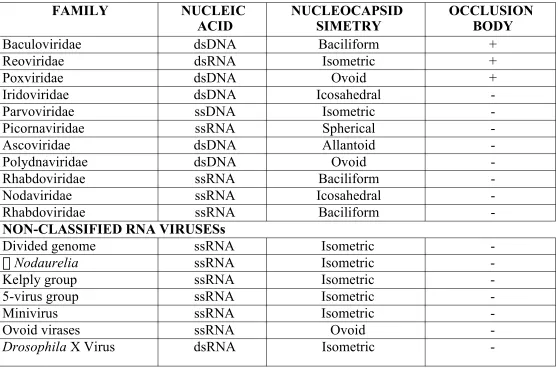
FAMILY NUCLEIC
ACID NUCLEOCAPSID SIMETRY OCCLUSION BODY
Baculoviridae dsDNA Baciliform + Reoviridae dsRNA Isometric + Poxviridae dsDNA Ovoid + Iridoviridae dsDNA Icosahedral -Parvoviridae ssDNA Isometric -Picornaviridae ssRNA Spherical -Ascoviridae dsDNA Allantoid -Polydnaviridae dsDNA Ovoid -Rhabdoviridae ssRNA Baciliform -Nodaviridae ssRNA Icosahedral -Rhabdoviridae ssRNA Baciliform
-NON-CLASSIFIED RNA VIRUSESs
Divided genome ssRNA Isometric
-Nodaurelia ssRNA Isometric
-Kelply group ssRNA Isometric -5-virus group ssRNA Isometric -Minivirus ssRNA Isometric -Ovoid virases ssRNA Ovoid
-Drosophila X Virus dsRNA Isometric
-Tabel 1. Kelompok Virus Entomopatogen
6
2 microns
Baculoviruses
Spodoptera littoralis
7
Baculoviruses
-Mode
of
action
8
Found only in invertebrates
No member of the family is known to infect plant or
vertebrate
Most have narrow host insect range, and infectivity is
restricted to the original host genus or family
Baculoviruses
9
Baculoviruses
Toxicity
studies
-
mammals
Toxicity test results from 1970s/80s of 29 NPVs
indicated no toxicity or pathogenicity. Doses were
generally 10 – 100 x the “per acre” (1 acre = 0.45ha)
field rate equated to a 70kg person.
10
Baculoviruses
Toxicity
studies
–
mammals
cont.
No effects of HzNPV found in:
Acute toxicity-pathogenicity tests in mouse, rat, guinea pig, rabbit, monkey and man at 6x10⁹ – 3 x 10¹² OB / kg.
Skin irritation sensitivity tests in guinea pigs, rabbits and man at 106
and 107 OB / mm2skin.
Eye irritation tests in rabbits with 105 and 2x10⁶ OB / eye
Subacute toxicity-pathogenicity tests and subcutaneous injection into mice, rats, dogs and rhesus monkeys.
Teratogenicity and carcenogenicity studies in rats and mice at 109 –
3.5x10¹² OB / kg.
11
Baculoviruses
Toxicity
studies
–
wildlife
Birds
Able to pass NPV through the alimentary tract unaffected No deleterious effects
Aquatic organisms
No adverse effects
Beneficial insects
12
Toxicity tests designed for testing effects of chemicals on
vertebrates are insufficient
Results reported in Gröner (1986) indicate no virus induced antibody production in test mammals and chicken.
No cytogenetic effects of baculoviruses in mammalian cells either
in vivo or in vitro.
Baculoviruses
13
AcNPV inoculated into vertebrate cells can be
taken-up and the degree of taken-up-take depends on cell type,
temperature, time and viral phenotype.
BUT, none of the human and nonhuman vertebrate
lines tested showed evidence of viral replication.
NPVs unable to activate retroviruses in mammalian
cell lines
Baculoviruses
15
Baculoviruses
a list of the baculoviruses regulated as pesticide
active ingredients by the US EPA Office of Pesticide
Programs as of May 2005
Anagrapha falcifera NPV
Cydia pomonella GV
Douglas fir tussock moth NPV
Gypsy moth NPV
Helicoverpa zea NPV Indian meal moth GV
Mamestra configurata NPV (pending)
16
Baculoviruses
–
US
EPA
fact
sheet
III. ASSESSING RISKS TO HUMAN HEALTH
These viruses infect only the target insect larvae and closely related species. Toxicity tests show that the viruses pose no risk to the public. Workers wear protective clothing to prevent possible irritation from handling and applying the product.
IV. ASSESSING RISKS TO THE ENVIRONMENT
17
Cypoviruses:
Mode
of
action
Polyhedra ingested and dissolved in larval midgut
Virions released and attach to midgut columnar cells
Viral core enters cell cytoplasm
RNA transcription and replication
RNA occluded in capsules
Virus capsules occluded by virogenic stroma to form occlusion
18
Cypoviruses
(Rheoviridae)
No CPV has been found infecting vertebrates or plants
(Belloncik, 1989)
Dendrolimus
spectabilis
CPV registered in Japan in
1974. Safety test results generally negative.
Poxviridae:Entomopoxvirus
Member of the family of Poxviridae has a wide host,
including vertebrates and invertebrates.
Chicken pox and Small pox virus belong to this family.
The show allantoid – to brick-shaped virions, occluded within
ovoid OBs called Spheroids.
Entomopoxvirus has been isolated from 27 orthopterans,
lepidopterans, dipterans and coleopterans.
The subfamily Poxvirinae includes three genera, i.e.
Entomopoxvirus
A
,
Entomopoxvirus
B
, and
Entomopoxvirus
C
Entomopoxvirus A
infects only coleopteran species;
Entomopoxvirus
B
infects lepidopteran and coleopteran
species;
Entomopoxvirus C
infects only dipteran species.
The fourth group, group D, has been proposed by ICTV
Poxviridae:Entomopoxvirus
Ascoviridae: Ascovirus
Members of the family of Ascoviridae are double strande
DNA (dsDNA) viruses that infect lepidopteran insects and
cause the unique pathology of forming virion containing
vesicles in the hemolymph of infected hosts.
The presence of the vesicles gives the hemolymph
a milky white appearance, which is a major characteristic
of the disease.
A few species of
Ascovirus
has been isolated only from
insects, specifically from Lepidopterans (Noctuidae).
Enveloped virions of ascoviruses are bacilliform, ovoid or
Ascovirus symptoms
In cases where a Microplitis wasp has both parasitised a caterpillar and infected it with ascovirus, the symptoms seen are those of the disease
rather than of the parasitoid. When ascovirus kills the caterpillar, it also kills the developing Microplitis larva.
Caterpillars infected with ascovirus will generally stop eating within two days. They stop growing, but can live for weeks in a lethargic state before they die.
The blood of an ascovirus-infected caterpillar is white and creamy,
whereas the blood of a healthy caterpillar is clear. Blood colour gives the best diagnosis in the laboratory and can be tested by splitting or pricking the caterpillar.
Iridoviridae: Iridovirus
Invertebrate Iridescent Viruses (IIVs) (family Iridoviridae)
are known to infect a number of agricultural pests,
medically important insect vectors, and terrestrial isopods that
live in damp or aquatic habitats.
The major characteristic of this family is the presence of
iridescent blue, green, orange, or purple coloration in heavily
infected individuals.
The small
iridovirus
tend to display colors from violet to
turquoise.
The viral structure is non-enveloped, non-occluded,
Iridoviridaeviridae: Iridovirus
Although some iridoviruses infect frogs and fishes, those
infecting insects belong to two genera:
Iridovirus
, whose viral
particles fluctuate between 120 to 130 nm in size.
They mostly infect arthropods, particularly insects, in damp
or aquatic habitats worldwide (see complete list of
invertebrate hosts.
They are highly infectious by injection but have low
infectivity by ingestion.
Horizontal transmission can occur by cannibalism or
Iridoviridaeviridae: Iridovirus
Iridovirus infected (blue) larva of Aedes aegypti
Polydnaviridae
Polydnaviridae only infects endoparasitic Hymenoptera.
Member of this family show non-occluded, ovoid virions,
containing multipartite dsDNA
ICTV recognizes two genera within this family, including
Perbanyakan Virus
A. Perbanyakan
in vivo
Walaupun produksi skala besar virus di dalam serangga hidup
membutuhkan tenaga kerja yang banyak, perbanyakan secara in vivo masih layak digunakan.
Bagi laboratorium skala kecil, memberi makan virus diikuti dengan memanen serangga terinfeksi adalah standar produksi stok virus.
1. Propagation of Cydia pomonella granulovirus (CpGV) in C. pomonella larvae
1.Rear neonate codling moth larvae for 10 days on virus-free artificial diet. 2.After 10 days, larvae reach instar L4eL5.
3.Pipette 1 ml virus suspension containing 1000 OBs on the surface of a small piece of diet (about 2 × 2 ×2 mm).
4.Keep larvae single in a well containing one piece of contaminated diet and incubate them for 24 h at 26○C.
5.Transfer larvae, which have eaten the contaminated diet completely, to virus-free diet.
6.Incubate larvae at 26○C until infection is visible (usually after 5e6 days)
and monitor daily.
7.Collect infected larvae before tissue rupture.
Virus propagation follows the same protocol for small- and large-scale production. Infection of about 200 codling moth larvae following this protocol will usually result in 5 ml purified virus suspension with a concentra- tion of about 1011 OB/ml.
Quality control of in vivo virus propagation
Perbanyakan virus di dalam tubuh serangga hidup dapat
menyebabkan variasi produk dalam hal komposisi dan kemurnian – mikroorganisme lain yang hadir di dalam serangga dapat
menyebabkan kontaminasi produk akhir.
Oleh karena itu “quality control" yang baik sangat diperlukan.
Stok virus yang digunakan untuk perbanyakan harus
menggunakan strain virus yang sudah dikarakterisasi sebelumnya dengan analisa DNA restriction analysis untuk menentukan
apakah isolat tunggal atau campuran genotip.
Purifikasi inokulum dengan meminimalisasi resiko kontaminasi dengan protozoa atau spora bakteri yang dapat mempengaruhi replikasi virus.
Setiap virus yang dihasilkan harus diestimasi dengan
B. Isolasi virus dari serangga
Isolasi virus dari inang yang terinfeksi biasanya tahapan lanjut setelah perbanyakan virus.
Sangat diperlukan suspensi virus yang sangat murni.
1. Homogenization and filtration
Serangga mati di-homogenisasi di dalam deterjen anionic yang rendah konsentrasi untuk memfasilitasi lepasnya jaringan tubuh serangga dan melepaskan partikel.
Membekukan larva sebelum homogenisasi juga membantu untuk merusak
sel.
Suspensi homogenisasi masih mengandung residu makanan rering, kapsul kepala, dan bagian besar integumen, sehingga perlu disaring dengan is therefore filtered through saringan kain (cheese-cloth / gauze).
2. Centrifugation
Suspensi virus yang disaring masih mengandung lemak, bakteri dan partikel halus non-virus lainnya.
Dengan proses sentrifugasi beberapa kali virus dapat terpisah dari kontaminan ini.
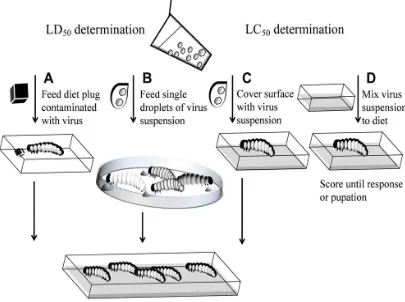
Figure 2.. Basic bioassay procedures for LD50 and LC50 determination. A. For the diet plug method, a known
dosage of virus suspension is pipetted on a small piece of diet and fed to one test larvae each until full consumption. Larvae are then reared on virus-free diet. B. Droplet feeding: single droplets of virus suspension containing a known dosage of virus mixed with food dye are fed to single larvae. Larvae which have ingested the droplet are then reared on virus-free diet. C. For surface contamination, virus suspension is added to a known unit of artificial diet to cover the surface. After a short time of feeding, larvae are transferred to virus-free diet. Concentration is given per mm2. D. Diet incorporation: virus suspension is mixed directly to a measured
![Figure 1. Example of a NPV [Agrotis segetum NPV Oxford strain (AgseNPV-B)] under the light microscope using an improved Neubauer hemocytometer (depth 0.1 mm)](https://thumb-ap.123doks.com/thumbv2/123dok/3607318.1790838/44.720.104.588.54.251/figure-example-agrotis-agsenpv-microscope-improved-neubauer-hemocytometer.webp)