An NAD
+, Mn
2+and DTT-dependent
α
-galactosidase
from
Bacillus halodurans
Andian Ari Anggraeni
1, Makiko Sakka
2, Tetsuya Kimura
2, Motomitsu Kitaoka
3,
and Kazuo Sakka
2(1State University of Yogyakarta, 2Mie University Japan , 3National Food Research Institute Japan )
Author for correspondence, email: [email protected]
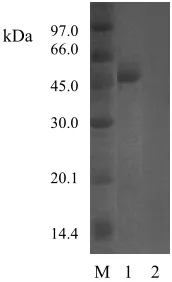
The α-galactosidase mel4A (previously called melA) gene of Bacillus halodurans was recombinantly expressed in Escherichia coli, purified and characterized. The mel4A gene consists of 1305 nucleotides encoding a protein of 434 amino acids with a predicted molecular weight of 49,761. According to its primary structure as deduced from the nucleotide sequence of the gene, Mel4A was assigned to family 4 of glycoside hydrolases. Almost all of the enzyme was produced as inclusion bodies at 37oC in E. coli. In order to reduce the expression level, cultivation temperature was decreased to 20oC so that the enzyme could be collected from soluble fraction. Recombinant α-galactosidase Mel4A was purified to homogeneity in a single step using His-binding metal affinity chromatography. B. halodurans Mel4A has the unusual property, i.e., absolutely depending on NAD+ and Mn2+ for activity. Co2+ and Ni2+ also activated Mel4A, albeit less efficiently than Mn2+. In addition, Mel4A activity required reducing condition which met by the addition of dithiothreitol (DTT). In the presence of all cofactors, optimum activity was achieved at 37oC and pH 7.4. The enzyme hydrolyzed p-nitrophenyl-α-D-galactopyranoside, melibiose, raffinose, and stachyose but not guar gum, indicating that this enzyme preferred small saccharides to highly polymerized galactomannans. Western immunoblots of intracellular and extracellularproteins of B. halodurans revealed that raffinose induced the expression of intracellular Mel4A of B. halodurans. This bacterium was also able to utilize guar gum as the carbon source, but Western blot analysis indicated that the production of Mel4A was not enhanced by the addition of guar gum.
INTRODUCTION
α-Galactosidases (α-Gal; α-D-galactoside galactohydrolase; melibiase; EC 3.2.1.22) are enzymes that catalyze hydrolysis of the α -1,6-galactosidic linkages from the non-reducing end in galactose-containing oligosaccharides, lipo saccha-rides and/or polysacchasaccha-rides. α-Gals widely occur in bacteria (5, 6), filamentous fungals (3), yeasts (11), plants (2), animals (7) and human (1). Some of them have been purified and characterized.
Based on the amino acid sequence similarity,
α-Gals have been classified under the families 4, 27, 36 and 57 of glycoside hydrolases (4). Almost all of the eukaryotic α-Gals showed a significant degree of amino acid sequence homology and they have been assigned to family 27. To date, some bacterial α-Gals have been characterized and grouped mainly into families 4, 36 and 57.
Galactose is the constituent of oligosaccharides (melibiose, raffinose, and stachyose) and polysaccharides such as galactomannan. These oligosaccharides are present in beans and mushrooms. Because monogastric animal and human body lack of
α-galactosidase, these oligosaccharides end up in the
large intestine undigested and cause flatulence. The use of microbial α-galactosidase treatment prior consumption has been proposed to prevent flatulence.
α-Galactosidase have been used in soymilk
production to reduce the content of undigested oligosaccharides. In the sugar beet industry, α -galactosidases have been used to increase the sucrose yield by eliminating raffinose, which prevents normal crystallization of beet sugar.
Bacillus halodurans C-125 was isolated in 1977 and reported as a β-galactosidase and xylanase producer. B. halodurans is a haloalkaliphilic bacteria which grow well in the pH range of 6.8 – 10.8. It is the strain most thoroughly characterized, physiologically, biochemically and genetically along with B. subtilis. This bacterium produces extracellular enzymes of industrial interest: protease, pectinase, amylase, xylanase. Extracellular enzymes produced by B. halodurans show relatively high optimum temperatures (50-70o C) and alkaline pH optima (8).
The complete genome sequence of B.
belonging to family 36 (4).
MATERIALS AND METHODS
Materials. Melibiose and raffinose were
purchased from Nacalai Tesque (Japan). p
NP-galacturonic acid and pNP-glucoronic acid were
kindly provided by Dr. Motomitsu Kitaoka (NFRI,
Japan). Stachyose, guar gum, pNP-Gal, other pNP glycosides, and other chemicals were purchased from Sigma Aldrich (St. Louis, MO, USA). Restriction endonucleases and other enzymes were purchased from the Takara (Kyoto, Japan) and used in accordance with the manufacture’s instructions.
Bacterial strains, plasmids, media and cultivation condition. Bacillus halodurans C-125 was obtained from the Japan Collection of Microorganism (JCM) and cultured aerobically in the Horikoshi-I medium pH 10 at 37o C overnight (?).
Escherichia coli strains XL1-Blue and BL21(DE3) were used as the cloning and gene expression host. Recombinant E. coli strains were cultured at 37o C in Luria-Bertani (LB) medium supplemented with ampicillin (75 μg ml-1) or kanamycin (60 μg ml-1). Plasmid pT7Blue and pET-28a(+) (Novagen, USA) were used for the TA cloning and gene expression experiments.
Construction of recombinant plasmid.
Open reading frame BH2228 (mel4A) was amplified by PCR using Taq polymerase master mix (Qiagen, USA). The PCR-derived DNA fragments were ligated into the TA cloning vector pT7Blue and introduced to
E. coli XL1-Blue. Plasmids were purified and inserted DNA fragments were ligated into expression vector pET-28a(+). Recombinant plasmid pET28-Mel4A was expressed in E. coli BL21(DE3).
Protein purification. E. coli BL21 (DE3) harboring pET28-Mel4A was used as a source for recombinant enzyme. The recombinant strain was grown overnight at 37o C in 500 mL of LB broth containing 60 μg ml-1 kanamycin. IPTG of 1 mM final concentration was added and the culture was incubated for further 20 h at 20o C. The cells were harvested by centrifugation and resuspended in lysis buffer. The cells were disrupted by sonication and cell debris was removed by centrifugation. The supernatant was used as the crude enzyme solution and purified to homogeneity in a single step using HiTrap Chelating HP (Amersham) column chromatography.
RESULTS AND DISCUSSION
The mel4A gene of B. halodurans encodes a
α-galactosidase. The B. halodurans Mel4A consists of 434 amino acids with a calculated molecular size of 49,761 kDa (Figure 1). According to amino acid sequence similarity-based classification of glycoside hydrolases, Mel4A belongs to glycoside hydrolase family 4 (GHF4). It is similar to E. coli MelA but distinct from reported eukaryotic α-Gal belonging to family 27 and bacterial α-Gal belonging to family 36.
97.0
Fig. 1. SDS-PAGE of purified Mel4A. Lane M, protein molecular mass standard (molecular masses shown at the left); lane 1, Mel4A; lane 2, protein purified from E-coli BL21(DE3) harboring pET28-a(+).
Mel4A lost almost all of its activity when assayed in the absence of NAD+. The highest activity was achieved when the enzyme incubated with NAD+, Mn2+ and DTT (Figure 3). Almost all of the GHF4 enzymes were reported to required NAD+ and Mn2+ for activity. In the presence of NAD+ or Mn2+, some of them require a high concentration of reducing agent (DTT or mercaptoethanol) for activity (6,10).
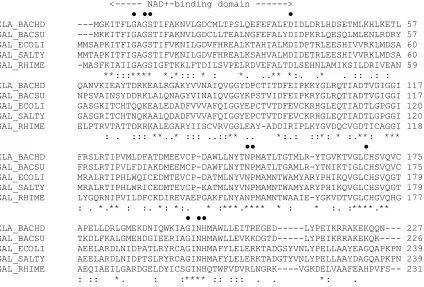
Multiple alignments of the GHF4 enzymes revealed many conserved glycine-rich residues (Figure 2). The presence of putative NAD+ binding protein in N-terminal (residue 1 to around 50) of GHF4 proteins has been suggested by Thompson et al
conserved N-terminal NAD+ binding motif is related with NAD+ binding affinity.
<--- NAD+-binding domain ---> ● ●● ●
MELA_BACHD ---MGKITFLGAGSTIFAKNVLGDCMLTPSLQEFEFALFDIDLDRLHDSETMLKHLKETL 57 AGAL_BACSU ---MKKITFIGAGSTIFAKNVLGDCLLTEALNGFEFALYDIDPKRLQESQLMLENLRDRY 57 AGAL_ECOLI MMSAPKITFIGAGSTIFVKNILGDVFHREALKTAHIALMDIDPTRLEESHIVVRKLMDSA 60 AGAL_SALTY MMTAPKITFIGAGSTIFVKNILGDVFHREALKSAHVALMDIDETRLEESHIVVRKLMDSA 60 AGAL_RHIME -MASFKIAIIGAGSIGFTKKLFTDILSVPELRDVEFALTDLSEHNLAMIKSILDRIVEAN 59 **:::**** *.*::: * : *. ..** *:. .* . :: .: : MELA_BACHD QANVKIEAYTDRKEALRGAKYVVNAIQVGGYDPCTITDFEIPKKYGLRQTIADTVGIGGI 117 AGAL_BACSU NPSVAINSYDDRKLALQNAGYVINAIQVGGYKPSTVIDFEIPKRYGLRQTIADTVGIGGI 117 AGAL_ECOLI GASGKITCHTQQKEALEDADFVVVAFQIGGYEPCTVTDFEVCKRHGLEQTIADTLGPGGI 120 AGAL_SALTY GASGRITCHTNQKAALQDADFVVVAFQIGGYEPCTVTDFEVCKRHGLEQTIADTLGPGGI 120 AGAL_RHIME ELPTRVTATTDRRKALEGARYIISCVRVGGLEAY-ADDIRIPLKYGVDQCVGDTICAGGI 118 : . ::: **..* ::: ..::** .. *:.: ::*: * :.**: *** ●● ●
MELA_BACHD FRSLRTIPVMLDFATDMEEVCP-DAWLLNYTNPMATLTGTMLR-YTGVKTVGLCHSVQVC 175 AGAL_BACSU FRSLRTIPVLFDIAKDMEEMCP-DAWFLNYTNPMATLTGAMLR-YTNIKTIGLCHSVQVC 175 AGAL_ECOLI MRALRTIPHLWQICEDMTEVCP-DATMLNYVNPMAMNTWAMYARYPHIKQVGLCHSVQGT 179 AGAL_SALTY MRALRTIPHLWRICEDMTEVCP-KATMLNYVNPMAMNTWAMYARYPHIKQVGLCHSVQGT 179 AGAL_RHIME LYGQRNIPVILDFCKDIREVAEPGAKFLNYANPMAMNTWAAIE-YGKVDTVGLCHGVQHG 177 : . *.** : :. *: *:. * :***.**** * : * :. :****.** ● ●●
MELA_BACHD APELLDRLGMEKDNIQWKIAGINHMAWLLEITREGED---LYPEIKRRAKEKQQN--- 227 AGAL_BACSU TKDLFKALGMEHDGIEERIAGINHMAWLLEVKKDGTD---LYPEIKRRAKEKQK---- 226 AGAL_ECOLI AEELARDLNIDPATLRYRCAGINHMAFYLELERKTADGSYVNLYPELLAAYEAGQAPKPN 239 AGAL_SALTY AEELARDLNIDPTSLRYRCAGINHMAFYLELERKTADGTYVNLYPELLAAYDAGQAPKPN 239 AGAL_RHIME AEQIAEILGARDGELDYICSGINHQTWFVDVRLNGRK----VGKDELVAAFEAHPVFS-- 231 : :: *. : :**** :: ::: . . *: .
Fig. 2. Multiple alignments of the GHF4 α-galactosidases. The amino acid sequences were aligned using the ClustalW algorithm. Identical amino acids are indicated by asterisks. Colon means that conserved substitutions have been observed and dot means that semi-conserved substitutions are observed. Numbers at right denote residue positions. The arrows above the sequence at the N terminus indicate a portion of the NAD+-binding domain, including the conserved GXGS motif of GHF4 proteins. Filled circle indicates that the residues are positionally conserved in GHF4 proteins. Abbreviations in alphabetical order (Swiss-Prot accession numbers in parentheses) are as follows: MELA_BACHD, α-galactosidase from B. halodurans (Q9KAQ9); AGAL_BACSU, α-galactosidase from B. subtilis (O34645); AGAL_ECOLI, α-galactosidase from E. coli (P06720); AGAL_SALTY, α -galactosidase from S. typhimurium (P30877); AGAL_RHIME, α-galactosidase from R. meliloti (Q9X4Y0).
The purified Mel4A was most active at 37o C and the maximum activity of the enzyme was observed at pH 7.4. The enzyme was stable between pH 7 and 8 at 4o C for 24 hr incubation. Purified enzymes were stable up to 40o C for 10 minutes incubation. Incubation at 50o C for 10 min resulted in a loss of approximately 40% of the enzyme activity, thus displaying distinct thermal instability.
Based on substrate specificity, α-Gals can be classified into two groups; i.e., one group is specific for small saccharides such as pNP-Gal, melibiose, raffinose and stachyose, and the other group can liberate galactose from highly polymerized
galactomannans such as guar gum in addition to small molecular mass substrates. Most of eukaryotic α-Gals generally specific to highly polymerized galactomannans in addition to small substrate, whereas prokaryotic α-Gals prefer small substrates. In this context, B. halodurans Mel4A also prefers small substrates.
data suggested that Mel4A was a non-secretory protein. The purified recombinant Mel4A required neutral pH for hydrolytic activity. It also indicates that the enzyme is an intracellular enzyme of B. halodurans.
This bacterium was also able to utilize guar gum as the carbon source, but Western blot analysis indicated that the production of Mel4A was not enhanced by the addition of guar gum.
0 requirements of Mel4A. A: The effect of DTT was measured in 100 mM Tris-HCl buffer (pH 7.4) containing 10 mM pNP-Gal, 60 μmM NAD+ and 1
1. Bishop, D.F., Calhoun, D.H., Bernstein, H.S., Hantzopoulus, P., Quinn, M. and Desnick, R.J.
1986. Human α-galactosidase A: Nucleotide
sequence of a cDNA clone encoding the mature enzyme. Proc. Natl. Acad. Sci. USA. 83:4859-4863
2. Carmi, N., Zhang, G., Petreikov, M., Gao, Z., Eyal, Y., Granot, D. and Schaffer, A.A. 2003. Cloning and functional expression of alkaline α -galactosidase from melon fruit: Similarity to plant SIP proteins uncovers a novel family of plant glycosyl hydrolases. Plant J. 33:97-106 3. Den Herder, I.F., Mateo Rosell, A.M., van Zuilen,
C.M., Punt, P.J. and van del Hondel, C.A.M.J.J.1992. Cloning and expression of a member of the Aspergillus niger gene family encoding α-galactosidase. Mol. Gen. Genet. 233:404-410
4. Henrissat, B. and Coutinho, P. Glycosyl hydrolase families. Architecture et Fonction des Macromoléules Bioloques, NRS, Marseille, France, http://afmb.cnrs-mrs.fr/~cazy/CAZY/index.html
5. Jindou, S., Karita, S., Fujino, E., Fujino, T., Hayashi, H., Kimura, T., Sakka, K. and Ohmiya K. 2001. α-Galactosidase Aga27A, an enzymatic component of the Clostridium josui cellulosome. J. Bacteriol. 184:600-604
6. Nagao, Y., Nakada, T., Imoto, M., Shimamoto, T., Sakai, S., Tsuda, M. and Tsuchiya, T. 1988. Purification and analysis of the structure of α -galactosidase from Escherichia coli. Biochem. Biophys. Res. Commun. 151:236-241
7. Ohshima, T., Murray, G.J., Nagle, J.W., Quirk, J.M., Kraus, M.H., Barton, N.W., Brady, R.O. and Kulkarni, A.B. 1995. Structural organization and expression of the mouse gene encoding α -galactosidase A. Gene 166:277-80
8. Takami, H. and Horikoshi, K. 2000. Analysis of the genome of an alkaliphilic Bacillus strain from an industrial point of view. Extremophiles 4:99-108
and genomic sequence comparison with Bacillus subtilis. Nucleic Acids Res. 28:4317-4331 10. Thompson, J., Pikis, A., Ruvinov, S.B., Henrissat,
B., Yamamoto, H. and Sekiguchi, J. 1998. The gene glvA of Bacillus subtilis 168 encodes a metal requiring, NAD(H)-dependent
6-phospho-α-glucosidase: assignment to Family 4 of the glycosylhydrolase superfamily. J. Biol. Chem. 273:27347-27356
11. Turakainen, H., Korhola, M. and Aho, S. 1991. Cloning, sequence and chromosomal location of
of a MEL gene from Saccharomyces