UNIVERSITI SAINS MALAYSIA
Second Semester Examination 2017/2018 Academic Session
May/June 2018
ESA380/3 – Orbital Mechanics
[Mekanik Orbit]
Duration : 3 hours Masa : 3 jam
Please check that this paper contains FIFTEEN (15) printed page, TWO (2) pages appendix and FIVE (5) questions before you begin the examination.
[Sila pastikan bahawa kertas soalan ini mengandungi LIMA BELAS (15) mukasurat bercetak, DUA (2) mukasurat lampiran dan LIMA (5) soalan sebelum anda memulakan peperiksaan.]
Instructions : Answer ALL questions.
[Arahan : Jawab SEMUA soalan].
Appendix/Lampiran
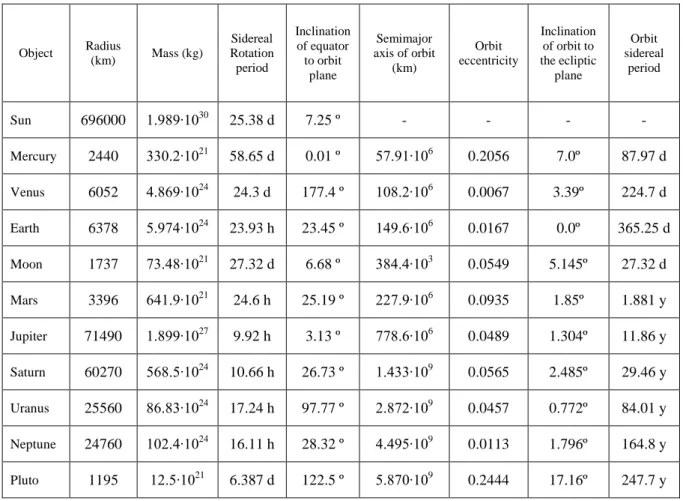
Table A. 1 Astronomical data for the Sun, planets and the Moon. [2 pages/mukasurat]
Student may answer the questions either in English or Bahasa Malaysia.
[Pelajar boleh menjawab soalan dalam Bahasa Inggeris atau Bahasa Malaysia].
Answer to each question must begin from a new page.
[Jawapan untuk setiap soalan mestilah dimulakan pada mukasurat yang baru].
In the event of any discrepancies, the English version shall be used.
[Sekiranya terdapat sebarang percanggahan pada soalan peperiksaan, versi Bahasa Inggeris hendaklah digunapakai].
1. [a] From the Newton’s Law of Gravitation, the weight W is defined as
𝑊 = 𝐺𝑀𝑀𝑟2 = 𝑚 �𝐺𝑀𝑟2� or 𝑊 = 𝑚𝑚 where
𝑚 =𝐺𝐺𝑟2
Explain about W under the condition of gravity and free fall.
(10 marks)
[b] Draw the location of the equilibrium points that also known as Lagrangian Points for Earth-Sun system. If a spacecraft for Sun observation is planned to be launched, which point of Lagrangian Point is suitable for this mission? Explain.
(40 marks)
[c] Relative to an earth-centered non-rotating frame, the position and velocity vectors of a spacecraft are
𝐫0 = 3450𝐢̂ − 1700𝐣̂ + 7750𝐤̂ 𝑘𝑚
𝐯0 = 5.4𝐢̂ − 5.4𝐣̂ + 1.0𝐤̂ 𝑘𝑚
(i) Calculate the distance and speed of the spacecraft after the true anomaly changes by 82°, see refer Appendix for equation.
(ii) Show that the specific angular momentum ℎ and total energy 𝜀 are conserved.
2. [a] Draw the orientation of the orbit in three dimensions and list all the classical orbital elements.
(50 marks)
[b] If the eccentricity of the elliptical orbit depicted in Figure 2[b] is 0.5, calculate, in terms of the period 𝑇, the time required to fly from 𝑃 to 𝐵. Given the mean anomaly and eccentric anomaly of this type of orbit are as follow 𝐺𝑒 = 𝐸 − 𝑒 sin 𝐸 𝐸 = 2 tan−1��1 − 𝑒 1 + 𝑒 tan 𝜃 2� Figure 2 [b] (30 marks)
[c] An essential aspect of a satellite mission is the occurrence of solar eclipses. Select a satellite orbit such that the satellite is in full sunlight throughout its mission lifetime. Give the definition of the selected orbit.
3. [a] NASA is planning to launch a satellite for monitoring global sea rise by gathering environmental intelligence from oceans. Suggest an orbit for this satellite and explain why you choose the orbit?
(20 marks)
[b] For a spacecraft, the following orbital parameters are given: 𝑒 = 1.5; perigee altitude = 300 𝑘𝑚; 𝑖 = 35°; Ω = 130°; 𝜔 = 115°. Calculate 𝐫 and 𝐯 at perigee relative to the geocentric equatorial frame.
(30 marks)
[c] A space vehicle in a circular orbit at an altitude of 500 km above the earth executes a Hohmann transfer to a 1000 km circular orbit (refer Figure 3[c]). Calculate the total delta-v requirement.
Figure 3[c]
4. [a] ESA wants to place a communications satellite into a Geosynchronous orbit from a low Earth, parking orbit (refer Figure 4[a]). What is the ∆𝑉𝑡𝑡𝑡𝑡𝑡 for this transfer and how long will it take? Given that Rorbit1 =
6570 km and Rorbit2 = 42160 km.
(50 marks)
[b] A spacecraft conducted a bi-elliptical Hohnmann transfer from a geocentric circular orbit of 7000 km radius to 105 000 km radius. The apogee of the first ellipse is 210 000 km. To summarize, rA = 7000 km,
rB = 210 000 km, rC = rD = 105 000 km
(i) Sketch the orbit path of the transfer
(10 marks)
(ii) Find the total delta V requirement for the transfers
(40 marks)
5. [a] Figure 5 [a] shows the
re- entry vehicle
during the Apollo
mission. Explain
FIVE characteristics
of the shape selection
Figure 5[a]
(10 marks)
[b] Satellites A and B are in the same circular orbit of radius r. B is 180° ahead of A. Calculate the semi-major axis of a phasing orbit in which A will rendezvous with B just one revolution in the phasing orbit.
(20 marks)
[c] Estimate the total delta V requirement for a Hohmann transfer from Earth to Mercury, assuming a 150 𝑘𝑚 circular parking orbit at Earth and a 150 𝑘𝑚 circular capture orbit at Mercury. Furthermore, assume that the planets have coplanar circular orbits with radii equal to the semi major axes listed in Table A.1.(Appendix)
1. [a] Daripada Hukum Gravitasi Newton, berat W didefinasikan sebagai 𝑊 = 𝐺𝑀𝑀𝑟2 = 𝑚 � 𝐺𝑀 𝑟2� atau 𝑊 = 𝑚𝑚 di mana 𝑚 =𝐺𝑀𝑟2
Terangkan tentang berat W di bawah keadaan gravity dan jatuh bebas.
(10 markah)
[b] Lukis lokasi titik ekuilibrium yang dikenali juga sebagai titik Langragian untuk system Bumi-Matahari. Jika kapal angkasa untuk memerhati Matahari dirancang untuk dilancarkan, di manakah titik Langrangian yang sesuai untuk misi ini. Terangkan.
(40 markah)
[c] Relatif kepada bingkai tidak berputar dan berpusat kepada bumi, kedudukan dan vector halaju sebuah kapal angkasa adalah
𝒓0 = 3450𝒊̂ − 1700𝒋̂ + 7750𝒌� 𝑘𝑚
(i) Kira jarak dan laju kapal angkasa itu selepas anomali benar berubah kepada 82°, lihat Appendiks.
(ii) Tunjukkan momentum sudut spesifik h dan jumlah tenaga adalah abadi.
(50 markah)
2. [a] Lukis orientasi tiga dimensi dan senaraikan semua elemen orbit klasik.
(50 markah)
[b] Jika eksentrisiti pada orbit elips di dalam Gambarajah 2 [b] adalah 0.5, kira, di dalam masa T, masa yang diperlukan untuk terbang dari P ke B. Diberikan min anomali dan eksentrik anomaly untuk orbit jenis ini adalah seperti berikut
𝐺𝑒 = 𝐸 − 𝑒 𝑠𝑖𝑠 𝐸 𝐸 = 2 𝑡𝑡𝑠−1��1 − 𝑒 1 + 𝑒 𝑡𝑡𝑠 𝜃 2� Gambarajah 2[b] (30 markah)
satu orbit satelit supaya satelit sentiasa menerima cahaya matahari penuh sepanjang misi di orbit. Beri definisi orbit yang dipilih tersebut.
(20 markah)
3. [a] NASA merancang untuk melancarkan satelit untuk memantau kenaikan paras laut secara global dengan mengumpulkan risikan persekitaran daripada laut. Cadangkan orbit untuk satelit ini dan terangkan kenapa orbit ini dipilih.
(20 markah)
[b] Untuk sebuah kapal angkasa, parameter orbit diberi seperti berikut: 𝑒 = 1.5; ketinggian perigee = 300 𝑘𝑚; 𝑖 = 35°; Ω = 130°; 𝜔 = 115°. Kira 𝒓 dan 𝒗 pada relatif perigee ke bingkai geopusat khatulistiwa.
(30 markah)
[c] Sebuah kapal angkasa pada orbit bulat di ketinggian 500 km dari permukaan bumi menjalankan pemindahan Hohnmann ke orbit bulat 1000 km.(rujuk Gambarajah 3[c]). Kira keperluan jumlah delta-V.
Gambarajah 3[c]
4. [a] ESA ingin meletakkan satelit komunikasi di orbit geosegerak dari orbit parking di orbit rendah bumi (rujuk Gambarajah 4[a]). Apakah ∆𝑉𝑡𝑡𝑡𝑡𝑡 untuk pemindahan ini dan berapa lama ia mengambil masa? Diberi Rorbit1 = 6570 km and Rorbit2 = 42160 km.
Gambarajah 4[a]
[b] Sebuah kapal angkasa menjalankan pemindahan Hohnmann secara bi-ellips daripada orbit bulat geopusat dengan jejari 7000 km ke jejari 105 000 km. Apogee untuk orbit ellips pertama adalah 210 000 km. Kesimpulannya,rA = 7000 km, rB = 210 000 km, rC = rD = 105 000 km
(i) Lakarkan perjalanan orbit untuk pemindahan ini
(ii) Cari jumlah delta V yang diperlukan untuk pemindahan ini.
(40 markah)
5. [a] Gambarajah 5[a] menunjukkan kenderaan masuk semula ketika misi
Apollo. Terangkan LIMA karakteristik untuk pemilhan bentuk kenderaan masuk semula.
Gambarajah 5[a]
(10 markah)
[b] Satelit A dan B berada di orbit bulat yang sama dengan radius r. B adalah 180° di hadapan A. Kira axis semi-major di orbit pemfasaan yang mana A aka berjumpa dengan B di dalam satu revolusi orbit pemfasaan.
parking Utarid adaah 150 𝑘𝑚. Tambahan, anggap planet-planet adalah di orbit bulat koplanar dengan jejari sama dengan paksi semi major di
Jadual A.1.(Appendiks)
(70 markah)
APPENDIX 1/LAMPIRAN 1
Object Radius (km) Mass (kg) Sidereal Rotation period Inclination of equator to orbit plane Semimajor axis of orbit (km) Orbit eccentricity Inclination of orbit to the ecliptic plane Orbit sidereal period Sun 696000 1.989∙1030 25.38 d 7.25 º - - - - Mercury 2440 330.2∙1021 58.65 d 0.01 º 57.91∙106 0.2056 7.0º 87.97 d Venus 6052 4.869∙1024 24.3 d 177.4 º 108.2∙106 0.0067 3.39º 224.7 d Earth 6378 5.974∙1024 23.93 h 23.45 º 149.6∙106 0.0167 0.0º 365.25 d Moon 1737 73.48∙1021 27.32 d 6.68 º 384.4∙103 0.0549 5.145º 27.32 d Mars 3396 641.9∙1021 24.6 h 25.19 º 227.9∙106 0.0935 1.85º 1.881 y Jupiter 71490 1.899∙1027 9.92 h 3.13 º 778.6∙106 0.0489 1.304º 11.86 y Saturn 60270 568.5∙1024 10.66 h 26.73 º 1.433∙109 0.0565 2.485º 29.46 y Uranus 25560 86.83∙1024 17.24 h 97.77 º 2.872∙109 0.0457 0.772º 84.01 y Neptune 24760 102.4∙1024 16.11 h 28.32 º 4.495∙109 0.0113 1.796º 164.8 y Pluto 1195 12.5∙1021 6.387 d 122.5 º 5.870∙109 0.2444 17.16º 247.7 y
Table A.2 Orbital Mechanics Useful Formulas
𝑚 = ℎ sin ∆𝜃
𝑓̇ =𝜇ℎ1 − cos ∆𝜃sin ∆𝜃 �ℎ𝜇2(1 − cos ∆𝜃) −𝑟1
0− 1 𝑟� 𝑚̇ = 1 −𝜇𝑟ℎ20(1 − cos ∆𝜃) where, 𝑟 = ℎ𝜇2 1 1 + � ℎ𝜇𝑟2 0− 1� cos ∆𝜃 − ℎ𝑣 𝑟0 𝜇 sin ∆𝜃 𝑣𝑟0 =𝐫0𝑟∙ 𝐯0 0 ℎ = 𝑟0𝑣⊥0 = 𝑟0�𝑣02 − 𝑣𝑟02 Mean anomaly 𝐺𝑒 = 𝐸 − 𝑒 sin 𝐸 𝐸 = 2 tan−1��1 − 𝑒 1 + 𝑒 tan 𝜃 2� 1. 𝜉 = 1 �1+�2𝜋𝛿�2