Journal of Forestry Policy Analysis Vol.16 No.1, Mei 2019
JURNAL
ANALISIS KEBIJAKAN KEHUTANAN
Analisis Kebijakan Kehutanan Vol.16, No.1, Mei 2019 : 1-87
KEMENTERIAN LINGKUNGAN HIDUP DAN KEHUTANAN Ministry of Environment and Forestry
BADAN PENELITIAN, PENGEMBANGAN DAN INOVASI Research, Development and Innovation Agency
PUSAT PENELITIAN DAN PENGEMBANGAN SOSIAL, EKONOMI, KEBIJAKAN DAN PERUBAHAN IKLIM Centre for Research and Development on Social, Economy, Policy and Climate Change
BOGOR - INDONESIA
KEMENTERIAN LINGKUNGAN HIDUP DAN KEHUTANAN Ministry of Environment and Forestry
BADAN PENELITIAN, PENGEMBANGAN DAN INOVASI Research, Development and Innovation Agency
PUSAT PENELITIAN DAN PENGEMBANGAN SOSIAL, EKONOMI, KEBIJAKAN DAN PERUBAHAN IKLIM Centre for Research and Development on Social, Economy, Policy and Climate Change
BOGOR - INDONESIA
RISTEKDIKTI No. 30/E/KPT/2018
Diterbitkan oleh (Published by):
Pusat Penelitian dan Pengembangan Sosial, Ekonomi, Kebijakan dan Perubahan Iklim (Centre for Research and Development on Social, Economy, Policy and Climate Change) Badan Penelitian, Pengembangan dan Inovasi
(Research, Development and Innovation Agency)
Alamat (Address) : Jl. Gunung Batu No.5 Bogor 16118, Indonesia
Telepon (Phone) : +62-251-8633944 Email : [email protected];
Fax (Fax) : +62-251-8634924 Laman (web) : www. puspijak.org
Jurnal Analisis Kebijakan Kehutanan telah terakreditasi berdasarkan Keputusan Kepala Lembaga Ilmu Pengetahuan Indonesia (LIPI) No.
1221/E/2016. Jurnal ini memuat karya tulis ilmiah dari hasil penelitian, pemikiran/tinjauan ilmiah mengenai kebijakan kehutanan atau bahan masukan bagi kebijakan kehutanan. Terbit pertama kali tahun 2004, terakreditasi tahun 2008 dengan nomor 124/Akred-LIPI/P2MBI/06/2008.
Jurnal Analisis Kebijakan Kehutanan terbit dengan frekuensi dua kali setahun (Mei dan November).
Journal of Forestry Policy Analysis is an accredited journal, based on decree of Director of Indonesian Science Institute (LIPI) No. 1221/E/2016.
This Journal is a scientific publication reporting research finding and forestry policy review of forestry policy recommendation. First published in 2004, accredited by LIPI in 2008 with number 124/Akred-LIPI/P2MBI/06.2008. Journal of Forestry Policy Analysis publish two times annually (May and November).
Penanggung Jawab (Advisory Editor) : Kepala Pusat Penelitian dan Pengembangan Sosial, Ekonomi, Kebijakan dan Perubahan Iklim DEWAN REDAKSI (EDITORIAL BOARD) :
Ketua (Editor in Chief) : Dr. Ir. Sulistya Ekawati, M.Si (P3SEKPI) Redaktur (Managing Editor) : Dana Apriyanto, S.Hut, M.Sc. M.T (P3SEKPI) Initial Reviewer : Yanto Rochmayanto, S.Hut., M.Si (P3SEKPI) Editor Bagian (Section Editors) : 1. Surati, S.Hut, M.Si (P3SEKPI)
2. Fentie J Salaka, S.Hut,M.Si (P3SEKPI) 3. Galih Kartika Sari, S.Hut.,M.Si (P3SEKPI) 4. Fulki Hendrawan, S.Hut (P3SEKPI)
Mitra Bebestari (Peer Reviewers) : 1. Prof. Dr. Ir. Hariadi Kartodihardjo, M.Sc (Kebijakan Kehutanan, Institut Pertanian Bogor) 2. Prof. Dr. Ir. Bramasto Nugroho, MS (Kelembagaan Ekonomi Kehutanan, Institut Pertanian Bogor) 3. Prof. Dr. Ir. Herry Purnomo,M.Comp. (Kebijakan Kehutanan, Mitigasi REDD+, Adaptasi Perubahan Iklim
dan Furniture Value Chain, CIFOR)
4. Prof. Dr. Ir. Dudung Darusman,M.Sc(Kebijakan Kehutanan, Institut Pertanian Bogor)
5. Dr. Ir. Boen M. Purnama, M.Sc (Ekonomi dan Sumber Daya Hutan, Institut Pemerintahan Dalam Negeri) 6. Prof. Ir. Yonariza, M.Sc., Ph.D (Manajemen Sumber Daya Hutan, Universitas Andalas)
7. Prof. Dr.Ir. Hadi Susilo Arifin, M.Sc. (Ekologi dan Manajemen Lanskap, Institut Pertanian Bogor) 8. Dr. Ir. Bambang Supriyanto, M.Sc. (Sosial Ekonomi Kemasyarakatan, Kebijakan Publik, Perubahan Iklim
dan Konservasi Sumber Daya Alam, Direktorat Jenderal Perhutanan Sosial dan Kemitraan Lingkungan) 9. Dr. Ir. I Wayan Susi Dharmawan,S.Hut, M.Si. (Hidrologi dan Kesuburan Tanah, Pusat Litbang Hutan) 10. Prof. Dr. Ir. Dodik R. Nurrochmat,M.Sc. (Politik Ekonomi Kehutanan, Institut Pertanian Bogor) 11. Frida Sidik, B.Sc., M.Sc., PhD. (Mangrove, Konservasi Sumber Daya Pesisir, Perubahan Iklim,
Kementerian Kelautan dan Perikanan)
12. Dr. Nurul Laksmi Winarni (Climate Change Adaptation, Universitas Indonesia)
13. Ir. Hunggul Yudhoyono, M.Sc (Hidrologi dan Konservasi Tanah, Balai Litbang LHK Makasar) Anggota Dewan Redaksi (Reviewers) : 1. Dr. Ir. A. Ngaloken Gintings, MS (Konservasi Tanah dan Air, MKTI)
2. Dr. Ir. Sulistya Ekawati, M.Si (Sosiologi Kehutanan, P3SEKPI) 3. Dr. Tuti Herawati,S.Hut,M.Si (Analisis Kebijakan, P3SEKPI)
4. Dr. Virni Budi Arifanti, S.Hut.,M.Sc (Penginderaan Jauh Geografi dan Informasi, P3SEKPI) 5. Ir. Ari Wibowo, M.Sc (Perlindungan Hutan, P3SEKPI)
6. Dr. Fitri Nurfatriani,S.Hut,M.Si (Ekonomi Kehutanan, P3SEKPI)
7. Dr Gamin,A.Md.,S.Sos.,MP (Pemetaan dan Analisis untuk Konflik dan Spasial, Balai Diklat LHK Kadipaten)
8. R. Deden Djaenudin,S.Si,M.Si (Ekonomi Kehutanan, P3SEKPI) 9. Dr. Ir. Subarudi,M.Wood.Sc (Sosiologi Kehutanan, P3SEKPI) 10. Dr. Ir. Niken Sakuntaladewi,M.Sc (Sosiologi Kehutanan, P3SEKPI) REDAKSI PELAKSANA (EDITORIAL TEAM) :
Penyunying Bahasa (Copy Editors) : 1. Drs. Hariono (P3SEKPI) 2. Drs. Sunaryanto (Pusdiklat SDM)
Penyunting Tata Letak (Layout Editor) : Suhardi Mardiansyah (Sekretariat Badan Litbang dan Inovasi) Administrasi Laman E-journal (Web
Admin) : Fulki Hendrawan, S.Hut (P3SEKPI)
Koreksi Naskah (Proofreader) : Prof. Dr.Ir. Djaban Tinambunan, MS.
Sekretariat (Secretariat) : 1. Drs. Hariono (P3SEKPI)
2. Parulian Pangaribuan,S.Sos (P3SEKPI) 3. Fulki Hendrawan, S.Hut (P3SEKPI)
KEMENTERIAN LINGKUNGAN HIDUP DAN KEHUTANAN Ministry of Environment and Forestry
BADAN PENELITIAN, PENGEMBANGAN DAN INOVASI Research, Development and Innovation Agency
PUSAT PENELITIAN DAN PENGEMBANGAN SOSIAL, EKONOMI, KEBIJAKAN DAN PERUBAHAN IKLIM Centre for Research and Development on Social, Economy, Policy and Climate Change
BOGOR - INDONESIA
Journal of Forestry Policy Analysis Vol.16 No.1, Mei 2019
JURNAL
ANALISIS KEBIJAKAN KEHUTANAN
RISTEKDIKTI No. 30/E/KPT/2018
penghargaan yang tinggi kepada Mitra Bebestari (Peer Reviewers) yang telah menelaah naskah- naskah yang dimuat pada edisi Vol. 16 No.1 Mei tahun 2019. Mitra Bebestari (Peer Reviewers) dimaksud adalah:
1. Prof. Dr. Ir. Hariadi Kartodihardjo, M.Sc.
2. Prof. Dr. Ir. Bramasto Nugroho, M.S 3. Dr. Ir. Boen M. Purnama, M.Sc.
5. Dr. Ir. I Wayan Susi Dharmawan,S.Hut, M.Si.
6. Ir. Hunggul Yudhoyono, M.Sc.
DAFTAR ISI (CONTENTS)
DECISIONS MAKING PROCESS IN ORGANIC STIMULANT INNOVATION ADOPTIONS USING STAKEHOLDERS ANALYSIS
(Proses Pengambilan Keputusan dalam Adopsi Inovasi Stimulan Organik Melalui Analisis Peran Pemangku Kepentingan)
Wa Ode Muliastuty Arsyad, Esti Rini Satiti & Sukadaryati ... 1-10 EFEKTIVITAS KEBIJAKAN PENGELOLAAN MANGROVE UNTUK MENDUKUNG MITIGASI PERUBAHAN IKLIM DI PROVINSI KALIMANTAN TIMUR
(Effectiveness of Mangrove Management Policies to Support Climate Change Mitigation in East Kalimantan Province)
Mimi Salminah & Iis Alviya ... 11-29 ANALISIS EKONOMI PENGEMBANGAN PEMBANGKIT LISTRIK TENAGA MIKRO HIDRO: STUDI KASUS DI KABUPATEN MUARA ENIM, SUMATERA SELATAN
(Economic Analysis of Micro Hydro Power Plant Development: A Case Study in Muara Enim Regency, South Sumatra)
Nur Arifatul Ulya, Efendi Agus Waluyo, & Adi Kunarso ... 31-45 EFEKTIVITAS KEBIJAKAN ALOKASI LAHAN 12,7 JUTA HA UNTUK PERHUTANAN SOSIAL: STUDI KASUS PROVINSI NUSA TENGGARA BARAT DAN DAERAH ISTIMEWA YOGYAKARTA
(Effectiveness of 12.7 Million Ha Land Allocation Policy for Social Forestry: Case Study of Nusa Tenggara Barat and Daerah Istimewa Yogyakarta Provinces)
Fitri Nurfatriani & Iis Alviya ... 47-66 REVITALISASI MATA PENCAHARIAN DI LAHAN GAMBUT: KERAJINAN
ANYAMAN DARI PURUN SEBAGAI SALAH SATU BENTUK USAHA BERKELANJUTAN DI KABUPATEN OGAN KOMERING ILIR (OKI), SUMATERA SELATAN
(Livelihood Revitalization in Peatlands: Woven Crafts from Purun as a Sustainable Business Option in Ogan Komering Ilir (OKI) Regency, South Sumatra)
Bunga Karnisa Goib, Nadia Fitriani, Satrio Adi Wicaksono, Muhammad Yazid & Dessy Andriani ... 67-87
RISTEKDIKTI No. 30/E/KPT/2018
p-ISSN 0216-0897
e-ISSN 2502-6267 Vol. 16 No.1, Mei 2019
Kata kunci yang dicantumkan adalah istilah bebas. Lembar abstrak ini boleh diperbanyak tanpa izin dan biaya.
UDC (OSDCF) 630*92
Wa Ode Muliastuty Arsyad, Esti Rini Satiti & Sukadaryati Proses Pengambilan Keputusan dalam Adopsi Inovasi Stimulan Organik Melalui Analisis Peran Pemangku Kepentingan
Jurnal Analisis Kebijakan Kehutanan Vol. 16 No. 1, hal. 1-10 Penelitian ini bertujuan untuk mengidentifikasi pemangku kepentingan yang terlibat dan menganalisis hubungan antar pemangku kepentingan dalam pengambilan keputusan adopsi penggunaan stimulandi wilayah Perhutani. Analisisyang digunakan adalah ISM dan analisis hubungan antar pemangku kepentingan yang diklasifikasi dalamlima kategori, yaitu interaksi, kontinuitas, sinergitas, kekuatan dan keberadaan konflik. Hasil penelitian menunjukkan bahwa pemangku kepentingan yang terlibat dalam kebijakan adopsi penggunaan stimulan adalah Perhutani (Kuadran IV). Penyadap pinus berada pada Kuadran I. Akademisi, peneliti, Polisi hutan, Dinas Kehutanan dan KLHK berada pada Kuadran II. Hubungan interaksi, sinergitas dan kontinuitas antar pemangku kepentingan telah terjalin dengan baik kecuali pihak akademisi dan peneliti.
Kata kunci: Interpretative Structural Modelling (ISM), kebijakan, pemangku kepentingan, stimulan.
UDC (OSDCF) 630*901:116(594.47)
Nur Arifatul Ulya, Efendi Agus Waluyo, & Adi Kunarso
Analisis Ekonomi Pengembangan Pembangkit Listrik Tenaga Mikro Hidro: Studi Kasus di Kabupaten Muara Enim, Sumatera Selatan
Jurnal Analisis Kebijakan Kehutanan Vol. 16 No. 1, hal. 31-45 Tulisan ini bertujuan untuk melakukan analisis kelayakan pembangunan dan pengelolaan PLTMH swadaya masyarakat untuk mendukung konservasi sumberdaya hutan. Analisis finansial dan ekonomi digunakan untuk mengetahui kelayakan pengembangan dan pengelolaan PLTMH swadaya masyarakat. Hasil analisis menunjukkan bahwa pembangunan dan pengelolaan PLTMH di Desa Danau Gerak tidak layak finansial. Pembangunan dan pengelolaan PLTMH secara finansial layak apabila menggunakan skema tarif listrik pascabayar Perusahaan Listrik Negara (PLN) untuk batas daya hingga 450 VA, dan layak secara ekonomis apabila menggunakan skema tarif listrik pascabayar PLN untuk batas daya hingga 1.300 VA. Pemanfaatan air untuk PLTMH meningkatkan kesadaran kolektif masyarakat untuk melakukan konservasi sumberdaya hutan.
Kata kunci: Ekonomi, finansial, mikro hidro, Sumatera Selatan, Daerah Aliran Sungai (DAS).
UDC (OSDCF) 630*94:176.2(594.11) Mimi Salminah & Iis Alviya
Efektivitas Kebijakan Pengelolaan Mangrove untuk Mendukung Mitigasi Perubahan Iklim di Provinsi Kalimantan Timur
Jurnal Analisis Kebijakan Kehutanan Vol. 16 No. 1, hal. 11-29 Tulisan ini mengkaji efektivitas implementasi kebijakan pengelolaan mangrove untuk menurunkan emisi di Kalimantan Timur dengan menggunakan teori Grindle. Hasil analisis menunjukkan bahwa masih terdapat ketidakefektifan dalam implementasi kebijakan tersebut karena belum adanya peraturan teknis yang menjelaskan lebih rinci kebijakan yang telah dikeluarkan, belum tersedianya data satu mangrove yang lengkap, serta belum banyak berkembangnya opsi pengelolaan tambak ramah lingkungan. Faktor lain yang berperan penting dalam implementasi kebijakan tersebut adalah koordinasi parapihak, sosialisasi, dan fasilitasi agar masyarakat mengembangkan tambak ramah lingkungan. Secara teori, efektivitas implementasi kebijakan dipengaruhi oleh kejelasan dan konsistensi isi dari kebijakan tersebut.
Kata kunci: Kebijakan pengelolaan mangrove, mitigasi perubahan iklim, efektivitas kebijakan, tata guna lahan.
UDC (OSDCF) 630*91(594.71+594.57) Fitri Nurfatriani & Iis Alviya
Efektivitas Kebijakan Alokasi Lahan 12,7 Juta ha untuk Perhutanan Sosial: Studi Kasus Provinsi Nusa Tenggara Barat dan Daerah Istimewa Yogyakarta
Jurnal Analisis Kebijakan Kehutanan Vol. 16 No. 1, hal. 47-66 Tulisan ini bertujuan untuk: (1) menentukan kriteria dan indikator prioritas dalam kebijakan alokasi lahan untuk perhutanan sosial, dan (2) menganalisis tingkat efektivitas kebijakan alokasi lahan untuk perhutanan sosial. Pendekatan Pairwise Comparison- AHP dan metode skoring digunakan dalam penelitan ini. Hasil penelitian menunjukkan bahwa aspek lingkungan merupakan prioritas utama dalam kebijakan alokasi lahan untuk PS, diikuti dengan aspek ekonomi. Dari aspek lingkungan, kebijakan PS memiliki prioritas utama untuk mengatasi kasus perambahan di kawasan hutan; sementara dari aspek ekonomi, kebijakan tersebut prioritaskan sebagai sumber pendapatan bagi masyarakat di dalam/
sekitar hutan. Berdasarkan indeks efektivitas, kebijakan PS masuk dalam kategori cukup efektif dengan nilai 10,79.
Kata kunci: Perhutanan sosial, pairwise comparison, kriteria dan indikator, AHP, efektivitas kebijakan.
Jurnal Analisis Kebijakan Kehutanan Vol. 16 No. 1, hal. 67-87
Studi ini bertujuan menganalisis penghambat usaha anyaman purun secara berkelanjutan di Kabupaten OKI, Sumatera Selatan, beserta potensi pemasaran hijau dari produk tersebut. Metode kualitatif dan kuantitatif digunakan dalam studi ini. Permasalahan yang teridentifikasi di antaranya terbatasnya akses dan pengetahuan pengrajin, ketidakstabilan persediaan bahan baku tanaman, keterbatasan akses pendanaan pengrajin, serta kualitas produk yang masih rendah. Hasil penelitian menunjukkan bahwa lebih dari 80% responden bersedia untuk membayar lebih tinggi anyaman berlabel hijau dibandingkan dengan anyaman biasa. Selanjutnya, penyesuaian kebijakan, peningkatan kapasitas spesifik, dan strategi pemasaran yang inovatif dibutuhkan untuk mendukung keberlanjutan dari usaha anyaman purun.
Kata kunci: : Lahan gambut; mata pencaharian; pasar; produk anyaman; purun.
p-ISSN 0216-0897
e-ISSN 2502-6267 Vol. 16 No.1, Mei 2019
The discriptors given are keywords. The abstract sheet may be reproduced without permission or charge.
UDC (OSDCF) 630*92
Wa Ode Muliastuty Arsyad, Esti Rini Satiti & Sukadaryati
Decisions Making Process in Organic Stimulant Innovation Adoptions using Stakeholders Analysis
Journal of Forestry Policy Analysis Vol. 16 No. 1, p. 1-10 This study aims to identify the involved stakeholders and to analyze the relationships among stakeholders in the policy of adopting stimulant innovation in Perhutani area. Analysis is performed by using ISM and stakeholder relationship are classified into five categories: interaction, continuity, synergy, strength, and the existence of conflicts. The results show that the stakeholders involved in the stimulants innovation adoption policy is Perhutani (Quadrant IV). The pine tappers are in Quadrant I. Academicians, researchers, forest rangers, forestry services officials and KLHK are in Quadrant II. Interaction, synergy and the relationship continuity among stakeholders ae well-established, except among the researchers and academicians.
Keywords: Interpretative Structural Modelling (ISM); policy;
stakeholders; stimulant.
UDC (OSDCF) 630*901:116(594.47)
Nur Arifatul Ulya, Efendi Agus Waluyo, & Adi Kunarso
Economic Analysis of Micro Hydro Power Plant Development: A Case Study in Muara Enim Regency, South Sumatra
Journal of Forestry Policy Analysis Vol. 16 No. 1, p. 31-45 This paper investigates feasibility of development and management of self-help MHP to support forest conservations.
Financial and economic analyses are applied to determine feasibility of development and management of MHP. The result indicates that construction and management of MHP in Danau Gerak village are not feasible. The development and management of MHP will be financially feasible when it implements postpaid tariff scheme of State Electricity Companyfor power limit up to 450 VA, and economically feasible when it applies postpaid tariff scheme for power limit up to 1,300 VA. Water utilization for MHP increases the collective awareness to conserve forest.
Keywords: Economic; financial; micro hydro; South Sumatra;
watershed.
UDC (OSDCF) 630*94:176.2(594.11) Mimi Salminah & Iis Alviya
Effectiveness of Mangrove Management Policies to Support Climate Change Mitigation in East Kalimantan Province
Journal of Forestry Policy Analysis Vol. 16 No. 1, p. 11-29 This paper analyses effectiveness of implementation of mangrove management-related policy to reduce emission in East Kalimantan using Grindle Theory. The results show that there is still ineffective practices in implementing the policy due to the absence of technical regulations determining the content of the issued policies, insufficient provision of one mangrove data, and of green fish pond management options. Moreover, coordination among related sectors, awareness raising programs, and facilitation for local coastal community to apply sustainable mangrove management play significant role in the policy implementation. In theory, effectiveness of policy implementation is affected by clarity and consistency of policy content.
Keywords: Mangrove management policy; climate change mitigation; policy effectiveness; land use.
UDC (OSDCF) 630*91(594.71+594.57) Fitri Nurfatriani & Iis Alviya
Effectiveness of 12.7 Million Ha Land Allocation Policy for Social Forestry: Case Study of Nusa Tenggara Barat and Daerah Istimewa Yogyakarta Provinces
Journal of Forestry Policy Analysis Vol. 16 No. 1, p. 47-66 This paper aims to: determine criteria and indicators priority in land allocation policy for social forestry, and analyze the effectiveness of the policy. This study applies Pairwise Comparison- AHP and scoring approaches based on Social Forestry expert judgement. The results show that the environmental aspect is the top priority in the policy, followed by economic aspect. From the aspect of environment, the main priority is to overcome estate forest encroachment issues, while from economic, is as a source of income for communities surrounding the forest. Based on effectiveness index, this policy is categorized quite effective with value of 10.79.
Keywords: Social Forestry Policy, pairwise comparison, criteria and indicators, communities.
South Sumatra
Journal of Forestry Policy Analysis Vol. 16 No.1, p. 67-87
This study aims to analyze the obstacles of sustainable purun weaving in OKI Regency, South Sumatra, and its 'green' marketing potential. Qualitative and quantitative methods are applied in this study. Identified challenges include the lack of market knowledge and connections, unstable supply of raw materials, lack of financial capitalization, and low product quality. Moreover, the market potential of green products is highly promising as more than 80% of respondents are willing to pay a higher price for the green products. Further, policy adjustment, specific capacity building, and innovative marketing strategies are required to support the business sustainability of purun weaving.
Keywords: Livelihood; market; peatland; purun; woven product.
DECISIONS MAKING PROCESS IN ORGANIC STIMULANT INNOVATION ADOPTIONS USING STAKEHOLDERS ANALYSIS
(Proses Pengambilan Keputusan dalam Adopsi Inovasi Stimulan Organik Melalui Analisis Peran Pemangku Kepentingan)
Wa Ode Muliastuty Arsyad, Esti Rini Satiti, & Sukadaryati
Pusat Penelitian dan Pengembangan Hasil Hutan, Jl. Gunung Batu No. 5, Bogor, 16610, West Java, Indonesia E-mail: [email protected]; [email protected]; [email protected]
Diterima 2 Juli 2018, direvisi 13 Maret 2019, disetujui 20 Maret 2019
ABSTRACT
Wood vinegar-based stimulant is potential to be developed in Perhutani, therefore, the process of adoption is indispersable to be analyzed. This study aims at identifying the involved stakeholders and analysing the relationships among stakeholders in the policy of adopting stimulant innovation in Perhutani areas. Respondents are selected using a snowball sampling method. Stakeholder analysis is performed by using Interpretative Structural Modeling (ISM) while stakeholder relations analysis is carried out by classifying the relation into five categories: interaction, continuity, synergy, strength, and the presence or absence of conflicts. The results shows that the stakeholders involved in the stimulants innovation adoption policy are mostly in Quadrant IV or performs that Perhutani officials have legal authority in decision-making process. The pine tappers in Quadrant I implies that they have limited influence to stimulants innovation adoption policy but they have enormous interest in the management of pine forests. Academicians, researchers, forest rangers, forestry services officials and Ministry of Environment and Forestry officials are in Quadrant II. They play important role as intermediaries or facilitators and have considerable influence on decision-making process. Interaction, synergy and relationship continuity among stakeholders are well-established, except among researchers and academicians. Meanwhile, they could colaborate research with Perhutani.
Keywords: Interpretative Structural Modelling (ISM); policy; stakeholders; stimulant.
ABSTRAK
Adopsi stimulan berbahan dasar cuka kayu berpotensi untuk dikembangkan di Perhutani, oleh karena itu proses pengadopsian inovasi stimulan cuka kayu tersebut perlu dikaji. Penelitian ini bertujuan untuk mengidentifikasi pemangku kepentingan yang terlibat dan menganalisis hubungan antar pemangku kepentingan dalam pengambilan keputusan adopsi penggunaan stimulan di wilayah Perhutani. Responden dipilih dengan menggunakan metode snowball sampling. Analisis pemangku kepentingan menggunakan Interpretative Structural Modelling (ISM) sedangkan analisis hubungan antar pemangku kepentingan dilakukan dengan mengklasifikasikan hubungan tersebut dalam lima kategori, yaitu interaksi, kontinuitas, sinergitas, kekuatan, dan ada tidaknya konflik. Hasil penelitian menunjukkan bahwa pemangku kepentingan yang terlibat dalam kebijakan adopsi penggunaan stimulan sebagian besar berada pada Kuadran IV (Independent) yaitu pejabat Perhutani yang memiliki kewenangan hukum dalam proses pengambilan keputusan. Penyadap pinus berada pada Kuadran I (Autonomous), artinya bahwa mereka memiliki pengaruh terbatas terhadap kebijakan adopsi inovasi stimulan tetapi memiliki minat yang sangat besar dalam pengelolaan hutan pinus. Akademisi, peneliti, Polisi Hutan, Dinas Kehutanan, dan KLHK berada pada Kuadran II (Dependent). Mereka memainkan peran penting sebagai perantara atau fasilitator dan memiliki pengaruh besar dalam proses pengambilan keputusan. Hubungan interaksi, sinergitas, dan kontinuitas antar pemangku kepentingan telah terjalin dengan baik kecuali pihak akademisi dan peneliti. Akademisi dan peneliti bisa terlibat melalui kerjasama riset dengan Perhutani.
Kata kunci: Interpretative Structural Modelling (ISM); kebijakan; pemangku kepentingan; stimulan.
I. INTRODUCTION
The increase of pine sap production is carried out by applying stimulants. Various studies on pine tapping stimulation have been developed, such as an-organic stimulants based on strong acids (H2SO4) and other strong acids. Almost all of Perhutani areas use an-organic stimulants in pine tapping with different compositions depending on the height of the place. The effect of using an-organic stimulants can disrupt the health of trees and their tappers and would cause environmental pollution (Sainoi & Sdoodee, 2012).
The application of friendly environmental stimulant, such as wood vinegar, is essential to support sustainable pine forest management in sap production. Wood vinegar is produced from a carbonized and condensed lignocellulosic waste material. The main component of wood vinegar is acetic acid (CH3COOH) which is classified as weak acids (Darmaji, 2009; Pari
& Nurhayati, 2009;Wijaya, 2010). Addition of acid substance in a pine-tapping process will reduce coagulated, thus it would increase sap production (Rodrigues, Azevedo, Sobreiro, Pelissari, & Fett-Neto, 2008; Reed et al., 2009; Rodrigues, Apel, Henrique, & Neto, 2011; Sharma & Lekha, 2013). Wood vinegar based stimulant is potential to be develop since it is easy to produce, cheap and friendly environmental.
The decision making process in adopting stimulant innovation in Perhutani area considers the following factors: economic, social, environment, and technology.
Economic factor relates to financial income of pine tappers and perhutani, while social factor relates to the pine tappers acceptance to the stimulant. Environmental factor relates to the safety of the stimulant adoption for tappers, pine stands and surounding environment.
Lastly, the technological factor associates with the easiness of the innovative technology.
Stakeholder analysis in adopting stimulant innovation process is necessary to determine which interests are the most probable to
accommodate in the program planning or in the decision making process. Recognizing the key role of stakeholders in order to implement the program is an important tool for policy- makers (Herawati, Widjayanto, Saharuddin,
& Eriyatno, 2010). Stakeholders are all those who influence and or are influenced by policies, decisions, and actions within a system (Reed et al., 2009). In this study, the parties are Perhutani as pine forest managers, pine tapper as workers and other parties, such as academicians and researchers. On the other hand, stakeholders have different influences and interests (Reed et al., 2009). They have plurality point of view in policy interventions which would base their decisions (Ferreti, 2016). Differences of interest and influence among actors could be a source of conflicts because each actor would try hard to achieve their interests the power that to get its interests (Febriyano, 2014). Therefore, it is necessary to know the intensity of stakeholders in the decision making of adopting stimulant innovations in Perhutani by conducting stakeholder analysis from the aspects of influence, relationships, and interests.
This study aims to identify the involved stakeholders, their importance and roles and the relationships among stakeholders in the policy of adopting stimulant innovation in Perhutani area.
II. RESEARCH METHODS
Primary and secondary data was collected in Perhutani regions from August to November 2016. Primary data was collected from the involved stakeholders. Secondary data in the form of reference data is taken from Perhutani and literature studies, and they are carried out to be the supplement of the primary data.
Data and information about the stakeholders in decision-making are collected using in- depth interview methods in accordance with the objectives that have been prepared.
Identification of stakeholders, the importance, and the role as well as the relationships among stakeholders are conducted using
snowball sampling method. This sampling method determines respondents based on the recommendations of the earlier stakeholders.
The data and information are then processed and analyzed.
A. Identification of Stakeholders
Identification of stakeholders is performed by using Interpretative Structural Modeling (ISM) developed by Saxena, Sushil, & Vrat (1992). The steps taken on the ISM method are (Marimin, 2009) covers:
1. Identifying and registering elements. The elements in this study were stakeholders.
2. Building contextual relationships among elements.
3. Preparing Structural Self Interaction Matrix (SSIM). This matrix represents respondents perception of elements of intended relationship, with the symbol representing types of relationship between the two elements. The symbols were:
a. V: relationship of elements Ei to Ej, not vice versa
b. A: relationship of elements Ej to Ei, not vice versa
c. X: interrelation between Ei and Ej, can be otherwise
d. O: unrelated Ei and Ej
4. Compiling Reachability Matrix (RM), by converting SSIM symbol into binary matrix.
5. Clasifying elements at different levels of ISM structure. For this purpose, two devices are associated with each element Ei of the system; Reachability Set (Ri), is a set of all elements that can be reached from the element Ei, and Antecedent Set (Ai), is a set of all elements in which the element Ei can be achieved. In the first iteration, all of elements where Ri = Ri∩Ai, are level 1 elements. In subsequent iterations, the elements are identified as level elements in the previous iterations that are omitted, and the new elements are selected for the next levels using the same rules. Furthermore, all elements of the
system are grouped into different levels.
6. Compiling Canonical matrix by grouping the same elements.This resultant matrix has most of triangular elements with the highest and the lowest is 0 and 1.
7. Preparing Diagraph, the graph of the elements that are related to each other and at a hierarchy level.
8. Generating ISM by moving the entire number of elements with the description of the actual elements.
ISM methodology and techniques are divided into two parts: preparation of hierarchy and classification of sub-elements.
Classification of sub-element refers to RM result which is fulfilled the transitivity rules to obtain the value of Driver-Power (DP) and the value of Dependence (D), in accordance with:
1. Quadrant I; weak driver-weak dependent variables (Autonomous) namely sub- element with DP value ≤ 0.5 X and D≤0.5 X; where X is the number of sub-elements.
These sub-elements are generally unrelated to the system and may have few relationships although they may be strong.
2. Quadrant II; weak driver-strongly dependent variables (Dependent), ie sub- element with DP value ≤ 0.5 X and D> 0.5 X. Sub-elements in this sector are bound sub-elements.
3. Quadrant III; strong driver-strongly dependent variables (Linkage) ie sub- element with DP value > 0.5 X and D >
0.5 X. Sub-elements in this sector should be examined carefully because of the relationship between the sub-element is unstable. Any actions on the sub-element will have an impact on the other sub- elements and the effect of the feedback can magnify the impact.
4. Quadrant IV; strong driver-weak dependent variables (Independent) ie sub-element with DP value > 0.5 X and D ≤ 0.5 X.
This sub-element is the remaining part of the system and it is called independent variable.
B. Relationships Among Stakeholders Stakeholder relations to the policy of adopting innovation stimulant in Perhutani are analyzed in order to identify relationships among various parties who have common interest. Analysis of relationships among stakeholders refers to relationship that is part of 4Rs framework analyst (Dubois, 1998). Identification of relationships among stakeholders comprises five categories, namely interaction, continuity, synergy, strength, and presence or absence of conflicts.
Each category is given a weight value based on Table 1.
III. RESULTS AND DISCUSSION A. Identification of Stakeholders
A stakeholder is a person with an interest or concern on the issues identified by certain considerations, i.e the importance and the influence they have (Harrison, Bosse,
& Phillips, 2009; Frow & Payne, 2011).
Based on the identification, the stakeholders involved or related to the stimulants adoption policy in Perhutani areas and their roles bases on the level of interest and influence which are presented in Table 2.
Based on Table 2, Perhutani and its staff are key factors that have legal authority in decision making of forest management. As a state- owned enterprise, Perhutani is also required
to generate profits for the company so that Perhutani must be able to achieve the targets set by the company. Therefore, Perhutani has the authority and responsibility for all planned program activities. The policy of stimulants adoption in pine tapping bases on SK No.
527/045.1/PROD/Dir datd on September 5th 2007, regarding recommendation for the use of un -organic stimulants, and SK No.220/045.9/PROSAR/Dir April 25th 2011 regarding the use of ETRAT stimulants on pine tapping. The policy on stimulant use is mentioned in a Decree issued by the Director of Perhutani in Jakarta.Based on interviews with Perhutani officials, it is known that the policy of using stimulants in pine tapping according to the decree mentioned above and the implementation will be submitted to the policies of each Unit.Therefore, the policy of stimulant used in each unit varies.
Pine tappers are parties directly affected by the adoption policy and have direct interest in the activity. They are beneficiaries of income from pine tapping business academicians, researchers, Forestry Services Officials to the Ministry of Enviroment and Forestry who have policy support roles. Researchers and academicians are responsible as scientists to contribute ideas to create new innovations and results that can be implemented. The Forestry Services Officials have roles in licensing, while the Ministry of Enviroment and Forestry has
Table 1 Description and weight of value of each relationship category Tabel 1 Deskripsi dan bobot nilai masing-masing kategori hubungan
Score
(Skor) Relationship category (Kategori hubungan)
Relationship criteria (Kriteria hubungan) Interaction
(Interaksi) Continuity
(Kontinuitas) Synergy
(Sinergitas) Strength
(Kekuatan) Conflict (Konflik)
5 Excellent Exist Continuous Exist Strong None
4 Good Exist Continuous Exist Sufficient None
3 Fair Exist Continuous None Weak None
2 Poor Exist None None Weak None
1 No connection None None None Weak None
0 Not identified - - - - -
-1 Potential conflict occurs Exist None None Weak Exist
-2 Conflict often occurs Exist Continuous None Sufficient Exist
Source (Sumber): Dubois (1998).
a role in determining regulations governing plantation forest management, specifically the management of pine forests. However, in the field, it is technically determined by Pehutani.
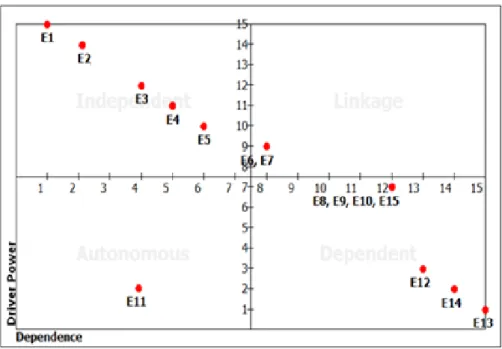
Contextual relationships among stakeholders of their driving power and their dependence can be illustrated as in Figure 1.
Further, it can be explained in Figure 1 that the stakeholders who play an important role in the stimulant adoption policy are mostly plotted in Quadrant IV (Independent) i.e.
Perhutani officials who consit of: Deputy Head of Unit Perhutani (E1), Chief of Non- Timber Production Bureau (E2), Head of KPH (E3), Deputy Head of KPH (E4), and Chief of Non-Timber Forest Product Section (E5). The elements in this quadrant have a considerable driving power. This implies that the policies decided by stakeholders will
support the success of adapting stimulants.
Perhutani has high interest and influence with regard to the authority and posseses the greatest responsibility as a manager that includes plannings, protection, utilization, and evaluation of the forest management work programs, particularly the management of pine forests in Java. This condition is often encountered in any natural resource management activities, wherein legally authorized managers always occupy positions as key stakeholders (Li, Ng, & Skitmore, 2012; Maguire, Potss, & Fletcher, 2012;
Ichsan, Soekmadi, Adiwibowo, & Kusmana, 2017).
Chief of Forest Product Marketing Section (E6) and Head of BKPH (E7) are in Quadrant III (Lingkage). Stakeholders in Quadrant III have high driving power and intervention
Table 2 The role of parties based on the level of interest and influence on stimulant innovation adoption policies Tabel 2 Peranan para pihak berdasarkan tingkat kepentingan dan pengaruh terhadap kebijakan adopsi inovasi
stimulansia
No. Stakeholders
(Pemangku kepentingan)
Interest
(Kepentingan) Influence
(Pengaruh) Score
(Nilai) Level (Tingkatan) Score
(Nilai) Level (Tingkatan) E1 Deputy Head of Unit Perhutani (Wakil
Kepala Unit) 24 High (tinggi) 22 High (tinggi)
E2 Chief of Non Timber Production Bureau (Kepala Biro Produksi Bukan Kayu)
22 High (tinggi) 20 High (tinggi)
E3 Head of KPH (Kepala KPH) 20 High (tinggi) 18 High (tinggi)
E4 Deputy Head of KPH (Wakil KPH) 19 High (tinggi) 17 High (tinggi) E5 Chief of Non Timber Forest Product
Section (Kepala Seksi Produksi Bukan Kayu)
16 Moderate (sedang) 15 Moderate (sedang)
E6 Chief of Marketing (Kepala Seksi
Pemasaran) 14 Moderate (sedang) 12 Moderate (sedang)
E7 Head of BKPH (Kepala BPKH) 14 Moderate (sedang) 13 Moderate (sedang) E8 Head of RPH (Kepala RPH) 12 Moderate (sedang) 12 Moderate (sedang) E9 Forest Ranger (Polisi Hutan) 12 Moderate (sedang) 11 Low (rendah) E10 Tapping Foreman (Mandor Sadap) 12 Moderate (sedang) 11 Low (rendah)
E11 Tappers (Penyadap) 22 High (tinggi) 10 Low (rendah)
E12 Academics (Akademisi) 11 Low (rendah) 15 Low (rendah)
E13 Researchers (Peneliti) 9 Low (rendah) 14 Moderate (sedang)
E14 Forestry Services Official (Dinas
Kehutanan) 10 Low (rendah) 17 High (tinggi)
E15 Ministry of Env. and Forestry (KLHK) 12 Moderate (sedang) 9 Low (rendah)
in policy formulation of stimulant adoption.
Both of the stakeholder elements are also closely linked to other elements. Head of RPH (E8), Forest Ranger (E9), Tapping foreman (E10), Academicians (E12), Researchers (E13), Officials in Forestry Services (E14) and Ministry of Environment and Forestry Officials (E15) are plotted in Quadrant II (Dependent). Stakeholders in Quadrant II are bonded, highly dependent on other stakeholders and have high influence. Their aspiration/intention is considered in pine forest management activities. However, they have relatively low interest towards regional management activities. These stakeholders could influence pine forest management policies by contributing criticism, problem- solving suggestions, and research results.
However, those contributions merely stand as consideration and aspiration by Perhutani.
Pine tappers (E11) are in Quadrant I (Autonomous) which implies that stakeholders have low effect and are not associated with stimulant adoption policy but have great importance in the management of
pine forests. The high dependence of tappers in Perhutani is primarily concerned with economic interests to sustain their livelihood.
Sundawati & Sanudin (2009) reveal that the high importance of community living around Lake Toba catchment area is due to their dependency to Lake Toba ecosystem as their livelihood source. The low impacts of stakeholders in the Quadrant I are due to the incapacity or exclusion of tappers in pine forest management policies, particularly in tapping pine. Tools and facilities of pine tapping, such as tapping devices, sap gutter, bucket for collecting sap and stimulant types, are provided by Perhutani. Perhutani, however, has a considerable interest of pine tappers to tap their pine trees. Therefore, an effective communication is essential which could be implemented through regular meetings for the sake of obtaining mutual agreements between Perhutani and pine tappers. Communication is mainly related to the economic impacts after adopting stimulant, whether positive impacts on increased revenue tapper or otherwise, as it also how to maintain the pine sap pricing
Source (sumber): primary data/processed 2018 (data primer/diolah, 2018)
Figure 1 Diagram of driving power and dependency relationship of stakeholder elements
Gambar 1 Diagram hubungan kekuatan penggerak dan ketergantungan elemen pemangku kepentingan.
mechanism that can benefit both sides.
Perhutani needs to listen to the inputs from tappers as a basis for determining stimulant adoption policies. Rangkuti (2009) states that communication becomes more important to produce balance in the perspective of information exchange through established institutional channels, supported by two-way communication, both vertical and horizontal.
Element Diagraph of stakeholder based on its driving power is illustrated in Figure 2. Hierarchical structure of the stakeholder element consisted of 10 levels. Deputy Head of Unit Perhutani (E1) is at level 10, who is a key element of successful stimulants adoption.
This is in line with the results of Herawati et al. (2010) which state that the provincial and district levels of forestry services have a high influence and interest in the implementation
of the Community Plantation Forest (CPF) programs.Thus, they play a key role to the successful implementation of CPF program policy. Thefore, the highest level decision maker has a high influence in adopting the programs.
B. Relationships Among Stakeholders
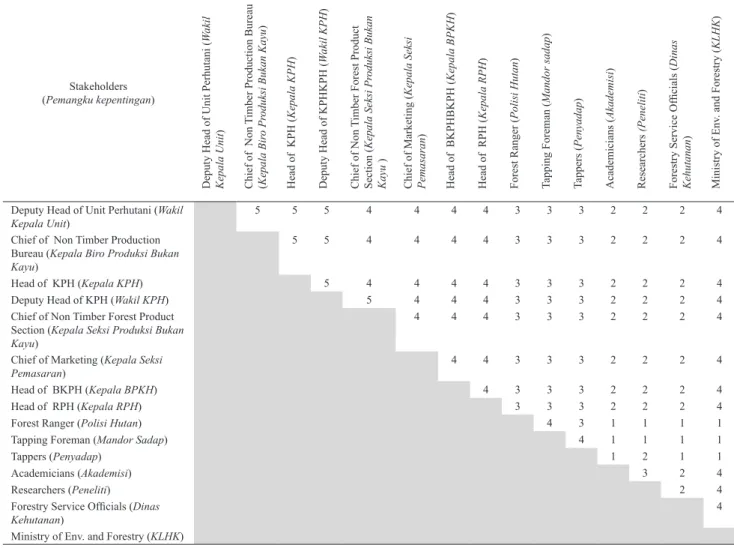
Stakeholder relationships analysis is conducted by identifying relationships among stakeholders based on five criteria, ie interaction, continuity, synergy, strength, and the presence or absence of conflicts.The results of stakeholder relationships analysis can be seen in Table 3. Table 3 shows that between Perhutani’s top management, tapping foreman and pine tappers, have good interaction, continuity and synergy relationship.Their legal power of Perhutani make it possible
Figure 2 Hierarchical structure of stakeholders Gambar 2 Struktur hirarki pemangku kepentingan.
to manage pine forest areas with activities and programs involving forest communities.
Community living around Perhutani area work as pine tappers for their livelihoods. Perhutani nevertheless obtain labour to collect sap pine from their area. Moreover, by involving community in forest management activities, Perhutani has performed social aspects of forest management. As the community are benefitted from the forest, they would secure the forest area, thus lessening conflicts with Perhutani.
Good relationship between Perhutani with academicians and researchers is inevitable to support innovation adoption. Academicians
and researchers can be involved through collaborative research with Perhutani.
These stakeholders can influence pine forest management policies, by providing criticism, solutions to problems, the results of studies, even though, are only limited to being considered and heard by Perhutani. However, sometimes it needed by Perhutani to adopt innovation due to certain considerations.
Improper relationship between Forest service officials and Perhutani sometimes occurs in the empowerment of communities as workers. This condition can be overcome by coordinating forest management between the two parties. Nurfitriani, Darusman,
Table 3 Matrix of stakeholder relationship in stimulant adoption policies
Tabel 3 Matriks Hubungan antar pemangku kepentingan dalam kebijakan adopsi stimulan
Stakeholders (Pemangku kepentingan)
Deputy Head of Unit Perhutani (Wakil Kepala Unit) Chief of Non Timber Production Bureau (Kepala Biro Produksi Bukan Kayu) Head of KPH (Kepala KPH) Deputy Head of KPHKPH (Wakil KPH) Chief of Non Timber Forest Product Section (Kepala Seksi Produksi Bukan Kayu ) Chief of Marketing (Kepala Seksi Pemasaran) Head of BKPHBKPH (Kepala BPKH) Head of RPH (Kepala RPH) Forest Ranger (Polisi Hutan) Tapping Foreman (Mandor sadap) Tappers (Penyadap) Academicians (Akademisi) Researchers (Peneliti) Forestry Service Officials (Dinas Kehutanan) Ministry of Env. and Forestry (KLHK) Deputy Head of Unit Perhutani (Wakil
Kepala Unit) 5 5 5 4 4 4 4 3 3 3 2 2 2 4
Chief of Non Timber Production Bureau (Kepala Biro Produksi Bukan Kayu)
5 5 4 4 4 4 3 3 3 2 2 2 4
Head of KPH (Kepala KPH) 5 4 4 4 4 3 3 3 2 2 2 4
Deputy Head of KPH (Wakil KPH) 5 4 4 4 3 3 3 2 2 2 4
Chief of Non Timber Forest Product Section (Kepala Seksi Produksi Bukan Kayu)
4 4 4 3 3 3 2 2 2 4
Chief of Marketing (Kepala Seksi
Pemasaran) 4 4 3 3 3 2 2 2 4
Head of BKPH (Kepala BPKH) 4 3 3 3 2 2 2 4
Head of RPH (Kepala RPH) 3 3 3 2 2 2 4
Forest Ranger (Polisi Hutan) 4 3 1 1 1 1
Tapping Foreman (Mandor Sadap) 4 1 1 1 1
Tappers (Penyadap) 1 2 1 1
Academicians (Akademisi) 3 2 4
Researchers (Peneliti) 2 4
Forestry Service Officials (Dinas
Kehutanan) 4
Ministry of Env. and Forestry (KLHK)
Source (sumber): primary data/processed, 2018 (data primer/diolah, 2018).
Nurrochmat, & Yustika (2015) state that strategy to optimize the potential conflicting stakeholder arrangements could be implemented through enhancing coalition, collaboration and stakeholder coordination.
In composing and implementing technical policies in pine forest management, Perhutani should continuously interact and synergize with Ministry of Environment and Forestry.
Further, Perhutani should conduct an extended technical coordination with forestry service officials.
IV. CONCLUSION AND RECOMMENDATION A. Conclusion
Perhutani officials are mostly plotted in Quadrant IV (Independent) because they posses legal authority in decision-making process. Perhutani involves in stimulants adoption policy. Pine tappers are directly affected to stimulants adoption policies and have enormous importance in the pine forests management. All parties who did not have direct interest in stimulants adoption policies but have concern are academicians, researchers, forest rangers, forestry service officials, and Ministry of Environment and Forestry officials. They play their important roles as intermediaries or facilitators who would influence decision making process.
Stimulants adoption policy is a top down policy. The position of Perhutani officials correspond with their influence and authority in decision making process.
Stakeholders relations which are in accordance to five categories are continuos interaction and continuous synergy with the absence of academicians and researchers.
Thus, it is expected that conflicts would not be existed. To avoid conflicts in forest management area, coordination between Perhutani and forest service officials is indispensable.
B. Recommendation
Perhutani should be listening to the aspirations of stakeholders involved in stimulant adoption, because it is very useful for the policy-making process. For this reason, communication between Perhutani and other stakeholders must be established through the establishment of communication forums.
Perhutani as a decision maker in stimulant adoption policy should not only limits himself in formulating the policy but should also perform in monitoring and evaluating the implementation.
REFERENCES
Darmaji, P. (2009). Teknologi asap cair dan aplikasinya pada pangan dan hasil pertanian (Pidato pengukuhan jabatan Guru Besar dalam bidang teknologi pangan dan hasil pertanian pada Fakultas Teknologi Pertanian. Yogyakarta:
Universitas Gadjah Mada.
Dubois, O. (1998). Capacity to manage role changes in forestry. London: International Institute for Environment Development.
Febriyano, I. G. (2014). Politik ekologi pengelolaan mangrove di Kabupaten Pesawaran Provinsi Lampung (Disertasi Pascasarjana). Institut Pertanian Bogor, Bogor.
Ferreti, V. (2016). From stakeholders analysis to cognitive mapping and multi-attribute value theory: an integrated approach for policy support. European Journal of Operational Research, 253(2), 524–541.
Frow, P., & Payne, A. (2011). A stakeholder perspective of the value proposition concept. European Journal of Marketing, 45(1/2), 223–240.
Harrison, J. S., Bosse, D. A., & Phillips, R. A. (2009).
Managing for stakeholders, stakeholder utility functions, and competitive advantage.
Strategic Management Journal, 31(1), 8–74.
Herawati, T., Widjayanto, N., Saharuddin, &
Eriyatno. (2010). Analisis respon pemangku kepentingan di daerah terhadap kebijakan hutan tanaman rakyat. Jurnal Analisis Kebijakan Kehutanan, 7(1), 13–25.
Ichsan, A. C., Soekmadi, R., Adiwibowo, S., &
Kusmana, C. (2017). Peran pemangku kepentingan dalam pelaksanaan model desa konservasi di Taman Nasional Gunung Rinjani. Jurnal Analisis Kebijakan Kehutanan, 14(1), 47–59.
Li, T., S., T., & Skitmore, M. (2012). Conflict or consensus : an investigation of stakeholder concerns during the participation process of major infrastructure and construction projects in Hong Kong. Habitat International, 36(2), 333–342.
Maguire, B., Potss, J., & Fletcher, S. (2012). The role of stakeholders in the marine planning process- stakeholder analysis within the solent, United Kingdom. Marine Policy, 36(1), 246–257.
Marimin, M. (2009). Teori dan aplikasi sistem pakar dalam teknologi manajerial. Bogor: IPB Press.
Nurfitriani, F., Darusman, D., Nurrochmat, D. R., &
Yustika, A. E. (2015). Analisis pemangku kepentingan dalam transformasi kebijakan fiskal hijau(stakeholder analysis in green fiscal policy transformation). Jurnal Analisis Kebijakan Kehutanan, 12(2), 105–124.
Pari, G., & Nurhayati, T. (2009). Cuka kayu dari tusam dan limbah campuran industri penggergajian kayu untuk kesehatan tanaman dan obat.
Bogor.
Rangkuti, P.A. (2009). Strategi komunikasi membangun kemandirian pangan. Jurnal Litbang Pertanian, 28(2), 39–45.
Reed, M. S., Graves, A., Dandy, N., Posthumus, H., Hubacek, K., Morris, J., Stringer, L. C. (2009).
Who’s in and why? A typology of stakeholder analysis methods for natural resource management. Journal of Environmental Management, 90(5), 1933–1949.
Rodrigues, K. C. S., Apel, M. A., Henrique, A. T.,
& Neto, F. A. G. (2011). Efficient oleoresin biomass production in pines using low cost metal containing stimulant paste. Journal Crops and Product, 35(10), 4442–4448.
Rodrigues, K. C. S., Azevedo, P. C. N., Sobreiro, L.
E., Pelissari, P., & Fett-Neto, A. G. (2008).
Oleoresin yield of Pinus elliottii plantations in subtropical cLimate: effect of tree diameter, wound shape and concentration of active adjuvants in resin stimulating paste. Journal Crops and Product, 27(3), 322–327.
Sainoi, T., & Sdoodee, S. (2012) The impact of ethylene gas aplication on young tapping rubber trees.
Journal of Agriculture Technology,8(4), 1497–1507.
Saxena, J. P., Sushil, & Vrat, P. (1992). Hierarchy and classification of program plan elements using interpretive structural modeling : a case study of energy conservation in the Indian Cement Industry. Systems Practice, 5(6), 651–652.
Sharma, K. R., & Lekha, C. (2013). Tapping of Pinus roxburghii (chir pine) for oleoresin in Himachal Pradesh, India, 2(3), 51–55.
Sundawati, L., & Sanudin, S. (2009). Analisis Pemangku Kepentingan dalam Upaya Pemulihan Ekosistem Daerah Tangkapan Air Danau Toba. Jurnal Manajemen Hutan Tropika, 15(3), 102–110.
Wijaya, M. (2010). Pirolisis limbah kayu dan bambu yang ramah lingkungan untuk menghasilkan asam asetat. Institut Pertanian Bogor.
Verhagen, K. (1996). Pengembangan keswadayaan : Pengalaman LSM di tiga negara. Cimanggis:
Pustaka Pembangunan Swadaya Nusantara (PUSPA SWARA).
EFEKTIVITAS KEBIJAKAN PENGELOLAAN MANGROVE UNTUK MENDUKUNG MITIGASI PERUBAHAN IKLIM
DI PROVINSI KALIMANTAN TIMUR
(Effectiveness of Mangrove Management Policies to Support Climate Change Mitigation in East Kalimantan Province)
Mimi Salminah & Iis Alviya
Pusat Penelitian dan Pengembangan Sosial, Ekonomi, Kebijakan dan Perubahan Iklim, Jl. Gunung Batu No. 5, Bogor, 16118, Indonesia.
E-mail: [email protected], [email protected]
Diterima 21 September 2018, direvisi 27 Februari 2019, disetujui 2 April 2019
ABSTRACT
As a climate change mitigation action, East Kalimantan Province has targeted emission reduction from mangrove forest. Mangrove-related policies at national and local levels have been issued before and after the program execution. It is necessary to measure the effectiveness of the policies to identify potential challenges in its implementation, particularly from policy aspect. This analysis is required to support the Government in achieving the emission reduction target, so it would obtain payment compensation from World Bank by 2024. Effectiveness of the policies is analysed using Grindle Theory combined with climate change mitigation principles in mangrove management. The results show that there is still ineffectivences in implementing climate change mitigation on mangrove management including requirements for technical regulations determining the content of the issued policies, provision of one mangrove and land use data, and of green fish pond management options. Moreover, coordination among related sectors, raising awareness programs, and facilitation for local coastal community to apply sustainable mangrove management play significant role in the effectiveness of the implementation. In theory, the effectiveness of policy implementation is affected by clarity of policy content, both in conceptual and practical terms, through coordination and communication within related actors, both authorities and affected actors.
Keywords: Mangrove management policy; climate change mitigation; policy effectiveness; land use.
ABSTRAK
Sebagai salah satu upaya mitigasi perubahan iklim, Provinsi Kalimantan Timur menargetkan penurunan emisi dari hutan mangrove. Kebijakan terkait pengelolaan mangrove, baik di tingkat nasional maupun Provinsi Kaltim telah banyak dikeluarkan sebelum dan sesudah program perubahan iklim dideklarasikan. Diperlukan kajian untuk mengukur efektivitas kebijakan tersebut sehingga dapat diketahui potensi kendala upaya mitigasi perubahan iklim dilihat dari aspek kebijakannya. Kajian ini diperlukan agar pemerintah Provinsi Kaltim dapat mencapai target penurunan emisi dan mendapat kompensasi pembayaran dari World Bank pada tahun 2024. Efektivitas kebijakan dianalisis menggunakan pendekatan teori Grindle yang dikombinasikan dengan konteks mitigasi perubahan iklim dalam pengelolaan mangrove. Hasil analisis menunjukkan masih terdapat ketidakefektifan dalam pelaksanaan mitigasi perubahan iklim pada pengelolaan mangrove, di antaranya adalah belum adanya peraturan teknis sebagai peraturan lanjutan yang menjelaskan isi kebijakan nasional yang telah dikeluarkan, penyediaan satu data mangrove dan tata guna lahan, serta penyediaan opsi pengelolaan mangrove ramah lingkungan. Selain itu, diperlukan koordinasi antar sektor terkait, sosialisasi dan pendampingan terhadap masyarakat pesisir dalam pemanfaatan mangrove secara berkelanjutan khususnya untuk tambak. Secara konseptual, kajian ini menunjukkan bahwa keberhasilan suatu kebijakan juga dipengaruhi oleh kejelasan isi kebijakan, baik yang bersifat konsep maupun praktis, serta proses koordinasi dan komunikasi antar pihak, baik yang berwenang maupun yang terkena dampak kebijakan.
Kata kunci: Kebijakan pengelolaan mangrove; mitigasi perubahan iklim; efektivitas kebijakan; tata guna lahan.