GUIDELINES FOR
MANAGING ADVANCED
HIV DISEASE AND
RAPID INITIATION
OF ANTIRETROVIRAL
THERAPY
JULY 2017
GUIDELINES
HIV TREA
MANAGING ADVANCED
HIV DISEASE AND
RAPID INITIATION
OF ANTIRETROVIRAL
THERAPY
July 2017
ISBN 978-92-4-155006-2
© World Health Organization 2017
Some rights reserved. This work is available under the Creative Commons
Attribution-NonCommercial-ShareAlike 3.0 IGO licence (CC BY-NC-SA 3.0 IGO; https://creativecommons.org/ licenses/by-nc-sa/3.0/igo).
Under the terms of this licence, you may copy, redistribute and adapt the work for non-commercial purposes, provided the work is appropriately cited, as indicated below. In any use of this work, there should be no suggestion that WHO endorses any specific organization, products or services. The use of the WHO logo is not permitted. If you adapt the work, then you must license your work under the same or equivalent Creative Commons licence. If you create a translation of this work, you should add the following disclaimer along with the suggested citation: “This translation was not created by the World Health Organization (WHO). WHO is not responsible for the content or accuracy of this translation. The original English edition shall be the binding and authentic edition”.
Any mediation relating to disputes arising under the licence shall be conducted in accordance with the mediation rules of the World Intellectual Property Organization.
Suggested citation. Guidelines for managing advanced HIV disease and rapid initiation
of antiretroviral therapy, July 2017. Geneva: World Health Organization; 2017. Licence: CC BY-NC-SA 3.0 IGO.
Cataloguing-in-Publication (CIP) data. CIP data are available at http://apps.who.int/iris.
Sales, rights and licensing. To purchase WHO publications, see http://apps.who.int/
bookorders. To submit requests for commercial use and queries on rights and licensing, see http://www.who.int/about/licensing.
Third-party materials. If you wish to reuse material from this work that is attributed to a third
party, such as tables, figures or images, it is your responsibility to determine whether permission is needed for that reuse and to obtain permission from the copyright holder. The risk of claims resulting from infringement of any third-party-owned component in the work rests solely with the user.
General disclaimers. The designations employed and the presentation of the material in
this publication do not imply the expression of any opinion whatsoever on the part of WHO concerning the legal status of any country, territory, city or area or of its authorities, or concerning the delimitation of its frontiers or boundaries. Dotted and dashed lines on maps represent approximate border lines for which there may not yet be full agreement.
The mention of specific companies or of certain manufacturers’ products does not imply that they are endorsed or recommended by WHO in preference to others of a similar nature that are not mentioned. Errors and omissions excepted, the names of proprietary products are distinguished by initial capital letters.
All reasonable precautions have been taken by WHO to verify the information contained in this publication. However, the published material is being distributed without warranty of any kind, either expressed or implied. The responsibility for the interpretation and use of the material lies with the reader. In no event shall WHO be liable for damages arising from its use.
CONTENTS
Abbreviations and acronyms iv
Definition of key terms v
Acknowledgements vii
Executive summary ix
1. Introduction 1
1.1 Objectives 1
1.2 Target audience 1
1.3 Guiding principles 1
2. Recommendations to reduce mortality and morbidity among
people presenting with advanced HIV disease 2
2.1 Background 2
2.2 Definition of advanced HIV disease 3
2.3 Burden of advanced HIV disease 3
2.4 Role of CD4 cell count testing in identifying and managing people
with advanced HIV disease 6
2.5 Providing a package of care to reduce mortality and morbidity among
people with advanced HIV disease 6
2.6 Considerations for people with advanced HIV disease re-engaging with
care after treatment interruption or treatment failure 15
2.7 Vaccination for people with advanced HIV disease 16
2.8 Research gaps 17
3. Recommendation for rapid initiation of ART 19
3.1 Background 19
3.2 Recommendations for rapid ART initiation 19
3.3 Clinical considerations when implementing rapid initiation
or same-day initiation 20
3.4 Considerations for children living with HIV who are hospitalized or severely ill 24
3.5 Research gaps 24
4. Plans for updating, dissemination and evaluation 25
References 26
Annex 1. Summary of recommendations for the package of care for people
with advanced HIV disease 34
Annex 2. Methods for developing the guidelines 38
ABBREVIATIONS AND ACRONYMS
ARV antiretroviral
ART antiretroviral therapy
BCG Bacille Calmette-Guérin
CI confidence interval
CrAg cryptococcal antigen
GRADE Grading of Recommendations, Assessment, Development and Evaluation
HIV human immunodeficiency virus
LF-LAM lateral flow lipoarabinomannan
NNRTI non-nucleoside reverse-transcriptase inhibitor
PICO population, intervention, comparator and outcome
RR relative risk
TB tuberculosis
DEFINITION OF KEY TERMS
Age groups and populations
The following definitions for adults, adolescents, children and infants are used to ensure consistency within these guidelines. Other agencies may use different definitions.
• An adult is a person older than 19 years.
• An adolescent is a person 10–19 years old inclusive.
• A child is a person younger than 10 years old.
• An infant is a child younger than one year of age.
Advanced HIV disease
• For adults, adolescents, and children ≥five years, advanced HIV disease is defined as a CD4 cell count <200 cells/mm3 or a WHO clinical stage 3 or 4 event at presentation for care.
• All children with HIV younger than five years old should be considered as having advanced disease at presentation (for rationale, see section 2.2).
• A seriously ill adult or adolescent is defined as having any of the following danger signs: respiratory rate ≥30 breaths per minute; heart rate ≥120 beats per minute; or unable to walk unaided. Other clinical conditions, such as body temperature ≥39°C can also be considered based on local epidemiology and clinical judgement.
• A seriously ill child is defined as having any of the following danger signs: lethargy or unconsciousness; convulsions; unable to drink or breastfeed; and repeated vomiting. Other clinical conditions such as body temperature ≥39°C and age-defined tachycardia and/or tachypnoea can be considered based on clinical judgement.
• A severely immunosuppressed adult is defined as having a CD4 cell count <50 cells/mm3.
• WHO Clinical Staging is a way to categorize HIV disease severity based on new or recurrent clinical events. There are 4 WHO clinical stages which range from mild symptoms (WHO clinical stage 1) to severe symptoms (WHO clinical stage 4).
Antiretroviral therapy
ARV (antiretroviral) drugs refer to the medicines used to treat and prevent HIV infection.
ART (antiretroviral therapy) refers to the use of a combination of three or more ARV drugs for treating HIV infection. ART involves lifelong treatment.
Clinically well refers to a person who has no active WHO clinical stage 3 or 4 disease and a CD4 cell count ≥200 cells/mm3.
Treatment failure refers to the current WHO virological criteria for treatment failure, which is two consecutive viral load tests ≥1000 HIV RNA copies/ml.
Viral suppression refers to a viral load below the detection threshold using viral assays (<1000 HIV RNA copies/ml).
Prophylaxis and treatment
Prophylaxis aims to avoid either the first occurrence of infections (primary prophylaxis) or their recurrence (secondary prophylaxis or maintenance).
Pre-emptive therapy is an alternative strategy to prophylaxis that aims to prevent
progression to disease after infection has occurred. For example, the term pre-emptive therapy is used to describe treating people who are positive for cryptococcal antigen since, by the time cryptococcal antigen is positive in the blood, disease and dissemination are considered significant even if they are not clinically apparent.
Presumptive treatment (also referred to as empirical treatment) refers to treatment that is initiated based exclusively on clinical suspicion and relying on clinical judgement. Presumptive treatment is generally reserved for severely ill people in settings where laboratory investigations are not available. There are two broad approaches: (1) treatment without laboratory diagnosis based on the opinion of an experienced clinician after considering all the available information and (2) treatment based on a prespecified clinical rule that aims to identify individuals at higher risk and does not require clinical judgement.
Service delivery
Continuum of HIV services refers to a comprehensive package of HIV prevention, diagnostic, treatment, care and support services provided for people at risk of HIV infection or living with HIV and their families. Examples of these services include pre-exposure prophylaxis; HIV testing and linkage to care; TB screening, prevention, diagnosis and care; management of opportunistic infections and other comorbid conditions; initiating, maintaining and monitoring ART response; adherence support; switching to second-line and third-line ART; and palliative care.
Continuum of HIV care refers to a comprehensive package of HIV services for people living with HIV.
Differentiated service delivery is an approach that simplifies and adapts HIV services to better serve the needs of people living with HIV and reduce unnecessary burdens on the health system. For example, under a differentiated service delivery approach, people who are stable on treatment would have a reduced frequency of clinical visits and medication prescribing (3-6 months), allowing health service resources to focus on care for patients who are ill and need intensive clinical follow up.
ACKNOWLEDGEMENTS
Guideline Development Group
Co-chairs:Alexandra Calmy (Hôpitaux Universitaires de Genève, Switzerland) and
Graeme Meintjes (University of Cape Town, South Africa).
Methodologist: Nandi Siegfried (independent clinical epidemiologist, South Africa)
Eduardo Arathoon (Asociacion de Salud Integral, Guatemala), Patricia Asero (International Community of Women Living with HIV, Kenya), Rosa Bologna (Hospital de Pediatría Prof. Dr. Juan P. Garrahan, Argentina), Mohamed Chakroun (Fattouma Bourguiba Teaching Hospital, Tunisia), Lucia Chambal (Ministry of Health, Mozambique), Tom Chiller (Mycotic Disease Branch, United States Centers for Disease Control and Prevention, USA), Francesca Conradie
(University of the Witwatersrand, South Africa), Serge Eholie (Centre Hospitalier Universitaire de Treichville, Côte d’Ivoire), Lisa Frigati (Tygerberg Hospital and Stellenbosch University, South Africa), Diana Gibb (Medical Research Council, United Kingdom), Eric Goemaere
(Médecins Sans Frontières, South Africa), Nelesh Govender (University of the Witwatersrand and National Institute for Communicable Diseases, South Africa), Alison Grant (London School of Hygiene and Tropical Medicine, United Kingdom), Nagalingeswaran Kumarasamy
(YRGCARE, India), David Lalloo (Liverpool School of Tropical Medicine, United Kingdom),
Thuy Le (Oxford University Clinical Research Unit, Viet Nam), Emilio Letang (Barcelona Institute for Global Health and Ifakara Health Institute, Spain), Dorothy Mbori-Ngacha
(UNICEF, Kenya), Sayoki Mfinanga (Muhimbili Medical Research Centre, National Institute for Medical Research, United Republic of Tanzania), Mathieu Nacher (Université de Guyane, French Guiana), Muhayimpundu Ribakare (Rwanda Biomedical Centre, Rwanda),
Kenly Sikwese (African Community Advisory Board, Zambia), Nini Tun (Medical Action Myanmar, Myanmar), Jose E. Vidal (Instituto de Infectologia Emílio Ribas and Universidade de São Paulo, Brazil).
Disclosures of interest for members of the Guideline Development
Group
Diana Gibb and Sayoki Mfinanga were principal investigators on trials considered for the formulation of the recommendation for the package of care for people presenting with advanced disease and were excluded from the decision-making process for these recommendations. There were no other conflicts of interest. Annex 3 describes the full process for managing declarations of interests.
Representatives of United Nations agencies and other partners
Ade Fakoya (Global Fund to Fight AIDS, Tuberculosis and Malaria, Switzerland), Greg Greene
(United States Centers for Disease Control and Prevention, USA), Ikwo Oboho (United States Centers for Disease Control and Prevention, USA), Carmen Perez Casas (UNITAID, Switzerland), George Siberry (Office of the United States Global AIDS Coordinator, USA).
Systematic review team
Contributors to supporting evidence
Nanina Anderegg (University of Berne, Switzerland), Sergio Carmona (National Health Laboratory Service, South Africa), Cadi Irvine (consultant, HIV Department, WHO),
Melani Marti (Department of Immunization, Vaccines and Biologicals, WHO).
External Review Group
Xavier Anglaret (Inserm – French National Institute of Health and Medical Research, France),
Moherndran Archary (King Edward VIII Hospital, South Africa), Moses Bateganya (United States Centers for Disease Control and Prevention, USA), David Boulware (University of Minnesota, Uganda), Sergio Carmona (National Health Laboratory Service, South Africa),
Marcelo Freitas (ICAP, Mozambique), Beatriz Grinstejn (Fundação Oswaldo Cruz, Brazil),
Joseph Jarvis (London School of Hygiene and Tropical Medicine, United Kingdom and Botswana Harvard AIDS Institute Partnership, Botswana), David Meya (Makerere University, Kampala, Uganda), Eyerusalem Kebede Negussie (Ministry of Health, Ethiopia), Daniel O’Brien (Barwon Health, Australia), Heather Paulin (United States Centers for Disease Control and Prevention, USA), Andy Prendergast (Queen Mary University of London, United Kingdom), George Siberry (Office of the United States Global AIDS Coordinator, USA) and
Evy Yunihastuti (Faculty of Medicine, Universitas Indonesia, Indonesia).
WHO Steering Group
Meg Doherty, Nathan Ford, Chantal Migone, Martina Penazzato, Marco Vitoria (HIV Department), Yohhei Hamada (Global TB Programme) and Frank Lule (WHO Regional Office for Africa).
WHO staff and consultants
The following WHO staff members and consultants contributed to developing these guidelines.
Annabel Baddeley (Global TB Programme, WHO), Haileyesus Getahun (Global TB Programme, WHO), Lara Vojnov (HIV Department, WHO).
Jasmin Leuterio, Laurent Poulain, Danilo Salvador and Mehdi Zoubeidi (HIV Department, WHO) provided administrative support.
Overall coordination and writing
Nathan Ford and Marco Vitoria (HIV Department, WHO) coordinated the overall guideline development process with support from Chantal Migone (HIV Department, WHO), under the leadership of Meg Doherty and Gottfried Hirnschall (HIV Department, WHO). Helen Bygrave (independent consultant, United Kingdom) wrote the guidelines with Nathan Ford.
Funding
EXECUTIVE SUMMARY
In 2016, WHO published its consolidated guidelines on the use of antiretroviral (ARV) drugs for treating and preventing HIV infection. As part of this revision, WHO recognized that, as antiretroviral therapy (ART) is scaled up and countries adopt the “treat all” policy, ART services will need to be differentiated to provide adapted packages of care to people living with HIV with varied clinical needs. The four groups of people defined are (1) individuals presenting or returning to care with advanced HIV disease, (2) individuals presenting or returning to care when clinically well (3), individuals who are clinically stable on ART and (4) individuals receiving an ART regimen that is failing.
The objectives of these guidelines are to provide recommendations outlining a public health approach to managing people presenting with advanced HIV disease, and to provide guidance on the timing of initiation of antiretroviral therapy (ART) for all people living with HIV. To develop these recommendations, WHO convened a Guideline Development Group in March 2017. Using the evidence generated through two systematic reviews, the GRADE process was used to determine the strength of the recommendation and quality of the evidence.
The first set of recommendations addresses the specific needs of people with advanced HIV disease and defines a package of interventions aimed at reducing HIV-associated morbidity and mortality. WHO recommends that a package of screening, prophylaxis, rapid ART initiation and intensified adherence interventions be offered to everyone living with HIV presenting with advanced disease. This is a strong recommendation that applies to all populations and age groups. The specific components of the advanced HIV disease package are detailed in Table 1, page 9 of the guidelines. The guidelines also include an algorithm to support decision making for providing care for people with advanced HIV disease.
The second set of recommendations defines how rapidly ART should be initiated within the context of the “treat all” policy, especially when coinfections are present. WHO strongly recommends that rapid ART initiation should be offered to people living with HIV following confirmed diagnosis and clinical assessment. Rapid initiation of ART is defined as within seven days of HIV diagnosis. WHO further strongly recommends ART initiation on the same day as HIV diagnosis based on the person’s willingness and readiness to start ART immediately, unless there are clinical reasons to delay treatment. Both of these recommendations apply to all populations and age groups. People with advanced HIV disease should be given priority for clinical assessment and treatment initiation.
Recommendations
Management of advanced HIV disease
A package of interventions including screening, treatment and/or prophylaxis for major opportunistic infections, rapid ART initiation and intensified
adherence support interventions should be offered to everyone presenting with advanced HIV disease.
(Strong recommendation, moderate-quality evidence)
Rapid initiation of antiretroviral therapy
Rapid ART initiationa should be offered to all people living with HIV
following a confirmed HIV diagnosis and clinical assessment.
(Strong recommendation: high-quality evidence for adults and adolescents; low-quality evidence for children)
aRapid initiation is defined as within seven days from the day of HIV diagnosis; people with advanced HIV disease
should be given priority for assessment and initiation.
ART initiation should be offered on the same day to people who are ready to start.
(Strong recommendation: high-quality evidence for adults and adolescents; low-quality evidence for children)
Good practice statement
ART initiation should follow the overarching principles of providing people-centred care. People-centred care should be focused and organized around the health needs, preferences and expectations of people and communities, upholding individual dignity and respect, especially for vulnerable populations, and should promote engaging and supporting people and families to play an active role in their own care by informed decision-making.
1.
INTRODUCTION
1.1
Objectives
The objectives of these guidelines are:
• to provide updated, evidence-informed clinical recommendations outlining a public health approach to managing people presenting with advanced HIV disease, focusing on settings with limited health system capacity and resources; and
• to provide guidance on the rapid initiation of antiretroviral therapy (ART) for all people living with HIV, including starting ART on the same day as HIV diagnosis.
1.2
Target audience
These guidelines are primarily intended for use by national HIV programme managers. They are also of value to the following audiences:
• people living with HIV and community-based organizations;
• national HIV treatment and prevention advisory boards;
• national TB programme managers;
• clinicians and other health workers;
• managers of national laboratory services; and
• international and bilateral agencies and organizations that provide financial and technical support to HIV programmes in low- and middle-income countries.
1.3
Guiding principles
The following principles have informed the development of these guidelines and should guide the implementation of the recommendations.
• The guidelines should contribute to realizing the Sustainable Development Goals through achieving key global and national HIV goals.
• The guidelines are based on a public health approach to scaling up the use of antiretroviral (ARV) drugs along the continuum of HIV prevention, care and treatment.
• Implementation of the guidelines need to be accompanied by efforts to promote and protect the human rights of people who need HIV services, including ensuring informed consent, preventing stigma and discrimination in the provision of services and promoting gender equity.
• Implementation of the recommendations in these guidelines should be informed by local context, including HIV epidemiology and prevalence of other comorbidities, availability of resources, the organization and capacity of the health system and anticipated cost– effectiveness.
2.
RECOMMENDATIONS TO REDUCE MORTALITY
AND MORBIDITY AMONG PEOPLE PRESENTING
WITH ADVANCED HIV DISEASE
2.1
Background
The burden of morbidity and mortality associated with HIV infection has decreased over the past decade as access to ART has increased. Since 2003, the annual number of people dying from AIDS-related causes has declined by 43%, with 1.1 million AIDS-related deaths reported in 2015 (1). This decline is largely the result of expanded access to ART and an evolution towards treating people earlier in the course of HIV infection (2); however, the decline in AIDS-related deaths appears to have plateaued during the past three years (1).
In 2015, WHO recommended that all people living with HIV start ART irrespective of clinical or immune status, and most national guidelines have adopted this recommendation (3). This shift towards earlier initiation of ART, together with improved access to HIV testing and treatment, has led to an overall improvement in health status at the start of ART (4), as reflected by a gradual increase in the median CD4 cell count at the start of ART in most settings (5).
Despite this progress, up to half of people living with HIV continue to present to care with advanced HIV disease – defined by WHO as having a CD4 cell count <200 cells/mm3 or a WHO clinical stage 3 or 4 disease (6). People presenting with advanced HIV disease are at high risk of death, even after starting ART, with the risk increasing with decreasing CD4 cell count, especially with CD4 cell count <100 cells/mm3 (7–9). Advanced HIV disease is also associated with increased health-care costs (10).
The scaling up of ART has benefited from a public health approach that has emphasized standardized, simplified treatment protocols along with decentralization, integration and task sharing to support service delivery (11). To date, service delivery within a public health approach in resource-limited settings has provided little differentiation of how ART is provided to people with differing clinical needs. The 2016 WHO consolidated guidelines on the use of antiretroviral drugs for treating and preventing HIV infection (hereinafter referred to as the 2016 WHO consolidated ARV guidelines) identifies four groups of people with specific needs:
• individuals presenting or returning to care with advanced HIV disease (WHO stage 3 or 4 disease and/or CD4 < 200 cells/mm3); such individuals may be ART naive or have interrupted treatment;
• individuals presenting or returning to care when clinically well (absence of WHO clinical stage 3 or 4 disease and/or CD4 cell count ≥200 cells/mm3); such individuals may be ART naive or have interrupted treatment;
• individuals who are clinically stable on ART;1 and
• individuals receiving an ART regimen that is failing.
For each of these categories, services may be differentiated to ensure that a people-centred approach to ART delivery is provided within a public health approach. People who are stable on ART with a suppressed viral load may be seen less frequently and receive longer supplies
1 Defined by WHO as: receiving ART for at least 12 months, no adverse drug reactions requiring regular monitoring, no current
illnesses, good understanding of adherence and evidence of treatment success (two consecutive undetectable viral load measures or, in the absence of viral load monitoring, rising CD4 cell counts or CD4 cell counts exceeding 200 cells/mm3) and an objective
of ART. For those with advanced HIV disease, more intensive follow-up and a package of interventions could reduce morbidity and mortality in this vulnerable group.
These guidelines focus on individuals presenting with advanced HIV disease. This category includes people presenting to care for the first time following an HIV diagnosis and people who had previously started ART and are re-engaging with care after a period of ART interruption.
The 2016 WHO consolidated ARV guidelines contain several recommendations to support disease prevention, diagnosis and treatment among people presenting with advanced HIV disease. However, the uptake of these recommendations is variable. The objective of these guidelines is to provide evidence-informed clinical recommendations outlining a public health approach to managing people presenting with advanced HIV disease, focusing on settings with limited health system capacity and resources.
2.2
Definition of advanced HIV disease
The following consensus definition of advanced HIV disease (see panel below) was defined through a Delphi process during the development of the 2016 WHO consolidated ARV guidelines (6). This definition has been used throughout the development of the
recommendations for advanced HIV disease for adults. For children, the Guideline Development Group put forward an expanded definition that all children younger than five years should be considered to have advanced HIV disease at presentation. This recognizes the fact that most children younger than five years present for care with advanced immunosuppression (12), and they have a heightened risk of disease progression and mortality regardless of their clinical and immune condition (13). Moreover, varying age-dependent CD4 cell count definitions for advanced immunosuppression among children younger than five years make definitions based on CD4 cell count difficult to implement in programmatic settings.
2.3
Burden of advanced HIV disease
The proportion of people presenting with advanced HIV disease has remained largely
unchanged during the past five years although the number of people receiving ART in low- and middle-income settings more than doubled over this period (1). Recent estimates suggest that about 30–40% of people living with HIV starting ART in low- and middle-income settings have a CD4 cell count of less than 200 cells/mm3, and 20% have a CD4 cell count of less than 100 cells/mm3 (14,15); in some settings, up to half of people present to care with advanced HIV disease (Figure. 1) (16). An additional number of people with advanced HIV disease have temporarily interrupted ART and return to care after a period of time off treatment when their CD4 cell count has dropped and they may have developed clinical symptoms. Studies suggest that about 25% of people interrupt treatment at some point after starting ART, with durations of treatment interruption ranging from a few days to longer than six months (17,18). One study, from South Africa, found that 19% of the people admitted to hospital with advanced HIV disease had previously initiated and interrupted their ART, and a further 21% of admissions were receiving ART with an unsuppressed viral load (19).
Definition of advanced HIV disease
For adults and adolescents, and children older than five years, advanced HIV disease is defined as CD4 cell count <200cells/mm3 or WHO stage 3 or 4 event.
Figure 1
Proportion of people with advanced HIV disease starting ART
by sex and country income group, 2010–2015
The results are based on 951 855 adults from 55 countries after imputation of missing data. The shaded areas represent 95% confidence intervals. Source: IeDEA/COHERE–WHO Collaboration (20)
Leading causes of mortality among adults with advanced HIV disease globally include tuberculosis (TB), severe bacterial infections, cryptococcal meningitis, toxoplasmosis and Pneumocystis jirovecii pneumonia. Among children, TB, severe bacterial infections,
Pneumocystis jirovecii pneumonia, diarrhoeal diseases, malnutrition and wasting are the leading causes of death (9 21,23).
Tuberculosis
TB is the leading cause of morbidity and mortality among people living with HIV (24), accounting for one third of the estimated 1.1 million people dying from AIDS-related causes globally in 2015, with most of these TB-associated deaths (200 000 cases) occurring among men (25). TB also remains a leading cause of HIV-associated hospitalization among adults and children living with HIV worldwide (26). Young children living with HIV have an especially high risk of progressing to TB disease following initial infection (27,28). The 2016 WHO consolidated ARV guidelines summarize the WHO recommendations for the prevention, diagnosis and treatment of TB among people living with HIV (29).
Severe bacterial infections
HIV regardless of CD4 cell count in settings where severe bacterial infections or malaria are highly prevalent. Increasing resistance to antimicrobial drugs can complicate the treatment of people with severe bacterial infections.
Cryptococcal meningitis
The incidence of cryptococcal meningitis remains substantial despite scale-up of ART (31). A recent review (32) estimated that there were 223 100 incident cryptococcal meningitis cases globally in 2014, with 73% of the cases occurring in sub-Saharan Africa; the annual global deaths from cryptococcal meningitis were estimated to be 181 100. Cryptococcal meningitis is a leading cause of mortality among hospitalized adults living with HIV, accounting for 15–20% of adult deaths (21,33), but is less common among children living with HIV (34). The 2016 WHO consolidated ARV guidelines summarize the WHO recommendations for the prevention, diagnosis and treatment of cryptococcal meningitis. Pre-emptive therapy for cryptococcal antigen–positive asymptomatic people is a key strategy to prevent cryptococcal meningitis (29).
Pneumocystis jirovecii pneumonia
Pneumocystis jirovecii pneumonia is a leading cause of mortality among hospitalized adults (13%) and children (29%) living with HIV (21). However, the global burden of morbidity and mortality attributable to Pneumocystis jirovecii pneumonia is poorly characterized because appropriate diagnostic facilities are lacking in most settings. This highlights the need for more accurate and feasible diagnostic approaches and improved access to co-trimoxazole and ART.
Toxoplasmosis
Cerebral toxoplasmosis is the most frequent cause of expansive brain lesions among adults living with HIV not receiving co-trimoxazole. Toxoplasmosis is a common protozoan infection among people with HIV, with the prevalence of coinfection especially high in sub-Saharan Africa (45%), Latin America and the Caribbean (49%) and North Africa and the Middle East (61%) (35). People with latent toxoplasmosis infection are at risk of developing cerebral toxoplasmosis when their CD4 count falls below 200 cells/mm3. The diagnosis of cerebral toxoplasmosis requires imaging techniques, such as computed tomography scans, which are rarely available in most sub-Saharan African settings, and thus, the knowledge of disease burden is limited. About 15% of the hospitalized adults living with HIV dying from AIDS-related illnesses die from cerebral toxoplasmosis (21). Ocular and pulmonary disease can also occur with or without concomitant encephalitis (36). Treatment options include high-dose co-trimoxazole or pyrimethamine-based regimens (plus sulfadiazine or clindamycin plus folinic acid), which appear to be equivalent in terms of safety and efficacy; however, co-trimoxazole is readily available in resource-limited settings (37).
Cytomegalovirus
Cytomegalovirus infection is a systemic viral infection that usually manifests as
Other causes
Other fungal infections, notably histoplasmosis and talaromycosis, are associated with advanced HIV disease in specific geographical areas.
Histoplasmosis is a systemic fungal infection with an especially high prevalence in Central and South America, where it can be a leading cause of AIDS-related deaths (40). Lack of simple diagnostic tests limits knowledge of the disease burden.
Talaromycosis (formerly known as penicilliosis) is a systemic mycosis that is endemic to many countries in South-East Asia, including parts of China and India, and is a leading cause of HIV-associated mortality, especially among individuals with a CD4 cell count <100 cells/mm3 (41,42). Untreated disseminated infection is usually fatal, and even when appropriate therapy is provided, the mortality rates among hospitalized people are up to 30% (41,42). The results from a recent randomized trial conducted in Viet Nam (43) found that mortality among people treated with amphotericin B was half that among people treated with itraconazole (11.3% versus 21.0%); amphotericin B was also associated with better clinical response, fungicidal activity and fewer disease complications, suggesting that amphotericin B should be made available to people living with HIV who have Talaromyces infection.
Other causes of mortality among people with advanced disease that are less common and not addressed by these guidelines include Kaposi sarcoma, gastrointestinal infections and renal failure.
2.4
Role of CD4 cell count testing in identifying and
managing people with advanced HIV disease
The 2016 WHO consolidated ARV guidelines recommend starting ART regardless of CD4 cell count and that the use of CD4 cell count for ART response monitoring can be stopped in settings where routine viral load monitoring is available and people are stable on ART (29). However, CD4 cell count testing at baseline for all people living with HIV remains important (44). Relying on clinical staging alone risks missing substantial numbers of people living with HIV with severe immune suppression. In a study from Kenya, Malawi, Uganda and Zimbabwe, almost half the people with CD4 count <100 cells/mm3 were classified as having WHO clinical stage 1 or 2 disease (45). Hence, identifying people with advanced HIV disease who are eligible for elements of a package of care requires CD4 cell count testing. In addition, determining the immune status of people whose treatment is failing by virological criteria can help in guiding clinical management decisions.
2.5
Providing a package of care to reduce mortality and
morbidity among people with advanced HIV disease
Recommendation
A package of interventions including screening, treatment and/or prophylaxis for major opportunistic infections, rapid ART initiation and intensified adherence support interventions should be offered to everyone presenting with advanced HIV disease.
Rationale and supporting evidence
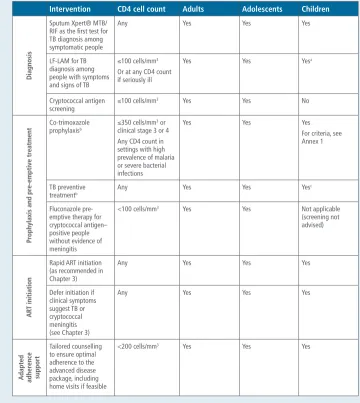
To address the leading causes of morbidity and mortality among people with advanced HIV disease, notably TB, severe bacterial infections, cryptococcal meningitis and cerebral toxoplasmosis (9,21), the 2016 WHO consolidated ARV guidelines recommend several individual interventions aimed at reducing morbidity and mortality among people with advanced HIV disease (29). Summarized in Table 1 below, these include the use of co-trimoxazole prophylaxis, TB preventive treatment, using Xpert® MTB/RIF (a nucleic acid based molecular test) for TB diagnosis among symptomatic people, using the lateral flow lipoarabinomannan (LF-LAM) antigen test for people with symptoms suggesting TB and who have a CD4 count ≤100 cells/mm3 or who are seriously ill, and cryptococcal antigen screening in those with CD4 cell count ≤100 and pre-emptive antifungal treatment for those with positive blood cryptococcal antigen.
A systematic review identified two randomized trials of packaged interventions aimed at people presenting with advanced HIV disease (45,46).
The first trial (REMSTART), conducted in the United Republic of Tanzania and Zambia, randomized 1999 ART-naive adults living with HIV with CD4 cell count <200 cells/mm3 to receive enhanced clinic-based care with serum cryptococcal antigen screening and pre-emptive antifungal treatment for those who tested cryptococcal antigen–positive and additional community support compared with standard care (46). ART was initiated within an average of two weeks for all trial participants (delayed by two weeks among people diagnosed with TB). The additional community support comprised a weekly home or community visit provided by trained and paid lay workers who delivered ART in the community, provided adherence support, and monitored participants for signs and symptoms of drug toxicity or new symptoms. Both groups received enhanced TB screening with Xpert® MTB/RIF regardless of symptoms at baseline (in the United Republic of Tanzania, people were rescreened for TB 6–8 weeks after ART initiation using Xpert® MTB/RIF regardless of symptoms). In this trial, the combination of four short home or community visits by lay workers combined with cryptococcal antigen screening followed by treatment for cryptococcal antigenaemia led to a 28% reduction in mortality among people presenting with advanced HIV disease (mortality was 13% in the intervention group versus 18% in the group receiving standard care). A tendency towards improved ART adherence in the intervention group compared with the standard-of-care group was reported at six months in the intervention arm (relative risk (RR) 1.05, 95% CI 1.00–1.10), but no difference was noted by 12 months on ART.
In this study, the enhanced prophylaxis package at the time of ART initiation reduced mortality by 27% (from 12.2% to 8.9%) over 24 weeks. Mortality from Cryptococcus was significantly reduced from 1.5% to 0.4%, and mortality from unascertained causes (most people died at home) from 6.0% to 3.8%. TB incidence was reduced by 28%, cryptococcal disease by 62% and hospitalization by 17% in the enhanced prophylaxis group compared with the standard-of-care group. The additional pill burden (three pills on day 1, two pills on days 2–5 and one pill thereafter) did not adversely affect viral load suppression which was the same in both groups. No difference in serious adverse events was observed. Most of the deaths in this study occurred within the first three weeks, highlighting the value of early prophylaxis for people with advanced disease. Economic analysis suggested that enhanced prophylaxis would be cost-effective for nearly all resource-limited countries.
Overall, the Guideline Development Group considered that these two randomized trials together provide moderate-quality evidence for the general approach to providing a package of targeted interventions to reduce mortality and morbidity among people presenting with advanced HIV disease in sub-Saharan Africa. Nevertheless, the Guideline Development Group was concerned about the available evidence to support the specific interventions assessed in the trials. Although severe bacterial infections are recognized as a common and frequently overlooked cause of HIV-associated morbidity and mortality, the Guideline Development Group did not consider that there is currently enough evidence to recommend including an additional broad-spectrum antibiotic (500 mg of azithromycin once a day for five days) within the package and that the unclear benefits of this specific component of the REALITY package (mortality reduction could not clearly be attributed to a decline in bacterial infections) do not outweigh concerns about the potential for antimicrobial resistance development. Nevertheless, the Guideline Development Group recognized the importance of further assessing the role of antibiotics in preventing mortality from severe bacterial infections among people presenting with advanced HIV disease.
Routine use of primary fluconazole prophylaxis for cryptococcal disease among adults, adolescents and children with advanced HIV disease has also not been included for routine administration as part of the package. Concerns with this approach include cost, development of fluconazole resistance and the need to avoid use because of fetal safety concerns among women of childbearing age who may not be taking adequate contraception. Nevertheless, in settings where cryptococcal screening tests are not available or results will be delayed, fluconazole prophylaxis may offer programmatic benefits after ruling out pregnancy, with a proven reduction in mortality and the incidence of cryptococcal disease (47). The updated WHO cryptococcal disease management guidelines to be issued later in 2017 will further review this recommendation.
may pose a further challenge to comprehending and remembering adherence messages. Hence, an adapted approach to providing treatment support, including an option for home- or community-based follow-up, should be considered. Early tracing of anyone who misses an appointment should also be implemented. The use of fixed-dose combinations is recommended as one way to improve adherence, and the fixed-dose combination tablet of co-trimoxazole, pyridoxine and isoniazid, as used in the REALITY trial, has recently been added to the WHO List of Essential Medicines.
Components of the package for people with advanced HIV disease
Table 1 summarizes the package of interventions from the 2016 WHO consolidated ARV guidelines that should be offered to everyone presenting with advanced HIV disease. Annex 1 provides full details of the recommendations.
Table 1
Components of the package of care for people with
advanced HIV disease
Intervention CD4 cell count Adults Adolescents Children
Diagnosis
100 cells/mm3 Yes Yes No
Pr
<100 cells/mm3 Yes Yes Not applicable
(screening not
<200 cells/mm3 Yes Yes Yes
a Limited data available for children. b Co-trimoxazole, isoniazid and pyridoxine are available as a fixed-dose combination tablet. c For children younger than 12 months, only those with a history of TB contact should receive TB preventive treatment if the
The role of presumptive treatment in managing TB, Pneumocystis jirovecii pneumonia, bacterial infections and cryptococcal disease should be considered in settings in which access to
diagnostic tests is limited and people present with typical signs and symptoms (especially when accompanied by clinical signs indicating severe illness2). To reflect this, the WHO algorithm for managing people with HIV who are suspected of having TB and are seriously ill incorporates presumptive treatment of TB, bacterial infections and Pneumocystis jirovecii pneumonia into the care pathway (48).
Co-trimoxazole, TB preventive treatment and fluconazole pre-emptive therapy for those with cryptococcal antigenaemia should be started as soon as they meet the criteria for the intervention. All medications may be started together. For people with advanced HIV disease who are eligible to start ART on the same day as HIV diagnosis (see the recommendation on ART initiation, Chapter 3), prophylaxis medications may be started at the same time (45). ART initiation should be deferred when clinical symptoms suggest TB or cryptococcal meningitis to avoid paradoxical worsening of the existing infection that can be life-threatening (see Chapter 3) (49); however, cryptococcal antigen screening is not a pre-condition for ART initiation.
Comparing benefits and harm
Providing a package of essential interventions will focus attention on diagnosing, preventing and treating the most common causes of morbidity and mortality among people with advanced HIV disease. However, attention should also be paid to other important causes of severe illness not covered by the package, in particular in regions where specific comorbidities and coinfections are prevalent. Increased pill burden and side effects may affect treatment adherence; however, in the trial setting, co-trimoxazole, isoniazid and pyridoxine were provided as a fixed-dose combination, and most participants found the enhanced prophylaxis package of medications to be easy or very easy to take (45).
Cost and cost–effectiveness
The package of screening and diagnostic tests and prophylactic and pre-emptive medications requires an initial investment in settings where these are not currently available. However, these costs are likely to be offset by savings incurred by reducing the costs associated with treating incident infections, hospitalization and death. Both randomized trials assessed for these guidelines included a formal cost analysis. In the REMSTART trial, the main costs were associated with ARV drugs (50%), clinic visits (19%) and hospitalization (19%). The incremental cost of the intervention to the health service over the first three months was US$ 59 and over a one-year period US$ 67, equivalent to a 25% increased cost over one year of follow-up. The investigators concluded that the package was an affordable approach to improving HIV care in resource-limited settings (50). In the REALITY trial, cost–effectiveness was assessed as being US$ 201 per quality-adjusted life-year and US$ 162 per life-year saved; this is likely to fall within the cost–effectiveness thresholds for most resource-limited settings (45).
Equity and acceptability
People with advanced HIV disease still account for a substantial proportion of the people starting ART (15). Recent attention has focused on adapting service delivery models to provide people-centred services for the people who are stable on ART (51), with less attention on the specific package required for those with advanced HIV disease. Providing a package of care for people with advanced HIV disease focuses attention on this vulnerable group of people.
2 A seriously ill adult is defined as having any of the following danger signs: respiratory rate ≥30 breaths per minute; heart
Providing less frequent clinical visits for people who are stable on ART is expected to more equitably direct clinical resources to those in greatest need of clinical care.
A community consultation conducted for these guidelines found support for providing a package of interventions to reduce mortality and morbidity in advanced HIV disease. People living with HIV also perceived increased adherence support as acceptable. However, the ability to provide home visits may depend on resources, and in settings where this may increase stigma people should be given options for where this support is received.
With respect to gender equity, the package of care is anticipated to have the greatest impact for men, who are more likely to present to care with advanced HIV disease and have higher HIV-associated mortality and lower life expectancy compared to women.
Feasibility
Both health-care workers and programme managers perceived delivering a package of interventions for advanced HIV disease as being feasible. Challenges to feasibility included the additional cost of such a package and the training of health-care workers required to implement the package of care. The ability to employ sufficient human resources to provide the increased intensity of adherence support such as that demonstrated in the REMSTART study (46) may also be a challenge where resources are limited.
The cost and programmatic challenges of performing baseline CD4 cell count testing, and the increased costs associated with the additional medication, may also challenge the feasibility of delivering such a package in resource-limited settings.
Implementation considerations
Providing a package of care for people with advanced HIV disease will require adapting the current service delivery models in resource-limited settings. The algorithm on the following page summarizes the steps to be considered in managing a person with advanced HIV disease.
In addition to CD4 cell count testing or WHO clinical staging the following additional assessments should be carried out:
• Does the person have signs of being seriously ill? Should this person be admitted to an inpatient facility?
• Is the person receiving an ART regimen that is failing (or has the person interrupted ART)?
• Does the person have signs or symptoms of TB (current cough, fever, weight loss, night sweats or other signs suggesting extrapulmonary TB such as enlarged lymph nodes)? Is the person currently receiving TB therapy?
• Taking a history and examining for major causes of morbidity and mortality among people with advanced HIV disease, such as cryptococcal meningitis, severe bacterial infections, cerebral toxoplasmosis, Pneumocystis jirovecii pneumonia, other fungal infections, and cytomegalovirus disease.
• Diagnostic tests: viral load if ART failure is suspected, sputum Xpert® MTB/RIF, urine LF-LAM if TB symptoms and CD4 cell count ≤ 100 cell/mm3 or if the person is seriously ill at any CD4 cell count, lumbar puncture for those with symptoms or signs of meningitis and, where feasible, for those with cryptococcal antigenaemia; and X-ray and blood culture if health system capacity allows.
• Treatment of confirmed diagnoses.
• If referral to a facility with diagnostic testing is not feasible, presumptive treatment of TB,
Pneumocystis jirovecii pneumonia, cryptococcal meningitis, toxoplasmosis, and severe bacterial infections should be considered if the person is seriously ill.
Importantly, if access to investigations is limited or there are significant delays in receiving results, presumptive treatment should be initiated and ART initiation should not be delayed.
Developing appropriate treatment literacy strategies is important to support people to identify signs and symptoms of advanced HIV disease and support adherence to medication. Empowering civil society organizations should also be considered within any differentiated service delivery model for people with advanced HIV disease.
Particular attention should be paid to people with advanced HIV disease who miss a clinic visit after initiating treatment for an opportunistic infection or during the first months after starting or restarting ART, since they are at high risk of mortality. Programmes should ensure capacity for actively tracing such people. Ideally, such people should consent to and be linked with a community-based health worker who may visit them at home.
Where can the package of care for advanced HIV disease be offered?
The package of care for people with advanced HIV disease should be offered at both hospitals and decentralized primary care clinics according to the clinical status of the person living with HIV (ambulatory or requiring hospital admission), the clinical skills of the health-care workers and access to diagnostics. However, to increase access to the package, improving access at peripheral sites through mobile outreach or decentralization should be encouraged. This may be enabled by providing point-of-care diagnostic tests at the peripheral level where feasible (CD4 cell count, cryptococcal antigen testing, LF-LAM testing and Xpert® MTB/RIF) or through sample transport systems.
13 TB symptoms absent
Start TB preventive treatment according to recommendations
TB symptoms present:
Perform Xpert MTB /RIF as first test LF LAM may be used if CD4 ≤ 100 cells/
Consider other diagnoses. If TB is considered unlikely, start TB preventive treatment according to recommendations. Consider presumptive TB treatment in patients who are seriously ill even if TB test is negative or result is unavailable.
ART Naive
Offer rapid ART initiation or delay initiation according to recommendations for TB or cryptococcal disease
Previously on ART (interrupted treatment) Offer rapid ART initiation or delay according to recommendations for TB or cryptococcal disease. Consider restarting on alternative ART regimen
Currently on ART
Check viral load and assess for treatment failure. If patient clinically failing and/or seriously unwell and VL > 1000 copies/ml or VL not available consider expedited switch to new regimen dependent on clinical history. Where possible use POC VL for these patients
• A seriously ill adult is defined as having any of the following danger signs: respiratory rate ≥30 breaths per minute; heart rate ≥120 beats per minute; or unable to walk unaided. Other clinical condition, such as temperature ≥39oC
combined with other signs such as headache, can also be considered based on local epidemiology and clinical judgement.A seriously ill child is defined as having any of the following danger signs: lethargy or unconsciousness; convulsions; unable to drink or breastfeed; repeated vomiting. Other clinical conditions such as temperature ≥39 and age-defined tachycardia and/or tachypnea can be considered based on clinical judgement. • Clear criteria for referral should be available. If the person is not seriously ill, the decision as to what interventions may be decentralized will be programmatic.
• In those admitted: mortality is highest in the first 48 hours after admission. Steps 1-4 should be completed as soon as possible on the same day as presentation. Based on clinical assessment: start TB and opportunistic infection therapies as soon as possible among those who are seriously ill. The availability of point of care diagnostics(CD4, cryptococcal antigen. LF-LAM, viral load) will support rapid diagonosis including at decentralized sites.
ART, antiretroviral therapy; CSF, cerebrospinal fluid; LP, lumbar puncture; TB, tuberculosis Blood CrAg = serum, plasma, or whole blood
# All patients with headache or confusion should have a lumbar puncture if CrAg+
## In settings where test results are available quickly, it would be more cost effective to test for cryptoccal infection prior to TB infection
STEP 1 If screening tests are not available and patient seriously unwell consider presumptive treatment for TB, cryptococcal meningitis and bacterial meningitis Meningitis symptoms present
Perform blood CrAg, Lumbar puncture#, CSF CrAg test, Xpert MTB/ RIF and microscopy#
CSF CrAg Negative Or LP not feasible Start pre-emptive treatment for
Assess for Symptoms of meningitis (headache, confusion)
STEP 5
Start co-trimoxazole prophylaxis according to WHO recommendations
STEP 6
Is the patient on ART ?
STEP 7
Offer intensified adherence support for both OI medication, ART and monitoring of condition. Home visits should be considered and rapid tracing of patients who miss appointments
STEP 4
Treat other opportunistic infections and possible bacterial infections. Empiric treatment of pneumocystis or bacterial pneumonia should be considered in patients with severe respiratory distress
STEP 8
Ensure communication for referral back to lower level facility after discharge for continuation of OI and/or ART medication, ART initiation or switch as indicated
Who can offer the package of care for advanced HIV disease?
Task sharing may be considered both for performing the point-of-care diagnostics within the package and for clinical management. A good practice statement within the 2016 WHO consolidated ARV guidelines states that trained and supervised non-laboratory staff, including laypeople, can undertake blood finger prick for testing and sample collection (29). This may enable lay health workers to perform point-of-care CD4 cell count, cryptococcal antigen testing and urine LF-LAM testing at peripheral sites (52). Task sharing to nurses and other mid-level health workers for the clinical management of people with advanced HIV should also be supported with training and mentorship. Initial screening procedures, treatment of TB and some opportunistic infections and prophylaxis may all be provided within a well-supported nurse-led programme. However, clear referral criteria and care pathways must be in place to ensure appropriate investigation and higher-level clinical management when required. Where referral is not feasible, lower-level health workers should consider presumptive treatment based on the clinical presentation, ideally after consulting with an experienced clinician.
Intensity of follow-up for people with advanced HIV disease
People with advanced HIV disease require closer follow-up during the initial period of receiving ART to monitor the response to ART and to identify signs and symptoms of possible immune reconstitution inflammatory syndrome. During the REMSTART study, weekly home visits were provided during the first month on ART (46). Even with close initial follow-up in the REALITY trial, many people died at home, with most deaths occurring very soon after ART initiation. People discharged after hospitalization for advanced HIV disease may also require more intensive follow-up. The feasibility of the frequency of visits is context specific and may also depend on the person’s ability to travel to the clinical site. People missing appointments should also be rapidly traced by phone or through home visits. Where face-to-face contact is not feasible, distance contact through telephone consultation, mHealth, text messaging or other mobile interventions, or visits through a community health worker or home-based caregiver should be considered, with consent of the client.
For hospitalized patients, programmes should provide measures to improve linkage and follow-up after discharge such as outpatient primary care clinic visits and home visits by community health workers to reduce the risks of loss to follow-up and of mortality after discharge.
Considerations for specific populations
The package of care should be provided to all patients presenting with advanced HIV disease, unless specifically contra-indicated (Table 1 and Annex 1). The following section provides some additional considerations for specific populations.
Children
The same definition of advanced HIV disease used for adults is applied to children older than five years. Based on data showing that more than 80% of children younger than five years starting ART are WHO clinical stage 3 or 4 and/or have severe immunosuppression, the Guideline Development Group considered all children younger than five years to be eligible for the package for advanced HIV disease (12). The major causes of mortality and morbidity among children with advanced HIV disease remain TB, severe bacterial infections and Pneumocystis jirovecii pneumonia but, in contrast with adults, cryptococcal disease is relatively rare. A laboratory-based survey performed in South Africa estimated the incidence of cryptococcal disease to be 47 per 100 000 children living with HIV (34) and within two trial cohorts of children, no cases of cryptococcal disease were reported in children younger than five years (53).
of the participants were 5–17 years old and received the same package of prophylactic interventions as the adults. No child had cryptococcal disease, one child had candidiasis at enrolment and no new cases were detected during the trial. One death was reported from probable bacterial pneumonia (45).
Based on previous recommendations included in the 2016 WHO consolidated ARV guidelines (29), Table 1 outlines the package of screening and prophylaxis interventions for children and adolescents, and Annex 1 provides the detailed recommendations. Increased pill or syrup burden is of particular concern for children, and fixed-dose combinations should be used if possible, including the new fixed-dose combination of co-trimoxazole, isoniazid and pyridoxine. Whether the current package is sufficiently adapted to the specific pathogens causing mortality among children is also of concern, especially to address the high rates of bacteraemia in those younger than three months (54). Further research is needed to determine the components of the package of care for young children and optimal administration and delivery in this age group.
Finally, the routine interventions recommended by WHO for children in general such as deworming, malaria prophylaxis, iron and vitamin A supplementation and growth monitoring should all be provided.
Adolescents
Adolescents generally face challenges in adhering to medication, and enhanced adherence counselling may be especially valuable.
Pregnant and breastfeeding women
For pregnant and breastfeeding women, WHO guidelines on antenatal care provide recommendations regarding nutrition support, disease prevention. managing common physiological symptoms and infant feeding support for women who cannot breastfeed (55).
Region-specific comorbidities and coinfections
Consideration should be given to regional differences in comorbidities and coinfections that may require additional prophylactic, diagnostic and therapeutic options not covered by the package (see section 2.3).
2.6
Considerations for people with advanced HIV disease
re-engaging with care after treatment interruption or
treatment failure
People re-engaging with care after treatment interruption with advanced HIV disease should be offered a comprehensive clinical assessment. The evidence supporting the package of interventions for advanced disease is derived from studies among ART-naive people,
Nevertheless, the package should be given to people with advanced disease who are re-engaging with care after a period of ART interruption or when ART fails, since such people are likely to benefit from the same set of interventions as ART-naive people with advanced HIV disease.
People interrupting treatment on a non-nucleoside reverse-transcriptase inhibitor (NNRTI)– containing regimen are at risk of drug resistance and may require more intensive virological monitoring, and consideration should be given to restarting ART using a non-NNRTI-containing regimen, with a goal of re-establishing viral suppression, according to the 2017 WHO guidelines on the public health response to pretreatment HIV drug resistance (56).
For people presenting with diagnoses consistent with treatment failure,3 WHO already
3 New or recurrent clinical event indicating severe immunodeficiency. Adults: WHO clinical stage 4 conditions; children:
recommends viral load testing; CD4 cell count testing is no longer recommended for ART monitoring for people stable on ART where viral load monitoring is available (29); however, CD4 cell count testing should be specifically prompted for people with a viral load exceeding 1000 copies/ml and for everyone whose clinical presentation suggests advanced HIV disease regardless of whether they have been exposed to ART or not. People presenting with advanced HIV disease as a result of treatment failure should also benefit from the advanced HIV disease package, and if severely ill, an expedited switch to a new regimen should be considered by reducing the time between the first and second viral load test (1–3 months) and by paying increased attention to ensuring rapid turnaround and action on the results. Where rapid viral load testing is not available the decision to switch should be assessed according to the individual clinical presentation of the patient. Further research is required to evaluate the optimal package of interventions to people presenting with treatment failure, for example before switching to second-line ART. A planned WHO review of the viral load algorithm for people receiving ART will also consider these monitoring considerations for managing people with advanced HIV disease.
2.7
Vaccination for people with advanced HIV disease
Providing vaccinations to people living with HIV does not appear to accelerate HIV disease progression and is recommended as an important part of the HIV care package. However, people with severe immunosuppression may be at higher risk of complications from some live attenuated vaccines, and the response to other inactivated vaccines may be less effective because of their degree of immunosuppression. Additional doses or revaccination after immune reconstitution on ART may therefore be required.
Nineteen of the 26 WHO vaccination position papers (57) provide general or specific guidance for people living with HIV. HIV-exposed infants, children and adolescents living with HIV should undergo the routine vaccination schedule according to local recommendations, with the following modifications.
Bacille Calmette-Guérin (BCG) vaccine
Children who are HIV positive or of unknown HIV status with symptoms consistent with HIV should not receive BCG vaccine. This policy is currently being reviewed by WHO and is potentially subject to change.
Human papillomavirus
A three-dose schedule (0, 1–2 and 6 months) should be used if human papillomavirus vaccination is initiated after 15 years of age and for those younger than 15 years known to be immunocompromised and/or living with HIV (regardless of whether they are receiving ART). It is not necessary to screen for human papillomavirus infection or HIV infection before human papillomavirus vaccination.
Measles
Vaccination should be routinely administered to potentially susceptible, asymptomatic children and adults living with HIV and should be considered for those with symptomatic HIV infection if they are not severely immunosuppressed according to WHO definitions (CD4 cell counts <50 cells/mm3).
In areas with a high incidence of both HIV infection and measles, the first dose of measles-containing vaccine may be offered as early as six months old followed by two additional doses according to the national immunization schedule up to two years.
measles-containing vaccine 6–12 months after initiation of ART. Current evidence is insufficient to recommend an additional dose for children who start ART before the first dose of measles-containing vaccine (58).
Meningococcal vaccination
Meningococcal vaccination should be offered to everyone with immunodeficiency, including those patients with advanced HIV infection.
Pneumococcal vaccine
Infants and preterm neonates living with HIV who have received their three primary vaccine doses before reaching 12 months of age may benefit from a booster dose in the second year of life. Interrupted schedules should be resumed without repeating the previous dose. The evidence supporting the use of pneumococcal vaccines for immunizing older populations (and the potential use of such vaccines for immunization in pregnancy to protect newborn babies) is currently not considered sufficient to support policy recommendations. Because of the low level of evidence for benefit, routine vaccination of adults living with HIV with 23-valent polysaccharide vaccine is not recommended in resource-limited settings.
Polio vaccine
Inactivated polio vaccine or bivalent oral polio vaccine may be administered safely to asymptomatic infants living with HIV. HIV testing is not a prerequisite for vaccination. Bivalent oral polio vaccine is contraindicated among severely immunocompromised people with known underlying conditions such as primary immunodeficiencies, disorders of the thymus, symptomatic HIV infection or low CD4 cell count; these populations can safely receive inactivated polio vaccine.
Rotavirus
Major contraindications for rotavirus vaccination include severe allergic reaction after a previous dose and severe immunodeficiency
Yellow fever
Yellow fever vaccine may be offered to asymptomatic people living with HIV with CD4 cell counts
≥200 cells/mm3 ; it is therefore contra-indicated in people with advanced HIV disease until they achieve a CD4 cell count ≥200 cells/mm3. Although the data on the safety and immunogenicity of yellow fever vaccine when used among children living with HIV are limited, yellow fever vaccine may be administered to all clinically well children. HIV testing is not a prerequisite for vaccination.
2.8
Research gaps
Research priorities related to diagnostics include the need for a simplified tool to perform CD4 cell count testing to ensure people with advanced immune disease are identified. Ongoing research is being undertaken, including using a semiquantitative CD4 cell count lateral flow assay for which operational research will be required to evaluate feasibility under field conditions. Further research is also needed to develop simplified point-of-care diagnostics for TB, severe bacterial infections, Pneumocystis jirovecii pneumonia, toxoplasmosis, cytomegalovirus disease and other opportunistic infections specific to geographical regions, such as histoplasmosis and talaromycosis. Enhanced TB screening with Xpert® MTB/RIF regardless of symptoms was provided in both groups in the REMSTART study (46) and its impact could therefore not be assessed. Further studies are needed on such strategies to improve TB screening.
people identified as cryptococcal antigen–positive at screening and approaches to antibiotic therapy within a public health approach, and specifically, the independent effect of short-course azithromycin on mortality. Some concerns have also been raised regarding the impact of moving to a dolutegravir-containing first-line ART regimen on the incidence of immune reconstitution inflammatory syndrome among people with advanced HIV disease (59), and although there was no evidence of increased risk of immune reconstitution inflammatory syndrome in the REALITY trial in which one arm of people with advanced HIV disease started a drug from the same class, raltegravir (60), this may warrant further assessment when dolutegravir is scaled up in resource-limited settings. The Guideline Development Group also highlighted programmatic assessment of the intensity of follow-up required and adherence strategies for people with advanced HIV disease as important areas for future implementation research.