14
Inequality in The Access to Social Housing in Cameroon: A
Decomposition of The Poverty Effect
Minfede Koe Raoul
Faculty of Economics and Applied Management, University of Douala E-mail: [email protected]
Received: September 21, 2017; Accepted: December 5, 2017; Published: December 18, 2017
Abstract
This article studies the gap of access to social housing between the poor and the non poor in Cameroon. The data used is from the third Cameroonian survey of households (ECAM, 2007). We use the non linear decomposition model of inequalities. The results show a strong discrimination with regards to poor households. The differences in the access to social housing between the poor and the non poor are highly influenced by the distribution of variables such as: the residential area (61.22%), the income (34.18%), age (23,50%), the socio-professional category (22.39%) and the sector of activity (21.11%). These results put into question public policies on social housing.
Keywords: Inequality, social housing, non-linear decomposition, the poor JEL Classification: H4, R2
INTRODUCTION
15
significant effect of income in the London context. The studies of Rex & Moore (1967) on their part show the significance of race in the United States. These later results are confirmed by the studies of Simon & Kirszbaum (2001).
Despite the pertinence of the studies presented above, they carry two major criticisms. First, these studies are mostly focused on the rental private housing market. The inequalities in the social housing market were not largely dealt with. The second criticism is relative to the methodology adopted. Very few studies used the tools of robust decomposition of inequalities which can be a source of bias and consequently affect the redress of target public policy. We correct this bias by using the most adapted decomposition model (Fairlie, 1999; 2005). Moreover, most previous studies are carried out in the context of developed countries. Very few studies have been interested in the context of under developed countries.
In Cameroon, the situation of the housing market presents structural insufficiencies in the quantity as well as the quality of housing. The figures of the National Institute of Statistics (INS, 2015), present a deficit of more than one million houses. To deal with this deficit the public supply of social housing was structured since independence around a multi-institutional armature, with the objective of creating the technical, environmental and financial conditions necessary for the development of social housing. The policy implemented by the different institutions responsible for the supply of social housing has produced almost 20 000 social houses so far essentially in the large political and economic metropolis of Yaounde and Douala. This represents 1.6% of all the demand. This number of social houses is not enough to meet up with the demand of the most vulnerable part of the population. This demand increases by an average of 10% every year (MINDUH, 2010). This generates a fierce competition among households in this housing market. The conditions of access to social housing are structures around opaque bureaucracies that are not transparent. Two types of housing are offered simple tenure and sales-tenure. As for the first type the households are called upon to pay a monthly rent of 20000 FCFA. As for the second type, the acquisition of a social housing requires an average cost of 25 million FCFA (INS, 2015). This is practically inaccessible to the vulnerable population. In this environment, it is possible that the population targeted by the public policy be finally excluded. Thus the need to better appreciate the repartition of social housing in Cameroon. This study is of particular interest for two reasons.
First, it serves in the evaluation of the public policies aimed at improving the living conditions of the vulnerable population. Thus it seeks social justice and well being. Secondly, it uses a decomposition model that has not been applied to the housing market so far. This approach permits to improve the quality of previous results. The rest of the article is organized as follows: the second section presents the methodology adopted. The third section presents the results obtained and the discussions and the fourth section concludes the study.
METHOD
This section presents the data and the specification of the model.
Data and construction of variables of the study Source of data
16
housing in Cameroon. It constitutes a large base to apprehend the problems of inequality in housing. The data is made up of 11 391 observations in the ten regions of Cameroon. However, in view of the spatial distribution of social housing, we retain only two major cities, namely Yaoundé and Douala. In the end, we retain a sample of 6311 individuals. The survey element is households.
Construction of variables
Two types of variables are retained: the explanatory variables related to the profile of households especially socio-demographic and economic and the
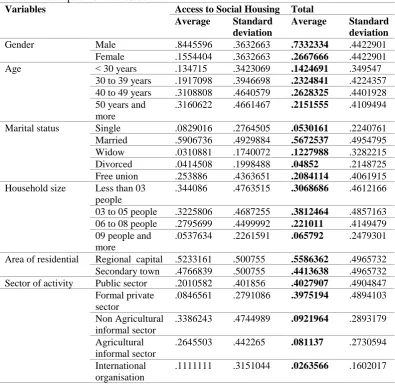
independent variable namely ‘access to social housing’. All the socio-economic variables are made up of modalities of appreciation in the form of dummy variables. The variable income enables to construct a poverty indicator whose incidence on inequality in the access to social housing is evaluated. The indicator of poverty retained is monetary. We make reference to the poverty line retained by the National Institute of Statistics of Cameroon (INS, 2014). In this case, a poor person is defined from a monetary stand point as any household with an annual income of less than 339 715FCFA that is 931FCFA per day per adult. On the basis of the monetary poverty line, the poverty index is situated at 37.5%. The following table provides a statistical description of the selected variables.
Table 1: Description of Variables
Variables Access to Social Housing Total
Average Standard
deviation
Average Standard
deviation Gender Male .8445596 .3632663 .7332334 .4422901
Female .1554404 .3632663 .2667666 .4422901 Age ˂ 30 years .134715 .3423069 .1424691 .349547
30 to 39 years .1917098 .3946698 .2324841 .4224357 40 to 49 years .3108808 .4640579 .2628325 .4401928 50 years and
more
.3160622 .4661467 .2151555 .4109494
Marital status Single .0829016 .2764505 .0530161 .2240761 Married .5906736 .4929884 .5672537 .4954795 Widow .0310881 .1740072 .1227988 .3282215 Divorced .0414508 .1998488 .04852 .2148725 Free union .253886 .4363651 .2084114 .4061915 Household size Less than 03
people
.344086 .4763515 .3068686 .4612166
03 to 05 people .3225806 .4687255 .3812464 .4857163 06 to 08 people .2795699 .4499992 .221011 .4149479 09 people and
more
.0537634 .2261591 .065792 .2479301
Area of residential Regional capital .5233161 .500755 .5586362 .4965732 Secondary town .4766839 .500755 .4413638 .4965732 Sector of activity Public sector .2010582 .401856 .4027907 .4904847
Formal private sector
.0846561 .2791086 .3975194 .4894103
Non Agricultural informal sector
.3386243 .4744989 .0921964 .2893179
Agricultural informal sector
.2645503 .442265 .081137 .2730594
International organisation
17
Socioprofessionnal category
Boss .4285714 .4961861 .1609302 .3674856 Employee .2380952 .427049 .0722481 .2589116 Self employed .0529101 .2244485 .6530233 .4760329 Labourer .0410078 .1983187 .1609302 .3674856 Family
assistance
.015873 .1253162 .017261 .130249
Level of education Primary level .1450777 .3530951 .080368 .2718749 Secondary level .373057 .4848749 .5697118 .4951397 Higher level .4818653 .5009706 .3499202 .4769669 Quartile of icome Quartile 1 .0580645 .2346235 .1096498 .3124775 Quartile 2 .116129 .3214181 .1706544 .3762365 Quartile 3 .2258065 .4194676 .240374 .4273444 Quartile 4 .2645161 .442505 .2305498 .4212181 Quartile 5 .3354839 .4736898 .248772 .4323356 Source: Author from ECAM 3 data, 2007.
From the table above, some preliminary interpretations can be made. In terms of gender, statistical results show that female-headed households have a low rate of access to social housing (26.67%), unlike male-headed households (73.32%). Discriminatory economic and public policy factors may explain these results. Age-related results show that young households have a low proportion of access to social housing. For households between the ages of 30 and 39, the access rate is 23.24%. This result augurs the inefficiency of public social housing policy. Because the objective of public housing policies is to provide low-cost housing to households in socio-professional transition. In the underdeveloped countries and especially in Cameroon, this age group is generally unstable from a socio-professional point of view. The targeting of public policies can be called into question.
In examining the sector of activity, it appears that households in the formal and public sectors have high access rates to social housing. They have respectively 40.27% and 39.75% access rates. Conversely, those working in the informal sectors have very low access rates to social housing. Their access rate is around 8%. These figures show that access to social housing remains the prerogative of households enjoying professional stability. This result is opposed to the ideology underlying the public policy of supplying social housing.
With regard to the level of education, households with a primary level of education occupy a proportion of 8% in terms of access to social housing. This low rate can reflect the informational limits of the public policy implemented. For households with a primary level of education, do not always have the intellectual capacity, allowing them to acquire and better process information related to the mechanisms of access to social housing. This then assumes the implementation of effective information strategies, to better inform the vulnerable layers.
18
These first trends may suggest the idea of unequal access to social housing in Cameroon. The determination of the contribution of the various explanatory variables finds all its interest to this effect. This is the idea of the following section.
Specification of the model
The objective of this study is to identify the sources of the differences in access to the social housing between the poor and the non poor. More specifically it is aimed at separating the unexplained part from that which can be explained by the observed characteristics. The estimation procedure involves two stages. The first stage involves in the evaluation of the probability that a household expresses the need for social housing. This first stage permits to eliminate the bias related to the overestimation of non eligible households. In other to do this we assume that
the distribution function of the event ‘Express a social housing need’ is a normal
distribution function. In addition, since the variable ‘Express a social housing need’ is dichotomous and qualitative we use a probabilistic Probit model. We assume that
the variable ‘Express a social housing need’ is binary and is written as . Moreover, this variable is the result of a latent variable ‘living a social housing’ written: ∗ ℎ� � � � �ℎ ℎ� :
= � ∗ = � � � � ��� ℎ �
= � ∗ = � � � � ��� ℎ �
The study also assumes that the latent variable is explained by the socio-economic characteristics expressed by the vector �. Linearly ∗ = + � + � with � ℎ . The second stage involves the decomposition of the inequalities of access to social housing between the poor and the non poor. The idea is to evaluate the contribution of each variable to the differences in the access to social housing between the poor and the non poor. We use the decomposition method proposed by Fairlie (1999, 2005). This method is better adapted to this type of problem where the independent variable is not continous (Barsky et al., 2002). Fairlies method permits to decompose the difference in average probability of access to social housing between the poor and the non poor into two parts. The first part of the decomposition refers to a difference that is attributed to the distribution of the observable characteristics. The second part refers to a difference attributed to the effects of these characteristics. The expression of the decomposition of the inequalities of the non linear models is established as follows:
�̅��− �̅� = [∑ �(�����̂��)
19
presented above uses the population of the non poor as reference. This implies that the poor are not favoured (Oaxaca, 1973). The estimated coefficients in the non poor population are used as weights of the first term of the decomposition equation. On the contrary the distribution of the characteristics of the poor is used to weight the second term of the decomposition expression. Using the estimated coefficients of the total sample, the approach of Fairlie permits to evaluate the relative contribution of each determinant to the difference in average probability of living in a social housing between the two populations. The contribution of each observable characteristic can be apprehended as follows:
��∑� ( ̂∗+ ��� ̂∗+ ⋯ + �� ̂∗) 1
= − ( ̂∗+ �� ̂∗+ ⋯ + �� ̂∗)
(2)
Where ̂∗ represents the coefficients estimated on the total population.
The relative contribution of each variable can have two effects. A negative effect suggests that the variable in question reduces the difference in the access to social housing that is attributed to a difference in the distribution of the observable characteristics between the non poor and the poor population. A positive effect implies that the variable in question contributes in widening the gap of accessibility to social housing that is attributed to the distribution of the observable characteristics between the two sub-populations.
RESULTS AND DISCUSSIONS Results
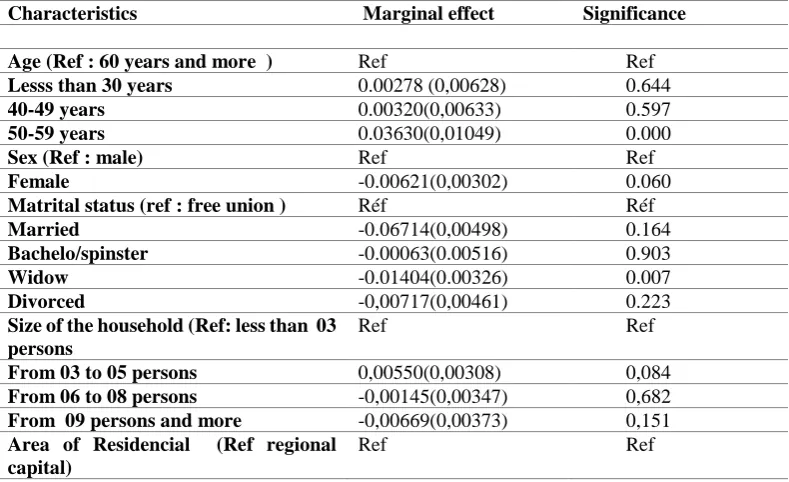
Two results are presented. The first result evaluates the determinants of access to the social housing using the Probit model. The second result presents the differences in the access to the social housing between the non poor and the poor. Tables 1 and 2 summarise the two results.
Table 2. Probability of access to social housing: the marginal effect of socio-economic variables
Characteristics Marginal effect Significance
Age (Ref : 60 years and more ) Ref Ref
Lesss than 30 years 0.00278 (0,00628) 0.644
40-49 years 0.00320(0,00633) 0.597
50-59 years 0.03630(0,01049) 0.000
Sex (Ref : male) Ref Ref
Female -0.00621(0,00302) 0.060
Matrital status (ref : free union ) Réf Réf
Married -0.06714(0,00498) 0.164
Bachelo/spinster -0.00063(0.00516) 0.903
Widow -0.01404(0.00326) 0.007
Divorced -0,00717(0,00461) 0.223
Size of the household (Ref: less than 03 persons
Ref Ref
From 03 to 05 persons 0,00550(0,00308) 0,084
From 06 to 08 persons -0,00145(0,00347) 0,682
From 09 persons and more -0,00669(0,00373) 0,151
Area of Residencial (Ref regional capital)
20
Secondary town -0,00311(0,00243) 0,195
Sector of activity (Ref :international organisation)
Ref Ref
Public sector 0,00606(0,00223) 0,004
Formal private Sector -0,00009(0,00209) 0,966
Non agricultural informal Sector -0,00107(0,00188) 0,596
Agricultural informal Sector -0,00197(0,00293) 0,500
Socio-professionnal category (Ref : Boss
Ref Ref
Employee 0,00691(0,00390) 0,012
Personal account -0,04633(0,00989) 0,000
Labourer -0,00034(0,00151) 0,823
Family asistance -0.00382(0,00174) 0,162
Level of education (Ref: higher level ) Ref Ref
Primary level of education -0,00479(0,00367) 0,208
Secondary level of education 0,01915(0,00469) 0.000
Quartile of revenu (Ref : Quartile 5) Ref Ref
Quartile 1 -0.00217(0.00765) 0.784
Quartile 2 0.01031(0.00749) 0.131
Quartile 3 0,01772(0.00842) 0.014
Quartile 4 0,02696(0.00922) 0.000
Number of observations: 6311 Pseudo R2 : 0,0426
Source: Author from ECAM3 data, 2007. The numbers in brackets represent the standard errors
Interpretation of results
Among all the socio-demographic variables the results obtained show a significant effect of age, sex and the size of the household. Poor households are less likely to have access to social housing in comparison to second and third age group households. Households with an age range of 50 years and above have significant and positive marginal effects (0.03630). Households managed by women have a lower probability of having access to social housing than those managed by men. At a threshold of 10%, the marginal effect is equal to -0.00621 and is significantly different from zero. The size of the household has a significant effect. The marginal effects obtained decrease as the size of the household increases. The results obtained are coherent with previous studies (Yinger, 1998; Andersen et al., 2013).
As for the effects of economic variables, the results obtained show that the economic conditions significantly affect the probability of access to social housing. Households with a stable and formal socio-professional status, a higher level of education and income are more likely to have access to social housing. These results are in conformity to those of previous studies (Rudge & Gilchrist, 2005; Cruz et al., 2007; Aberhardt et al., 2010). However, these results contradict the idea behind the public policy of social housing since social housing is aimed at the disfavoured and vulnerable population. These include essentially the youths, women and the poor. In the case of Cameroon, the low volume of the available social housing and the operational governance relative to the attribution of social housing can explain these results everything being equal.
21
Table 3. Decomposition of the differences in the access to social housing between the poor and the non poor
Contribution of determinants to the difference in social housing
P value Standard errors %(Explained
proportion )
Source: Author from ECAM3 data, 2007. *, ** and *** are respectively thresholds of 1%, 5% and 10%
Interpretation
We notice that the explained portion is negative (-4.62%). That suggests that the unexplained portion that is assimilated to discrimination tends to explain an important proportion of the differences in access to social housing between the poor and the non poor. Moreover, we observe two types of signs namely positive and negative signs.
22
social housing between the poor and the non poor is 21.11%. This result can be explained by the fact that the different income generating activities carried out by the poor are mostly in the informal sector and are very unstable. Nevertheless, the difference in income between the populations contributes 34.18% in the explanation of their difference in access to social housing. This suggests that the lowest income level of the poor partially explains their low level of access to social housing. On the contrary, the level of education has a negative contribution (-94.26%). That suggests that an improvement in the level of education of the poor population contributes to reducing the difference in access to social housing by 94%. Our results are in contradiction with those obtained by several French studies (Driant & Rieg, 2004; Verdugo, 2010). The later show that a high proportion of the poor population in France live in social housing. In the French context, the supply of social housing represents 37% of housing tenure (Castéran & Ricroch, 2008). But in the context of Cameroon, the supply of social housing represents only 1.6% of the total supply. This does not predispose the poor population to have access to social housing.
CONCLUSION
In this study, we evaluate the difference in access to the social housing between the poor and the non poor. In other to do this we use the tools of decomposition of inequalities proposed by Fairlie (2005). The data used is from the survey on poor housing carried out in Cameroon by the National Institute of Statistics in 20017. Our objective is achieved in two stages. The first stage consists in evaluating the individual variables that affect the probability of access to social housing. We use a probabilistic Probit model. The economic variables such as level of education, sector of activity and income are found to be significant. Poor households are less likely to have access to social housing. In addition, the results reveal a significant impact on age and sex. Young households and those managed by women are less likely to have access to social housing. The second stage enabled us to decompose the contribution of individual variables to the difference in access to social housing. This result reveals that the public programme of supply of social housing is suffering from the wrong target population. This suggests that the supply available is not adapted to the socioeconomic conditions of the most vulnerable. These results invite public decision-makers to increase the volume of the available social housing. This orientation will let loose the tension of demand. The transparency of the procedure of attribution of social housing has to be assured. Credible information on the level of income and the living standards of the future occupants has to be collected and used as a tool of attribution of social housing. This study permits to envisage the analysis of the efficiency of the different state programmes of supply of social housing. This is the aim of the study we are presently carrying out.
References
23
Andersen, H. S., Turner, L. M., & Søholt, S. (2013). The special importance of housing policy for ethnic minorities: evidence from a comparison of four Nordic countries. International Journal of Housing Policy, 13(1), 20-44. Barsky, R., Bound J., Charles, K., & Lupton, J. (2002). Accounting for the
Black-White Wealth Gap: A Nonparametric Approach. Journal of the American Statistical Association, 97(459), 663-673
Bazyl & Monika. (2009). Factors influencing tenure choice in European countries. SOEP papers, 186
Carter & Steven. (2011). Housing tenure choice and the dual income household.
Journal of Housing Economics, 20, 159- 170
Castéran, B., & Ricroch, L. (2008). Les logements en 2006 : le confort s’améliore, mais pas pour tous, Insee Première, 1202
Cruz, M., Piedade., & Oliveira. (2007). Housing demand, Tenure choice and housing policy in Brazil. Institute of Applied Economic Research
Danierre., & Amrita (1992). Determinants of Tenure Choice in the Third World: An Empirical Study of Cairo and Manila. Journal of Housing Economics, 2, 159-184.
Driant, J., & Rieg, C. (2004). Les ménages à bas revenus et le logement social Insee Première, 962.
ECAM3. (2007). Résultats de l ‘Enquête Camerounaise Auprès des Ménages Edwards., & Michael (1990). Rental housing and urban poor: Africa and Latin
America compared, in Amis, Philip et Lloyd, Peter (éd.), Housing Africa’s
Urban poor. Manchester University Press.
Fairlie, R. (1999). The Absence of the African-American Owned Business: An Analysis of the Dynamics of Self-Employment. Journal of Labor Economics, 17, 80-108.
Fairlie, R. (2005). An extension of the Blinder-Oaxaca decomposition technique to logit and probit models. Journal of Economic and Social Measurement, 30, 305–316.
INS. (2014). Institut National de la Statistique : Rapport annuel sur l’état de la pauvreté au Cameroun.
INS. (2015). Institut National de la Statistique : Rapport annuel sur l’état de la pauvreté au Cameroun.
MINDUH. (2010). Ministère du développement urbain et de l’habitat : Rapport
annuel d’activités.
Oaxaca, R. (1973). Male-female wage differentials in urban labor markets.
International Economic, Review, 14, 693-709.
Pahl, K., & Way,N. (2006). Longitudinal trajectories of ethnic identity among urban Black and Latino adolescents. Child Development. 2006,77,1403–1415. Rawls, J (1971). A theory of justice. Cambridge, MA: Harvard University Press. Rex, J., & Moore, R. (1967). Race, Conflict and Community: A Study of parkbrook.
Oxford, Oxford University Press.
Rudge, J., & Gilchrist, R. (2005). Excess winter morbidity among older people at risk of cold homes: A population-based study in a London borough, Journal of Public Health, 27, 353-358.
24
Sen, A. (1992). Inequality Reexamined. Oxford University Press / Harvard University Press, Oxford / Cambridge, MA.
Shapiro, T.M. (2004). The hidden costs of being African-American: How wealth perpetuates racial inequality. New York, NY, Oxford University Press. Simon, P. (1995). Le logement des immigrés. Population et Sociétés n° 303. Simon, P., & Kirszbaum, T. (2001). Les discriminations raciales et ethniques dans
l’accès au logement, Note Geld, 3.
Tabard, N. (2002). Représentation socioéconomique du territoire, typologie des
quartiers et communes de France selon la profession et l’activité
socio‑économique de leurs habitants. France métropolitaine, recensement de 1999, Document de travail n° F0208, Insee.
Verdugo, G. (2010). Public Housing and Residential Segregation of Immigrants in France, IZA. Discussion Paper, 5456.
World Health Organization. (2010). A Conceptual Framework For Action on the Social Determinants of Health. Retrieved from http://www.who.int/ sdhconference/resources/ConceptualframeworkforactiononSDH_eng.pdf. Yinger, J. (1998). Evidence on Discrimination in Consumer Markets. Journal of