By the Editors of
KIPLINGER’S PERSONAL
FINANCE MAGAZINE
Your all-in-one guide for
success from America’s leading
personal finance authority
Buying
Selling
&
Home
a
Revised
& Updated
Buying
&
Selling
Kiplinger’s Practical Guide to Investing But Which Mutual Funds?
Making Money in Real Estate Buying & Selling a Home Retire Worry-Free
Retire & Thrive
Dollars & Sense for Kids Next Step: The Real World Home•ology
Taming the Paper Tiger at Home Know Your Legal Rights
Financing College
KIPLINGER’S BUSINESS MANAGEMENT LIBRARY Business 2010
Customer Once, Client Forever Raising Capital
Taming the Paper Tiger at Work Cash Rules
Hunting Heads Parting Company
You Can’t Fire Me, I’m Your Father Fast-Track Business Growth
Kiplinger offers excerpts and tables of contents for all of our books on our Web site (www.kiplinger.com)
For information about volume discounts contact:
Cindy Greene
Kiplinger Books & Tapes 1729 H Street, N.W. Washington, DC 20006
e-mail: [email protected] 202-887-6431
By the Editors of
KIPLINGER’S PERSONAL
FINANCE MAGAZINE
Your all-in-one guide for success
from America’s leading
personal finance authority
Buying
&
Selling
a Home
1729 H Street, N.W. Washington, D.C. 20006
Library of Congress Cataloging-in-Publication Data
Buying & selling a home : your all-in-one guide for success from America’s leading personal finance authority / by the editors of Kiplinger’s personal finance magazine.— 7th ed.
p. cm. Includes index.
ISBN 0-938721-92-5 (pbk.)
1. House buying. 2. House selling. 3. Home ownership. 4. Real estate business. I. Title: Buying and selling a home. II. Kiplinger’s personal finance magazine.
HD1379 .K52 2002
2001050787
© 2002 by The Kiplinger Washington Editors, Inc. All rights reserved. No part of this book may be reproduced or transmitted in any form or by any means, electronic or mechanical, including photo-copying, recording or by an information storage and retrieval system, without the written permission of the Publisher, except where permitted by law.
This publication is intended to provide guidance in regard to the subject matter covered. It is sold with the understanding that the author and publisher are not herein engaged in rendering legal, accounting, tax or other professional services. If such services are required, professional assistance should be sought.
Seventh edition. Printed in the United States of America.
INTRODUCTION ix
PART I—For Buyers
CHAPTER 1: To Buy or Not to Buy 3
The Intangibles • Financial Benefits • The Risks and Hard Work of Homeownership • Rent Versus Buy • Buying a House With Others
CHAPTER 2: Assessing Your Resources 11
Figure Your Net Worth • The Down Payment • How Big a Loan? • Prepare Yourself • How Much Down, How Much Borrowed? • Clean Up Your Credit Report • Your Credit Score • Obtaining Preapproval With a Lender • Kinds of Loans • Get Your Earnest Money Ready
CHAPTER 3: Home Sweet Tax Shelter 29
Deductibility of Mortgage Interest • Adjust Your Withholding • Record Keeping • Deductibility of Mortgage Points •
Deductibility of Closing Costs • Other Tax Angles of Owning • Deductibility of Interest on Debt Secured by a Home • Refinancing
CHAPTER 4: Define Your Needs, Pick a Neighborhood 45
Make a List of Needs and Wants • Make a ‘Don't Want’ List, Too • Choosing a Neighborhood • Tips for Relocation • Weigh the Negatives • How is the Neighborhood Organized? • Examine the Lot
CHAPTER 5: Many Kinds of Homes 61
Single-Family Detached Houses • Condominium Ownership • Cooperative Apartments • Manufactured Homes
CHAPTER 6: House-Hunting Strategies 87
The Buyer's Market • The Seller's Market • Searching on Your Own • Shopping With a Real Estate Agent • Using a Buyer's Broker • Perusing the Ads • Handling the 'Sale by Owner' • Touring the House • Scope Out the Sellers • If You Encounter Discrimination
C
Establish Your Priorities • Need Seller Financing? • Hire Your Own Representative • Hone Negotiating Skills • Put It in Writing • The Opening Bid • The Purchase Contract • Presentation and Counteroffer • Relocation Loans • Guaranteed Sale • Bidding on a Sale-by-Owner House
CHAPTER 8: Have the Home Inspected 131
Finding a Good Inspector • The Cost • The Inspection • The Report • Back to the Seller? • Special Situations: New Homes, Condos and Co-ops • New-Home Warranties • Help From the FHA or VA
CHAPTER 9: Pick the Right Mortgage 147
The Basics • Fixed or Adjustable Rate? • Fixed-Rate Loans • Adjustable-Rate Mortgages • No-Down, No Kidding • Making a Mortgage Choice • Go for Equity? • The Vanishing Point
CHAPTER 10: Find a Lender, Get a Loan 171
The Secondary Market's Role • Sources of Mortgage Money • Other Types of Financing • Using a Reporting Service • Fine-Tuning Your Choice • The Loan-Application Process • Private Mortgage Insurance • Credit Life Insurance— Something You Can Do Without • The Wait and the Tension
CHAPTER 11: Get a Good Title 195
How the Process Works • Hazards of a Clouded Title • Less Than Best • Buying Title Insurance • Title Documents You May See at Closing
CHAPTER 12: Get Ready for Settlement 205
How to Take Title • Insurance on Your New Home • Flood Insurance • Earthquake Insurance • Insurance on Your Life • On to Settlement • What to Bring to Closing • The Final Inspection • Prepare a File for Your Taxes • When Your Mortgage Is Sold
CHAPTER 13: Buying a Vacation Home 229
PART II—For Sellers
CHAPTER 14: Alternatives to Selling 247
Tapping Your Home Equity • Second Mortgages • FHA Loans • Full Refinancing • Special Help for Senior Citizens
CHAPTER 15: Tax Angles of Selling a Home 271
Keeping Uncle Sam's Hands Off Your Profit • A Tax-Free Vacation Home • A Home-Office Trap • Record Keeping • No News Is No News • Owner Financing • What If You Can't Sell? • Permanent Rental • Selling for a Loss • Moving Expenses
CHAPTER 16: Polishing the Merchandise 285
First Impressions Count • Get the Place in Shape • Do Your Homework • Are Disclosures Needed?
CHAPTER 17: Sell Through an Agent or Go It Alone? 293
An Agent's Strengths • Going It Alone • Steps to Success for the Fizzbo • Getting Help
CHAPTER 18: Picking a Broker, Listing Your Home 309
Selecting the Firm • Finding the Best Agent • Interviewing the Agents • Kinds of Listings • Get Ready to Sell
CHAPTER 19: Setting the Right Price 321
The Dangers of Overpricing • Study the Comparables • Seller Financing? • Get an Appraisal? • Special Advice for Fizzbos • Faster Ways to Sell • Offer Help With Financing
CHAPTER 20: Negotiating With Buyers 337
Negotiating Through an Agent • Considering the Contract • Take Back a Mortgage? • Forging an Agreement • Selling on Your Own
CHAPTER 21: Preparing for Settlement 351
Keep Yourself Informed • The Papers You'll Need
hat amazing changes have occurred in residential housing markets in the 19 years since the first edition of this book was published.
The interest rate on a 30-year fixed-rate mortgage fell from more than 13% in 1983 to less than 7% in 2001, dramatically improving the af-fordability of housing, even in the face of steadily rising home prices. A surge of first-time buyers has pushed the homeownership rate to the highest level in Ameri-can history—68% of all households in 2001, according to U.S. Census data.
New homeowners include not just the traditional young couples and families, but also surprising num-bers of single people, especially women. Immigrants, who came to America in record numbers over the past 25 years, have also joined the ranks of homeowners at a gratifying rate, often revitalizing urban neighbor-hoods in the process.
Big changes have also occurred in where and how Americans are choosing to live. As traffic worsens in most large metropolitan areas, more and more home-owners are rediscovering the joys of living in town, close to shopping, work and mass-transit lines. This has caused a boom in “in-fill” development—new homes built on vacant lots in older neighborhoods—and “tear-down” development—removing an older home and re-placing it with a new one. And even in many new suburban communities, developers are seeing a strong demand for homes laid out in a neo-traditional, small-town pattern. These new homes on small lots are often sited within walking distance of stores, offices and
In
tr
oduc
tion
schools, and they face sidewalks and narrow streets around a village green or square, with porches in front and garages (some with apartments above) on alleys be-hind the house.
While the average new home today is higher priced than ever before, it is also much bigger, more energy efficient and filled with amenities that were once seen only in luxury homes.
There have been a lot of changes in the marketing of homes, too. Discount brokers and buyer’s brokers abound, challenging the traditional full-commission broker who is compensated entirely by the seller. The Internet has become a force in real estate, with online Multiple Listing Services offering detailed information and “virtual open houses” of every listing in their re-gion. And thousands of home buyers are now using the Internet to shop for their financing, sometimes ac-tually applying for the mortgage online, though the lender’s Web site.
The strong earnings of Baby Boomers are creating a strong market for upscale trade-up housing. When home prices softened during the recession of 1990–’91, forecasts of long, deep declines in real estate values began to appear in the popular press. We saw no basis for these projections, and our judgment was vindicated by the generally strong housing market of the past decade.
In some regions of the East and West coasts, the soaring stock market and high-tech bubble of the late ’90s caused crazy speculation in housing, with double-digit annual increases in home prices. This cooled off dramatically during the bear market and recession of 2001–’02, and sanity is returning to once-sizzling hous-ing markets.
In most regions, homeownership has returned to its traditional role in a family’s finances. It will rarely be a hot investment, outperforming annual gains in the stock market. But owning a home will continue to be a good inflation hedge (matching or slightly exceed-ing the rate of inflation), an excellent tax shelter (one of the few left), and a handy forced-savings plan,
quiring you to add to your equity each time you write a mortgage check. And in case you forgot, an owned home will also be your shelter, some place you know you can stay, without worrying about hikes in rent or termination of the lease.
How This Book Will Help You
T
his book is really two books in one: Part One, forbuyers and Part Two, for sellers. Whichever you are—buyer, seller, or both at once—carefully read the part addressed to the other party. You will gain insight into the concerns and strategies of all the major players in a transaction, and the knowledge will help you get a better deal for yourself.
Recognizing that the vast majority of real estate transactions are handled by brokers and agents who receive a commission on the sale, Buying and Selling a Home tells you the right way to select and deal with these professionals. For the few homeowners who have the time and marketing flair to try their hand at selling without an agent—a very challenging task—we give realistic, step-by-step advice on how to do it.
The book also recognizes that your home is most likely your major investment. It will assist you in invest-ing wisely, both in terms of choosinvest-ing a house and fi-nancing it in a way that best meets your needs. Buying and Selling a Home also helps you safeguard your in-vestment and tells you how to use the equity you’ll build up to relieve other financial concerns, from re-modeling expenses to college tuition. Special solutions to problems senior citizens may face are also covered. Inclusion of a score of worksheets and checklists and reference to many more resources will make your going easier.
executive editor of Kiplinger’s Personal Finance Magazine, has contributed and consulted on the tax angles of real estate in many editions. Elizabeth Razzi, who covers real estate for the magazine, offered assistance in pointing out trends. Editing was done by David Harri-son, Pat Esswein and Jennifer RobinHarri-son, with editorial support from Cindy Greene. This edition also sports a new design, thanks to Cynthia Currie and Heather Waugh of Kiplinger’s magazine art department. Allison Leopold proofread the finished pages.
We hope that Buying and Selling a Homehelps guide you through the murky and often turbulent waters of real estate deals in America today and tomorrow. Real estate has long been a core subject of Kiplinger’s Personal Finance Magazine, the first magazine of personal fi-nance guidance, so the subjects discussed here will be periodically updated there and on the Kiplinger Web site at www.Kiplinger.com.
Don’t hesitate to write us with your questions or comments. Your ideas will help us strengthen the book in future editions.
Knight A. Kiplinger Editor in Chief
Kiplinger’s Personal Finance Magazine
omeownership has long been regarded as one of the key elements of the Amer-ican dream. The reasons for America’s love affair with homeownership are many. Some are financial. Our tax code continues to subsidize heavily the ownership of homes, making it more attractive than renting for most people. Homeownership is also America’s fa-vorite forced-savings and investment plan, with an in-creasing share of the monthly mortgage payment going into the building of equity for future uses— another home, college expenses or retirement, for ex-ample. A home is truly the only investment you can live in, and over the past 50 years or so, it has been an investment that’s generally performed well, relative to alternative uses of money.
But much of the motivation behind homeowner-ship is psychological. This country was founded on principles of individual destiny, personal control over one’s life and surroundings, and freedom of individ-ual expression. A home of one’s own helps fulfill all those promises, making the owner free from rent hikes and landlord’s whims, and free to live life as he or she wishes. A home can provide a sense of security and pride. A home gives a feeling of stability and com-mitment, not to mention autonomy and privacy. It is often the first step a person takes to put down roots in a community.
But like most freedoms, those that come with homeownership also carry heavy responsibilities—not only financial obligations but also the duties of mainte-nance, record keeping, and planning.
Ch
apt
e
r
1
To Buy or
Not to Buy
The Intangibles
I
t’s no wonder that psychologists rank buying a home high on the list of stress-producing events. Not only is it the biggest purchase most people make in a life-time, but also it forces a wholesale examination of goals, commitments and lifestyle. It’s an emotional as well as a financial investment.People buy homes for lots of different reasons. Be-fore you dive into the search for a home, examine your motives, clarify your wants and needs, and focus your investigation.
With so much at stake, don’t rush into the market without thoughtful preparation. If you join the ranks of buyers charging about for answers without knowing the right questions, you may—by luck—end up with a house you can live with. Then again, you may spend weeks, even months, looking at houses only to end up feeling thwarted and confused.
Financial Benefits
T
reating a home solely as an investment proba-bly is impossible. Financial calculations alone don’t give you the perspective you need for such a big decision. Still, a home is a major invest-ment, and the financial aspects of homeownership should not be ignored. Some key financial benefits of homeownership:Budgetary Discipline
Accumulating the down payment on a home is often the goal that leads to a family’s first real savings pro-gram. Later on, paying the mortgage is a strong in-ducement to creating and sticking with a budget. Depending on your personality and level of discre-tionary income, this form of enforced savings (and con-sequent equity buildup) can be an important factor in boosting family net worth. Stripped to its essentials, eq-uity is the difference between what you would get if you sold your home and what you still owe. Equity in-cludes the down payment, all payments against the
Before you
dive into
the search
for a home,
examine your
motives,
Chapter 1TO BUY OR NOT TO BUY
principal balance and any appreciation in the market value of your home that occurs after you buy it.
The Power of Leverage
Buying a home offers you the opportunity to magnify the purchasing power of your money through what is called leverage—the use of borrowed money to pur-chase an asset that is likely to appreciate, magnifying your profit.
Normally, you buy property—whether it’s a home or a commercial building—with some of your own funds plus a long-term mortgage. That use of bor-rowed money enables you to profit from price increas-es on property you haven’t yet paid for.
The larger your loan as a proportion of the home’s value, the greater your leverage and potential gain. Say you purchase a $100,000 single-family house with no loan and sell it three years later for $125,000. The $25,000 gain represents a 25% return on your $100,000 outlay.
Suppose, on the other hand, that you had invested only $20,000 of your own money and borrowed the
QUALITY OF LIFE
Before you take the plunge into homeowner-ship, address questions like these:
■What does being a homeowner mean
to you?To your spouse or partner? ■What do you really want in a home,
and from a home?
■If you have children or plan to some-day, how will your choice of a home affect them?Where you buy determines where children will go to school; what facilities will be nearby for recreation, shopping and worship; and whether your neighborhood will be “child-friendly.”
■What about proximity and
con-venience for friends?Your home’s location or design can make it a favorite gathering place for your friends or extended family.
■How will becoming a homeowner
other $80,000. When you sell (ignoring for the sake of simplicity the cost of the loan, tax angles, commissions and other costs) you’ll have made $25,000 on your $20,000 investment, a spectacular 125% return over the three years of ownership.
Using maximum leverage—with a very small down payment and very large mortgage—isn’t prudent or advantageous for everyone, but most first-time buyers will need all they can get just to open the door.
Appreciation
If your home is worth more when you sell it than when you bought it, that’s appreciation. When you sell it you can use the profit as a springboard to a better home. Or you can tap the equity (appreciation buildup) to pay college tuition, buy a vacation hideaway, or take a long-dreamed-of ocean cruise. For many people, the equity in their homes becomes a major source of retire-ment funds.
Tax Benefits
Homeowners benefit from the tax deductibility of mortgage interest and property taxes. In addition, when you sell your home, $250,000 of profit from the sale is tax-free if you file a single return, and up to $500,000 is tax-free if you file a joint return.
The Risks and Hard Work
of Homeownership
S
o far, it may sound as if there’s no way to lose. But homeownership is not for everyone. There are risks—as well as burdens.Financial Risks
The value of your home is not guaranteed to go up, and it could go down. The leverage that is so alluring when real estate values are on the rise can act to mag-nify losses as well as gains. For example, suppose you invest $20,000 in a home valued at $100,000 in a
The leverage
booming economy. Then recession hits your commu-nity, you lose your job and you’re forced to sell for $80,000; the $20,000 loss wipes out 100% of your in-vestment, and you’ll probably have to dig into your pocket to cover commissions and other expenses. Real estate is not a liquid asset. You can lose if you have to sell in a hurry, because of a divorce or job loss, for example.
You lose, too, if you invest in a home money that could have been invested elsewhere for a better return. If alternative investments—such as stocks or bonds— are rising in value faster than homes in your area, you might do better, in the short run, as a renter-investor rather than a homeowner.
Even if you buy a home, you may want to hold back some of your cash to invest in income-producing assets rather than pour it all into your new home; this is espe-cially relevant for the trade-up home buyer who has substantial cash from the sale of the previous home.
Homes cost money to maintain. You have to be prepared to pay for routine maintenance (usually with time and money) and for the inevitable replacement of big-ticket items. Average annual maintenance costs are about $475, not counting major replacements such as the roof or furnace.
Reduced Flexibility
Homeowners have less freedom of movement; it’s not easy to pack up and move for a change of scenery or a new job. And a hefty mortgage payment may make it hard to maintain savings and investment programs for retirement, vacations and other things.
Rent Versus Buy
I
n the short run, renting can make more financial sense than buying, in terms of how much shelter you can afford for a given price.Rents tend to accurately reflect the free-market pric-ing of houspric-ing simply as shelter. But the ownership cost of a house or condominium is a combination of both the
The ownership
cost of a house
or condo is a
combination
of both shelter
value and
investment
expectation.
dwelling’s shelter value and investment expectation.
So at any given moment, you can usually rent an apartment or house for less than the monthly costs that a buyer of that property would pay to carry it through the early years of ownership.
This explains why many young people can’t afford to own the very condominium they’ve been renting with no financial strain, or why a young family might be able to rent a much fancier, more spacious house than they could buy.
That’s the short-run picture, but the long-range view is different. Over time, rents tend to rise. But, if you have a fixed-rate mortgage, the basic cost of own-ing your own home—the monthly payment of princi-pal and interest—stays the same. This relatively stable cost, combined with price appreciation, is what makes homeownership financially attractive in the long run.
Until the “long run” arrives, however, you may have to make some sacrifices as a homeowner. You may have to put up with less space if you have to pay more to own a small home than to rent a larger one. To find a house you can afford, you might have to move to a location farther from your job and favorite haunts; that may result in the need of a second car, extra travel costs and a change of lifestyle.
Buying a House With Others
W
hile the vast majority of houses are ownedeither solely by individuals or jointly by married couples, single people living as couples or in groups may want the advantages of homeownership, too. Many lenders are still cool to such arrangements, but willing ones can be found.
The two most usual ways of buying property jointly with relatives or unrelated friends are tenancy-in-common and partnership. A good real estate lawyer can explain these arrangements to you (see also the discussion in Chapter 12 of how to take title).
Owning as part of a group or with an unmarried partner can create problems. When a share of
Over time,
tenancy-in-common ownership changes hands, the lender may declare the whole loan due. For remain-ing owners who don’t want to sell the property, the only recourse is to refinance.
The best strategy for unrelated individuals may be to set up a limited partnership, in which the partner-ship, not the individual owners, takes the title. In a limited-partnership arrangement, a deceased part-ner’s heirs would acquire the interest in the partner-ship; the partners could be among the heirs. This precludes problems if one partner goes into bankrupt-cy or has other legal problems that could cloud the title, because the partnership is separate from any legal hassles of the individual partners.
If you choose to set up a limited partnership, con-sult with a lawyer experienced in partnerships who can help you draw up the partnership agreement.
The legal and financial details associated with own-ership by unrelated individuals are just the beginning of your consideration of this issue.
Just as important (perhaps more so) is compatibili-ty of lifescompatibili-tyle and the prospects of a durable friendship among all involved. As for investment value, keep in mind that partnership interests in a commonly owned house are not highly liquid. For any individual to get
Chapter 1TO BUY OR NOT TO BUY
A SMART CONTRACT FOR PARTNERS
Make sure your partnership agreement addresses the following points:
■How the use of the house’s space is to be divided.
■How ownership will be divided, which determines who pays how much of the down payment, the monthly pay-ment, and the cost of maintenance and repairs. The contract should describe how any profits or losses from rent or sale of the place will be divided and how
tax benefits will be distributed. ■What constitutes a deciding vote,
and under what circumstances such a vote is considered necessary.
■Which owner will act as managing partner and thus be responsible for signing checks and paying routine expenses.
■How much advance notice a
with-drawing partner must giveand
full value for his or her share, the whole group may have to sell.
nce you have determined that you’re se-rious about buying a home—but before you start looking at houses—gather the information you will need to present to lenders. Review your financial situation to determine what you can pay down and how large a monthly load you can carry.
When you’ve completed that task, contact a lender to get your figures plugged into mortgage for-mulas that yield an affordable price range. This kind of preparation—called prequalifying—will give you a financial comfort zone within which to shop. You’ll know what’s easy, what’s possible and what is out of the question.
Keep in mind that prequalifying gives you only a general idea about your borrowing power. Once you start looking in earnest for a home or begin working with a Realtor, you should get preapprovedby a lender. A preapproval is a lender’s firm commitment to giv-ing you a loan, and it tells the seller that you are a se-rious buyer. It demonstrates your financial strength and shows that you have the ability to go through with a purchase. This information is important to sell-ers because they do not want to accept an offer that will likely fail if the would-be buyers can’t obtain fi-nancing. In fact, in a sellers market, most sellers won’t pay much attention to your offer unless you have al-ready been okayed for a loan. However, you can even get online preapproval for a mortgage before you start shopping.
Ch
apt
e
r
2
Assessing Your
Resources
HOW TO FIGURE YOUR NET WORTH
What You Own
CASH $ AMOUNT
Cash on hand ____________ Checking accounts ____________ Savings accounts ____________ Money-market accounts ____________ Life insurance cash value ____________ Money owed you ____________
MARKETABLE SECURITIES Art, antiques and other
collectibles ____________
REAL ESTATE (APPRAISED VALUE)
Homes ____________
Other properties ____________
RETIREMENT FUNDS Vested portion of company
plans ____________
Vested benefits ____________ IRAs or Keogh plans ____________ Annuities (surrender value) ____________
OTHER ASSETS
Equity in business ____________ Partnership interests ____________
TOTAL ASSETS $____________
What You Owe
CURRENT BILLS $ AMOUNT
Rent ____________
Utilities ____________
Credit card balances ____________ Insurance premiums ____________ Alimony or child support ____________ Other bills ____________
TAXES
Federal ____________
State ____________
Local ____________
Taxes on investments ____________
Other ____________
MORTGAGES
Homes ____________
Home equity ____________ Other properties ____________
DEBTS TO INDIVIDUALS ____________
Figure Your Net Worth
I
f you don’t have a net-worth statement already, it’s time to put one together. That inventory of your as-sets and liabilities will help you to determine the maximum down payment you can make. If money you will need is tied up in illiquid assets such as your cur-rent home, land or collectibles, you must allow yourself plenty of time either to sell or to borrow against them. You can use the worksheet on the previous page to cal-culate your net worth.The Down Payment
N
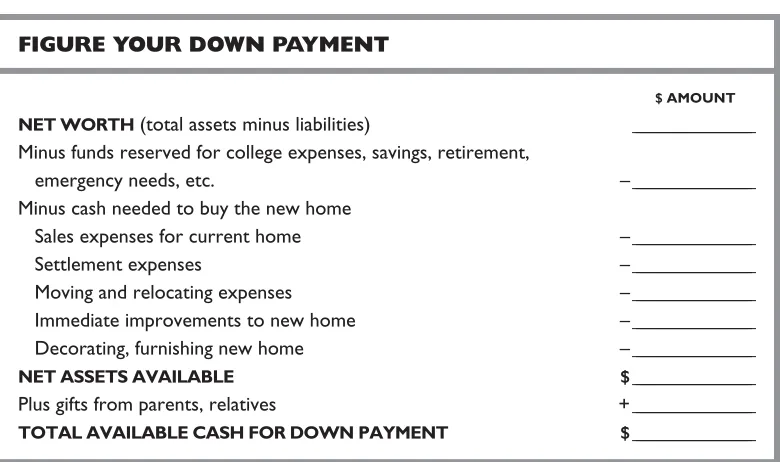
ow use the worksheet below to find the maxi-mum down payment you could make if you wanted to put all your liquid assets into the purchase of a new home. From your total liquid net worth (including the equity you’ll get from the sale of your present home), subtract:■savings for emergencies, educational expenses, or
retirement;
■settlement and moving costs;
Chapter 2ASSESSING YOUR RESOURCES
FIGURE YOUR DOWN PAYMENT
$ AMOUNT
NET WORTH(total assets minus liabilities) _ _ _ _ _ _ _ _ _ _ _ _ _ _ _ _ _ _ _ _ _ _ _ _ _ _ _ _ _ _ _ _ _ Minus funds reserved for college expenses, savings, retirement,
emergency needs, etc. – _ _ _ _ _ _ _ _ _ _ _ _ _ _ _ _ _ _ _ _ _ _ _ _ _ _ _ _ _ _ _ _ _
Minus cash needed to buy the new home
Sales expenses for current home – _ _ _ _ _ _ _ _ _ _ _ _ _ _ _ _ _ _ _ _ _ _ _ _ _ _ _ _ _ _ _ _ _
Settlement expenses – _ _ _ _ _ _ _ _ _ _ _ _ _ _ _ _ _ _ _ _ _ _ _ _ _ _ _ _ _ _ _ _ _
Moving and relocating expenses – _ _ _ _ _ _ _ _ _ _ _ _ _ _ _ _ _ _ _ _ _ _ _ _ _ _ _ _ _ _ _ _ _
Immediate improvements to new home – _ _ _ _ _ _ _ _ _ _ _ _ _ _ _ _ _ _ _ _ _ _ _ _ _ _ _ _ _ _ _ _ _
Decorating, furnishing new home – _ _ _ _ _ _ _ _ _ _ _ _ _ _ _ _ _ _ _ _ _ _ _ _ _ _ _ _ _ _ _ _ _
NET ASSETS AVAILABLE $ _ _ _ _ _ _ _ _ _ _ _ _ _ _ _ _ _ _ _ _ _ _ _ _ _ _ _ _ _ _ _ _ _
Plus gifts from parents, relatives + _ _ _ _ _ _ _ _ _ _ _ _ _ _ _ _ _ _ _ _ _ _ _ _ _ _ _ _ _ _ _ _ _
■and cashyou’ll need to improve, decorate and fur-nish your new home.
The bottom line will be the sum that you could put down on the new house, if you wished to use it all. The more cash you pay up front, the less you will have to pay month by month on the mortgage, and the lower your total interest costs will be.
Conversely, the less you put down, the greater will be your leverage, tax deductions for mortgage inter-est, and available funds for other expenses, including decorating and furnishing. Also keep in mind that the money you hold back from your down payment, if invested wisely, might earn you more than the appreciation on your property will add to your equity.
As you figure the amount of your liquid assets, remember that you might not have to put the whole sum into the down payment. Though lenders would ideally like to see you put 20% down, many home buyers (particularly first-time buyers) have a difficult time coming up with that much cash. If you put less than 20% down, you will be expected to have a higher income relative to long-term debt than someone who puts down 20%. And you may be required to purchase private mort-gage insurance, which protects the lending institution if you default. But the minimum amount required will ultimately be determined by the lender, the type of mortgage you choose, and whether the loan will be sold in the secondary mortgage market.
Mortgage lenders, of course, prefer a big down payment to a minimal one. That tells the lender that the new homeowner has a major stake in the property and won’t be tempted to default on the loan and walk away from the house. The larger the down payment, the less risk of foreclosure and the less chance the
FOR STATE INFORMATION
Contact the National Council of State
lender will suffer any financial loss on the property. If your calculations indicate that you can’t put at least 10% down, here are some options:
Check with the FHA or VA. Find out whether you are
eligible for a loan guaranteed by the Federal Housing Administration (FHA) or the Department of Veterans Affairs (VA), which require little or no down payment.
Consider a no-down loan or a 97% loan. There are
mort-gages out now that will let you put down as little as 3% or will finance 100% of the sales price (see Chapter 9). Some will even finance as much as 103% for amounts up to $325,000.
Inquire about private mortgage insurance (PMI) to lower
down-payment requirements (for a full discussion of PMI, see Chapter 10).
Investigate state and local programs for low- and
moder-ate-income families and for first-time buyers. You may be able to get a lower-rate mortgage with a small down-payment requirement. Check what’s available through any lender or real estate agent, or through your state or local housing agency (see the box at left).
Consider buying a less expensive condo or house that
needs fixing up.
Use a lease-option contract, which gives you the right to
live in the house for a period of time and the right to buy the property for a specified price during an agreed-on period of time (see Chapter 19 for details).
Look for property whose seller is willing to act as the
lender. You don’t have to meet institutional credit
stan-dards and may be able to work out a better deal.
Consider an equity-sharing purchase with a family
mem-ber who is willing to make the down payment (see Chapter 10).
Try to get help from family or friends. As a rule, you’ll be expected to make at least a 3% cash down payment in addition to any funds received as a gift toward the pur-chase. A relative or friend may be willing to make you a “second-trust loan” (at a competitive market rate, not subsidized) to close the gap between the down pay-ment and the mortgage. But such loans are not
al-HOW MUCH CAN YOU PAY MONTHLY?
Income
Add up the following:
Wages, salary, tips $_____________
Interest _____________
Dividends from stocks
and mutual funds _____________
Bonuses _____________
Other income _____________
Total Income $_____________
Expenses
Other Than Housing Costs
Now, add up your expenses:
Income taxes $_____________
Social security taxes _____________
Other taxes _____________
Food _____________
Life, health, auto insurance _____________
Medical bills not covered
by insurance _____________
Automotive loans _____________
Auto expenses
(gas, repairs, other) _____________
Other transportation _____________
Other loans _____________
Credit card payments _____________
Child care _____________
Alimony or child support _____________
Education _____________
Clothing _____________
Home furnishings _____________
Recreation and entertainment_____________
Meals out _____________
Vacations _____________
Charity _____________
Miscellaneous _____________
Total Expenses $_____________ AMOUNT AVAILABLE
FOR HOUSING EXPENSES
Do this calculation:
Total Income $_____________
minusTotal Expenses –_____________
equalsTotal Cash Flow or
Discretionary Income $_____________
Divide that by 12 to get
Maximum Available for Monthly Housing
lowed by many lenders, and even if acceptable, the lender will scrutinize your finances carefully to make sure you can afford to carry both mortgages.
Most lenders will regard this loan as a gift and re-quire you and the giver to sign a form saying the money is a gift that need not be repaid; if you and the giver want to treat the gift as a loan later—after the purchase—that’s up to you. There may be gift tax and estate considerations involved, so consult a lawyer.
Use a seven- to ten-year balloon loan. This lets you make
payments comparable to those for a much longer-term loan, although a lump sum will be due at the end of seven or ten years (see Chapters 9 and 10).
Consider a penalty-free IRA withdrawal for a first home.
Once in your lifetime you can withdraw up to $10,000 from your IRA, regardless of your age, to help pay for a first home for yourself or a family member (such as a spouse, child, grandchild, parent or grandparent). You won’t get hit with the usual 10% early-withdrawal penalty, but the money will be fully taxed in your top bracket (except to the extent that the withdrawal rep-resents nondeductible contributions—money on which you paid federal income before stashing it in the IRA).
How Big a Loan?
H
ow much you can borrow will depend on yourincome and the size of your down payment. Job stability, credit references, payment histories and other indications of creditworthiness also are factors. (The down payment required by a lender can be affect-ed by whether the home you are buying is locataffect-ed in an area where prices are appreciating or depreciating. You may be permitted to buy a home with 5% down where prices are rising but be asked to put down 10% where prices are declining. Minimum down payments for ad-justable-rate mortgages may be as high as 10%.)
An old rule of thumb says you can qualify for a loan up to twice your family income. Using that
out-Once in your
lifetime you
can withdraw
up to $10,000
from your IRA,
regardless of
your age, to
help pay for a
first home for
yourself or a
family member.
dated guideline, $50,000 of income should translate to a $100,000 mortgage. Sound too simple? It is. A family with $50,000 of annual earnings, three chil-dren, $5,000 in savings and a new car loan just won’t stack up the same way with lenders as a childless cou-ple with the same income, no debts and a $30,000 stock portfolio.
You’ll get closer to reality by applying some of the same tools lenders use to evaluate the creditworthi-ness of prospective buyers. One common method is to apply a number of ratios to gross monthly income. For example, if you are making a 10% down pay-ment, you may be allowed to devote up to 28% of gross (pretax) monthly income to housing expenses (including mortgage, property taxes, insurance, fees, utilities and maintenance). However, your combined housing expenses and installment-debt obligations may not exceed 36%.
Prepare Yourself
R
ules and formulas used to evaluate the credit-worthiness of borrowers vary depending on the type of loan being sought. But whether you are seeking a conventional loan from a savings and loan or a government-backed (FHA or VA) loan from a mortgage company, the less you pay down, the more closely your finances will be examined. Lenders will want to know how many people you are supporting and how old they are. Government rules require lenders to estimate your living costs rather than take your word for it.As you work through the worksheets in this chapter and examine your budget, try to assess the impact homeownership will have on your spending patterns. Will you take fewer vacations? Will you spend less on clothing? Will the cost of commuting to work rise or fall?
Most important, how much will your tax bill go down—and your monthly take-home pay rise—once you begin taking big deductions for mortgage interest,
In deciding
how much cash
to put down,
remember
that getting
settled in a
new home
always ends
up costing
more than
which constitutes most of your monthly mortgage ex-pense early in the term of the loan? Study the next chapter carefully to get a full appreciation of the range and variety of tax breaks you will get from the pur-chase and ownership of your new home.
How Much Down,
How Much Borrowed?
I
n deciding how much cash to put down, remember that getting settled in a new home always ends up costing more than you anticipate. Hold back some cash for furnishing and unexpected outlays. Add an extra cushion of cash if you’re buying an older home that could surprise you with a plumbing or roofing expenses.Should you borrow as much as you can? Small down payments and big mortgages give you the power of leverage (see Chapter 1) as well as available cash for other investments. And when inflation runs as high as or higher than mortgage interest rates, and you are paying back what you borrowed with dollars that are steadily losing their purchasing power, the answer is easy: The bigger the mortgage, the better.
Current tax law still stacks the deck in favor of the largest possible mortgage. Your original mortgage sets Chapter 2ASSESSING YOUR RESOURCES
HELP FOR RURAL BUYERS
The U.S. Department of Agriculture’s Rural Housing
the cap for debt on which interest is deductible. (One exception lets you increase this cap by amounts you borrow—via refinancing or a second mortgage—for major home improvements. For details, see Chapter 3.) If you make a large down payment but later need the cash, you can tap the money with a home-equity loan or refinance the house. But interest on home-equity loans over $100,000 isn’t deductible.
For most first-time buyers, there’s no point in weighing the trade-offs. Most will have to borrow to the hilt and scrape hard to come up with the minimum down payment. However, many so-called move-up buyers will come into a substantial sum of money when they sell their old home. Their decision will be tougher: whether to invest the cash in the new home and take out a small mortgage or invest the money elsewhere and borrow a large amount.
SHOP ONLINE FOR A MORTGAGE
Mortgage lending is a national business these days, so you can conduct a national search for the best rate. The fastest way to do it is online. (If you don’t have access to the Inter-net, ask your broker to help or make a trip to a computer-equipped friend’s house or a large public library.) The following sites can be especially helpful. Each carries up-to-date listings of lenders and rates, as well as gener-al mortgage information, cgener-alculators and other helpful tools for mortgage shoppers.
HSH Associates(www.hsh.com). Provides
mortgage rates, averages by city and state, calculators and links to lenders.
HomePath(www.homepath.com).
Sponsored by Fannie Mae, offers general in-formation on home and mortgage shopping.
iOwn®(www.iown.com). Lists rates from
the nation’s largest mortgage lenders and brokers, allows online mortgage application.
Kiplinger.com(www.kiplinger.com).
Click on “Tools,” then “Find a Mortgage” for help in comparing mortgages.
BankRate Monitor (www.bankrate.com).
Follows competitive rates in all 50 states and Washington, D.C., provides credit news and helpful calculators.
Nationally, investment returns on single-family homes over time have been modest compared with re-turns on such financial investments as stocks and bonds. Home values in some areas will keep pace with inflation and in some areas may do significantly better. Before you buy, try to assess the future of the economy in your home area and the demand for homes of the type, location and price range of the one you want to own. For example, within a given metropolitan area, some neighborhoods may appreciate very well, while others stagnate. In some areas, luxury-priced houses will go up relatively more in value than starter houses; in others, just the opposite will occur.
If you have unusually good job security, you may want to gamble on a bigger mortgage than someone whose employment is precarious. Job security will af-fect the kind of mortgage you choose, too. If your job is safe in high-inflation or recessionary times and your earnings will likely keep pace with the cost of living, you’ll be more comfortable with an adjustable mort-gage than someone who lost ground in the last period of high inflation and high interest rates.
Remember that home equity—unlike financial as-sets such as bonds, CDs and dividend-paying stocks— pays no current income, so be cautious about pouring all you have into a new home. For example, if the stock market is moving up, your cash will be tied up in a home that is not paying you any income and that may be appreciating less rapidly than good-quality stocks. If you put all your cash into your home and then need some money later, you can borrow it, but you’ll be paying at or above the prime lending rate for a home-equity loan, and usually more for a fixed-rate second mortgage.
Clean Up Your Credit Report
E
ven as you consider your strategy for buying ahome, you should be paying attention to your current credit status. Any lender is going to scru-tinize your monthly income and outgo at the time
Remember
that home
equity pays
no current
income, so
be cautious
about pouring
all you have
into a new
home.
you apply for a mortgage. Debts and other obliga-tions reduce the amount of cash you can spend on housing, so try to clear the decks as much as possible before applying for a loan. Pay off as many high-in-terest consumer loans as possible. If you are planning to buy a new car, boat or expensive furniture (paying either by cash or credit), postpone the purchases until after you’ve bought your home.
On the other hand, a good credit record requires that you have used credit in the past. Some cash-only buyers find themselves hampered by their own pru-dence when it comes time to buy a home. If you’ve
A DO-IT-YOURSELF CREDIT CHECK
Federal law gives you the right to know what’s in your credit files. Before you apply for a mortgage loan, find out whether any-thing in your record might present a problem. Order a report two or three months before making a loan application to give yourself plenty of time to iron out any wrinkles that you discover.
It’s wise to check all three major
credit bureaus— Equifax, Trans Union
and Experian—for errors. Experian and Trans Union offer consumers in the following states one free report a year: Colorado, Georgia, Maryland, Massachusetts, New Jersey and Vermont. Contact each credit bureau for further details:
■Equifax(P.O. Box 740241, Atlanta, GA 30374; 800-685-1111; www.equifax.com)
■Trans Union(Trans Union LLC, Customer
Disclosure Center, P.O. Box 1000, Chester, PA 19022; 800-888-4213; www.tuc.com) ■Experian(P.O. Box 2002, Allen, TX 75013;
888-397-3742; www.experian.com)
You may order online and pay by credit card. If you are ordering a free credit report or paying by check or money order, you will need to write a letter including your full name, date of birth, names of current and past spouses, your social security number, and current and previous addresses going back five years. Your date of birth and a copy of your driver’s license may also be required.
Mailing letters or filling in forms online can be a hassle. First American Credco Inc. (800-443-9342; www.facredco.com), a Santa Ana, Cal., credit-reporting company, sells a merged report that shows your combined credit history. At $29.95 the merged report costs about the same as getting separate reports directly from the big three.
been diligently saving for a down payment and haven’t borrowed for a year or more, it’s a good idea to create a record of credit activity during the year in which you plan to buy. Stick to small-ticket items, make one or two minimum payments promptly, then pay off the balance.
Typically, your credit file will contain information covering the preceding three years. No adverse credit information, except bankruptcy, can be kept on file for more than seven years. Lenders look for these red flags: late payments, overextension, liens, garnish-ments and, the biggest flag of all, bankruptcy.
Chapter 2ASSESSING YOUR RESOURCES
that the matter has been satisfactorily resolved.
If you’ve been tagged unfairly for
nonpayment or slow payment,write
a well-documented letter setting forth your understanding of the facts, and file it with the appropriate credit bureaus. If you aren’t sure which bureaus have a file on you, find out from the problem creditor.
Better still, get the problem resolved; then request, in writing, that the creditor inform all relevant reporting services that the problem has been fixed—with copies to you. This could take 30 to 90 days.
Errors generated by the credit
bureau— such as mixed-up files— need
to be corrected there. If using a complaint line or calling the local office doesn’t help, write to the manager of consumer affairs. The bureau should accept documentation proving the account isn’t yours.
Report your problemsto the U.S. Public
Interest Research Group (218 D St., S.E., Washington, DC 20003; 202-546-9707; www.pirg.org/uspirg/index.htm or by e-mail at [email protected].
If the problem remains unresolved, you’ll probably need to consider hiring a lawyer to clear things up.
Your Credit Score
M
ortgage lenders, Freddie Mac and Fannie Mae now request a mortgage credit score from cred-it bureaus to help them determine your cur-rent creditworthiness and predict what kind of credit risk you will be in the future. The score is determined by a statistical analysis of the information contained in your credit file. A good score may change the time re-quired to get approval on your mortgage as well as the rate you receive and the way in which your mortgage is managed. If you have a good score, you could receive a loan at a lower interest rate than someone with a less favorable score. And later, if you’re late on a payment, the lender will also be less likely to hassle you than someone with a questionable score.The analysis takes into account about 100 vari-ables gathered from your credit file at one of the big three credit bureaus—Experian, Equifax and Trans Union—and specifically looks at such things as how much you are currently in debt, how many places you have applied for credit recently, and what kind of credit you have taken in the past. According to Fair, Isaacs & Co. Inc., a research company that was one of the original developers of credit scoring, multivariate modeling (modeling that considers a group of vari-ables) synthesizes information by looking at all of your credit history—the bright spots and the shad-ows. Where the human mind might reject a mortgage application because you once declared bankruptcy, the statistical model will weigh that fact as just one component among the many that it considers.
There are several statistical scoring models avail-able, and each has a different way of determining your score and translating the results. But whatever the methodology, consumers with good credit scores are more likely to repay their debts than consumers with poor credit scores.
Unfortunately, you are not given your credit score even when you request a copy of your credit file. If, however, you are rejected for a mortgage because of your credit score, ask the reason behind your rejection.
The statistical models used for scoring will issue rea-sons for the score you were given—and this informa-tion can be passed on to you by the lender. (Fair Isaac’s commonly used credit-scoring product is known as a FICO®score. You may obtain your current FICO score
as well as an explanation of the score, your credit-risk factors and tips on how to improve your score online, at www.myfico.com, for $12.95.)
Obtaining Preapproval
With a Lender
N
ow that you’ve gotten your financial affairs in order and checked out your credit record, the next step is to contact a lender—mortgage company, savings and loan, bank or credit union— where you can translate all the data into hard facts about the upper price limit you can handle and the types of mortgages suited to your needs.The preapproval interview should be free. Be-cause of technological advances, many banks now offer this service over the Internet and by phone, as well as at their offices. You’re not obliged to use the lender who conducts the interview. When you’re ready to borrow, talk with several lenders. Have tax returns, salary stubs and other financial data available to enter information online or provide in an inter-view—along with net worth and monthly cash flow worksheets you’ve prepared.
Kinds of Loans
F
ind out how much mortgage debt you can carry under the most commonly available mortgages. “Conventional mortgages” are transactions between borrowers and institutions operating in the private sector of the economy. They are not insured or guaranteed by the government. Traditionally they feature set monthly payments, fixed interest rates, ex-tended loan terms and full amortization.benchmark against which other loans are compared, find out what size conventional 30-year loan you quali-fy for under the guidelines issued by secondary-market mortgage buyers such as Fannie Mae or Freddie Mac. Because these institutions buy only loans that meet their criteria, such mortgages are often referred to as “conforming” loans.
Find out how much you can borrow under a con-forming 30-year fixed-rate mortgage, a one-, three-, five- and seven-year adjustable-rate mortgage, and perhaps a 15-year fixed-rate loan as well. Knowing what you can afford to buy with these four mortgage types is a useful starting point.
Mortgage information is now readily available on-line. You can find daily and weekly rate quotes for mortgages and home-equity loans, the requirements for qualifying for special Fannie Mae programs, esti-mates of closing costs, an analysis of different mort-gages, programs available for veterans and for active-duty military personnel, as well as many other helpful bits of information.
If you’re planning on getting an FHA-insured or VA-guaranteed mortgage, you may qualify for a bigger
FOR MORE INFORMATION
Knowing and Understanding Your Credit andChoosing the Mortgage That’s Right for You are free, step-by-step guides from the Fannie Mae Foundation (4000 Wisconsin Ave., N.W., North Tower, Suite One, Washington, DC 20016-2804; 800-611-9566; www.fanniemaefoundation .org). You may download them online or receive them by mail via phone, mail or online order.
Affording Your First Homecontains a review of fees first-time buyers face, a worksheet for determining how much they
can afford to borrow, and an amortization table (HSH Associates, Financial Publishers, 1200 Route 23, Butler, NJ 07405; 800-873-2837; www.hsh.com/catalog.html#3primer; include $3 for postage and handling).
loan. However, keep in mind that sellers in a hot mar-ket are usually not eager to do business with buyers using this type of financing. They may expect to have plenty of would-be buyers using conventional mort-gages, so it’s not uncommon for sellers to put the phrase “no FHA and no VA financing” right in the sales contract.
Due to the extra paperwork and appraisal delays these loans often entail, it may take longer to reach set-tlement, and some sellers won’t put up with that. It’s a good idea to see whether you can manage a home pur-chase without resorting to an FHA or VA mortgage.
When interest rates are changing rapidly, shopping for a home can be frustrating. What you can afford may vary week to week. In such a market you can ask the institution preapproving you to provide a list of the various size mortgages for which you qualify at widely varying interest rates. Or, you can figure it out yourself using online calculators such as those at Kiplinger com.
Get Your Earnest Money Ready
S
ome people are short on liquid assets but havesubstantial equity in their homes. This could pose a problem when they have to write a check for earnest money to submit to a seller along with their purchase contract. Earnest money shows that you’re a serious, qualified purchaser. (If the contract is not ac-cepted or the deal later hits a snag through no fault of yours, you’ll get the earnest money back, with interest if you specified in your offering contract that the money be held in an interest-bearing escrow account.)
If after assessing your resources you find that you’ll be short on earnest money when it comes time to begin house hunting, consider getting a home-equity loan— a line of credit secured by the equity in your current house (see Chapters 3 and 14 for details). But don’t succumb to the temptation to use your new equity credit line for unneeded things. As you prepare for the mortgage-application process, you’ll want to avoid adding to your current debt.
Chapter 2ASSESSING YOUR RESOURCES
If you find
that you will
be short on
earnest money,
consider
our home—probably the biggest invest-ment of your life—can be the best tax shelter you’ll ever enjoy.
Uncle Sam is standing by to serve as a generous partner in your investment, ready to subsidize your mortgage payments while you’re paying for your house and virtually willing to turn a blind eye to the profit you make when you sell it. Given the favored status of homeownership in America, it is no surprise that deductions for mortgage interest and local property taxes have survived as others have gone the way of the dodo bird. Yes, there is a limit on mortgage-interest write-offs, but it kicks in only when mortgage debt exceeds $1 million. The mortgage-interest deduction can also be nicked by a restriction that applies to taxpayers whose adjusted gross income (AGI) exceeds a certain level, which is adjusted each year. The law wipes out deductions equal to 3% of the amount by which AGI exceeds the threshold. If your 2001 AGI is $150,000, for example, the first $512 (3% of the $17,050 over the 2001 trigger point of $132,950) of your deductions lose their tax-saving power.
It is impossible to say exactly how this will affect any specific taxpayer, because much depends on AGI and the makeup of your deductions. For that reason— and the fact that, despite the restriction, tax breaks for homeownership remain enormous—the discussion that follows generally assumes that all your mortgage interest will remain deductible.
Buying a home will cut your tax bill. But as veteran homeowners know, it will also complicate your tax life. If you don’t itemize deductions now, you’re almost
Ch
apt
e
r
3
Home Sweet
Tax Shelter
sure to begin once you buy a home. After all, the mort-gage-interest portion of the first 12 monthly payments on a $100,000, 8%, 30-year mortgage is nearly $8,000. That exceeds the $7,600 standard de-duction for married couples filing jointly and the $4,550 deduction for singles for 2001. You’ll also get to deduct what you paid in state and local property taxes.
And once you begin itemizing, other expenses that are of no value to nonitemizers—such as state income taxes, charitable contributions and possibly medical bills—are trans-formed into tax-saving write-offs.
The deductions for mortgage in-terest and property taxes just scratch the surface of the tax benefits attached to homeownership. While becoming a homeowner doesn’t demand that you memorize the tax law, you do need a general awareness of the rules to take advantage of them.
This chapter is designed as a primer for first-time buyers and a refresher for veteran homeowners in the process of moving.
Deductibility of
Mortgage Interest
T
he opportunity to trade nondeductible rent pay-ments for mostly deductible mortgage paypay-ments is a powerful lure enticing you from your rental abode into a home of your own.Whether you are looking for a first home or plan-ning to move up, the number-crunching necessary to determine how much house you can afford demands two calculations: one for actual monthly outlays, the other for the true, after-tax cost.
In the early years of a home mortgage, nearly all of BUYING & SELLING A HOME
DEDUCTIBLE INTEREST
This table reflects the deductible interest on a $100,000, 30-year fixed-rate mortgage at 8%.
Annual
Year Payments Principal Interest
1 $ 8,805 $ 835 $7,970
2 8,805 905 7,900
3 8,805 980 7,825
4 8,805 1,061 7,744 5 8,805 1,149 7,656 10 8,805 1,712 7,093 15 8,805 2,551 6,254 20 8,805 3,800 5,005 25 8,805 5,662 3,143
every monthly payment is interest. That’s disappoint-ing from one standpoint: It means that you are paydisappoint-ing off only a tiny bit of the loan principal. But it’s great in terms of tax savings.
Look again at the $100,000, 30-year, 8% mortgage cited above. The monthly payment would be about $734, and the table below shows the breakdown be-tween principal repayment and deductible interest in various years.
In the first year, $7,970 of $8,805 in payments—or 91%—would be deductible as mortgage interest. Even in the tenth year, almost 81% of your payments would be deductible. In fact, only in the unlikely event that you live in the house for 22 years would the scales tip so that less than half of the total paid during the year would be tax-deductible.
Just what the deductions are worth to you de-pends, of course, on your tax bracket. If you are in the 27% bracket, every $1,000 of deductible interest and
A SQUEEZE ON DEDUCTIONS
As mentioned, the tax law can restrict the deduction of mortgage interest for tax-payers whose 2001 adjusted gross income (AGI) exceeds $132,950. (AGI is basically your income before deductions and ex-emptions are subtracted.)
Although this take-away doesn’t hit all deductions, mortgage interest and proper-ty taxes are among those threatened. But don’t assume this diminishes the tax-saving power of a bigger mortgage or higher property-tax bill. Since the law sets a floor for itemized deductions—only those that exceed 3% of your adjusted gross income in excess of $132,950—it takes away the first dollars of your itemized deductions, not the last. Once your deductions pass
the floor, every extra dollar of deductible expenses has full tax-saving power.
taxes translates to a $270 subsidy from Uncle Sam. In our $100,000 mortgage example, assume that in addi-tion to the $734 monthly mortgage payment you pay $150 a month for local property taxes (which, most likely, your mortgage lender will collect, deposit into an escrow account and pay out as required). During the first 12 months, you pay a total of $10,605—that’s about $884 a month.
But $9,770 (your total mortgage payment and local property taxes, less payment of the first year’s principal) is deductible. In the 27% bracket, that gen-erates tax savings of $2,637.90 and pulls the after-tax cost to $7,967.10, or about $664 a month.
The tax savings built into the home-buying equa-tion is why you can afford to make higher mortgage payments than your current rent payments without squeezing your budget. As disgruntled renters often complain, there is no similar tax subsidy for tenants. In this example, the after-tax cost of home payments of $884 a month are the equivalent of rent at $664 or $599 a month, depending on your tax bracket. Of course, owning the house could present you with re-pair bills a renter doesn’t have to worry about, but on the other hand, as an owner you reap all the apprecia-tion on the value of your home.
Adjust Your Withholding
W
hat good is the tax subsidy if you’re worry-ing about comworry-ing up with the cash needed each month to make the mortgage pay-ment? Fortunately, you don’t have to wait until you file a tax return to cash in on the savings. As soon as you purchase your first home or buy a new house that carries higher deductible expenses, you can direct your employer to begin withholding less from your paychecks. If you are self-employed, it’s likely you will be able to scale back your quarterly estimated tax pay-ments beginning with the next one due. In either case, your cash flow can increase almost immediately to help cover the mortgage payments.BUYING & SELLING A HOME
As soon as
you purchase
a new home
with higher
deductible
expenses,
you can direct
your employer
to begin
The revised W-4 form can be complicated, but ba-sically, to reduce withholding, you must file a revised W-4 form with your employer. Get a copy of the form and its instructions from your personnel office or local Internal Revenue Service office, or download a copy at www.irs.gov/prod/forms_pubs/form.html.
Record Keeping
B
uying a home may be your introduction to the endearing term “tax basis.” That’s the home’s value for tax purposes. Until the 1997 tax bill was enacted, keeping track of this figure was demanding and important. The basis of your home is the figure you’d subtract from the amount you got when you sold the place, and the result determined whether you had a taxable profit that piqued the interest of the IRS.For most people, tracking of basis is now unneces-sary. The rules e xempt from federal taxation $250,000 of profit on the sale of a home for those fil-ing sfil-ingle returns and $500,000 of profit for those who file joint returns.
PROVING YOUR BASIS
Although it’s unlikely that you’ll have to pay any tax on the profit of your home when you sell, you should still maintain records to en-sure accuracy when computing your home’s taxable basis. Remember, starting to keep track when you purchase will be a lot easier than trying to reconstruct the basis later on.
As you begin the running tab on your adjusted basis, add these items to the purchase price.
■Appraisal and credit-report fees
■Attorney and notary fees
■Recording and title-examination fees
■State and county transfer taxes
■Property-inspection fees
■Title-insurance premiums
■Utility-connection charges
■Amounts owed by the seller that
you agree to pay,such as part of the real estate agent’s commission or back taxes and interest
■The cost of an option to purchase
under a rent-with-option-to-buy arrangement
■Part of the rent payments made
prior to closing,which may be added