ISSN 2085-9937
Patanjala
Volume 13 Nomor 1 April 2020
Patanjala bermakna air sungai yang tiada hentinya mengalir mengikuti alur yang dilaluinya hingga ke muara. Seperti halnya karakteristik air sungai, manusia harus bekerja dan beramal baik, serta fokus pada cita-citanya. Patanjala adalah majalah ilmiah yang memuat hasil-hasil penelitian tentang nilai budaya, seni, dan film serta kesejarahan yang dilaksanakan oleh Balai Pelestarian Nilai Budaya Jawa Barat di wilayah kerja Jawa Barat, DKI Jakarta, Banten, dan Lampung. Redaksi juga menerima artikel hasil penelitian di Indonesia pada umumnya. Mulai 2020, Patanjala hanya diterbitkan dua kali dalam setahun, yaitu pada April dan Oktober. Siapa pun dapat mengutip sebagian isi dari jurnal penelitian ini dengan ketentuan menuliskan sumbernya.
Pelindung
Direktur Jenderal Kebudayaan Kementerian Pendidikan dan Kebudayaan
Penanggung Jawab
Kepala Balai Pelestarian Nilai Budaya Jawa Barat Dewan Redaksi
Ketua : Iim Imadudin, S.S., M.Hum (Sejarah) Anggota : 1. Dra. Ria Intani T. (Antropologi)
2. Dra. Lina Herlinawati (Sastra Indonesia) 3. Dra. Lasmiyati (Sejarah)
4. Hary Ganjar Budiman, S.S. (Sejarah) 5. Desmond Satria Andrian, S.S., M.Si.
(Editor Bahasa Inggris) Redaktur Pelaksana Titan Firman, S.Kom.
Mitra Bestari
Prof. Johan Iskandar M.Sc., Ph.D. (Antropologi, UNPAD) Dr. Ade Makmur Kartawinata (Antropologi, UNPAD)
Dr. Ading Kusdiana (Sejarah Peradaban Islam, UIN Sunan Gunung Djati) Dr. Dade Mahzuni, M.Si. (Kajian Budaya, UNPAD)
Dr. Didik Pradjoko, M.Hum (Sejarah, UI) Dr. Gani Ahmad Jaelani, DEA, (Ilmu Sejarah, UNPAD)
Diterbitkan oleh
Balai Pelestarian Nilai Budaya Jawa Barat Kementerian Pendidikan dan Kebudayaan Jl. Cinambo No. 136 Ujungberung – Bandung 40294
Telp./Faks. (022) 7804942 e-mail: [email protected] http://ejurnalpatanjala.kemdikbud.go.id http://kebudayaan.kemdikbud.go.id/bpnbjabar
Penata Sampul: Titan Firman
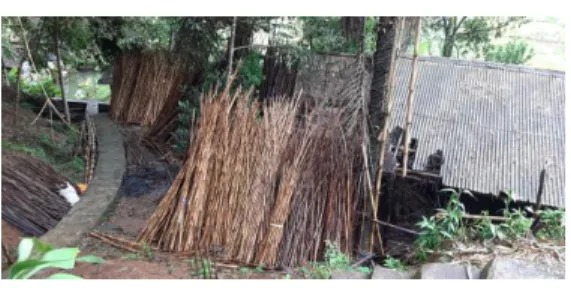
Gambar: Bambu di Kampung Angklung Ciamis, 2020. Sumber: Dokumentasi Risa Nopianti
Dicetak oleh
CV. MAWAR PUTRA PERDANA Kebon Jati 79 Bandung
Telp/Fax : (022) 4266016 - 082128240114, e-mail: [email protected] Isi di luar tanggung jawab percetakan
PENGANTAR REDAKSI
Jurnal Patanjala Vol. 13 No. 1 menyajikan sejumlah artikel yang menempatkan sistem pengetahuan sebagai ide, gagasan, dan pemikiran yang mendorong keberlangsungan suatu kebudayaan. Sistem pengetahuan memiliki lingkup yang sangat luas, karena mencakup pengetahuan manusia tentang berbagai unsur yang digunakan dalam kehidupan. Sistem pengetahuan mengandung nilai-nilai tempatan yang dikembangkan secara terus menerus dan diwariskan secara turun-temurun. Beberapa artikel budaya di bawah ini memiliki tema terkait sistem pengetahuan tradisional. Sementara itu, artikel sejarah yang hadir pada nomor ini mencuatkan ide dan gagasan sebagai kekuatan sejarah yang mendorong berlangsungnya suatu peristiwa.
Bahagia, Fachruddin Majeri Mangunjaya, Zuzy Anna, Rimun Wibowo, dan Muhammad Shiddiq Ilham Noor mengungkap kearifan lokal pada masyarakat adat Cipatat Kolot. Masyarakat harus beradaptasi terhadap perubahan iklim mulai dari seleksi benih padi lokal, penggunaan pupuk organik, dan manajemen panen secara tradisional. Seleksi benih dilakukan secara fisik dan fisiologi. Benih disimpan hingga tiga bulan agar benih bertumbuh dengan kuat. Padi yang dipanen harus matang, meski iklim berubah, agar padi tidak mengalami pembusukan. Dalam pengelolaan hasil panen digunakan alat pengering padi tradisional sehingga hasil panen padi menjadi lebih tahan iklim. Kearifan lokal juga terlihat dalam proses pemupukan. Pupuk organik dipakai untuk memperkecil produksi emisi sebagai penyebab perubahan iklim secara global.
Risa Nopianti dan Hary Ganjar Budiman mengelaborasi peran masyarakat di Kampung Angklung Ciamis dalam mengembangkan ekosistem kebudayaan angklung yang berkelanjutan. Seluruh subsistem dapat ekosistem kebudayaan angklung terus berkembang, antara lain ekosistem tanaman bambu, pengrajin angklung, seniman angklung, sistem produksi, dan distribusi, serta kelembagaan masyarakat. Pergerakan masing-masing subsistem berperan dalam menghidupkan ekosistem kebudayaan yang berkelanjutan. Ada tiga makna penting terpeliharanya ekosistem kebudayaan angklung, yaitu terawatnya ekosistem lingkungan, adanya manfaat ekonomis, dan lestarinya kebudayaan angklung.
Silvia Devi dan Rois Leonard Arios mengungkap strategi petani Keramba Jaring Apung (KJA) di Kawasan Danau Maninjau Provinsi Sumatera Barat dalam menghadapi tubo melalui pendekatan ekologi budaya. Tubo adalah peristiwa kematian ikan secara massal di Danau Maninjau akibat keracunan. Petani KJA menerima peristiwa tubo sebagai sesuatu yang alamiah sehingga untuk keberlangsungan ekonominya harus dapat beradaptasi dengan kondisi yang dihadapinya. Adaptasi petani KJA tampak dari pemahaman mereka terhadap lingkungan, tubo, teknologi yang ada, dan nilai-nilai religi yang mereka miliki. Melalui analisis ekologi budaya, diperoleh fakta petani KJA mampu bertahan menghadapi perubahan alam dan teknologi.
Fikrul Hanif Sufyan menghubungkan kepanduan (padvinders) dan politik di Padang Panjang Sumatra Barat pada awal abad ke-20. Padvinders di Padang Panjang telah dimulai sejak tahun 1924. Gerakan kepanduan yang aktif di Padang Panjang saat itu, antara lain International Padvinders Organitatie, El-Hilal, Hizbul Wathan, dan
Kepanduan Indonesia Muslim (KIM). Kepanduan berawal dari sekolah-sekolah yang
muncul sejak awal abad ke-20, dan segera berubah menjadi gerakan politik. Kasus gerakan politik KIM menjadi PNI Baru Hatta dan Sjahrir menunjuk arah perubahan tersebut. Beberapa kali gerakan kepanduan di Padang Panjang melakukan gerakan protes dan menyuarakan tuntutan Indonesia merdeka.
Aziz Ali Haerulloh, Etty Saringendyanti, Ayu Septiani menjelaskan secara kronologis pengaruh persebaran industri batik terhadap kesejahteraan masyarakat Bandung, Cirebon, dan Tasikmalaya tahun 1967-1998. Dalam rentang waktu tersebut terjadi pasang-surut industri batik tradisional di tengah-tengah gempuran modernisasi di bidang industri. Industri batik di tiga kota tersebut memiliki skala produksi industri rumah tangga, kecil, dan menengah. Cara-cara tradisional masih dikembangkan, meski saat itu industrialisasi terus digalakkan. Keahlian membatik, baik tulis maupun cap, terus berkembang sejalan dinamika sejarah masyarakatnya.
Adi Putra Surya Wardhana dan Fiqih Aisyatul Farokhah mengungkap bentuk, fungsi, dan makna politik tubuh dalam Serat Kawruh Sanggama karya Raden Bratakesawa yang terbit pada awal abad XX. Ketika itu naskah-naskah soal seksualitas cukup populer yang dicetak dalam bentuk buku yang diperjualbelikan di lapak-lapak buku. Serat Kawruh Sanggama ditulis di Kediri dan disebarluaskan oleh penerbit
Boekhandel Tan Khoen Swie Kediri. Naskah ini berupa narasi tentang tata cara atau
aturan bersenggama. Naskah ini mengandung politik tubuh yang berfungsi untuk menundukkan, mengontrol, dan mendominasi tubuh perempuan. Naskah ini dapat dimaknai sebagai upaya laki-laki memahami misteri tubuh perempuan. Sebaliknya, naskah ini dimaknai pula sebagai daya perempuan, sehingga laki-laki berusaha untuk memahami seluk beluk tubuh perempuan.
Hanifah P. Utami, Aquarini Priyatna, Tisna Prabasmoro membahas Luh Ayu Manik Mas sebagai perempuan Bali yang menjadi sosok superhero dalam komik. Komik tersebut lekat dengan nilai dan tradisi Bali. Luh Ayu Manik Mas ditampilkan memiliki kekuatan yang bersumber dari gelang Tri Datu dan kepercayaan pada Tri Hita Karana.
Tri Datu diyakini sebagai sumber kekuatan hidup, sedangkan Tri Hita Karana diyakini
sebagai prinsip hidup yang menjamin keharmonisan dalam setiap aspek kehidupan. Luh Ayu Manik Mas hadir dalam sosok superhero perempuan ketika budaya masih tunduk pada sistem patriarki.
Adinda Sanita Putri Khinari, Ni Made Yuni Sugiantari, Dania Nabila Lubis, Ni Kadek Ari Marlina, Ni Putu Indah Juliyanti, A. A. Ayu Isna Surya Dewi, Rochtri Agung Bawono mengungkap representasi maskulinitas dalam ritual etu di Kampung Adat Tutubhada Kabupaten Nagekeo, Nusa Tenggara Timur. Etu merupakan tinju tradisional yang berasal dari Kabupaten Nagekeo. Etu merupakan salah satu tahapan dari ritual pasca panen (gua meze) sebagai rasa syukur masyarakat lokal atas berkah dalam panen musim panas. Selain itu, etu merupakan wujud bagi kaum laki-laki untuk menampilkan kembali maskulinitas dirinya. Representasi maskulinitas laki-laki tampak dari rangkaian kegiatan, pelaku, perlengkapan, dan aturan dari etu di Kampung Adat Tutubhada.
ISSN 2085-9937
Patanjala
Volume 13 Nomor 1 April 2021
DAFTAR ISI
Local Knowledge of Cipatat Kolot on The Climate Adaptation: Seed, Organic Fertilizer, and Harvest Processing
Kearifan Lokal Masyarakat Cipatat Kolot Menghadapi Iklim
Melalui Penggunaan Benih, Pupuk Organik, dan Pengelolaan Hasil Panen
Bahagia, Fachruddin Majeri Mangunjaya, Zuzy Anna, Rimun Wibowo, Muhammad Shiddiq Ilham Noor
1 - 16
Kampung Angklung di Ciamis: Penjaga Ekosistem Budaya Angklung
Kampung Angklung in Ciamis:
The Preserver of The Ecosystem of Angklung Culture
Risa Nopianti, Hary Ganjar Budiman
17 - 33
Tubo dalam Perspektif Ekologi Budaya Petani Keramba Jaring Apung di Kawasan Danau Maninjau Provinsi Sumatera Barat
Tubo in The Cultural Ecology Perspective of The Floating Net Cage Farmer in The Lake Maninjau in West Sumatera
Silvia Devi, Rois Leonard Arios
35 - 49
Kepanduan dan Politik:
Gerakan Padvinders di Padang Panjang 1926-1934
Scouting and Politic: The Scout Movement in Padang Panjang During 1926-1934
Fikrul Hanif Sufyan
51 - 70
Persebaran Industri Batik di Bandung, Cirebon, dan Tasikmalaya 1967-1998
The Presence of The Batik Industries
in Bandung, Cirebon, and Tasikmalaya During 1967-1998
Aziz Ali Haerulloh, Etty Saringendyanti, Ayu Septiani
71 - 86
Politik Tubuh dalam Serat Kawruh Sanggama Karya Raden Bratakesawa Awal Abad XX
Politics of The Body in The Serat Kawruh Sanggama By Raden Bratakesawa in The Early 20th Century Adi Putra Surya Wardhana, Fiqih Aisyatul Farokhah
87 - 102
Luh Ayu Manik Mas Sebagai Representasi Superhero Perempuan Bali dalam Komik
Luh Ayu Manik Mas as The Representation of A Balinese Female Superhero in Comics
Hanifah P. Utami, Aquarini Priyatna, Tisna Prabasmoro
Representasi Maskulinitas dalam Ritual Etu di Kampung Adat Tutubhada Kabupaten Nagekeo, Nusa Tenggara Timur
The Representation of The Masculinity in The Rituals of ‘Etu’ in Kampung Adat Tutubhada in Nagekeo Regency, East Nusa Tenggara
Adinda Sanita Putri Khinari, Ni Made Yuni Sugiantari, Dania Nabila Lubis, Ni Kadek Ari Marlina, Ni Putu Indah Juliyanti, A. A. Ayu Isna Surya Dewi, Rochtri Agung Bawono
119 - 136
Tinjauan Buku
Sorgum dan Diversifikasi Pangan Lokal Arief Dwinanto
137 – 139
Biodata Penulis Pedoman Penulisan
Local Knowledge… (Bahagia, Fachruddin M. M., Zuzy A., Rimun W., Muhammad Shiddiq I.N.)
Patanjala, ISSN 2085-9937 (print), ISSN: 2598-1242 (online)
1
LOCAL KNOWLEDGE OF CIPATAT KOLOT
ON THE CLIMATE ADAPTATION: SEED, ORGANIC
FERTILIZER, AND HARVEST PROCESSING
KEARIFAN LOKAL MASYARAKAT CIPATAT KOLOT
MENGHADAPI IKLIM MELALUI PENGGUNAAN BENIH, PUPUK ORGANIK,
DAN PENGELOLAAN HASIL PANEN
Bahagia1, Fachruddin Majeri Mangunjaya2, Zuzy Anna3, Rimun Wibowo4, Muhammad Shiddiq Ilham Noor5
1 Universitas Ibn Khaldun and Researcher at LPM Equator 2 Graduate School Universitas Nasional, Jakarta
3 Universitas Padjadjaran, Bandung
4 STIMMA IMMI Jakarta and Chairman LPM Equator 5 Researcher LPM Equator, Bogor
e-mail: [email protected], [email protected], [email protected], [email protected], [email protected]
Naskah Diterima: 28 Desember 2020 Naskah Direvisi: 20 Maret 2021 DOI: 10.30959/patanjala.v13i1.721
Naskah Disetujui :30 April 2021
Abstract
Climate change is characterized by several elements, namely unpredictable rainy and dry seasons, floods, and unpredictable droughts. This study aims to determine the indigenous peoples’ local wisdom in adapting to climate change, which includes screening process of local paddy seeds, the use of organic fertilizers, and traditional harvest management strategies. The method used in this research is the qualitative research method combined with the ethnographic approach. This method is applied based on the consideration that the topic of this research is related to the culture and social of indigenous peoples. The data was collected by means of in-depth interviews, observation, and documentation. Informants were selected by using the purposive sampling technique. The results were scrutinized carefully by means of the triangulation process. The results of the study show the facts that the way indigenous peoples deal with climate change is by physically and physiologically selecting seeds and storing seeds for three months so that the seeds will grow stronger. In addition, they only selects paddies that has reached a full state of growth, that is mature to avoid going rotten even though the climate change occurs. Then, they have the traditional rice dryers to get rice dried, thereby enabling those to be more climate-resistant. They also use the organic fertilizer to reduce the production of emissions as a cause of global climate change.
Keywords: adaptation, climate, local knowledge, local seed, harvest
Abstrak
Perubahan iklim dapat diamati mulai dari musim penghujan dan musim kering yang tidak menentu, bencana banjir, dan kekeringan yang sulit untuk diprediksi. Penelitian ini bertujuan untuk mengetahui kearifan lokal pada masyarakat adat dalam beradaptasi terhadap perubahan iklim mulai dari seleksi benih padi lokal, penggunaan pupuk organik, dan manajemen panen secara tradisional. Metode yang digunakan adalah kualitatif dengan pendekatan etnografi. Metode ini diterapkan karena penelitian berkaitan dengan budaya dan sosial masyarakat adat.
Patanjala Vol. 13 No. 1 April 2021: 1-16
Patanjala, ISSN 2085-9937 (print), ISSN: 2598-1242 (online)
2
Pengumpulan data dilakukan melalui wawancara mendalam, observasi, dan dokumentasi. Pemilihan informan menggunakan teknik purposive sampling. Kemudian, hasil pengumpulan data diteliti dengan cermat melalui triangulasi. Hasil penelitian menunjukkan bahwa masyarakat adat mengatasi perubahan iklim dengan melakukan seleksi benih secara fisik dan fisiologi dan menyimpan benih sampai dengan 3 bulan agar benih kuat dalam pertumbuhannya. Disamping itu, petani adat harus memanen padi matang sehingga padi tidak mengalami pembusukan meskipun terjadi perubahan iklim. Kemudian, masyarakat menggunakan mengelola hasil panen dengan alat pengering padi tradisional sehingga hasil panen padi lebih tahan iklim. Setelah itu, masyarakat adat menggunakan pupuk organik sebagai cara untuk memperkecil produksi emisi sebagai penyebab perubahan iklim secara global.
Kata kunci: adaptasi, Iklim, pengetahuan lokal, benih lokal, Panen A. INTRODUCTION
Climate change can be defined as the shift in climate patterns which is major caused by greenhouse gas emissions, including carbon dioxide (CO2) and gas methane (CH4) in the atmosphere. Greenhouse gas emissions cause heat to be trapped by the earth's atmosphere, this main as a cause of global warming (Fawzy, Osman, Doran & Rooney, 2020). Climate change can be observed through an extreme heatwave and rain seasons which impact to harm the human in the world. Honestly, improper modern technology is the main cause that destroys local wisdom (Ludwig & Macnaghten, 2020). The adverse impact of climates such as extreme temperature and intensive rainfall lead to damaged rice yield (Khan, Gao & Abid 2020). Fischer (2020) said that climate change also results in the scarcity of water to make farmers have difficulties determining the time for planting crops. Even some of them leave agriculture activity. Tanyanyiwa (2019) said that climate change including extreme heat, drought, and impact on crop production. Another adverse effect of climate change, it may create new and suitable conditions for weeds, insects, and pathogens to proliferate, resulting in a further decline in agricultural productivity (Kgosikoma, Lekota & Kgosikoma 2017).
Unfortunately, indigenous
knowledge overlooks in participating in combating climate change. The community has adapted to the environment and climate variance for a longstanding time but local knowledge has a burden to mobile in
government policy. However, the local knowledge has to combat climate dynamic because they have experienced life perturbances that impact livelihood daily. It makes them for searching and adapting the best action and knowledge for facing the changes in the environment. Local knowledge can be mentioned as rules locally, ideas, action or behavior, norms like prohibition, and rituals. Kusuma (2018) remarks that the local knowledge about societies wisdom to comprehend nature as well as maintenance human necessities and nature. Nadroh (2018) reveals that indigenous knowledge is the knowledge that has been agreed upon by the community which content about the life policy, rules for adjusting behavior The knowledge contains a unique perception of a culture or given to the community (Rodríguez-Larramendi et al., 2017). The knowledge comes from certain societies through their experience and has not been undergone by other societies. The knowledge has been adapted for long periods (Daniah, 2016). Devi, Usman & Malik (2018) said that the value also can traverse another culture for creating national culture.
Local knowledge in one location is not similar depending on their experience and life obstacle (Sidabutar, Sayamar, & Kausar 2016). Nursey-Braya et al. (2020) said that local knowledge comprises actual observations recent for climate variability, as well as changes to flora, fauna, land, and cultural sites. For applicating agriculture activity, societies adopt mutual
Local Knowledge… (Bahagia, Fachruddin M. M., Zuzy A., Rimun W., Muhammad Shiddiq I.N.)
Patanjala, ISSN 2085-9937 (print), ISSN: 2598-1242 (online)
3
helping or working rather than anindividual. Activity is not a private activity but it is a common activity that is conducted by collective action and individual awareness which impact the collective consciousness. The impact is the societies who they live in the group are more resilient rather than life in an individual trait (Mangunjaya et al., 2020). Besides, in Urug societies are discovered that societies conduct the activity collectively through mutual cooperation like irrigating of paddies (Bahagia et al., 2020). Even mutual assisting as part of societies to create societies resilience when there is a disaster like COVID 19 (Bahagia., Nurrahmawati., & Nurhayati, 2020). Another tradition of mutual helping is Mapalus. Mapalus can define as mutual assisting based on collectively in the social life of societies (Mulyawan, 2015). Hussein (2016) remarks that the tradition of Mapalus also is implemented in agriculture activity which each farmer likely to assist another farmer. Furthermore, Graha (2015) reveals that the form of local knowledge is a tradition like Merti Deso. It can be marked where the farmer gathers together for cleaning water irrigation building, sanitation, garbage, and sedimentation. Once this activity has been conducted, the farmer begins to begin agriculture activity. Rozaita, Rosyani, & Sativa (2018) informed that local knowledge in Kerinci can be released through cooperation and harvesting ceremony. In Dayak Bakumpai, Kalimantan Selatan local knowledge in agriculture like Mandirik (cleaning of land) Wayah Manunggal (seedling), Wayah Malacak (cultivating of paddies), then the farmer continues to conduct Manatak activity which is the farmer clean the land from shrubs and let bushes decay, the other step is Wayah Maimbul (cutting rice shoot) and the last activity is to bide harvesting periods. To gather the paddy's yield, Dayak Bakumpai exerts an ani-ani-small knife (traditional hand equipment for cutting panicles of
paddy) (Wahyu & Nasrullah 2011) Moreover, in Halmahera Barat Maluku Regency, the knowledge is mentioned as rion-rion.
It is a tradition of the farmer to applicate mutual assisting or cooperation among peasants. Rion-rion is implied in some activities in agriculture including mutual working in land plowing, cultivating, and harvesting (Nindatu, 2020). In North Halmahera, Poma Aaduhunu is local knowledge which is mentioned as mutual helping in some activity including agriculture. Society contributes its power to assist another farmer (Balisosa, Moniaga & Jocom 2020). Furthermore, in Samin societies, Blora Central Java, local knowledge has been held by societies in which the societies don’t admit to sell their land and trade their paddies and agriculture outcome. In their perspective, the land is not owned by human but it is owned by nature, the humans don't have an entitlement to sell it. It makes the transformation of land to another function can be restricted. Local knowledge has a pivotal role in facing climate to jump the level of resilience for climate variation and environmental change (Kurniasari, Cahyono & Yuliati 2020). Rivero-Romero et al. (2017) reveal that traditional climate knowledge is a comprehensive system of insights, experience, and practice used by peasant communities to cope with climate condition which impacts their livelihood.
In customary societies typically in Urug, they societies create a forbidden forest where have a role to protect the environment and climate (Bahagia et al., 2020). Even they adjust the climate to determine the drying season and the rainy season from observing a star in the sky. As star has been placed in the west, meaning that rainy season come and drying period can be determined as Kidang star have been in east position. Kihila (2018) reveal that to cope climate change, farmers in Tanzania use traditional practice including terracing, tree planting, construction of
Patanjala Vol. 13 No. 1 April 2021: 1-16
Patanjala, ISSN 2085-9937 (print), ISSN: 2598-1242 (online)
4
water reservoir, and mixed crop and crop diversification as well as harvesting rainwater. Nurhayatia, Dhokhikah & Mandalac (2020) reveal that there is some action to combat climate encompasses diversify crops, modify the planting and harvest periods, and short-term growing season. Adiyoga & Lukman (2017) remark that to cope with climate change, farmers cultivate in the early rainy season, crop rotation, cover cropping, using tolerant variety, implement minimum soil plowing, applicating organic pesticide, and obtain climate information completely as well as looking for a job outside of agriculture. Besides, adaptation to climate can be conducted through diversification of livelihood sources including livelihood from agriculture, non-agriculture like fishery (Sakuntaladewi & Sylviani, 2014). To combat climate change, the farmer must have information related to climate to jump the level of their awareness of climate (Popoola, Yusuf & Monde, 2020). Migration can be categorized as an action to combat climate, farmer opts to migrate from agriculture livelihood to search another alternative livelihood (Jha et al., 2017).
There are some activities to create resilience for climate including combining the strategy and protection of the ecosystem, sustainable use of water and soil, agroforestry, diversification of farming, and use of stress-tolerant crops (Mijatović et al., 2013). The farmer can combine some strategies such as diversification of crops in location, agroforestry which mix between crops production and livestock for obtaining variety benefit, minimum soil tillage, and water management (Teklewold, Mekonnen & Kohlin, 2019). Satria & Wibowo (2015) reveal that in fishery societies, they conduct some of the sources economic when climate change combat they life including they change fishery job to the builder, collecting coconut, picker clove because they have clove plantation and the people who landless of clove, they have a
vacancy to involve in gathering the outcome. The previous research has been conducted in some location but the research doesn’t investigate again what the last researcher have been discovered. Halimi (2014) has been conducted research namely Kearifan Lokal dalam Upaya
Ketahanan Pangan di Kampung Urug Bogor. The researcher has investigated
such as the life principle of Urug societies like tradisi mipit kudu amit ngala kudu
menta. Another finding is Urug societies
applicate some pamali (forbidden) like banning the societies from using modern technology and trading rice. Galudra (2013) also discovered local knowledge for forest management and land including drying land or mentioned as huma. In this research, the aim of study is to discover about local knowledge on seed selection of paddy varieties for combating climate and environment change, find out about local knowledge on using organic fertilizer to deal with climate alteration and the environment dynamic as well as local knowledge on traditional management of harvesting paddy to withstand paddy quality for adapting to climate dynamic. B. RESEARCH METHODOLOGY The research local knowledge of Cipatat Kolot customary for climate adaptation through local seed, organic fertilizer, and harvest management is conducted in Kiara Sari village, Sukajaya District, Bogor Regency, West Java, Indonesia. The studies use qualitative research with an ethnography approach. Ethnography is implied in this research because the research tends to discover the tradition of customary societies, cultural, local knowledge, and ritual in agriculture development. Ethnography is characterized by the in-depth observation of groups of individuals, being cognisant of the influences of historical and cultural contexts on social interactions (Jones & Smith, 2017).
While qualitative research is the process of research for transforming the
Local Knowledge… (Bahagia, Fachruddin M. M., Zuzy A., Rimun W., Muhammad Shiddiq I.N.)
Patanjala, ISSN 2085-9937 (print), ISSN: 2598-1242 (online)
5
world and converting the world torepresentation including fieldwork notes, interviews, conversations, photos, records, and private notes (Creswell, 2014). To determine the sample, the research uses purposive technique sampling. The way of this exert because the sample must have a strong ability to explain profoundly the local knowledge and culture in agriculture. The researcher determines the key leader of the Cipatat Kolot community namely: (1) Abah Sacim and (2) Abah Nurhasim. Abah Sacin is selected because abah Sacin is offspring from the previous generation. It indicates that he is the widest knowledge about the local culture of Cipatat Kolot societies. It must be encouraged by Abah Nurhasim which the person who has the highest knowledge about agriculture cultivation, pest management, and production of paddies. Even he as a person who is the most trusted by Abah Sacin to adjust agriculture activity. Data are gathered through in-depth interviews with two of the leader in Cipatat Kolot societies.
Data are selected including the local knowledge in key person perspective about the quality of seed both physically and physiology and the connection of quality with the growth of paddies and the number of paddies yield harvest as well as the relation quality of the local seed to adapt
climate and environment
perturbance. Another data is the way of Cipatat Kolot societies for harvesting management including the determination of the period for harvesting paddies and retaliation to quality of rice as well as the capacity of rice to adapt for the environment. Besides that harvest, management must be conducted directly in the field without bringing paddies grain to the house. The societies conduct drying naturally through using lantayan. This is a traditional tool for drying paddies locally which is constructed directly in the field. It is connected to adapt to the environment and climate disturbances because the grain of paddies can save immediately without
paddies are combated by unpredicted rain and storm season.
What is more, is, data are collected related to the behavior of societies for using organic fertilizer and some time is combined with an-organic fertilizer. It is friendly to natural behavior to reach agriculture sustainability because the land of agriculture will not be devastated by fertilizer. The data which is gathered from an interview with the sample will be mixed to observation. Observation can be mentioned as collecting data from observing directly, such as viewing objects and locations or real fact of the application of indigenous knowledge. Data will be investigated and analyzed by triangulation data. Suciana (2018) said that there is two triangulation including time and technique. Triangulation time is to collect data based on time (morning, daylight, and evening). When data is collected in the morning, respondents still fresh and it distinguishes as garnishing data in the evening. While the triangulation technique is to exert a variety of ways. In this research, the combination from numerous sources including in-depth-interview, observation, and documentation can be trusted as valid. C. FINDING AND DISCUSSION 1. Local Knowledge About Seed for
Climate Adapting
Cipatat Kolot community typically the leader of Cipatat Kolot has conserved local paddy varieties. There are some local
paddy varieties including Sri Kuning, Raja Wesi, Harupat, etc. Local paddy varieties
have confronted numerous environmental
perturbances because local paddy varieties
have been cultivated for a long period since the local people of Cipatat Kolot societies have been living in Bogor. It is indicated that local paddy varieties have undergone numerous climate dynamics and stress of ecology like the drying period. Local paddy varieties have been tested to confront environmental obstacles both biotic and abiotic perturbances. Generally,
Patanjala Vol. 13 No. 1 April 2021: 1-16
Patanjala, ISSN 2085-9937 (print), ISSN: 2598-1242 (online)
6
environment and the taste of rice is uniquely suited to a sense of local people (Sobrizal, 2016). Setyowati, Irawan, Marlina (2018) reveal that local paddy
varieties resist diseases. In these societies, there are some local paddies variety which is distinguished to three sorts of paddy
varieties such as white, black, and red of paddies. Cipatat Kolot customary community have local knowledge to indicate that seed of paddy can be used as the best seed. Paddies can be appropriated seed for cultivating when paddy panicles are binger and longer rather than another paddy panicle. The community can identify the best seed for farming. It can be supported by the number of seeds in one panicle. The other clue that can use is the size of each grain of paddies. The grain of paddies which is length is related to the yield of paddies.
The longer and bigger of grain paddies, the higher of paddies yield (Prayoga et al., 2018). The paddies are decided as vigor seed in each grain of paddy in one panicle is bigger instead of another grain in a panicle. Local people will select this paddy as a propagation seed for planting. There is a connection between the size and number of paddy when a farmer plants paddy. As they cultivate grain of paddy in one panicle is longer, it leads to growing tall of paddies trees instead of using a small number of paddy in one panicle. Even the production of paddy relies on the number of paddy in one panicle, a farmer will obtain abandoned paddy when they applicate this local knowledge. If farmers propagate short paddy panicle and a slight number of paddy grain in one panicle are impacted to gather shortage of yield. The growth of seed has a connection to the number stock of food for seed when its plant in the field, seed with bigger size have a bigger stock of feeding fro growing instead of the small size of seed (Wulandari, Bintoro & Duriat, 2015). It shows that Cipatat Kolot societies have measured the quality of seed based on viewing directly about the condition of
seed (physically) and fisiologis where they observe the growth of paddies from physically observing. The physical quality of the seeds is based on the cleanliness of seeds, grain uniformity as well the integrity of the seeds without any cuts or cracks (Sari & Faisal, 2017).
Meanwhile, Ningsih et al. (2018) said that the quality of the physiology of seed is reflected in its viability (such as germination) and value vigor (such as growth rate, synchronous growth, and storage capacity). Sari & Faisal (2017) said that physiology quality is determined by deteriorating rate and seed vigor. To select the seed, Cipatat Kolot societies will not take a seed of paddies in the field naturally but they gather paddies in leuit (traditional barn of paddies). They will not gather or create a sign which is paddies will be utilized for seed. All of the paddies in wetland paddies will be harvested by a farmer. All of the paddy's yield is distributed to the traditional barn. When cultivating periods come, people will take some for seed based on the size of grain and amount of grain in one panicle. These storage structures are comparatively cheap, eco-friendly, and impart high shelf life to the stored commodities (Mobolade et al., 2019). The structure of seed storage can impact the quality of seed. The other knowledge is they don’t plant seed immediately after paddy yield has been harvested. Paddy requires to store in leuit (traditional storage of paddies) initially to make sure it more mature. When paddy yields are propagated directly without saving in traditional storage, the growth of paddy will heavy weaken.
Therefore, paddies plant can produce paddy grain but the outcome is lower rather than farmer save seed of paddy before cultivating. In the Cipatat Kolot community, the local policy from their forefather is the seed of paddies must be saved for about 3 months in traditional storage. The objective to save seeds is to refrain from the quality of the seed (Nuraini et al., 2018). The more longer
Local Knowledge… (Bahagia, Fachruddin M. M., Zuzy A., Rimun W., Muhammad Shiddiq I.N.)
Patanjala, ISSN 2085-9937 (print), ISSN: 2598-1242 (online)
7
seed of paddies are keeved, the less theability of the seed to grow (Kartika & Sari 2015; Nurhayati, Basuki & Ainurrasjid 2017). The method is to store a yield of paddies without selection in the field. The paddies that have been gathered in the field must be stored in leuit and must be dried. Local people have not distributed to leuit when the seed still contains the high rate of the liquid. The low moisture of seed impact to the maintenance of the seed from the physicological and biochemical reaction which affects to deterioration of the seed (Saeed et al., 2020).
Generally, local people lose the rate of paddies using sunshine which all of the paddies with panicle must be hanged in lantayan. If a seed of paddy is cultivated while the time saving is about 1 month, paddy tress will be easily ravaged by wind because the trees can't refrain from the heavy wind direction. Therefore, the outcome of paddy can be attained suited goal but the trees of paddy are vulnerable. Conversely, as paddy is too long in stores, the percentage of paddy growth will severe small. Even seeds can’t grow in the seedling. The period of saving paddy is around two years. As the seed is saved more than this time, paddy will not grow. The fact is supported that the viability of seed growth is influenced by the duration of storage (Kartika & Sari, 2015). The paddies seed which is stored for a long duration can result in to decline in the viability of seed growth (Tefa, 2018). Seed knowledge has a strong connection in adapting climate and food security. Climate and environment dynamics is a heavy hurdle for human, the quality of seed can combat the perturbances like this. The local knowledge about the size of seed influences the growth of seed in the field because the bigger the seed the more vigor the seed for growing. The quality of seed is linked to food security (Hampton et al., 2017). It leads to produce more paddies when the seed still can save from environmental disturbances, the impact is the farmer can save bigger the number of
paddies after harvesting instead of growing the small size of the seed. It leads to saving the farmer from hunger because of the capacity of seed to face environmental pressure. When climate dynamics combat human life, farmers have to storage the paddy's yield. It saves them from a life obstacle. Local Cipatat Kolot has selected which is the best seed through physically and observing the ability of the seed to grow in stress condition. As the seed is vigor, the seed can pass the stressor periods in the physical environment when planting it in the land. Another adaptation value is local people have created seed banks like leuit. The role of it is not just for saving the fundamental need for running life but it is a storage place for seed.
It looks like bank seed for the person where the community saves food stock. The local community has saved seed for a temporary period until the cultivating season coming. It can be categorized as anticipation before a disaster occurs the seed bank also has a role to conserve biodiversity typically for loss of local variety (Vernooy et al., 2017). In traditional societies like Cipatat Kolot societies, generally, the role of leuit is to save only local paddies seed including Sri Kuning and Raja Wesi. Society also doesn't use chemicals for protecting the seed from an insect. While local paddies include the major sources of paddies resources for facing climate change. Local paddies have been tested directly in the field for location testing for a longstanding time along with the existing traditional community in the previous period but the community still exists nowadays. At the same time, the existence of local paddies seed is an indicator the seed adapt to the environment. It shows that local paddies have passes nature selection which is nature has the power to combat local paddies under some environmental pressure.
It is the best experiment in the field directly because the best seed is where the
Patanjala Vol. 13 No. 1 April 2021: 1-16
Patanjala, ISSN 2085-9937 (print), ISSN: 2598-1242 (online)
8
seed can live when the seed is tried to plant in the land field. Local people have tried it because of no modern seed at that time except the local seed of paddies. While the seed in Cipatat Kolot still is found in the modern era. Meaning that the local seed has passed numerous environmental stressors including eco-catastrophe, flooding, drying period, and climate disturbances. The fact is local seed doesn’t vanish from the environment. We can detect it from the ages of the community and the sort of the plant in previous time. The use of local paddies can be categorized to continue the tradition and culture from the forefather in previous times. Directly, local paddies can be mentioned as the cultural and local traditions of local people. Chaniago (2019) said that local paddies have a strong capacity to adapt to unfavorable biotic environmental conditions, especially pests and diseases as well as abiotic environments such as low temperatures, salinity, acid soils, drought, and other suboptimal environmental conditions.
Favored by farmers because some have good adaptability to the sub-optimal environment between other peatland ecology, the good taste of rice, fragrant aroma, tested its resistance against pests and good quality rice, although production is not as high new rice varieties. Even local paddies variety tolerate soil acid (Bakhtiar, 2011). Moreover, Effendi et al., (2017) reveal that local paddies variety can refrain in drought conditions. It shows that local seed paddies can combat environmental stressors including drought, climate change, soil acid, and it is more refrain to paddies disease. Nurnayetti & Atman (2013) said that the results of the study concluded that the competitiveness of local varieties was higher than superior varieties, as seen from the high distribution of local varieties (62.2%) of superior varieties (37.8%), the use of local varieties (76%) height of improved varieties (24%). The other is people use local paddies variety because of flavor reasons. However, the
local knowledge in Cipatat Kolot societies need to extend to other member of sociestis because the people need to understand the tradition from their forefather.
2. Organic Fertilizer for Saving Soil and
Face Climate
Indigenous knowledge has achieved agriculture sustainability because of local knowledge applicate Low Internal Input Agriculture. Indigenous knowledge action has mixed organic and an-organic manure. Even the usage of an-organic manure is less instead of using organic fertilizer. When the application of organic fertilizer is dominated rather than an-organic manure, agriculture sustainability can be achieved by local people. It is related to the decline in the usage of chemical fertilizer and changes it to internal input without chemistry (Panjaitan et al., 2015). Methods optimize in using local resources or internal input like the production of organic manure locally. The resources locally include livestock activity which can be used as sources of organic production of fertilizer and natural resources that can be encouraged for production of composting (Nuraini, Yuwariah & Rochayat 2015). Struik & Kuyper (2017) remark that sustainability is the power of farmers to continue animal and crop production without deteriorating the environment for economic advantage and social stability. Agriculture sustainability must comprise the integration among economic, ecology, and social dimension (Mahmuddin 2013; Wardie & Sintha 2016).
Cipatat Kolot societies have implied behavior locally like using organic manure to jump the rate of paddies production. Ibeawuchi, Obiefuna & Iwuanyanwu (2015) reveal that reducing the usage of an-organic fertilizer can replenish the soil and control pests, weeds, and disease to create sustainability. It is strengthened that It helps to (1) reduce off-farm inputs, such as synthetic fertilizer, pesticides, and energy (e.g., for water pumps, fuel, crop
Local Knowledge… (Bahagia, Fachruddin M. M., Zuzy A., Rimun W., Muhammad Shiddiq I.N.)
Patanjala, ISSN 2085-9937 (print), ISSN: 2598-1242 (online)
9
harvest machinery, storage, processing,etc.) and (2) mitigate negative macro-economic externalities (GHG emissions, biodiversity loss, ground- and surface water contamination, soil organic matter loss, erosion, degradation, land-use change), while (3) ensuring feasible economic benefits at farm level (Cossel et al., 2019). The impact is to raise the social and economic benefit through declining using input from outside of the local region and refine the quality of the environment (Firman, Herlina & Yulianto, 2019).
To achieve sustainable agriculture, the key of customary societies namely Nurhasyim in Cipatat Kolot societies utilizes organic manure. Meanwhile, the implementation of organic fertilizer can reduce the emission rate (Wihardjaka 2018. The community uses two sorts of fertilizer including an-organic manure and natural manure. They don’t applicate fully factory fertilizer but combining factory fertilizer with organic manure. Urea mix to organic fertilizer. Another period of spreading urea fertilizer after cleaning grass or ramet. Local people exert organic matter like goat, cow, buffalo feces for inventing organic fertilizer. People use organic material for the production of fertilizer. Organic fertilizer like goat feces must be burned until produce organic dust fertilizer. The objective to ensure that fertilizer can be absorbed by soil completely. However, when organic goat feces have not altered to dust, it can be demerits because compost fertilizer will not be absorbed. Organic fertilizer is utilized in the land. After planting paddy in rice paddy yield about 20 days, an-an-organic fertilizers are implied to help paddy growth. The usage of fertilizer relies on the level of soil fertility. Wet paddy land doesn’t need to render fertilizer when land in the mountains area where the location is still a virgin area. To decide soil is fertile can exert biological, physical indicator, and chemistry measurement (Huera-Lucero, 2020; Griffiths, Faber, & Bloem, 2018).
3. Traditional Harvesting Management for Paddies
The quality of paddy relies on the ages of paddy for harvesting. Paddy can refrain without composting in storing if a grain of paddy is collected when paddies are mature. However, when gathering paddies too mature, the farmer will lose their yield and be attacked by a pest like birds (Satriadi, 2015). Cipatat Kolot society based on local knowledge have been separated numerous step of paddy for harvesting. In the first period, the emerging of paddies panicles when the ages of paddy are about 40 days. Another stage is paddies with panicle has been ducked. In this period, the grain of paddies is green in color and paddies already contain starch. It can continue to a grain of paddies which is altered from a green color to yellow, in this time paddies have not been collected. It requires one week further for a gathering of paddies. When the grain of paddies with panicle has been moved to mature and some grain of paddies have fallen, this the right time for harvesting paddies. As following the local knowledge to gather of paddies, the paddies will not decay when paddies are saved in traditional storage. In these periods, the rate of rice moisture is about 20 to 40 % wet basis (wb) (Akowuah, Addo, & Bart-Plange, 2012). However, there are some paddies panicle which has not mature, societies will let the paddies until it is more mature.
Vongxayya et al. (2019) said that harvesting can be released when 80 percent of the panicle has altered the color to a golden brown appearance. If this clue has arisen, Cipatat Kolot society will collect all of the paddies soon with ani-ani (traditional equipment for a gathering of paddy). Once paddy has been gathered, paddy panicle will hang in lantayan for 15 days in the rice paddies field. Cipatat Kolot societies will let the paddies in the field until the grain of paddies is drying. Once paddies have dried, local people will save them in leuit (traditional storage) for paddies. It is tradition and culture where
Patanjala Vol. 13 No. 1 April 2021: 1-16
Patanjala, ISSN 2085-9937 (print), ISSN: 2598-1242 (online)
10
customary societies will not trade paddies grain instead of they storing in storage. A process like this can withstand the quality of rice because Cipatat Kolot societies gather paddies yield when paddies grain are mature. As there are paddies panicles still need time to let until paddies more mature, they will gather another time. There numerous indicators to indicate the quality of rice including size and shape of rice, moisture content, degree white, percentage of head rice, broken grains, groats, yellow-damaged grains, and grains calcifying (David & Kartinaty, 2019).
If the grain of paddies is collected when the grain of paddies has not mature, a grain of paddies easily decays. Yehia & Khatab (2017) reported that too early or too late harvesting of rice results in more broken milled rice. The quality also depends on the rate of liquid content in grain of paddies, the community vanish the liquid of paddies grain naturally, they hang paddies panicle which has been bound and hang it in lantayan (traditional hanging equipment for paddies). The paddies will not get in touch with sunshine directly because there is a roof for this equipment. This method will abolish the rate of liquid in paddies gradually. The best rate of paddies for processing is 12 %. The impact of this action can avoid creating rice groats when it is processed traditionally through using mortar (traditional equipment to produce rice). Conversely, as the rate of paddies moisture more than 14,20 %, it emerges the percent of rice breakage (Iswanto, Akbar & Rahmi 2018). This tool is a hand appliance where the power comes from people. The merits are to invent rice which refrains until 25 years without decaying.
The way of societies to follow numerous steps leads to produce the best quality of rice because the quality of rice relies on some process including the perioded for harvesting, postharvest action, and storing of paddies. Even Cipatat Kolot societies still preserve local paddies which have been adapted for long periods of time.
The local paddies have passed numerous environmental disturbances but local paddies still can be cultivated without extinguishing by the environment. The qualities of paddy grain rely on the capacity of the type of paddies. Local paddies resist the environment, the effect is paddies avert from a disease that can influence the quality of paddies' grain. Swastika (2012) reveals that there is numerous factor that can indicate to quality of rice including varieties or sort of paddies, environment, and another factor including threshing, milling, drying, storage, and distribution. Besides that, to avoid losing a long harvesting period, indigenous knowledge doesn’t bring paddies that have been collected but they save paddies in the field directly through building equipment for drying naturally namely lantayan.
The usage of lantayan only for local paddies because lantayan just applied for paddies which the paddies are gathered with paddies panicle. It distinguishes to national paddie variety like IR 64 which is gathered without panicle. The impact is paddies is vulnerable to decay because it needs to dry immediately once after it collecting and poured in the gunny sack. It can impact to decline the rate of yield paddies vanishing through transportation because the farmer doesn’t need to move paddies yield from land to house. Even it results to withstand the quality of paddies because it the way to protect paddies quality from the unpredicted season which it can impact to reduce the quality of paddies. Generally, lantayan is placed where the paddies are zone. The objective is to fasten for the management of paddies' yield. It can be supported by Hasbi (2012) said that management of postharvest must be conducted immediately to protect paddies from deteriorating. When the loss of yield in the field avoiding because the local paddies have better traits compare to the introduction variety. Local paddies are heavy strong for falling especially for
Local Knowledge… (Bahagia, Fachruddin M. M., Zuzy A., Rimun W., Muhammad Shiddiq I.N.)
Patanjala, ISSN 2085-9937 (print), ISSN: 2598-1242 (online)
11
grain. It is impossible to lose the grain ofpaddies quickly.
The manual farmer outside of the community can be losing their harvest yield because they don’t use local paddies variety which has a strong trait. The character of local paddies is the paddy's grain uneasy to fall from the paddy's panicle (Budiwati, Kriswiyanti & Astarini 2019). The characteristic of local paddies like this can face environmental disturbances including heavy rain and wind. The alteration of the season which is observed through the changing period time from rain season and drying can be overcome by local paddies variety. Despite climate change, the farmer doesn't harm because the use of local paddies genetic can decline and reduce losing before harvesting and post-harvesting of paddies. After testing and comparison to Cisantana variety, local paddy ensured that Cisantana is easy to fall rather than local paddies (Limbongan & Djufry, 2015).
D. CONCLUSION
There are several aspects that can be concluded from the result above such as Cipatat Kolot societies have determined the quality of paddies seed through physically like the size of paddies grain including the length and the number of paddies in paddies panicle. When collecting length of grain and take paddies seed from a big number of paddies in panicle lead to produce bunting of paddies in forthcoming. It must be continued to physiology quality where the size of seed has related to the growth of paddies in the field. The seed is more vigor if come from the bigger size and bigger number of seed in one panicle, as well as the length of the panicle. As result, it can determine the good growth of seed on the land.
The kind of seed has adequate food stock for growing instead of small seed size. The vigor seed which has been passed through manual selection has a strong capacity to adapt to the climate and environment dynamic. Despite climate and
environment continue to change, the seed can withstand environmental disturbances including drying, flooding, and strong stump to face rain and wind heavy which unpredicted occurs nowadays. Even the character of local paddies is tolerated to drying and flooding. It can save the paddies from devastating amid global warming and climate recently. The quality of seed must be supported by store paddies for 3 months. Local people also don’t use directly the seed after harvesting, indigenous knowledge saves seed at least 3 months before cultivating. As the seed is used directly, it leads to weak for growing in the field.
Conversely, the growth of paddies is severely stringent as the seed is saved before planting seed. Another local knowledge is regarded with the behavior to use organic fertilizer. The aim of this temper is to protect the soil and land of agriculture through using organic manure instead of adopting an-organic fertilizer. However, the combination of organic and an-organic is conducted to improve the soil. Local people have adapted to the environment and contribute to the decline in the rate of emission which is the major cause of global warming.
Then, local knowledge of harvesting of paddies. Cipatat Kolot societies are to determine the appropriate periods for gathering paddies' yield. There are three-step to indicate the level of mature paddies in rice paddy field including paddies is just emerging. The ages of cultivating are about 40 days. It continues to rise the paddies panicle and the color of paddies alter to green. It is followed by the alteration of color from greening to yellow but farmers can’t collect paddies yield at this time. Another stage is the paddy's color switch to full yellow color. However, there are some paddies that must be left because there are some of the paddies have not mature to gathering although paddies have experienced the last phase. Once after paddies collecting, the societies let it in the
Patanjala Vol. 13 No. 1 April 2021: 1-16
Patanjala, ISSN 2085-9937 (print), ISSN: 2598-1242 (online)
12
field by way of hanging paddies in lantayan (drying tool locally).
It salvages paddies from losing during transportation because of lantayan construct near to rice paddies field. The equipment also has a function to ensure that the paddies grain avoids rainwater because lantayan have a roof to protect the paddies' yield from water. Meanwhile, lantayan just utilize for local paddies. While local paddies typically for a grain of paddies is very difficult to fall. It saves paddies amid climate change which farmer is not harmed. In in the future, local knowledge in head or key person of customary societies must expand to member of community because this is the knowledge from their forefather.
REFERENCES
Adiyoga, W., & L. Lukman. (2017). Persepsi dan Adaptasi Petani Sayuran Terhadap Perubahan Iklim di Sulawesi Selatan. Jurnal Hortikulture, 27 (2): 279-296. Akowuah, J.O., A. Addo and A. Bart-Plange.
(2012). Influence of Drying Temperature and Storage Duration on Fissuring and Milling Quality of Jasmine 85 Rice Variety. Journal of Science and Technology, 32 (2):26-33.
Bahagia, B., F.M. Mangunjaya, R. Wibowo, Z. Rangkuti, M.A. Al-wahid. (2020). Leuit and prohibition forest: Indigenous knowledge of an Urug community resilience. Jurnal Harmoni Sosial 7 (2):130-140.
Bahagia, B., Mangunjaya, F. M., Anna, Z., Wibowo, R. (2020). Indigenious Knowledge of Urug Societies for Agriculture Irrigation in Bogor West Java. Jurnal Sosial Humaniora, 11(2), 169-181.
Bahagia, B., Wibowo, R., Mangunjaya, F.M., Priatna, O.S. (2020). Traditional Knowledge of Urug Community for Climate, Conservation, and Agriculture. Mimbar, 36 (1):240-249.
Bahagia., Nurrahmawati., D., Nurhayanti, I. (2020). Resilience of Housewife in
Dealing with Covid-19. Tunas Geografi 09 (02):129-136.
Bakhtiar, B., E. Kesumawati, T. Hidayat & M. Rahmawati. (2015). Karakterisasi Plasma Nutfah Padi Lokal Aceh untuk Perakitan Varietas Adaptif pada Tanah Masam. Jurnal Agrista 15 (3): 79-86.
Balisosa, N., V. R. B. Moniaga & S.G. Jocom. (2020). Kearifan Lokal Poma Aaduhunudi Desa Soamaetek Kecamatan Kao Barat Kabupaten Halmahera Utara. Agri-socioekonomi, 16 (2): 325-332.
Budiwati, Kriswiyanti & Astarini. (2019). Aspek Biologi dan Hubungan Kekerabatan Padi Lokal (Oryza sativa L.) di Desa Wongaya Gede Kecamatan Penebel, Kabupaten Tabanan, Bali. Metamorfosa: Journal of Biological Sciences, 6(2): 277-292.
Chaniago, N. (2019). Potensi Gen-gen Ketahanan Cekaman Biotik dan Abiotik pada Padi Lokal Indonesia: A Review. AGRILAND Jurnal Ilmu Pertanian, 7(2): 86-93.
Cossel, M.V., I. Lewandowski, B. Elbersen, I. Staritsky. (2019). Marginal Agricultural Land Low-Input Systems for Biomass Production. Energies, 12 (3123): 1-25. Creswell, John W. (2014). Research design
pendekatan kualitatif, kuantitatif, dan mixed. Yogyakarta: Pustaka Pelajar. Daniah. (2016). Kearifan Lokal (Local
Wisdom) sebagai Basis Pendidikan Karakter. Pionir: Jurnal Pendidikan, 5 (2):1-14.
David, D & T. Kartinaty. (2019). Karakteristik Mutu Beras di Berbagai Penggilingan Pada Sentra Padi di Kalimantan Barat. Journal Tabaro, 3 (1): 276-286.
Devi, R., J. Usman, I. Malik. (2018). Pengaruh Nilai-Nilai Kearifan Lokal Terhadap Kinerja Pegawai di Kantor Dinas Kependudukan dan Catatan Sipil Kabupaten Bulukumba. Kolaborasi: Jurnal Administrasi Publik, 4 (3): 338-351.
Effendi, B., Zaitun & L. Hakim. (2017). Enhancement of Drought Stress Tolerance in Aceh’s Local Rice by Mutation with
Local Knowledge… (Bahagia, Fachruddin M. M., Zuzy A., Rimun W., Muhammad Shiddiq I.N.)
Patanjala, ISSN 2085-9937 (print), ISSN: 2598-1242 (online)
13
Gamma Rays Irradiation. Advances inNatural and Applied Sciences, 11(11): 51-57.
Fawzy, S., A. I. Osman, J. Doran, D.W. Rooney. (2020). Strategies for Mitigation of Climate Change: A Review. Environmental Chemistry Letters, 18: 2069–2094.
Firman, A., L. Herlina & S. Yulianto. (2019). Analisis Low External Input Sustainable Agriculture (Leisa) pada Ternak Domba di Kawasan Agribisnis Desa Ternak, Desa Cintalaksana Kecamatan Tegalwaru, Kabupaten Karawang. MIMBAR AGRIBISNIS Jurnal Pemikiran Masyarakat Ilmiah Berwawasan Agribisnis, 5(1): 124-133.
Fischer, H.W. (2020). Policy Innovations for Pro-Poor Climate Support: Social Protection, Small-Scale Infrastructure, and Active Citizenship Under India’s MGNREGA. Climate and Development, 12 (8): 689-702.
Galudra, G. (2003). Kesepuhan and Their Socioculture Interaction to the forest. Bogor: ICRAF Southeast Asia Working Paper No. 3.
Graha, A.A.W. (2015). Potret Kearifan Lokal, Perubahan Iklim dan Penggaruhnya Terhadapproduktivitas Padi Sawah di Salatiga. AGRIC, 27 (1): 50–59.
Griffiths, B.S., Faber, J., & Bloem, J. (2018). Applying Soil Health Indicators to Encourage Sustainable Soil Use: The Transition from Scientific Study to Practical Application. Sustainability 10 (9): 3021.
Halimi. (2014). Kearifan Lokal dalam Upaya Ketahanan Pangan di Kampung Adat Urug Bogor. Skripsi. Jakarta: Fakultas Tarbiyah Universitas Islam Negeri Syarif Hidayatullah.
Hampton, J.G., A.J. Conner, B. Boelt, G. Thomas, Chastain & P. Rolston. (2017). Climate Change: Seed Production and Options for Adaptation. Agriculture, 6 (33): 1-17.
Hasbi. (2012). Perbaikan Teknologi Pascapanen Padi di Lahan Suboptimal. Jurnal Lahan Suboptimal, 1 (2): 186-196.
Huera-Lucero, T., J. Labrador-Moreno, J. Blanco-Salas & T. Ruiz-Téllez. (2020). A Framework to Incorporate Biological Soil Quality Indicators into Assessing the Sustainability of Territories in the Ecuadorian Amazon. Sustainability, 12 (3007): 1-29.
Hussein, J. (2016). Kajian Kearifan Lokal Dalam Usahatani di Desa Warembungan Kecamatan Pineleng Kabupaten Minahasa. Cocos, 1 (2):1-14.
Ibeawuchi, Obiefuna, & Iwuanyanwu. (2015). Low External Input Agricultural Farming System for the Increase in Productivity of Resource Poor Farmers. Journal of Biology, Agriculture and Healthcare, 5 (2): 109-116.
Iswanto., A.R.M. Akbar, A. Rahmi. (2018). Pengaruh Kadar Air Gabah Terhadap Mutu Beras Pada Varietas Padi Lokal Siam Sabah. Jtam Inovasi Agroindustri, 1 (1): (12-23).
Jha, C.K., V. Gupta, U. Chattopadhyay & B.A. Sreeraman. (2017). Migration as An Adaptation Strategy to Cope with Climate Change A Study of Farmers' Migration in Rural India. International Journal of Climate Change Strategies and Management, 10 (1):121-141.
Jones, J., & Smith, J. (2017). Ethnography: challenges and opportunities. Evid Based Nurs 20 (4):98-100.
Kartika & D.K. Sari. (2015). Pengaruh Lama Penyimpanan dan Invigorasi Terhadap Viabilitas dan Vigor Benih Padi Lokal Bangka Aksesi Mayang. Enviagro, Jurnal Pertanian dan Lingkungan, 8 (1):10-18. Kgosikoma, K. R., P.C. Lekota, O.E.
Kgosikoma. (2017). Agro-Pastoralists’ Determinants of Adaptation to Climate Change. International Journal of Climate Change Strategies and Management, 10 (3): 488-500.
Khan, N.A., Q. Gao & M. Abid. (2020). Public Institutions’ Capacities Regarding Climate Change Adaptation and Risk Management Support in Agriculture: The Case of Punjab Province, Pakistan. Scintific Reports, 10, 14111.
Patanjala Vol. 13 No. 1 April 2021: 1-16
Patanjala, ISSN 2085-9937 (print), ISSN: 2598-1242 (online)
14
Kihila, J. (2018). Indigenous Coping and Adaptation Strategies to Climate Change of Local Communities in Tanzania: a review. Climate and Development, 10 (5): 406-416.
Kurniasari, D. A., E.D. Cahyono, Y. Yuliati. (2018). Kearifan Lokal Petani Tradisional Samin di Desa Klopoduwur, Kecamatan Banjarejo, Kabupaten Blora. Habitat, 29 (1):33-37.
Kusuma, R.S. (2018). Peran Sentral Kearifan Lokal dalam Peningkatan Kualitas Pendidikan. Jurnal Pedagogik, 05 (02): 228-239.
Limbongan, Y., & F. Djufry. (2015). Karakterisasi dan Observasi Lima Aksesi Padi Lokal Dataran Tinggi Toraja, Sulawesi Selatan. Bul. Plasma Nutfah, 21(2):61–70.
Ludwig, D., & Macnaghten, P. (2020). Traditional ecological knowledge in innovation governance: a framework for responsible and just innovation. Journal
of Responsible Innovation, 7(1): 26-44.
Mahmuddin, M. (2013). Paradigma Pembangunan Pertanian: Pertanian Berkelanjutan Berbasis Petani dalam Perspektif Sosiologis. Jurnal Sosiologi Universitas Syiah Kuala, 3 (3):59-75. Mangunjaya, F.M., Bahagia., Wibowo., &
Yono. (2020). Nujuh Bulanan Tradition Value for Societies Resilience in Costumary Community Urug Bogor West Java. Sosial Budaya, 17 (2):106 – 117.
Mijatović, D., F.V. Oudenhoven, P. Eyzaguirre & T. Hodgkin. (2013). The Role of Agricultural Biodiversity in Strengthening Resilience to Climate Change: Towards an Analytical Framework. International Journal of Agricultural Sustainability, 11 (2): 95-107.
Mobolade, A.J., Bunindro, N., Sahoo, D., & Rajashekar, Y. (2019) The Traditional Methods of Food Grains Preservation and Storage in Nigeria and India. Annal Agriculture Science, 64 (2): 196-205. Mulyawan, R. (2015). Penerapan Budaya
Mapalus dalam Penyelenggaraan Pemerintahan di Kabupaten Minahasa
Provinsi Sulawesi Utara. CosmoGov, 1 (1): 35-47.
Nadroh, S. (2018). Pikukuh Karuhun Baduy Dinamika Kearifan Lokal di Tengah Modernitas Zaman. Jurnal Pasupati, 5 (2): 196-216.
Nindatu, P.I. (2020). Rion-Rion Untuk Pengembangan Pertanian Berkelanjutan. Jurnal Kalwedo Sains (KASA), 1 (2): 84-91.
Ningsih, N.N.D.R., I.G.N. Raka, I.K. Siadi, G.N.A.S. Wirya. (2018). Pengujian Mutu Benih Beberapa Jenis Tanaman Hortikultura yang Beredar di Bali. E-Jurnal Agroekoteknologi Tropika, 7 (1): 64-72.
Nuraini, A., Sumadi, M. Kadapi, A. Wahyudin, D. Ruswandi, M. N. Anindya. (2018). Evaluasi Ketahanan Simpan Enambelas Genotip Benih Jagung Hibrida Unpad pada Periode Simpan Empat Bulan. Jurnal Kultivasi, 17 (1): 568-575.
Nuraini, A., Y. Yuwariah & Y. Rochayat. (2015). Pengembangan Produksi Pertanian Lahan Kering Dengan Sistem Low External Input Sustainable Agriculture (Leisa) di Desa Cigadog, dan Mandalagiri Kecamatan, Leuwisari Kabupaten Tasikmalaya. Dharmakarya: Jurnal Aplikasi Ipteks untuk Masyarakat, 4 (2): 113 – 118.
Nurhayati., N. Basuki & Ainurrasjid. (2017). Pengaruh Lama dan Media Penyimpanan Benih Terhadap Perkecambahan Karet (Hevea brasiliensis Muell Arg) KLON PB 260. Jurnal Produksi Tanaman, 3 (7): 607-614.
Nurhayatia, D., Y. Dhokhikahb & M. Mandalac. (2020). Persepsi dan Strategi Adaptasi Masyarakat Terhadap Perubahan Iklim di Kawasan Asia Tenggara. Jurnal Proteksi: Jurnal Lingkungan Berkelanjutan 1 (1): 39-44.
Nurnayetti & Atman. (2013). Keunggulan Kompetitif Padi Sawah Varietas Lokal di Sumatera Barat. Jurnal Pengkajian dan Pengembangan Teknologi Pertanian, 16 (2): 102-110.
Nursey-Braya, M., R. Palmera, A. Stuartb, V. Arbonb, & R. Lester-Irabinna. (2020).