MODERATION OF GENDER ON THE RELATIONSHIP BETWEEN TASK
Gender as an individual characteristic has been used in many studies to provide some explanations of different effects on outcomes. Different effects of gender on employee’s attitudes and behavior has been found in many studies. Recent study by Humphrey et al (2007) found out that successful work design innovation has positive impact on employee’s behavior and attitudes such as performance, satisfaction, commitment, involvement, motivation, role perception of outcomes, anxiety and stress. However, few scholars have investigated the effects of gender on task characteristics and performance relationship. This study employed self efficacy theory to provide further insight into gender differences in this relationship. Work design proposed by Morgesson (2006) was used to explore task characteristics of job design. Structural equation modeling was used to analyze the model. The result showed that male and female employees have different effects on task characteristics and performance relationship. Implications of the findings and suggestions for future research are discussed
Keywords: Task Characteristics, Performance, Gender
Introduction
Work design becomes something of a fad among leaders and organizational consultants.
The practice of job design produced popular programs such as TQM and reengineering, and
human capital management (Deming, 1986; Juran et al 1988; Waldman, 1994; Hammer et al,
1993; Lepak & Snell, 1999). Job was designed to simplify employee activities at work, manage
social-interpersonal daily work, and help to achieve the goal of work efficiently. Hence
successful work design innovation had positive implications on employee’s behavior and
attitudes such as performance, satisfaction, commitment, involvement, motivation, perception of
outcomes, anxiety and stress (Humphrey et al 2007).
Conceptually, employees and organization’s conditions influence the design of job
(Humphrey et al, 2007, MacKinnon, 2008). Human resources department sometimes change the
requirement and characteristics of the job to increase organizational effectiveness and business
competitiveness, and improve employee capability and competency fit so as to accelerate their
performance achievement (O’Reilly et al 1991; Chatman, 1991; Edward, 1996; Judge, 1996;
Saks et al, 1997). Employee’s capability and competency fit on the job is related to individual
characteristics such as tenure, gender, ages, job experiences, and level of education. Hence
scholars have investigated employee’s cohort and demographic characteristics in order to
all, 2004; Judge, 2007). Gender has been used in social studies to provide explanations for
different effects on outcomes. It was found to have different effects several contexts ranging
from interpersonal relationships to household decision-making (Qualls, 1987, Baghat et al,
2008). For example, females were known to be more expressive than male, and this was
manifested in their socio-emotional behavior which in turn had affect on their attitude and
behavior at work (Meyers-Levy and Maheswaran, 1991).
Empirically, correlation between job design and job satisfaction, work motivation,
performance, and absenteeism, was found in various studies. Furthermore, various jobs also had
different affects on job design. Perker (1998) outline job performance based on self-efficacy.
Employees who feel confident are able to carry out broader and more proactive roles, and
achieve higher performance. However, Morgeson et al, (2008) found out that job characteristics
and performance relationship were influenced by the moderation effects of individual differences
such as urban-rural, middle-class norm, community size, religiosity, growth need strength, ability
level, quality of interpersonal relationships, and effectiveness in terms of the stable tendency to
experience emotions. Male and female employees were found to have an inverse working
achievement on the job. For example, Haswel et al. (1991) and Bernardi (2008) indicated that
females have better achievement at work, whereas O’neil et al. (2008) found that male have
differences in the type, nature and requirements of the job (Meece, 1991; Pajares et al, 1994;
Wigfield et al 1996; Eisenberget al, 1996; Wilson et al, 2009). However few scholars have
investigated gender to explore the effects of job characteristics innovation on job performance.
Researchers found that male and female employees have different sensitivity, expressive
behaviors, and motivational response on the job (Haswell et al., 1999; Lysonski and Gaidis,
1991; Whipple and Swords, 1992; Bernardi, 2008). This study employed self efficacy of
motivation theory to provide further insight into gender differences and outcome relationships
(Deci et al, 1985; Baghat et al, 2008). Hence, employee’s belief of their capabilities to perform
the task will influence the achievement of their job performance. Therefore, it is worthy of
exploring whether the task characteristics may engage employee’s gender-base to achieve higher
performance. Does a difference in gender of employees influence different beliefs to achieve
higher performance within certain task characteristics of jobs? Accordingly, by employing self
efficacy theory, this study has therefore attempted to investigate the relationship between task
characteristics and performance moderated by gender.
Task Characteristics of Work Design and Performance
Work design has emerged as a topic of central importance in the management discipline.
Interest was prompted by concerns that work design produced work quality effects on employee
positions that are similar in terms of the work performed or goals served by the organization
(Brannick, Levine, & Morgeson, 2007). Work design thus refers to the content and structure of
jobs that is performed by employees (Oldham, 1996). The focus of work design research tends to
be on the tasks and activities that job incumbents perform on a day to day basis. Task
characteristics are primarily attributable to the traditional focus on job design of the work itself.
Recent research demonstrated the importance of task characteristics (Humphrey et al., 2007;
Morgeson & Humphrey, 2006).
Conceptually the task characteristics included five dimensions that make jobs more
satisfying for workers: autonomy, skill variety, task identity, task significance, and feedback
from the job (Morgeson and Humphrey, 2008). Autonomy is the freedom an individual should
have in carrying out work. Skill variety reflects the extent of which various skills are needed for
job performance. Task identity is the extent of which an individual completes an entire piece of
work. Task significance reflects the degree of which a job impacts the lives of others, both inside
and outside the organization. Feedback from the job is the extent of which a job imparts
information about an individual’s performance.
Empirically, Fried and Ferris (1987) found that dimensions of task characteristics were
strongly related to job satisfaction, growth satisfaction, and internal work motivation, with
Humphrey et al (2007), found that all five motivational characteristics were positively related to
job satisfaction, growth satisfaction, and internal work motivation. Autonomy was related to
objective performance. In contrast, autonomy, task identity, task significance, and feedback from
the job had non-zero correlations with subjective performance. However, they were all related to
absenteeism, but had zero significance on skill variety and task significance.
Task characteristics were expected to have effects on employee behavior such as decreased
absenteeism and increased job performance. Job performance is a commonly used, yet even the
concept is poorly defined. It refers to whether a person performs their job well. Performance is
an extremely important criterion that influences organizational outcomes and success. Among
the most commonly accepted theories of job performance are theories from the work of John P.
Campbell and colleagues (1990, 1993) who describe job performance as an individual level
variable. That is, performance is something a single person does. Conceptually, task
characteristics were closely related to high performance achievement. Autonomy is ability to
carry out work freely. Skill variety implies performing a job with different skills. Using task
identity, employees can complete a whole piece of work. Nevertheless, interaction of task
significance and other characteristics are able to influence performance achievement. Feedback
from the job is able to impart information about an individual’s performance (Humphrey et al,
Empirically, Morgeson et al (2008) concluded that overall these five task characteristics
have effect on performance. Autonomy has been linked to both objective and subjective
performance ratings. Skill variety does have the expected effect on keeping workers motivated,
involved and satisfied which in turn supports achievement of higher performance. Task identity
can be useful information to start and finish the work and it is related to performance evaluation.
Task significance is positively related to subjective performance. Nonetheless, feedback from the
job is able to timely provide reliable information and direct accurate feedback from the job
performed.
However, individually, a range of knowledge, skills, abilities and other characteristics
(KSAOs) are needed to perform a job. Job knowledge reflects the declarative and procedural
knowledge of the job and role, whereas technical skill reflects the capability to perform the work
itself. Knowledge of the job and technical skills will appear to be essential if one work
effectively in a job. Whereas, Self efficacy theory employed the understanding on the level of
employee belief in order to achieve higher performance with their actual skill level (Gist &
Mitchell, 1992). The level of employee belief found in the task experience is the most important
aspect (Tesluk and Jacobs, 1998). Task experience reflects the amount of time spent performing
a task and the number of times the task has been performed. Task experience confers job
responsibilities. Therefore, it is likely that having higher task experience will help workers
perform successfully in jobs that have breadth or depth of knowledge, whereas technical skills
are reflected in the capacity to perform the broader roles. It was implied by many of the task on
work characteristics. Hence, it is directly related to the performance of work (Morgeson, Reider,
& Campion, 2005). It is also supported by Burr and Cordery (2001) who provided evidence on
the importance of further skills of self-management. Therefore, the theory of efficacy strengthens
the evidence of task characteristics and performance relationship. Based on the aforesaid
discussion, the following hypothesis is proposed:
Hypothesis 1: task characteristics related to performance positively
Gender of employee is known as one of the controlled variable in researches. Different
effects of gender on employee’s attitude and behavior have been found in many studies. Gender
was found to have an effect on outcomes such as performance, commitment, satisfaction,
involvement, and stress (Bernardi, 2008, Baghat, 2008, William, 2008, Tanriverdi, 2009; Burke,
et al, 2008, Jones et al, 2009). For example, job career of female employees has been identified
as pattern of their larger-life contexts, families and careers, career paths patterns, and human and
social capital are critical factors for their career (O’Neil et al, 2008). Empirically, O’Neil et al
(2008) indicated that females tend to be more expressive (Meyers-Levy and Maheswaran, 1991),
Bernardi, 2008). Accordingly, females respond to work design and thus achieve work
performance differently from male (Haswel et al, 1991; Meece, 1991; Pajares et al, 1994;
Wigfield et al 1996; Eisenberget al, 1996; Bernardi, 2008; O’Neil et al, 2008; Wilson et al, 2009)
Self-efficacy beliefs function as an important set of proximal determinants of human
motivation, affect, and action [which] operate on action through motivational, cognitive, and
affective intervening processes. Identification allows the observers to feel a one-to-one
connection with the individual being imitated and will be more likely to achieve those imitations
if the observers feel that they have the ability to follow through with the mimicked action. It is
believed that if how some future event turns out is under their control, they may or may not
believe that they are capable of behaving in a way that will produce the desired result. Research
found evidence that male may have a greater believe that they control their life related to
academic achievement (Schultz & Schultz, 2005). Expressiveness of female employee suggested
reinforces the autonomy and strengthens the task variety of job (O’Neil, 2008). Besides,
sensitivity characteristics of female precipitates precisely impart information on performance and
may influence the degree of live impact (Bernardi, 2008). Accordingly, self-efficacy theory
strengthened the evidence of task characteristics and performance relationship and therefore it
proposed that:
Hypothesis 3: Male and female employee have different effects on the task characteristics and performance relationship
Aut=autonomy, TV=task variety, TS=task significant, TI=task identity, FFJ=feedback from job,
P=performance
Figure 1
Model Of Moderating Of Gender On Autonomy, Task Variety, Task Significant, Task Identity, Feedback From Job, And Performance Relationship
Methods
Sample
This study collected 412 responses from 750 questionnaires distributed to various
businesses (55% response rate). They were approximately 35.16 years old and worked for 13.36
years, 299 (72.6%) were married, and 150 (36.4%) were men. From the participants 145 (35.2%)
graduated from college, 121 (29.4%) held a graduate degree, 21 (5.1%) held a master degree and
Measures
Items were written by the authors or obtained from previous research. After reviewing of
words, content, and so forth, 31 item sets for total items were retained for inclusion in the
instrument. Responses were made on a 5-point Likert-type scale with scale anchors ranging from
1 (strongly disagree) to 5(strongly agree). Task characteristics were measured using 24 items
taken from Morgeson & Humphrey’s (2006) WDQ. Participants were asked i.e., “The job allows
me to make my own decisions about how to schedule my work”. The five task characteristics
dimension included work scheduling autonomy, decision-making autonomy, work-method
autonomy, task variety, task significant, task identity and feedback from job. Performance was
measured using 7 items taken from William and Andersons (1991). Participants supervisor were
asked i.e., “Adequately completes assigned duties”.
Result and Analysis
Measurement Model Analysis
This study tested the assumptions underlying the use of structural equation modeling.
Confirmatory analysis using the traditional factor loading of SPSS generated the formulation of
each construct. Initial solution with KMO and Bartlett’s test of sphericity, maximum likelihood
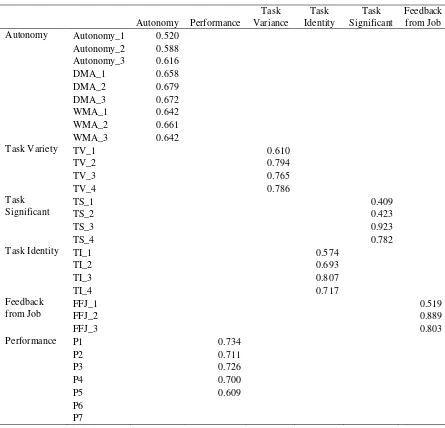
extraction method, and varimax rotation was used in this CFA. The result on the Table 1
decision-making autonomy, and work-method autonomy into one single dimension “autonomy”.
Table 1
Rotated factors and loading for task characteristics
DMA= Decision making autonomy, WMA=work-method autonomy, TV=task variety, TS=task significant,
square to degree of freedom (df.) was 1.516 for measurement model not exceed 2 (Marsh and
Hovecar 1985). Goodness-of-fit of the model represented on the root mean square error of
approximation (RMSEA) .039 and the standardized root mean square residual (RMR) = .028.
RMSEA values was less than .06 and RMR values was less than .08 therefore, indicating a good
fit of the model to the data (Hu & Bentler, 1999, Browne & Cudeck, 1992; Steiger, 1990). The
goodness-of-fit index (GFI) = .926, the adjustment goodness-of-fit index (AGFI) = .900, the
comparative fit index (CFI) =.970, Non-normed Fit Index (NFI) = .927, and the Tucker–Lewis
index (TLI) =.963. According to Marcoulides and schumacker’s (1996) standard of fitting, the
result of CFA indicated a satisfactory fit for the measurement model. Second order analysis
confirmed the single factor of task characteristics was with the following model of fit GFI=.920,
AGFI=.891, RMR=.044 CFI= .953, TLI = .942, IFI= .953, RFI=.902, NFI=920, and RMSEA=
.0457 (Kline, 2004; Byrne, 2006).
Confirmatory factor analysis (CFA) is adopted to test for the quality and adequacy of the
measurement model (Anderson and garbing, 1988). Therefore, this study investigates reliability,
convergent validity, and discriminant validity. Evidence for the unidimensionality of each
construct included appropriate items that loaded at least 0.524 on their respective hypothesized
component and loaded larger than .30 on other components in a factor of analysis. In addition,
Convergent validity was supported by all loadings being significant (p < 0.01) and all SMC
(square of multiple correlation) exceeding 0.275 (Hildebrandt 1987). This study assessed
reliability jointly for all items of a construct by computing the composite reliability and average
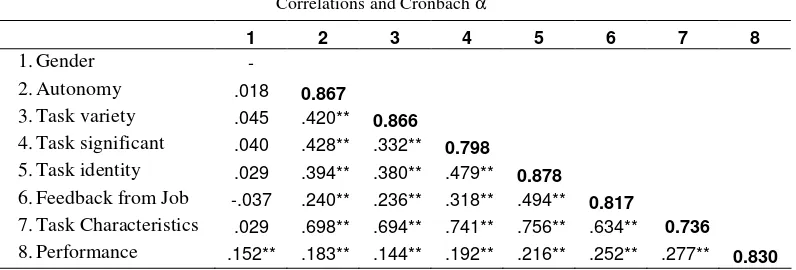
variance extracted (Steenkamp and van Trijp 1991). Cronbach’s α is the most widely used
** Correlation is significant at the 0.01 level (2-tailed).
Convergent validity is determined by the reliability of each construct and the average
variance extracted (AVE) of each construct. Anderson and Gerbing (1988) suggested that
convergent validity can be assessed from the measurement model by determining whether each
indicator’s estimated pattern coefficient on its posited underlying construct factor is significant
or not. Table 3 revealed that each item’s factor loading is more than 0.5 and their loading range
is between 0.55 and 0.99, which are in line with Anderson and Gerbing’s (1988) suggestion.
Variance extracted is not only the average percentage of variation explained among the items,
but also a summary measure of convergence among a set of items representing a latent construct.
Variance extracted is computed as the total of all squared standardized factor loadings divided by
the number of items. In other words, it is the average squared factor loading. Fornell and Larcker
(1981) suggested that variance extracted of 0.5 or greater than squared multiple correlations is
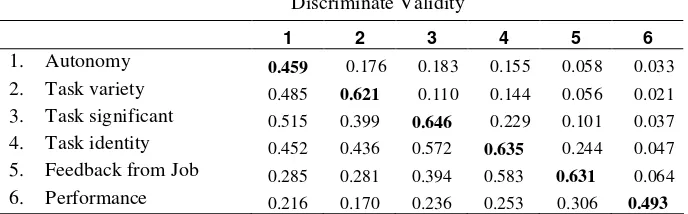
good. Table 4 shows AVE exceeding correlations in all squared multiple correlations. Therefore
the indicator variables of this study have a good convergent validity. Discriminant validity
describes the degree to which the operationalization is not similar to (diverges from) other
operationalizations that it theoretically should not be similar to. Campbell and Fiske (1959)
introduced the concept of discriminant validity in their discussion on evaluation of validity test.
They stressed the importance of using both discriminant and convergent validation techniques
Table 3
DMA= Decision making autonomy, WMA=work-method autonomy, TV=task variety, TS=task
significant, TI=task identity, FFJ=feedback from job
discriminant validity shows that a test of a concept is not highly correlated with other tests
designed to measure theoretically different concepts. In showing that two scales do not correlate,
it is necessary to correct for attenuation in the correlation due to measurement error. It is possible
to calculate the extent of which the two scales overlap by using the following formula where rxy
Although there is no standard value for discriminant validity, a result less than .85 tells us
that discriminant validity likely exists between the two scales. A result greater than .85, however,
tells us that the two constructs overlap greatly and they are likely measuring the same thing.
Therefore, the results shown in table 4, demonstrated adequate unidimensionality, convergent
validity, reliability, and discriminant validity.
Table 4
Average Variance Extracted, square correlation, and
Discriminate Validity
Hierarchical moderated regression analysis was conducted to test the mediating effect of
employee gender. Table 5 shows the result of the estimations of the main effect and the
moderating effect of gender. The result indicates that moderating effect of gender is significant
for dimension of autonomy, task identity, task significant, feedback from job and construct of
task characteristics. Although female employees achieved higher performance, the moderation of
gender shows that effect of task characteristics and its dimensions on performance were higher
for male employees than female employees.
Table 5
Testing result of main effect and moderating effect of gender
Performance
Feedback from Job x gender -.235**
Task Characteristics x gender -.291**
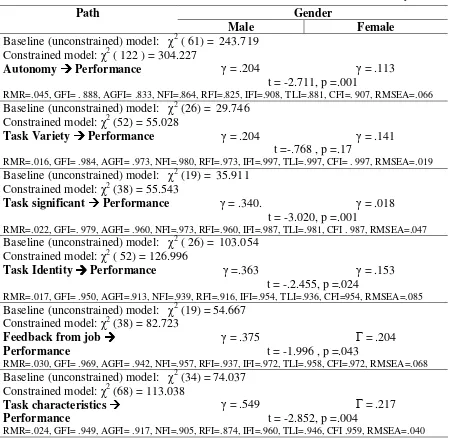
Moderation effect of gender analyzed using structural equation modeling shown in table 6
was also found equal. To test hypothesis-3, this study built separate structural models for the
male and female sub-samples, and conducted tests of moderation to determine whether the
respective path coefficients differed. Table 6 summarizes the analyses and results. The procedure
that this study used was as follows for each test: this study constructed two multiple-sample
models. In the first model, all paths were unconstrained between the two groups. This is the “no
constraints” or baseline model in Table 6. In the second model, this study constrained the
relevant path to be equal for both sub-samples. This is the “equal paths” model. The difference in
chi-square values between the two models provides a test for the equality of the path for the two
groups. Similarly, the path is stronger for the male than for female. Gender moderate task
characteristics and its dimensions are related to performance. Thus, hypothesis-3 is supported for
moderating variables.
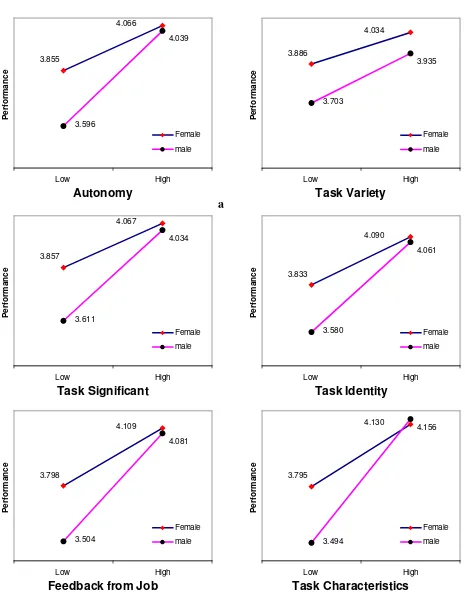
Figure 1 provides graphical representation of moderating effects of gender. The graphs
show that when the construct of task characteristics is high, male employees demonstrate higher
performance, than female employees. Whereas on high and low level of autonomy, task
significant, task identity, and feedback from job, female employees demonstrate higher
characteristics and performance relationship.
Table 6
SEM Moderation effect of Gender on Task Characteristics and Performance relationship Gender
RMR=.045, GFI= . 888, AGFI= .833, NFI=.864, RFI=.825, IFI=.908, TLI=.881, CFI=. 907, RMSEA=.066 Baseline (unconstrained) model: 2 (26) = 29.746
Constrained model: 2 (52) = 55.028
= .204 = .141
Task Variety Performance
t =-.768 , p =.17
RMR=.016, GFI= .984, AGFI= .973, NFI=.980, RFI=.973, IFI=.997, TLI=.997, CFI= . 997, RMSEA=.019 Baseline (unconstrained) model: 2 (19) = 35.911
Constrained model: 2 (38) = 55.543
= .340. = .018
Task significant Performance
t = -3.020, p =.001
RMR=.022, GFI=. 979, AGFI= .960, NFI=.973, RFI=.960, IFI=.987, TLI=.981, CFI . 987, RMSEA=.047 Baseline (unconstrained) model: 2 ( 26) = 103.054
Constrained model: 2 ( 52) = 126.996
=.363 = .153
Task Identity Performance
t = -.2.455, p =.024
RMR=.017, GFI= .950, AGFI=.913, NFI=.939, RFI=.916, IFI=.954, TLI=.936, CFI=954, RMSEA=.085 Baseline (unconstrained) model: 2 (19) = 54.667
Constrained model: 2 (38) = 82.723
= .375 = .204
Feedback from job
Performance t = -1.996 , p =.043
RMR=.030, GFI= .969, AGFI= .942, NFI=.957, RFI=.937, IFI=.972, TLI=.958, CFI=.972, RMSEA=.068 Baseline (unconstrained) model: 2 (34) = 74.037
Constrained model: 2 (68) = 113.038
= .549 = .217
Task characteristics
Performance t = -2.852, p =.004
Autonomy
Conclusion
Discussion
This study employed self-efficacy theory to investigate the different effects of task
characteristics on the performance achieved by gender. Although female employees were found
to achieve higher performance than male employees, the results of this study revealed that male
employees have higher effect of task characteristics on performance. Therefore male employees
indicated to be more confident than female employees. This result is consistent with the findings
by Meece (1991), Pajares et al (1994) and a study by Wigfield et al (1996).
Acceptance of the hypotheses provided some notes. It explains that gender has a significant
individual attachment effects on performance. Female employees were found to be more likely to
accept higher job performance. Expressiveness of female employees (O’Neil et al, 2008) might
influence the support of work achievement. However Haswell et al., (1999) and Bernardi (2008)
indicated that female employees’ sensitivities might inhibit their effort to achieve higher outputs.
Therefore, that explains why the effect of task characteristics on performance was higher for
male than female employees. This applies to all dimensions of task characteristics.
Expressiveness and sensitivities of gender are important in developing jobs. Zin (2006)
indicated that the responsibility for children affect job commitment among female employees. In
balancing role obligations may precipitate work-family conflict. These conflicts are predicted in
the form of stress, hence affect weakened performance. Therefore, the findings of this study
indicate that managers must pay attention to this when designing the tasks for male and female.
Limitation and Future Research Direction
Notwithstanding these contributions, this study also has several limitations. Specific task
and level of performance should be determined. Different task might influence the confidence of
both male and female employees to achieve high performance. Hence exploring the task and
achievement in the academic field might be different from entrepreneurial field (Meece, 1991;
Pajares et al, 1994; Wigfield et al 1996; Eisenberget al, 1996; Wilson et al, 2009).
Although these findings lend strong support to self-efficacy theory, future researchers may,
however, want to attempt to develop this work further, incorporating other related psychological
theories such as expectancy theory. The use of different theories may enrich the accumulation of
related knowledge and further understanding of empirical practices. Another possible direction
for further development is to investigate the impact of task characteristics on commitment, work
satisfaction and other possible outcomes.
Based on Tesluk and Jacob (1998) suggestion, further investigation on the joint moderating
effects of gender and tenure is imperative. Even though, the findings supported one of various
design affect performance differently. It is also possible to investigate gender effects on other
forms of performance. This study used role performance to represent the performance explored.
Extra role performance such as organizational citizenship behavior (OCB) may enrich further
understanding of total performance related to task characteristics of job design. Experimental or
quasi-experimental research designs are needed to help in ruling out potential alternative
explanations for these results (Morgeson, 2006). The sampling data collected was inadequate to
improve on the group level analysis (HLM). Other studies can also investigate the effects of
individual assessments on the job, since team assessment has become a fad.
References
Baghat, Parimal S., Williams, Jerome D. (2008), Understanding gender differences in professional service relationships, Journal of Consumer Marketing, 25/1, 16–22
Bernardi, Richard A., Guptil , Steven T., , (2008), Social Desirability Response Bias, Gender, and Factors Influencing Organizational Commitment: An International Study, Journal of Business Ethics, 81:797–809
Brief, A.P., (1998), Attitudes In and Around Organizations, Thousand Oaks, CA: Sage Publications
Campbell, J. P. (1990), Modeling the performance prediction problem in industrial and organizational psychology. In M. D. Dunnette & L. M. Hough (Eds.), Handbook of Industrial and Organizational Psychology (pp. 687-732). Palo Alto, CA: Consulting Psychologists Press, Inc.
Campbell, J. P., McCloy, R. A., Oppler, S. H., & Sager, C. E., (1993), A theory of performance: In N. Schmitt & W. C. Borman (Eds.), Personnel Selection in Organizations (pp. 35-70). San Francisco: Jossey-Bass.
Campion M. A., & McClelland, C. L. (1993). Follow-up and extension of the interdisciplinary costs and benefits of enlarged jobs, Journal of Applied Psychology, 78, 339–351
Chatman, J.A., (1991), matching people and organizations: selection and socialization in public accounting firms, Administrative science quarterly, 36 pp. 459-484
Deci, E.L. and Ryan, R.M., (1985), Intrinsic Motivation and Self-determination in Human Behavior, Plenum Press, New York, NY
Deming. W. E. (1986). Out of the crisis. Cambridge: Massachusetts Institute of Technology, Center for Advanced Engineering Study
Edward, JR. (1996), An examination of competing versions of the person-environment fit approach to stress. Academy of Management Journal, 392), 292-339.
Ferris, GR, Adams, G, Kolodinsky, RW, (2002), Perceptions of organizational politics: Theory and research directions, Research in multi issues, Vol. 1 pg. 179-254
George, J.M., & Jones, G.R., , (2008), Understanding and managing Organizational Behavior (Fifth Edition) Upper Saddle River: New Jersey, Pearson Prentice Hall
Ghazawwi, Issam, (2008), Job Satisfaction Antecedents and Consequences: A New Conceptual Framework and Research Agenda, The Business Review, Vol. 11, Num. 2
Hammer, Michael and Champy, James (1993), Reengineering the corporation A Manifesto For motivational, social, and contextual work design features: A meta analytic summary and theoretical extention of the work design literature, Journal of Applied Psychology, vol 92., No. 5, pg. 1332-1356
Judge Timothy A, Robins P Stephen, (2007), Organizational Behavior – 12th edition, Pearson international edition
Judge, T.A., Cable, D.M. (1996), person organization fit, job choice decision and organizational entry, Organizational behavior and Human decision processes 67 pp 294-311
Juran, JM, (1988), Planning for quality, Free press New York
Lepak & Snell, (1999) in Samuel Ngunia, Peter Sleegersb, and Eddie Denessen, (2006), Transformational and Transactional Leadership Effects on Teachers’ Job Satisfaction, Organizational Commitment, and Organizational Citizenship Behavior in Primary Schools: The Tanzanian case, School Effectiveness and School Improvement, Vol. 17, No. 2, , pp. 145 – 177
Lysonski, S. and W. Gaidis, (1991), ‘A Cross-Cultural Comparison of the Ethics of Business Students’, Journal of Business Ethics 10(2), 141–150.
MacKinnon, David P., (2008), Introduction to statistical mediation analysis, Lawrence Erlbaum Associates NY
Morgeson F. P., & Campion, M. A. (2003), Work design, In W. C. Borman, D. R. Ilgen, & R. J. Klimoski Eds., Handbook of psychology: Industrial and organizational psychology Vol. 12, pp. 423–452). Hoboken, NJ: Wiley.
Morgeson Frederick P. and Stephen E. Humphrey, (2006), The Work Design Questionnaire WDQ): Developing and Validating a Comprehensive Measure for Assessing Job Design and the Nature of Work, Journal of Applied Psychology (2006), Vol. 91, No. 6, 1321– 1339
O’Neil, Deborah A, Hopkins, Margaret M, Bilimoria, Diana, (2008), Women's Careers at the Start of the 21st Century: Patterns and Paradoxes Journal of Business Ethics, Vol. 80, Iss. 4; p. 727
O’Reilly III, C.C., Chatman, J., and Caldwell, D.F., (1991), people and organizational culture: A profile comparison approach to assessing person-organization fit, Academy of management journal, pp. 487-516
Qualls, W.J., (1987), “Household decision behavior: the impact of husbands’ and wives’ sex role orientation”, Journal of Consumer Research, Vol. 14, pp. 264-79
Saks, A.M., and Ashfort, B.E., (1997) A longitudinal investigation of the relationships between job information source, applicant perceptions of fit, and work outcomes., personnel psychology, 50, pp. 395-426
Schultz, D.P. & Schultz, S.E., (2005), Theories of Personality 8th Edition, Wadsworth: Thomson. I.S.B.N.: 0-534-62403-2
Smith, Elizabeth A, (2005), Communities of Competence: new resources in the workplace, Journal of Workplace Learning, Vol. 17, Iss. 1/2; p. 7
Tanriverdi, Haluk , (2008), Workers' Job Satisfaction and Organizational Commitment: Mediator Variable Relationships of Organizational Commitment Factors, Journal of American Academy of Business, Vol. 14, Iss. 1; p. 152 (12 pages)
Whipple, T. W. and D. S. Swords, (1992), ‘Business Ethics Judgments: A Cross-Cultural Comparison’, Journal of Business Ethics 11(9), 671–678.
William, H. Sumrall, David W. Cox, D. Adrian Doss, and Don W. Jones, (2008), Participative Decisions and Organizational Commitment: A Quantitative Analysis, Southern Business Review, 39-52