VOLUME 41, NO. 1, JUNI 2014: 1 – 16
Constructtion of Student Well-being Scale
for 4-6
thGraders
Irine Kurniastuti1, Saifuddin Azwar2
Faculty of Psychology Universitas Gadjah Mada
Abstrak. Student well-being pada anak usia Sekolah Dasar di Indonesia belum banyak dikaji, demikian pula usaha untuk mengembangkan indikator yang relevan untuk mengungkap well-being anak di sekolah belum banyak dilakukan. Di sisi lain, alat ukur untuk mengetahui well-being
siswa sangat dibutuhkan seiring dengan meningkatnya kesadaran masyarakat terhadap well-being
siswa di sekolah. Penelitian ini bertujuan untuk mengembangkan instrumen pengukuran student well-being dalam konteks Sekolah Dasar (SD). Skala yang dikembangkan didasarkan pada tinjauan penelitian well-being pada anak yang dilakukan oleh Pollard dan Lee dan disesuaikan dengan konteks sekolah yang mengacu pada pendekatan kesejahteraan psikologis dari Ryff dan Keyes. Penelitian dilakukan dengan menyusun tiga skala paralel. Setiap skala yang disusun ini diujikan kepada 200 responden, sehingga total responden adalah 600 siswa. Hasil analisis terhadap ketiga skala dijadikan dasar untuk menyusun satu skala kompilasi. Skala kompilasi ini kemudian diujikan kepada 215 responden. Hasil analisis terhadap skala kompilasi menunjukkan bahwa 39 aitem yang disusun mempunyai properti psikometris yang memuaskan jika ditilik dari koefisien reliabilitas, daya beda aitem, dan validitas isi, sedangkan secara struktural, struktur faktornya masih perlu diperbaiki.
Kata kunci:kesejahteraan psikologi, sekolah dasar, student well-being
Abstract. Student well-being in the context of elementary school in Indonesia has not been much studied. Accordingly, the effort of developing relevant indicators for revealing student well-being has not been done too. Along with the increase of public awareness of student well-being at school, appropriate tools to measure it is greatly needed. This study aimed to develop an instrument for measuring student well-being in elementary school. The scale was based on the review of a research on children well-being by Pollard and Lee and was adapted for school context using the psychological well-being approach suggested by Ryff and Keyes. This study had three parallel scales, each of which was tested on 200 respondents. Accordingly, the study involved 600 respondents. The results of the analysis of the scales were used as basis for preparing a compilation scale. It was then tested on 215 respondents. The results of the analysis of it showed that 39 items composed had satisfying psychometric properties, i.e. the reliability coefficient, item discrimination index, and content validity. However the structural factor still needed to be improved.
Keywords:elementary school, psychological well-being, student well-being
Middle-childhood1 span is an impor-tant time for children to develop their various competencies cognitively, socially, and emotionally. Children who succeed in passing the middle-childhood well will
1 Korespondensi mengenai isi artikel ini dapat dila-kukan melalui: [email protected]
2 Atau melalui: [email protected]
and at risk for children if they do not make it through the challenges of this period (Eccles, Lord, & Buchanan, 1996; NICE, 2008; Yazdani, 2011) which often influen-tial to the well-being of children (Charlesworth, Wood, & Viggiani, 2007), especially the well-being of children in schools. Case studies of school-quitting client in Consulting Psychology Unit show that mostly it occurs in the mid-range of childhood (Ampuni & Andayani, 2007).
The discussion about middle-child-hood cannot be separated from the envi-ronment and school despite the fact that many factors influence it (Charlesworth et al., 2007). Children’s condition in school will affect his/her well-being. Schools become an important context in the devel-opment of children well-being in middle-childhood, which is also often referred to school age. Well-being of school children cannot be viewed separately from the con-text of the school because children spend a lot of time in school (Eccles, 1999).
The results of Huebner and Gilman study (2006) on life satisfaction in children as an indicator of well-being suggested that when children felt dissatisfaction with the school, they were more susceptible to a variety of behavioral problems in the fu-ture. This underscores the importance of protecting children’s well-being in school environment, such as the effort by the World Health Organization (WHO) in promoting mental health and well-being at school; the students seek emotional and social well-being (WHO, 2011). This is supported also by Gutman and Feinstein (2008) and Opdenakker and Van Damme (2000) who found that the experiences in schools have an important role to the well-being of children.
However, researches on children’s well-being, especially during the middle-childhood period are still rare to find
(Gadermann, 2009). In Indonesia, research on children's well-being school context has not been done a lot. Efforts to conceptual-ize the well-being of children is still less satisfying (Fattore, et al., 2007; Lippman, 2005). Besides, there is not much effort made to make the appropriate well-being measure for children (Ben-Arieh, 2006). Limitations of the study on the measure-ment of well-being in children are a chal-lenge for education to continue pursuing and developing the well-being measure-ment. This study aims to develop a stu-dent well-being measurement in the con-text of school, namely Student Well-Being (SWB).
The measuring instrument developed is still at the level of research instruments. Thus, this instrument cannot be used as a diagnostic tool, but the results can be used as an initial step in the development of a measurement tool for screening or moni-toring purposes. The expected outcome of the construction of this research is a valid and reliable measuring instrument, which also has feature-items that are able to dis-tinguish between individuals who have a low-measured attributes and those who have high-measured attributes.
Theory and Measurement of Well-being
In its development, well-being re-search is currently dominated by two main approaches, namely hedonic and eudai-monic (Waterman, 1993). Hedonic ap-proach perceives well-being subjectively. Subjective well-being is often interchange-able with happiness, namely high positive affect, low negative affect and high life satisfaction (Deci & Ryan, 2008). The hedonic view improves the well-being of a person by increasing his happiness (Ryan & Deci, 2001).
perspective of eudaimonic is the Psycho-logical Well-being by Ryff (1989). Ryff and Keyes (1995) suggested that the levels of psychological well-being is a person’s level in having a purpose in life, realizing the self potencies, having quality relationships with others, and feeling responsible to his own life. From the perspective of this theory, well-being tends to be seen as the emergence of a positive self attributes (Keyes, 1998).
The perspective used in this study is the eudaimonic approach, which draws on the theory of psychological well-being of Ryff and Keyes (1995). Ryff and Keyes (1995) formulated the concept of psycho-logical well-being which consists of per-sonal growth, self-acceptance, autonomy, purpose in life, environmental mastery and positive relations with others. The six aspects are then used as the basis for pre-paring the construct and modified by adding or subtracting some adjustments to the level of development of the respon-dents and the results of research on the well-being of children by Pollard and Lee (2003) and review of Fraillon (2004) on Student Well-Being (SWB).
Identifying theMeasurement Purpose and the Operationalization of Student Well-being Concepts
The purpose of this measurement is to construct a scale to measure the well-being of students in the school context, the SWB scale. SWB is defined as the level of stu-dents' ability to carry out their duties ef-fectively in the school community (Frail-lon, 2004). SWB refers that a better life is more like an effort to demonstrate the positive potency of a student in the school context.
Researcher’s review resulted in two dimensions of the student well-being. In-trapersonal dimension consists of six
as-pects: emotional regulation, resilience, self-esteem, curiosity, engagement, mastery orientation. Whereas, the interpersonal dimension comprises four aspects: com-municative efficacy, empathy, acceptance, and connectedness.
At the intrapersonal aspects, a student internalizes what he/she felt at him-self/herself and turns it into something that affects his/her function in the school community. Students who have high well-being in intrapersonal aspects are shown in the following capabilities.
Able to control emotions
Emotion controlling forms the core of the ability to control emotions and in-cludes the monitoring, evaluation, and modification of emotional reactions (Pollard & Davidson in Frailon, 2004). Emotion controlling is manifested as emo-tional responses of students indicated fairly and in accordance with the circum-stances around them.
Resilientin facing the problems (having resis-tance)
The resilience model of this study is aimed to measure difficulty focusing on the expression of students’ resilience in the hypothetical contexts. The evidence of dif-ferences in the level of students’ resilience is manifested by forcing students to responses that they explicitly show when facing a number of school hypothetical difficulties.
Not feeling inferior (having high self-esteem)
valued as something fundamental to the construct of intrapersonal well-being (Ryan & Deci, 2001). Self-esteem included in this aspect is the self-esteem in perform-ance or academic and social.
Having a high curiosity
Ryff and Keyes (1995) emphasize the importance of human beings to grow, be opened to new experiences, and face new challenges. Humans are expected to have the feelings to continue growing by devel-oping a curiosity as an intrinsic desire to learn more (Pollard & Davidson, 2001, in Fraillon, 2004).
Participating in learning and school activities
Ryff and Keyes (1995) wrote that one of environmental mastery forms is partici-pating actively in the environment. Stu-dents’ engagement in the learning process includes the involvement in the learning process and school community.
Persevere in the learning process
Persevere in the learning process is an orientation to proficiency. Orientation to proficiency is defined as a desire to com-plete tasks with all of the efforts. A con-struct broader than environmental mastery (Ryff & Keyes, 1995, Ryff & Singer, 1996) can be seen as a part of the orientation on the proficiency and involvement in aca-demic and school activities.
The following aspects are interper-sonal aspects which include: the well-being aspect influenced by the experience of interaction with others, one's assess-ment of the state of the environassess-ment, and its function in society (Keyes, 1998). These aspects are: (1) Being able to communicate what he/she feels and thinks (having
communicative efficacy). Communicative efficacy describes the aspects of social competence and positive relationships with others (Ryff & Singer, 1996). To be able to function effectively in the school community, students need to interact with all members of the school community in-cluding other students from different grades of schools, teachers, parents, and colleagues. (2) Positioning themselves in others’ situations (empathy). Positive rela-tionships with others can be demonstrated by showing empathy (Ryff & Keyes, 1995) cognitively and affectively. Gladstein (1983) suggests cognitive empathy as 'thinking as if being others' and affective empathy as 'responding with the same emotions as others’.’ (3) Demonstrating confidence and comfort in interacting with friends, teachers, and community mem-bers. Keyes (1998) calls this aspect as an acceptance of the social environment. The acceptance is an 'understanding of society through the character and quality of others'. It is found in students' beliefs about the basic goodness of others; there-fore, it becomes a construct that includes interpersonal values that are often men-tioned, respect, tolerance, and under-standing. (4) Maintaining good relation-ships with friends, teachers, and commu-nity members (interpersonal connected-ness). Interpersonal connectedness is 'sub-jective awareness to establish a close rela-tionship with the social world' (Lee & Robbins, in Fraillon, 2004). This suggests a meaningful relationship with 'the broader and more scopeof people, as well as the variety of colleagues' (Fuller, in Fraillon, 2004; Keyes, 1998).
Table 1
The Indicators of Student Well-Being Behavior
Aspects Indicators
Able to control emotion
1. Not doing any action against the social norm to meet a temporary need (impulsivity) such as cheating, stealing, or doing an aggressive action
2. Not showing excessive response when angry/sad
Resilient in facing problems
3. Keep feeling enthusiastic to go to school after experiencing a bad event (ex.: being bullied by friends or scolded by teachers) 4. Keep doing homework although there are some obstacles (ex.:
blackout, no helper, broken pencils)
Not feeling inferior (having high self-esteem)
5. Feeling smart and able in academic and school work 6. Not worried by others’ opinion
Having a high curiosity
7. Trying to find out a solution (ex.: answers for questions) although is not an obligation
8. Finding out matters dealing with the lessons that are not taught in the class
Participating in learning and school activities
9. Joining activities outside of the learning hours (ex.: extracurricular, optional programs) happily
10. Paying attentions to the teachers’ explanation and participating in the learning process actively (ex.: answering questions, being active in groups)
Persevere in the learning process
11. Persevering in the learning process to master the lessons 12. Doing homework optimally
Able to communicate what he/she feels and thinks
13. Being able to communicate what he/she feels (ex.: expressing objections, asking for help when finding difficulties)
14. Able to communicate what he/she feels
Able to position themselves in others’ situations
15. Showing care about the situation experienced by others 16. Having his/her emotions stirred when heard, saw, or read a
heartbreaking/funny story
Demonstrating
confidence and comfort in interacting with friends, teachers, and community members
17. Feeling comfortable being among friends and teachers 18. Thinking that all friends and teachers are good
Maintaining good relationships with friends, teachers, and community members
19. Having many friends
Method
Respondents
The first test was conducted to 600 4-6th graders of elementary school (men: 52%, women: 48%). The second phase of testing with scale of compilation was con-ducted to 215 4-6th graders of elementary school (male = 50.2%, female = 49.8%).
Procedures of the Measuring Instrument con-struction
The construction of the items was started by making items and pre-testing the comprehension of the items draft. Furthermore, the researcher asked for ad-vices from her peer consisting of a litera-ture scholar, psychology scholars and practitioners often involved with children for the refinement of the items in the scale. Items refinement included language in terms of compliance with the language of children and the contextualization with the real children’s well-being in schools.
After the draft of the item was refined and reassembled, panelists who were competent in the preparation of measuring instruments and related topics judged the relevance of the items with the measured indicators. Assessment was done by as-signing a number between 1 through 5. Assessment results were analyzed using statistical formulas of Aiken's V as follows:
V= ∑s / [n c-1)]
s = r-lo
lo = lowest validity assessment value (in this case = 1)
c = highest validity assessment value (in this case = 5)
r = number given by an appraiser
After that, a pretest to 32 respondents was conducted to know the understanding
and acceptance of the respondents to the items arranged. Then the items were re-viewed and refined based on the panelists’ assessment, and the advices from panelists and respondents. The selection of the items was based on the highest item rele-vance value and the basic understanding of the pre-test respondents.
Reliability and Validity
Reliability methods used in this study were in the form of internal consistency by computing the α-coefficients. The validity used is the content validity and the factor structure test. The Aiken's V formula was used to calculate the content validity coef-ficient. The factor analysis approach with exploratory factor analysis/EFA was used to test the factor structure. EFA is often used for data exploration, associated with the spread of grain on a number of certain latent factors (Brown, 2006).
Results
Item Generation
The first item writing produced 80 items. The results of the first pre-test to 5 elementary school students showed that sentences in the item draft and the selec-tion method of responses were easy to understand. Nevertheless, there were still many suggestions to refine the items from the students, elementary school teachers and children practitioners.
The second item writing produced 115 items. The items were then split into two scales, each of which contained 55 and 60 items. Each scale was then tested on 17 students and 15 students from the lowest grade level, the 4th grade.
the value of V ranges from 0 to 1, then the panelists’ assessment result indicated that the constructed items were relevant with the indicators measured according to the panelists.
Advices from the panelists were col-lected and combined with the advice from the pre-test respondent. After the items were corrected or eliminated as the advice from the panelists and respondents, 80 fi-nal items were obtained. Some examples of the items are shown in Table 2.
Alternative Forms Generation
Considering that a scale with many items will make the respondents feel tired and lost focus, which will affect the scores obtained, shorter alternative scales were drafted and they could be tested in many subjects at a time. The alternative scales were developed by selecting the best 55 of the 80 items. The selected 55 items were then duplicated into three parallel scales.
The three parallel scales composed had the same substance presented in dif-ferent sentences. To make them easy to distinguish, they were named scale1, scale2, and scale3. Furthermore, each of the scales was distributed to 200 respon-dents.
The discriminant index analysis for the items of each scale using standard rix >0.3 indicated that scale1 successfully managed to capture 21 of the 40 items ex-pected to have a good discriminant index, scale2 was able to capture 30 items, and scale3 captured 21 items.
Scale Compilation
The number of the targeted items was 40 on the scale. The result of the items se-lection on scale1, scale2, and scale3 did not meet the expected target, which was 40 items, in which each indicator had two items. Therefore, items with the best dis-criminant index from each scale were compiled to create a single scale.
The compilation of the three scales, by considering the best discriminant index of the items and the target fulfillment of one indicator consisted of two items, produced 39 items. The reduction of one item from the first target was because from the com-pilation result, there was one indicator that was only represented by one item. The other items did not qualify because they did not meet the psychometric require-ments. The compiled scale was then ready to be tested again.
Table 2
Items and assessment results of V
Item examples V
Aku mengambil barang temanku yang sangat kuinginkan 0.958
Aku menyontek dalam keadaan terdesak 0.958
Aku mengambil uang temanku ketika tidak ada orang lain yang melihat 0.875
Aku mencoret-coret meja sekolah 0.917
Aku memukul teman yang membuatku marah 0.958
Aku kembali bermain dengan teman yang membuatku marah 0.750
Aku memukul teman yang merusak barangku 0.917
Aku menangis meraung-raung karena marah dengan temanku 0.750
Aku membolos karena benci dengan salah satu pelajaran 0.875
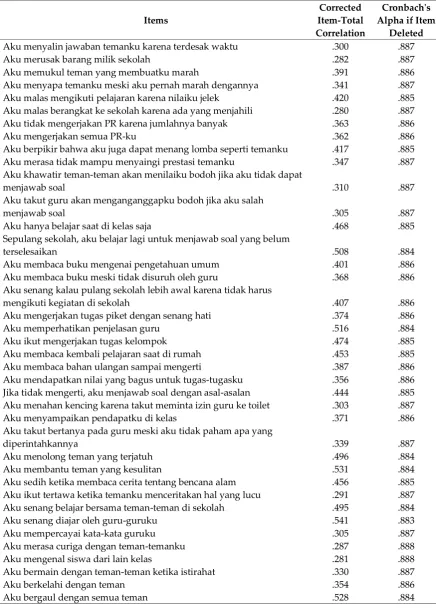
The compilation scale was tested on 215 respondents. The data obtained was then analyzed. The analysis result of the compiled scale showed that almost all of the items had satisfying discriminant in-dex (rix >0.3) and only five of them that did not meet the standard rix= 0.3 (see Table 3 in Appendix). However, the items were not necessarily excluded from the analysis. Discriminant index coefficient of the items approaching rix = 0.3 was still acceptable considering the scope of the content do-main to be disclosed and the usage pur-pose of the test results (Azwar, 2012).
Considering the fulfillment of the measured domain and psychometric re-quirements based on item-total correlation coefficient, a number of items approaching nearly the value of rix = 0.3 was still pre-served. Thus, the total of items passing the selection was 39 items.
Reliability Test
The reliability of the 39 best items contained in the compilation scale was then tested. The reliability was tested us-ing internal consistency reliability which showed that the reliability coefficient based on Cronbach's Alpha was 0.88.
Factor Structure Analysis
Furthermore, factor analysis was con-ducted to examine the factor structure. The analysis showed the value of KMO was 0.815 with a significant Bartlett's Test of Sphericity (<0.01). From these results, it can be concluded that the sample of the study was eligible for factor analysis.
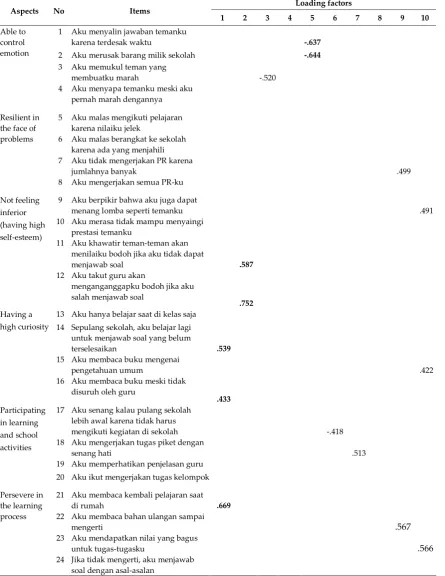
The analysis was done by confirming the aspects that have been made before, namely 10 aspects. The analysis results are shown in Table 4 (appendix). The result of factor analysis with 10 extracted factors showed that some items had a very low
factor loading to show, some items did not cohere in the expected factor, and some items managed to cohere in the expected factor.
If the positive and negative signs were ignored, of the 10 factors that were ex-pected to arise on the result of this analy-sis, there were four factors corresponding to the construct. These factors were fac-rived from different indicators.
Thus, it can be seen that the result of confirmatory factor analysis has not been able to show a satisfying confirmation re-sult. The emerged factors did not represent the previously arranged factors. This result raised another question about the factors that actually construct the SWB scale. Therefore, further analysis with explora-tory factor analysis was conducted to de-termine the factor composition of the SWB scale.
Table 5
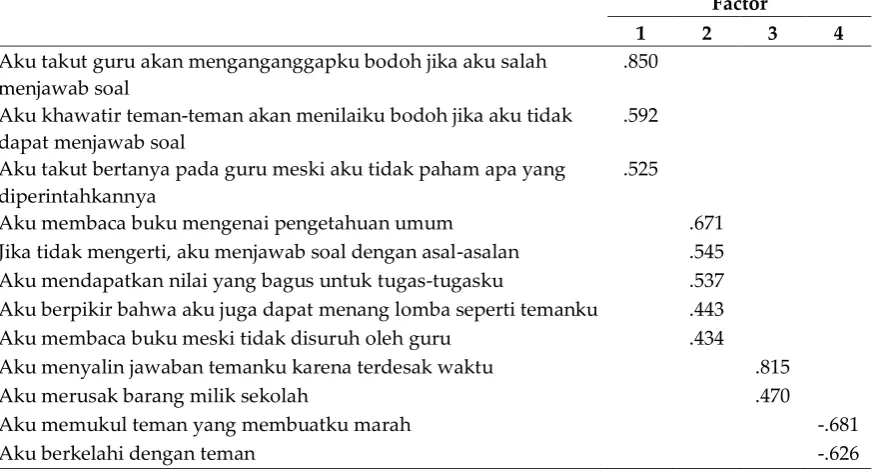
The results of Analysis of Exploratory Factor
Factor
1 2 3 4
Aku takut guru akan menganganggapku bodoh jika aku salah menjawab soal
.850
Aku khawatir teman-teman akan menilaiku bodoh jika aku tidak dapat menjawab soal
.592
Aku takut bertanya pada guru meski aku tidak paham apa yang diperintahkannya
.525
Aku membaca buku mengenai pengetahuan umum .671
Jika tidak mengerti, aku menjawab soal dengan asal-asalan .545 Aku mendapatkan nilai yang bagus untuk tugas-tugasku .537 Aku berpikir bahwa aku juga dapat menang lomba seperti temanku .443 Aku membaca buku meski tidak disuruh oleh guru .434
Aku menyalin jawaban temanku karena terdesak waktu .815
Aku merusak barang milik sekolah .470
Aku memukul teman yang membuatku marah -.681
Aku berkelahi dengan teman -.626
Based on the similarity of the collected items, factor1 showed items revealing about the components of self-esteem. The second emerged factor was a collection of items indicating someone's effort in devel-oping him/herself to reach the maximum achievement. Factor3 was related to the way a person controls him/herself not to show a behavior that is contrary to the so-cial norms in order to meet immediate needs. Factor4 showed the inability of controlling emotions.
Discussion
The reliability coefficient in the con-struction of this scale was 0.88. If com-pared to the standard specified by the ex-perts before such Urbina (2004) and De Vauss (2002), which stated that a mini-mum reliability coefficient of 0.8 is consid-ered as quite significant, the level of reli-ability obtained in the construction of this scale is already satisfying.
Some other well-being scales which can be said have a good reliability also had
more than 0.70 reliability, such as the Psy-chosocial Well-Being Inventory (PSWBI) arranged by Negovan (2010), and more than 0.80 reliability , such as the Pacific Identity and Wellbeing Scale (PIWBS) by Manuela and Sibley (2012). The scale in this study had an internal consistency of 0.88. Therefore, it can be concluded that the constructed SWB scale was reliable.
However, a high reliability value should be interpreted carefully because the reliability of the scale will produce a dif-ferent coefficient if tested on other respon-dents and in other situations when im-posed on a group of respondents in certain situations (Azwar, 2012). The scale was tested on a group of respondents with relatively similar characteristics. Therefore, the existing reliability coefficient should be interpreted carefully and needs to be tested to a broader sample so that the reli-ability figures can actually be enforced.
meas-ured attributes and the respondents with low measured attributes. Perceived from the item-total correlation coefficient, the items in this scale met the satisfying psy-chometric property requirement. Never-theless, the high items correlation coeffi-cient does not show the attributes meas-ured by the items and the desired attrib-utes.
In the construction of this scale, the items generated were already written cor-rectly and in accordance with the behav-ioral indicators that have been formulated correctly too. This was supported by the high content validity given by the panel-ists. Logically, the items were valid be-cause they had been through the correct process and based on the review of panel-ists and practitioners. However, even though the content validity of the scale already met the requirements, it did not guarantee the items would be valid on the construct test.
Construct validity test was performed to prove that the measurement result ob-tained by items of the scale were highly correlated with the theoretical construct underlying in the construction of the scale (Azwar, 2012). The confirmatory factor analysis result showed that aspects emerging on the SWB scale were not in accordance with the previously prepared construct, i.e. consist of 10 aspects. Factor structure that emerged from the result of confirmation with 10 factors did not show the expected factors’ structure. Several factors had a low factor loading and some others overlap or cross over into other
might provide information about things described by the measurement results of other items in the same scale. Aspect that was jointly described by several items was identified as a variable or latent factor. This latent factor can be expressed indi-rectly through a number of operational behavioral indicators. On the other hand, to formulate appropriate behavioral indi-cators is not an easy thing to do.
Behavioral indicators in the construc-tion of this scale was limited by two indi-cators of each aspect due to a considera-tion that the respondents were still chil-dren and it would be inappropriate if they were given a long scale. The limited the number of indicators made the scale con-structed not comprehensive enough to re-veal the desired attributes. In addition, parts of the limited behavioral indicators are likely to overlap with behavioral indi-cators of the other psychological attributes (Azwar, 2012).
The second possibility was that the level of difficulty in constructing simple and easy to understand items by child respondents. In this scale, every aspect arranged was different, but the indicators were still posing a double meaning when gated the distinctive power of each item.
for-mat, and the description of the items in negative sentences. In this scale, there were ambiguous items needed to be fixed for the purpose of further development of the scale.
Conclusion
From the validity of the content, the discriminant index, and the reliability co-efficient, the scale in this study had ful-filled the requirement of satisfying psy-chometric properties. However, structur-ally, this scale still needs a lot of improve-ment to be able to run its measuring func-tion correctly. The structural factors analy-sis result showed that the emerging factors were inconsistent with the previous com-posed construct while the result of factor exploratory produced four factors identi-fied, namely factors containing items re-lated to self-esteem, self-development, normative behavior, and emotional con-trol.
Suggestion
Suggestions for the next researchers who wish to continue this research are, firstly, review the construct of the student well-being in the school and determine the appropriate construct with the objective of the measure. Secondly, review the indica-tors that construct each aspect in terms of wording and the amount of indicators. In-dicators which are less able to represent measured attributes operationally can be rearranged and then redo the item writing. Thirdly, future studies should be applied to a more extensive and varied respon-dents characteristics.
References
Ampuni, S., & Andayani, B. (2007). Me-mahami anak dan remaja dengan ka-sus mogok: gejala, penyebab, struktur kepribadian, profil keluarga, dan ke-berhasilan penanganan. Jurnal Psiko-logi,34 (1), 55-75.
Azwar, S. (2012). Reliabilitas dan Validitas. Yogyakarta: Pustaka Pelajar
Ben-Arieh, A. (2006). Measuring and Moni-toring the well-being of young children around the world (a Report to UNESCO). Retrieved from http:// unesdoc.unesco.org/images/0014/0014 74/147444e.pdf
Brown, T. A. (2006). Confirmatory Factor Analysis for Applied Research. New York: The Guilford Press.
Charlesworth, L., Wood, J., & Viggiani, P. (2007). Dimensions of human behav-ior: the changing life course (4th Ed) In Hutchison, E. D. Middle Childhood (pp. 175-26). New Delhi: Sage Publication, Inc.
Deci, E. L., & Ryan, R. M. (2008). Hedonia, eudaimonia, and well-being: an intro-duction. Journal of Happiness Studies, 9, 1-11. doi: 10.1007/s10902-006-9018-1
De Vaus, D. A. (2002) Surveys in Social Research (5th edition) London: Routledge.
Eccles, J. S. (1999). The development of children ages 6 to 14. The Future of Children: When School is Out, 9(2), 30-44.
Brooks-Gunn, & A. C. Petersen (Eds.), Transitions through adolescence: Inter-personal domains and context (pp. 251-284). Hillsdale, NJ: Lawrence Erlbaum Associates.
Eid, M., & Larsen, R. J. (2008). The Science of Subjective Well-Being. New York: The Guilford Press.
Fattore, T., Mason, J., & Watson, E. (2007). Children’s conceptualization s of their well-being. Social Indicator Re-search, 80, 5-29. doi: 10.1007/s11205-00609019-9
Fraillon, J. (2004). Measuring Student Well-being in the Context of Australian Schooling: Discussion Paper Commis-sioned by the South Australian de-partment of Education and Children’s services as an agent of the Ministerial Council on Education, Employment, Training and Youth Affairs. Retrieved from http://www.mceetya.edu.au/ verve/_resources/Measuring_Student_ Well-Being_in_the_Context_of_ Australian_Schooling.pdf
Gadermann, A. M. (2009). The satisfaction with life scale adapted for children: Inves-tigating the structural, external, and sub-stantive aspects of construct validity
Master’s thesis). Retrieved from https://circle.ubc.ca/bitstream/handle/ 2429/16320/ubc_2010_spring_gaderma nn_anne.pdf?sequence=1
Gladstein, G. A. (1983). Understanding Empathy: Integrating Counseling De-velopmental, and Social Psychology Perspectives. Journal of Counseling Psy-chology, 30(4), 467-482.
Gutman, L. M., & Feinstein, L. (2008). Chil-dren’s Well-Being in Primary School: Pu-pil and School Effects. London: Centre for Research on The Wider Benefits of Learning.
Huebner, E. S., & Gilman, R. (2006). Char-acteristics of adolescents who report very high life satisfaction. Journal of Youth and Adolescence, 35(3), 311-319. Keyes, C. L. M. (1998). Social well-being.
Social Psychology Quarterly, 61(2), 121-140.
Keyes, C. L. M. (2003). Complete mental health: An agenda for the 21th cen-tury. In C. L. M. Keyes & J. Haidt (Eds.), Flourishing. Positive psychology and the life well-lived (pp. 293–312). Washington, DC: American Psycho-logical Association Press.
Lippman, L. (2005). Indicators and Indices of Child Well-being: A Brief History. Maryland: The Annie E. Casey Foun-dation.
Manuela, M. S., & Sibley, C. G. (2012). The pacific identity and wellbeing scale (piwbs): A culturally-appropriate self-report measure for pacific peoples in new Zealand. Social Indicator Research, 1, 1-21. doi: 10.1007/s11205-012-0041-9 Negovan, V. (2010). Dimensions of stu-dents‟ psychosocial well-being and their measurement: Validation of a students‟ Psychosocial Well Being In-ventory. Europe’s Journal of Psychology, 2, 85-104. Diunduh dari www.ejop.org Opdenakker, M. C., & Van Damme, J. (2000). Effects of schools, teaching staff and classes on achievement and well-being in secondary education: Similarities and differences between school outcomes. School Effectiveness and School Improvement, 11, 165–196. Podsakoff, P. M., MacKenzie, S. B., & Lee,
Pollard, E., & Lee, P. (2003). Child well-being: a systematic review of the lit-erature. Social Indicators Research, 61 (1), 59-78.
Ryan, R. M., & Deci, E. L. (2001). On happiness and human potentials: A review of research on hedonic and eudemonic well-being. Annual Review of Psychology, 52, 141-166.
Ryff, C. D. (1989). Happiness is everything, or is it? Explorations on the meaning of psychological wellbeing. Journal of Personality and Social Psychology, 57, 1069-1081.
Ryff, C. D. (1995). Psychological well-being in adult life. Journal of Personality and Social Psychology, 57, 1069-1081.
Ryff, C. D., & Keyes, C. L. M. (1995). Psy-chological well-being revisited. Journal of Personality and Social Psychology, 69(4), 719-727.
Ryff, C. D., & Singer, B. (1996). Psychologi-cal Well-Being: Meaning,
Measure-ment, and Implications for Psycho-therapy Research. Psychother Psycho-som, 65, 14 - 23.
Urbina, S. (2004). Essential of psychological testing. Hoboken: John Wiley & Sons. Waterman, A. (1993). Two conception of
happiness: contrast of personal ex-pressiveness (eudaimonia) and he-donic enjoyment. Journal of Personality and Social Psychology, 64(4), 678-691.
World Health Organization. Mental health: a state of well-being (2011). Re-port of the WHO Departement of Mental Health. Retrived from http://www. who.int/features/factfiles/mental_healt h/en/
APPENDIX
Table 3
AppendixItems Discrimination Index of the Compiled Scale
Items
Corrected Item-Total Correlation
Cronbach's Alpha if Item
Deleted Aku menyalin jawaban temanku karena terdesak waktu .300 .887
Aku merusak barang milik sekolah .282 .887
Aku memukul teman yang membuatku marah .391 .886
Aku menyapa temanku meski aku pernah marah dengannya .341 .887 Aku malas mengikuti pelajaran karena nilaiku jelek .420 .885 Aku malas berangkat ke sekolah karena ada yang menjahili .280 .887 Aku tidak mengerjakan PR karena jumlahnya banyak .363 .886
Aku mengerjakan semua PR-ku .362 .886
Aku berpikir bahwa aku juga dapat menang lomba seperti temanku .417 .885 Aku merasa tidak mampu menyaingi prestasi temanku .347 .887 Aku khawatir teman-teman akan menilaiku bodoh jika aku tidak dapat
menjawab soal .310 .887
Aku takut guru akan menganganggapku bodoh jika aku salah
menjawab soal .305 .887
Aku hanya belajar saat di kelas saja .468 .885
Sepulang sekolah, aku belajar lagi untuk menjawab soal yang belum
terselesaikan .508 .884
Aku membaca buku mengenai pengetahuan umum .401 .886
Aku membaca buku meski tidak disuruh oleh guru .368 .886 Aku senang kalau pulang sekolah lebih awal karena tidak harus
mengikuti kegiatan di sekolah .407 .886
Aku mengerjakan tugas piket dengan senang hati .374 .886
Aku memperhatikan penjelasan guru .516 .884
Aku ikut mengerjakan tugas kelompok .474 .885
Aku membaca kembali pelajaran saat di rumah .453 .885
Aku membaca bahan ulangan sampai mengerti .387 .886
Aku mendapatkan nilai yang bagus untuk tugas-tugasku .356 .886 Jika tidak mengerti, aku menjawab soal dengan asal-asalan .444 .885 Aku menahan kencing karena takut meminta izin guru ke toilet .303 .887
Aku menyampaikan pendapatku di kelas .371 .886
Aku takut bertanya pada guru meski aku tidak paham apa yang
diperintahkannya .339 .887
Aku menolong teman yang terjatuh .496 .884
Aku membantu teman yang kesulitan .531 .884
Aku sedih ketika membaca cerita tentang bencana alam .456 .885 Aku ikut tertawa ketika temanku menceritakan hal yang lucu .291 .887 Aku senang belajar bersama teman-teman di sekolah .495 .884
Aku senang diajar oleh guru-guruku .541 .883
Aku mempercayai kata-kata guruku .305 .887
Aku merasa curiga dengan teman-temanku .287 .888
Aku mengenal siswa dari lain kelas .281 .888
Aku bermain dengan teman-teman ketika istirahat .330 .887
Aku berkelahi dengan teman .354 .886
Table 4
The factor analysis results with extraction of 10 factors
Aspects No Items Loading factors
1 2 3 4 5 6 7 8 9 10
Able to control emotion
1 Aku menyalin jawaban temanku
karena terdesak waktu -.637
2 Aku merusak barang milik sekolah -.644
3 Aku memukul teman yang
membuatku marah -.520
4 Aku menyapa temanku meski aku pernah marah dengannya
Resilient in the face of problems
5 Aku malas mengikuti pelajaran karena nilaiku jelek
6 Aku malas berangkat ke sekolah karena ada yang menjahili 7 Aku tidak mengerjakan PR karena
jumlahnya banyak .499
8 Aku mengerjakan semua PR-ku
Not feeling inferior (having high self-esteem)
9 Aku berpikir bahwa aku juga dapat
menang lomba seperti temanku .491
10 Aku merasa tidak mampu menyaingi prestasi temanku
11 Aku khawatir teman-teman akan menilaiku bodoh jika aku tidak dapat
menjawab soal .587
12 Aku takut guru akan
menganganggapku bodoh jika aku salah menjawab soal
.752 Having a
high curiosity
13 Aku hanya belajar saat di kelas saja 14 Sepulang sekolah, aku belajar lagi
untuk menjawab soal yang belum
terselesaikan .539
15 Aku membaca buku mengenai
pengetahuan umum .422
16 Aku membaca buku meski tidak disuruh oleh guru
.433 Participating
in learning and school activities
17 Aku senang kalau pulang sekolah lebih awal karena tidak harus
mengikuti kegiatan di sekolah -.418
18 Aku mengerjakan tugas piket dengan
senang hati .513
19 Aku memperhatikan penjelasan guru 20 Aku ikut mengerjakan tugas kelompok
Persevere in the learning process
21 Aku membaca kembali pelajaran saat
di rumah .669
22 Aku membaca bahan ulangan sampai
mengerti .567
23 Aku mendapatkan nilai yang bagus
untuk tugas-tugasku .566
Aspects No Items Loading factors
1 2 3 4 5 6 7 8 9 10
Able to communicate what he/she feels and thinks
25 Aku menahan kencing karena takut meminta izin guru ke toilet 26 Aku menyampaikan pendapatku di
kelas
27 Aku takut bertanya pada guru meski aku tidak paham apa yang
diperintahkannya .543
Able to position themselves in situations experienced by others
28 Aku menolong teman yang terjatuh .498
29 Aku membantu teman yang kesulitan .627
30 Aku sedih ketika membaca cerita tentang bencana alam
31 Aku ikut tertawa ketika temanku menceritakan hal yang lucu
Demonstratin g confidence and comfort in interacting with friends, teachers, and community members
32 Aku senang belajar bersama
teman-teman di sekolah -.446
33 Aku senang diajar oleh guru-guruku -.754
34 Aku mempercayai kata-kata guruku .662
35 Aku merasa curiga dengan teman-temanku
Maintaining good relationships with friends, teachers, and community members
36 Aku mengenal siswa dari lain kelas
37 Aku bermain dengan teman-teman
ketika istirahat .410
38 Aku berkelahi dengan teman -.607